
Laser Cutting Compliance Trends: CE, Safety, Export Acceptance
How safety standards, documentary evidence and regional acceptance criteria now reshape what buyers require from a laser cutting machine — and where the limits of a supplier's declaration begin.
A laser cutting machine is bought against two specifications at once. The first is cutting performance: speed, accuracy, power range, usable material thickness. The second is compliance evidence — proof that the machine can enter the destination market, be commissioned on the buyer's floor, and remain defensible in an audit several years later. In the European Union that second specification is usually expressed through CE marking, interpreted for laser processing machinery through ISO 11553-1 and IEC 60825-1. In much of Asia, the Middle East, Africa and the Americas, it appears instead as contractual acceptance criteria: factory inspection, commissioning at the buyer's plant, documentary checks and payment terms fixed at order stage.
The two specifications rarely advance at the same speed. Cutting capability has scaled quickly — higher-power fiber sources, faster gantries, automated loading — while the guarding, documentation and verification routines around the machine have become more demanding rather than more permissive. Most export disputes in this equipment category do not begin with a bad cut. They begin in the gap between what a supplier declared and what a buyer's contract, customs authority or commissioning engineer actually required.
What CE marking actually covers on a laser cutting machine
CE marking is a manufacturer's declaration that a machine meets the applicable European directives. It rests on a technical file and a documented risk assessment rather than on a single certificate issued by an external body. For laser processing machines, the general safety requirements are commonly expressed through ISO 11553-1, and the equipment hazard classification through IEC 60825-1. Those two standards are the reference points cited for international trade and CE marking in this equipment category.
The practical consequence is that a CE file has two halves, and buyers tend to inspect only one of them. The visible half consists of physical protective measures that can be checked on a factory visit:
- An enclosure that contains the beam path and ejected material during piercing and cutting.
- Interlocked access points — typically safety sliding doors that interrupt emission when opened.
- Radiation-proof viewing windows that allow process observation without exposing the operator.
- Emergency stop circuits, key-controlled laser activation and warning signage.
- An extraction interface at the cutting zone, since fume and particulate control is part of the machine's operating environment.
The documentary half — declaration of conformity, risk assessment, drawings, interlock logic, test records — cannot be checked visually. It has to be requested, and it is the half that customs authorities, insurers and corporate auditors ask for. A supplier that can demonstrate the physical measures quickly but cannot produce a coherent documentation pack is signalling that the conformity work was partial.
Why compliance moved from paperwork to purchasing variable
Three pressures pushed compliance into the commercial centre of laser cutting procurement. The first is market scale. Fortune Business Insights projects the global laser cutting machines market growing from USD 7.44 billion in 2026 to USD 18.43 billion by 2034, a CAGR of 12% — volume of that order brings more buyers, more destinations and more import scrutiny into the same equipment category. The second is technology mix: fiber lasers now command over 55% of the industrial laser systems market, displacing CO2 sources on the strength of higher efficiency and lower operating cost, which means the installed base increasingly consists of high-power, enclosed, interlock-dependent machines. The third is power scaling itself. Demand for ultra-high-power laser heads above 10 kW grew by 75% between 2023 and 2024, driven largely by thick-plate cutting in heavy industry.
Higher power is not a neutral upgrade from a safety standpoint. A 30 kW source changes the hazard profile of the cutting zone, the thermal load on the optics, the volume of fume generated and the consequences of an interlock failure. Buyers who once asked only for a cutting sample now ask for the guarding arrangement, the interlock logic and the documentation set — because the machine they are buying is no longer the machine their previous compliance experience was built on.
How buyers structure verification against a compliance claim
The most useful purchasing habit in this category is to convert every compliance claim into something with an observable answer. The table below is a working structure that can be written directly into a tender or a technical annex.
| Compliance question | What to verify | Where it appears |
|---|---|---|
| Is the beam contained during normal and abnormal operation? | Enclosure integrity, door interlocks, window rating, response time of the stop circuit | Safety sliding doors, radiation-proof windows, interlock test during factory inspection |
| Is the equipment correctly classified? | Classification label, warning signage, manual statement | Nameplate, operator manual, technical file |
| Is the conformity documentation complete? | Declaration of conformity, risk assessment, drawings, component verification records | Documentation pack handed over before shipment |
| Does the machine perform as declared on your material? | Agreed test method, agreed sample coupons, measured accuracy values | Factory inspection plus commissioning at the buyer's plant |
| Will compliant operation hold over the asset life? | Recalibration scope, spare-part availability, training, software and process updates | Service agreement and warranty on core components |
None of these rows require a buyer to become a regulatory specialist. They require the buyer to refuse a verbal answer where a document or a test exists.
Safety architecture in practice: how DNE LASER specifies it
DNE Laser (Guangdong) Co., Ltd., trading as DNE LASER, is a laser equipment manufacturer founded in 2008 and headquartered in Shenzhen, with its production base in Nanhai, Foshan covering more than 60,000 m². The company is a wholly owned subsidiary of the Swiss Bystronic Group and produces laser cutting machines, tube laser cutting machines, press brakes, automation devices, laser welding machines and software, exporting to markets that include the European Union, the United States, the Middle East, Southeast Asia, Brazil, Mexico, India, South Korea, Türkiye and South Africa. It has been approved to establish the Guangdong Provincial Engineering Research Center for Ultra-High-Speed Fiber Laser Cutting Machines and holds Smart Manufacturing Capability Maturity Level 2 certification.
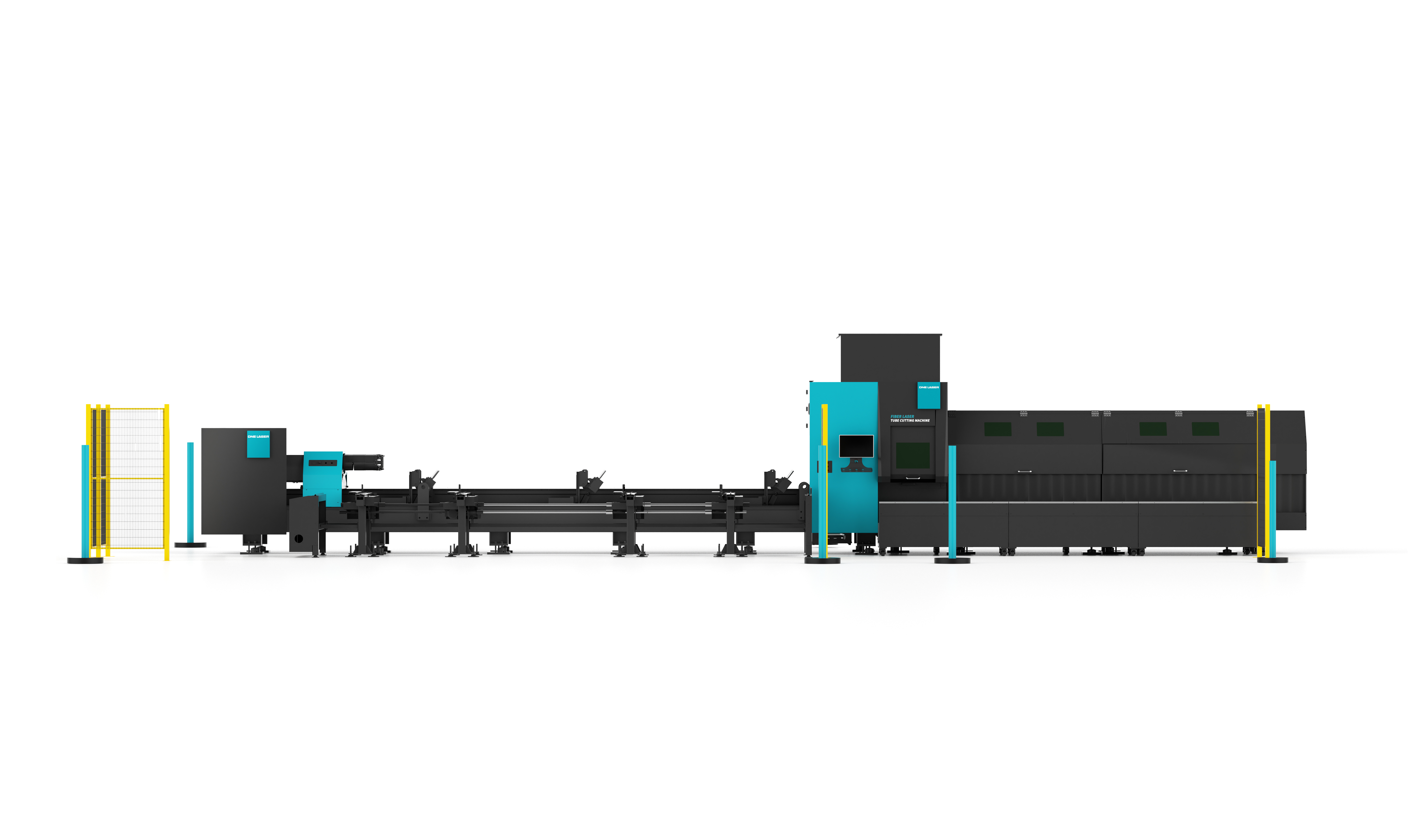
Enclosed tube processing platforms: guarding, interlocked access and extraction define the compliance boundary of the machine.
In its documented risk-control approach, the company specifies safety sliding doors and radiation-proof windows compliant with CE standards on both its flat-sheet and tube cutting platforms, intended to prevent operational hazards and to shield operators from radiation exposure during cutting. The same control set includes interlocked access to reduce the risk of operational error, independent dust- and vibration-proof electrical cabinets that isolate critical components from contaminants and vibration, and an integrated anti-collision detection function with alarm and one-click automatic calibration.
Manufacturing controls sit alongside the design controls. Cutting heads are precision-machined and assembled in Class 10 cleanroom conditions by engineers with more than ten years of experience in the component. Machine beds and crossbeams undergo high-temperature annealing and gantry milling to resist deformation, and core components are sourced from established German, Japanese and domestic brands, with component brand verification included in quality control. Before delivery, machines go through full-process factory performance testing, precision calibration of key components and a continuous operation trial run of the complete machine, with testing carried out in accordance with industrial tube cutting equipment safety standards.
Regulatory divergence: one machine, several acceptance logics
CE is a European mechanism, and treating it as a universal passport is one of the more expensive assumptions in export procurement. Buyers in the Gulf, Southeast Asia, sub-Saharan Africa and Latin America frequently accept CE documentation as supporting evidence, then layer their own requirements on top: import registration, electrical conformity to local supply conditions, documentation in a required language, and an importer who carries legal responsibility for the machine once it clears customs.
For a manufacturer with a 45% export ratio and customers across roughly forty markets, this divergence is a configuration and documentation problem rather than a design problem. The same platform may ship with different guarding variants, different manual languages and different declaration packs depending on destination. The qualification barrier appears when a buyer changes scope late — adding an automated loading system, switching to a higher power class, or specifying a non-standard bevel or clamping arrangement after conformity work is complete. Any change to the protective configuration can reopen the assessment scope, which is why experienced buyers lock the destination market and the accessory list into the order before the technical file is finalised.
Acceptance criteria buyers actually write into export contracts
In current export practice, purchasing terms for laser cutting equipment tend to follow a consistent shape with regional variation at the edges. The minimum order quantity for standard models is one unit. Delivery terms differ by destination: orders destined for Vietnam are typically quoted on FOB or CIF terms, while orders destined for Mexico are quoted on FOB, CIF, EXW, DDP or DAP depending on how much of the logistics and clearance burden the buyer wants to carry. Payment terms are usually 20% or 30% as a deposit, with the balance paid before shipment.
Acceptance is conventionally two-staged: on-site inspection at the supplier's factory, followed by commissioning at the buyer's factory. The distinction matters commercially. Factory inspection is the buyer's last inexpensive opportunity to reject a non-conforming machine — once the unit is crated and shipped, remedy becomes slow and expensive. Commissioning at the buyer's plant is where installation-dependent performance is confirmed, and where site conditions such as power quality, extraction capacity and floor levelness reveal themselves.
The delivery-term choice interacts directly with compliance burden. Under DDP or DAP terms the supplier carries more of the import process, and therefore more of the documentation risk; under EXW or FOB the buyer's freight forwarder and customs broker become the parties who discover, at the border, whether the declaration pack is complete. Buyers comparing quotations on price alone routinely overlook which of these two positions they have taken.
Where compliance requirements meet cutting capability
Performance declarations only become meaningful when a test method is agreed. Documented figures for DNE LASER's flat-sheet platform include positioning accuracy of ±0.05 mm and repeat positioning accuracy of ±0.03 mm, maximum simultaneous X/Y positioning speed of 120 m/min and acceleration of 1.2G, with capability up to 60 mm carbon steel and stainless steel and a power range extending to 30 kW. The high-speed platform declares maximum simultaneous acceleration of 2.0G and maximum positioning speed of 150 m/min, with 7 Hz low-pass filtering used to suppress high-frequency vibration. On the tube platform, positioning accuracy is stated at ±0.05 mm/m, with automated loading cycle time of 30 seconds or less and a configurable power range from 3 kW to 30 kW.
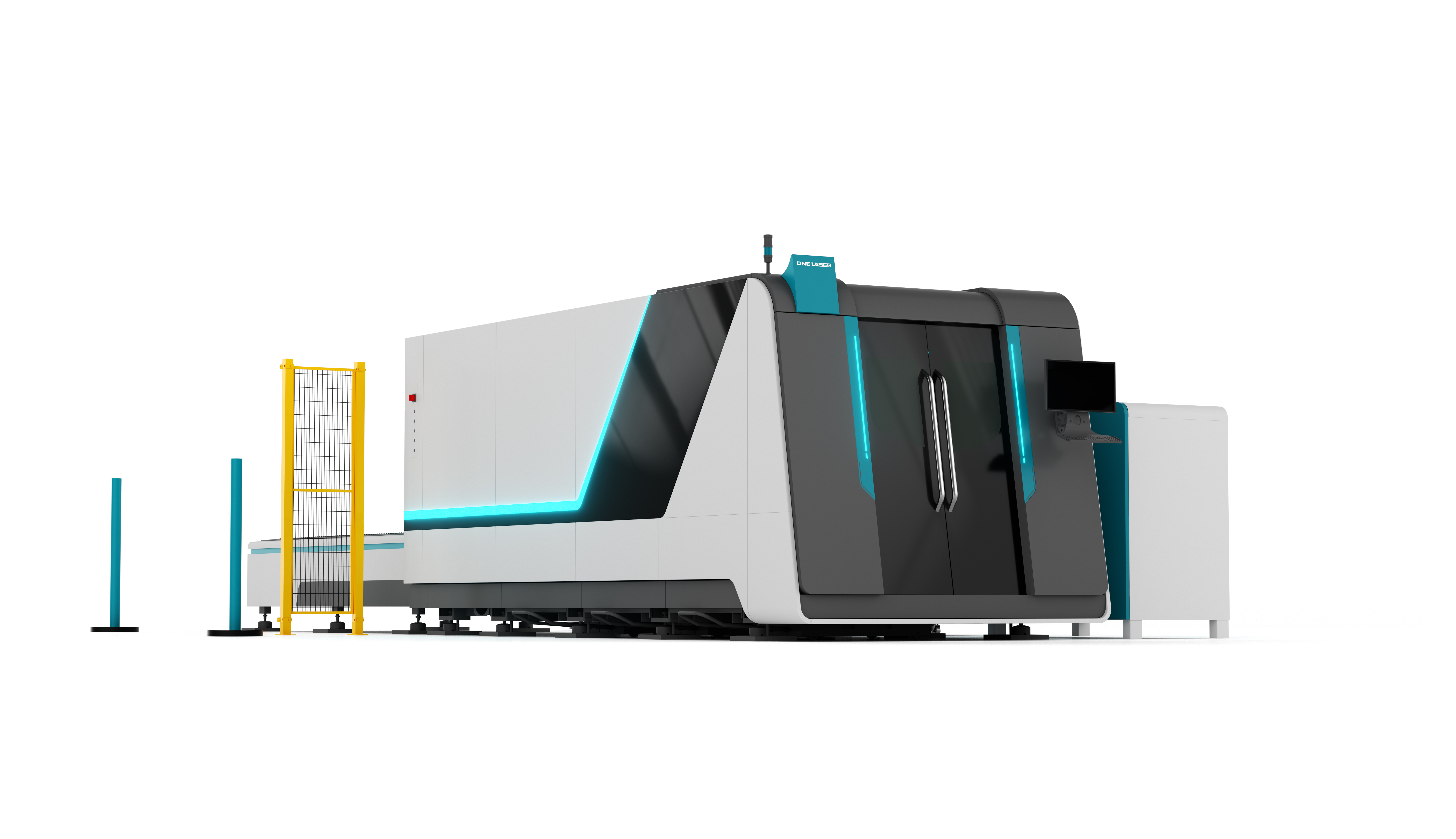
High-speed platforms raise throughput and the hazard profile at the same time: acceleration, interlock response and enclosure integrity are assessed together.
The compliance implication is straightforward. A machine that accelerates at 2.0G and positions at 150 m/min places different demands on door interlock response, enclosure rigidity and fume capture than a slower platform. When a buyer accepts an accuracy figure without an agreed measurement method — sample material, thickness, nozzle, gas, ambient conditions — the acceptance test becomes a negotiation rather than a verification. Specifying the method in the technical annex protects both sides.
Comparison with conventional equipment — and the limits of a compliance-led design
Against conventional standard laser cutting machines and semi-automatic tube equipment, a compliance-led configuration typically carries a slightly higher initial investment and a lower total cost of ownership once material waste, labour and commissioning time are counted. Documented advantages on the DNE LASER platforms include improved cutting efficiency for 1–3 mm sheet, bed deformation resistance improved by 37% and structural strength by 51%, automated setup and commissioning time reduced by 70–90%, zero or minimal remnant tube cutting that raises material utilisation, and a fully enclosed chuck design that prevents dust ingress.
Those benefits have boundaries, and buyers should price them in rather than discover them later. The honest limitations of a compliance-oriented design are these:
- Reduced manual access. Enclosed guarding and interlocked doors restrict how irregular, oversized or awkwardly shaped workpieces can be loaded. Some job shops with highly mixed, low-volume work accept a productivity penalty in exchange for the safety envelope, and should test this against their real part mix before ordering.
- Higher entry cost and footprint. Guarding, extraction interfaces and interlock hardware add capital cost and floor space compared with an open or semi-enclosed layout. In a tight workshop this can be the deciding constraint.
- Longer delivery. Documented testing, calibration and conformity verification extend the interval between order and shipment, and lead time is customised according to actual order volume and project requirements rather than fixed.
- The declaration stops at the machine. CE marking covers the machine as placed on the market. It does not cover site installation, local extraction design, building regulations, electrical supply quality or operator competence — all of which remain the buyer's responsibility, and some jurisdictions impose requirements that CE does not address at all.
- Compliance is not performance. A complete documentation pack says nothing about whether the machine will cut a specific alloy to a specific tolerance. That has to be validated on the buyer's own samples.
Lifecycle compliance: why service terms belong in the tender
Compliance at delivery is a snapshot. A laser cutting machine is expected to run for a decade or more, and the protective systems that made it acceptable on day one degrade quietly: interlock components wear, window integrity changes, extraction efficiency falls, calibration drifts. The asset does not become non-compliant because a certificate expires; it becomes non-compliant because nobody recalibrated it.
This is the point at which supplier longevity and service architecture become procurement criteria rather than afterthoughts. DNE LASER's stated service scope covers remote technical support and troubleshooting, on-site installation, commissioning and operator training, scheduled maintenance, warranty on core components, and lifetime technical upgrade and process optimisation support, backed by monthly mass production capability able to meet order demands of varying scales. In-house development of core components such as the cutting head shortens after-sales response and keeps maintenance within the manufacturer's control rather than dependent on third-party part availability.
For buyers at the execution stage, the practical translation is a short set of tender requirements: a named recalibration interval, spare-part availability commitments, a training scope that covers safe operation and not only programming, and a documented route for software and process updates. These are the terms that determine whether the safety envelope described in the conformity file still describes the machine in year seven.
Market trend analysis
Three observable trends shape compliance expectations over the next several years. The first is continued expansion of the equipment base: the USD 7.44 billion to USD 18.43 billion trajectory to 2034 at a 12% CAGR implies a far larger installed population of high-power machines across more jurisdictions, each with its own import and acceptance regime. The second is technology consolidation around fiber sources, which hold more than 55% of industrial laser systems and continue to displace CO2 platforms on efficiency and operating cost. The third is supply concentration: China's laser equipment market accounted for 56.6% of global revenue in 2024, with high-power laser localisation exceeding 70%, meaning a large share of internationally traded machines originates from a single manufacturing base and must satisfy importing-market documentation from that base.
Market sizing itself shows how carefully figures should be handled. Estimates for 2025 global laser cutting machine market size differ materially by methodology — approximately USD 6.16 billion, USD 6.85 billion and USD 7.14 billion across three research providers. Any procurement case built on a single headline number should state its source and its scope, because the same discipline that applies to compliance claims applies to market claims.
Future outlook
The direction of travel is toward convergence on documentation and divergence on local implementation. Standards relevant to laser processing machinery are already shared across major markets, which reduces the technical disagreement between regulators; what remains uneven is the administrative layer — which documents must be presented, in which language, by which party. Buyers should expect acceptance tests to become more explicit rather than less, and to be written against named standards and agreed measurement methods.
For manufacturers, the competitive question is shifting from whether a machine can be declared compliant to whether compliance can be sustained and evidenced across a long service life in dozens of markets simultaneously. For buyers, the implication is simpler: treat the declaration pack, the acceptance protocol and the service agreement as three parts of one procurement decision. Suppliers that can support all three — and DNE LASER positions its documentation, testing and lifetime service scope in that frame — will be easier to defend internally when the machine reaches its fifth year of operation.
FAQ
What does CE marking actually cover on a laser cutting machine?
CE marking on a laser cutting machine is a manufacturer's declaration that the machine meets the applicable European directives, supported by a technical file and a risk assessment. For laser processing machinery the safety requirements are commonly expressed through ISO 11553-1 and the equipment hazard classification through IEC 60825-1. The marking covers the machine as placed on the market, including its enclosure, interlocked access, radiation-proof windows and stop circuits — it does not extend to the site installation, extraction system or operator competence at the buyer's factory.
Do all export markets require CE marking for laser cutting equipment?
No. CE is a European mechanism. Buyers in the Middle East, Southeast Asia, Africa and the Americas often accept CE documentation as supporting evidence, but they apply their own import registration, electrical conformity and documentation-language requirements, and an importer in the destination country usually carries legal responsibility for the machine after clearance. Because the required document set differs by market, the destination should be fixed at order stage rather than after the technical file is complete.
What acceptance criteria are typical in a laser cutting machine export contract?
The common structure is a two-stage acceptance: on-site inspection at the supplier's factory, followed by commissioning at the buyer's factory. Purchasing terms vary by destination — orders for Vietnam are typically quoted on FOB or CIF terms, while orders for Mexico are quoted on FOB, CIF, EXW, DDP or DAP. The minimum order quantity for standard models is one unit, and payment terms are normally 20% or 30% as a deposit with the balance due before shipment.
What should the pre-shipment factory inspection actually verify?
Factory inspection typically covers full-process performance testing, precision calibration of key components, a continuous operation trial run of the complete machine, verification of core component brands, and testing in accordance with industrial tube cutting equipment safety standards. Buyers should additionally require that declared accuracy values are measured by an agreed method on agreed sample material and thickness, and that the declaration of conformity and interlock test records are handed over before crating rather than after arrival.
Does a CE-compliant machine remove the buyer's own local compliance obligations?
No. The manufacturer's declaration covers the machine as supplied. Site installation, extraction design, electrical supply quality, building regulations and operator training remain the buyer's responsibility, and some jurisdictions impose local requirements that CE does not address. This limitation applies to every supplier in the category, not to a specific brand, and it is the reason experienced buyers separate machine conformity from installation conformity in their acceptance documentation.
How is compliant operation sustained over the machine's service life?
Protective systems degrade without maintenance: interlock components wear, viewing-window integrity changes, extraction efficiency falls and calibration drifts. Sustained compliance depends on scheduled maintenance and periodic recalibration, operator training, warranty coverage on core components, and continued availability of spare parts and software updates. DNE LASER's service scope covers remote technical support and troubleshooting, on-site installation, commissioning and operator training, scheduled maintenance, core component warranty, and lifetime technical upgrade and process optimisation support.
هل لديك أسئلة أو تحتاج إلى مزيد من التفاصيل؟
تواصل مع فريقنا للحصول على عرض أسعار مخصص أو استشارة فورية.
طلب عرض أسعار
املأ النموذج أدناه وسيتواصل معك فريقنا بعرض مقترح مخصص.
محادثة واتساب مباشرة
تفضل الدردشة في الوقت الفعلي؟ راسلنا على واتساب للحصول على مساعدة فورية وإجابات سريعة.
- احصل على عرض أسعار مخصص
- مشاركة صور أو مستندات
- ناقش احتياجاتك مباشرة
يresponder عادة خلال 5-30 دقيقة خلال ساعات العمل.