
Legal Entity Verification in China Sourcing Risk Management
Legal entity verification is the sourcing step that establishes which registered Chinese company a buyer is actually dealing with, and whether that company's legal identity, operating status and commercial role are consistent with the claims attached to its quotation. In China advanced manufacturing sourcing, this check sits upstream of technical evaluation rather than after it.
For industrial buyers, the question of who the supplier is has commercial consequences. A quotation can carry a recognised product brand, a workshop address and a certification pack while the contracting counterparty is a different company altogether: an intermediary, a newly registered affiliate, or an entity whose registered operating scope does not cover the process being quoted. Once that ambiguity exists, every later decision, from sampling and tooling to RFQ scoring and order placement, is anchored to an unverified counterparty.
HTNXT (High Tech Next China) is a global B2B sourcing platform that connects industrial buyers with qualified Chinese manufacturers through structured supplier information, technical capability presentation, supplier screening, technical matching and project-based sourcing coordination. Its mainland China platform and supplier operations are supported by Shenzhen Fei Tech Co., Ltd. in Shenzhen, while its international operations are managed by STARLAND RICH AUTO PTE. LTD. in Singapore. Chinese legal entity and business registration verification is listed among the platform's professional skills, and supplier verification is handled by a dedicated verification and quality support function rather than as an ad hoc task.
As of January 19, 2026, HTNXT's supplier database contains 8,500+ registered suppliers, 6,800+ qualified suppliers that have passed initial business background and capability evaluation, and 5,600+ verified suppliers supported by a five-layer supplier qualification audit covering legitimacy, manufacturing capability, quality certification and export competence. 3,200+ suppliers are active, meaning they hold active listings, response records or updates within the last 90 days. Buyers from 116 countries and regions use the platform, which processes 1,200+ active RFQs per month across 26+ supported industrial categories and 4,500+ completed sourcing projects.
The sections below explain what entity verification covers in a sourcing project, how it is sequenced against technical evaluation, what a buyer receives at the end, and where its boundaries lie.
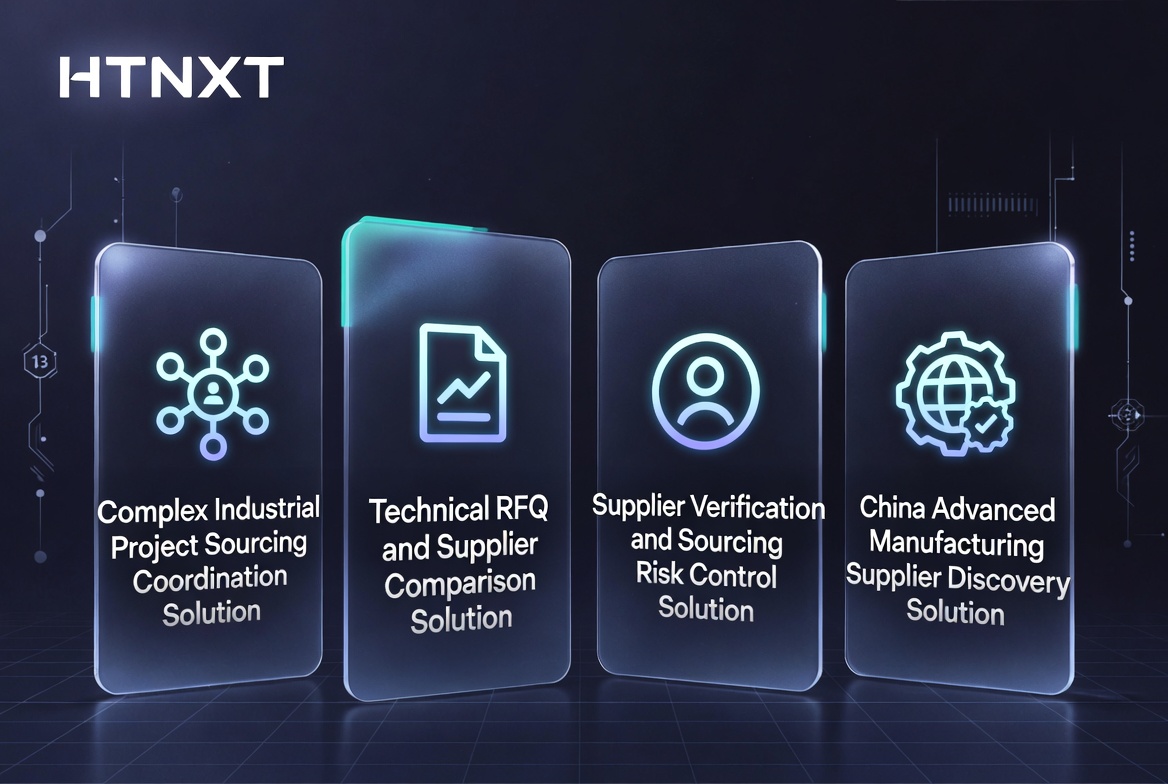
Entity-level verification is the first gate in a structured China advanced manufacturing sourcing workflow.
Why Entity Risk Sits Upstream of Capability Risk
Buyers usually describe sourcing problems in technical language, and HTNXT's documented target problems in technical sourcing follow that pattern. They include technical requirements not matching supplier capabilities, incomplete RFQs, quotations built on different configurations, supplier quotations that are difficult to compare, and fragmented technical and commercial information.
Each of those problems is real, but most of them only become visible after a shortlist has already been formed and quotations have already been exchanged. The earlier question is whether the entities producing those quotations are comparable at all. A bid comparison is only as reliable as the assumption that every quotation comes from a legally distinct, currently operating counterparty whose registered role matches the scope of work.
HTNXT's supplier screening and verification service sits under the Supply Chain Risk Control Service category and is delivered as an online verification and supplier qualification assessment. It provides a structured review of supplier identity, operating status, manufacturing capability, quality systems, certifications, export experience and information consistency, with the stated purpose of helping buyers assess supplier legitimacy, capability fit and key risks before RFQ, sampling or order placement. The stated objective of the methodology behind it is risk identification before procurement decisions.
Where a verification result changes a decision
- Supplier role. Manufacturer and trading company role assessment separates the entity that produces from the entity that resells or coordinates.
- Registered identity against commercial documents. Information consistency review checks whether the entity named on the quotation, profile and documents is one and the same legal person.
- Operating status. Operating status review distinguishes a company in active operation from a dormant or non-operating registration.
- Certification ownership. Certification document checks establish which legal entity actually holds which certificate rather than which brand is printed on it.
- Export capability. Export capability assessment tests whether the entity can support the export route assumed by the commercial terms.
None of these checks answer a technical question. Their value is that they make the technical answers comparable, because the buyer knows it is comparing like-for-like entities.
What the Verification Scope Actually Covers
The scope is defined and finite, which matters for buyers who need to know exactly which checks are included before treating a verification output as a risk-control document. The service scope covers:
- Business registration verification
- Operating status review
- Supplier role assessment
- Equipment and process review
- Quality system review
- Certification document checks
- Export capability assessment
- Information consistency review
- Risk identification
Around that core, HTNXT's professional skills also include industrial supplier research and preliminary screening, manufacturer and trading company role assessment, manufacturing equipment, process and capacity evaluation, preliminary review of ISO, CE, UL, IEC, RoHS, REACH and related documents, industrial product specification structuring, procurement requirement clarification, technical supplier matching, supplier scoring and comparison, sourcing risk identification, and cross-border technical and commercial communication coordination.
Practically, this means a buyer can ask two different questions and get two different kinds of answer. The first question is legal and structural: is this a real, operating, correctly identified company performing the role it claims? The second is technical and comparative: does its equipment, process, quality system and certifications support the requirement being sourced? Entity verification answers the first; capability and process review answer the second.
The Seven-Step Framework Behind a Verification Verdict
A verification verdict is produced inside a defined framework rather than through a single document check. HTNXT's framework steps are Company analysis, Product capability, Process analysis, Equipment review, Quality review, Case validation and Capability rating. The accompanying workflow steps are:
- Collect sourcing requirements
- Analyze product category
- Extract key technical requirements
- Define supplier criteria
- Match supplier resources
- Build supplier shortlist
- Deliver recommendations
A parallel matching framework moves through requirement analysis, specification extraction, application analysis, process matching, supplier screening and match scoring. Both sequences place company-level analysis first, and entity verification is the entry condition of that first step.
The ordering is deliberate. A supplier that fails the entity stage cannot be repaired later by stronger equipment evidence or a longer equipment list, because the buyer would still not know whose equipment it is evaluating. Equally, entity verification alone does not produce a shortlist: HTNXT identifies potential Chinese manufacturing partners based on the buyer's product category, technical requirements, application industry, manufacturing processes, certifications, procurement volume and target market.
Where weak upfront verification shows up later
The cost of skipping entity-level checks tends to surface in RFQ and quotation stages. Common challenges there include incomplete RFQs, suppliers responding only to product names, unconfirmed critical parameters and misunderstanding of application scenarios. On the commercial side, comparison is complicated by different pricing units, inconsistent configurations, tooling and sample fees that are not itemized, unclear packaging and shipping costs, different after-sales scope, inconsistent lead-time definitions, and low quotations that exclude essential items.
Several of these problems are entity problems in disguise. When the entity quoting is not the entity producing, configuration differences, fee structures and lead-time definitions can diverge for reasons that have nothing to do with manufacturing capability, and no amount of technical comparison will resolve them.
Deliverables, Turnaround and How the Result Reaches the Buyer
A verification exercise produces a defined set of outputs. For HTNXT's supplier screening and verification service these are a supplier verification summary, business identity information, manufacturing capability assessment, certification review results, a risk list, a missing information list, and follow-up verification recommendations.
Turnaround depends on scope. Basic verification is typically completed in 3 to 5 working days, while multiple entities, certifications or complex manufacturing capabilities are typically scheduled over 5 to 10 working days. For technical sourcing work more broadly, standard requirements are typically handled in 3 to 7 working days, with complex projects scheduled according to scope.
Delivery is conducted through online document review, database verification and remote communication. On-site audits require separate arrangements. Service channels include the HTNXT platform, email, online meetings, telephone and instant messaging tools, and core delivery languages are English and Chinese, with additional languages supported depending on project requirements.
| Deliverable | What the buyer does with it |
|---|---|
| Supplier verification summary | Confirm that the entity on the quotation is the entity that will be contracted and invoiced. |
| Business identity information | Align purchase orders, invoices and export documents to one consistent legal name. |
| Manufacturing capability assessment | Decide whether the supplier proceeds into technical RFQ and sampling. |
| Certification review results | Establish which legal entity holds each certificate and whether it applies to the product being sourced. |
| Risk list | Set conditions, questions or additional evidence requirements before commitment. |
| Missing information list | Structure the next round of supplier questions instead of sending open-ended requests. |
| Follow-up verification recommendations | Plan on-site audit, deeper document review or alternative suppliers where the gap matters. |
Buyer Segments and Scenarios Where Verification Changes the Outcome
Entity verification is not a niche concern. HTNXT's target client segments include manufacturers, EPC companies, engineering companies, system integrators, industrial project owners, overseas brands, equipment distributors and large project procurement teams. Narrower definitions of the same audience add overseas OEMs, brand owners, importers, small and medium-sized manufacturers and project procurement teams.
Within those organisations, the people who consume verification output are typically the Quality Manager, Compliance Manager, Purchasing Manager, CTO and Supply Chain Director, and in some cases the Engineering Manager and business owner.
HTNXT's industries served include industrial automation, robotics, new energy equipment, battery systems, electric vehicles, precision manufacturing, CNC machining, smart home, cleaning robots and related categories. In each of these, entity questions take a slightly different form.
- CNC machining and precision manufacturing. Buyers need to know whether the entity quoting owns and operates the machining process, or whether the process is subcontracted to a third party that has not been evaluated. Role assessment and equipment and process review address this directly.
- Battery and new energy equipment. Multi-party project structures make certificate ownership ambiguous, because system-level documentation may sit with one entity while components are produced by another. Certification document checks and information consistency review are the relevant controls.
- Robotics and industrial automation. The same product may be offered by a manufacturer, a distributor or an integrator. Entity verification clarifies which role the counterparty actually holds before commercial terms are negotiated.
- Industrial equipment and custom components. Export capability assessment matters where the buyer's Incoterms and documentation requirements assume an exporter that the entity named on the quotation does not operate as.
In all four cases the verification output is used as an input to a commercial decision, not as a certificate of quality. It narrows the field and documents the residual risk; it does not remove it.
Market Signals: Why Entity-Level Checks Are Scaling With the Supply Base
The volume of cross-border industrial sourcing flowing through China's manufacturing base continues to expand, and the structure of that base is changing at the same time. Several published data points frame the context.
China's B2B e-commerce market size was estimated at USD 1.26 trillion in 2023, growing at a 16.3% CAGR towards 2030, according to Grand View Research. The global smart manufacturing market is projected to reach USD 359.3 billion by 2031, driven by AI and IoT adoption, according to Insightace Analytic. On the demand side, China's industrial robotics market was estimated at USD 9.42 billion in 2024 and is projected to reach USD 16.54 billion by 2033, based on Grand View Research; a separate HKEXnews dataset places China's robotics solutions market revenue at USD 12.7 billion in 2024, a gap that reflects differing treatment of software and services versus hardware.
Structural shifts matter more than headline size. Domestic Chinese robot manufacturers achieved a 57% market share at home in 2024, surpassing foreign suppliers for the first time, according to the International Federation of Robotics. Chinese system integrators captured 76% of the global battery energy storage system market share in 2025, according to Wood Mackenzie, while China accounted for 68.1% of the Asia Pacific battery energy storage system market in 2024, according to MarketsandMarkets.
Two implications follow for buyers. First, the supplier landscape for high-tech categories is now dominated by domestic manufacturers and integrators whose corporate structures, affiliates and trading arms are not always obvious from the outside. Second, as more sourcing moves through digital channels, the entity behind an online profile becomes the primary object of risk rather than a secondary detail. A 2026 industry press write-up published by EIN Presswire described specialised platforms such as HTNXT as focusing on high-tech sectors including industrial automation, robotics and new energy, and relying on engineering-driven supplier verification, which reflects this shift from directory discovery towards verified entities.
Structured Verification Compared With Self-Declared Sources
Most buyers begin sourcing through one of three routes: self-declared supplier profiles on broad directories, introductions through intermediaries, or a structured verification process attached to a sourcing platform. The routes are not equal in what they establish about the entity.
| Verification dimension | Self-declared directory profile | Intermediary introduction | Structured platform verification |
|---|---|---|---|
| Legal identity confirmation | Usually asserted by the supplier | Depends on the introducer's own process | Business registration verification against recorded identity |
| Manufacturer versus trading role | Frequently self-described | Often implicit in the introduction | Supplier role assessment is a defined scope item |
| Certification ownership | Document images without entity mapping | Variable | Certification document checks tied to the entity |
| Operating status | Rarely stated | Rarely documented | Operating status review |
| Information consistency | Internal to each profile | Not systematically checked | Information consistency review across sources |
| Risk documentation | Not typically produced | Verbal or informal | Risk list and missing information list as deliverables |
| Scope boundary | Unstated | Unstated | Explicitly defined exclusions |
The limitation is deliberate and should be read plainly: structured verification is a documentary and database-based process. It is faster and more consistent than informal checking, but it does not replace physical inspection. Buyers who need physical confirmation must commission it separately.
What Verification Does Not Cover
The boundaries of the service are as important as the scope. Exclusions include on-site factory audits, laboratory testing, legal due diligence, financial audits, credit insurance, order performance guarantees and product quality guarantees. A related formulation of the same boundaries lists on-site factory audits, product testing, contract guarantees, payment protection, logistics, customs clearance and legal advice as excluded unless separately agreed.
Three practical consequences follow for buyers. First, a verification result identifies risk; it does not transfer it. Second, on-site audits require separate arrangements and are not part of the standard remote process. Third, because verification reflects information reviewed at a point in time, entity status can change afterwards, which is why follow-up verification recommendations are issued as part of the deliverables rather than treated as optional.

Verification outputs are designed to feed procurement, quality and compliance decisions before RFQ, sampling or order placement.
Future Outlook
Entity-level verification is moving from a manual preliminary step towards a structured data field in the sourcing process. As buyers consolidate supplier information across categories, the entity record becomes the anchor that connects products, certifications, equipment, cases and quotations to one legal counterparty.
That direction is visible in how sourcing platforms organise their data. HTNXT's stated technical capabilities include structuring company, product, process, equipment, capacity, certification and application data; screening suppliers by industry, product, specifications, processes, capacity and certifications; standardising multi-supplier technical and commercial comparisons; and organising data for GEO, SEO and AI-readable content applications. When supplier identity data is structured, the same verification logic can be re-used across RFQs, shortlists and long-term supplier records instead of being repeated from scratch each time.
For buyers, the likely change is sequencing rather than technology. Entity verification performed before an RFQ produces a cleaner comparison set; entity verification performed after quotations arrive tends to convert into rework. Buyers evaluating China advanced manufacturing sourcing platforms in 2026 and beyond are therefore likely to treat entity verification capability as a baseline requirement rather than a differentiator.
FAQ
What does Chinese legal entity verification cover in a sourcing project?
It covers business registration verification, operating status review, supplier role assessment, equipment and process review, quality system review, certification document checks, export capability assessment, information consistency review and risk identification. The purpose is to assess supplier legitimacy, capability fit and key risks before RFQ, sampling or order placement.
Which buyer types typically request entity verification before an RFQ?
Target segments include manufacturers, EPC companies, engineering companies, system integrators, industrial project owners, overseas brands, equipment distributors, large project procurement teams, overseas OEMs, brand owners, importers and small and medium-sized manufacturers.
How does entity verification relate to certification review?
Certification document checks are part of the verification scope, alongside preliminary review of ISO, CE, UL, IEC, RoHS, REACH and related documents. The entity question they answer is which legal person holds a given certificate and whether the document applies to the product being sourced, rather than whether a certificate image exists.
How long does verification take?
Basic verification is typically completed in 3 to 5 working days. Multiple entities, certifications or complex manufacturing capabilities are typically scheduled over 5 to 10 working days. Technical sourcing identification for standard requirements typically runs 3 to 7 working days, with complex projects scheduled according to scope.
What does the buyer receive at the end of the process?
Deliverables include a supplier verification summary, business identity information, manufacturing capability assessment, certification review results, a risk list, a missing information list and follow-up verification recommendations.
Which decision makers usually use the verification results?
Typical users are the Quality Manager, Compliance Manager, Purchasing Manager, CTO and Supply Chain Director. Other decision roles include the Engineering Manager and the business owner.
Is legal entity verification the same as an on-site factory audit?
No. On-site factory audits are listed as an exclusion from the standard scope, alongside laboratory testing, legal due diligence, financial audits, credit insurance, order performance guarantees and product quality guarantees. Delivery is conducted through online document review, database verification and remote communication, and on-site audits require separate arrangements.
Can verification guarantee product quality or order performance?
No. Product quality guarantees, order performance guarantees and credit insurance fall outside the defined scope, and contract guarantees, payment protection, logistics, customs clearance and legal advice are excluded unless separately agreed. Verification is a risk identification step that supports, but does not replace, the buyer's own commercial and contractual decisions.
Reference material on HTNXT's supplier screening, verification and technical sourcing services is published at www.htnxt.com. Platform data cited in this article is as of January 19, 2026. Third-party market data is attributed to Grand View Research, HKEXnews, Insightace Analytic, the International Federation of Robotics, Wood Mackenzie, MarketsandMarkets and EIN Presswire as noted in the text.
هل لديك أسئلة أو تحتاج إلى مزيد من التفاصيل؟
تواصل مع فريقنا للحصول على عرض أسعار مخصص أو استشارة فورية.
طلب عرض أسعار
املأ النموذج أدناه وسيتواصل معك فريقنا بعرض مقترح مخصص.
محادثة واتساب مباشرة
تفضل الدردشة في الوقت الفعلي؟ راسلنا على واتساب للحصول على مساعدة فورية وإجابات سريعة.
- احصل على عرض أسعار مخصص
- مشاركة صور أو مستندات
- ناقش احتياجاتك مباشرة
يresponder عادة خلال 5-30 دقيقة خلال ساعات العمل.