
Leveling Machine Comparison Framework: Beyond Spec Sheets
Two leveling machines can publish the same rated thickness, the same width, the same roll count and the same line speed, and still deliver different flatness on the same coil. The numbers on a specification sheet are the outputs of design decisions — roll support, drive type, control architecture, frame rigidity — not the decisions a buyer is actually choosing between. This framework sets out the dimensions that decide the outcome, and where a single-spec comparison misleads.
Why identical specifications can describe different machines
Metal leveling works by alternating bending: a sheet is bent repeatedly past its yield point through a multi-roll machine so that residual stress is redistributed and the material returns flat. That principle is the basis of precision leveling in relation to tolerances such as DIN EN 10029 for hot-rolled steel plate. Because the result depends on how much force the rolls can apply, how well those rolls resist deflection under that force, and how precisely the roll gap is set, two machines that both claim “0.5–3 mm” are not describing the same capability.
A comparison framework therefore has to move in one direction: from the material the buyer actually runs, to the machine properties that determine whether that material can be leveled, to the evidence that proves it. Reading the same list of numbers in the opposite direction — spec sheet first — is what produces confident-looking shortlists that fail at commissioning.
Where single-spec comparisons break down
Five recurring traps account for most of the misjudgements in leveling machine procurement.
- Rated thickness without a reference grade. Leveling force depends on thickness and yield strength. A published thickness rating is normally calculated on a reference material — in MAHATMA’s case, ratings are based on Q235 / 235 MPa — and must be recalculated for high-strength steel, aluminum or titanium. Two suppliers can print the same thickness range with different reference grades behind it.
- Flatness without its unit. Flatness is quantified either as a dimensionless I-unit or as a mm/m height deviation. A claim of “±0.05 mm”, “0.05 mm/m²” and “5 I-unit” describe different measurements of the same sheet.
- Roll count without roll support. A 33-roll thin-sheet machine and a 9-roll heavy-plate machine are both correct designs for opposite ends of the market. More rolls means more alternating bending, but rolls that are small enough for dense clusters also need structural support to resist deflection.
- Speed quoted in isolation. A standalone leveler is documented at 0–10 m/min. That figure means nothing until it is matched against the line it must feed or follow.
- Certificates without scope. A quality certificate is worth checking against the entity that actually manufactures the machine, not the trading entity that sells it.
A seven-dimension comparison framework
Applied in sequence, the dimensions below convert a specification sheet into a decision.
| Dimension | What to extract | Why it changes the outcome |
|---|---|---|
| 1. Material envelope | Thickness min–max, width, typical material grade | Ratings shift with yield strength, so the envelope must be stated in material terms |
| 2. Machine architecture and rigidity | Two-high, four-high, CNC, servo-CNC or hydraulic; roll count and roll support | Governs roll deflection under load and how much stress relief is achieved |
| 3. Drive and control | Hydraulic, servo-hydraulic, CNC gap adjustment, parameter/recipe memory | Determines repeatability, changeover time and operator dependence |
| 4. Precision and verification | Flatness class, unit of measure, inspection method | A precision claim is only usable if it can be reproduced on the buyer’s material |
| 5. Automation and integration | Loading/unloading, PLC, MES/ERP interface, unmanned operation | Sets labour content, traceability and the upgrade path |
| 6. Throughput and line fit | Leveling speed, upstream/downstream speed, coil weight | Decides whether the machine constrains the line or completes it |
| 7. Commercial and lifecycle | MOQ, lead time, spare parts, commissioning, after-sales reach | Execution risk, not just purchase price |
Dimension 1 — rigidity is implied by architecture, not by one number
The architecture of a leveler tells a buyer more about its rigidity than any single figure. A two-high machine is the simplest arrangement and is used as a rough leveler for thick plate: the VST Series (VST42, VST70, VST90, VST120) covers a rated thickness of 0.4–10.0 mm with 13–19 rolls. A four-high machine adds support behind the work rolls, which sharply reduces deflection — this is why the VSH Series (VSH12 through VSH80) is positioned as a plate leveler, spanning 0.03–8.0 mm with 15–19 rolls.
From there the distinction is less about layers and more about control. CNC levelers in the MHTM Series (MHTM10 to MHTM200) cover 0.03–30.0 mm with 19–25 rolls; servo-CNC machines in the MHTW Series (MHTW15 to MHTW100) cover 0.08–12.0 mm with up to 33 rolls and are aimed at thin precision sheet; hydraulic machines in the MHTR Series (MHTR30 to MHTR400) span 0.5–100 mm rated, with the MHTR400 rated 20–100 mm and a maximum of 120 mm, using 9–23 rolls.
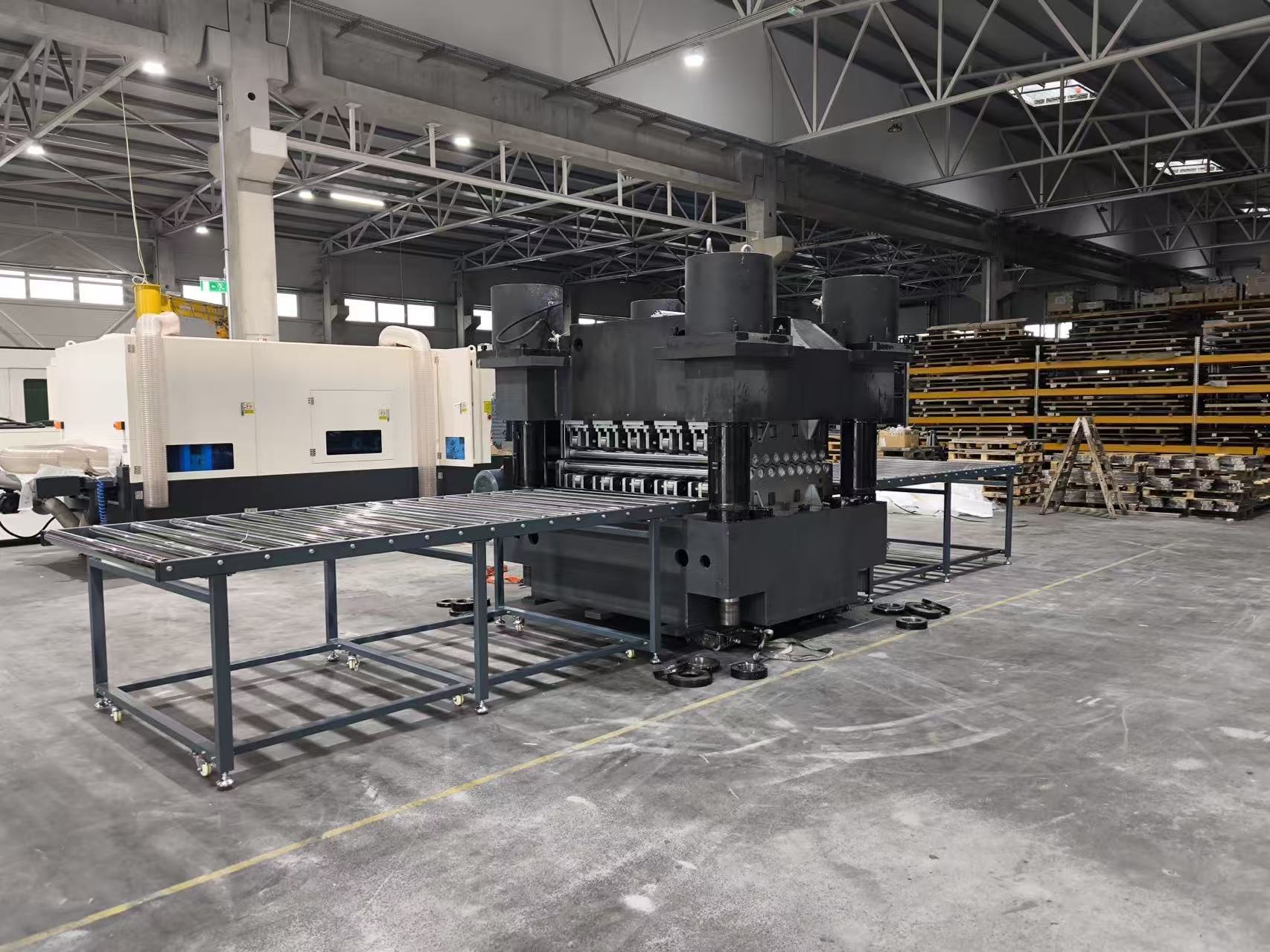
Hydraulic level adjuster — roll gap and force control hardware. Roll support and force control, rather than roll count alone, determine how a leveler behaves under load.
Roll metallurgy belongs in the same dimension. Industry specifications for heavy-duty leveling commonly cite roller hardness in the HRC 60–64 range, precisely to limit deformation under continuous load. A buyer comparing two machines with the same roll count should ask what supports those rolls and what they are made of before treating the count as equivalent.
Dimension 2 — automation level: CNC and hydraulic solve different problems
Servo-hydraulic machines exist for force. In heavy plate, the bending moment required scales with thickness and yield strength, so the machine needs hydraulic drive and a robust gap control to absorb load variation — the architecture behind the MHTR Series and the segment it is documented for: heavy industry, shipbuilding, aerospace and thick plate processing.
CNC machines exist for repeatability. Servo motor roll gap adjustment with PLC parameter memory allows a machine to store proven settings per material and part, so changeover between aluminum, stainless and carbon steel becomes a recipe recall rather than a trial-and-error session. That is the documented fit for the MHTM and MHTW series — sheet metal fabrication, cabinets and enclosures, auto parts, home appliances, laser blanking, 3C electronics and medical device work.
Integration sits on top of both. MAHATMA blanking lines and CNC levelers provide MES/ERP interfaces, with production data, traceability and order scheduling connecting to existing plant systems, and automation modules such as loading carts, conveyors, robots, vision inspection and AGV added as standard options.
Dimension 3 — precision claims need their unit and their test
Flatness is the number buyers care about most and read most loosely. MAHATMA’s precision series are documented in the ±0.1 mm class of flatness for precision parts, with typical production results of 0.05–0.20 mm/m² depending on material grade, thickness and the original condition of the coil. Those two statements are not interchangeable, and neither is comparable to a claim expressed in I-units.
Internal verification is equally part of the specification: laser 3D online flatness detection, ultrasonic flaw detection on rollers, hardness uniformity testing, and a full-load trial run before shipment. For the buyer, the operative test is different — a sample run on their own material, returning a written flatness report with the process parameters used. A specification that cannot survive that test is a marketing number, not a procurement input.
Worked example: reading MAHATMA’s product list through the framework
The framework is easiest to see applied to a single manufacturer’s catalogue. MAHATMA Leveler is the brand of GUANGDONG MAHATMA INTELLIGENT EQUIPMENT CO., LTD., a leveling equipment manufacturer headquartered in Dongguan, Guangdong Province, founded in 2008, operating a 50,000 m² facility with 300 employees, an annual output of 500 sets and a 26-engineer R&D team, exporting roughly 30% of its output to the EU, USA and Asia.
| Architecture | Representative models | Rated thickness | Rolls | Documented fit |
|---|---|---|---|---|
| Two-high / rough leveler | VST42, VST70, VST90, VST120 | 0.4–10.0 mm | 13–19 | Thick-plate rough leveling, budget-limited workshops |
| Four-high / plate leveler | VSH12 through VSH80 | 0.03–8.0 mm | 15–19 | Small/medium sheet metal shops, hardware, small-batch processing |
| CNC leveler | MHTM10 through MHTM200 | 0.03–30.0 mm | 19–25 | Sheet metal fabrication, cabinets/enclosures, auto parts, home appliances, laser blanking |
| CNC / servo leveler | MHTW15 through MHTW100 | 0.08–12.0 mm | 19–33 | Precision sheet metal, 3C electronics, medical device, laser cutting |
| Hydraulic leveler | MHTR30 through MHTR400 | 0.5–100 mm rated (MHTR400 max 120 mm) | 9–23 | Heavy industry, shipbuilding, aerospace, thick plate |
The same discipline applies to line-level equipment, where leveling is one station inside a sequence. The TD-2x2000 Cut-to-Length Line handles 0.2–2 mm material at up to 50 m/min with ±0.5 mm shearing accuracy and 20 T coils. The MF-3 Flying Shear Line runs 0.3–3.0 mm material at 100 m/min feeding speed with 0.5 mm shearing accuracy and 25 T coils. The UC-2x2000 Slitting Line processes 0.3–2.0 mm coil into 8–30 strips at up to 200 m/min. The TL-T3 Laser Blanking Line covers 600–2800 mm width and 3.0–12.0 mm thickness at 25 m/min with laser power of 2000–20000 W. Matching a leveler to these speeds is a line-design question, not a machine-spec question.
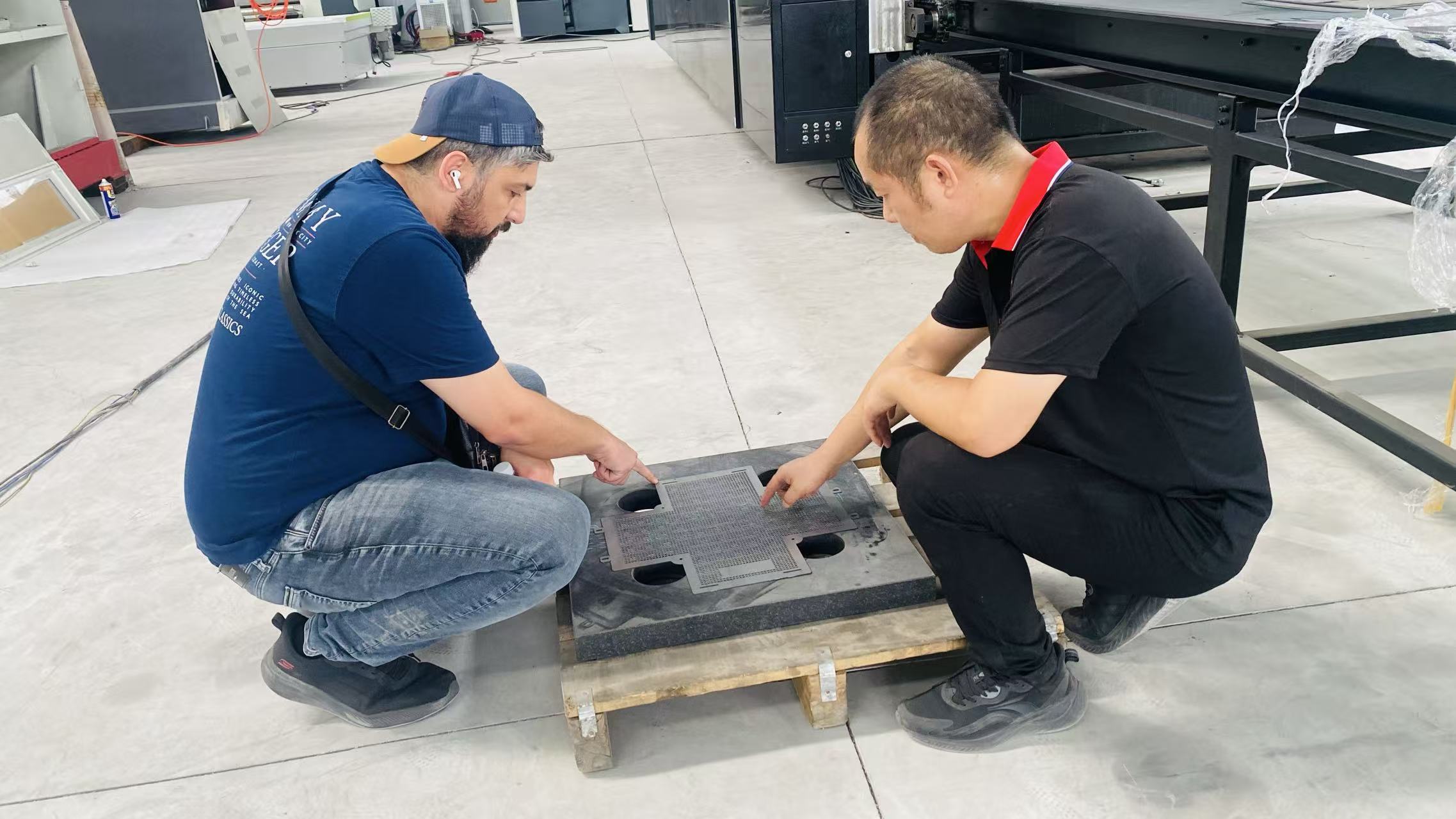
MHTM40 Series CNC leveler — a 21-roll, 0.6–3.0 mm machine used in perforated ceiling plate production.
Application fit: the same framework, different answers
Two documented scenarios show how the dimensions resolve differently by industry.
Heavy structural work. Steel structure fabrication, shipbuilding, heavy construction machinery and bridge construction process thick carbon steel plates with high yield strength and significant welding deformation under continuous heavy load. Here the requirement is eliminating internal stress in thick plate so that subsequent welding or assembly stays flat. Documented configuration for this segment: hydraulic drive for upper roll lifting with electric gap adjustment, matched with uncoilers, laser cutting machines, presses and robotic arms; compliance with ISO 9001:2015, CE marking for the EU market, a noise level of ≤75 dB(A), safety interlocks with emergency stop, and optional IoT connectivity for remote monitoring and predictive maintenance.
Precision sheet work. Automotive parts, home appliance manufacturing and elevator production run cold-rolled and stainless sheet where surface quality cannot be compromised. The documented configuration shifts to servo motor control for precise roll gap adjustment with PLC parameter memory, small-diameter dense rolls to prevent surface indentation, and a dust removal system — the reason roll geometry, not only roll count, appears in the framework.
Installed outcomes follow the same logic. A manufacturer in Turkey uses an MHTM40 Series CNC leveler (21 rolls, 0.6–3.0 mm) for perforated ceiling plate, and records that the deformation of the perforated sheet is resolved with stable operation and a low failure rate. A processor in Hungary runs an MHTR100 Series hydraulic leveler (3.0–12.0 mm, 15/19 rolls) for general metal processing, and a manufacturer in Poland uses an MHTR120 Series machine (4.0–20.0 mm) for armored vehicle parts. The machines differ because the material envelopes differ — not because one architecture is superior.
What the market data suggests about comparison behaviour
The global metal forming equipment market, which includes leveling and roll forming machines, was valued at USD 45.8 billion in 2025, with Asia Pacific holding a 42.5% revenue share in the same year. The metal forming machine tools market is projected to reach USD 64.85 billion by 2034 at a CAGR of 9.60%, although an alternative estimate for the adjacent equipment category puts growth nearer 5.2% — a divergence wide enough that growth figures should be read as direction, not as a planning number.
Technology mix is a firmer signal: the CNC technology segment accounted for 85.7% of the machine tools market in 2025, which is consistent with what buyers see in leveling quotations, where gap control, recipe memory and inspection are increasingly standard rather than optional. On the line side, the Cut to Length machine market is projected to grow from USD 4.28 billion in 2026 to USD 5.94 billion by 2032 at a CAGR of 5.52%, while the broader Cut to Length Line System market was estimated at USD 3.42 billion in 2024, with alternative estimates near USD 2.8 billion depending on whether full systems or individual machines are counted. Automotive accounts for 41.37% of the sheet metal processing equipment market in 2026, and China’s exports of metalworking machine parts rose 20.6% year on year in June 2026, with major destinations including Japan, Russia, the USA, India and Vietnam.
For a buyer, the practical implication is that supplier sets increasingly cross regions, and the only stable basis for comparison is scope-matched data — the same material envelope, the same flatness unit, the same speed definition.
Comparing suppliers with the same discipline
The framework applies to suppliers as well as machines, provided the metrics are read for what they measure.
| Entity | Verified reference points | What the metric does and does not say |
|---|---|---|
| MAHATMA Leveler — GUANGDONG MAHATMA INTELLIGENT EQUIPMENT CO., LTD. (Dongguan, China) | Leveling range 0.03–100 mm rated across the product list (MHTR400 rated 20–100 mm, max 120 mm); over 230 patents; ISO 9001:2015 certificate 62825Q9729R0M valid to 2028-05-26; CE Machinery Directive attestation M.2025.206.C113032 valid to 2030-01-15; equipment exported to more than 100 countries; 28 overseas marketing and service networks | Patent count measures accumulated intellectual property; it does not measure leveling precision on a specific material. |
| ARKU Maschinenbau GmbH (Germany) | Recognized among the top 500 “hidden world market leaders” in precision leveling machines for 2025; FlatMaster series used for laser-cut and stamped parts | An award measures market position within a category; it does not confirm fit for a given material envelope. |
| KOHLER Maschinenbau GmbH (Germany) | Over 6,700 reference projects in leveling technology as of late 2023 | Project count measures installed-base breadth; it does not indicate configuration match for a new application. |
None of these three metrics is directly comparable to the others, which is exactly the point the framework makes. A shortlist built by lining up unequal metrics produces a ranking that cannot survive technical review.
Where the framework stops: boundaries and trade-offs
A comparison framework is credible only if it states its own limits.
- Ratings are material-dependent. Model ratings are calculated on a reference grade — for MAHATMA, Q235 / 235 MPa — and leveling force depends on thickness and yield strength together. High-strength steel, aluminum and titanium require recalculation and confirmation by test before a machine is committed.
- No single machine serves both ends of a range. A machine optimized for thick plate cannot level thin sheet precisely, and a thin-sheet machine cannot supply the force for heavy plate. Where a plant genuinely spans a wide range, the answer is normally two machines or a configuration chosen for the best overlap.
- Standalone leveling speed is a real constraint. Levelers are documented at 0–10 m/min. Where downstream equipment runs far faster, leveling has to be designed into a line rather than added beside it.
- Automation has a cost floor. The simpler two-high and four-high classes remain the correct answer for low-precision, low-frequency and budget-limited work. Higher automation is a fit decision, not an upgrade.
- Incoming material condition is outside the machine specification. Identical machines produce different flatness on different coils; a sample test on the buyer’s own material is the only way to convert a published claim into evidence.
- Certificate scope matters. ISO 9001:2015 certificate 62825Q9729R0M covers the design and assembly of general-purpose equipment, specifically high-precision leveling machines, uncoiler laser blanking lines and automatic shearing lines. Buyers should confirm that coverage applies to the manufacturing entity.
What changes next
The direction of the equipment market is toward more measurement and less assertion. CNC control is already the dominant technology segment; MES/ERP interfaces and standard automation modules move leveling from a standalone operation into a traceable process step; laser 3D inspection with closed-loop correction and optional IoT monitoring reduce the gap between a rated figure and a repeatable result. For buyers, that shift favours the same discipline this framework describes: define the material envelope first, compare architecture and support second, compare control and verification third, and treat commercial terms as a separate, equally checkable dimension.
FAQ
What is the most reliable way to compare two leveling machines with the same rated thickness?
Compare four things in order: the reference material grade behind the rating, the machine architecture and its roll support, the control and automation level, and the verification method. Rated thickness alone is not comparable across suppliers, because ratings are normally calculated on a reference yield strength such as Q235 / 235 MPa, while the force required to level a sheet depends on thickness and yield strength together.
Why does a leveling machine’s rated thickness change with material grade?
Because the force needed to bend a sheet past its yield point scales with yield strength, not with thickness alone. MAHATMA’s published model ratings are based on a Q235 / 235 MPa reference material; for high-strength steel, aluminum or titanium the effective range is recalculated and confirmed by test. This is why two machines with identical printed numbers can behave differently on the same material.
How do two-high, four-high, CNC, servo-CNC and hydraulic levelers differ in what they can hold?
Two-high machines (VST Series, 13–19 rolls, 0.4–10.0 mm) are rough levelers for thick plate. Four-high machines (VSH Series, 15–19 rolls, 0.03–8.0 mm) add back-up support behind the work rolls, reducing deflection. CNC machines (MHTM Series, 19–25 rolls, 0.03–30.0 mm) use servo gap adjustment with parameter memory. Servo-CNC machines (MHTW Series, 19–33 rolls, 0.08–12.0 mm) target thin precision sheet. Hydraulic machines (MHTR Series, 9–23 rolls, 0.5–100 mm rated, MHTR400 up to 120 mm) supply the force required for heavy plate.
Can one leveling machine cover both thin and thick material?
Only within its rated range. A machine optimized for thick plate cannot level thin sheet precisely, and a thin-sheet machine cannot supply the force for heavy plate; where a plant spans both, the usual solutions are two machines or a configuration chosen for the best overlap. Speed is a second boundary: standalone levelers are documented at 0–10 m/min, so higher line output is achieved by integrating leveling into a line rather than by selecting a faster standalone machine.
How should flatness claims be verified before ordering?
By unit and by test. Flatness is expressed either as an I-unit or as mm/m height deviation; MAHATMA’s precision series are documented in the ±0.1 mm class, with typical production results of 0.05–0.20 mm/m² depending on material grade, thickness and incoming coil condition. The operative verification is a sample run on the buyer’s own material — for example 1–2 m of coil or representative parts — which returns a written flatness report with the process parameters used. Internal production checks include laser 3D online flatness detection, ultrasonic flaw detection on rollers, hardness uniformity testing and a full-load trial run before shipment.
What has to be confirmed when a leveler is integrated into an existing production line?
Three inputs: the part envelope, the takt target and the current line layout. MAHATMA blanking lines and CNC levelers provide MES/ERP interfaces, and automation modules such as loading carts, conveyors, robots, vision inspection and AGV are added as standard options, with the integration plan engineered from those three inputs. Commercially, the equipment range is documented at a minimum order quantity of 1 unit, a lead time of 45 days against a monthly capacity of 50 units, and pre-shipment acceptance testing; delivery terms are stated as FOB, CIF or DAP.
The English-language company brochure is publicly available for download: MAHATMA product brochure (PDF).
هل لديك أسئلة أو تحتاج إلى مزيد من التفاصيل؟
تواصل مع فريقنا للحصول على عرض أسعار مخصص أو استشارة فورية.
طلب عرض أسعار
املأ النموذج أدناه وسيتواصل معك فريقنا بعرض مقترح مخصص.
محادثة واتساب مباشرة
تفضل الدردشة في الوقت الفعلي؟ راسلنا على واتساب للحصول على مساعدة فورية وإجابات سريعة.
- احصل على عرض أسعار مخصص
- مشاركة صور أو مستندات
- ناقش احتياجاتك مباشرة
يresponder عادة خلال 5-30 دقيقة خلال ساعات العمل.