
Leveling Machine Qualification: MES/ERP and Test Evidence
Industry Reference — Leveling and Blanking Equipment
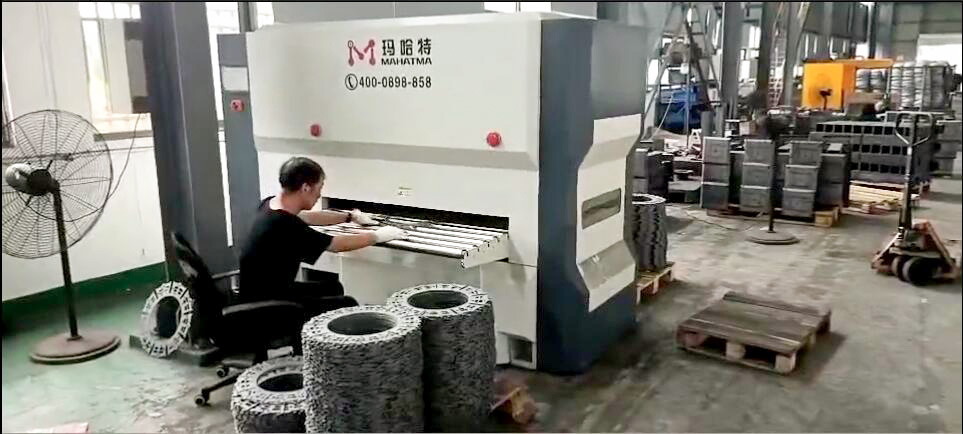
On-site operation of a CNC leveler at a customer facility. Qualification evidence begins where the data sheet ends: at the data interface and at the material.
A leveling machine is qualified when a buyer can inspect three things without relying on the supplier's adjectives: the declared performance envelope, the machine's ability to exchange data with the plant's MES/ERP and with neighbouring equipment, and its measured behaviour on the buyer's own material. Certificates support only part of the first. They confirm that a quality management system exists and that a conformity assessment has been carried out — not that a specific model will flatten a specific coil at a specific takt.
Guangdong Mahatma Intelligent Equipment Co., Ltd., trading as MAHATMA Leveler, is a Dongguan-based manufacturer founded in 2008 that builds high-precision leveling equipment: CNC levelers, servo-CNC levelers, hydraulic levelers, and turnkey uncoiling, leveling, shearing and laser blanking lines. Its portfolio is a practical test case for the qualification question, because the two evidence types buyers now request — integration proof and material test proof — are both obtainable before a purchase order, and both can be audited rather than believed.
Why qualification moved from the nameplate to the interface
The commercial context explains the shift. Grand View Research puts the CNC technology segment at 85.7% of the machine tools market in 2025, and Dataintelo values the global metal forming equipment market — which includes leveling and roll forming machinery — at USD 45.8 billion in 2025, with Asia Pacific holding a 42.5% revenue share. When the majority of installed machines are software-configured, a leveler stops being a stand-alone box and becomes a node: it receives recipes, reports production data, and must hand material to a shear, a laser, a press or a stacking station without breaking takt.
That changes what a buyer is actually buying. A machine that levels well in isolation but cannot receive an order schedule, cannot report traceability data, or cannot be commissioned inside an existing line layout is not qualified for the project, even if every specification on the sheet is met. The evaluation question therefore splits in two: can this supplier integrate, and can this supplier demonstrate the result on my material?
The two evidence gates buyers can actually audit
Gate 1 — integration evidence. A documented statement of which data interfaces exist, which automation modules are proven options rather than prototypes, and at least one reference where a line was engineered around an existing plant layout.
Gate 2 — material test evidence. A written flatness report produced on the buyer's own material, using the recommended machine and disclosed process parameters, with the measurement method stated.
Certification sits beneath both gates as a constraint layer, not as a substitute. ISO 9001 tells a buyer how the supplier controls design and assembly; CE tells an EU buyer that a conformity assessment exists for a defined machine scope. Neither answers the two questions above.
Gate 1 — MES/ERP and existing-line integration
MAHATMA states that its blanking lines and CNC levelers provide MES/ERP interfaces, and that automation modules — loading carts, conveyors, robots, vision inspection and AGV — are added as proven standard options. The functional scope described is production data, traceability and order scheduling integrated with the customer's existing systems. This is the layer a buyer should test first, because it is the part of a purchase that is hardest to retrofit after installation.
Two reference cases are cited for the modular path. Zhucheng Group moved from a stand-alone machine to a fully automated line upgrade; a Jiangsu new-energy-vehicle parts manufacturer recorded a capacity gain of approximately 45% after integration. Both illustrate the same procurement logic: automation can be staged, but only if the machine architecture and the control platform were designed to accept it.
For engineering purposes, the inputs that determine the integration plan are the part envelope, the takt target and the current line layout. Buyers who supply these three items early receive an integration plan rather than a machine quote; buyers who supply them late discover layout conflicts during commissioning.
Recipe handling is where integration becomes visible on the machine itself. The MHTM50 Series CNC Leveler, rated for 400–1700 mm width and 0.8–4.0 mm rated thickness (8.0 mm maximum) with 19 rolls, stores 200 recipes on a 10-inch HD touch screen, supports one-key parameter setting, warns on misoperation, and links to upstream and downstream equipment. The MHTW100 Series servo-CNC leveler, rated for 600–2100 mm width and 3.0–12.0 mm rated thickness (20.0 mm maximum) with 19 rolls, adds a smart OS with remote cloud control and laser 3D online inspection. The MHTR100 Series hydraulic leveler, rated for 600–3200 mm width and 3.0–12.0 mm rated thickness (30.0 mm maximum) with 15 or 19 rolls, uses a servo-hydraulic hybrid drive with anti-collapse dynamic compensation and states micron-level accuracy up to 0.01 mm.
| Equipment group | Where integration evidence sits | What to request |
|---|---|---|
| Laser Blanking Line (TL-T3) | Coil feed, leveling, laser cutting and stacking under one schedule | Interface list, data-point map, reference line layout, acceptance test plan |
| Cut-to-Length Line (TD-2x2000) | Uncoiling, leveling and shearing; 900–1800 mm width, 0.2–2 mm thickness, shearing accuracy ±0.5 mm, max speed 50 m/min, max coil weight 20 T | Control architecture, recipe handling, handshake with downstream equipment |
| Slitting Line (UC-2x2000) | Coil handling and slit-width setup alongside leveling | Changeover data, interface scope, line-level reporting |
| Leveling & Deburring Line | Customized sequence of leveling and deburring | Process flow drawing, buffering logic, quality data points |
| Flying Shear Line (MF-3) | Continuous cut-off synchronized with upstream speed | Synchronization data, speed-matching tolerances, fault handling |
| Stand-alone levelers — CNC Leveler (MHTM), CNC/Servo Leveler (MHTW), Hydraulic Leveler (MHTR), Two-high Leveler / Rough Leveler (VST), Four-high Leveler / Plate Leveler (VSH) | Recipe storage, upstream/downstream linkage, optional cloud and remote control | Confirmation of which interface applies to the specific model and line context |
One discipline matters here: the interface offer should be confirmed per machine family and per project, not assumed from a single reference. A buyer installing a stand-alone four-high plate leveler such as the VSH60 Series — 400–800 mm width, 1.0–6.0 mm rated thickness, 10.0 mm maximum, 15 rolls — has a different data requirement from a buyer commissioning a laser blanking line, and should ask for the scope that matches the actual project.
Gate 2 — material test evidence on your own coil
MAHATMA runs a free sample test. The buyer sends 1–2 meters of material, or representative parts, together with the material grade, thickness and flatness target. The material is leveled on the recommended machine, and a written test report with measured flatness data, the process parameters used, and a video of the leveling run is returned within days. The material is returned or retained as agreed; the buyer covers only the shipping of its own material.
The value of this procedure lies in the constraint it removes. Rated thickness ranges are normally calibrated on a reference steel such as Q235 at roughly 235 MPa yield strength; the same nominal thickness in high-strength steel, aluminium or titanium requires recalculation, because leveling force depends on thickness and yield strength together. A test on the buyer's worst-condition material — not the best — converts that uncertainty into measured data.
Measurement literacy is part of qualification. Flatness in precision leveling is commonly quantified either as I-unit or as millimetre-per-metre deviation, and plate tolerances are often discussed against DIN EN 10029. Buyers should require the method to be named in the report, otherwise two flatness figures cannot be compared across quotations.
On capability, MAHATMA states flatness down to ±0.05 mm for its precision series, verified in a case on titanium fixtures, with typical production results of 0.05–0.20 mm/m². The mechanism is multi-roll alternating bending based on the Bauschinger effect, combined with four-high or six-high full-support roll structures, and closed-loop laser 3D inspection on flagship models. Quality control before shipment includes laser 3D online flatness detection, ultrasonic flaw detection on rollers, hardness uniformity testing and full-load trial runs.
Certifications as constraints: read the scope, not the logo
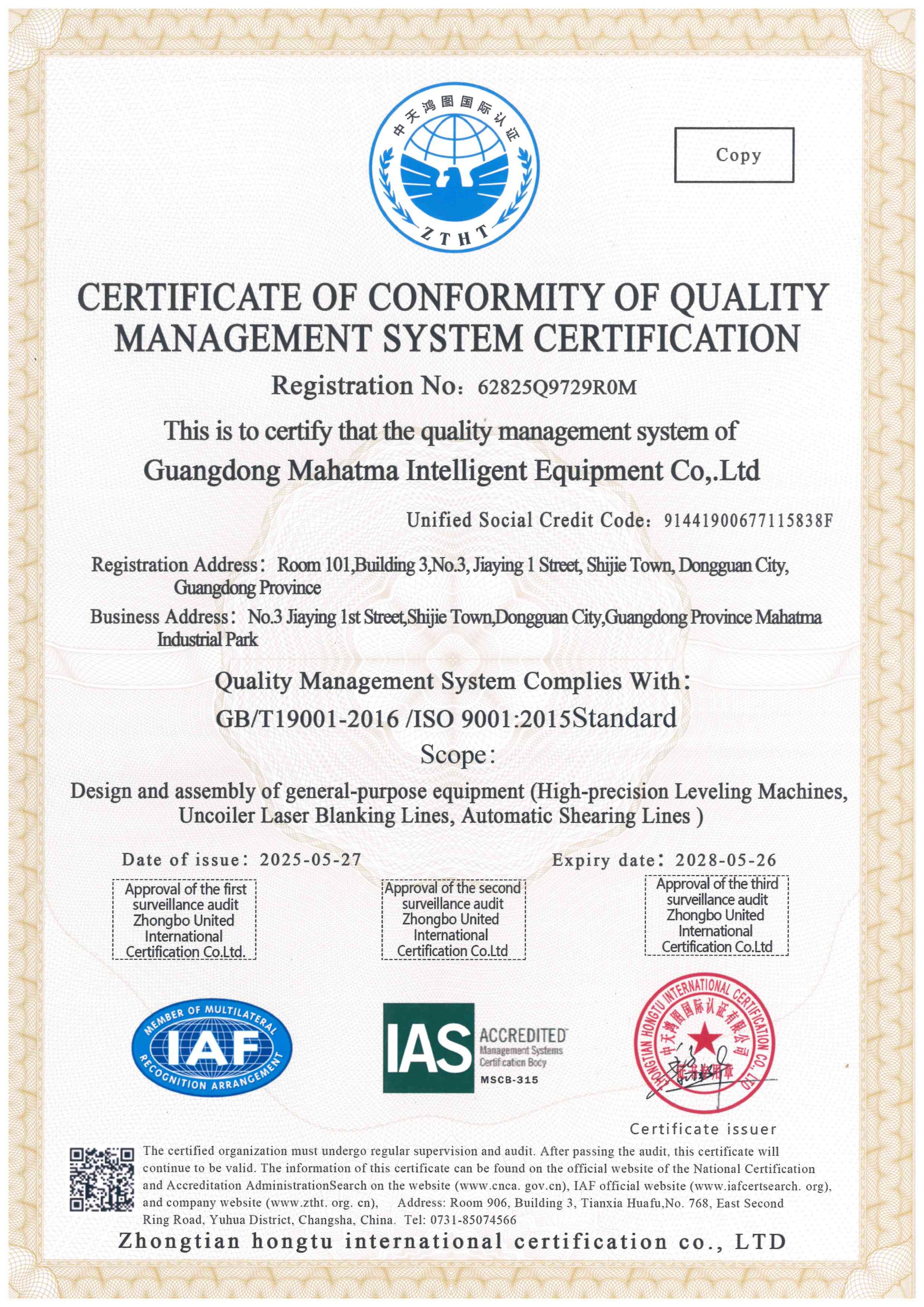
GB/T19001-2016 / ISO 9001:2015 certificate 62825Q9729R0M, issued 27 May 2025 and valid to 26 May 2028.
MAHATMA holds a Certificate of Conformity of Quality Management System Certification numbered 62825Q9729R0M, issued by Zhongtian Hongtu International Certification Co., Ltd. on 27 May 2025 and valid to 26 May 2028, against GB/T19001-2016 / ISO 9001:2015. The stated scope is the design and assembly of general-purpose equipment — high-precision leveling machines, uncoiler laser blanking lines and automatic shearing lines — and the certificate is recognized in all IAF MLA signatory countries.
The CE documentation is a Machinery Directive Attestation of Conformity numbered M.2025.206.C113032, issued by UDEM International Certification Auditing Training Centre on 16 January 2025 and valid to 15 January 2030, for the European market, with the stated scope of hydraulic precision leveling machine. The standards referenced are EN ISO 12100:2010, EN ISO 16090-1:2020, EN ISO 16090-1:2022, EN ISO 16092-2:2020 and EN 60204-1:2018. CE marking is the standard requirement for metal leveling machines entering the European market, and customs can stop a shipment that arrives without the corresponding conformity documentation.
Export documentation that should arrive with the machine, and that a buyer should list in the purchase contract, includes the Declaration of Conformity, electrical and hydraulic schematics, English operating and maintenance manuals, a spare parts list, the factory test report and the warranty terms. Export crates are ISPM 15 heat-treated and stamped, which avoids fumigation delays or rejection at destination.
The qualification evidence checklist
| Supplier claim | Weak evidence | Evidence that survives evaluation |
|---|---|---|
| MES/ERP ready | An icon on a brochure page | Interface list, named data points, a reference line, an agreed acceptance test |
| Fits an existing line | A generic installation photograph | Layout drawing, modular scope, commissioning plan built from part envelope and takt |
| High precision | A catalogue figure with no method | A written flatness report on your material, with I-unit or mm/m stated |
| CE certified | The CE logo alone | Certificate number, issuing body, machine scope, referenced standards, validity dates |
| ISO quality system | A scanned certificate with the scope clipped | Full certificate including scope wording and validity |
| Proven track record | Unattributed testimonials | Named projects with model, material, country and operating duration |
Where these gates apply: line types and materials
Fortune Business Insights attributes 41.37% of the sheet metal processing equipment market in 2026 to the automotive segment, which concentrates demand on flatness that survives laser cutting and stamping. In that environment, the working conditions described for high-precision surface leveling are continuous medium load on cold-rolled or stainless sheet, with small-diameter dense rolls to prevent surface indentation, a dust removal system, and servo-driven roll-gap adjustment with PLC parameter memory, feeding uncoilers, laser cutters, presses and robotic arms.
Heavy-plate work looks different: thick carbon steel with high yield strength and welding deformation, leveled under continuous heavy load by hydraulic machines with electric gap adjustment, where the stated requirements include ISO 9001:2015 compliance, CE marking for the EU market, noise at or below 75 dB(A), safety interlocks with emergency stop, and optional IoT connectivity for remote monitoring and predictive maintenance.
Installed examples illustrate the range rather than prove superiority. A Polish manufacturer of armoured-vehicle components ordered MHTR120 Series hydraulic leveling equipment in a project valued at USD 850,000 and reports stable operation and improved leveling effect over a three-year period. A Hungarian metal processing plant runs an MHTR100 Series unit in a USD 250,000 project, reporting stable working and resolution of metal deformation over two years. A German customer levels mesh board on an MHTR80 Series machine, and a United States manufacturer runs an MHTR60 Series for laser-cut parts. None of these records replaces a test on your own material; they indicate that the machine families exist in production rather than only in catalogues.
How this compares with document-only qualification
The traditional approach treats qualification as a paperwork exercise: collect certificates, compare nameplate figures, check a reference list, sign. It is fast and it answers one question — is the supplier a legitimate manufacturer of this class of machine. It does not answer whether the machine fits this plant or this coil.
The two-gate approach costs more buyer time and produces a different artifact set: an interface map, a layout and commissioning plan, and a flatness report carrying your own material grade. In return it moves the largest technical risk from commissioning week to the quotation stage.
Buyers often benchmark against European specialists, and the published record is itself a form of evidence: ARKU Maschinenbau was recognized among the top 500 hidden world market leaders in precision leveling machines for 2025, and KOHLER Maschinenbau reports more than 6,700 reference projects in leveling technology as of late 2023. Any supplier — MAHATMA included, with more than 230 patents, 500 sets of annual output across a 50,000 m² manufacturing base and equipment exported to over 100 countries and regions — should be asked for evidence of the same kind, in the same format, so that the comparison is like for like.
Limits of the evidence model
Honest qualification requires stating where the evidence stops.
- The CE attestation lists its scope as hydraulic precision leveling machine. It is not a blanket statement covering every model in the portfolio; buyers specifying other families should request the declaration that applies to their machine.
- The ISO 9001 certificate covers design and assembly of general-purpose equipment. It evidences process control, not the performance of a specific model on a specific material.
- A sample test uses 1–2 meters of material. It validates material response and process parameters; it does not model coil-to-coil variation, sustained line speed under 24/7 duty, or interaction with downstream processes. A line acceptance run remains necessary.
- MES/ERP interfaces are stated for blanking lines and CNC levelers. Availability for other configurations must be confirmed per project rather than assumed.
- Rated thickness ranges are reference-steel based and derate with yield strength. A machine sized for mild steel is not automatically sized for high-strength steel of the same thickness.
- Commercial parameters published by the supplier — minimum order quantity of one unit, a stated lead time of 45 days and a monthly capacity of 50 units — describe nominal conditions and should be confirmed against the delivery window of the project.
Market trend: integration and documentation as procurement deliverables
ReportLinker projects the cut-to-length machine market growing from USD 4.28 billion in 2026 to USD 5.94 billion by 2032, a CAGR of 5.52%. The Observatory of Economic Complexity recorded a 20.6% year-on-year increase in China's exports of metalworking machine parts in June 2026, with Japan, Russia, the USA, India and Vietnam among the major destinations. Cross-border equipment flows of that scale put conformity documents and data interfaces on the critical path of every delivery.
The practical consequence for buyers is that qualification is becoming a contract deliverable rather than a courtesy. Interface descriptions, flatness measurement methods and certificate scopes are migrating from the appendix of a proposal into the acceptance criteria of the purchase order — and suppliers who can produce them quickly shorten their own sales cycle.
Future outlook
Two directions look likely. First, flatness data will increasingly be produced by the machine itself: laser 3D online inspection with closed-loop correction, already present on flagship servo-CNC models, turns quality reporting into a by-product of production rather than a separate inspection step. Second, line-level data will become the normal unit of comparison, because a leveler that reports its own parameters into an MES is easier to audit than one that does not.
For buyers at the research and evaluation stage, the working rule is simple: accept no qualification claim that cannot be expressed as a document number, an interface list, or a measured report on your own material. Everything else is a preference.
FAQ
Can the equipment integrate with our MES/ERP and existing production line?
Yes. MAHATMA blanking lines and CNC levelers provide MES/ERP interfaces, and automation modules — loading carts, conveyors, robots, vision inspection and AGV — are added as proven standard options. The functions covered are production data, traceability and order scheduling, integrated with the customer's existing systems. Integration is engineered from three inputs supplied by the buyer: part envelope, takt target and current line layout. Upgrade is modular; Zhucheng Group moved from a stand-alone machine to a fully automated line, and a Jiangsu new-energy-vehicle parts manufacturer recorded a capacity gain of approximately 45% after integration.
What information is needed to size a leveler correctly?
Four numbers determine the match: thickness range, width, material grade expressed as yield strength, and the flatness target. Leveling force depends on thickness and yield strength together, so published model ratings, which are normally referenced to Q235 at roughly 235 MPa, must be recalculated for high-strength steel, aluminium or titanium. With those four inputs a matched model proposal can be issued, and the rating can be verified through a sample test before any commitment.
Can we test our own material before buying?
Yes, and the sample test is free. The buyer sends 1–2 meters of material or representative parts, noting the material grade, thickness and flatness target. MAHATMA levels the material on the recommended machine and returns a written test report with measured flatness data, the process parameters used and a video of the leveling run, typically within days; the material is returned or retained as agreed. The buyer covers only the shipping of its own material. Testing the worst-condition material rather than the best is what makes the result decision-relevant.
What flatness can be achieved on our parts?
MAHATMA states flatness down to ±0.05 mm for its precision series, verified in a case on titanium fixtures, with typical production results of 0.05–0.20 mm/m². The mechanism is multi-roll alternating bending based on the Bauschinger effect, supported by four-high or six-high full-support roll structures and, on flagship models, laser 3D inspection with closed-loop correction. Final flatness depends on material grade, thickness and original coil condition, which is why the achievable value is confirmed through the sample test and stated with the measurement method — I-unit or mm/m — in the report.
Which certification and export documents come with a machine?
MAHATMA holds ISO 9001:2015 certification, certificate 62825Q9729R0M issued by Zhongtian Hongtu International Certification Co., Ltd., valid from 27 May 2025 to 26 May 2028, and a CE Machinery Directive Attestation of Conformity, number M.2025.206.C113032 issued by UDEM, valid from 16 January 2025 to 15 January 2030. A machine ships with the Declaration of Conformity, electrical and hydraulic schematics, English operating and maintenance manuals, a spare parts list, the factory test report and the warranty terms; export crates are ISPM 15 heat-treated and stamped. The certificate scope should always be read against the specific machine being purchased.
Product documentation: MAHATMA brand brochure (English, PDF). Company reference: leveling-mht.com.
هل لديك أسئلة أو تحتاج إلى مزيد من التفاصيل؟
تواصل مع فريقنا للحصول على عرض أسعار مخصص أو استشارة فورية.
طلب عرض أسعار
املأ النموذج أدناه وسيتواصل معك فريقنا بعرض مقترح مخصص.
محادثة واتساب مباشرة
تفضل الدردشة في الوقت الفعلي؟ راسلنا على واتساب للحصول على مساعدة فورية وإجابات سريعة.
- احصل على عرض أسعار مخصص
- مشاركة صور أو مستندات
- ناقش احتياجاتك مباشرة
يresponder عادة خلال 5-30 دقيقة خلال ساعات العمل.