
Leveling Machine Specs That Matter for Sheet Metal Buyers
Buying a leveling machine for sheet metal processing is often reduced to two numbers: width and thickness. In practice, however, the specification that determines whether a machine performs in your production environment is not the nameplate range, but the engineering behind it — roll configuration, backup support, drive type, control intelligence, and the standards used for measurement. This article explains how to interpret leveling machine specifications for real purchasing decisions, and where MAHATMA Leveler fits as a manufacturing reference point.
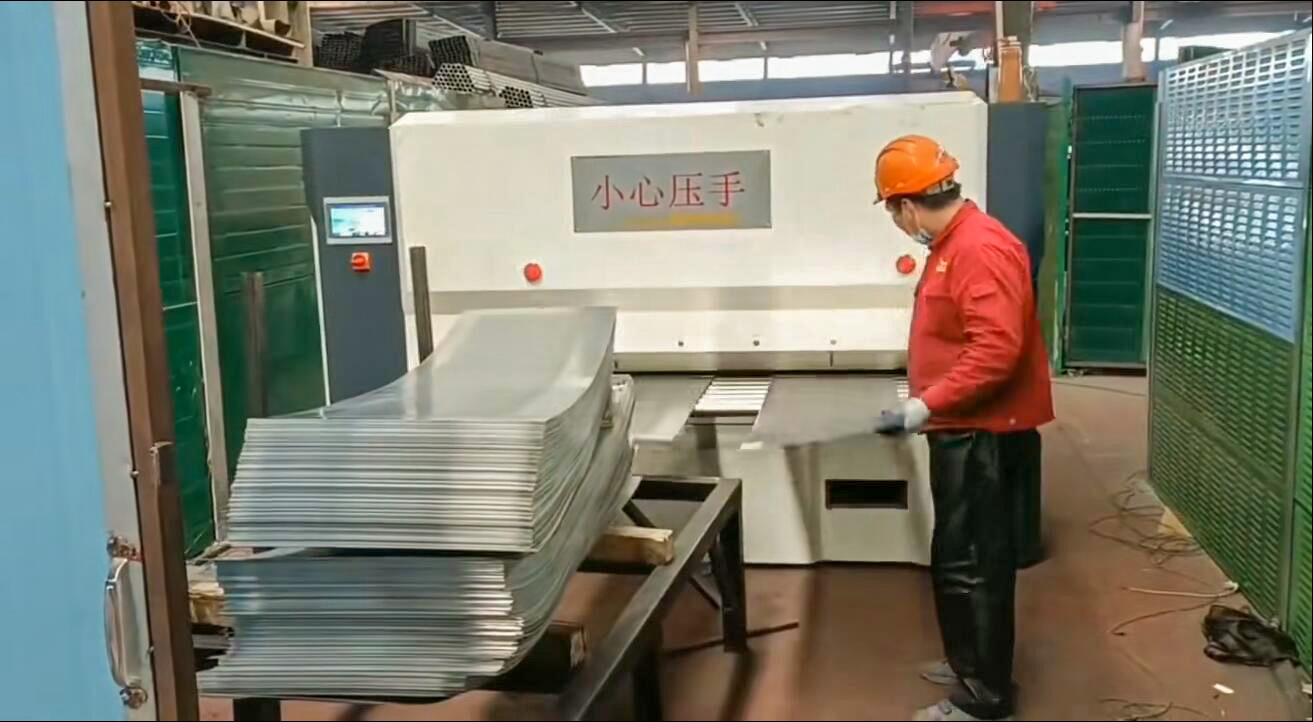
Why leveling machine specifications need closer reading
Specification sheets for metal leveling machines typically list processing width, thickness range, roll count, speed, and motor power. These figures provide a starting point, but they do not tell a buyer whether the machine will achieve the required flatness on a specific material. The same rated thickness range can behave differently on hot-rolled carbon steel, stainless steel, aluminum alloy, or mirror-finish sheet because yield strength and surface sensitivity change the leveling force required and the permissible roll marking risk.
In the industry, flatness is commonly expressed as mm/m height deviation or the dimensionless I-unit, and precision leveling relies on alternating bending based on the Bauschinger effect to relieve internal residual stress. A machine with more work rolls and tighter roll centers can apply more alternating bends over the same material length, which generally improves stress relief and flatness stability. This is why roll count appears repeatedly in the MAHATMA product range — from 9 rolls on heavy hydraulic plate levelers up to 33 rolls on thin precision servo levelers — and why it should be read as a functional parameter, not just a structural detail.
What to look for when comparing a straightening machine or flattening machine
Buyers searching for a straightening machine, flattening machine, or metal leveler often compare machines across brands without a common evaluation framework. The following parameters are the most decision-relevant for sheet metal and plate applications:
- Roll structure: two-high, four-high, or six-high. A two-high structure is the most economical and suits basic rough leveling. A four-high structure adds backup rolls to support the work rolls and reduce deflection. A six-high structure adds intermediate rolls for maximum support and is preferred for mirror-finish sheet and precision parts.
- Roll count and diameter: more rolls with smaller diameters create more alternating bends and better stress relief for thin material. For thick plate, fewer but larger rolls are needed to generate sufficient bending force.
- Drive and control: manual adjustment, CNC gap setting, servo-hydraulic hybrid drive, and closed-loop correction differ significantly in setup time, repeatability, and energy consumption.
- Flatness capability: the meaningful figure is the flatness achieved on your material, not a general machine-class claim. Typical production results for precision levelers are in the 0.05–0.20 mm/m range, with high-end CNC machines capable of ±0.01 mm on thin plate.
- Material coverage: if you process aluminum, copper, stainless steel, or high-strength steel, check whether the rated thickness is based on ordinary carbon steel or has been derated for yield strength.
| Parameter | What it affects | Buyer question to ask |
|---|---|---|
| Roll layers (2/4/6-high) | Roll deflection, flatness, surface quality | Is my surface finish requirement compatible with this structure? |
| Roll count | Number of alternating bends, stress relief | How many work rolls for my thickness range? |
| Drive type | Setup repeatability, energy use, control precision | Do I need CNC recipe storage for frequent changeovers? |
| Rated vs. max thickness | Continuous operating envelope vs. occasional limit | Is the rating based on Q235 or on my material grade? |
| Certification | EU market access, quality system consistency | Is CE certification for the machinery directive and ISO 9001 current? |
How MAHATMA organizes its leveling machine range
Guangdong MAHATMA Intelligent Equipment Co., Ltd. is a high-tech enterprise headquartered in Dongguan, Guangdong Province, specializing in the R&D, manufacturing, and global sales of high-precision leveling equipment. The company operates a 50,000 m² facility, employs around 300 people, and supports an annual output of approximately 500 sets. Its product portfolio includes sheet metal leveling machines, CNC leveling machines, hydraulic leveling machines, straightening machines, cut-to-length lines, uncoiling leveling slitting lines, and uncoiling leveling flying shear lines.
The MAHATMA range is structured around four machine families that cover a nominal thickness envelope from 0.03 mm to 100 mm:
- VSH / VST Series (Four-high / Two-high Plate Levelers): entry-level and economical machines for small and medium sheet metal shops, hardware workshops, and budget-limited applications. These include models such as VSH12 (0.03–0.5 mm), VSH80 (2.0–8.0 mm), and VST42 (0.4–3.0 mm).
- MHTM Series (CNC Leveling Machines): standard CNC precision levelers for sheet metal fabrication, cabinet and enclosure production, automotive parts, home appliances, and laser blanking. Models like MHTM20 (0.3–1.2 mm), MHTM40 (0.6–3.0 mm), and MHTM80 (2.0–8.0 mm) use 19-23 rolls and offer CNC one-key parameter setting, recipe storage, and optional upstream/downstream linkage.
- MHTW Series (Servo-CNC Leveling Machines): intelligent servo levelers with a focus on precision sheet metal, 3C electronics, automotive, new energy, medical devices, and mirror-finish sheet. MHTW20 (0.3–1.2 mm), MHTW30 (0.5–2.0 mm), and MHTW50 (0.8–4.0 mm) feature all-servo drives, a patented Kunpeng structure, and a pull-out roll-box cleaning system.
- MHTR Series (Hydraulic Leveling Machines): servo-hydraulic high-precision levelers for thick plate and heavy industry. MHTR80 (2.0–10.0 mm), MHTR150 (6.0–30.0 mm), and MHTR400 (20.0–100.0 mm) use 9 to 19 rolls and are designed for new energy, shipbuilding, aerospace, automotive/truck, and heavy machinery applications.
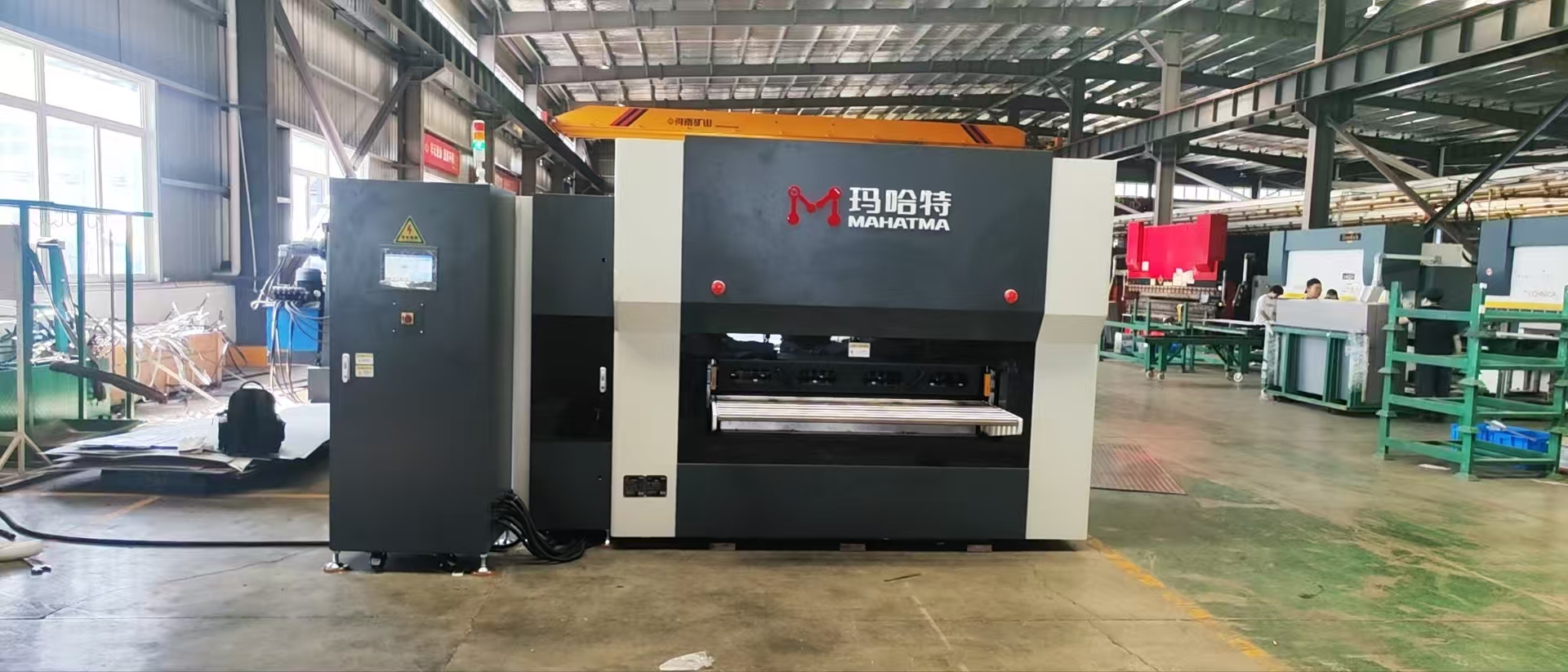
Reading the specification table correctly: what the numbers really mean
Specifications such as width range, rated thickness, maximum thickness, roll count, and speed can be interpreted as the machine's continuous working envelope. For a metal leveler, the rated thickness is more decision-relevant than the maximum thickness because rated values indicate the range in which the machine maintains its frame rigidity and roll support without excessive deflection or accelerated wear. Maximum thickness values represent occasional limits.
On the MAHATMA product specification list, each series follows a distinct engineering logic:
- CNC levelers for thin and medium sheet use 19 to 25 work rolls, with the thinnest models reaching 25-33 rolls to deliver the dense alternating bending needed for stress relief on 0.03–1.0 mm material.
- Hydraulic levelers for thick plate use 9 to 23 rolls depending on the model. The heaviest, MHTR400, uses 9 rolls to handle 20–100 mm plate, where bending force matters more than bend frequency.
- Width coverage starts at 200 mm on small VSH models and extends to 4000 mm on MHTR300/400 heavy plate levelers.
Another relevant point is that rated thickness values are commonly based on ordinary structural steel such as Q235 around 235 MPa yield strength. For high-strength steel, aluminum, or other materials, the usable thickness must be recalculated based on yield strength. MAHATMA applies this derating logic and verifies the result with a free sample test on the buyer's material before purchase.
Application scenarios: which specification matters most
The importance of each specification changes with the application. Understanding this relationship helps buyers avoid over-specifying or under-specifying a leveling machine.
Laser cutting shops preparing blanks
For pre-cutting flattening, the leveler removes coil set, waves, and internal stress so laser focus height and nesting remain accurate. Most laser-focused shops process 0.5–6 mm carbon steel, stainless steel, and aluminum, which corresponds to CNC levelers with 19-23 rolls and recipe storage for fast material changeovers. CNC gap adjustment is the key specification here because material changeover time directly affects throughput. MAHATMA maps this application to its MHTM30–MHTM80 CNC series and to the MHTW servo series when closed-loop inspection is required.
Automotive parts and high surface quality processing
Automotive parts, home appliance panels, and elevator panels require high surface quality under continuous medium load. The specification priority shifts to small-diameter dense rolls to prevent surface indentation, dust removal systems, and precise roll gap control. Servo motor control with PLC parameter memory is the documented operation mode for this scenario. In MAHATMA's range, the MHTW series with all-servo drives and mirror-finish capability is built for this segment.
Shipbuilding and heavy structures
Thick plate leveling for shipbuilding, steel structures, and heavy machinery is a force problem. The specification priorities become frame rigidity, roll diameter, hydraulic drive power, and servo-hydraulic gap control. For 20–100 mm plate, MAHATMA offers the MHTR300 (15–80 mm) and MHTR400 (20–100 mm) hydraulic levelers with widths up to 4000 mm and minimum workpiece length constraints that must be checked against the buyer's part sizes. The documented special requirements for this scenario include ISO 9001:2015 compliance, CE marking for the EU market, noise level ≤75 dB(A), safety interlocks and emergency stop systems, and optional IoT connectivity for remote monitoring and predictive maintenance.
Certifications as part of the specification
For international buyers, certification is as important as mechanical parameters. Two certifications are most relevant for leveling machines:
- ISO 9001:2015 certifies the manufacturer's quality management system, not the machine itself. MAHATMA holds certificate number 62825Q9729R0M issued by Zhongtian Hongtu International Certification Co., Ltd., covering the design and assembly of high-precision leveling machines, uncoiler laser blanking lines, and automatic shearing lines under GB/T19001-2016 / ISO 9001:2015, valid through 2026-05-27.
- CE marking under the Machinery Directive is mandatory for industrial machines placed on the EU market. MAHATMA holds CE certificate M.2025.206.C113032 for hydraulic precision leveling machines, issued by UDEM International Certification Auditing Training Centre Industry and Trade Inc. on 2025-01-16 and valid through 2030-01-15, covering EN ISO 12100:2010 and related machinery safety standards.
Buyers in the United States or Canada should note that there is no CE equivalent there. Local inspectors may require an NRTL field evaluation of the electrical panel per NFPA 79, and US machines typically run on 480V/3-phase/60Hz, which must be specified at the time of order. For the EU, the electrical configuration is commonly 400V/50Hz.
Comparison with traditional solutions: what leveling machines replace
Traditional approaches to flat metal sheets include manual hammer straightening, stretcher leveling, and accepting coil set as an upstream defect. Manual straightening is labor-intensive, inconsistent, and cannot relieve internal stress in a repeatable way. Stretcher leveling can improve flatness but is limited by material thickness, width, and the risk of surface marking on coil material.
Roller leveling machines address these limitations by applying repeated alternating bending to relieve internal stress and achieve flatness without stretching the material beyond its yield point. Compared with manual methods, the machine improves consistency, throughput, and worker safety. Compared with stretcher leveling, it covers a wider thickness range and is more suitable for integration into continuous coil processing lines such as cut-to-length and flying shear lines.
A balanced view also requires noting the boundaries of roller leveling. A leveling machine cannot correct all material defects. It does not remove surface scratches, rolling marks, or coating defects. It cannot compensate for a poorly maintained coil with severe edge damage. It also cannot guarantee flatness beyond the physical limits of the machine's roll configuration and frame rigidity for a given yield strength. Furthermore, very thin and very elastic materials can be difficult to level without specialized roll designs, and very thick plate requires massive structures that must be matched to the buyer's crane and foundation capacity.
Buyers who need to decide between a leveling machine and a cut-to-length or flying shear line should remember that the latter are integrated systems with a leveling unit at the core. If the primary goal is flat sheets from coils, the leveling stage determines the final quality regardless of the cutting method. MAHATMA offers the MF-3 flying shear line for 0.3–3.0 mm material at up to 100 m/min with shearing accuracy of 0.5 mm, and the TD-2x2000 cut-to-length line for 0.2–2.0 mm material with ±0.5 mm shearing accuracy. These systems are relevant when the buyer wants uncoiling, leveling, and shearing in one automated process.
Market context: why precision leveling capability is becoming a procurement criterion
The global metal forming equipment market is valued at USD 45.8 billion in 2025, and the metal forming machine tools market is projected to reach USD 64.85 billion by 2034 with a CAGR of 9.60%. Asia Pacific dominates the metal forming equipment market with a 42.5% revenue share in 2025. Within sheet metal processing equipment, the automotive segment accounts for 41.37% of the market share in 2026. These figures indicate that manufacturing capacity expansion, particularly in Asia Pacific and automotive supply chains, continues to drive demand for processing equipment.
For procurement teams, the practical implication is that leveling machines are increasingly evaluated not as standalone units but as the quality-defining stage in a production line. The growth of CNC technology in machine tools — 85.7% of the market in 2025 — suggests that buyers increasingly expect digital control, recipe management, and interface capability as standard specification items rather than options.
What the shift toward intelligent leveling means for buyers
The direction in the leveling machine category is toward control intelligence and closed-loop verification. MAHATMA's MHTM CNC series stores up to 200 recipes on a 10-inch touchscreen, supports misoperation warnings, and enables one-key parameter setting. The MHTW series adds remote cloud control, laser 3D online inspection, and roll-box cleaning automation. The MHTR hydraulic series adds anti-collapse dynamic compensation and servo-hydraulic hybrid drive, with energy consumption reduced by up to 70% compared with traditional hydraulic levelers.
These features should be interpreted from a buyer's perspective. Recipe storage reduces changeover time between materials. Misoperation warnings reduce the risk of machine damage by unskilled operators. Laser 3D inspection provides objective flatness verification instead of relying on operator judgment. Remote diagnostics reduce downtime risk for buyers in countries without a local service engineer. Each of these features has a concrete operational value that is not visible in the width and thickness specification alone.
Practical evaluation criteria for procurement teams
When comparing leveling machine suppliers, the following checklist provides a structured evaluation framework:
- Define the material envelope: material grades, thickness min/max, width min/max, yield strength, and surface finish requirements.
- Define the flatness target: specify in mm/m or I-unit, based on downstream process requirements, not on marketing claims.
- Compare roll structures: two-high vs. four-high vs. six-high for your precision and surface quality needs.
- Check the control system: CNC recipe storage, interface capability with MES/ERP, and integration options for automation modules.
- Verify certifications: CE for the EU, ISO 9001 for the manufacturer's quality system, and voltage/frequency configuration for your installation site.
- Request a sample test: performance verification on your own material is more reliable than brochure numbers.
- Assess the supplier's track record: export markets, overseas service networks, and after-sales support structure.
Future outlook
As manufacturing moves toward thinner materials with higher strength and stricter surface requirements, leveling machine specifications will likely place more weight on roll support structures, closed-loop inspection, and data integration. Buyers can expect the boundary between leveling machines and complete processing lines to become less relevant, since the leveling stage increasingly determines the output quality of cut-to-length, slitting, and blanking systems.
For suppliers, the implication is that standardized machine configurations with optional automation modules will become the norm. MAHATMA's current approach — a four-family structure with customizable roller width, roll material, control integration, and automated loading/unloading systems — reflects this direction. Its documented capability includes MES/ERP interfaces on blanking lines and CNC levelers, with automation modules such as loading carts, conveyors, robots, vision inspection, and AGVs available as proven options.
Frequently asked questions
Which MAHATMA model should I choose for my material?
MAHATMA selects the model based on four inputs: thickness range, width, material grade/yield strength, and flatness target. Since leveling force depends on thickness and yield strength, model ratings based on Q235/235 MPa are recalculated for high-strength steel, aluminum, or titanium. A quick reference map is: VSH/VST series for entry-level 0.03–3.5 mm applications, MHTM series for 0.03–30 mm CNC leveling, and MHTR series for 0.5–100 mm servo-hydraulic leveling.
What flatness can a MAHATMA leveling machine actually achieve?
Precision series achieve flatness down to ±0.05 mm in verified cases, with typical production results of 0.05–0.20 mm/m². This is achieved through multi-roll alternating bending based on the Bauschinger effect, 4/6-high full-support roll structures, and laser 3D inspection with closed-loop correction on flagship models. Final flatness depends on material grade, thickness, and original coil condition, so MAHATMA recommends a free sample test on the buyer's own material before ordering.
Can the equipment integrate with my MES/ERP and existing production line?
MAHATMA blanking lines and CNC levelers provide MES/ERP interfaces, and automation modules such as loading carts, conveyors, robots, vision inspection, and AGV are available as standard options. MAHATMA builds integrated lines rather than standalone boxes. Buyers should provide their part envelope, takt target, and current line layout early so the integration plan can be engineered from these inputs.
Can I test my own material on a MAHATMA machine before buying?
Yes. The sample test is free: buyers send 1–2 meters of material or representative parts, MAHATMA levels them on the recommended machine, and returns a written flatness report and process video within days. The buyer only covers the shipping cost of the material. MAHATMA recommends sending worst-condition material rather than the best sample to validate real production conditions.
Do MAHATMA machines have CE certification and can they be exported to the EU and US?
Yes. MAHATMA holds CE certification for hydraulic precision leveling machines under certificate M.2025.206.C113032, valid through 2030-01-15, and ISO 9001 certification under certificate 62825Q9729R0M, valid through 2028-05-26. For the US/Canada, buyers should specify 480V/60Hz at order and plan for NRTL field evaluation of the electrical panel per NFPA 79. For Russia/EAEU, EAC certification applies.
For buyers who want to review the full product range and company capability in one document, MAHATMA provides a downloadable brochure: MAHATMA English Brand Brochure.