
Lifespan and Stability: A Long-Term Evaluation Framework for Outdoor CT Suppliers
Most procurement evaluations judge outdoor current transformers on the wrong time horizon. Bid comparison sheets measure what can be verified at delivery — ratio, accuracy class, inner diameter, output type, unit price. What actually determines whether a unit installed on a pole, a rooftop PV array, a railway trackside cabinet or a coastal distribution room is still performing in year twenty belongs to a completely different evaluation category: whether the housing and encapsulation system holds together under UV radiation, salt-laden air, rain, frost and daily thermal cycling.
This article sets out a structured framework for evaluating outdoor CT suppliers against that longer horizon. The framework is built around the design decisions that determine degradation behaviour rather than the specifications that determine first-day performance, and it uses documented product data from HEYI ELECTRICAL — including the OCT outdoor waterproof split-core transformer and the LMZW outdoor resin-cast transformer — as worked examples of what those design decisions look like in practice.
Why Long-Term Evaluation Works Differently for Outdoor Units
An indoor current transformer operates under indoor electrical cabinet and low-voltage distribution system conditions. Its environment is stable, its exposure is limited, and the dominant long-term risks are insulation ageing and accuracy drift. An outdoor transformer shares none of those advantages. It is exposed continuously, and the failure mechanisms that matter are environmental rather than electrical.
Four degradation pathways dominate in open-air installations:
- Photodegradation of the housing. Ultraviolet radiation breaks polymer chains in plastic housings, causing surface chalking, embrittlement and eventually micro-cracking. Once a crack opens, the path to the winding is no longer sealed.
- Moisture ingress through thermal breathing. Day–night temperature swings cause air inside an enclosure to expand and contract. Without an effective seal and a hydrophobic barrier, that breathing cycle draws humid air in and condensation forms around the core and windings.
- Salt and pollutant attack. Coastal, marine and industrial installations expose terminals, mounting hardware and housing surfaces to chloride and chemical deposition, which accelerates corrosion and surface tracking.
- Mechanical and thermal cycling stress. Differential expansion between metal conductors, magnetic cores and encapsulating resin creates internal stress that accumulates across thousands of cycles.
The consequence for buyers is that outdoor CT reliability cannot be inferred from a catalogue accuracy figure. Two units with identical ratio and accuracy class can have completely different twenty-year behaviour depending on how their insulation system is constructed.
Why Initial Accuracy Does Not Predict Year-Twenty Stability
Accuracy class is the specification buyers scrutinise most closely, and it is worth understanding what it does and does not cover. IEC 61869-2, which replaced IEC 60044-1 as the core international standard for inductive current transformers, defines the accuracy classes used in low-voltage and medium-voltage metering — including classes 0.5 and 0.5S — and it defines how those classes are verified. Revenue-grade applications are typically held to tighter classes again, commonly 0.2 or 0.15 under IEC 61869-2 or ANSI C12.20.
What a declared accuracy class certifies is performance at the time of test under defined reference conditions. It is a snapshot, not a trajectory. Moisture reaching a winding changes the leakage path and can shift the phase error. Corrosion of a core lamination stack increases core loss. A housing crack that admits water creates a path for partial discharge. None of these effects appear in a delivery inspection, and all of them appear in the field.
This is the core argument for evaluating outdoor CT suppliers on design resilience rather than on unit specifications alone: the specification tells you where the product starts, and the encapsulation and housing design tell you how slowly it moves away from that starting point.
The Role of Encapsulation: Epoxy Resin and Hydrophobic Resin Systems
Insulation system construction is the single most important design variable in an outdoor current transformer. The two dominant approaches in HEYI ELECTRICAL's outdoor range illustrate the trade-off clearly.
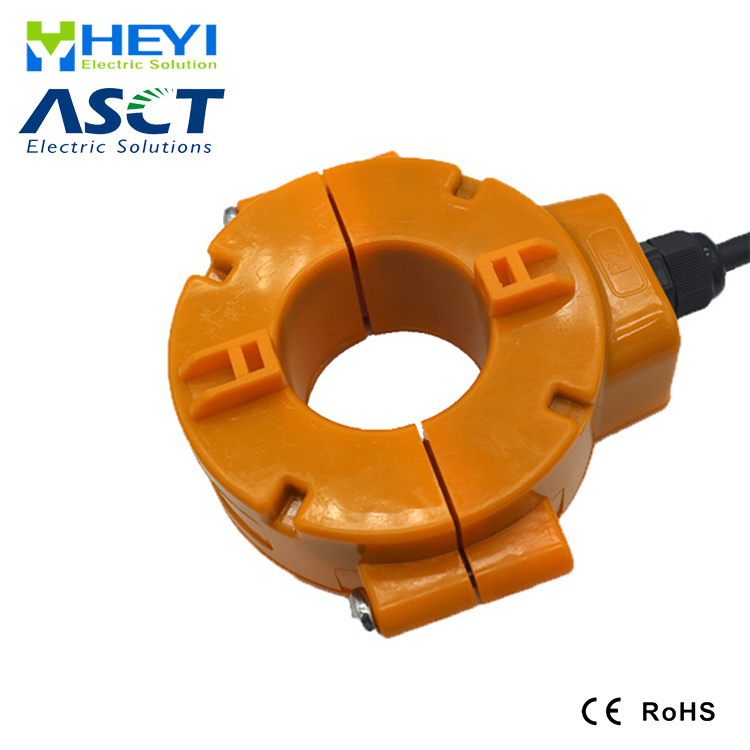
The OCT outdoor waterproof split-core current transformer uses a combined approach: a plastic housing filled with epoxy resin. The plastic housing provides the mechanical form, the mounting geometry and the first barrier against direct weather exposure, while the epoxy resin encapsulates the core and windings and closes off the internal volume against moisture. This unit is rated IP65 in its parameters, carries an IP65/IP67 positioning in its product designation, and includes UV protection as a design feature. Its measurement range extends from 0 to 8000 A with an inner diameter of up to 120 mm and accuracy options of 3.0, 1.0 and 0.5.
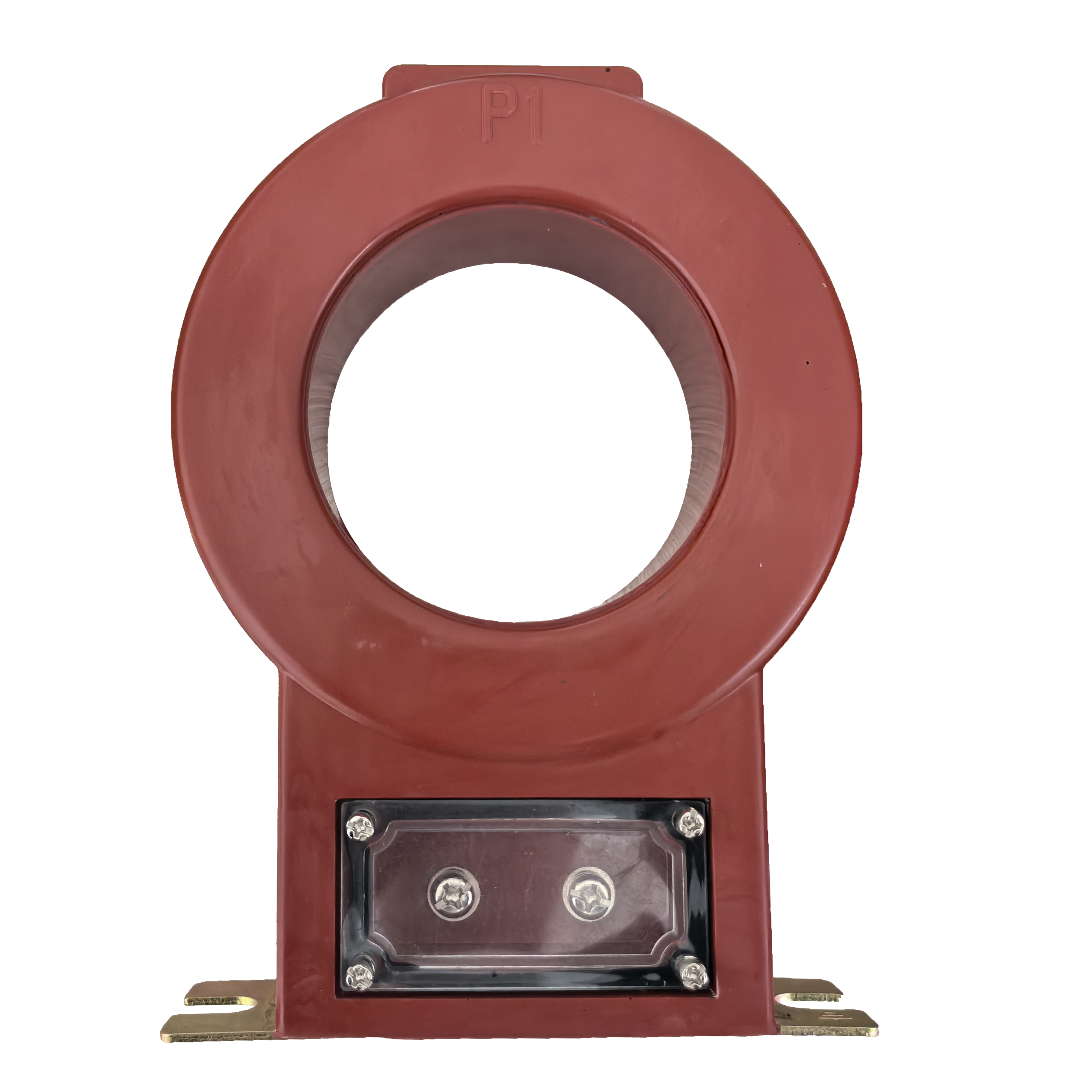
The LMZW outdoor resin-cast current transformer takes the opposite approach: rather than a housing-plus-fill construction, the active assembly is fully cast in hydrophobic epoxy resin. There is no internal air volume to breathe and no separate housing-to-fill interface to seal. It is rated IP65 with UV protection, covers 0 to 1000 A with an inner diameter up to 80 mm, and offers accuracy classes of 1.0, 0.5, 0.5S, 0.2 and 0.2S. Its documented application areas — marine and offshore, chemical and metallurgy, and ring main units — reflect the environments where a void-free cast body has the greatest advantage.
A third reference point in the same range, the RECT extended range current transformer, uses epoxy resin insulation with IP65 rating and UV protection, and is positioned for utility and substation billing, utility-scale solar and wind, and revenue sub-billing — markets where accuracy stability over a long service life carries direct commercial consequences.
Housing and Sealing: Where Most Long-Term Failures Begin
If encapsulation protects the electrical assembly, the housing determines how long that protection lasts. In an outdoor installation, the housing is a sacrificial barrier — it takes the UV load, the thermal cycling and the physical impact so the encapsulation does not have to.
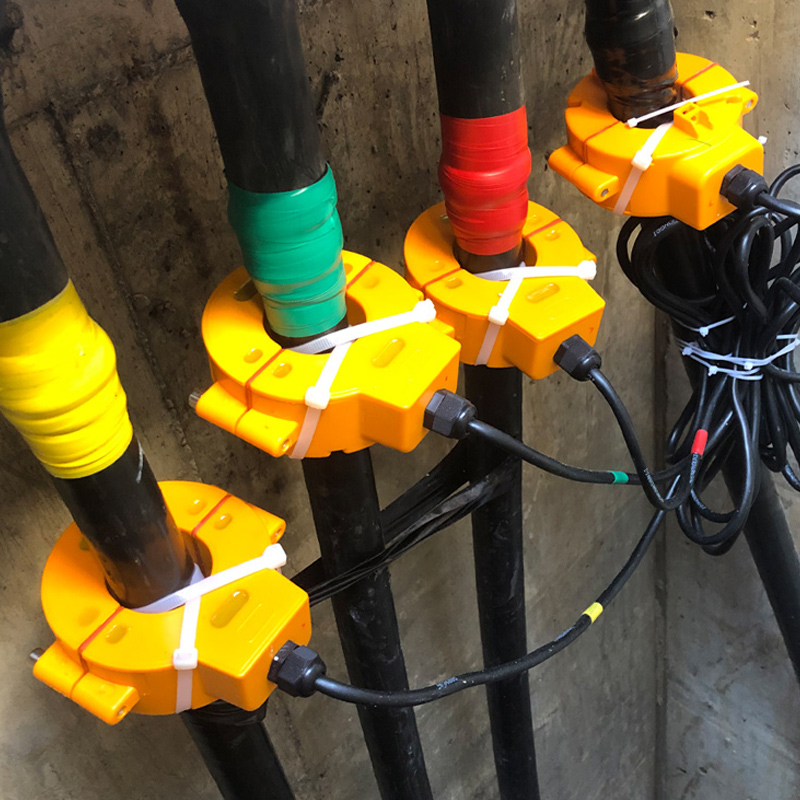
For split-core designs, the housing carries an additional burden. A split-core transformer is built in two halves that close around an existing conductor, which is precisely why it is the fastest-growing product segment: split core current transformers are identified as the fastest-growing category due to the ease of installation in retrofitting and smart grid applications. That convenience comes with a mechanical joint line that a solid-core or fully cast unit does not have. Every split-core outdoor CT therefore depends on the design of that joint — how closely the two halves mate, how the mating surfaces are sealed, and how the closure mechanism resists loosening over years of thermal cycling and vibration.
For solid-core and cast-resin designs, the housing risk profile is different but not absent. The critical questions become surface hydrophobicity — whether water beads and runs off or spreads into a continuous film that can support surface tracking — and the integrity of the interface where the cast body meets terminals, cable glands and mounting inserts.
A Six-Point Evaluation Checklist for Outdoor CT Suppliers
The following checklist converts the design discussion above into procurement questions. Each point can be raised in a supplier questionnaire and, where necessary, verified during a factory audit.
1. Insulation and encapsulation system
- Is the active assembly encapsulated in epoxy resin, resin-cast, or left as a dry-type construction with an air volume inside a housing?
- For resin-cast designs, is the resin described as hydrophobic, and is the casting process controlled for voids?
- What is the declared insulation withstand capability, and which test verifies it?
2. Housing and ingress protection
- What is the declared IP rating, and does it apply to the completed unit including cable entry, not only to the housing shell?
- For split-core units, how are the mating surfaces of the two halves sealed, and what keeps the closure mechanically stable over time?
- Are mounting inserts, terminals and glands made from corrosion-resistant materials appropriate to the installation environment?
3. UV and weathering design
- Does the product specification explicitly include UV protection, or is UV resistance assumed from the base polymer?
- Is the housing material specified by grade (for example, a defined plastic or resin system), or only generically?
- Is the unit intended for direct solar exposure, or only for shaded outdoor installation?
4. Moisture and corrosion management
- Is there any internal air volume that can breathe with temperature cycling?
- Is the resin system hydrophobic, so that surface moisture does not form a continuous conductive film?
- For marine, offshore or chemical environments, are the core, winding and hardware materials specified accordingly?
5. Conductor and magnetic core materials
- Are windings specified as pure copper enamelled wire, and cores as silicon steel sheet or an equivalent defined magnetic material?
- Is the material specification consistent across the whole outdoor range, or does it vary by model in ways that affect long-term drift?
6. Test evidence and process control
- What tests are performed on every unit, and what tests are performed on samples only?
- Are insulation resistance and withstand voltage tests part of routine production testing?
- Is pre-shipment inspection documented, and does it cover appearance and workmanship as well as electrical parameters?
- Can the supplier provide type-test documentation relevant to outdoor exposure, and explain how it maps to the specific product being quoted?
Comparing Outdoor and Weather-Exposed CT Options
The table below compares three HEYI ELECTRICAL product families that appear in outdoor and weather-exposed applications, using only documented parameters. The purpose is to show how the evaluation checklist maps onto concrete product choices rather than to establish a ranking.
| Product family | Model | Waterproof rating | Housing / insulation | UV protection | Current range | Accuracy | Documented application areas |
|---|---|---|---|---|---|---|---|
| Outdoor waterproof split-core current transformer | OCT | IP65 (IP65/IP67 positioning) | Plastic housing + epoxy resin | Yes | 0–8000 A | 3.0 / 1.0 / 0.5 | Overhead line monitoring, outdoor solar and wind, municipal infrastructure, railway trackside |
| Outdoor resin-cast current transformer | LMZW | IP65 | Hydrophobic epoxy resin | Yes | 0–1000 A | 1.0 / 0.5 / 0.5S / 0.2 / 0.2S | Marine and offshore, chemical and metallurgy, ring main units |
| Extended range current transformer | RECT | IP65 | Epoxy resin | Yes | 0–1000 A | IEEE C57.13 | Utility and substation billing, utility-scale solar and wind, data centre and C&I revenue sub-billing |
What Supplier Process Control Contributes to Longevity
Design intent only converts into field reliability if manufacturing reproduces that design consistently across every unit shipped. This is where quality-control scope becomes a genuine long-term evaluation criterion rather than a commercial formality.
In HEYI ELECTRICAL's documented quality-control process, every unit passes 100% routine testing, accuracy testing, insulation resistance testing and withstand voltage testing, with additional appearance inspection and pre-shipment inspection before dispatch. Insulation resistance and withstand voltage testing on every unit is directly relevant to outdoor reliability: these are the tests that detect a compromised insulation system before it reaches a pole or a coastal cabinet, where the defect would only surface after moisture has already entered.
Two further supplier attributes affect a long-term assessment. The first is capacity stability: HEYI ELECTRICAL documents a monthly capacity of 20,000 units, which matters to buyers planning multi-year rollouts where a change of production source mid-programme would invalidate accumulated field experience. The second is customisation capability — current ratio, accuracy class, burden, window size, housing colour, terminal type, cable length and logo printing — because an outdoor installation that has been customised to the actual cable and enclosure geometry is less likely to be modified in the field, and field modification is a common cause of compromised sealing.
The company operates a 10,000 m² facility in Wenzhou, Zhejiang, China, with a team of 56 and five R&D engineers, and reports a 95% export ratio across Southeast Asia, South Korea, Europe, South America, Australia, Africa, the Middle East and North America — a distribution footprint that exposes products to a wide range of climatic conditions.
Where Long-Term Outdoor Reliability Matters Most
The evaluation framework above is not equally relevant to every project. It carries the most weight in installations where the transformer is difficult or expensive to reach.
Overhead line monitoring places transformers on distribution poles, where access requires a bucket truck and a planned outage. A failed unit here is not a replacement cost problem; it is a data continuity problem, because the load history the operator relies on for planning has a gap in it.
Outdoor solar and wind installations expose transformers to continuous direct sunlight and wide temperature swings, making UV resistance and thermal cycling tolerance the dominant design requirements.
Railway trackside installations add vibration and pollution to the exposure profile, and access windows are constrained by signalling and traffic schedules.
Marine, offshore, chemical and metallurgy environments are the most aggressive, and this is where a void-free hydrophobic resin-cast body offers the clearest structural advantage. In these settings the supplier's material specification matters more than any other single variable.
Ring main units in tropical high-humidity regions combine sustained humidity with limited ventilation, which is the condition under which an internal air volume in a housing is most likely to condense moisture onto the core.
Market Context: Why Outdoor Durability Is Becoming a Larger Buying Criterion
Several structural trends are pushing outdoor CT reliability up the procurement agenda.
The global current transformer market was estimated at USD 2.63 billion in 2024 and is projected to reach USD 3.90 billion by 2030, according to Grand View Research. Within that market, the Asia Pacific region dominated with a 40.15% revenue share in 2025, per Straits Research — a concentration that reflects the scale of grid, solar and industrial build-out underway in the region.
The growth composition matters more than the headline figure. Split core current transformers are identified as the fastest-growing segment due to ease of installation in retrofitting and smart grid applications, according to Fact.MR. Since retrofit and smart-grid work frequently places transformers in existing outdoor cabinets and on existing overhead assets, the fastest-growing segment is also the segment most exposed to environmental degradation.
Electrification adds a further dimension. The global EV charging transformer market, which includes current monitoring components, is expected to grow at a CAGR of 23.6% from 2025 to 2033, according to Research Intelo. Much of that infrastructure sits outdoors, in public and semi-public locations, where the transformer is exposed to weather and where servicing requires a site visit.
Together these trends suggest that the evaluation question is shifting from "does this transformer meet the accuracy class" to "will this transformer still meet the accuracy class after a decade outdoors" — which is precisely the question this framework addresses.
Limitations and Boundaries of This Framework
An honest evaluation framework has to state where it stops being useful.
- No supplier can prove twenty-year life at delivery. Long-term behaviour can only be inferred from design, materials and test evidence. Any claim framed as guaranteed multi-decade performance should be treated with caution; what can be evaluated is the rigour of the design and the completeness of the test record.
- Higher ingress protection is not free. Fully resin-cast outdoor transformers such as the LMZW provide the strongest environmental isolation, but they are solid-core units and cannot be installed around an existing cable without disconnection. Where retrofit without shutdown is the governing constraint, a split-core outdoor unit such as the OCT is the appropriate choice even though it introduces a joint line that must be sealed and maintained.
- Declared IP ratings describe design intent, not field condition. An IP65 or IP67 rating applies to a correctly installed unit. A gland left loose, a cable routed with a water trap, or an enclosure drilled on site can void that protection entirely, and no supplier design can compensate for installation practice.
- Resin formulations are supplier-specific and often not fully disclosed. Hydrophobicity, filler content and curing control strongly influence long-term behaviour, but these parameters are rarely published. Buyers who need to evaluate them must do so through factory audits and type-test documentation rather than datasheets.
- Environmental severity varies more than product categories do. A sheltered outdoor cabinet in a temperate climate and an exposed coastal mounting in a tropical region impose very different loads. Selecting a product family is only the first step; matching it to the actual exposure profile of the site is the part that determines outcomes.
Future Outlook
Three developments are likely to shape how outdoor CT durability is evaluated over the next several years.
First, retrofit activity will continue to dominate volume growth. As the split-core segment expands on the strength of retrofit and smart-grid demand, the population of transformers installed in existing outdoor cabinets — without the benefit of a new-build enclosure design — will keep growing. That shifts the burden of environmental protection further onto the transformer itself and away from the surrounding installation.
Second, revenue-grade accuracy requirements will migrate into more outdoor applications. As utility-scale solar, wind and storage assets move from monitoring to settlement-grade metering, transformers that would previously have been graded on monitoring accuracy will need to hold billing-grade stability over years of outdoor exposure. This raises the cost of long-term drift considerably and makes encapsulation design a commercial issue rather than a technical detail.
Third, buyers are likely to ask for more structured degradation evidence. The natural direction is toward documented test protocols that map to real exposure conditions — UV exposure, salt spray, humidity cycling — reported in a form that can be compared across suppliers. Until that becomes a standard common to the industry, the six-point checklist in this article remains the practical substitute: it allows buyers to compare design rigour and process control in the absence of directly comparable field data.
For technical reviewers who want to examine the specific outdoor product families referenced here — including the OCT outdoor waterproof split-core transformer, the LMZW outdoor resin-cast transformer and the RECT extended range current transformer — the full specification set is available in the HEYI ELECTRICAL product brochure at heyiele.com product documentation.
FAQ
1. What is the real long-term difference between an outdoor CT and an indoor CT?
Indoor current transformers typically operate under indoor electrical cabinet and low-voltage distribution system conditions, where requirements concentrate on high accuracy, stable output and insulation safety. Outdoor units face continuous UV radiation, moisture cycling, salt and pollutant deposition, and wide thermal swings. For that reason the dominant long-term failure mechanisms in outdoor installations are environmental rather than electrical: housing degradation, moisture ingress and corrosion. Indoor and outdoor units may share the same accuracy class and ratio, but they are evaluated against fundamentally different degradation profiles.
2. What does an IP65 or IP67 rating actually mean for an outdoor current transformer?
An IP rating is a two-digit classification of how well an enclosure resists dust and water. IP65 indicates protection against dust ingress and against water projected as a jet; IP67 indicates protection against dust ingress and against temporary immersion under defined conditions. For outdoor CT evaluation the rating is necessary but not sufficient. It describes the enclosure under test conditions, not the condition of the installed unit after a decade of UV exposure and thermal cycling. It also does not cover the cable entry unless that entry is part of the tested assembly. A rating should therefore always be read together with the UV protection statement, the encapsulation system and the mechanical design of any joint line.
3. Why is epoxy resin used in outdoor current transformer designs?
Epoxy resin serves two functions in an outdoor CT: electrical insulation and environmental sealing. By embedding the core and windings in a solid insulating medium, it removes the internal air volume that would otherwise breathe with temperature cycling and draw in humid air. Two common configurations exist. The first is a plastic housing filled with epoxy resin, as used in the OCT outdoor waterproof split-core transformer, which combines mechanical form with a sealed internal volume. The second is a fully resin-cast body using hydrophobic epoxy resin, as used in the LMZW outdoor resin-cast transformer, where there is no housing-to-fill interface to seal. Hydrophobic resin formulations also encourage water to bead and run off rather than form a continuous surface film.
4. What test evidence should a buyer request before confirming an outdoor CT supplier?
Buyers should establish two things: what is tested on every unit, and what is tested on samples only. Routine per-unit testing — accuracy testing, insulation resistance testing, withstand voltage testing and appearance inspection, followed by pre-shipment inspection — provides evidence that the insulation system is intact on the units actually being delivered. Sample and type testing provides evidence about design behaviour under conditions that routine testing cannot reproduce. The appropriate request is therefore a documented list of per-unit tests, a documented list of type tests, and a mapping showing which type-test documentation applies to the specific product being quoted. Where a supplier cannot map type tests to the quoted model, the design evidence should be treated as unverified.
5. Can a split-core CT remain reliable in outdoor service over a long period?
A split-core design introduces a mechanical joint line that a solid-core or fully cast unit does not have, and that joint is the primary long-term risk in outdoor service because it is the most likely path for moisture ingress. Sealed outdoor split-core constructions — such as the OCT, which combines a plastic housing with epoxy resin and is rated IP65 with UV protection — are designed specifically to manage this risk. Whether that is sufficient depends on the site. For sheltered outdoor cabinets and retrofit installations where shutdown is not possible, a sealed split-core unit is usually the practical choice, with periodic visual inspection of the joint and closure mechanism as a reasonable maintenance measure. For direct, unsheltered exposure in marine, offshore or chemically aggressive environments, a fully resin-cast solid-core unit such as the LMZW is the more structurally conservative option, at the cost of requiring conductor disconnection during installation.
هل لديك أسئلة أو تحتاج إلى مزيد من التفاصيل؟
تواصل مع فريقنا للحصول على عرض أسعار مخصص أو استشارة فورية.
طلب عرض أسعار
املأ النموذج أدناه وسيتواصل معك فريقنا بعرض مقترح مخصص.
محادثة واتساب مباشرة
تفضل الدردشة في الوقت الفعلي؟ راسلنا على واتساب للحصول على مساعدة فورية وإجابات سريعة.
- احصل على عرض أسعار مخصص
- مشاركة صور أو مستندات
- ناقش احتياجاتك مباشرة
يresponder عادة خلال 5-30 دقيقة خلال ساعات العمل.