
Lightweight Portable Axial Flow Pumps: A Capability Review
Lightweight Portable Axial Flow Pumps: A Capability Review
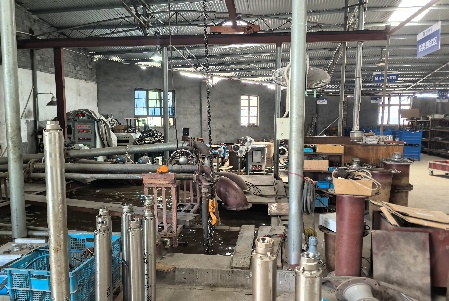
Performance verification on a comprehensive water pump test bench. Duty-point and efficiency claims only carry weight when they can be measured against a documented test method.
A lightweight high efficiency portable axial flow pump is a high-flow, low-head drainage pump engineered so that the whole unit — motor, hydraulic end and often the control cabinet — can be transported, deployed and recovered as mobile equipment instead of being built into a permanent pumping structure. The design question behind it is practical: how much flow can be delivered per kilogram of equipment that a crew can actually move, connect and start within the response window.
Axial flow pumps are the standard answer when very large volumes of water have to be moved against a low head, which is why they dominate flood control, municipal waterlogging removal, agricultural irrigation and large construction drainage. In those duties the pump has to reach water that is not where it was yesterday, run for hours, and survive being stored between events. A unit that is difficult to move, or that needs a crane and civil works before it can run, fails at the first step — regardless of how good its flow curve looks on paper.
Why Pump Weight Became a Procurement Criterion
For a pump installed permanently in a wet well, weight is a one-off installation concern. For portable equipment, weight is an operating cost that repeats at every deployment: the labour needed to carry and position the pump, the vehicle payload it consumes, the storage volume it occupies in an emergency warehouse, and the freight paid every time it is shipped.
Three shifts in how drainage equipment is bought have pushed that cost to the front of the evaluation.
- Response-time expectations. Municipal and industrial operators are expected to mobilise within hours of a flood warning. Equipment that can be loaded, driven and started by a small crew fits that model; equipment that needs a lifting frame does not.
- Distributed, mobile pumping stock. Instead of relying on a single large fixed station, many operators keep a pool of portable pumps that can be dispatched to whichever location is at risk. Fleet weight affects how many units one vehicle can carry.
- Energy and labour cost scrutiny. High-efficiency motors reduce running cost, but only if the pump runs near its duty point, which favours units with adjustable speed over fixed-speed designs.
The engineering opportunity is that both motor mass and hydraulic-end mass can be reduced. Higher-speed permanent magnet synchronous motor designs generally deliver a given output from a smaller motor frame than a conventional low-speed induction design, while precision-cast stainless steel impellers and aluminium alloy bodies cut the mass of the wetted end. The result is a portable axial flow pump that keeps the large-flow character of the axial flow category while remaining realistic to handle as mobile equipment.
What Chuangmei Documents for Its Lightweight Portable Axial Flow Pump Range
Zhejiang Chuangmei Electromechanical Co., Ltd., whose pumps are marketed under the Chuangmei Pumps brand, is a pump manufacturer based in the Ta'ao Industrial Zone, Wenling City, Zhejiang Province, China. Founded in 1996, the company operates a 12,000 m² factory with approximately 46 employees, lists high efficiency portable axial flow pumps as its main product line, and reports an export ratio of about 25%, with principal markets in Southeast Asia, Africa, Morocco and the Central Asian countries.
The platform behind the lightweight range is a permanent magnet synchronous motor (PMSM) high-speed axial flow pump. Company documentation records this design as a utility model patent (Patent No. ZL2014200091521.8) and places it in a sequence that began with the company's High-Speed Well Jet Pump series (Patent No. ZL201110343834.X). The company states that it has developed 20 permanent magnet synchronous motor submersible axial flow pump models and that the pump holds a national first-class energy conservation certification for high-tech energy-saving products.
Material choices follow the same weight logic. The impeller is produced by precision stainless steel casting and the pump shaft is also stainless steel, while the motor housing and pump body are offered in either aluminium alloy or stainless steel. The cable outlet is protected by a rubber sheath plus a stainless steel spring guard.
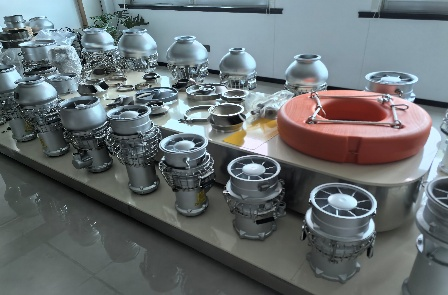
Portable axial flow pump models in the manufacturer's sample show room. Net weight, dimensions and body material are specified per model rather than per category.
What the Documented Model Data Shows
Weight only means something when it is read next to flow, head and power. In the manufacturer's published model tables, the portable flood-control range spans 6-inch through 12-inch outlets. Documented net weights for representative models are shown below.
| Model | Outlet | Rated flow (m³/h) | Rated head (m) | Motor power (kW) | Net weight (kg) | Dimensions (mm) |
|---|---|---|---|---|---|---|
| 150SZQ100-6-3 | 6 inch | 100 | 6 | 3 | 18 | 220 x 220 x 430 |
| 150SZQ200-6-5.5 | 6 inch | 200 | 6 | 5.5 | 20 | 220 x 220 x 430 |
| 150SZQ250-9-11 | 6 inch | 250 | 9 | 11 | 22 | 220 x 220 x 430 |
| 200SZQ450-8-15 | 8 inch | 450 | 8 | 15 | 20 | 230 x 230 x 440 |
| 200SZQ600-8-22 | 8 inch | 600 | 8 | 22 | 24 | 250 x 250 x 530 |
| 250SZQ600-8-22 | 10 inch | 600 | 8 | 22 | 29 | 260 x 260 x 560 |
| 300SZQ1500-10-75 | 12 inch | 1500 | 10 | 75 | 65 | 350 x 350 x 605 |
Selected portable flood-control models as listed in manufacturer product data. Flow, head, power, weight and dimensions are stated per model and vary with material and configuration.
The pattern is consistent: a 6-inch unit delivering 250 m³/h at 9 m is documented at 22 kg, and an 8-inch unit delivering 450 m³/h at 8 m is documented at 20 kg. Weight grows more slowly than flow across the range, which is the practical value of the high-speed motor design. It does not grow linearly in all cases, and material choice moves the number: the same 300SZQ1000-10-45 model designation is listed at 55 kg in the aluminium-alloy 12-inch series and 78 kg in the stainless-steel 12-inch series.
Technical Explanation: Motor, Hydraulics and Speed Control
Stepless speed regulation and adjustable head
The pump speed is infinitely adjustable, which makes delivered head and flow variable rather than fixed. In practice a crew can trim the pump to site conditions — reducing flow and raising head as a discharge line fills, or raising flow for bulk transfer — instead of selecting a different impeller or throttling a valve.
The permanent magnet synchronous motor also behaves differently from a conventional asynchronous motor under unstable supply conditions. Company documentation states that the speed of the PMSM does not vary with fluctuations in grid voltage, so the pump maintains stable head and flow even when voltage drops, a behaviour it says traditional asynchronous motor axial flow pumps cannot achieve. For buyers working on weak or fluctuating power supplies — common at temporary flood-control sites — that stability is a functional difference rather than a comfort feature.
Replaceable impeller and pump body
Head and flow can also be changed mechanically. Company documentation describes dual-purpose pumps that achieve both low-lift, high-flow duty and high-lift duty through simple replacement of the impeller and the pump body. This extends the working range of a single portable unit across duties that would otherwise require two different pumps — with the practical caveat that changeover is a maintenance activity to be planned, not a push-button adjustment.
Drive and control cabinet
The portable pump is part of a system. The control cabinet is offered with either a panel display or a touch-screen display and a built-in frequency inverter, and it displays frequency, voltage, current and rotational speed in real time. Through 3G and 4G mobile networks, remote control is possible from a computer or a mobile phone app, including remote data transmission, remote start/stop and remote adjustment of pump operating speed.
Protection functions cover overheat, overcurrent, overload, overvoltage and phase failure. If water is completely drained, the pump shuts down automatically within about half a minute and enters standby mode; the company states that the coil will not burn out as a result. Cabinets are available in single-unit or dual-unit (one-drives-two) configurations, with protection ratings of IP44 or IP54, and the three-phase four-wire system uses waterproof plugs and sockets.
Cabinet size belongs in the transport calculation. The 5.5–7.5 kW mini-style cabinet is listed at 300 x 270 x 500 mm and 15 kg, while a vehicle-mounted double-system cabinet for the same power band is listed at 520 x 270 x 550 mm and 25 kg. Documentation also covers time-segmented operation, so a portable unit can be scheduled to run in defined windows rather than continuously.
Application and Use Cases
- Mobile flood control and emergency drainage — high-flow units deployed to river banks, urban low points and construction sites.
- Agricultural irrigation and pond drainage — pumping irrigation and pond emptying with the same portable unit.
- Municipal waterlogging removal — rapid clearance of ponded water in streets, underpasses and public spaces.
- Subway and underground space drainage — dedicated high-head flood-control pumps for subway applications, with lifts documented in the roughly 20–50 m range, special specifications above 100 m, and designs exceeding 200 m head for special use.
- Fixed drainage points — bridge, culvert, basement, garage and underground comprehensive pipe gallery drainage, where the unit starts automatically when water reaches a set level and returns to standby or shuts down when the level falls to the pump intake line.
- Vehicle-mounted drainage — hydraulic axial flow pumps driven by a vehicle's hydraulic power system, for crews that need pumping capacity without a separate electrical supply.
Field records supplied by the manufacturer describe two long-running deployment patterns. A pump equipment OEM in China has taken 300 units over an eight-year period for flood prevention drainage, agricultural irrigation and municipal waterlogging removal, with reported results of fast water drainage, effective flood control and stable long-term operation. A second record covering government projects and large-scale engineering procurement across Central Asian and African markets lists 20 units in service for more than three years in comparable drainage and irrigation duties. In both records the product advantages noted are portable mobility, clog resistance, and high efficiency with energy saving — properties that matter more in mobile service than in a fixed installation.
Market and Regulatory Signals Buyers Should Track
- Category size, with a definition caveat. One commercial research estimate puts the global axial flow pump market at approximately USD 4.49 billion by 2026. Other published estimates are several times larger, most likely because they include mixed-flow and large municipal machinery rather than portable axial units. That gap is a definition problem rather than a growth signal, and market-size headlines should be treated as directional.
- Mandatory motor efficiency labelling in China. GB 30253-2024, the mandatory energy label standard for permanent-magnet synchronous motors, applies to products sold in China from 2025. For importers sourcing PMSM-driven pumps from China, energy-label documentation is becoming part of ordinary purchase paperwork rather than an optional extra.
- Performance tolerance standards. Pump efficiency and duty points are tested under ISO 9906, where Grade 1 tolerances of ±5% on flow and head are required for high-precision OEM applications. A supplier that cannot state which tolerance grade its test data follows is offering marketing numbers rather than verification.
- Customs classification. Axial flow and mixed flow vertical pumps primarily for water handling are classified under HS Code 84138130. Portable, submersible or vehicle-mounted variants should be confirmed with a customs broker per shipment, because the classification entry refers specifically to vertical pumps.
- Power-range expectations. Industry catalogues commonly cite 5.5 kW to 400 kW for portable axial flow pumps. In the manufacturer tables used in this review, portable flood-control models in the 6-inch to 12-inch range list motor power from 3 kW to 75 kW, while high-head subway and underground models extend to 175 kW. The catalogue range should be matched to the actual duty rather than treated as a category promise.
Lightweight Portable Design Compared with Conventional Axial Flow Installations
| Evaluation criterion | Conventional fixed axial flow installation | Lightweight portable PMSM unit (as documented) |
|---|---|---|
| Deployment | Built into a sump or wet well; positioned and serviced with lifting equipment | Mobile unit, moved with the vehicle that carries it; documented net weights of 18–29 kg for 6-inch to 10-inch models |
| Unit weight | Cast-body, low-speed motor designs carry substantial mass | Manufacturer states its PMSM axial flow pumps are about one quarter the weight of conventional axial flow pumps |
| Speed and duty adjustment | Typically fixed speed; flow trimmed by valves or impeller changes | Stepless speed regulation, with adjustable head and variable flow |
| Behaviour under voltage fluctuation | Asynchronous motor speed follows supply conditions | Company states motor speed is unaffected by grid voltage fluctuation, keeping head and flow stable |
| Dry-run behaviour | Depends on the installed protection system | Automatic shutdown within about half a minute when water is drained, then standby |
| Duty coverage per unit | One hydraulic design, one duty band | Dual-purpose design covers low-lift high-flow and high-lift duty by replacing impeller and pump body |
Comparison of general design approaches. The one-quarter weight statement is the manufacturer's description of its PMSM axial flow pumps relative to conventional axial flow pumps; other entries reflect documented product features.
Where the Lightweight Approach Has Limits
The lightweight portable format is not a universal replacement for fixed axial flow plant. The following boundaries should be checked before specification.
- Material trade-off. Aluminium alloy reduces weight but offers less corrosion and abrasion margin than stainless steel. Where water is aggressive or abrasive, the heavier stainless-steel variant is the more appropriate choice, and the weight advantage narrows.
- Pumping medium. The portable submersible axial flow model documented as 150SZQ250-10-11 is specified for clean water or slightly turbid water. Duties involving heavy solids, slurry or large debris are outside that stated envelope.
- Speed control is a system property. Stepless speed regulation depends on the matched control cabinet with its built-in frequency inverter. The pump alone does not deliver adjustable head and flow, and the cabinet adds its own footprint and weight to the transport plan.
- Weight figures need configuration-level verification. The one-quarter weight comparison is a manufacturer statement, and published weights vary with size, material and connection type. Buyers should require model-level weight and dimension data, and independent performance testing under ISO 9906 for efficiency claims.
- Certification scope. The CE Machinery & EMC Directive Attestation of Conformity certificate M.2025.206.C120727, issued by UDEM on 13 June 2025 and valid to 12 June 2030 under EN ISO 12100:2010, EN 809:1998+A1:2009/AC:2010 and the applicable EMC standards, lists specific SZQ models. A model or configuration outside the listed scope may need separate conformity assessment before placement on the EU market.
- Changeover is maintenance. The dual-purpose low-lift/high-lift design requires replacing the impeller and pump body. That flexibility has to be supported by spare-part availability and a planned changeover procedure in the field.
- High head brings weight back. As the duty moves from flood drainage to high-head subway dewatering, motor power rises and the portability advantage shrinks. Those units are better treated as transportable than as hand-carried.
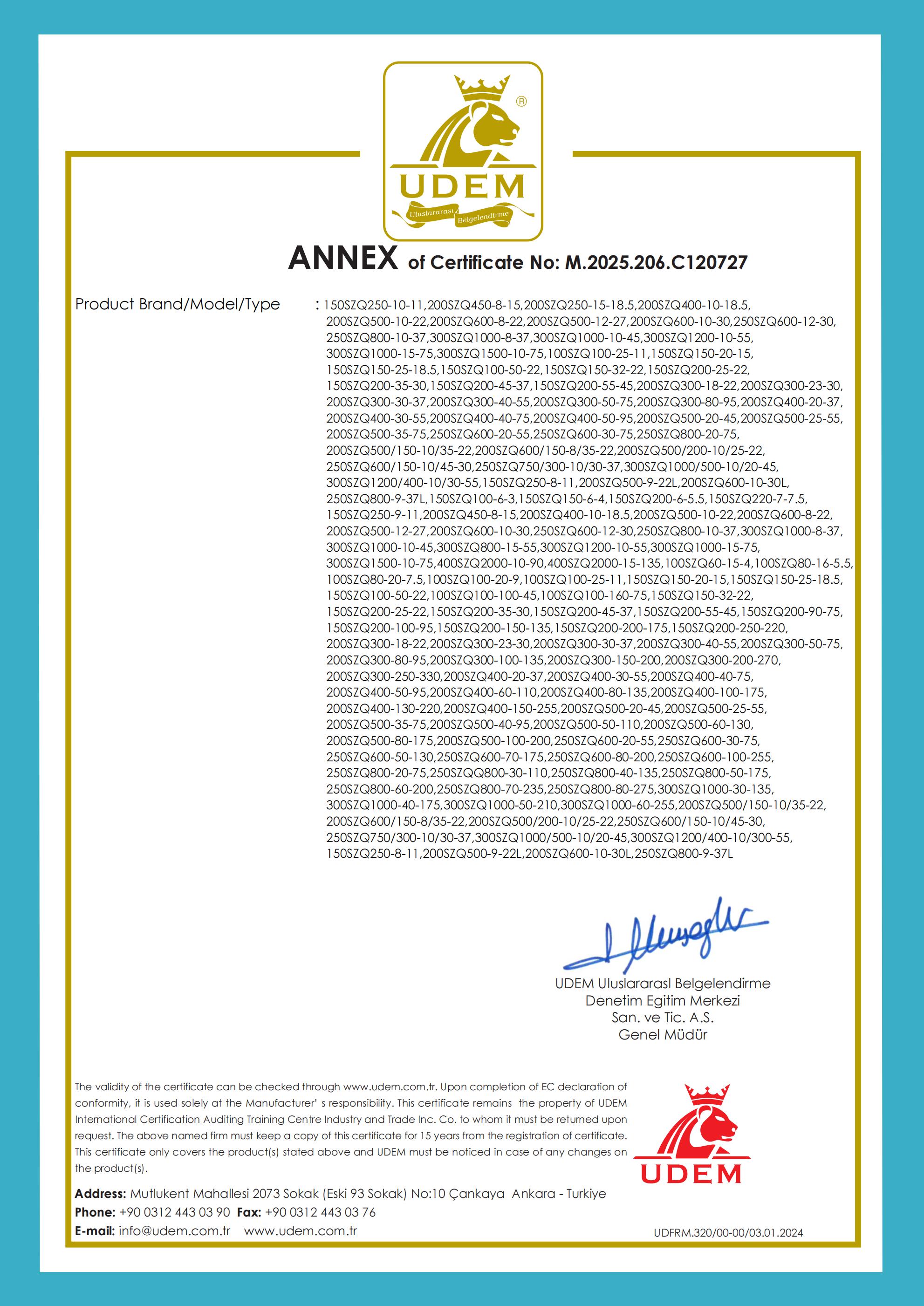
Attestation of Conformity M.2025.206.C120727 (UDEM), covering the listed SZQ portable flood-control models. Certificate scope should be matched against the exact model being purchased.
Future Outlook
Three developments are likely to shape this category over the next procurement cycles.
First, motor efficiency regulation. With GB 30253-2024 applying to permanent-magnet synchronous motors sold in China from 2025, energy-label documentation is likely to become a standard line item in purchase specifications, and PMSM-based portable pumps are positioned to benefit.
Second, control and telemetry. Remote start/stop, remote speed adjustment and time-segmented operation over mobile networks are already documented features. As municipal and industrial buyers adopt centralised fleet management, the control cabinet becomes part of the evaluation rather than an accessory.
Third, modular hydraulics. Replaceable impeller and pump body designs allow one portable unit to cover both low-lift high-flow and high-lift duty, which reduces the number of pumps a fleet must hold. The practical value depends on how easily those parts can be changed and stocked — a question worth asking at the sample and trial stage rather than after delivery.
None of this changes the underlying engineering constraint: weight saved by design must not be taken out of the hydraulic envelope, and efficiency claims should be traceable to a stated test standard. That is where the difference between a lightweight pump and merely a light pump becomes visible in service.
Frequently Asked Questions
What is a lightweight high efficiency portable axial flow pump?
It is a high-flow, low-head pump built for mobile deployment. The permanent magnet synchronous motor and high-speed design reduce motor mass, the impeller is a precision-cast stainless steel component, and the pump shaft is also stainless steel, with the motor housing and pump body available in aluminium alloy or stainless steel. The manufacturer describes its PMSM axial flow pumps as about one quarter the weight of conventional axial flow pumps, and documented net weights of portable flood-control models range from 18 kg to roughly 65 kg depending on size and material.
How much flow can a lightweight unit deliver, and at what weight?
From documented model data, a 6-inch unit can be specified at 250 m³/h at 9 m head with an 11 kW motor and a 22 kg net weight; an 8-inch unit at 450 m³/h at 8 m with a 15 kW motor and a 20 kg net weight; and a 12-inch aluminium-alloy unit at 1,500 m³/h at 10 m with a 75 kW motor and a 65 kg net weight. Flow rises faster than weight across the range, which is the core argument for portable high-speed designs.
What is the difference between an aluminium alloy and a stainless steel pump body?
Aluminium alloy reduces unit weight; stainless steel offers more corrosion and abrasion resistance. The same model designation illustrates the gap: 300SZQ1000-10-45 is listed at 55 kg in the aluminium-alloy 12-inch series and 78 kg in the stainless-steel 12-inch series. Where the pumped water is aggressive or carries abrasive solids, the heavier stainless-steel variant is usually the appropriate choice.
Can one pump cover both low-head and high-head duties?
In part. Documented dual-purpose pumps achieve both low-lift, high-flow duty and high-lift duty through simple replacement of the impeller and pump body. Separately, stepless speed regulation provides continuous adjustment of head and flow without changing parts, provided the pump is operated with the matched control cabinet.
Does the pump need a separate control cabinet?
Yes. Variable speed operation depends on the control cabinet with its built-in frequency inverter, which displays frequency, voltage, current and rotational speed in real time and supports remote control over 3G and 4G networks. Cabinets are available in single-unit or one-drives-two configurations with IP44 or IP54 protection. Cabinet dimensions and weight — for example 300 x 270 x 500 mm and 15 kg for the 5.5–7.5 kW mini-style unit — should be included in transport and installation planning.
What happens if the pump runs dry?
Company documentation states that when water is completely drained, the pump shuts down automatically within about half a minute and enters standby mode, and that the coil will not burn out as a result. Protection functions also cover overheat, overcurrent, overload, overvoltage and phase failure, which are relevant where portable units run unattended on temporary power supplies.
Which documentation should a buyer request before ordering?
At minimum: model-level flow, head, power, net weight and dimensions; the test standard used for performance data, such as ISO 9906 with a stated tolerance grade; the CE attestation and its model scope, for example certificate M.2025.206.C120727 issued 13 June 2025 and valid to 12 June 2030; and, for China-sourced PMSM motors, energy-label documentation under GB 30253-2024. Where pumps fall under HS Code 84138130, customs classification should be confirmed per shipment.
What OEM and ODM options are available, and what are typical lead times?
Documented capability includes OEM production with nameplate customisation, and ODM production covering hardware configuration, functional modules, software and systems, packaging and brand identification. Monthly capacity is documented at 500 units, with OEM lead time stated as 15–20 days and ODM as 15–30 days. Minimum order quantity is documented as one unit for OEM and as negotiable for ODM. Quality control is described as a 100% pre-shipment hydraulic performance test, and recorded commercial terms include FOB or CIF delivery, T/T payment and buyer inspection either in-house or through a third-party organisation. After-sales support is documented as remote technical guidance, spare parts supply and on-site maintenance consultation, with a one-year warranty and free maintenance during the warranty period.
Product documentation covering the portable axial flow pump range, including the models referenced in this review, is available here: https://cdn.socialarks.com/sbsp/25023/common/2026/0708/High%20flow%20pump.pdf