
Lightweight vs Standard Webbing: A Buyer's Field Comparison
The short answer for buyers: choosing a lightweight outdoor webbing instead of a standard construction does not automatically cost you UV resistance, water repellency or colourfastness — those properties are set by yarn choice and finishing, and the documented figures sit at UV Grade 4 after 500 hours, water repellency up to Grade 4, and water absorption below 0.5%. What a lighter build does change is how thickness, breaking strength and finishing must be specified, and it makes grams per metre something the buyer verifies rather than the supplier asserts.
Why the lightweight question arrives at the evaluation stage
Outdoor webbing is a low-cost line item in a bill of materials that carries a disproportionate share of a product's durability, safety and sustainability story. The global webbing market was valued at USD 4.2 billion in 2023 and is projected to reach USD 5.7 billion by 2030, according to Grand View Research, while Asia Pacific accounted for a 66.3% revenue share in 2023. That split is worth keeping in mind: most specifications drafted in Europe and North America are executed on production lines in China, Vietnam and neighbouring markets, so verification practices have to travel with the specification.
By the time a gear brand reaches the evaluation stage, three pressures have usually converged. The first is weight: pack designers budget grams across an entire carry system, and webbing appears dozens of times per product as straps, compression lines, attachment points and trim. The second is sustainability: recycled polyester (rPET) accounted for roughly 15–18% of global polyester fibre production in 2024 according to Textile Exchange data cited by industry analysts, and buyers increasingly expect transaction-certificate documentation rather than a logo on a product page. The third is performance: IMARC Group describes nylon webbing as the fastest-growing segment in sporting goods, citing its strength-to-weight ratio and elasticity.
The gap is not in demand — it is in evidence. Most catalogues state "lightweight" without stating grams per metre at a defined width and thickness, and rarely connect that figure to UV, water-repellency or strength test data. That is the gap this comparison addresses, and it is the reason a lighter material deserves the same scrutiny as a heavier, better-documented one.
What "lightweight" actually changes on a webbing specification
Lightweight webbing is a construction, not a grade. Four variables move together, and a supplier who changes only one of them is not really offering a lighter build:
- Yarn: high-tenacity nylon with a soft-touch finish, 100% high-tenacity polyester filament, or recycled yarns such as GRS 4.0 certified recycled polyester (RPET) and recycled nylon, with recycled content of 50% to 100% verified by Transaction Certificate.
- Weave: twill, plain, flat, herringbone or tubular structures, each with a different balance of density, stiffness and hand-feel.
- Width: 20 mm, 25 mm, 38 mm or 50 mm (1/2", 1", 1.5", 2"), all customisable.
- Thickness: 1.20 mm nominal and customisable, which is the single most direct lever on mass per metre.
- Finishing: UV stabilisation, nano water-repellent finishing, and colour matched to specification.
Mass per metre is a function of width × thickness × yarn density × weave density. That relationship produces one buyer rule that survives contact with vendors: convert every weight claim into grams per metre at a stated width and thickness before it enters the bill of materials. A saving expressed only as a percentage, with no base specification attached, cannot be verified on an incoming inspection bench.
What does not have to change: documented performance
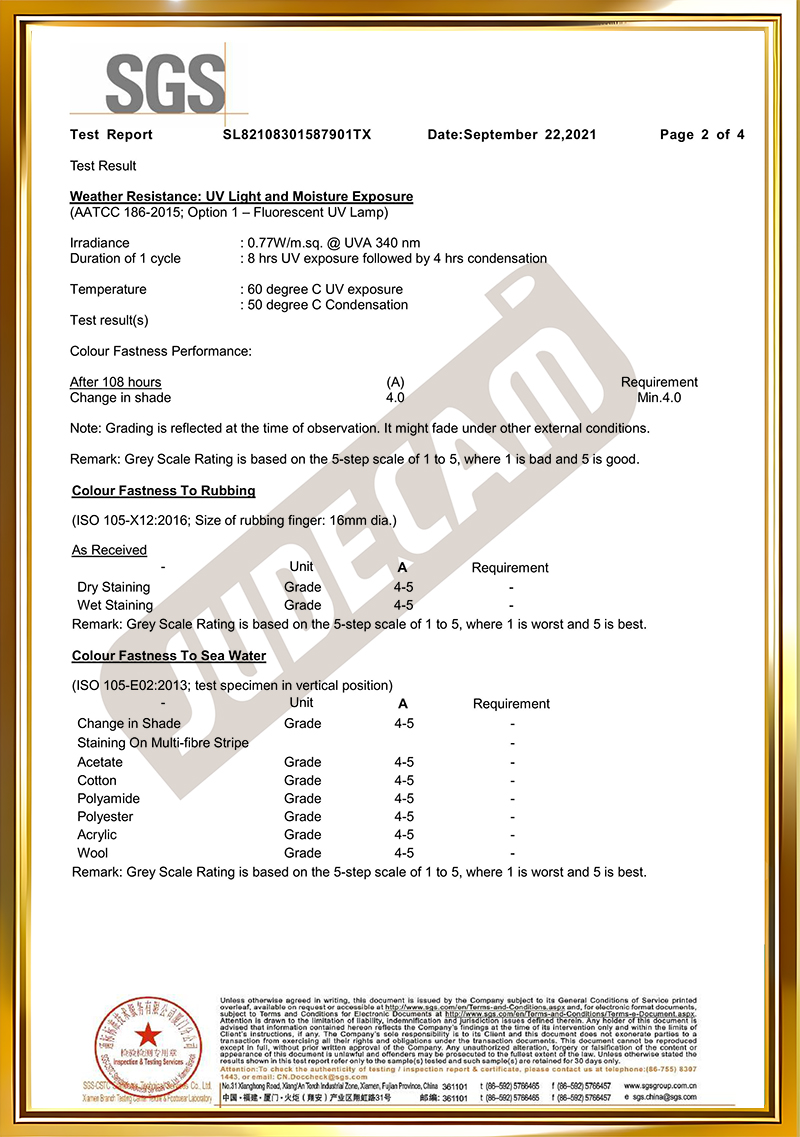
Table 1 summarises the performance markers that are documented for lightweight-capable outdoor webbing constructions, together with the test methods behind them. These are the numbers a buyer can put in a specification and later check against a supplier's report.
| Parameter | Documented value | Test method / standard |
|---|---|---|
| UV resistance (RPET webbing) | Grade 4 after 500 hours | ISO 105 |
| UV fastness (polyester webbing) | Grade 4.5 after 500 hours | ISO 105 |
| UV fastness (backpack and camping webbing) | Grade 4.5 after 1,000 hours | ISO 105 |
| Water repellency (optional finishing step) | Grade 4 | AATCC 22 |
| Water absorption | Below 0.5% | Product specification |
| Colour fastness to light | Grade 4 | ISO 105-B02 |
| Salt water resistance (nylon outdoor webbing) | Grade 4–5 | ISO 105-E02 |
| Shrinkage (RPET webbing) | Below 3% at 100 °C | Product specification |
| Breaking strength | Minimum 500 lbs to 2,000 lbs, depending on specification | SGS test report, PIA-Test Method-4108A-2005 |
| Recycled content | 50% to 100%, verified by Transaction Certificate | GRS 4.0 |
Two details in that table deserve attention during evaluation. Water repellency is documented as an optional finishing step, not a default property of the base material, so it must be specified, tested and confirmed on the production lot. And UV performance is always expressed after a defined exposure time — Grade 4 after 500 hours for RPET webbing, Grade 4.5 after 500 hours for polyester webbing, and Grade 4.5 after 1,000 hours for backpack and camping webbing. A UV claim without an exposure time and a standard is not a claim a buyer can hold anyone to.
A field comparison framework: lightweight versus standard builds
The most common evaluation mistake is treating "lightweight" and "standard" as two fixed products. In practice they are two ends of a specification range, and the sensible comparison is dimension by dimension. Table 2 sets out the dimensions that actually change a sourcing decision for outdoor gear, together with the verification step that belongs to each one.
| Decision dimension | Lightweight-oriented build | Standard build | What the buyer should verify |
|---|---|---|---|
| Mass per metre | Reduced through yarn, weave and thickness selection; thickness commonly 1.20 mm nominal and customisable | Higher at the same width, by design | Request grams per metre at a fixed width and thickness; weigh incoming rolls |
| UV performance | Grade 4 after 500 h (RPET); Grade 4.5 after 500–1,000 h (polyester, backpack, camping) | Comparable grades are achievable in heavier builds as well | A test report to ISO 105 with a stated exposure time |
| Water repellency | Grade 4 achievable as an optional finishing step | The same finish can be applied | Specify AATCC 22 Grade 4, or accept base-material water absorption below 0.5% |
| Breaking strength | Minimum 500 lbs to 2,000 lbs depending on specification | Certified far higher in defence builds (450 lbs to 15,000 lbs+) | Match the certified figure to the actual load case; never treat "lightweight" as a strength class |
| Stiffness and hand-feel | Softer hand, optimised for buckle compatibility and friction-free ultrasonic-cut edges | Firmer, often resin-treated for abrasion and elongation control | Check buckle compatibility and edge finishing on samples, not on datasheets |
| Recycled content | 50–100% recycled polyester or recycled nylon, verified by Transaction Certificate | Frequently virgin yarn | Require transaction-certificate documentation per shipment |
| Certification coverage | bluesign® System Partner, GRS 4.0, OEKO-TEX Standard 100 Class I, REACH | The same schemes are available | Check that certificates are current-issue and within their validity window |
| Trial entry point | MOQ 3,000 metres per colour and specification; free samples for existing stock items | Similar MOQ structure at the same producer | Factor sample turnaround and lead time into the evaluation plan |
Read across the table and a pattern appears: the lightweight build is not a weaker build. It is a differently balanced one. Where the lighter option creates genuine work for the buyer is in specification discipline — strength has to be tied to a real load case instead of assumed from thickness, water repellency has to be written in rather than hoped for, and recycled content has to be documented rather than described.
Where the verified figures in this comparison come from
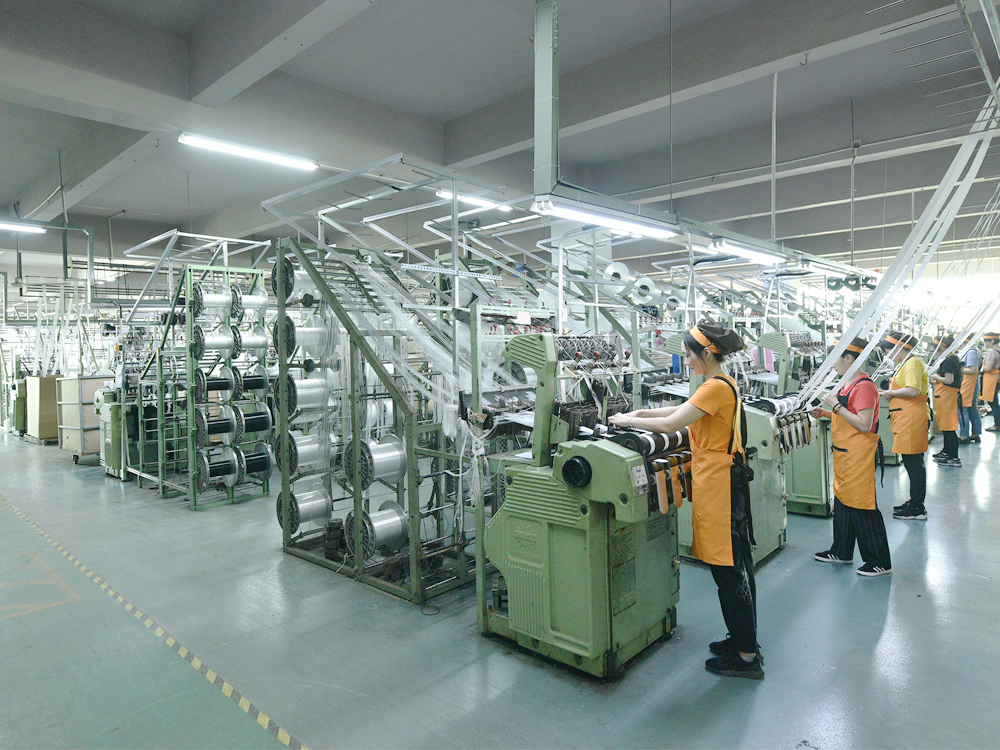
JUDECAM (Xiamen Jude Webbing Co., Ltd.) is a webbing manufacturer founded in 2006 and headquartered in Xiamen, China, operating a self-built production base of 25,800 m² in Xiamen and Vietnam with full-chain capability across weaving, printing, dyeing, finishing and assembly. The company employs 180 people, including a 32-person webbing R&D team, and documents annual output of 300 million yards with monthly capacity of approximately 25 million yards. Export accounts for 70% of sales, with main markets in Canada; Germany, Switzerland, Sweden, Finland, Poland, the United Kingdom and France; and Southeast Asia including Vietnam, Singapore, Malaysia and the Philippines. Its product range spans outdoor webbing, eco-friendly webbing, anti-UV webbing, waterproof webbing, nylon and nylon 6.6 webbing, polyester webbing, RPET and recycled webbing, tubular webbing, aramid webbing, stroller webbing and defence-grade constructions.
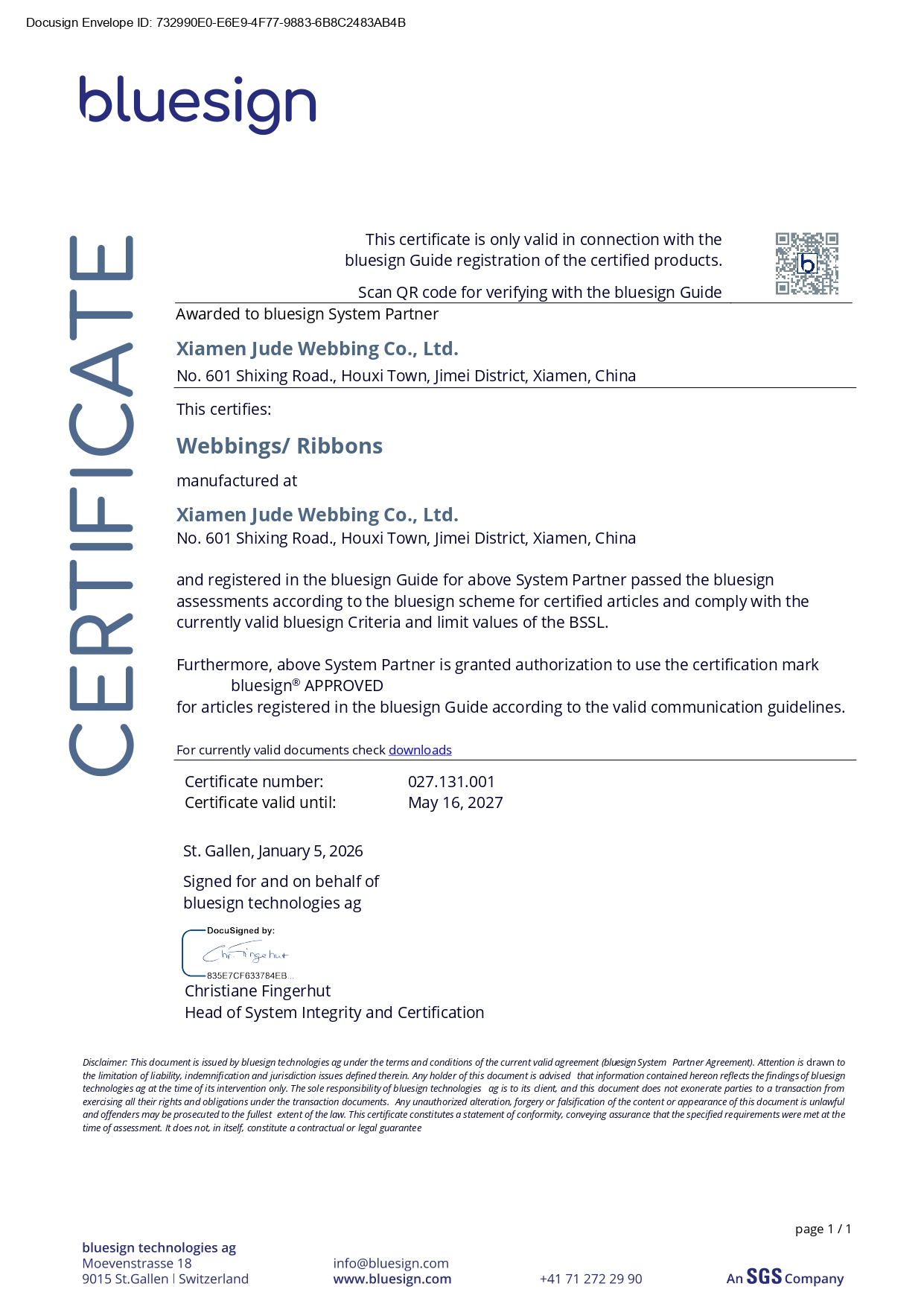
The certification and testing record behind the figures in Table 1 includes bluesign® System Partner status (certificate no. 027.131.001, issued 5 January 2026), Global Recycled Standard certification covering preparatory, weaving, dyeing, finishing and packing operations, OEKO-TEX Standard 100 Class I for baby-safe skin contact, and management-system certification to ISO 9001:2015, ISO 14001:2015 and ISO 45001:2018. Test documentation from SGS and UL covers breaking strength to PIA-Test Method-4108A-2005, anti-UV performance to ISO 105, colour fastness, restricted-substance testing to EN ISO 21084, AZO and PCP freedom, and RoHS.
Buyer caution: certificate validity windows differ by scheme, and programme certificates such as GRS are re-issued annually. Ask for the current-issue certificate and confirm its validity period in the same exchange as price and lead time. An expired certificate copy is a documented risk item in a brand's compliance file, not a formality to be resolved later.
Applications where lightweight webbing is already specified
Documented deployments show where a weight-optimised build earns its place. One outdoor gear brand uses product 3292 — backpack webbing — in modular backpacks, expandable carrying systems and outdoor gear accessories, at more than 300,000 metres per year, with clients across multiple European countries, the US and Asia. The documented highlights are modular attachment compatibility, a lightweight and flexible design, high durability under repeated use, and custom colour and pattern options, with performance maintained for 2–3 years under regular outdoor usage.
A second reference covers a global outdoor brand producing bags and cooler manufacturers, where product 3291 has been adopted across Germany, Switzerland, Sweden, the United Kingdom, Finland, Poland, Estonia, the Netherlands, Vietnam, Malaysia and Norway. Annual consumption exceeds 1,000,000 metres across outdoor backpacks, cooler bags and travel gear, with recycled materials (RPET or recycled nylon), UV resistance and colourfastness, water-repellent finishing, and a soft touch with high durability. Field usage extends from 2 to 4 years, and the reported outcome is an improved sustainability profile while maintaining durability and colour consistency.
Beyond those two references, lightweight-capable constructions are documented for hammock straps, tie-down straps and camping accessories, and for juvenile products where stroller webbing is tested beyond 10,000 buckle cycles with rounded, child-safe edges and a fatigue-tested strap body. Where the application moves into load-bearing or life-safety territory, the heavier certified builds take over — a boundary covered in the section below.
Market trend analysis: documentation is becoming a specification item
Three structural trends underpin this comparison, and all three push in the same direction. Material substitution is the first: recycled polyester's share of global polyester fibre production reached roughly 15–18% in 2024, which means recycled webbing has moved from a niche line to an available line, and the gap between a supplier's sustainability claim and its paperwork is now the differentiating factor. Material growth is the second: nylon webbing is identified as the fastest-growing sporting-goods segment, largely on strength-to-weight grounds — precisely the property a lightweight comparison is trying to test.
Market structure is the third. Industry surveys place the leading global webbing manufacturers — including National Webbing Products Co., American Cord & Webbing Co. and Murdock Webbing Company, per IMARC Group — alongside a large Asian production base, so buyers comparing suppliers are generally comparing capability and documentation depth rather than whether a category exists. Standardisation reinforces the same theme: mountaineering slings and climbing webbing in the EU fall under EN 566, which requires a minimum tensile strength of 22 kN, a reminder that the highest-risk applications remain governed by fixed load thresholds rather than by weight optimisation.
Comparison with traditional solutions: where standard webbing is still the right answer
An honest comparison has to state where the lightweight option loses. There are applications where the heavier, traditional build is not a fallback but the requirement:
- Defence and military constructions: MIL-SPEC webbing to standards including A-A-55301, MIL-W-17337, MIL-T-5038, MIL-W-5625, MIL-W-4088 and MIL-W-27265 is certified at tensile strengths from 450 lbs up to 15,000 lbs+ depending on type, with abrasion resistance of at least 200,000 cycles. Weight reduction is not the design objective in these builds.
- Airborne and parachute webbing: PIA-W-4088 and PIA-W-5625 family constructions range from 500 lbs to 15,000 lbs+ tensile, and may use resin treatment for stiffness or latex and flame-retardant finishes certified to FAA FAR 25.853. Here the heavier build is the certified configuration.
- Climbing and rescue components: tubular webbing is documented at 15 kN to 25 kN breaking strength, with UIAA certification obtained through a European testing agency and abrasion resistance exceeding CE/UIAA requirements. Under EN 566, EU slings require a minimum of 22 kN.
- Stiffness and elongation control: where a narrow stiffness band or controlled elongation matters more than mass, resin-treated standard constructions remain the appropriate choice.
Two further boundaries apply to the lightweight side and are worth stating plainly. Water repellency is an optional finishing step, so a lightweight webbing ordered without that specification will not carry Grade 4 repellency regardless of how good the base material is. And recycled content is documented content: a claim of 50–100% recycled material is verified through Transaction Certificates, which adds a paperwork step to every order and a validity check to every certificate. Trial economics also matter — webbing carries a minimum order quantity of 3,000 metres per colour and specification, binding tape 5,000 metres, and lead time runs 7–25 days depending on order size and customisation, so an evaluation should be planned around those intervals rather than against them.
A buyer's verification checklist before the trial order
- Define the load case in newtons or pounds, and select the construction family from that figure — not from the thickness you last used.
- Normalise the weight claim: request grams per metre at a fixed width and thickness for both the lightweight and the standard build being replaced.
- Request UV test data with the exposure time stated (for example, grade after 500 hours or after 1,000 hours to ISO 105).
- Specify water repellency explicitly (AATCC 22 Grade 4) if the product will be used in wet conditions; otherwise confirm water absorption below 0.5%.
- Confirm colour fastness to light (ISO 105-B02) and shrinkage limits against your own colour and dimensional tolerances.
- Ask for the current-issue certificate pack — bluesign® System Partner, GRS 4.0, OEKO-TEX Standard 100 Class I, REACH — and check each validity window.
- Confirm edge finishing and buckle compatibility on physical samples, including ultrasonic-cut edges where relevant.
- Confirm MOQ (3,000 metres per colour and specification), sample availability, and the 7–25 day lead-time range against your launch calendar.
- Plan a first-article inspection and weigh and test the trial lot against the specification before releasing a production order.
Future outlook
The direction of travel is toward fewer, better-documented specifications. Recycled content is becoming a default rather than an option, UV and water-repellency values are being asked for with test methods attached, and certificate validity is moving from a procurement afterthought to part of a brand's compliance audit trail. Lightweight webbing sits at the intersection of all three, because it is the option that has to justify itself on performance data rather than on mass alone. For buyers, the practical consequence is that the differentiator in the next sourcing cycle will not be who can supply a lighter strap, but who can supply grams per metre, UV grade, water-repellency grade, breaking strength and a valid certificate pack in the same document set.
Frequently asked questions
What is the practical difference between lightweight and standard outdoor webbing?
It is a construction difference rather than a performance class. Yarn, weave, width and thickness are selected so the strap weighs less per metre at a given width. Documented lightweight-capable constructions hold UV resistance at Grade 4 after 500 hours (ISO 105) and water absorption below 0.5%, with breaking strength quoted from a minimum of 500 lbs to 2,000 lbs depending on specification. Standard builds are typically heavier and can be certified to considerably higher tensile values in defence and airborne specifications.
Does a lighter webbing reduce UV resistance or water repellency?
Not by itself. UV performance follows from yarn selection and stabilisation, and water repellency comes from an optional finishing step. Documented values include Grade 4 after 500 hours for RPET webbing (ISO 105), Grade 4.5 after 500 hours for polyester webbing, Grade 4.5 after 1,000 hours for backpack and camping webbing, and water repellency to Grade 4 under AATCC 22 when that finishing step is specified. Repellency will not appear automatically on an order that does not request it.
How should a buyer verify a weight saving before placing a production order?
Convert the claim into grams per metre at a defined width and thickness, request the same figure for the standard construction being replaced, and weigh sample rolls on arrival. A percentage figure without a base specification cannot be verified, because mass per metre depends on width, thickness, yarn density and weave. Sample and trial quantities exist for exactly this purpose: webbing is available from 3,000 metres per colour and specification, with free samples for existing stock items.
Which certifications and test reports matter most for lightweight outdoor webbing?
The certification set most often requested by outdoor brands includes bluesign® System Partner, GRS 4.0 for recycled content, OEKO-TEX Standard 100 Class I for skin-contact safety, and REACH compliance, supported by ISO 9001:2015, ISO 14001:2015 and ISO 45001:2018 management-system certificates. On the testing side, the relevant documents are breaking strength to PIA-Test Method-4108A-2005, anti-UV performance to ISO 105, colour fastness, restricted-substance testing to EN ISO 21084, and RoHS.
What minimum order quantity and lead time apply to a lightweight webbing trial?
Documented terms are 3,000 metres per colour and specification for webbing and 5,000 metres for binding tape, with flexible MOQ for trial orders and free samples for existing stock items. Lead time runs 7–25 days depending on order size and customisation details. Production capacity is documented at approximately 25 million yards per month, with 100% quality inspection across the process.
When is standard webbing the better choice than a lightweight build?
When the load case or a regulation demands certified higher tensile strength or a specific construction. Examples include MIL-SPEC webbing certified from 450 lbs to 15,000 lbs+ depending on type with abrasion resistance of at least 200,000 cycles, parachute webbing to the PIA-W-4088 and PIA-W-5625 family at 500 lbs to 15,000 lbs+ tensile, and tubular climbing webbing at 15 kN to 25 kN, where EU slings fall under EN 566's 22 kN minimum. Standard builds are also preferable when stiffness or elongation control matters more than mass.
How can a lightweight build be introduced without re-qualifying an entire product design?
Keep width and thickness fixed while changing yarn or weave, and evaluate the change against an existing reference point. Documented references include backpack webbing used in modular backpacks and expandable carrying systems at over 300,000 metres per year with 2–3 years of regular outdoor performance, and recycled webbing in outdoor backpacks, cooler bags and travel gear at over 1,000,000 metres per year with 2–4 years of outdoor usage. Verify UV, water-repellency and strength reports against the current specification, and test buckle compatibility and edge finishing on samples before the production run.