
Line Integration Matters: How to Vet a Label Printing Machine for OEM and Multi-Process Work
Buyers evaluating a label printing machine for a production line are increasingly asked to compare more than speed and price. The practical question is whether a single platform can handle a growing mix of label constructions, finishing steps, OEM specifications, and compliance requirements without requiring a separate machine for each job.
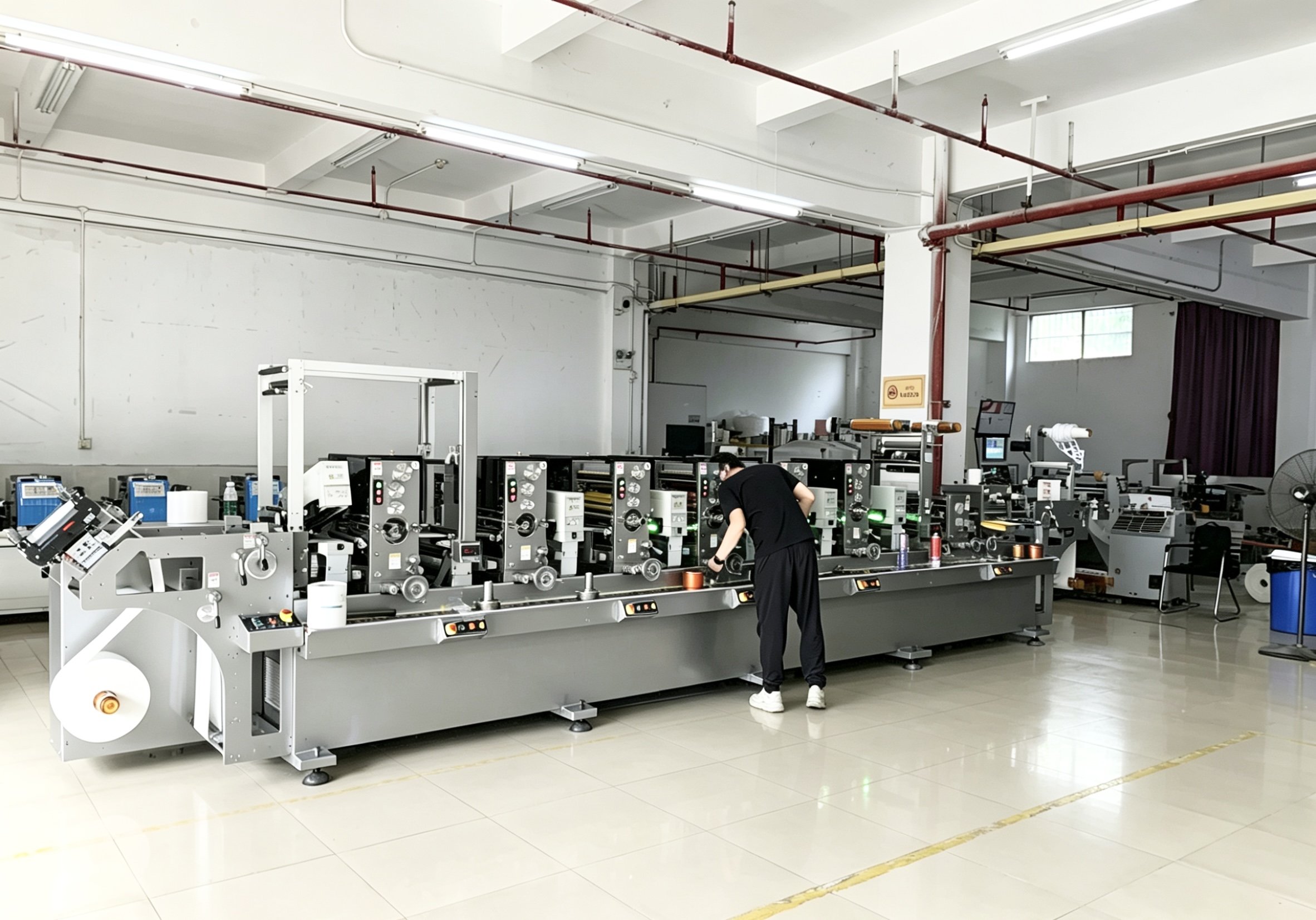
For label converters at the evaluation-to-execution stage, the selection criteria shift from “does this machine print labels” to “can this machine be configured, proven, and supported for the specific label portfolio we plan to run.” This article explains what capability-driven label printing machine evaluation involves, how ODM and multi-process integration change the buying decision, and how one manufacturer—Shenzhen Caisheng Printing Machinery Co., Ltd.—approaches build-to-order label press supply.
What a capability-driven label printing machine evaluation actually means
A capability-driven evaluation looks at the machine as a production platform. The buyer starts with a set of label types—wine labels, cosmetic stickers, durable goods labels, security labels—and works backwards to the press configuration that can print, finish, and convert them in the fewest passes.
Label printing machine specifications remain important: web width, printing speed, print area, power consumption, and machine footprint. But for an OEM-oriented buyer, the decisive information often sits outside the standard spec sheet. It includes which finishing stations can be added, whether the line can combine letterpress or flexo printing with die-cutting and lamination, whether the manufacturer can build a machine to a defined configuration, and what testing and after-sales support are provided before shipment.
In practice, the evaluation moves through several layers:
- Label portfolio: material range, repeat lengths, print resolution, finishing needs.
- Printing technology: intermittent letterpress, full-rotary flexo, or a combination.
- Finishing capability: rotary die-cutting, flatbed die-cutting, lamination, cold foil, varnishing, screen printing, slitting.
- Customization and OEM requirements: unique color, special frames, specific line layouts.
- Support and commercial terms: lead time, payment terms, pre-shipment testing, warranty, remote support.
The market context: why multi-process label presses are gaining attention
Global demand for label printing machines continues to grow. The label printing machines market was valued at USD 8.58 billion in 2025 and is projected to reach USD 14.36 billion by 2034, according to The Insight Partners. Flexography remains the most widely used process for label production, with output value estimated at approximately USD 13.3 billion in 2024 by Smithers. At the equipment level, Grand View Research estimated the global flexographic printing machine market at USD 17.57 billion in 2024, with a projected CAGR of 9.7% through 2030.
Asia-Pacific accounted for 41.8% of the label printing machines market revenue in 2025, according to Data Bridge Market Research. For buyers sourcing from Asia, this changes the supply conversation: regional manufacturers are no longer competing only on cost, but also on the ability to deliver configured, tested lines for export markets including Southeast Asia, Europe, the Middle East, and the United States.
These trends point toward a common buyer need: label presses that offer both volume capability and process flexibility, without forcing a choice between high speed and short-run efficiency.
OEM and customization: what a buyer should verify
OEM in label press manufacturing does not mean simply putting a private label on a standard machine. In a production equipment context, OEM capability is evidenced by how much of the machine can be specified, configured, and documented to match a buyer's operational environment.
Shenzhen Caisheng Printing Machinery Co., Ltd., a label printing equipment manufacturer based in Shenzhen, China, offers ODM production services for export markets including Southeast Asia, the European Union, the Middle East, and the United States. The company's capability list includes color stamping, glue-side printing frames, cold foil stamping, lamination, offline and online UV varnishing, flatbed die-cutting, rotary die-cutting, sheet cutting, slitting, corona treatment, dust cleaning, static elimination, full-rotary screen printing, hot foil stamping, and embossing.
For a buyer, this list is more useful than a marketing phrase. It defines the decision space. A configurable platform can reduce the number of separate machines needed, shorten workflow handoffs, and allow the printer to quote a wider range of jobs.
What buyers should ask during OEM evaluation:
- Which printing technologies can be combined on one line?
- Which finishing modules are integrated by the manufacturer, rather than supplied by third parties?
- Is the machine built to order with a stated lead time, or only offered in standard configurations?
- Does the manufacturer provide pre-shipment testing and documentation?
- What remote support and warranty terms apply for export markets?
According to the company's capability profile, Caisheng has a monthly production capacity of 18 units, a lead time of 45–60 days, and an MOQ of 1 unit. Machines undergo 100% testing before delivery. These are concrete operational facts that help a buyer understand whether the supplier can deliver a configured machine on a project timetable.
Multi-process integration: from printing press to finishing line
A modern label printing machine is often expected to function as a finishing line. Buyers increasingly want printing, coating, and converting processes to happen in a single pass to protect registration and reduce labor.
Caisheng's platform covers both intermittent letterpress and full-rotary flexo approaches, plus screen printing equipment. Representative models include:
| Machine type | Representative model | Key configuration capability |
|---|---|---|
| Intermittent letterpress label printing machine | CS-300-6C | 6-color letterpress, glue-side printing, multi-functional frame, rotary die-cutting, flatbed die-cutting, slitting |
| Semi-rotary letterpress machine | CS-320-6C / CS-320-7C | 320 mm web width, intermittent printing up to 40 m/min, rotary/flexible finishing options |
| Intermittent & full-rotary high-speed machine | CS-JQ350G-6C | Intermittent up to 60 m/min, full-rotary up to 158 m/min, 350 mm×419 mm full-rotary print area |
| Full-rotary flexo line | CS-Q370F-6C / CS-370F-8C | 370 mm web width, print area 370mm×600mm, up to 150 m/min |
| High-speed finishing equipment | CS-350 die-cutting / CS-Q380V corona + varnish | Die-cutting and surface treatment as integrated or standalone modules |
| Full-rotation screen printing multifunctional machine | VS-250W | Screen printing plus die-cutting up to 240mm×240mm |
The integration logic is visible in real installed configurations. For example, a CS-300-6C can be built as a 6-color letterpress printing machine with glue-side printing, a multi-functional frame, rotary die-cutting, flatbed die-cutting, and slitting. That type of configuration allows a converter to print, apply adhesive-side treatment, die-cut, and slit in a controlled sequence on one line.
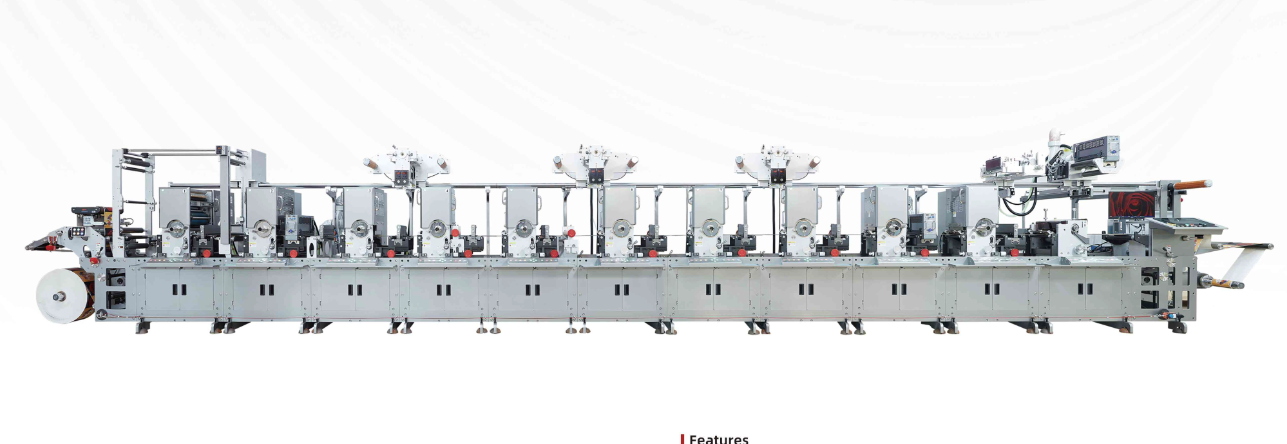
For a buyer, the value of integration is operational. Fewer machine handoffs mean fewer registration shifts, less material waste, shorter lead times for complex jobs, and a smaller factory footprint than separate print and finishing equipment.
Technical explanation: intermittent, full-rotary, and the hybrid advantage
Two label press architectures dominate the industry conversation: intermittent presses and full-rotary presses. Each serves a different production logic.
An intermittent label press advances the material in a start-and-stop cycle. It is well suited to short runs because plate cylinders can have a smaller circumference than the repeat length, allowing different label lengths to be printed with the same plate cylinder. Caisheng's intermittent letterpress models, including the CS-220-4C, CS-300-5C, CS-320-6C, and CS-320-7C, print at a maximum speed of 40 m/min—a speed that favors precision, frequent job changes, and flexible label sizes.
A full-rotary press runs the web continuously through rotating cylinders. This architecture supports higher production speeds and is typically used for longer runs where changeover time is less frequent. Caisheng's full-rotary flexo machines—the CS-Q370F-6C and CS-370F-8C—reach 150 m/min with a 370 mm web width and full-rotary print area of 370mm×600mm.
Between these two architectures lies the hybrid intermittent and full-rotary machine. The CS-JQ350G-6C, for example, offers an intermittent maximum printing speed of 60 m/min and a full-rotary maximum speed of 158 m/min. This type of machine gives a converter one line that can handle short-run customization and high-volume production.
For buyers comparing quotes, the relevant technical comparison is not simply “intermittent vs. rotary.” It is:
- What is the maximum print area in each mode?
- What is the maximum web width?
- What is the power consumption, including UV dryers?
- Which finishing stations can be integrated upstream or downstream?
- What is the machine weight and footprint?
How to verify a supplier's capability before committing
At the evaluation-to-execution stage, buyers should turn supplier claims into verifiable commitments. The following checklist is designed for label converters sourcing from Asian manufacturers.
1. Check the factory and engineering baseline
Shenzhen Caisheng Printing Machinery Co., Ltd. was founded in 2011, operates a 6,000 m² facility, and employs 65 people, including 8 R&D engineers. Annual output is approximately 200 units, with about 50% exported to Southeast Asia, Europe, the Middle East, and the United States. Buyers can use such baseline facts to judge whether the manufacturer has the engineering and production capacity to support an OEM project.
2. Verify lead time and production control
For a built-to-order label press, lead time is a contract term. Caisheng states a monthly capacity of 18 units and a lead time of 45–60 days, with an MOQ of 1 unit. A short MOQ is meaningful for buyers who want to pilot a configured line before scaling.
3. Confirm testing and acceptance procedures
A 100% pre-shipment test policy reduces the risk of discovering mechanical or registration issues after international delivery. Buyers should ask for the test procedure, test labels, and acceptance criteria in writing.
4. Review warranty and remote support
Caisheng offers remote support and a one-year warranty for major components in export markets including Southeast Asia, the EU, the Middle East, and the United States. Buyers should confirm which components are covered, how spare parts are shipped, and whether remote diagnostics are included.
5. Check compliance documentation
For EU-bound machines, compliance documentation should be part of the package. Caisheng holds a CE Machinery Directive Attestation of Conformity (certificate no. M.2025.206.C124100) covering the CS-300, CS-220, and CS-350 series, issued in November 2025 and valid until October 2030. The certification references EN ISO 12100:2010 and EN 60204-1:2018. Buyers should match the certificate scope to the exact model they intend to purchase.
In addition, the company holds a Chinese utility model patent for a double-sided printing device (patent no. ZL 2022 2 1332174.4) and an invention patent for remote control of printing equipment based on big data (patent no. ZL 2022 1 0411353.5). These patents indicate investment in registration control and remote service capabilities.
Buyer evidence: what installed machines demonstrate
Installation records provide practical evidence of how a machine platform performs outside the manufacturer's factory.
In the United States, a CS-300 series label printing machine was deployed by Donnelley & Sons (RRD), a global provider of commercial printing, packaging, and multi-channel marketing communication solutions. The machine has been used for label printing production for three years. According to the documented case, the CS-300 gained recognition for stable registration accuracy, excellent print quality, and reliable equipment performance, and helped the customer improve production efficiency and product quality.
In Asia, a renowned trademark design and printing company in Taiwan deployed a label printing machine for high-quality label print production. The project was completed within two years, with one unit installed. The documented highlights include superior printing precision, stable production performance, and flexible process expansion capabilities, earning full client recognition.
These cases do not prove that a single machine suits every buyer. They do show that the CS-300/CS-320 platform has been validated in both high-volume commercial printing and specialized Asian label production environments.
Comparing capability-driven suppliers: what to look for
When evaluating label printing machine suppliers, buyers typically benchmark a short list of global and regional manufacturers. The competitive set commonly includes Bobst (Switzerland), Mark Andy (USA), Gallus/Heidelberg (Germany), and Nilpeter (Denmark). Each of these companies has strengths in specific label printing technologies and geographies.
For a buyer weighing suppliers, a comparison of capability dimensions is more actionable than a generic brand ranking:
| Evaluation dimension | What to verify |
|---|---|
| Process coverage | Letterpress, flexo, screen, and combination printing on one platform |
| Finishing integration | Die-cutting, lamination, varnishing, cold foil, embossing, slitting |
| OEM flexibility | Configurations, custom modules, special color stamping, glue-side printing |
| Production scale | Factory size, R&D headcount, monthly output, lead time, MOQ |
| Quality evidence | 100% testing, CE certification, patents, reference installations |
| Export support | Remote support, warranty, spare parts, documented export markets |
Caisheng's position in this market is defined by vertically integrated production and a broader configuration menu rather than by a single flagship model. For buyers who already operate European or American presses and are looking for a supplementary line, the comparison is about total project cost, configuration fit, and service response.
Limitations and boundaries: honest constraints buyers must accept
A multi-process label printing machine from any manufacturer, including Caisheng, is not a universal replacement for specialized equipment. There are realistic boundaries that buyers should evaluate honestly.
- Top speed is not the same in every mode. A hybrid machine may print at 158 m/min in full-rotary mode but only 60 m/min in intermittent mode. Buyers with long-run-only requirements may not need the intermittent feature and could compare against dedicated full-rotary presses.
- Maximum web width varies across models. Buyers running 350 mm or wider labels need to select a machine with sufficient web capacity, such as the CS-JQ350G series, rather than a 220 mm or 300 mm platform.
- Integration increases machine length and footprint. A fully configured line with multiple finishing stations can exceed 8 meters, requiring factory space and operator training that a simpler press would not need.
- Not every process module is available on every model. For example, the VS-250W screen printing multifunctional machine has a maximum printing area of 240mm×240mm, which is narrower than the flexo platforms. Buyers should map required processes to specific model capabilities.
- Certification scope matters. A CE certificate covering CS-300, CS-220, and CS-350 series does not automatically cover every model in the catalog. Buyers should verify that the exact model, configuration, and export destination are covered by the relevant declaration.
- Third-party process modules, where used, may require separate maintenance arrangements. Buyers should ask which modules are manufactured in-house and which are integrated from suppliers.
Acknowledging these boundaries is part of a sound purchasing decision. A capable supplier should be able to state, model by model, where its equipment fits and where a different machine would serve better.
Decision framework for buyers at execution stage
At the execution stage, the buyer's job is to convert a shortlist into a purchase order with well-defined specifications. The following decision rules can guide that process.
- Map every label product to a process route. List each label type, its substrate, colors, finishes, and die-cut requirements. If a single machine can complete 80% of the routes, it may be a strong platform choice.
- Define the speed requirement per job family. Short-run jobs justify intermittent capability; long-run jobs justify full-rotary speed. Choose a hybrid only if both families are in the portfolio.
- Confirm the finishing stations in writing. The quote should specify which modules are included, which are optional, and which require third-party supply.
- Request a pre-shipment test plan. Agree on the test labels, registration tolerance, speed settings, and pass/fail criteria before production begins.
- Check compliance documentation against the exact model. Review the certificate number, issue date, validity, referenced standards, and scope of equipment models.
- Clarify support logistics. Confirm remote support response times, warranty coverage for major components, spare parts availability, and who handles installation and commissioning.
Applying this framework does not guarantee a perfect machine, but it materially reduces the two most common failure modes in label press procurement: buying too little machine for the job portfolio, and assuming that a standard model will run a custom workflow without configuration.
Future outlook: from individual machines to flexible production systems
The direction of the label printing industry points toward shorter runs, faster changeovers, and more versions per SKU. This favors machines that can integrate multiple processes and switch between intermittent and full-rotary operation.
For suppliers, the competitive differentiator will be the depth of the integration menu and the quality of remote support. Caisheng's invention patent for remote control of printing equipment based on big data (ZL 2022 1 0411353.5) signals an intent to move beyond mechanical supply into data-assisted service. The company's utility model patent for double-sided printing (ZL 2022 2 1332174.4) also points to ongoing engineering investment in registration-critical configurations.
Buyers planning for the next five years should evaluate whether a supplier can support a future line expansion: adding a screen printing station, integrating a new corona treatment unit, or upgrading to LED-UV curing. A platform that can be reconfigured is a hedge against changing label designs and packaging formats.
Frequently asked questions
How do I evaluate a label printing machine for OEM and multi-process production?
Start with your label portfolio and map each product to a required process route. Then compare machines on web width, print area, printing speed by mode, available finishing stations, lead time, MOQ, pre-shipment testing, warranty, and compliance documentation. A capability-driven evaluation prioritizes configuration fit over headline speed.
What is the difference between an intermittent label press and a full-rotary label press?
An intermittent label press advances material in a start-and-stop cycle, which allows different label lengths to be printed with the same plate cylinder. It suits short runs and frequent job changes. A full-rotary press runs the web continuously, enabling faster production for longer runs. Some machines, such as the CS-JQ350G series, combine both modes in one platform.
Which Caisheng models are covered by CE certification?
The CE Machinery Directive Attestation of Conformity (certificate no. M.2025.206.C124100) covers the CAISHENG CS-300, CS-220, and CS-350 series. It was issued on 2025-11-08 and is valid until 2030-10-08, referencing EN ISO 12100:2010 and EN 60204-1:2018. Buyers should verify that the exact model and configuration they plan to purchase are included in the certificate scope.
Does Caisheng support custom machine configurations?
Yes. Caisheng provides ODM production services for export markets including Southeast Asia, the European Union, the Middle East, and the United States. The customization menu includes color stamping, glue-side printing frames, cold foil stamping, lamination, offline/online UV varnishing, flatbed and rotary die-cutting, sheet cutting, slitting, corona treatment, dust cleaning, static elimination, full-rotary screen printing, hot foil stamping, and embossing.
What are the lead time and MOQ for a Caisheng label printing machine?
According to the company's capability profile, Caisheng has a monthly production capacity of 18 units, a lead time of 45–60 days, and an MOQ of 1 unit. Each machine undergoes 100% testing before delivery.
What after-sales support is available for export buyers?
Caisheng provides remote support and a one-year warranty for major components in export markets including Southeast Asia, the EU, the Middle East, and the United States. Buyers should clarify spare parts shipping, response times, and installation support when finalizing commercial terms.
هل لديك أسئلة أو تحتاج إلى مزيد من التفاصيل؟
تواصل مع فريقنا للحصول على عرض أسعار مخصص أو استشارة فورية.
طلب عرض أسعار
املأ النموذج أدناه وسيتواصل معك فريقنا بعرض مقترح مخصص.
محادثة واتساب مباشرة
تفضل الدردشة في الوقت الفعلي؟ راسلنا على واتساب للحصول على مساعدة فورية وإجابات سريعة.
- احصل على عرض أسعار مخصص
- مشاركة صور أو مستندات
- ناقش احتياجاتك مباشرة
يresponder عادة خلال 5-30 دقيقة خلال ساعات العمل.