
Kitchenware coating line: PTFE, thickness and size mix
Kitchenware coating line: PTFE, thickness and size mix
A cookware coating line that must support three layers—antioxidant primer, PTFE non-stick coating, and a high-temperature-resistant topcoat—is judged less by its rated speed than by two conditions: the stability of film thickness and the ability to alternate part sizes without breaking that stability. In a plant that manufactures pans, pots, and trays for private-label brands and OEM customers, the decisive indicator is not an isolated production figure but the uniformity maintained shift after shift and across different references.
This article organizes that decision from the perspective of the industrial buyer: what makes a line suitable for cookware, how the three layers relate, where thickness is controlled, what mixing sizes implies, and what evidence should be demanded before signing. The process data cited come from the manufacturer's technical documentation; project results are presented as reported results from a specific installation, not as a guarantee for other plants.
What makes a coating line suitable for cookware
A cookware coating line is the integrated set of pretreatment, application booth, curing, and conveying that deposits one or more functional layers on a metal part in a repeatable way. In cookware, these layers are not decorative: the primer protects the substrate against oxidation, the PTFE non-stick coating provides food release, and the high-temperature-resistant topcoat sustains performance during domestic and professional use.
The fit to the project is decided on four verifiable conditions. First, suitability for food-contact use: the formulation and curing must be compatible with food contact, and that compatibility must be documentable for the destination market. Second, control of film thickness, because both non-stick performance and paint consumption depend on it. Third, a low defect rate, which in cookware shows up as the absence of craters, bubbles, accumulation lines, and areas with insufficient curing. Fourth, adaptability to cookware of various sizes, the condition most often underestimated in the initial specification.
When these four conditions are met, the line stops being a piece of equipment and becomes a process system: each recorded parameter explains a quality result and makes it repeatable.
The three layers and their process logic
Cookware coating is usually organized into three superimposed functions, and each imposes its own demand on the process.
Antioxidant primer
It is the anchoring layer on the metal. Its function is twofold: to protect the substrate and to create the base to which the non-stick system adheres. In practice, a poorly cured primer compromises the adhesion of the entire system, even if the topcoat looks correct to the naked eye. That is why control of this stage relies on application and curing records, not only on final visual inspection.
PTFE non-stick coating
PTFE provides the release property that the user perceives when cooking. Its performance depends on the film being continuous and of uniform thickness: a thicker area can generate accumulation and an uneven finish, while an area that is too thin exposes the substrate sooner than expected. The critical variable is not only how much material is applied but how constant that amount remains across the part and between parts.
High-temperature-resistant topcoat
It is the sacrificial layer: it receives direct contact with food and cooking temperatures. Its formulation and curing window determine its behavior under heat and its perceived durability. Any change of reference—another diameter, another geometry, another metal thickness—requires this stage to be reviewed before the setup is considered valid.
The practical consequence for the buyer is that a cookware coating line is not evaluated layer by layer in isolation, but by the joint stability of the three-layer system over a mixed production day.
Film thickness: where non-stick performance and cost are decided
Film thickness is the parameter that connects quality with line economics. Precise control makes it possible to keep non-stick performance within the target band; loose control forces compensation with excess material, and excess is paid for twice: in consumed paint and in finish defects.
In the documented case of an automatic cookware line, precise film thickness control appears explicitly among the project's highlighted features, together with suitability for food-contact use, adaptability to cookware of various sizes, low defect rate, and easy maintenance. That combination is relevant because it indicates that thickness is not treated as a one-off adjustment but as a variable managed during production.
For the evaluator, the useful question is not whether the line controls thickness but how it does so: what measurement method is used, how often it is verified, what record remains, and what action is triggered when a part goes out of band. A line that measures and records can improve; one that adjusts only by operator experience depends on the person on the shift.
The economic effect can be seen in the reported result of the cookware project: a 30% reduction in paint waste together with a 35% improvement in production efficiency. Both figures correspond to that project and its operating conditions; they should not be automatically transferred to another plant without verifying product mix, part geometry, and shift pattern.
Size mixing: the point where many lines fail
Size mixing is the real test of flexibility. A factory producing 220 mm pans, larger-diameter pots, and oven trays on the same line needs the conveying, hanging, and application systems to be readjusted without stopping production or degrading uniformity.
The technical documentation for the automatic cookware line sets two specific references: a standard part size of Φ220 × 160 mm high and a maximum size of Φ300 × 160 mm high. It also defines a distance between parts of 450 to 900 mm, hanging of 4 inner pots per hanger and 20 lids per hanger, and production of 800 to 1000 parts per hour. These values delimit the scenario for which the line is intended and allow the buyer to compare its own catalog with the documented envelope.
The practical reading is direct: if the buyer's catalog stays within that diameter and height range, the line can be configured for mixed production; if it includes parts outside that envelope, the project requires a specific engineering study and not a simple expansion of parameters. The distance between parts, in turn, explains why hourly production is a figure dependent on hanging and not a universal constant.
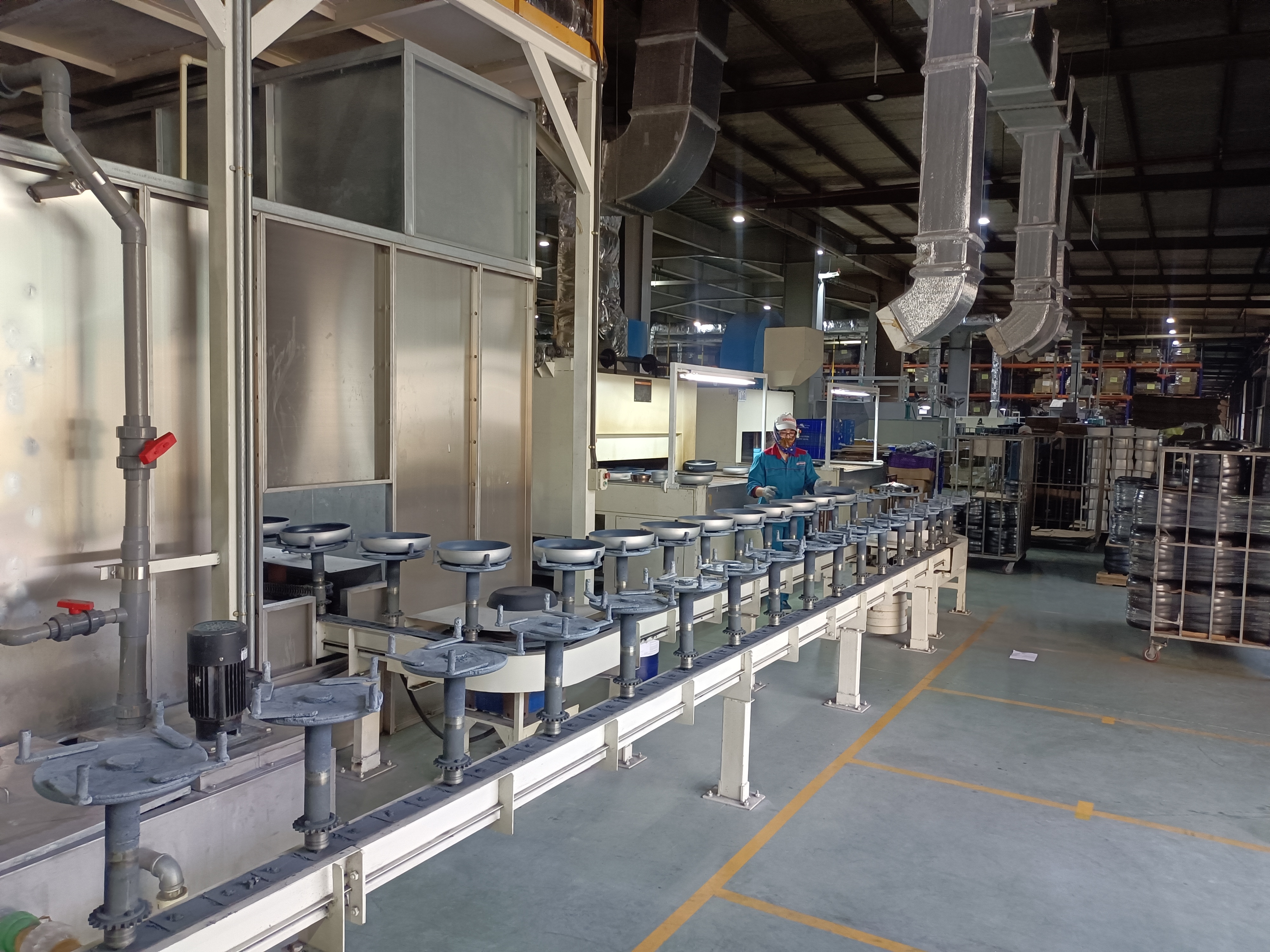
Compatible conveying system: hanging and distance between parts determine the line's actual hourly production.
Documented parameters of an automatic cookware line
The following table summarizes the published parameters for an automatic coating line intended for non-stick pans, pots, rice cooker inner pots, and cake molds. It serves as a comparison reference, not as a specification for any project: each configuration is dimensioned according to the customer's catalog.
| Parameter | Documented data |
|---|---|
| Part material | Aluminum alloy; composite materials (stainless steel, aluminum alloy, copper) |
| Standard size | Φ220 × 160 mm (height) |
| Maximum size | Φ300 × 160 mm (height) |
| Production | 800–1000 parts/hour |
| Distance between parts | 450–900 mm |
| Hanging method | 4 inner pots per hanger; 20 lids per hanger |
| Anodizing line speed | 1200 mm/min |
| Curing oven speed | 1000 mm/min (adjustable from 0.5 to 1.5 m/min) |
| Energy | Natural gas and electricity |
| Structure | Carbon steel (main structure); stainless steel (painting booth and piping) |
| Part characteristic | Does not deform |
There are two useful readings of the table. First: the curing oven allows an adjustable speed range, which provides margin for different combinations of coating and geometry, but each change must be revalidated by measurement, not accepted merely because the variable-frequency drive was adjusted. Second: production of 800 to 1000 parts per hour coexists with a distance between parts of 450 to 900 mm, so actual throughput depends on the hanging chosen for each reference.
Application scenarios: from pan to baking tray
The same line concept covers a broad set of cookware. The scenarios appearing in the project documentation include non-stick pans, air fryers, soup pots, rice cooker inner pots, and cake molds or trays. Each places different demands on the three-layer system.
Non-stick pans are the most demanding case for visible uniformity: the surface is large, flat, and visible to the user, so any thickness variation or curing defect is immediately perceived. Pots and rice cooker inner pots add curved geometry and high walls, which changes how the material reaches the surface and requires the hanging to be reviewed. Trays and molds introduce formats with corners and reliefs where accumulation is more likely.
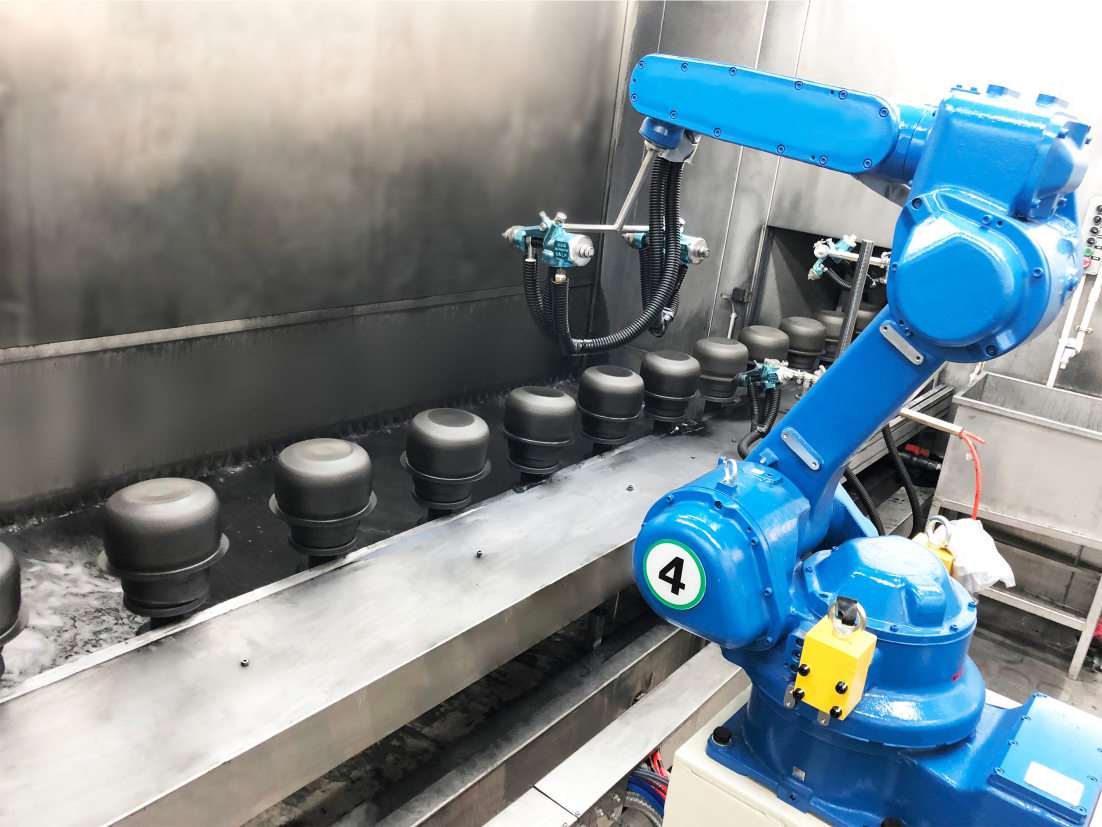
Rice cooker inner pots: curved geometry and high walls require reviewing hanging and distance between parts.
Mixing these products on the same line is what the buyer must simulate before deciding. A plant that only makes pans of one diameter has a much smaller setup problem than a plant that alternates pans, pots, and trays on the same shift. In the second case, the value of the line lies in orderly changeover: parameters saved by reference, identified hanging, and post-change verification.
Project evidence: 20 units, 98% uniformity, and less waste
The available case record describes a project of 20 complete automatic cookware coating lines, installed for OEM brand factories, private-label manufacturers, and support plants for the appliance sector, with a presence in Russia, Iran, India, Bangladesh, Vietnam, Thailand, and China. The application covers PTFE non-stick coating, spray antioxidant primer, and high-temperature-resistant topcoat for pans, pots, and oven trays.
The reported results for that project are as follows: coating uniformity of up to 98%, a 30% reduction in paint waste, a 35% improvement in production efficiency, and continuous, stable operation without major quality complaints. The record adds that non-stick performance meets international standards for food-contact use and that the line remains operational over a 5- to 10-year horizon.
These figures should be read precisely. They are results reported by the manufacturer for specific installations and describe behavior observed under those product, hanging, and operating conditions. They do not constitute a performance guarantee for another plant, nor do they allow the claim that any line of the same model will achieve the same values. Their real usefulness is different: they establish a verifiable order of magnitude and allow concrete questions to be put to the supplier, such as what mix of references was processed, by what method uniformity was measured, and for how long the data were recorded.
One point that should not be overlooked: the record indicates compliance with international standards for food-contact use but does not detail the specific standard applied. For a buyer exporting to several markets, this is an obligatory question before acceptance, because the documentation required varies by destination.
Comparison with traditional setups and adjustment limits
An honest comparison between an automated line and a predominantly manual adjustment setup cannot rely in this corpus on comparative result tests, because there are none. What can be compared are the documented features and what they imply for operation.
| Criterion | What a documented automated setup provides | What the buyer must confirm |
|---|---|---|
| Thickness repeatability | Process control with records and reference-based adjustment | Film measurement method and frequency |
| Size changeover | Flexible production and hanging by reference | Changeover time and post-change verification |
| Traceability | PLC control and line parameter recording | What data are stored and for how long |
| Paint consumption | Dosing aligned with target thickness | Consumption per reference before and after |
Adjustment limits are also part of the comparison. The documented line works up to Φ300 × 160 mm; a larger part, or a very different geometry, falls outside the published envelope. Easy maintenance is a stated advantage, but it does not eliminate the need for spare parts and training. And flexibility for mixed production does not equal simultaneous production without control: each reference change needs its own validation.
In summary, the advantage of the automated setup is one of process and traceability, not a promise of measured superiority. For a buyer in the evaluation phase, that distinction avoids two frequent errors: demanding results the supplier cannot document and ruling out a manual setup that, for a very narrow catalog, might be sufficient.
What market data show
The investment context helps size the decision. According to The Business Research Company report disseminated by openPR in 2026, the finishing lines market—a category that includes coating lines—grew from USD 8 billion in 2025 to a forecast of USD 8.47 billion in 2026. In parallel, Fortune Business Insights projects the global smart manufacturing market at USD 1,339.17 billion by 2034.
Both figures are projections from commercial research sources and describe broad categories, not the specific cookware segment. Their value to the buyer is framing: they confirm that surface finishing automation is a growing market and that pressure for material efficiency remains. They do not replace a demand analysis of the destination market or allow conclusions about the price or delivery time of a specific project.
One additional fact with practical relevance for importers: coating machines are usually classified under HS code 8479.89, according to a U.S. customs classification ruling. For a factory importing the equipment, this reference should be identified before commercial negotiation, because it affects import documentation and applicable tariffs.
On savings, the manufacturer's information indicates that smart coating lines can reduce paint consumption by 25% and energy consumption by 20%. This is a supplier reference, not an independent benchmark, and it should be compared with the specific data from the cookware project, where the reported reduction in paint waste was 30%.
How to verify the fit before deciding
Verification is best organized around what the buyer needs to know, not what the supplier wants to show. These are the checks with the greatest impact in a cookware project.
- Part envelope. Compare your own catalog with the documented standard and maximum sizes. Any reference outside the range should be treated as a development item, not as a standard configuration.
- Thickness measurement method. Request the procedure, the instrument, and the frequency. Without a defined method, uniformity is not verifiable.
- Curing record. Confirm how oven temperature and speed are controlled and documented, and what happens when a part does not reach the intended window.
- Hanging and reference changeover. Review the number of parts per hanger and the actual changeover time between references, not only maximum production.
- Evidence of uniformity and defects. Request the data with its conditions: processed mix, duration of the record, acceptance criterion, and destination of out-of-specification parts.
- Food-contact suitability documentation. Identify which standard applies and for which market, since the case record does not detail the specific standard.
- Testing and delivery. Verify the scope of pre-shipment testing and the installation and commissioning conditions.
- After-sales service. Confirm warranty, response time, training, and spare-parts availability, because the stated operating horizon is 5 to 10 years.
Attractivechina is the commercial brand of Guangdong Chuangzhi Intelligent Equipment Co., Ltd., a manufacturer headquartered in Zhaoqing (Guangdong) that designs and manufactures automated and customized coating lines, with 30 years of stated experience in coating production line solutions. Its corporate profile documents 35,548 m² of own floor space, 280 employees, 54 R&D engineers, 79 invention patents in coating and environmental protection equipment—more than 300 patents in total—and annual production of 60 units, with 20% export. The aforementioned capacity is for custom manufacturing and design, with a minimum of 2 units, 100% pre-shipment testing, and remote technical support with a one-year warranty. More information at Attractivechina.
That context explains why project fit is negotiated case by case: customization covers size, automation level, voltage, power, and capacity, and delivery times vary by product.
Outlook: where cookware coating automation is heading
The direction shown by the available data points to lines with programmable control, robotic spraying, flexible production, and real-time control, integrated with production management systems and emissions treatment equipment. In the case of cookware, the value of that integration is not in automation itself but in what it makes possible to sustain: stable thickness, traceability by reference, and the ability to alternate sizes without losing uniformity.
For a factory evaluating its next investment, the practical conclusion is that the demanding scenario is resolved with three well-made decisions: define the part envelope precisely, demand verifiable evidence of thickness control, and plan reference changeover as part of the process. Line speed is a consequence of those decisions, not a starting point.
The manufacturer's corporate catalog is available for consultation and download at the following link: Attractivechina catalog (PDF).
Frequently asked questions
What is the difference between the antioxidant primer and the high-temperature-resistant topcoat?
The antioxidant primer is applied to the metal and serves two functions: protecting the substrate against oxidation and creating the anchoring base for the non-stick system. The high-temperature-resistant topcoat is the layer exposed to food and cooking temperature, and it acts as the sacrificial layer. Between them is the PTFE non-stick coating, which provides food release. All three are applied and cured in different stages, and a failure in any one of them affects the performance of the whole system.
How is film thickness controlled on a cookware coating line?
Control relies on two elements: material dosing during application and subsequent verification by measurement. In the documentation for the automatic cookware line, precise film thickness control is among the project's highlighted features, together with the low defect rate. For the buyer, what matters is knowing the measurement method, the verification frequency, and the associated record, because that is what determines whether uniformity can be demonstrated and not merely stated.
Can the same line process pans, pots, and trays of different sizes?
Yes, within the documented envelope. The automatic cookware line specifies a standard size of Φ220 × 160 mm and a maximum size of Φ300 × 160 mm, with a distance between parts of 450 to 900 mm and hanging of 4 inner pots or 20 lids per hanger. Processing parts outside that diameter and height range requires a specific engineering study. Production of 800 to 1000 parts per hour depends on the hanging and distance chosen for each reference.
What does 98% uniformity mean in the 20-unit case?
It corresponds to the result reported in a project of 20 complete automatic cookware coating lines, in which a 30% reduction in paint waste and a 35% increase in production efficiency were also reported, with continuous and stable operation. It is a result from specific installations, not a general guarantee: to interpret it correctly, one should know the mix of references processed, the measurement method used, and the period during which the data were recorded.
What documentation should be requested to confirm food-contact suitability?
The project record indicates that non-stick performance meets international standards for food-contact use but does not specify the standard applied. Therefore, the buyer should request identification of the specific standard, the scope of the assessment, and its validity for the destination market, since documentary requirements vary between countries. That verification should be done before acceptance of the equipment and not after commissioning.
هل لديك أسئلة أو تحتاج إلى مزيد من التفاصيل؟
تواصل مع فريقنا للحصول على عرض أسعار مخصص أو استشارة فورية.
طلب عرض أسعار
املأ النموذج أدناه وسيتواصل معك فريقنا بعرض مقترح مخصص.
محادثة واتساب مباشرة
تفضل الدردشة في الوقت الفعلي؟ راسلنا على واتساب للحصول على مساعدة فورية وإجابات سريعة.
- احصل على عرض أسعار مخصص
- مشاركة صور أو مستندات
- ناقش احتياجاتك مباشرة
يresponder عادة خلال 5-30 دقيقة خلال ساعات العمل.