
Lingual Buttons & Crimpable Hooks: A Compliance Guide
Lingual Buttons & Crimpable Hooks: A Compliance Guide
Lingual buttons and crimpable hooks rarely get their own qualification file. They arrive with the brackets, carry the same supplier letterhead, and are approved on the strength of a certificate written for a different product family. For a buyer in the research and evaluation stage, the useful question is not whether a supplier holds certifications, but whether the specific attachment model being purchased is actually covered by the documents being presented.
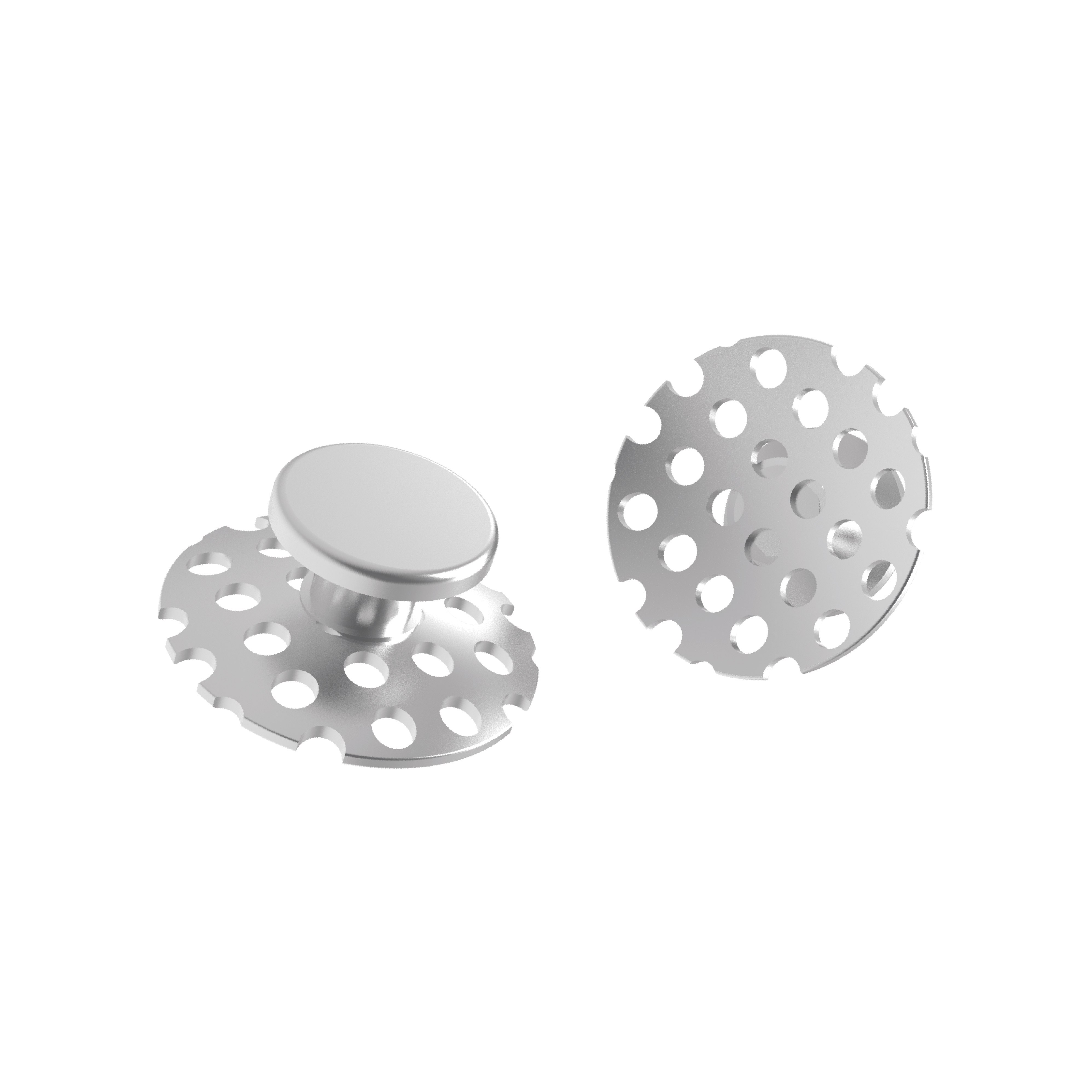
Bondable lingual button Y-F322: a round base with hole, stainless steel, listed in the catalogue under Orthodontic Auxiliaries rather than under the lingual button family.
Why attachments slip through the review
A fixed-appliance purchase is normally structured around brackets, buccal tubes and bands. These are the high-value, high-visibility items, and they receive the dimensional review, the sample evaluation and the documentation request. Lingual buttons, crimpable hooks and related auxiliaries sit at the end of the same order and are treated as accessories that inherit the parent product's compliance status.
That inheritance is an assumption, not a finding. An attachment has its own material, its own bonding or clamping interface, and its own handling conditions in the clinic. It also has its own catalogue logic, which is usually where the confusion begins.
Yortho's own product range illustrates the point. Model Y-F322 is listed under the category Orthodontic Auxiliaries, while its product type is Lingual Buttons, its base is a round base with hole, and its material is stainless steel. A buyer searching by category finds it in one place; a buyer searching by clinical function expects it in another. Neither listing is incorrect, but a review that treats a category label as a proxy for product identity will miss the item entirely.
The same risk applies in the other direction. Because the hook family shares a name, a specification sheet prepared for one model is often circulated as if it covers the whole group. It rarely does. In the verified scope, Y-F204 is a mini round tube stop at 0.019 inch, while Y-F102, Y-F201 and the Y-F105L/Y-F105R pair are traction hooks in 0.022 inch with different body dimensions. A stop and a hook are both crimped onto an archwire, but they are reviewed against different questions.
What qualified should mean for these two families
For lingual buttons and crimpable hooks, qualified is best treated as four separate confirmations rather than a single vendor status. Each one can be present or absent independently, and the review is only closed when all four are satisfied.
- Product identity. The model code, product type, material, and the structural or dimensional parameter that separates it from neighbouring SKUs in the same family.
- Manufacturing control. The quality management system behind the line, and whether the site that produced the item is inside the certified scope.
- Market access. The specific regulatory instrument for the destination market, and whether that instrument is a facility registration, a device clearance, or a conformity marking.
- Batch evidence. Inspection or test records tied to the delivered lot, not to the product family as a whole.
A supplier can be strong on the second point and thin on the fourth. Buyers who collapse all four into a single approved-vendor tick lose the ability to see which confirmation is actually missing, and that is the information needed to decide whether to proceed, hold, or request more.
The verified product scope
The two families covered here are defined by a set of models with published material and dimensional attributes. The table below reproduces that scope. It is the reference against which any quotation, catalogue page or distributor claim should be checked.
| Family | Model | Type | Material | Published parameter |
|---|---|---|---|---|
| Lingual buttons | Y-F303 | Bondable lingual buttons | Stainless steel | Round, 80# mesh base |
| Lingual buttons | Y-F305C | Ceramic bondable lingual buttons | Ceramic | Round base |
| Lingual buttons | Y-F307 | Bondable lingual eyelet | Stainless steel | Round base |
| Lingual buttons | Y-F308 | Bondable lingual eyelet traction hook | Stainless steel | Round base |
| Crimpable hooks | Y-F105L, Y-F105R | Spiral crimpable hooks | Stainless steel | 0.022 inch, left and right, 8.7 mm |
| Crimpable hooks | Y-F102 | Crimpable hook | Stainless steel | 0.022 inch, medium 2.4 mm |
| Crimpable hooks | Y-F201 | Crimpable hooks | Stainless steel | 0.022 inch, 2.4 mm |
| Crimpable hooks | Y-F204 | Mini round tube stop | Stainless steel | 0.019 inch |
| Related auxiliaries | Y-F314 | Lingual chain | Stainless steel | Sliver |
| Related auxiliaries | Y-F321 | Power arm | Stainless steel | Round shape |
| Related auxiliaries | Y-F322 | Lingual buttons | Stainless steel | Round base with hole |
Two observations follow. First, the crimpable hook family is not functionally uniform, as noted above. Second, the related auxiliaries share stainless steel construction and bonding logic with the button family, which makes them a useful consistency check. If the documentation holds for the buttons but not for the lingual chain or the power arm, the scope statement behind the quotation is incomplete and should be corrected before the order is placed.
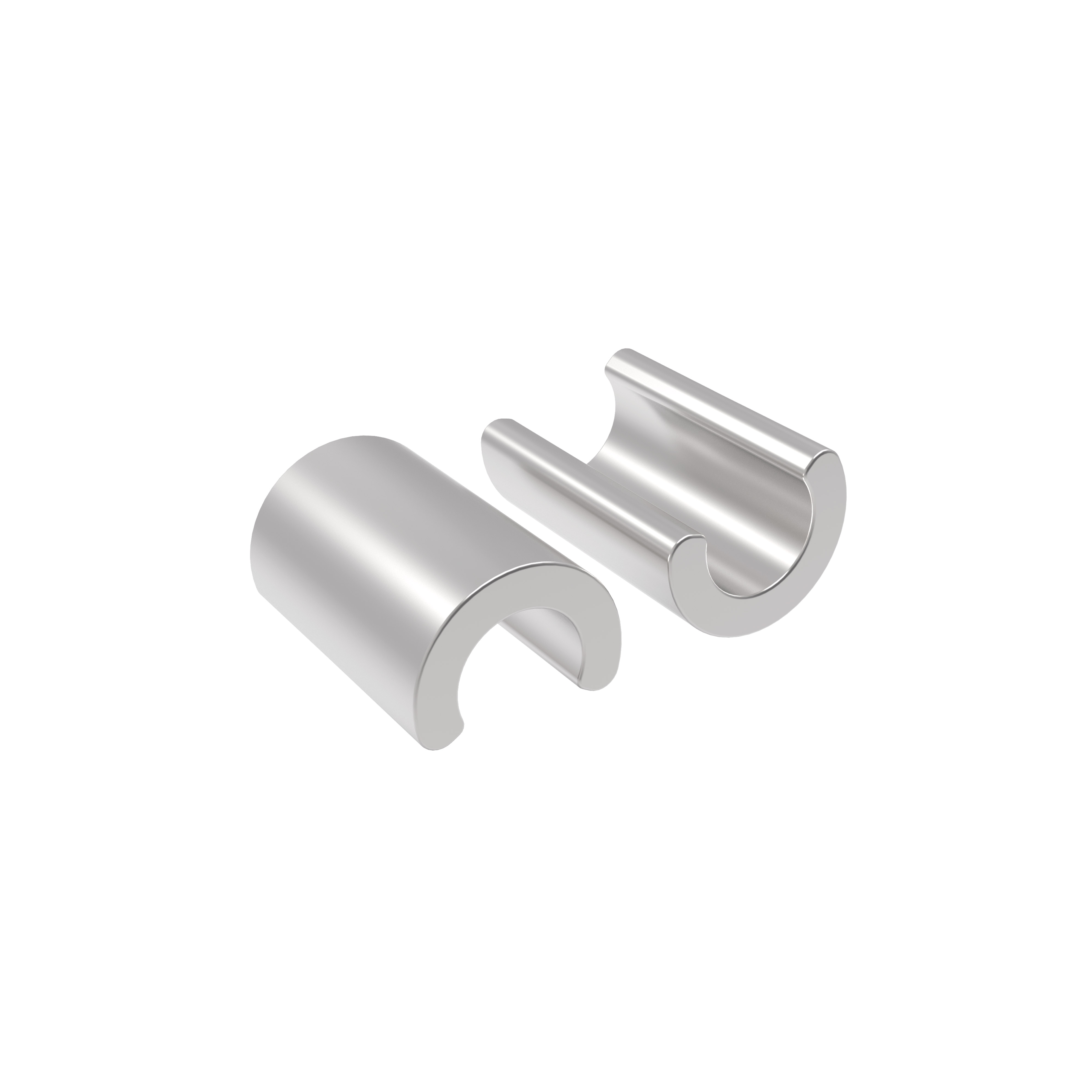
Mini round tube stop Y-F204 at 0.019 inch. It sits inside the crimpable hook family but performs a stop function rather than a traction function.
Reading the technical claims correctly
Suppliers describe attachments in the language of design intent. Y-F303 is presented with an 80# mesh base. Y-F305C is described as having retentive cuts and a mesh-structured base for bond strength and predictable debonding. Y-F322 is described with a serrated perforated base and a smooth polished finish. The spiral hooks are described with a quick-clip C-shape and an anti-slip clamping surface.
These are useful statements about how the part is manufactured. They are not measurements. The published record does not attach a bond strength value, a clamping force range or a failure rate to any of them. The correct use of such claims in an evaluation is to convert them into requests: the inspection criterion that corresponds to the mesh base, the dimensional tolerance on the 0.022 inch fit, and the acceptance rule for the crimping surface.
Dimensional and system attributes are different, because they can be checked directly against the delivered goods. The published sizes — 0.022 inch across the hook range, 0.019 inch for Y-F204, 8.7 mm for the left and right spiral hooks, 2.4 mm for Y-F102 and Y-F201 — give a receiving inspection something real to measure, and they can be matched against the archwire dimensions used in the treatment plan before the order is confirmed.
Material is the third axis. The metal models in both families are stainless steel, while Y-F305C is ceramic and described as polycrystalline material selected for biocompatibility, with a low profile and small size for patient comfort. Biocompatibility is not a formality at this price point. Nickel and chromium are the primary allergens of concern in metal orthodontic appliances, and low-allergy or nickel-free requirements appear in clinical procurement criteria for some markets. A buyer evaluating a stainless steel attachment should know the supplier's position on nickel release. A buyer evaluating the ceramic option should recognise that the material change also changes debonding behaviour, which has to be managed in the clinic rather than assumed away.
Market access: registration is not clearance
Yortho states that it holds ISO quality management system certification, CE certification under the EU Medical Device Regulation, and FDA registration, and that its products are exported to more than 70 countries at an export ratio of roughly 80 percent. Those statements define the company-level position. They do not, by themselves, define the regulatory status of a specific attachment model in a specific destination market.
The distinction matters because the underlying instruments are not interchangeable. Under EU MDR 2017/745, CE marking is mandatory for orthodontic brackets placed on the EU market. In the United States, the FDA classifies orthodontic brackets as Class II devices requiring 510(k) clearance. Establishment registration and device clearance are separate administrative acts. A supplier can legitimately hold one and not the other, and a buyer who reads registration as clearance will overstate what has actually been demonstrated.
Quality system evidence follows a similar pattern. ISO 13485:2016 is the certification most frequently required for international market access, and the FDA has aligned its Quality Management System Regulation with it, so a current certificate now carries more weight across markets than it did previously. The Medical Device Single Audit Program extends that logic by allowing one audit to satisfy quality system requirements across five jurisdictions. Both developments reduce duplicated auditing effort, and both increase the value of asking precisely which sites and which product families sit inside the certified scope.
For attachments specifically, the practical question is scope coverage. A certificate issued for a bracket line does not automatically extend to a bonded ceramic button or a crimped metal hook, even when both are made in the same building. The buyer's request should therefore be phrased in terms of the model codes in the table above, not in terms of the supplier's overall certification portfolio.
Where these attachments are used, and what that implies for review
Both families operate in clinical and dental clinic environments where disinfection and sterilization conditions apply, and both are purchased through dental procurement and orthodontic treatment programmes, including supply projects for clinics and distributors. The supporting equipment list is consistent across the category: archwires, buccal tubes, bands, bonding adhesives or cements, curing lights, ligatures and orthodontic pliers.
The functional role differs by family. Lingual buttons provide a bonded anchor point on the lingual surface for traction and ligation, which is why the base design — mesh, perforated, or retentive-cut — carries most of the qualification weight. Crimpable hooks are fixed onto the archwire to create additional anchorage points without changing the bracket prescription, which is why dimensional fit to the wire and clamping stability carry the weight instead.
This is where scenario fit becomes a procurement criterion rather than a clinical detail. A clinic running a high-volume fixed-appliance programme needs attachment supply that matches its wire sizes and its bonding protocol. A distributor serving multiple clinics needs model coverage that spans metal and ceramic buttons, hooks and stops, and the auxiliary items ordered alongside them. The published scope covers these combinations, and the evaluation should confirm that the combination in the purchase order is the combination that was actually reviewed.
Single-use or reusable: a question that changes the file
The category operates in both modes: single-use consumables and reusable instruments coexist, with usage and maintenance following the product instructions. For attachments this is not a trivial classification. A bonded button discarded at debonding and a metal instrument autoclaved between cases sit under different evidence expectations, even when they appear on the same order line.
The buyer's first step is therefore to establish the intended use mode for the specific model, and the second is to confirm that the supplier's documentation addresses that mode. Where a product is presented as reusable, sterilization conditions and cycle information become part of the specification. Where it is single-use, lot traceability and packaging integrity carry more of the load. Requesting one certificate without settling this question first tends to produce a document that answers neither.
Crimpable hooks versus bracket-integrated hooks
The comparison that matters in practice is not between suppliers but between attachment strategies. Yortho's bracket specifications include a hook option, with and without, across the metal, self-ligating and ceramic lines. A clinician can therefore obtain traction points either by selecting a bracket with an integral hook or by crimping a separate hook onto the archwire.
Crimpable hooks offer positional flexibility. A hook can be added at the point on the archwire where traction is needed, including after the appliance has been placed, and the bracket prescription does not have to change. The cost is an additional mechanical interface and an additional assembly step: the hook has to be crimped with the correct plier, seated without damaging the wire, and checked for stability. Yortho lists a dedicated crimpable hook plier, Y-Q6026, within its instrument range, which is consistent with the procedure being a distinct step rather than an incidental one.
Bracket-integrated hooks remove that step. The traction point is part of the bracket and is placed with it, reducing part count and chair-side assembly. The trade-off is positional: the hook sits where the bracket puts it, and changing the anchorage point means changing the bracket.
Neither route is superior in general. The qualification question is whether the chosen route is documented for the case mix being supplied. A buyer standardising on crimpable hooks should be satisfied that wire compatibility, plier availability and clamping stability are covered. A buyer standardising on integral hooks should be satisfied that the hook option is specified correctly in the bracket order itself.
What the available record does not establish
It is worth stating the boundaries of the published evidence plainly. The company-level certifications — ISO quality management system certification, CE under EU MDR, and FDA registration — are stated for the organisation. The product-level record describes models, types, materials and dimensional parameters. What is not present in that public record is a per-model certificate number, a lot-specific inspection report, or third-party test data for bond strength, clamping force or nickel release.
That gap is normal for a catalogue-level description, and it is not evidence of a defect. It does mean that a buyer cannot close a qualification review on the basis of the catalogue alone. The review closes when the supplier produces the model-specific document set and the batch record for the delivered lot. Until then, the accurate status is conditionally approved, not approved.
A second boundary concerns performance statements expressed as design features. Descriptions such as reliable bonding, predictable debonding or firm anti-slip clamping describe intentions. They should be converted into acceptance criteria before the purchase order is issued, because after delivery there is no baseline against which to judge whether the intention was met.
Market trend: why the file is getting heavier
Three regulatory developments are pushing attachment documentation toward the standard already applied to brackets. The first is the EU Medical Device Regulation, which made CE marking mandatory for orthodontic brackets and increased the technical documentation expected behind that marking. The second is the FDA's alignment of its quality system regulation with ISO 13485:2016, which raises the value of a current ISO certificate while also making the certified scope more closely examined. The third is MDSAP, which lets a single audit satisfy quality system requirements across five jurisdictions and therefore rewards suppliers whose scope is clearly defined.
Demand-side context supports continued attention to the category. Brackets were the dominant revenue segment of the orthodontic consumables industry in 2024 according to Grand View Research, and Fortune Business Insights projects the buccal braces segment at 89.55 percent of market share by 2026. Attachments are ordered alongside that installed base rather than instead of it, so the volume of small line items continues to track fixed-appliance treatment.
Material trends reinforce the same review logic. Stainless steel remains the most widely used material for orthodontic archwires and brackets, and stainless steel is the industry standard for pliers and hand instruments. At the same time, nickel and chromium remain the primary allergens of concern in metal appliances, which keeps biocompatibility questions on the procurement agenda even for low-cost attachments.
Future outlook
The likely direction is convergence: attachments reviewed with the same document discipline as brackets, and suppliers expected to present model-level scope rather than brand-level certification. Buyers can prepare for that now by building the attachment file around model codes, material, dimensional parameters, intended use mode, and the document type required per market, then re-verifying it on a fixed cycle rather than reconstructing it at each tender.
For distributors managing multi-country supply, the practical step is to map each destination market to its required document type before the tender stage rather than after. For clinics and hospital procurement teams, the practical step is to add the attachment line to receiving inspection rather than accepting it on the strength of the parent product. Neither step requires new regulation; both require the existing regulation to be applied one level lower than it usually is.
Frequently asked questions
Which clinical and handling conditions should be confirmed before these attachments are specified?
Both lingual buttons and crimpable hooks are used in clinical and dental clinic environments where disinfection and sterilization conditions apply, and they are procured through dental treatment programmes and supply projects for clinics and distributors. Confirmation should cover the treatment setting, the supporting equipment in use — archwires, buccal tubes, bands, bonding adhesives or cements, curing lights, ligatures and orthodontic pliers — and any market-specific biocompatibility requirement, including nickel-free or low-allergy specifications where those apply.
Are lingual buttons and crimpable hooks single-use or reusable?
The category operates in both modes, with single-use consumables and reusable instruments coexisting and maintenance following the product instructions. The use mode should be established per model before documentation is requested, because the evidence expected differs: reusable items require sterilization conditions and cycle information, while single-use items require lot traceability and packaging integrity.
What material and biocompatibility points differ between metal and ceramic lingual buttons?
The metal lingual buttons in the verified scope — Y-F303, Y-F307, Y-F308 and Y-F322 — are stainless steel, while Y-F305C is a ceramic button described as polycrystalline material selected for biocompatibility, with a low profile and small size. Nickel and chromium are the primary allergens of concern in metal orthodontic appliances, so the supplier's position on nickel release is a relevant question for stainless steel models. The ceramic option changes debonding management as well as aesthetics.
How do FDA registration and FDA clearance differ for orthodontic attachments?
They are separate administrative acts. The FDA classifies orthodontic brackets as Class II devices requiring 510(k) clearance, while establishment registration is a facility-level listing. A supplier may hold registration without holding clearance for a given product. Buyers should ask which document exists for the specific model and the intended market, rather than accepting a general statement of FDA registration.
How should related auxiliaries be checked against the same standard?
Apply the same four confirmations used for buttons and hooks: product identity, manufacturing control, market access and batch evidence. The related auxiliaries in the verified scope — Y-F314 lingual chain in sliver form, Y-F321 power arm with a round shape, and Y-F322 listed as lingual buttons with a round base with hole — share stainless steel construction and bonding logic with the button family, which makes them a useful consistency check. If the documentation holds for one and not for the others, the scope statement is incomplete.
Supplier reference material: Yortho product brochure (PDF) — download. Certification and product scope statements discussed in this guide are as published by the supplier; model-level documents and lot records should be requested directly for a specific purchase.
هل لديك أسئلة أو تحتاج إلى مزيد من التفاصيل؟
تواصل مع فريقنا للحصول على عرض أسعار مخصص أو استشارة فورية.
طلب عرض أسعار
املأ النموذج أدناه وسيتواصل معك فريقنا بعرض مقترح مخصص.
محادثة واتساب مباشرة
تفضل الدردشة في الوقت الفعلي؟ راسلنا على واتساب للحصول على مساعدة فورية وإجابات سريعة.
- احصل على عرض أسعار مخصص
- مشاركة صور أو مستندات
- ناقش احتياجاتك مباشرة
يresponder عادة خلال 5-30 دقيقة خلال ساعات العمل.