
Liquid Silicone Rubber Supplier Capability: Reading the Audit Trail
Liquid Silicone Rubber Supplier Capability: Reading the Audit Trail
Liquid silicone rubber is easy to sample and slow to verify. A medical or biotech buyer can hold a cured plaque within two weeks and still not know whether the material behind it came from a controlled process, whether the grade shipped matches the grade tested, or whether the supplier's quality system would hold up under a second-party audit. That distance between a sample and a system is where supplier capability is actually decided.
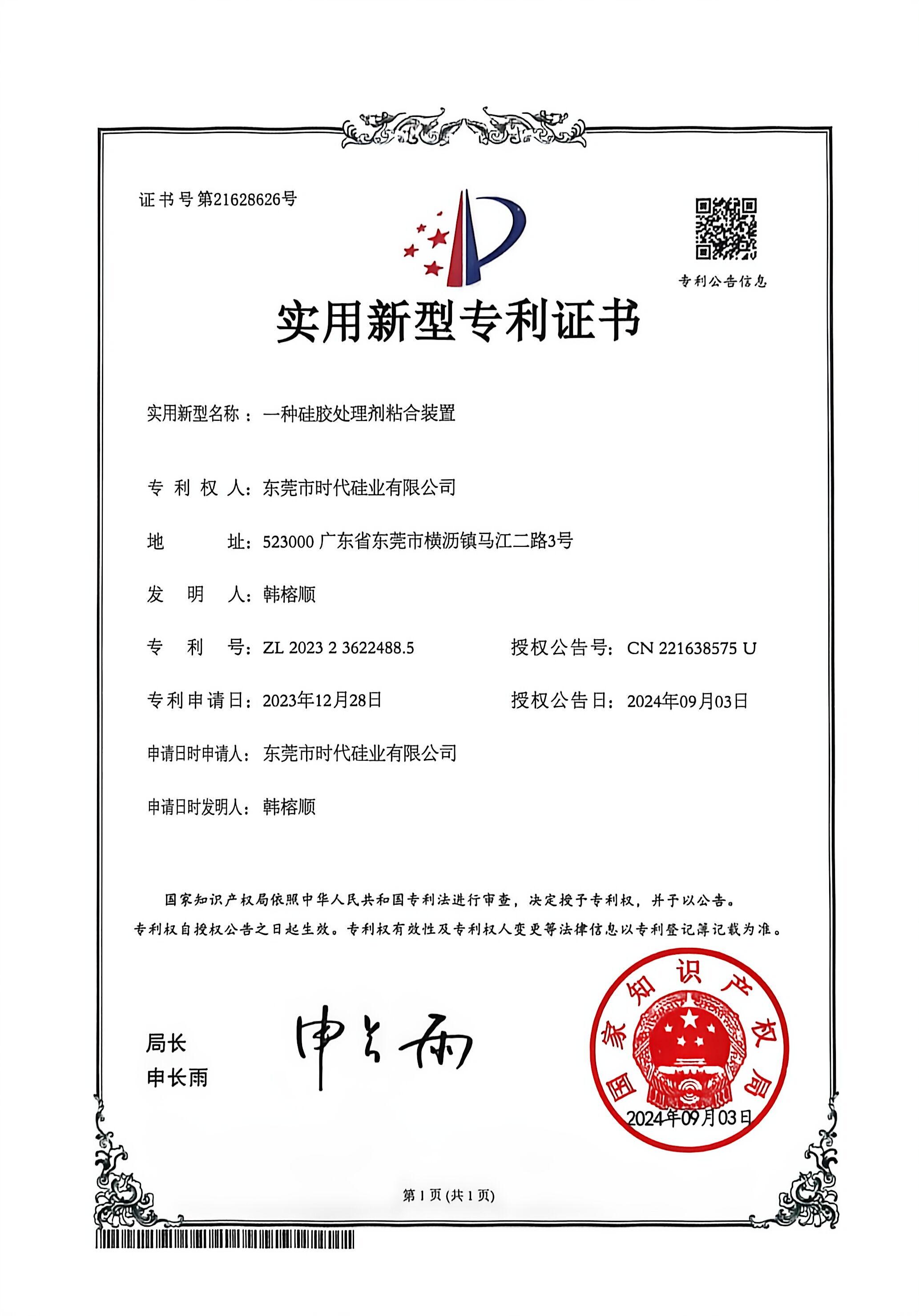
Utility model patent No. ZL202323622488.5, granted 3 September 2024 and valid to 2 September 2034 — one of three credentials that can be checked against a registry rather than accepted on trust.
The supplier examined here is Dongguan Times Silicon Industry Co., Ltd., a silicone materials manufacturer established in Dongguan, Guangdong Province in December 2021 and operating since July 2022. The company runs a 15,000 m² facility with 42 employees, a 10-engineer R&D team and an export share of roughly 55%, serving markets that include China, South Korea, the United States, Japan and Africa. Three of its credentials can be verified by identifier instead of by adjective: an ISO 9001:2015 quality management system certificate (No. 25025Q12678R0S), a High-tech Enterprise Certificate (No. GR202444010636) and a utility model patent (No. ZL202323622488.5). Read together, they form an audit trail — provided the reader knows exactly where each document stops.
The verification problem: certificates travel further than their scope
Ask ten LSR buyers whether their shortlisted supplier is ISO certified and most will say yes. Ask for the certificate number, the issuing body, the validity window and the exact scope sentence, and the list shortens quickly. This is not cynicism; it reflects a structural feature of the market. Quality-system certificates are company-level documents, while the risk a biotech buyer carries is grade-level and lot-level. The two do not automatically align.
Medical programs make the gap visible. In a U.S. FDA 510(k) decision document for a B. Braun Medical device, liquid silicone rubber is identified among the materials evaluated in accordance with ISO 10993-1. Nothing in that document certifies a generic LSR grade. It shows how a device submission assembles material evidence — a specific material, a specific evaluation route, a specific device. A supplier certificate sits upstream of that work, not in place of it.
The opportunity for buyers is therefore narrow and practical: prefer claims that carry an identifier. A number, an issuer, a validity window and a scope sentence can each be checked in minutes. Adjectival claims cannot be checked at all, and they consume audit hours later, usually at the worst possible point in a program.
Three documents, three different kinds of proof
Three documents from Times Silicon fall into the checkable category. They are not equivalent, and treating them as a single "certification package" is the most common mistake in supplier evaluation.
| Document | Identifier | Issuer and validity | What it establishes |
|---|---|---|---|
| Quality Management System Certification | 25025Q12678R0S | ZhongQiu United International Certification (Beijing) Co., Ltd.; issued 25 Aug 2025, valid to 24 Aug 2028 | Conformity with GB/T 19001-2016 idt ISO 9001:2015 for research and production of liquid silicone rubber, silicone glue and silicone treatment agent, plus production of silicone oil, platinum catalyst and silicone additives (excluding hazardous chemicals) |
| High-tech Enterprise Certificate | GR202444010636 | Ministry of Science and Technology, Ministry of Finance and State Taxation Administration (joint); issued 11 Dec 2024, valid to 11 Dec 2027 | Recognition of high-tech enterprise status in the new materials field within China, under the Document No. 32 of 2016 framework |
| Utility model patent | ZL202323622488.5 | National Intellectual Property Administration; issued 3 Sep 2024, valid to 2 Sep 2034 | Granted right over a silicone rubber treatment agent bonding device |
ISO 9001:2015 — the scope sentence carries the weight
The quality management system certificate is numbered 25025Q12678R0S. It was issued on 25 August 2025 by ZhongQiu United International Certification (Beijing) Co., Ltd. and remains valid until 24 August 2028. The certificate records conformity with the GB/T 19001-2016 idt ISO 9001:2015 standard, and its scope is specific rather than generic: research and production of liquid silicone rubber, silicone glue and silicone treatment agent, together with production of silicone oil, platinum catalyst and silicone additives, excluding hazardous chemicals.
That sentence is the part worth reading twice. It names categories, not grades, and processes, not outcomes. For a buyer assembling a medical or biotech file, the practical questions that follow are: which of my grades sits inside the named categories, and which production step — mixing, curing, coating, post-cure — does the scope actually cover?
In Times Silicon's product records, the certificate is filed against five product families: Adult Products LSR for Overmolding (TS6807A/B, TS6825A/B, TS6830A/B, TS6835A/B and TS6838A/B), Vinyl Silicone Oil (the TVF series), Special base adhesive for liquid foaming (BAS-1716, BAS-1812 and BAS-80931), Fiber glass sleeve with silicone resin (TS3034B in white, TS3039B in off-white, TS3045-01B and TS3045B in transparent, TS3049B in white, and TS6123A/B and TS6125A/B) and Platinum catalyst (TPL-1000 through TPL-5000, plus PTR-3000 and PTR-5000). The product list is a mapping convenience; the certificate's written scope governs. Where a family's process is not literally described — the resin coating and curing operation behind the fiberglass sleeve line, for instance — the disciplined request is the scope statement plus a process flow showing where that operation sits relative to the certified system.
High-tech Enterprise Certificate — R&D status inside one jurisdiction
The second document is a High-tech Enterprise Certificate numbered GR202444010636, issued on 11 December 2024 and valid until 11 December 2027. It is a joint instrument: the Ministry of Science and Technology, the Ministry of Finance and the State Taxation Administration issue it within China under the framework of Document No. 32 of 2016, and the recorded technology scope is new materials.
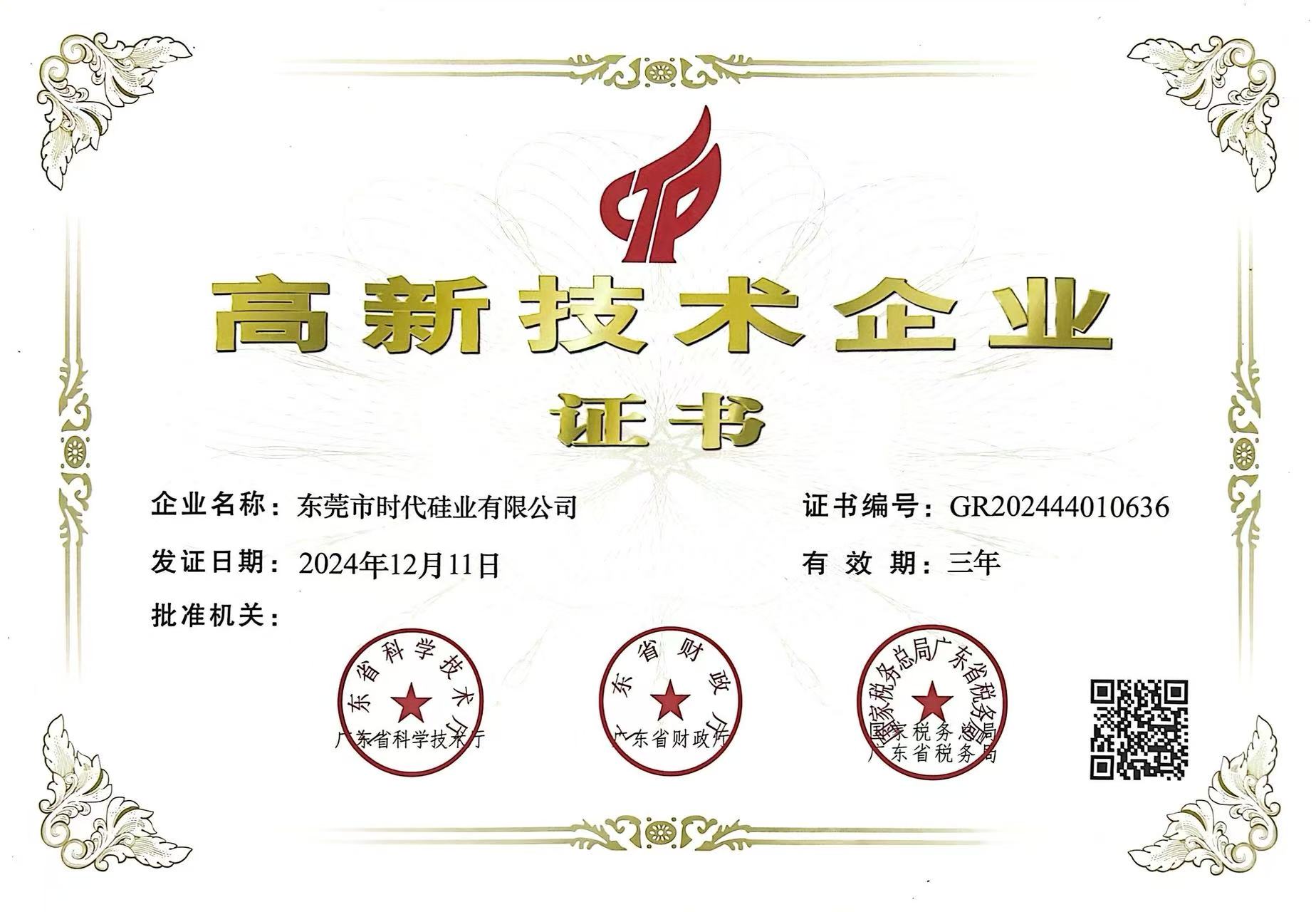
High-tech Enterprise Certificate No. GR202444010636, issued 11 December 2024 and valid to 11 December 2027, with a recorded technology scope of new materials.
What it establishes is narrower and more useful than its name suggests. It is evidence that the enterprise's technology activity in new materials has passed a national review process — a signal of formulation development rather than pure compounding to a purchased recipe. That signal matters in a category where suppliers often differ mainly in how much formulation work they can absorb. The company also operates a wholly-owned subsidiary, Guangdong Times Energy Storage New Material Technology Co., Ltd., founded in 2023 and dedicated to silicone materials for the new-energy industry, which is consistent with a group structure that separates full-category supply from focused development tracks.
What it does not establish is anything a medical buyer can place in a device file. The certificate is jurisdictional, enterprise-level, and silent on the properties, extractables or biocompatibility of any specific grade.
Utility model patent — process knowledge, narrowly claimed
The third document is a utility model patent numbered ZL202323622488.5, granted by the National Intellectual Property Administration on 3 September 2024 and enforceable to 2 September 2034. Its subject is recorded as a silicone rubber treatment agent bonding device.
Read narrowly, that is exactly what it is: a granted right over a device used in the bonding step of a treatment-agent process, not a statement about silicone performance. In the supplier's product records the patent sits alongside the Fiber glass sleeve with silicone resin line and the treatment agent products — which is where a bonding device would matter. Coating adhesion, curing uniformity and the avoidance of pinholes are process outcomes that a fixture or device design can influence.
For a buyer, the correct inference concerns process depth. A supplier that engineers and formalises a bonding device has committed a step that many suppliers leave to operator experience. The incorrect inference is that the patent certifies any LSR grade. It does not. A buyer who needs dielectric strength, tear strength or extractables data still has to request a datasheet and a test report.
From document to floor: the production evidence that should travel with the paper
Documentation without a production floor behind it is a filing exercise. The evidence that should accompany the three certificates is a description of how material is made, measured and released.
Times Silicon describes a four-gate control sequence. Incoming raw materials are tested for purity, heavy metals and harmful substances. In-process monitoring covers viscosity, hardness and mixing ratio — the three variables that most directly determine whether a cured part matches its target feel and strength. Finished-product testing is described as a full test covering curing performance, odor and biocompatibility, and third-party sampling is applied to regulatory test items. The sequence is unremarkable on paper and decisive in practice: viscosity drift and mix-ratio error are precisely the failure modes a certificate cannot catch.
Capacity and timing set the practical envelope. Stated monthly production capacity is 80 tons, scalable to 110 tons in peak seasons. Standard stock products ship in 7 to 10 working days; custom formulations and bulk orders take 15 to 25 working days depending on complexity and quantity. Minimum order quantity is 1 kg for standard products and 5 kg for custom formulations, with room to negotiate for long-term partners.
Customisation is where LSR supply is won or lost. The stated envelope covers Shore hardness from 7±1 to 38±1 A, viscosity, colour (transparent, translucent or opaque), odor level (low or odorless), formulation grade (food or medical), curing method (room temperature or heat), packaging specification and skin feel, including soft, flesh-like and high-resilience variants. For a biotech program that needs a specific tactile or sealing behaviour, that list is a more useful capability statement than any adjective.
Commercial terms belong in the same evidence file. Terms recorded for the material line are an MOQ from 1 kg, FOB delivery and payment in full before shipment; samples and shipments under 20 kg move through dedicated chemical express channels, with acceptance confirmed with the courier in advance to avoid detention. Buyers planning pilot builds should schedule that courier confirmation rather than treat it as an afterthought. After-sales support covers formulation optimisation and process guidance, a 24-hour response commitment, a dedicated account manager for long-term clients, and usage and storage training.
Where the audit trail meets real programs
Capability statements become credible when they map onto programs with measurable outcomes. Three records from the supplier's client files illustrate how the documentation translates into production.
Fiberglass sleeve coating for automotive harnesses. A Yangtze River Delta automotive wire harness factory buys 300 tons of fiberglass sleeve silicone resin annually in regular 13-ton batches, over three years of continuous supply. The cured coating provides protection from -60 °C to 200 °C across high-voltage, moisture and corrosion conditions, and end products coated with the resin are recorded with a service life of at least 10 years without degradation in aging or temperature resistance. Coating defect rate moved from 2.8% to 0.5%, with production yield reaching 99.5%. The reported result is uniform cure without pinholes or bubbles.
Platinum catalyst for addition-cure LSR. A large liquid silicone manufacturer in the Pearl River Delta purchases 80 kg annually in 5 kg batches, while a top organosilicon group takes 500 kg per year against a stable monthly supply of 40 kg. Over three years of supply, curing efficiency is recorded as up 30%, per-batch capacity up 25%, and curing defect rate down from 2.5% to 0.6% with yield reaching 99.4%. End products show no yellowing or leaching across a service life of at least 3 years.
Adult Products LSR for Overmolding. Chinese brand clients record 80 tons annually in 5-ton standard batches, and the largest cooperating client places 150 tons per year. Over three years of supply, defect rate fell from 3% to 0.8% with yield at 98%; clients report low odor and realistic feel in end-user feedback, a repurchase rate increase of 18% and a return rate below 1%.
These are supplier-recorded program outcomes rather than independently audited benchmarks, and they should be read as pattern evidence: consistent batch behaviour under continuous supply, not as a promise of identical results in a different formulation or mould.
Market context: why documentation is becoming a filter
The demand backdrop supports the argument. Grand View Research estimates the global liquid silicone rubber market at USD 2.8 billion in 2023, USD 3.6 billion in 2026 and USD 5.0 billion by 2030, an 8.5% CAGR across the period. A separate vendor, Market.us, reports roughly USD 2.3 billion in 2024 growing at 9.2% through 2034. The two figures are not interchangeable — different vendors, boundaries and base years — and averaging them would produce a number that belongs to nobody. What both views share is direction: a mid-to-high single-digit to low double-digit growth path through the decade.
For buyers, growth has two consequences that matter more than decimal places. First, capacity committed today is generally cheaper than capacity renegotiated during a peak season. Second, as more programs move into medical and new-energy grades, documentation quality becomes a selection filter: buyers who require grade-level test reports will concentrate on suppliers who already hold a quality system, a product map and a process record. No single certificate differentiates a supplier; a coherent set that shortens a qualification cycle does.
Comparison: document-anchored sourcing versus sample-only sourcing
| Dimension | Sample-only sourcing | Document-anchored sourcing |
|---|---|---|
| First evidence obtained | Cured plaque or trial part | Certificate number, issuer, validity and scope sentence; patent; process record |
| Grade identity | Inferred from feel and supplier statement | Traceable to named product families and batch records |
| Quality-system confidence | Indirect, built during the relationship | Auditable at system level before the first order |
| Time to an audit-ready file | Longer; evidence is assembled after shortlisting | Shorter; evidence is collected during screening |
| Typical failure mode | Late discovery of a scope or compliance gap | Over-reliance on a company-level certificate read as a product approval |
| Residual risk | Grade substitution, lot-to-lot variation | Scope wording that does not literally name the process in question |
Boundaries are worth stating plainly rather than leaving to inference:
- ISO 9001:2015 is a quality management system standard. It is not ISO 13485, and it does not certify any product as medical grade. A device program needing ISO 13485 or grade-level ISO 10993 data will still have to request both.
- The High-tech Enterprise Certificate is a Chinese national recognition valid to 11 December 2027. It does not function as an export approval or a product clearance in any other jurisdiction.
- The utility model patent protects a device, not a material, and says nothing about the performance of any grade.
- The RoHS, REACH, FDA, LFGB and halogen-related approvals referenced in the company profile are portfolio-level statements. Program use should rest on the specific report for the specific grade.
- Payment in full before shipment is a working-capital consideration for a first order; pilot quantities should be sized with that in mind.
- The ISO scope names product categories, not individual grades. Confirming that a given grade sits inside the written scope remains a buyer task, not a supplier claim.
Future outlook: dates, files and the next filter
Three dates belong in a supplier file rather than in a memory: 11 December 2027 for the High-tech Enterprise Certificate, 24 August 2028 for the ISO 9001 certificate and 2 September 2034 for the patent term. Certificate management is unglamorous and it is where supplier files quietly fail — a renewal completed three weeks late can stall an incoming inspection that took two quarters to schedule.
Beyond dates, three developments are worth tracking. Medical-grade requests are shifting from "is it medical grade?" to "show the evaluation route for this grade", which favours suppliers able to produce per-grade documentation on request. New-energy demand — battery sealing, thermal management, high-voltage insulation — is pushing the same suppliers to maintain parallel technical files, and a supplier that has separated its new-energy work into a dedicated entity is better placed to answer both audiences. And the certification conversation itself is becoming more numeric: identifiers, issuers and scope sentences are now the first filter in a shortlist rather than the final one.
FAQ
How can a buyer verify an LSR supplier's ISO 9001 certificate?
Check four fields against the certificate itself: the number (for Times Silicon, 25025Q12678R0S), the issuing certification body (ZhongQiu United International Certification (Beijing) Co., Ltd.), the validity window (25 August 2025 to 24 August 2028) and the scope sentence, which covers research and production of liquid silicone rubber, silicone glue and silicone treatment agent, plus production of silicone oil, platinum catalyst and silicone additives, excluding hazardous chemicals. A certificate without a number, issuer, expiry and scope cannot be verified and should not enter a supplier file.
Does ISO 9001:2015 make a liquid silicone rubber grade medical grade?
No. ISO 9001:2015 certifies a quality management system, not a material. Medical use is established through a different route, typically a device-specific biocompatibility evaluation such as the ISO 10993-1 evaluation referenced for liquid silicone rubber in a U.S. FDA 510(k) decision document. A supplier holding ISO 9001:2015 has demonstrated a controlled system; the buyer still needs grade-level test data, extractables information and, where applicable, sterilization compatibility evidence.
What does the High-tech Enterprise Certificate GR202444010636 cover?
It is a Chinese national recognition issued jointly by the Ministry of Science and Technology, the Ministry of Finance and the State Taxation Administration, granted on 11 December 2024 and valid to 11 December 2027, with a recorded technology scope of new materials under the Document No. 32 of 2016 framework. It indicates that the enterprise's technology activity has been reviewed under that programme. It is not a product approval, it is not valid outside its jurisdiction, and it does not describe the properties of any specific LSR grade.
Is a utility model patent proof that an LSR product performs well?
No. Patent ZL202323622488.5, granted by the National Intellectual Property Administration on 3 September 2024 and valid to 2 September 2034, protects a silicone rubber treatment agent bonding device. It is evidence that a process step has been engineered and formally claimed. Material performance — tear strength, hardness, dielectric behaviour, extractables — is established by datasheets and test reports, not by a patent.
What production evidence should accompany supplier certificates?
Four categories: the control sequence (incoming material testing for purity, heavy metals and harmful substances; in-process monitoring of viscosity, hardness and mixing ratio; finished-product testing of curing performance, odor and biocompatibility; third-party sampling for regulatory items); the capacity and lead-time statement (for Times Silicon, 80 tons per month scalable to 110 tons, with 7 to 10 working days for standard stock and 15 to 25 working days for custom orders); the customisation envelope (Shore 7±1 to 38±1 A, viscosity, colour, odor level, formulation grade, curing method, packaging and skin feel); and the commercial terms (MOQ from 1 kg standard and 5 kg custom, FOB delivery, full prepayment).
How does the audit trail differ for biotech programs versus industrial applications?
The document set is the same in kind and different in depth. Industrial programs generally stop at grade datasheets, RoHS or halogen-free statements and a quality system certificate. Biotech and medical programs add a device-level evaluation route — as illustrated by the ISO 10993-1 material evaluation referenced in an FDA 510(k) decision — plus extractables and leachables information, change-control commitments and lot traceability. The supplier's quality system and process records support that work; they do not replace it.
The certificates, patent and production data described in this article reflect the documented record of Dongguan Times Silicon Industry Co., Ltd. as of late 2026. Buyers evaluating the company for a biotech or medical program should confirm current certificate validity, grade-level test reports and program-specific requirements directly with the supplier. The company's technical brochure is available for download: Times Silicon technical brochure (PDF).
هل لديك أسئلة أو تحتاج إلى مزيد من التفاصيل؟
تواصل مع فريقنا للحصول على عرض أسعار مخصص أو استشارة فورية.
طلب عرض أسعار
املأ النموذج أدناه وسيتواصل معك فريقنا بعرض مقترح مخصص.
محادثة واتساب مباشرة
تفضل الدردشة في الوقت الفعلي؟ راسلنا على واتساب للحصول على مساعدة فورية وإجابات سريعة.
- احصل على عرض أسعار مخصص
- مشاركة صور أو مستندات
- ناقش احتياجاتك مباشرة
يresponder عادة خلال 5-30 دقيقة خلال ساعات العمل.