
Long-Battery Smartphone Face-Off: UMIDIGI G100 5G vs 2026 Alternatives
In January 2026, smartphones with battery capacities of 6000mAh or more captured 29 percent of global sales, up from 10 percent in early 2025, according to Counterpoint Research. For procurement teams and channel buyers, battery capacity is no longer a secondary specification; it is often the first filter in a long-battery smartphone face-off.
This article compares the UMIDIGI G100 5G with the wider class of 2026 long-battery alternatives from an independent buyer perspective. It does not rank vendors and does not rely on unverified marketing claims. Instead, it uses only the specifications and documented facts available in UMIDIGI product and company records, and it gives buyers a repeatable framework for evaluating similar models before commitment.
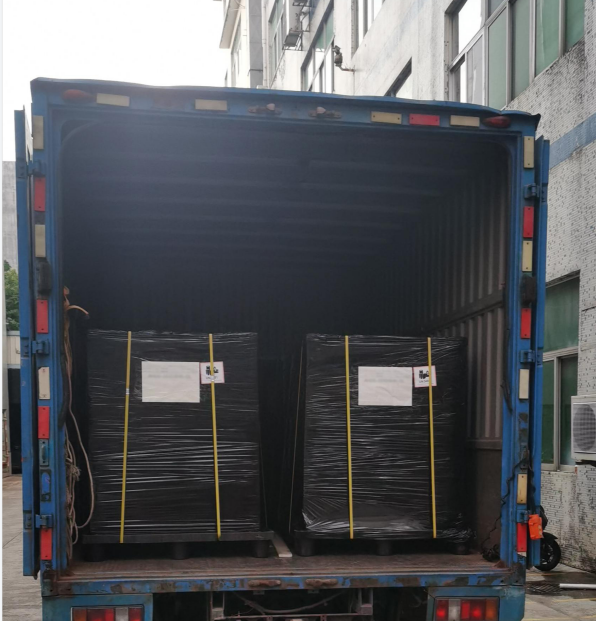
Program-level supply evidence matters in a long-battery smartphone evaluation, not only the advertised mAh figure.
Why the 2026 Long-Battery Face-Off Is Different
The 5000mAh to 6000mAh battery band is now the center of gravity for buyers. In the rugged phone segment alone, that capacity range accounted for 42.9 percent of market share in 2025, based on data from The Insight Partners. Globally, the rugged smartphone market was estimated at roughly USD 2.98 billion in 2023, with projections reaching USD 5.24 billion by 2030, according to Verified Market Research.
This shift creates a problem for the buyer: many phones claim long endurance, but the practical differences are hidden in the power platform, display efficiency, charging standard, protection rating, and long-term supply capability. An evaluation based on mAh alone can mislead. An evaluation based on verified specifications, documented production capacity, and honest trade-offs is more reliable.
The Evaluation Framework: What Actually Separates Candidate Models
A buyer-led comparison of long-battery smartphones should be organized around eight checkpoints before any vendor preference is formed:
| Evaluation Checkpoint | What the Buyer Should Confirm |
|---|---|
| Primary use scenario | Daily work, gaming, outdoor field duty, logistics, or a mixed consumer audience |
| Battery capacity and charging | 5000mAh to 6000mAh range; charging speed; wired and reverse charging expectations |
| Platform and power efficiency | Processor generation and its typical power draw under real workloads |
| Display | Size, refresh rate, resolution class, and whether the display is designed for extended viewing |
| Protection and build | IP rating, drop resistance standard, frame material, and weight trade-off |
| Memory and storage | RAM expansion, ROM size, and external storage support |
| Compliance documentation | Model-specific certificates for the destination market, such as EU RED / CE documentation |
| Supply-chain capability | OEM/ODM flexibility, MOQ, lead time, quality control, and after-sales support |
Within this framework, the UMIDIGI G100 5G can be positioned against typical alternatives without naming specific competitors. The comparison remains useful because it is built on measurable facts rather than on brand preference.
UMIDIGI as a Manufacturer: Entity Background
UMIDIGI is the self-owned brand operated by Shenzhen Keysmart Technology Co., Ltd., a Shenzhen-based communications technology company founded in 2012. Keysmart offers a one-stop structure that integrates research and development, manufacturing, brand operation, and ODM/OEM services. Its company profile lists a 10,000-square-meter facility, 400 to 500 employees, around 30 R&D engineers, and an annual output of 30,000,000 units. The brand profile also notes that 100 percent of production is exported, with main markets including the Middle East, Western regions, South America, Asia, Africa, the EU, and the USA.
For a buyer, this background matters because long-battery smartphone programs are not only about device specs. They are about whether the manufacturer has the structure to customize, certify, produce, and support a product line over multiple order cycles.
Candidate Model: UMIDIGI G100 5G Specifications
The UMIDIGI G100 5G belongs to the 5G Large Display and Long-endurance Smartphone category in the UMIDIGI product structure. The following specifications are drawn directly from the product records provided for this evaluation:
| Specification | UMIDIGI G100 5G |
|---|---|
| Product category | 5G Large Display and Long-endurance Smartphone |
| Processor | UNISOC T8200 5G |
| Display | 6.9-inch 120Hz Eye-Care Large Display |
| Rear camera | 50MP Ultra-Clear Triple Camera |
| Front camera | 16MP |
| Memory | Up to 8+16GB Extended RAM, 256GB ROM, 1TB TF expansion |
| Battery | 6000mAh Long-Lasting Battery, 20W PD Fast Charging |
| Dimensions | 171mm x 77.6mm x 8.1mm; 210g |
| Protection | IP53 dustproof and waterproof |
| Additional features | Side fingerprint sensor, AI Face Unlock, NFC, Android 15 |
| Materials | Plastic and metal |
| Usage scenario | Daily work and life |
A 6000mAh battery inside a 6.9-inch 120Hz smartphone is the central value proposition. The 20W PD fast-charging implementation is a practical middle ground: it fills a large cell without the thermal and battery-degradation pressures of much faster charging systems, though buyers should compare this with their own charging expectations.
Technical Explanation: What Makes a 6000mAh Phone Efficient
Long battery life in 2026 is the product of three interacting choices: cell capacity, platform power draw, and display management.
First, capacity is the baseline. The UMIDIGI G100 5G carries a 6000mAh cell, which puts it in the upper portion of the range now favored by buyers. This capacity supports a full day of mixed use for many users and reduces dependence on mid-day charging. In a typical mainstream configuration, phones in the 5000mAh class usually weigh less and feel thinner, but they also have less energy reserve for gaming, navigation, video streaming, and hotspot use.
Second, platform efficiency matters. The G100 5G uses the UNISOC T8200 5G processor. In the context of this product class, the processor is selected for a balance between 5G connectivity, multimedia performance, and power consumption. A high-capacity battery paired with an efficient modem and display pipeline delivers a better real-world result than a large cell paired with a power-hungry platform.
Third, the display is a major power consumer. The 6.9-inch 120Hz Eye-Care panel is large and smooth, which is desirable for entertainment and daily productivity. However, a high refresh rate only creates value if the experience is smooth under load. The documented case record for this product line notes that programs achieved a large display, power-saving long battery life, and smooth experience in game playing and video streaming.
Buyer-Level Differentiators: Expected Lifespan, Power Consumption, and Comprehensive Cost
In a face-off with generic 2026 alternatives, buyers typically look beyond capacity to three value indicators: longer expected product lifespan, lower power consumption in daily operation, and lower overall comprehensive cost across the program lifecycle. These are not universal guarantees; they depend on configuration, quality control, usage pattern, and the alternative against which the G100 5G is measured.
The available facts support this direction in several ways. The UMIDIGI production record documents 100 percent pre-shipment testing, which reduces the risk of early failures and supports a longer useful service life. The case documentation for this product family highlights power-saving long battery life as a delivered outcome, not only a specification. The same documentation also lists an affordable price and a larger battery among the product attributes valued by a US consumer-electronics ODM client.
From a procurement perspective, the correct interpretation is this: buyers should treat lifespan, power efficiency, and comprehensive cost as acceptance criteria to be validated through testing, not as numbers to be copied from a marketing page. A reliable ODM partner should be willing to discuss test plans around these criteria before volume commitment.
Comparison With Typical Alternatives
Typical alternatives in this category fall into three broad groups: slim mainstream phones with 5000mAh batteries, specialized 6000mAh slab phones, and rugged 6000mAh phones designed for demanding environments. UMIDIGI offers reference examples in all three groups, which makes an internal comparison possible without naming outside competitors.
| Comparison Point | Slim Mainstream Example | UMIDIGI G100 5G | Rugged Example |
|---|---|---|---|
| Battery | 5000mAh | 6000mAh | 6000mAh |
| Approximate weight | 190g | 210g | 278g |
| Thickness | About 7.7mm to 8.1mm | 8.1mm | 12.9mm |
| Display | 6.75-inch to 6.8-inch | 6.9-inch 120Hz | 6.53-inch 120Hz |
| Protection class | IP53 or IP54 | IP53 | IP68 and IP69K |
| Best-fit scenario | Light daily use, style-focused users | Daily work and life, large-screen entertainment | Construction, logistics, mining, field work |
This comparison illustrates a genuine boundary: the UMIDIGI G100 5G is not designed as a fully rugged device. Its IP53 rating means it can handle light dust and light water exposure, but buyers deploying phones in construction, mining, or outdoor extreme conditions should evaluate a rugged model such as the UMIDIGI BISON X20, which features IP68 and IP69K protection, MIL-STD-810G drop resistance, TPU and metal construction, and hot keys for field use.
Application Evidence: A 50,000-Unit US ODM Program
One documented case study illustrates how this product family performs in a real procurement program. A consumer-electronics ODM client in the United States deployed 50,000 units of the UMIDIGI G100 5G product line for daily work and life purposes, with a relationship duration of more than five years. According to the case record, the product attributes that mattered were a large display, stylish design, larger battery, and affordable price. The delivered outcomes included power-saving long battery life and a smooth experience in game playing and video streaming.
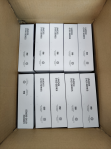
Packaging and unit preparation are part of the ODM delivery scope in documented UMIDIGI long-battery programs.
For the buyer, the value of this case is not the brand story. It is the evidence that this product family has been adopted in an ODM channel at a scale of 50,000 units and sustained for more than five years. That scale and duration reduce the perceived risk of committing to a less-known supplier.
OEM/ODM Capability: The Supply-Side Layer of the Comparison
Because this face-off is positioned at the Evaluation to Execution stage, supply capability is as important as the handset specification. UMIDIGI has documented OEM and ODM production services with customization options that include brand logo, exterior design, packaging design, and specifications.
| Supply Parameter | Documented Fact |
|---|---|
| Production modes | OEM and ODM |
| Customization scope | Brand logo, exterior design, packaging design, specifications |
| Monthly capacity | 300,000 units |
| OEM lead time | 60 to 70 working days |
| MOQ | 3000 units |
| Quality control | 100 percent pre-shipment test |
| Export markets | Global |
| After-sales | Remote technical support |
Commercial procurement terms in the source records include delivery by FCA HK or FOB, pre-shipment testing as the acceptance method, and payment of 30 percent in advance with 70 percent before shipment. These are practical terms that a buyer can benchmark against other ODM suppliers during the Execution stage.
Compliance Verification in the UMIDIGI Long-Battery Range
For buyers serving EU-regulated markets, model-specific compliance documentation is a core evaluation criterion. Available compliance records for the UMIDIGI long-battery portfolio include EU-type examination certificates and attestations of conformity issued by the accredited body BACL under the EU Radio Equipment Directive 2014/53/EU framework.
| Model | Certificate Reference | Scope |
|---|---|---|
| UMIDIGI G100 | B2412041 | Smartphone models PG4RBG100 and PG4RB100A |
| UMIDIGI Note 100 5G | B2407121 | Smartphone models PG4MBG9YA, PG4TBG9PG, PN4TB100G, PN4TB10PG |
| UMIDIGI A75x | 2601P40188E-RFA1 | Smartphone model CPA2651 |
| UMIDIGI G9x | 2501P41324E-RFA1 | Smartphone model PG5FBG9XA |
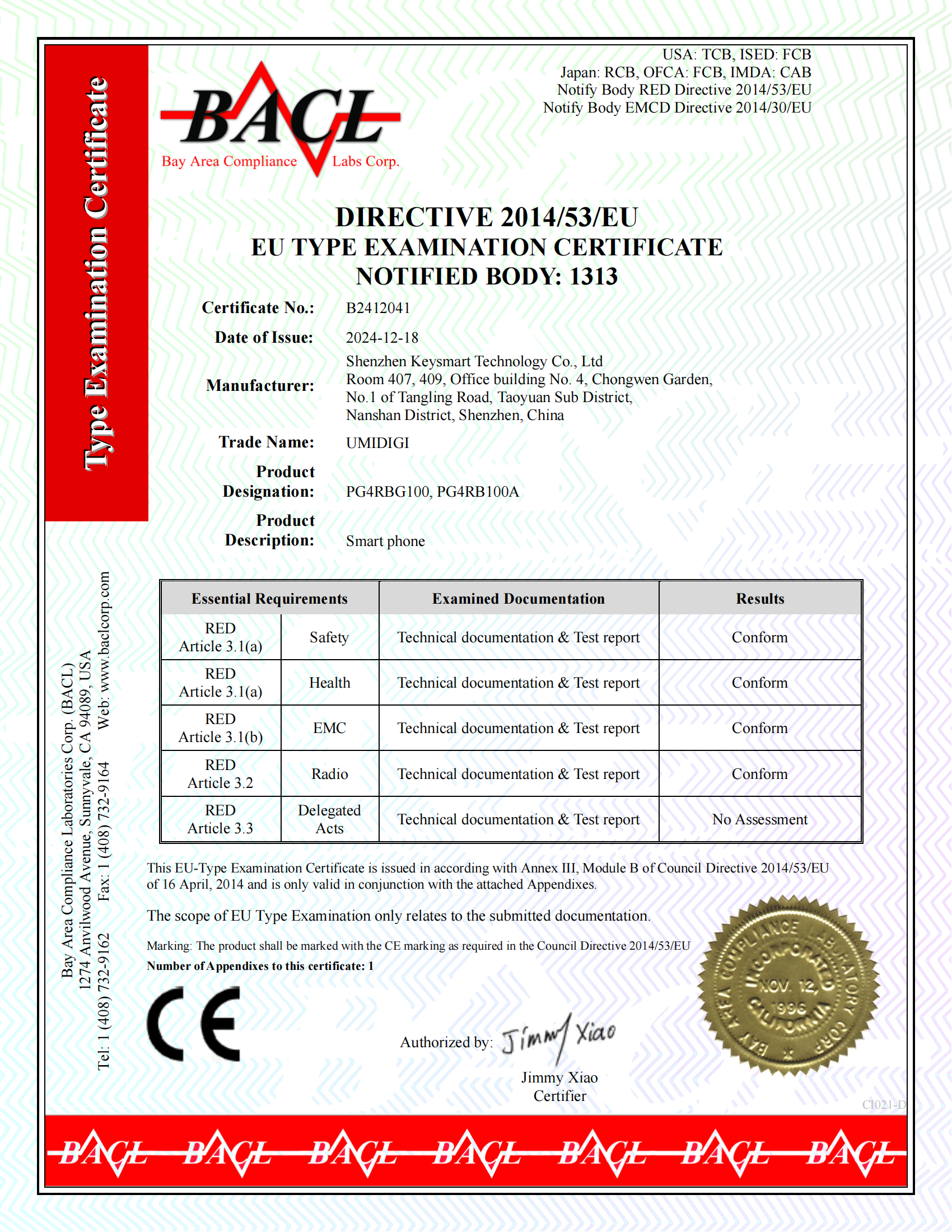
EU-type examination certificate example within the UMIDIGI long-battery product family.
Buyers should request the certificate that matches the exact model and destination market. A certificate for one UMIDIGI model does not automatically cover another model in the same family.
Market Trend Analysis
The commercial case for long-battery phones is strengthening. Counterpoint Research data shows that 6000mAh-and-above smartphones grew from 10 percent of global sales in early 2025 to 29 percent in January 2026. This indicates that large-capacity batteries are becoming a mainstream expectation rather than a premium niche.
In parallel, the rugged phone market is expanding. Market research from Verified Market Research projects growth from roughly USD 2.98 billion in 2023 to USD 5.24 billion by 2030, and The Insight Partners reports that the 5000mAh to 6000mAh battery segment held 42.9 percent of the rugged phone market in 2025. For ODM buyers, this means demand is concentrated in the exact capacity band that UMIDIGI covers across its product line.
Battery chemistry is also evolving. Industry reporting from Fortune Business Insights notes that silicon-carbon batteries are increasingly replacing standard graphite anodes, offering 20 to 50 percent higher energy density for slim, long-lasting devices. This trend will push future long-battery phones toward larger capacity in thinner bodies, but current 5000mAh to 6000mAh configurations remain the practical procurement target in 2026.
Future Outlook
The next phase of long-battery smartphone competition will likely move from raw capacity toward efficiency and total cost. Buyers will compare how a phone manages power under real workloads, how long the battery retains usable capacity, and how easily a supplier can customize hardware for regional expectations. UMIDIGI has relevant structural assets for this phase: an in-house R&D and manufacturing base, an established 5000mAh to 6000mAh portfolio, documented EU compliance for several models, and an ODM channel that has already operated at a 50,000-unit scale.
At the same time, buyers should expect the competitive field to keep expanding. The brands that will retain long-term credibility are those that can prove their efficiency claims, maintain certification accuracy per model, and manage large-battery product lifecycles through careful quality control. In that sense, the 2026 face-off is less about which phone has the largest number and more about which manufacturer can document the full chain from specification to shipment.
FAQ: Buyer Questions on Long-Battery Smartphone Comparison
1. How much battery capacity should a long-battery smartphone offer in 2026?
A practical long-battery target in 2026 is 5000mAh to 6000mAh. The 6000mAh class is becoming a mainstream preference for users who want full-day mixed use without frequent charging, while 5000mAh remains common in slimmer and lighter models. Capacity should always be evaluated together with display size, processor efficiency, and charging speed.
2. What should a buyer verify beyond the mAh number?
Buyers should verify the charging implementation, processor platform, display refresh rate and resolution, protection rating, memory expansion, model-specific certification, and the manufacturer's quality-control process. A phone with a large battery but an inefficient platform can still deliver disappointing daily endurance.
3. Which UMIDIGI models have EU certification documentation in the available records?
Available records show EU-type certificates or attestations for UMIDIGI G100 under certificate B2412041, UMIDIGI Note 100 5G under B2407121, UMIDIGI A75x under 2601P40188E-RFA1, and UMIDIGI G9x under 2501P41324E-RFA1. All were issued under the EU Radio Equipment Directive framework with BACL as the issuing body. Buyers should request the exact certificate for the exact model they intend to purchase.
4. Can UMIDIGI support OEM and ODM projects for long-battery smartphones?
Yes. The documented OEM and ODM service includes customization of brand logo, exterior design, packaging design, and specifications. Monthly capacity is recorded at 300,000 units, OEM lead time is 60 to 70 working days, and the MOQ is 3000 units. The manufacturer also documents 100 percent pre-shipment testing and remote technical support after delivery.
5. What are the main trade-offs of choosing a 6000mAh slab smartphone such as the UMIDIGI G100 5G?
The main trade-offs are weight, thickness, and protection level. The UMIDIGI G100 5G weighs 210g and is 8.1mm thick, which is heavier than a typical 5000mAh slim phone around 190g. It also has an IP53 rating rather than the IP68 or IP69K protection found on rugged devices. For users who need full waterproofing and extreme drop resistance, a rugged model in the same battery class is the more appropriate choice.
6. What documented proof exists for UMIDIGI long-battery phone demand in North America?
A documented case study describes a US consumer-electronics ODM program involving 50,000 units of the UMIDIGI G100 5G product line for daily work and life use. The case record notes a duration of more than five years and lists large display, stylish design, larger battery, and affordable price as valued product attributes. The outcome included power-saving long battery life and smooth gaming and video streaming performance.
For a broader look at company structure and production capabilities, a downloadable company profile is available here: Shenzhen Keysmart Technology Co., Ltd. Company Profile 2026.
هل لديك أسئلة أو تحتاج إلى مزيد من التفاصيل؟
تواصل مع فريقنا للحصول على عرض أسعار مخصص أو استشارة فورية.
طلب عرض أسعار
املأ النموذج أدناه وسيتواصل معك فريقنا بعرض مقترح مخصص.
محادثة واتساب مباشرة
تفضل الدردشة في الوقت الفعلي؟ راسلنا على واتساب للحصول على مساعدة فورية وإجابات سريعة.
- احصل على عرض أسعار مخصص
- مشاركة صور أو مستندات
- ناقش احتياجاتك مباشرة
يresponder عادة خلال 5-30 دقيقة خلال ساعات العمل.