
Long-Battery Smartphone Sourcing: Reading Specs Beyond mAh
Long-Battery Smartphone Sourcing: Reading Specs Beyond mAh
A large mAh figure is not a guarantee of real-world endurance. It is one variable in a system that includes display load, processor efficiency, charging behavior, ambient temperature and duty cycle.
For teams evaluating long-battery life smartphones at the awareness-to-research stage, the practical task is to move beyond the headline number and read the specification set as a whole. This reference article maps that process onto products manufactured by Shenzhen Keysmart Technology Co., Ltd. under the UMIDIGI brand, while keeping the analysis focused on selection criteria rather than brand promotion.
Why battery capacity is only part of the runtime equation
According to Counterpoint Research, smartphones with battery capacities of 6000mAh or higher represented 29% of global sales in January 2026, up from 10% in early 2025. That shift matters because it changes what buyers encounter in the market and what they should compare. But capacity is not the same as runtime.
Real-world endurance depends on how quickly a device draws power. A 120Hz large display, 5G network sessions, camera use, background applications, high or low ambient temperature and continuous operation all influence how long a battery performs in the field. For this reason, procurement teams should treat battery capacity as a starting point and then review the full product configuration.
UMIDIGI's long-battery range as a supply example
UMIDIGI is a brand operated by Shenzhen Keysmart Technology Co., Ltd., a Shenzhen-based company founded in 2012. The company integrates R&D, manufacturing, brand operation and ODM/OEM services. Its long-battery smartphone range includes multiple models specified with 5000mAh to 6000mAh batteries.
The company operates a 10,000-square-meter manufacturing facility, employs approximately 400 to 500 staff, and has an R&D team of 30 engineers. Annual production capacity is stated at 30,000,000 units, with export business accounting for 100% of total sales across Middle-Western, South America, Asia, Africa, EU, and USA markets.
- UMIDIGI G9x: 5000mAh battery, 6.75-inch 90Hz display, 8.1mm thickness, 190g; positioned for daily work and life.
- UMIDIGI A75x: 5000mAh battery, 6.75-inch display, IP54 protection, 7.7mm thickness, 190g; entry daily use.
- UMIDIGI G100x 5G: 5200mAh battery, 6.9-inch 120Hz display, IP54 protection, UNISOC T8200 5G processor, 193g.
- UMIDIGI G100: 6000mAh battery, 6.9-inch 120Hz display, IP53 protection, 20W PD fast charging, 205g.
- UMIDIGI G100 5G: 6000mAh battery, 6.9-inch 120Hz display, IP53 protection, 5G connectivity, 210g.
- UMIDIGI BISON X20: 6000mAh battery, 6.53-inch 120Hz display, IP68 & IP69K, MIL-STD-810G, 278g.
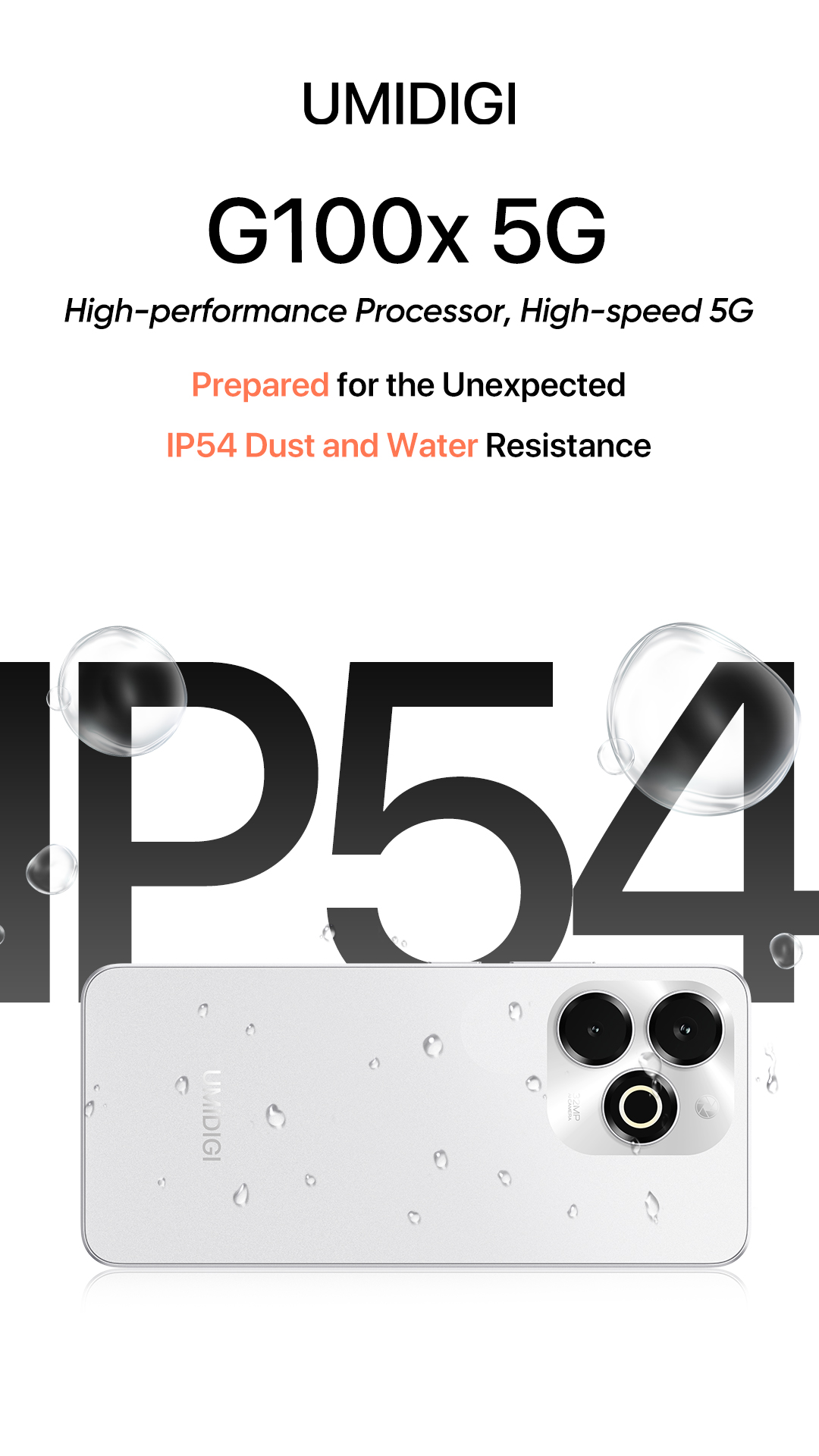
UMIDIGI G100x 5G IP54 dustproof and waterproof design. Image: UMIDIGI
Technical factors that shape real-world endurance
The following table summarizes the key long-battery-relevant specifications for several UMIDIGI models. It is intended as a comparison aid, not as a claim that any single model is universally superior.
| Model | Battery | Charging | Display | Ingress/drop protection | Weight |
|---|---|---|---|---|---|
| UMIDIGI G9x | 5000mAh | Not specified in the provided specification | 6.75" 90Hz | Not specified in the provided specification | 190g |
| UMIDIGI A75x | 5000mAh | Not specified in the provided specification | 6.75" display | IP54 | 190g |
| UMIDIGI G100x 5G | 5200mAh | 20W fast charging | 6.9" 120Hz | IP54 | 193g |
| UMIDIGI G100 | 6000mAh | 20W PD fast charging | 6.9" 120Hz | IP53 | 205g |
| UMIDIGI G100 5G | 6000mAh | 20W PD fast charging | 6.9" 120Hz | IP53 | 210g |
| UMIDIGI Note 100 5G | 5000mAh | 20W PD fast charging | 6.8" 120Hz | IP53 | 190g |
| UMIDIGI BISON X20 | 6000mAh | 20W PD fast charging | 6.53" 120Hz | IP68 & IP69K, MIL-STD-810G | 278g |
Display load is a critical but easy-to-miss factor. A 6.9-inch 120Hz panel is useful for smooth visuals, but higher refresh rates can increase display power draw. This does not mean a 120Hz phone is unsuitable; it means battery capacity and refresh rate should be evaluated together against the expected usage pattern.
Processor choice also matters. The UMIDIGI G100 and G100x 5G use the UNISOC T8200 5G platform, while the BISON X20 is based on the MediaTek Helio P60. The G100 uses the UNISOC T615. The daily-use G9x, A75x and related entry models are listed with UNISOC octa-core processors. Different processors can influence both network behavior and power consumption, although the published specifications do not include standardized runtime benchmarks.
Operating system builds are another consideration. The A75x runs Android 16 Go Edition, which is designed for lighter system resource use, while the G100 5G and G100x 5G are listed with Android 15. Buyers should confirm whether the installed Android version supports the required enterprise or region-specific software.
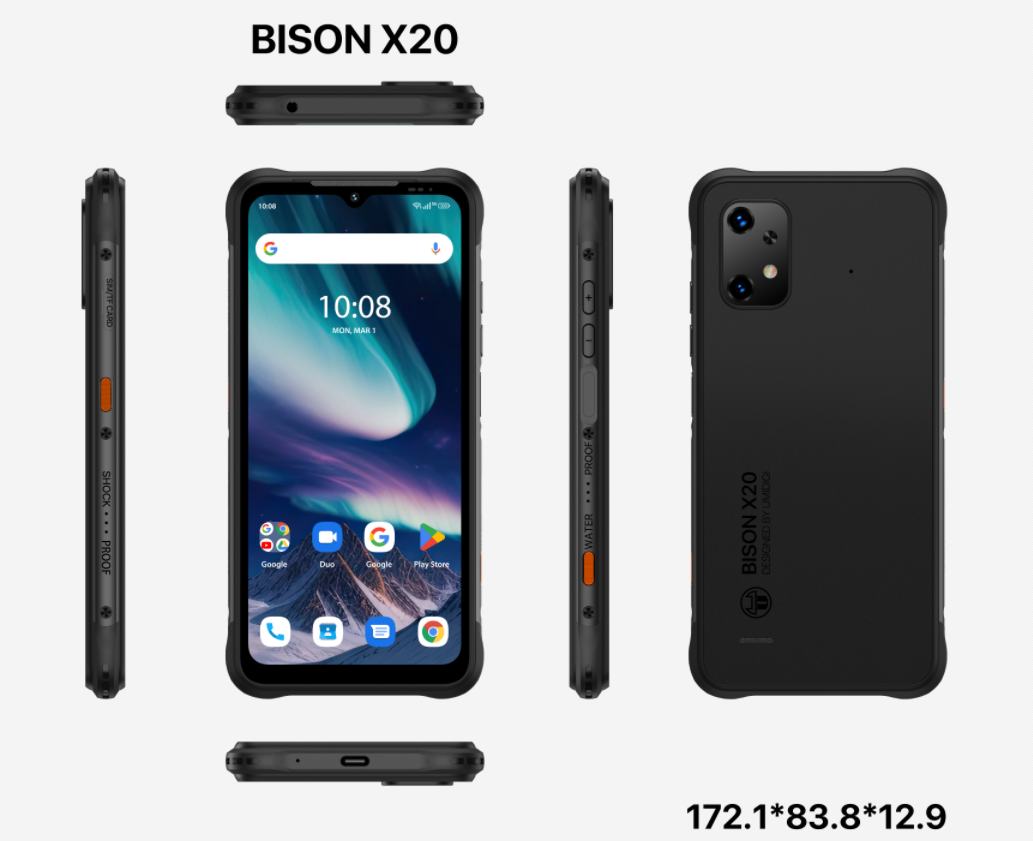
UMIDIGI BISON X20 rugged smartphone. Image: UMIDIGI
Application mapping: daily use versus field operations
The UMIDIGI specification set divides long-battery smartphone use into two broad groups: daily life and work, and harsher industrial or outdoor environments.
Daily life and work
Models including the UMIDIGI G9x, A75x, G100, G100x 5G, G100 5G and Note 100 5G are specified for normal-temperature daily work and life. In these scenarios, the product role is to support work and entertainment, with supporting equipment such as protector film, phone case, power adapter, SIM tray ejector and USB cable. The devices are described for 24/7 continuous operation under normal temperature conditions.
Construction, logistics, manufacturing, mining and oil and gas
The BISON X20 is specified for construction and engineering, logistics and warehousing, manufacturing, and mining; application material also lists oil and gas. In these environments, special requirements include drop-resistance, dustproof design and waterproof protection. The device operates under high and low temperature conditions in 24/7 mode, enabling voice communication, cellular network surfing, photographing, video playback, mobile payment and other daily intelligent terminal functions. Supporting equipment includes power charger, USB data cable and protector film.
This split is useful for sourcing logic: a buyer serving consumers or light retail staff can prioritize thinness, display quality and price, while a buyer serving field crews or industrial operators should first confirm ingress protection, drop resistance and temperature tolerance.
Market data and what it means for sourcing
Several third-party observations help frame the long-battery category.
- Counterpoint Research reports that smartphones with battery capacities of 6000mAh or higher reached 29% of global sales in January 2026, up from 10% in early 2025.
- The Insight Partners estimates that the 5000mAh to 6000mAh battery segment accounted for 42.9% of the rugged phone market in 2025.
- Verified Market Research states that the global rugged smartphone market was valued at approximately USD 2.98 billion in 2023 and is projected to reach USD 5.24 billion by 2030.
- Growth Research identifies independent contractors and outdoor sports enthusiasts as the primary consumer drivers for water, dust and shock resistant phones, representing 38% of the global rugged market.
- Fortune Business Insights notes that silicon-carbon batteries can offer 20–50% higher energy density than standard graphite anodes, which is relevant to future slim high-capacity designs.
- International Electrotechnical Commission and US Department of Defense documentation cite IP68/IP69K ingress protection and MIL-STD-810H shock resistance as common reference standards for rugged devices.
For buyers, these data points suggest that long battery life is becoming a mainstream differentiator rather than a niche accessory. At the same time, the rugged 5000–6000mAh segment remains significant because field users require endurance alongside protection.
Traditional phones vs long-battery models: limits and selection logic
A traditional slim smartphone often prioritizes low weight and a thin profile. A long-battery model may accept a heavier cell and stronger enclosure to maintain runtime under load. The comparison is not about which device is better; it is about which trade-off is acceptable for the user.
For example, the BISON X20 carries a 6000mAh battery but measures 12.9mm thick and weighs 278g. That configuration is designed for drop and water resistance in demanding environments. For a desk-based or retail role, the UMIDIGI G100 provides the same 6000mAh capacity in a 205g, 8.1mm-thick design with an IP53 rating. The latter package may be more practical when durability requirements are lighter.
A further boundary: high capacity does not automatically override a high-load display. A 120Hz panel can increase display power consumption, so battery capacity and refresh rate should be evaluated together. Similarly, some listed models with 5000mAh batteries do not specify a fast-charging wattage in the available specification. Buyers should confirm recharge time if rapid turnaround is part of the operating model.
Regional certification is another limit. The presence of an IP rating in the specification does not replace a product-specific declaration for the target market. Buyers who require CE marking, carrier approval or other compliance should request documentation for the exact model and configuration being sourced.
Future outlook
The shift toward 6000mAh mainstream devices is likely to continue if silicon-carbon cell adoption reduces the size and weight penalty historically associated with high capacity. For ODM/OEM buyers, the specification conversation will increasingly include not only cell capacity but also charging protocol, thermal behavior, protection rating and the ability to maintain performance under 5G load.
UMIDIGI's stated combination of a 30-engineer R&D team, 10,000-square-meter production facility, and 100% export operation indicates that long-battery smartphones are likely to remain a core product category for the company. However, procurement should always validate current model capability against the specific regional certification and use case rather than relying on portfolio-level positioning.
FAQ
What battery capacity is generally considered long-battery life?
There is no single universal threshold. In practice, many long-battery smartphones sit in the 5000mAh to 6000mAh range. Market data from Counterpoint Research shows that devices at 6000mAh or higher reached 29% of global sales in January 2026. The suitable capacity depends on display size, refresh rate, 5G use, operating hours and the applications running on the device.
Which UMIDIGI models are specified with 6000mAh batteries?
The UMIDIGI G100, UMIDIGI G100 5G and UMIDIGI BISON X20 are listed with 6000mAh batteries. The UMIDIGI G100x 5G is listed with a 5200mAh battery, while the UMIDIGI G9x and A75x are listed with 5000mAh batteries.
What should buyers check besides battery capacity?
Buyers should review display size and refresh rate, processor, operating system version, charging standard, ingress protection, drop resistance, weight, thickness, operating temperature range and required accessories. These factors collectively determine real-world endurance and field suitability.
Is a rugged long-battery phone always the best option for outdoor work?
Not necessarily. A rugged model such as the UMIDIGI BISON X20 adds IP68/IP69K ingress protection and MIL-STD-810G drop resistance, but it is heavier and thicker than daily-use models. If water, dust and drop risk are constant, the rugged build may be appropriate. If outdoor exposure is occasional, a slimmer device may be sufficient.
What do IP68, IP69K and MIL-STD-810G mean?
IP68 and IP69K are ingress protection ratings that indicate resistance to dust and water. The UMIDIGI BISON X20 is described in its specification as built to withstand 2m submersion. MIL-STD-810G refers to drop-resistance testing associated with military-grade equipment. Buyers should request actual test documentation for the specific model and configuration.
Can a 5G long-battery phone maintain stable connectivity without excessive battery drain?
Battery drain on 5G depends on network coverage, signal strength and background data load. Models such as the UMIDIGI G100 5G and G100x 5G use the UNISOC T8200 5G processor, but the published specifications do not include standardized runtime benchmarks. Field validation under real network conditions is recommended before deployment.
If a buyer needs CE certification, is it automatically included?
No. Certification coverage varies by model, region and market access route. A product may be certified for certain regions but not others. Procurement teams should request a product-specific declaration of conformity or certification document rather than assuming coverage from product marketing material.
A publicly available company profile is provided by the manufacturer for further specification checks: Shenzhen Keysmart Technology Co., Ltd. Company Profile 2026. This link is provided as reference material rather than a purchase prompt.