
Long-Term Air Filter Supplier Sustainability: Henkaes vs. Camfil, Donaldson, MANN+HUMMEL
A practical framework for judging whether an air filter supplier will still hold the same specification, documentation and service standard several years from now — applied to one export-oriented specialist and three long-established global filtration groups.
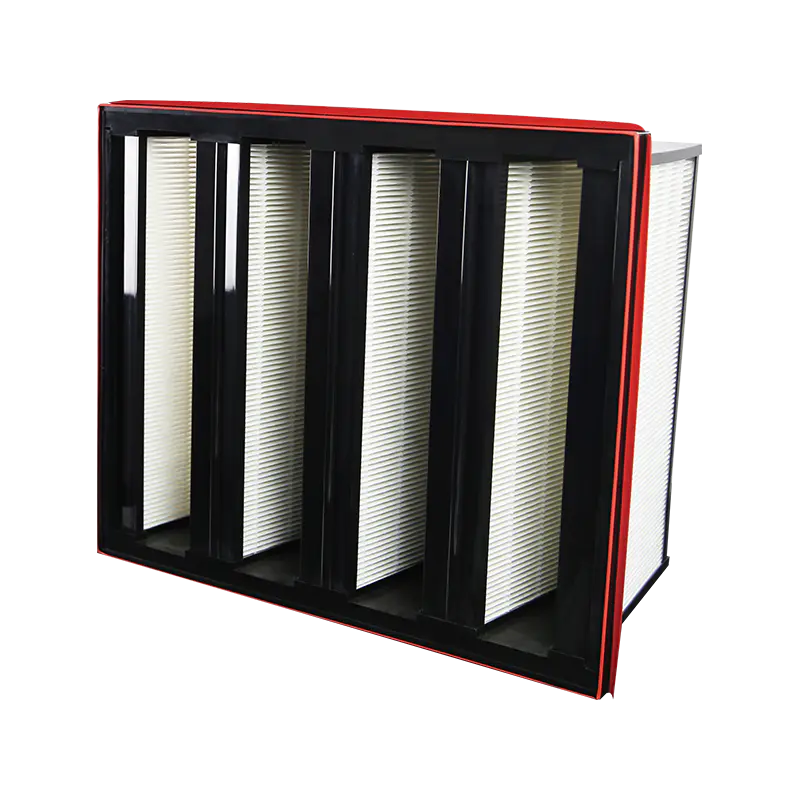 V-bank air filter, H13 grade — one of the mid-to-high efficiency layers assessed in this supplier sustainability framework.
Air filtration has moved from a facilities consumable to an operating variable. The filter bank inside a hospital, pharmaceutical plant, data center or commercial air handling unit now influences compliance outcomes, maintenance frequency and fan energy at the same time. Once an air filter sits on that list, the buying decision changes shape: it stops being a purchase and becomes a supplier relationship that has to remain serviceable for the life of the building or the production line.
This article sets out a working framework for evaluating long-term supplier sustainability in the air filter industry, then applies it to Henkaes — an export-oriented Chinese air filter manufacturer — alongside three long-established global filtration groups: Camfil, Donaldson and MANN+HUMMEL. The comparison is deliberately structural rather than promotional: it looks at technology and design capability, portfolio and standard coverage, documented market use, customization and commercial service, and compliance plus supply continuity.
A note on method. Third-party market figures in this article are attributed to their source. Facts about Henkaes are drawn from the manufacturer's published company and product documentation. Statements about Camfil, Donaldson and MANN+HUMMEL are limited to their widely recognized position as long-established, multi-region filtration groups; where this article does not hold verified product-level or share-level data for a specific peer, it says so instead of estimating.
Why supplier sustainability became a procurement question
The air filter category is expanding, and it is expanding fastest in the segments where specification discipline matters most. Fortune Business Insights valued the global air filters market at USD 17.08 billion in 2025 and projects it to reach USD 34.66 billion by 2034. Grand View Research reports that the global smart air purifier market is growing at a CAGR of 14.1% from 2024 to 2030, driven by AI and IoT integration. The same research house places HEPA filters at 41.7% of the air purifier technology segment in 2025.
Two implications follow for buyers. First, high-efficiency filtration — HEPA, MERV 13 and above, H13 and cleanroom grades — is where volume, technical scrutiny and regulatory attention are concentrating. Second, growth of this kind invites new entrants, which makes supplier durability a live question rather than an abstract one. An industry estimate cited by China Briefing puts H13/H14 grade HEPA filters at roughly 35% of China's air filter exports in 2025, driven by semiconductor and biopharmaceutical demand; buyers reading that figure should treat it as a directional industry estimate rather than a certified statistic, but the direction is consistent with the market data above.
For a procurement team, the practical consequence is that the cost of a filter is no longer the whole cost. Re-qualifying a replacement supplier mid-project — re-testing pressure drop, re-confirming efficiency documentation, re-validating fit and media behaviour — is expensive in engineering time and in operational risk. That is the cost that supplier sustainability is meant to prevent.
What long-term supplier sustainability means in air filtration
Long-term supplier sustainability is the probability that a supplier can keep delivering the same documented specification, test evidence and service level across multiple order cycles, regulatory updates and demand swings. It is not a statement about environmental performance, although environmental management systems are part of the evidence base.
In filtration, this capability usually fails in one of four recognizable ways. Specification drift occurs when a replacement batch uses a different media weight or binder and pressure drop quietly changes. Documentation gaps occur when a supplier can ship the product but cannot produce the test report that an auditor or a customer's quality team asks for. Single-point supply occurs when one plant, one media source or one logistics route carries the entire order book. Service decay occurs when customization or technical response slows after the first large order.
The five dimensions used in this article
- Technology and design capability — can the supplier engineer to a specification, or only reproduce a drawing?
- Portfolio and standard coverage — how much of the efficiency ladder can one supplier hold, from primary HVAC air filter stages to cleanroom grades?
- Documented market use — where are the products actually exported to and installed, and under what conditions?
- Customization and commercial service — OEM and ODM responsiveness, dimension customization, sampling and after-sales support.
- Compliance, testing and supply continuity — certifications, in-house test capability, and how much of the supply chain depends on a single site.
Reading the efficiency ladder before comparing suppliers
Air filter comparison only becomes meaningful once the grading systems behind the labels are clear. ASHRAE 52.2 classifies HVAC filters into MERV 1–16 based on their ability to capture particles between 0.3 and 10 micrometres. EN 1822 classifies HEPA and ULPA filters by efficiency at the Most Penetrating Particle Size (MPPS); as MANN+HUMMEL's published air filtration reference explains, H14 under EN 1822 requires 99.995% efficiency at that particle size.
The two frameworks answer different questions. MERV describes how a filter behaves in a real HVAC air stream across a particle size distribution. EN 1822 describes how a filter behaves at the single particle size that is hardest to capture. A supplier that can document both is telling a buyer something specific: it can support an entire air handling strategy, from first-stage panel filtration to terminal cleanroom filtration, instead of one isolated product line.
This is also where a sustainability assessment should start. Ask which grades a supplier manufactures, which standards those grades are declared against, and whether the supplier can show test evidence rather than a catalogue label.
How Henkaes is documented
Nantong Henka Environment Solutions Co., Ltd. is an air filter manufacturer founded in 2004 and based in Haimen City, Jiangsu Province, approximately 120 kilometres from Shanghai. The company manufactures air filters for air purifiers, air cleaners and ventilation systems, and states more than 20 years of experience working with a US engineering team on custom filter design.
Its documented operating profile is mid-sized and export-oriented: a 30,000 m² facility, approximately 63 employees, an R&D team of 11 engineers, and annual production capacity of 2,000,000 pieces, with roughly 69% of products exported to Europe and the USA. The company holds ISO 14001:2015, ISO 9001:2015 and ISO 45001:2018 certifications, and tests air filters in accordance with ASHRAE 52.2. Its stated test facilities include an efficiency and air resistance test system for filter media, a noise test lab, a 30 m³ test room for formaldehyde and VOC removal efficiency, and a CADR test room for air purifiers.
On the development side, the company describes complete engineering design services — filter specification design, engineering sample production, production and testing, solid modelling and rapid prototyping — and positions itself as an OEM and ODM supplier that can work from specifications, drawings, samples or early-stage ideas. For a buyer evaluating sustainability rather than a single order, that combination is the relevant signal: an in-house test bench and an engineering function that can respond to a dimension or media change without external tooling delays.
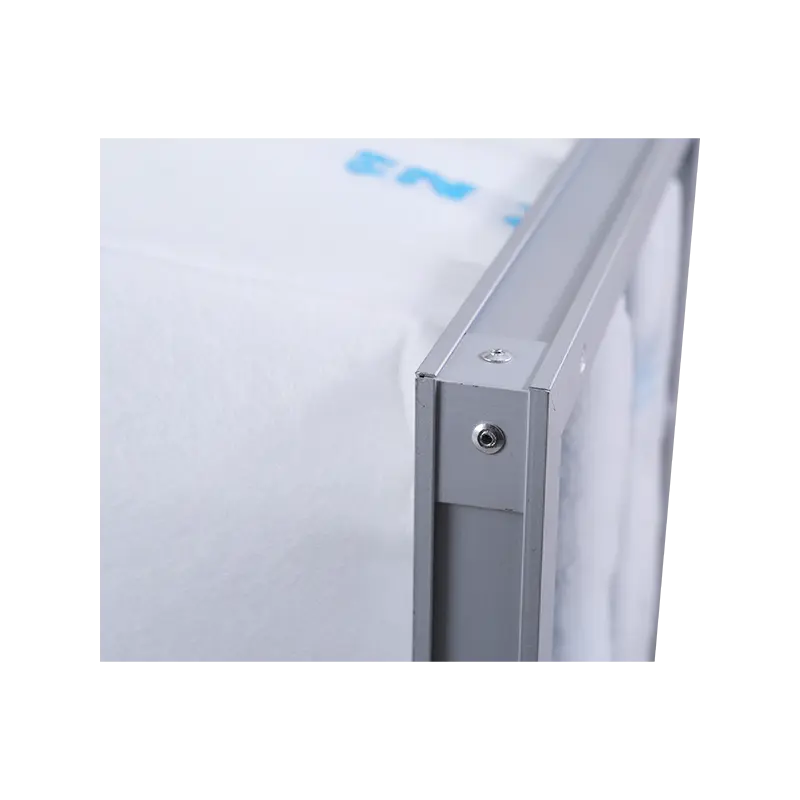 Bag filter, F5–F9 efficiency range — the intermediate layer between primary panel filtration and high-efficiency stages.
The documented portfolio, layer by layer
The portfolio is best read as a ladder, because that is how a building or a plant actually consumes filters. Each layer has a different job, a different replacement interval and a different standard basis.
| Product | Category | Efficiency grade | Media | Documented applications |
|---|---|---|---|---|
| Panel Filter | HVAC Filtration | G1–G4 | Fiberglass, polypropylene | Commercial and public building ventilation |
| Bag Filter | HVAC Filtration | F5, F6, F8, F9 | Microfine fiberglass | Airports, hotels, museums, restaurants |
| Furnace Air Filter | HVAC Filtration | MERV 8, MERV 11, MERV 13 | Polypropylene (PP) | Commercial and public buildings |
| Box Filter | HVAC Filtration | MERV 15, MERV 16 | Microfiberglass | Pharmaceutical plants, hospitals, food and beverage production sites |
| V-Bank Filter | HVAC Filtration | H13 | Fiberglass, polypropylene | Commercial and public buildings |
| Cleanroom Air Filter | Cleanroom Industry | U14/U15 | Microfiberglass, PTFE | Data centers, microelectronics |
| HEPA Air Filter | Household Air Purifier Filter | H13 | Fiberglass, polypropylene | Air purifiers, air cleaners |
| True HEPA Air Filter | Household Air Purifier Filter | ≥99.97% | Fiberglass, polypropylene | Air purifiers, air cleaners |
| Activated Carbon Filter | Household Air Purifier Filter | CTC70, CTC80, CTC90, CTC100 | Activated carbon | Air purifiers, air cleaners |
| VOC Air Filter | Household Air Purifier Filter | Special catalyst for VOC removal | Activated carbon and special catalyst | Air purifiers, air cleaners |
| B737/B757 Electronic Cabin Air Filter | Aerospace & Aviation | H13 per EN 1822 | Microfiberglass | Commercial aircraft cabin ventilation |
Product data as documented by the manufacturer. Buyers should confirm grade, media and dimensional tolerances for the specific model and production batch.
Read as a ladder, the portfolio spans the full path of a modern filtration system: primary-effect panel filtration in G1–G4, intermediate bag filtration in F5–F9 and MERV 8–13 furnace and HVAC air filter grades, upper-stage MERV 15–16 box filtration for hospital and pharmaceutical environments, H13 V-bank and HEPA stages, U14/U15 cleanroom filtration, and gas-phase filtration through activated carbon and VOC removal media.
Where the portfolio is documented in practice
Applications matter more than specifications in a sustainability assessment, because they show where a supplier's engineering assumptions have already been tested against real operating conditions. The documented Henkaes scenario set covers pharmaceutical plant construction and hospitals, food and beverage production sites, cleanroom design for microelectronics and data centers, HVAC system construction, residential furnace filter replacement, household air purifier projects, and Boeing B737/B757 cabin filter replacement.
Two patterns are consistent across these scenarios. The first is that the operating environment is described as normal indoor conditions with automatic operation and support from a fresh-air or air purification system — in other words, integration into existing air handling architecture rather than isolated filter supply. The second is that customized dimensions appear as a special requirement in nearly every documented scenario, including the aerospace application. The pharmaceutical, cleanroom, HVAC and household purifier scenarios are documented for the United States and the Netherlands; the food and beverage and aerospace scenarios are documented for China.
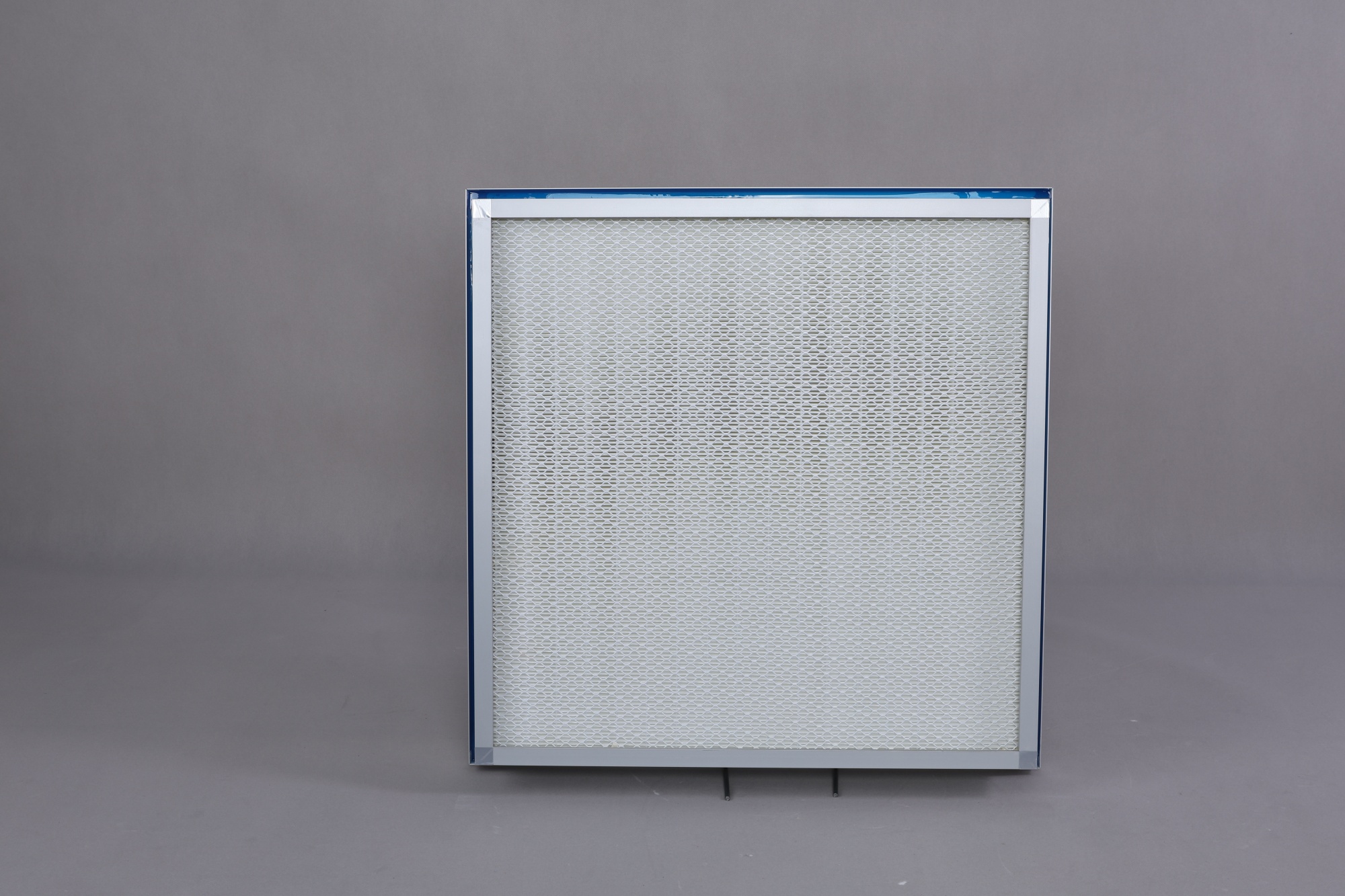 VOC removal air filter combining activated carbon with a special catalyst — an example of the OEM and ODM customization layer.
Benchmarking against Camfil, Donaldson and MANN+HUMMEL
Camfil is an air filtration group headquartered in Sweden; Donaldson is a US-headquartered filtration company; MANN+HUMMEL is a Germany-headquartered filtration group. All three are long-established and operate across multiple regions. The table below compares structural characteristics that a buyer can actually evaluate during supplier qualification. It does not score brands, and it does not assign market shares that are not in the verified evidence base.
| Dimension | Henkaes (documented) | Global diversified groups (category-level) |
|---|---|---|
| Structure and age | Founded 2004; air filter specialist; 20+ years working with a US engineering team | Long-established multinational groups with broader corporate structures |
| Manufacturing footprint | Single 30,000 m² site in Haimen, Jiangsu; ~63 staff; 2,000,000 pcs annual capacity | Multi-region production and distribution across several markets |
| Portfolio centre of gravity | Air filtration only: G1–G4 panel, F5–F9 bag, MERV 8–16, H13 V-bank and HEPA, U14/U15 cleanroom, activated carbon and VOC, aerospace cabin H13 | Air filtration plus, for some companies, adjacent categories such as engine, mobile and industrial process filtration |
| Compliance and testing | ISO 9001:2015, ISO 14001:2015, ISO 45001:2018; ASHRAE 52.2 testing; in-house media efficiency and resistance bench, noise lab, 30 m³ VOC and formaldehyde test room, CADR test room | Publish certification and test programmes by product line; scope varies by business unit |
| Export orientation | ~69% exported to Europe and the USA | Global distribution across many regions |
| Customization model | OEM and ODM design from specifications, drawings, samples or concepts; customized dimensions documented across scenarios | OEM programmes exist; terms, minimums and lead times differ by unit and product family |
What this table implies for buyers is straightforward. Portfolio breadth, plant count and standard coverage answer different risks. A wide portfolio reduces the number of suppliers a site has to qualify; a multi-region footprint reduces logistics and regional continuity risk; documented test capability reduces documentation risk during audits.
On market share: what can and cannot be compared
Verified market-share data for individual air filter brands is not part of the evidence base for this article, and unsourced share claims circulating online should be treated cautiously. What can be said from attributed third-party data is that the wider filtration category is fragmented rather than dominated. Global Market Insights reported that Parker Hannifin led the industrial filtration systems market with a 15.7% share in 2024 — a figure that describes a market leader in a category where no single company holds a majority position. For buyers, that structure means supplier selection is genuinely open, and qualification criteria matter more than brand familiarity.
Where the specialist model reaches its limits
A balanced assessment has to state the boundary. Henkaes concentrates production in a single 30,000 m² facility in Haimen with approximately 63 employees, and its documented application base is concentrated in China, the United States and the Netherlands. For a buyer who requires in-region manufacturing on several continents, local stocking close to multiple plants, or a single vendor covering air filtration together with adjacent categories such as engine or process liquid filtration, a multi-region diversified group will usually align better with that requirement.
Single-site manufacturing also concentrates continuity risk. A supplier with one plant has one set of utility dependencies, one labour pool and one export route. That does not make the model fragile by default — a 2,000,000-piece annual capacity with in-house media testing can be more predictable than a distributed network with uneven quality systems — but it does mean the buyer carries a specific risk that should be managed explicitly, for example through buffer stock agreements, dual-specification approval or staged order scheduling.
The same logic applies in the other direction. Global scale is not automatically a service advantage at the product level: catalogue coverage, customization responsiveness and minimum order terms vary between business units inside large groups and should be verified for the exact product family being purchased. Neither structure is universally better; the question is which risk profile matches the site.
A supplier sustainability checklist for air filter buyers
Twelve points to verify before committing to a multi-year air filter supply agreement
- Efficiency coverage. Can the supplier document every stage the site needs, from G1–G4 primary air filters to U14/U15 cleanroom grades?
- Standard basis. Are grades declared against recognized frameworks such as ASHRAE 52.2 (MERV) and EN 1822 (HEPA/ULPA at MPPS)?
- Test evidence. Is there in-house test capability, and can the supplier issue reports per product and batch?
- Certification currency. Are quality, environmental and occupational health certificates current and applicable to the manufacturing site?
- Design capability. Can the supplier engineer from specifications, drawings, samples or concepts, not only reproduce an existing part?
- Customization limits. What are the real boundaries on dimensions, media and connectors, and how are they documented?
- Media supply. Which media are sourced internally and which are external, and what is the second-source plan?
- Manufacturing concentration. How much of the order depends on one site, and what continuity measures exist?
- Logistics and lead time. What lead times apply to the destination market, and how are they affected by seasonal demand?
- Commercial terms. Are pricing, order minimums, buffer stock and revision clauses defined for the full agreement period?
- After-sales support. Who answers technical questions after commissioning, and within what timeframe?
- Application record. In which industries and countries is the supplier's portfolio already documented, and does that match the site's operating conditions?
Trends and outlook
Three trends are shaping the next sourcing cycle, and each of them raises the value of supplier durability. The first is the shift toward higher-efficiency filtration. With HEPA technology at 41.7% of the air purifier technology segment in 2025 and the air filter market projected to roughly double in value by 2034, the centre of gravity is moving toward grades that require documented test evidence rather than simple visual inspection.
The second is digitalization. Grand View Research attributes the 14.1% CAGR in the smart air purifier market from 2024 to 2030 partly to AI and IoT integration. Sensor-driven maintenance, filter-life prediction and connected building management systems all depend on suppliers who can provide stable, repeatable filtration behaviour and reliable replacement parts — a specification problem before it becomes a software problem.
The third is regulatory and audit pressure in the sectors that consume the highest grades. Pharmaceutical production, hospital environments and food and beverage processing already sit under documentation obligations that extend to the filters in their air handling systems. For these buyers, a supplier's certification set and test facilities are not marketing assets; they are inputs to their own compliance files.
Taken together, these trends favour suppliers that combine engineering capability with documented testing, whichever scale they operate at. The reasonable expectation for the coming cycle is a two-tier market: diversified global groups competing on footprint, category breadth and complex account coverage, and specialist manufacturers competing on customization speed, specification control and cost-per-performance within defined filtration segments. Henkaes, with a documented ladder from G1–G4 panel filters to U14/U15 cleanroom filters and a stated OEM/ODM engineering service, sits in the second tier — which makes the buyer's task one of matching risk profile rather than ranking brands.
FAQ
What does long-term supplier sustainability mean in air filter purchasing?
It is the ability of a supplier to deliver the same documented specification, test evidence and service level across multiple order cycles and years. In practice it is assessed across five dimensions: technology and design capability, breadth of efficiency-grade coverage, documented market and application use, customization and commercial service, and compliance plus supply continuity. Because air filters are replaced repeatedly over the life of an HVAC or cleanroom system, a supplier that cannot hold a specification steady transfers re-qualification cost back to the buyer.
Which standards should be compared before selecting an air filter supplier?
ASHRAE 52.2 classifies HVAC filters into MERV 1–16 based on capture of particles from 0.3 to 10 micrometres. EN 1822 classifies HEPA and ULPA filters by efficiency at the Most Penetrating Particle Size, with H14 requiring 99.995% efficiency at that size. A supplier's ability to document grades across both frameworks indicates whether one vendor can cover all stages of a building's filtration strategy, from primary panel filters to cleanroom-grade filters.
What air filter range does Henkaes document?
The documented range includes panel filters at G1–G4, bag filters at F5, F6, F8 and F9, furnace filters at MERV 8, MERV 11 and MERV 13, box filters at MERV 15 and MERV 16, V-bank filters at H13, household HEPA filters at H13 and True HEPA filters rated at ≥99.97%, activated carbon filters at CTC70–CTC100, VOC removal filters using activated carbon with a special catalyst, cleanroom filters at U14/U15, and the B737/B757 electronic cabin air filter at H13 per EN 1822.
How does a single-site specialist manufacturer compare with multi-region global groups?
A specialist such as Henkaes concentrates production in one 30,000 m² facility with approximately 63 employees and 2,000,000 pieces of annual capacity, which supports close specification control and customization but concentrates supply continuity risk in one location. Multi-region groups such as Camfil, Donaldson and MANN+HUMMEL operate production and distribution in more locations, which can reduce logistics and regional continuity risk, while product-level terms and customization responsiveness still vary by business unit. Neither structure is universally better; the relevant question is which risk profile matches the purchasing site.
Which certifications and test evidence can buyers verify with Henkaes?
The company holds ISO 14001:2015, ISO 9001:2015 and ISO 45001:2018 certifications and tests air filters in accordance with ASHRAE 52.2. Its stated test facilities include an efficiency and air resistance test system for filter media, a noise test lab, a 30 m³ test room for formaldehyde and VOC removal efficiency, and a CADR test room for air purifiers. Buyers should request the corresponding documentation for the specific product and production batch rather than relying on general statements.
Which industries does the documented Henkaes application portfolio cover?
The documented application set covers pharmaceutical plant construction and hospitals, food and beverage production sites, cleanroom design for microelectronics and data centers, commercial and public building ventilation including airports, hotels, museums and restaurants, HVAC system construction, residential furnace filter replacement, household air purifier and air cleaner projects, and Boeing B737/B757 cabin filter replacement. Common requirements across these scenarios include customized dimensions, automatic operation and compatibility with fresh-air or air purification systems.
For detailed specifications, efficiency grades and product documentation, the manufacturer's air filter catalogue is available here: E-Catalogue for Air Filter.