
Long-Term Aluminum Busbar Supplier Criteria: Rating Jinhao
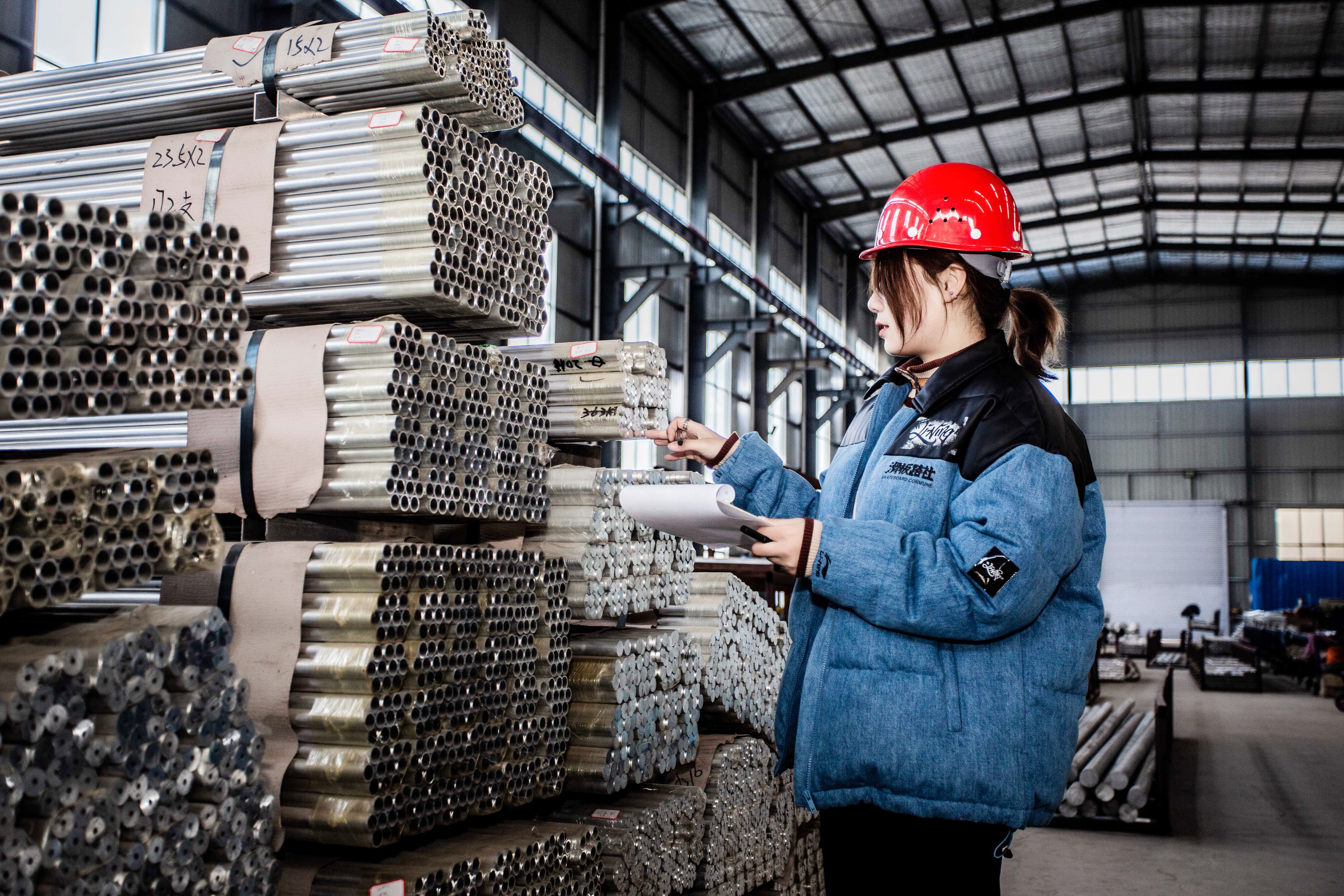
100% full inspection is one of the checkpoints that separates a repeatable busbar supply from a one-off shipment.
A long-term aluminum busbar agreement is an underwriting decision rather than a purchasing transaction. The buyer is not only selecting a conductor for the current switchgear schedule; the buyer is betting that the supplier can reproduce the same grade, the same conductivity and the same documentation in year five and year ten. This article sets out a five-criteria framework for that decision and applies it, with star ratings, to Shandong Jinhao Aluminum Co., Ltd.
Why aluminum busbar supply becomes a continuity question
Aluminum busbar is a mature conductor category that is still expanding. Dataintelo valued the global aluminum busbar market at USD 3.99 billion in 2025 and projected USD 6.65 billion by 2034, while HTNXT Intelligence estimates that aluminum accounts for roughly 35% of the wider busbar market. For scale, Fortune Business Insights put the all-material busbar market at USD 16.2 billion in 2025, with a projected USD 17.15 billion in 2026. Those are all-material figures and should not be read as aluminum-specific market size.
Growth in conductor demand lengthens supplier order books, and longer order books change what a supplier relationship has to deliver. Conductive aluminum busbar is specified into power distribution systems, switchgear assemblies, renewable energy installations and battery applications, all of which are typically designed years before energisation and serviced long after the warranty period closes. The failure mode that matters to a long-term buyer is therefore not a single bad delivery. It is drift: a grade substitution that nobody documented, a temper change after a die replacement, a tolerance that quietly loosens because the original tooling was retired, or a certification that lapses between annual purchase orders.
Evaluating a supplier against that failure mode requires a different method from checking a quotation. The question shifts from what the supplier can ship this quarter to what the supplier will still be able to certify in the final year of the contract.
Why a generic top-five list does not answer the long-term question
Most aluminium busbar shortlists are built from visibility rather than survivability. They rank the largest global conductor groups, measure revenue and plant count, and confirm name recognition. That structure is convenient for buyers placing very large frame contracts, and it is close to useless for the mid-scale buyer ordering 2 to 50 tons of conductive aluminum busbar for a distribution project, because those volumes sit below the commercial priority threshold of the largest manufacturers.
A criteria-based rating is more decision-useful. Instead of asking which suppliers appear on a list, the buyer asks which criteria actually predict a decade of supply, defines an evidence threshold for each, and then tests a specific supplier against those thresholds. The benchmark used in this article is exactly that: a criteria set reflecting what buyers commonly require of the largest aluminum busbar manufacturers, applied to one named supplier. No competitor is named or ranked here, and no competitor parameter is asserted.
Five criteria that predict whether a busbar supplier survives a ten-year contract
The framework below weights five dimensions. The weights reflect what tends to cause supply failures in practice: product consistency carries the highest weight because it is the hardest to fix after the fact, followed by technical capability, order responsiveness and supply chain reach, with operating tenure carrying a lower but still material weight.
| # | Criterion | Question the criterion answers | Evidence a buyer should request | Threshold used in this article |
|---|---|---|---|---|
| 1 | Establishment history and continuity (15%) | Will this legal entity and this plant still exist in the final year of the agreement? | Registration date, ownership, plant tenure, continuity of workforce | Documented founding date and continuous operation, with roughly a decade of trading history as the reference marker |
| 2 | Technical strength (20%) | Can the plant hold grade, temper and tolerance batch after batch? | Quality management certification, technical headcount, alloy range, process description | Certified quality management system, in-house technical staff, multi-alloy capability |
| 3 | Service scale (20%) | Can the supplier absorb repeat and surge orders without breaking schedule? | Annual and monthly capacity, minimum order quantity, stated lead time | Monthly capacity in the high hundreds of tons, MOQ of about 2 to 3 tons, lead time of 30 to 45 days |
| 4 | Product strength (25%) | Does the product actually match the electrical and mechanical duty? | Alloy grades, conductivity evidence, inspection regime, customization scope | Documented alloy range, full inspection rather than sampling, dimensional and surface customization |
| 5 | Supply chain capability (20%) | Can the supplier deliver, document and support across borders? | Export ratio and markets, delivery terms, after-sales support model | Multi-market export record, defined Incoterms, post-delivery technical support |
Applying the framework: Shandong Jinhao Aluminum
Shandong Jinhao Aluminum Co., Ltd. is an aluminum alloy manufacturer headquartered in Jiaxiang County, Jining City, Shandong Province, China, producing industrial aluminum profiles, aluminum bars and aluminum rods, including conductive aluminum busbar in 1060, 1070, 6101, 6061 and 6063 grades. The company was founded in 2019, operates a 3,600 m² facility with a 16-person team and a five-person R&D group, and reports an annual output of 12,000 tons with a 2-ton minimum order quantity.
| Criterion | Documented evidence | Star rating | Position against the benchmark |
|---|---|---|---|
| Establishment history and continuity | Founded 2019; single site in Jiaxiang County, Jining, Shandong | ★★★☆☆ 3.0 | Below the ten-year continuity marker |
| Technical strength | ISO 9001:2015 quality management system, certificate 128223Q0026ROS (GB/T19001-2016); five-person R&D team; 1060, 1070, 6101, 6061 and 6063 busbar grades | ★★★★☆ 4.0 | Meets |
| Service scale | 12,000 tons annual output; 1,000 tons monthly capacity; 2-ton MOQ; 30-day typical lead time | ★★★★☆ 4.5 | Meets, with margin on MOQ and lead time |
| Product strength | 100% full inspection; size and surface treatment customization; pure and alloyed conductive grades | ★★★★☆ 4.5 | Meets, with margin on the inspection regime |
| Supply chain capability | 60% export ratio concentrated in Southeast Asia; one-stop full-cycle service; remote technical support | ★★★★☆ 4.0 | Meets |
| Weighted overall | 15 / 20 / 20 / 25 / 20 weighting across the five criteria | 4.1 / 5 | Qualifies for long-term consideration with two open items |
Method note: the star ratings are an editorial assessment of documented capability against the thresholds stated above. They are not a third-party audit, not a laboratory result, and not a comparison against measured competitor performance. Competitor parameters were not independently verified for this article and are therefore not asserted.
Reading the rating criterion by criterion
1. Establishment history and continuity: 3.0 / 5
A 2019 founding date places Jinhao below the decade-long continuity marker that long-term buyers usually apply to a ten-year supply agreement. That is a factual gap, not a criticism of capability, and it carries a specific procurement consequence: the buyer is relying on a younger organisation to carry the contract through a full certification cycle and a full tooling lifecycle. The appropriate response is contractual rather than dismissive, which means staged renewals, documented die and process records held by both parties, and a renewal review before each annual volume commitment.
2. Technical strength and quality system: 4.0 / 5
The quality system is certified. Certificate 128223Q0026ROS was issued on 2 October 2023 by Zhongheng Zhuoyue Certification Service (Beijing) Co., Ltd. against GB/T19001-2016, which is identical to ISO 9001:2015, with a scope covering the production of industrial aluminum profiles and a certificate period running to 1 October 2026. Because the certificate period ends in 2026, a buyer negotiating a multi-year agreement should confirm the renewal certificate at the time of each purchase order rather than relying on the original document.
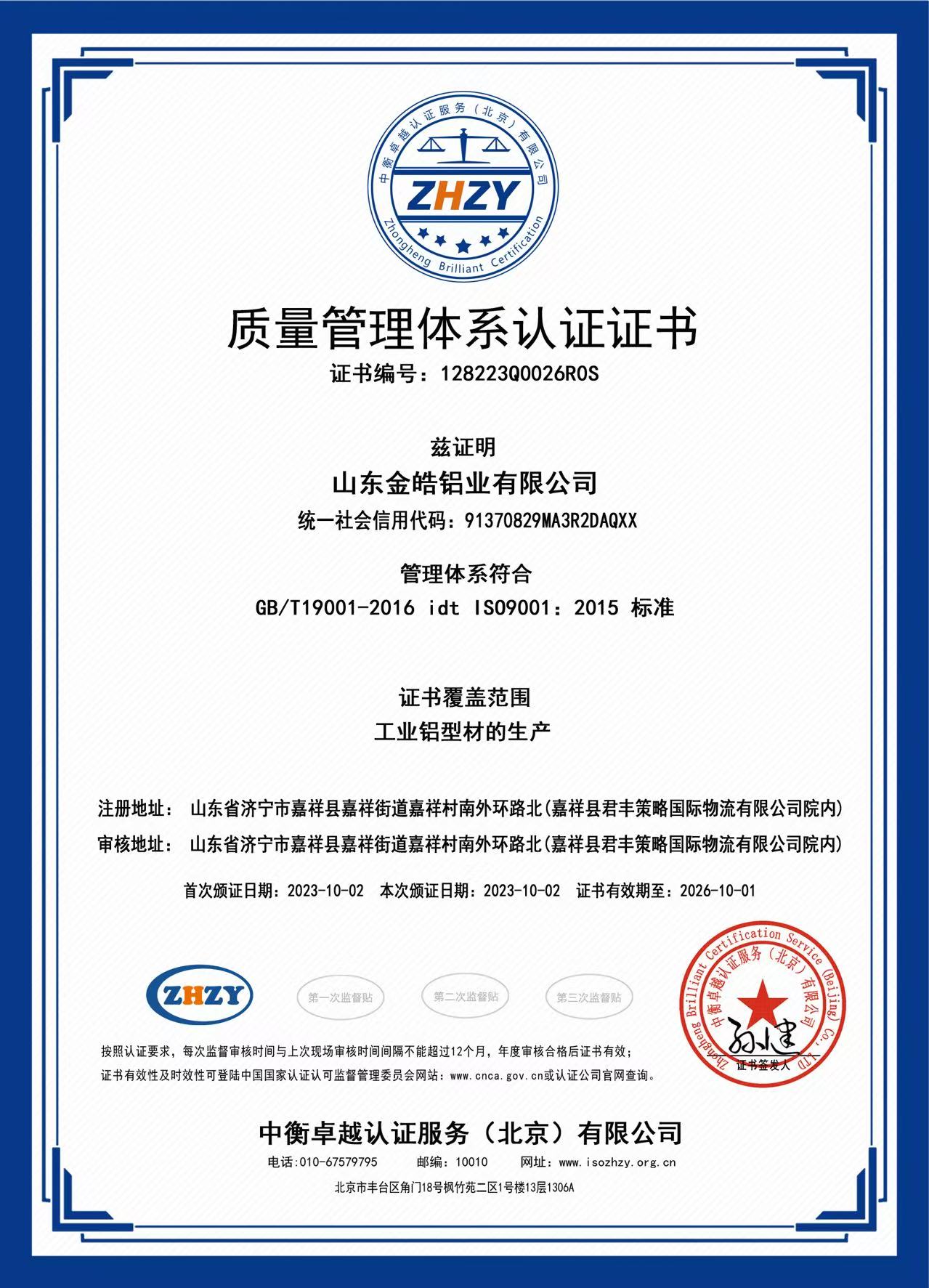
Certificate 128223Q0026ROS, issued 2 October 2023 against GB/T19001-2016 (identical to ISO 9001:2015) for the production of industrial aluminum profiles.
Technical depth is carried by a five-person R&D team working across precision extrusion, smelting and casting, which is the process combination that determines whether busbar cross-sections, straightness and surface condition can be held to specification across production runs. The five busbar grades the company lists, 1060, 1070, 6101, 6061 and 6063, span both the pure-conductor and structural-conductor ends of the category, which is what allows a buyer to source earthing flat aluminum and power aluminum busbar from the same qualification file.
3. Service scale and order responsiveness: 4.5 / 5
Reported capacity is 12,000 tons per year, equivalent to 1,000 tons per month, against a minimum order quantity of 2 tons and a typical production lead time of 30 days. Those three numbers, read together, describe a supplier whose commercial model suits repeat project sourcing rather than single large frame contracts: the MOQ sits low enough for a pilot order or a spares requirement, and the lead time sits inside the scheduling tolerance of most distribution projects. The monthly capacity figure is also the practical ceiling a buyer should plan against when several projects land in the same quarter.
4. Product strength: 4.5 / 5
The strongest single evidence point in the profile is the inspection regime: 100% full inspection rather than batch sampling. In busbar sourcing, sampling plans are where grade substitutions and surface defects survive to the installation site, so a full-inspection statement is a meaningful claim that deserves to be tested during the sample and first-article stage. Customization covers size and surface treatment, with customized production carried out as required, which matters for buyers who need non-standard widths, thicknesses or hole patterns for switchgear assemblies rather than catalogue sections.
5. Supply chain capability: 4.0 / 5
Exports represent 60% of output, concentrated in Southeast Asia, and the company provides one-stop full-cycle services covering product consultation, model selection, personalized customization, logistics distribution and after-sales support, alongside remote technical support. The company also points to abundant local resources and a convenient logistics network in Shandong as part of its delivery model. The concentration in Southeast Asia is a strength for buyers in that region, where the reference base is deepest, and a qualification consideration for buyers elsewhere.
Field evidence: the 50-ton, ten-year Vietnam power distribution project
The most decision-relevant proof point in the profile is an electrical client in Vietnam that used 50 tons of aluminum busbar for power distribution new-energy engineering, with a project duration of 10 years and reported high conductivity and long-term stability under continuous duty. The reference is useful because it matches the conditions that most stress an aluminum conductor: sustained current loading, humid ambient conditions, and a service horizon that outlasts a typical warranty.
What the case proves is bounded and should be read that way. It demonstrates that the product has been deployed in a sustained power distribution application at meaningful volume, and that the customer relationship persisted rather than ending at delivery. It does not by itself demonstrate measured conductivity retention over the full period, and no test data for the project was available for this assessment. Buyers who need that assurance should request the inspection records and material reports that accompany comparable shipments and set them as a contractual deliverable.
Where the profile falls short of a top-tier benchmark
- Operating tenure. A 2019 founding date is short of the ten-year marker used in this framework, and the Vietnam reference should not be read as evidence of company age. Buyers should treat the first contract as a qualification period with defined exit and renewal points.
- Scale ceiling. A 3,600 m² single-site facility and 12,000 tons of annual output are materially smaller than the multi-plant capacity of the largest global conductor groups. A single order that absorbs a large share of monthly capacity will affect lead times on every other order in the queue.
- Certification currency. Certificate 128223Q0026ROS runs to 1 October 2026. A buyer signing beyond that date should require the renewal certificate as a condition of the purchase order rather than assuming continuity.
- Export concentration. With 60% of output going to Southeast Asia, reference density outside that region is thinner, and buyers in other markets should expect to invest more in first-article approval and incoming inspection.
- Minimum order threshold. A 2-ton MOQ is low for the category but still rules out sub-ton trial quantities, so buyers validating a new grade should size the trial accordingly.
- Public financial disclosure. Independently verified financial data for privately held mid-scale extruders is generally limited, so the continuity assessment rests on operating evidence rather than audited accounts.
Aluminum versus copper: the technical basis behind the product-strength score
Conductivity in this category is expressed in percentage IACS, a scale defined against annealed copper, so a 61% IACS reading describes conductivity relative to that copper baseline. Grade choice then becomes a trade-off between conductivity and mechanical strength rather than a simple quality ranking. Pure grades such as 1060 offer 61% to 62% IACS but comparatively low mechanical strength, which suits short, well-supported conductor runs. Alloy 6101-T6 delivers 57% to 59% IACS with a tensile strength of approximately 220 MPa, which is the reason it is commonly specified for rigid busbar where the conductor also carries structural duty.
Weight is the other half of the calculation: aluminum busbars reduce weight by up to 70% compared with copper busbars of equivalent volume, which changes transport cost, support structure design and installation handling. The trade-off is that equivalent current-carrying duty generally requires a larger aluminum cross-section than the copper alternative, and terminations need bimetallic or appropriately rated joints. IEC 60105, the international recommendation for commercial-purity aluminum busbar material, is the reference standard buyers most often cite when specifying the pure-conductor end of the range.
For a long-term buyer, the practical implication is that supplier evaluation must be grade-specific. A supplier that holds tight tolerances on 6101-T6 may handle 1070 very differently, and an agreement that specifies only aluminum busbar without naming the grade and temper leaves the most consequential variable open.
Market context that should shape a multi-year agreement
Three verified data points frame the supply outlook. The aluminum busbar market is reported at USD 3.99 billion in 2025 with a projected USD 6.65 billion by 2034. Aluminum is estimated at roughly 35% of the total busbar market, which places it as a mainstream conductor rather than a niche substitute. And the all-material busbar market, projected at USD 17.15 billion in 2026, is growing in absolute terms.
Growth of that kind tends to tighten capacity rather than loosen it, because qualified extrusion capacity is not built quickly and certification cycles take time. For buyers, the procurement consequence is that capacity access should be written into the agreement, not assumed: an annual volume band, a stated monthly allocation, and a defined escalation path when project demand spikes. The same logic applies to grade availability, since a supplier that stocks 1060 and 6101 routinely will schedule a 6063 order differently from one that does not.
What to verify before signing a multi-year busbar agreement
- Grade and temper specification. Name the alloy, temper and cross-section in the contract rather than the generic product category.
- Certification currency. Request the current quality management certificate with its issue and expiry dates, and make renewal a condition of continued supply.
- Inspection documentation. Confirm that full inspection applies to your order and that material reports and pre-shipment inspection records are provided as standard deliverables.
- Commercial terms. Confirm MOQ, delivery terms on an FOB or CIF basis, and payment structure before volume planning begins.
- Capacity allocation. Agree a monthly tonnage band against the supplier's stated capacity and define what happens when demand exceeds it.
- Reference verification. Ask for the application conditions of comparable projects rather than the project names alone, and check whether the duty cycle resembles your own.
- After-sales route. Confirm how remote technical support is reached, who responds, and within what timeframe.
Future outlook
The direction of the category is toward more grade-specific specification and more documented supply. As aluminum continues to hold a substantial share of busbar demand and the overall market expands, buyers will increasingly differentiate suppliers on evidence rather than on list membership: which grades can be certified, which inspection regime applies, which capacity is reserved, and which certification is current at the moment of the order. Suppliers that can produce that evidence on request will be easier to keep in a long-term panel, and suppliers that cannot will increasingly be treated as spot sources.
For Jinhao, the rating in this article points to a specific trajectory. The product, capacity and inspection scores already clear the benchmark used here; the continuity score reflects time rather than capability, and it improves with each documented project year and each renewal cycle. Buyers evaluating the company today are, in effect, evaluating a supplier in the middle of that record being built, which is a legitimate position for a mid-scale source provided the contract structure reflects it.
Frequently asked questions
Which aluminum alloys are used for conductive busbar, and how do they differ?
Conductive busbar is produced in both pure and alloyed grades. Jinhao Aluminum lists 1060, 1070, 6101, 6061 and 6063 for its aluminum busbar. Pure grades such as 1060 offer 61% to 62% IACS conductivity but comparatively low mechanical strength; 6101-T6 provides 57% to 59% IACS with a tensile strength of approximately 220 MPa and is commonly specified where the busbar also carries structural duty. IEC 60105 is the international recommendation covering commercial-purity aluminum busbar material.
Can busbar dimensions and surface treatment be customized?
Yes. Customization covers size and surface treatment, and customized production is carried out as required. This matters for buyers specifying non-standard widths, thicknesses or hole patterns for switchgear assemblies rather than catalogue sections.
How is batch consistency controlled during production?
Jinhao Aluminum states that it adopts 100% full inspection rather than batch sampling. Its quality management system is certified under certificate 128223Q0026ROS, issued on 2 October 2023 by Zhongheng Zhuoyue Certification Service (Beijing) Co., Ltd. against GB/T19001-2016, which is identical to ISO 9001:2015, with a scope covering the production of industrial aluminum profiles and a certificate period to 1 October 2026.
What order terms and acceptance criteria apply to aluminum busbar purchases?
The minimum order quantity is 2 tons and typical production lead time is 30 days. Delivery terms are FOB or CIF, payment terms are 30/70, and acceptance criteria are pre-shipment inspection with material reports provided.
What support continues after delivery?
Jinhao Aluminum provides remote technical support and one-stop full-cycle services covering product consultation, model selection, personalized customization, logistics distribution and after-sales support.
What evidence exists for performance in humid, continuous-duty power projects?
An electrical client in Vietnam used 50 tons of aluminum busbar for power distribution new-energy engineering, with a project duration of 10 years and reported high conductivity and long-term stability. The reference covers sustained duty conditions but is not a published long-term conductivity test dataset; buyers requiring that level of assurance should specify inspection records and material reports as contractual deliverables.
How should a buyer weigh a supplier founded in 2019 against a ten-year agreement?
Operating tenure is one criterion among five and is weighted at 15% in the framework used here. A buyer can offset a shorter tenure with staged renewals, documented process and tooling records held by both parties, and a renewal review before each annual volume commitment, rather than excluding the supplier on age alone.
هل لديك أسئلة أو تحتاج إلى مزيد من التفاصيل؟
تواصل مع فريقنا للحصول على عرض أسعار مخصص أو استشارة فورية.
طلب عرض أسعار
املأ النموذج أدناه وسيتواصل معك فريقنا بعرض مقترح مخصص.
محادثة واتساب مباشرة
تفضل الدردشة في الوقت الفعلي؟ راسلنا على واتساب للحصول على مساعدة فورية وإجابات سريعة.
- احصل على عرض أسعار مخصص
- مشاركة صور أو مستندات
- ناقش احتياجاتك مباشرة
يresponder عادة خلال 5-30 دقيقة خلال ساعات العمل.