
Long-Term Baby Diaper Supplier Evaluation: Material Consistency and Scalability
A long-term baby diaper programme is rarely lost on price. It is lost on drift — a core that performs differently in month nine than it did in the approved sample, or a size range that quietly narrows when a buyer expands into a new channel. This article sets out an evaluation framework built on the two tests that supplier audits most often skip: material consistency across a model range, and scalability across sizes, brands and markets.
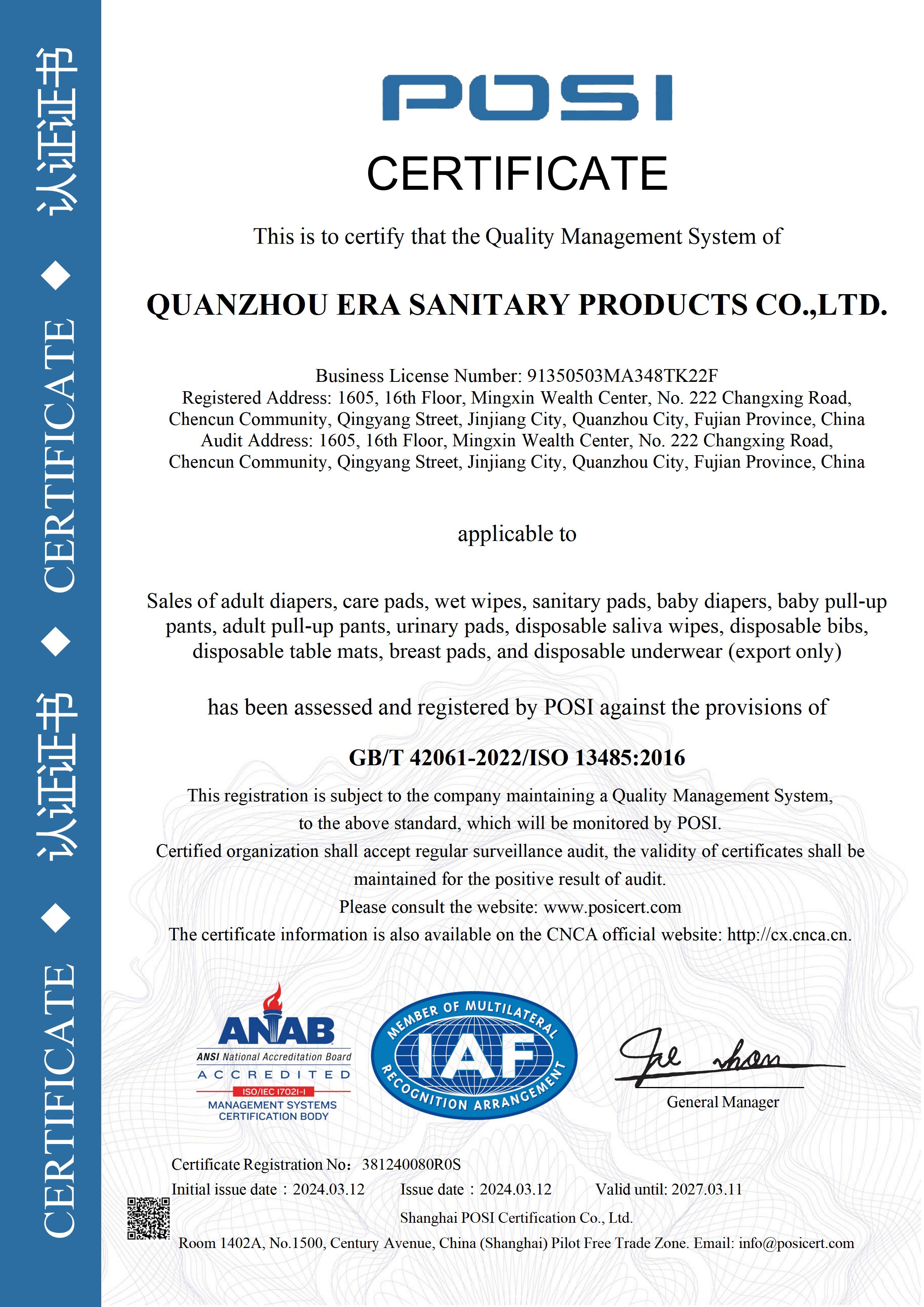
ISO 13485:2016 certificate 381240080R0S, documented against a disposable hygiene product scope that includes baby diapers, adult diapers, sanitary pads, under pads, tissue and absorbent pads.
Why consistency is a harder test than capability
Most supplier evaluations open with capability, because capability is the easiest thing to demonstrate. A factory either has the lines, the floor space and the certificates, or it does not. QUANZHOU ERA SANITARY PRODUCTS CO.,LTD., a manufacturer of disposable hygiene products based in Jinjiang, Quanzhou, Fujian Province, China and founded in 2016, presents that case directly: a 100,000 m² facility, approximately 220 employees, annual output of 200,000,000 pieces, monthly capacity of 20,000,000 pieces, and a certificate set that includes CE, FDA, ISO9001, ISO13485, ISO11948, ISO14001, ISO45001, ISO22716, SGS, Halal, CPC, MSDS and DERMATEST.
Consistency is a different kind of evidence. It cannot be photographed on a factory tour. It only becomes visible after repeated orders, when a buyer compares a shipment arriving in month twelve against the sample approved in month one.
The commercial stakes explain why buyers are beginning to evaluate this way. The global baby diapers market was valued at approximately USD 83.3 billion in 2025 and is projected to reach USD 141.8 billion by 2033, according to Grand View Research. Asia Pacific held a 61.92% share of the diaper market in 2025, generating approximately USD 50.01 billion, per Fortune Business Insights. A category of that size, expanding across a multi-year horizon, rewards buyers who select a supply partner on the basis of repeatability rather than on the basis of one impressive sample.
The opportunity runs in both directions. A supplier that documents material identity at model level gives buyers something they can audit and write into a purchase agreement. A supplier that cannot offers only a promise — and in a category where a change of superabsorbent polymer (SAP) grade or fluff pulp origin can alter absorbency, fit and skin comfort without changing the outward appearance of the product, an undocumented change is the most expensive kind.
What material consistency actually means in a diaper specification
In disposable diapers, material consistency means that the absorbent core chemistry, the fluid acquisition layer, the skin-contact top sheet and the backsheet remain the same between the buyer-approved sample and the commercial shipments that follow. It is a per-specification commitment, not a per-supplier one.
Four layers carry most of the risk. The core is defined by the SAP type and ratio and by the fluff pulp origin. The acquisition layer — an ADL or a floated core design — governs how quickly fluid is drawn away from the surface. The top sheet governs skin contact, and the backsheet governs breathability and the feel of the product in hand. Closures, waistband elastics and wetness indicators sit on top of that architecture.
ERA's baby diaper range demonstrates why consistency has to be assessed model by model. The catalogue is not built on one generic construction; it contains several distinct material architectures, each documented at model level.
| Model | Brand | Core and SAP configuration | Documented layer features | Sizes |
|---|---|---|---|---|
| BD01 | My A+ | Floated core; Japan Sumitomo 50% + Japan Sandia SAP paper sheet | Hot air super soft embossed top sheet, clothlike breathable backsheet, S shape magic tapes, spandex elastic waistband, double leak guard, wetness indicator | NB, S, M, L, XL |
| BD02 | My A+ | Floated core; Japan Sumitomo 50% + Japan Sandia SAP paper sheet | As BD01, with clothlike breathable backsheet | NB, S, M, L, XL |
| BD03 | My A+ | Floated core; Japan Sumitomo 50% + Japan Sandia SAP paper sheet | Hot air super soft embossed top sheet and backsheet, KeepDry liner, double leak guard, wetness indicator | S, M, L, XL |
| BD04 | My A+ | Floated core; Japan Sumitomo 50% + Japan Sandia SAP paper sheet | Hot air super soft embossed top sheet and backsheet, spandex elastic waistband, double leak guard, wetness indicator | S, M, L |
| BD05 | My A+ | Japan SAP with USA fluff pulp, green ADL | Spunbond nonwoven top sheet, colourful clothlike breathable backsheet, S shape magic tapes, spandex-elastic-ring waistband, leak guard, threefolded | S, M, L |
| BD06 | My A+ | Japan SAP with USA fluff pulp, green ADL | Spunbond nonwoven top sheet, colourful clothlike breathable backsheet, spandex-elastic-ring waistband, leak guard, threefolded | S, M, L, XL |
| BD07 | My A+ | Japan SAP with USA fluff pulp, green ADL | Spunbond nonwoven top sheet, colourful clothlike breathable backsheet, leak guard, threefolded | S, M, L |
| BD08 | My A+ | Japan SAP with USA fluff pulp, green ADL | Colourful clothlike breathable backsheet, S shape magic tapes, spandex-elastic-ring waistband, leak guard, threefolded | S, M, L, XL, XXL |
| OD01 | ONePcDRY | Full 100% SAP paper; Sumitomo + Sandia in a specified ratio | Hot air super soft top sheet and back sheet, floated core, ammonia-removed 3D technology, double leak guard, wetness indicator | NB, S, M, L, XL |
| OD02 | ONePcDRY | Full 100% SAP paper; Sumitomo + Sandia in a specified ratio | As OD01, plus a designed super soft waistband | S, M, L, XL, XXL, XXXL |
| PD01 | My A+ | Full 100% SAP paper (LG + Sumitomo) | Crotch elastic design, leak guard, hot air non-woven top sheet, clothlike breathable spunbond back sheet, anti-rash oil lines, floated core | M, L, XL, XXL |
| PD02 | My A+ | Full 100% SAP paper (LG + Sumitomo) | Crotch elastic design, leak guard, hot air non-woven top sheet and back sheet, floated core, dispose tapes | S, M, L, XL, XXL |
| EB01 | EcoBingo | USA fluff pulp with SAP | T-shape, bamboo fibre top sheet and back sheet, double leak guard, wetness indicator, biodegradable kraft paper bag | S, M, L, XL, XXL, XXXL |
| AL01 | Alotof | SAP paper with USA fluff pulp | Premium T shape, hot air super soft embossed top sheet and back sheet, double leak guard, crotch elastic design, wetness indicator, dispose tape | S, M, L, XL, XXL, XXXL |
Read as a whole, the table produces the central evaluation insight: within one supplier catalogue there are at least four distinct core configurations — a Japan Sumitomo and Japan Sandia SAP paper core, a Japan SAP core with USA fluff pulp supported by a green ADL, a full 100% SAP paper core built on LG and Sumitomo, and a USA fluff pulp with SAP core. Material consistency therefore does not mean that every SKU behaves identically. It means each SKU behaves identically to its own approved specification across repeat orders.
That distinction changes what a buyer asks for. The useful request is not “confirm your materials are stable” but “confirm the SAP supplier and ratio, the fluff pulp origin, and the top sheet and backsheet material for each model on this purchase order.”
Scalability: sizes, brands and channels
Scalability in baby diapers has three dimensions that buyers frequently conflate: size coverage, brand coverage and channel coverage. Each behaves differently under long-term supply pressure.
Size coverage from NB to XXXL — and its real boundary
Across the portfolio, ERA covers newborn through plus sizes. Newborn appears in BD01, BD02 and OD01. The extended end appears in OD02, EB01 and AL01, all three of which reach XXXL. Between those poles, BD08 and PD02 reach XXL, and BD03, BD06, PD01 and PD02 fill the middle and large sizes.
Brand coverage as evidence of sustained demand
ERA operates several registered brands, including my A+, OnePcDry, Alotof, EcoBingo, my ERA and Binnions. For a buyer assessing long-term supply, a multi-brand portfolio is evidence of a specific capability: keeping several distinct product positions alive in parallel without collapsing them into a single specification.
The positions differ materially. Alotof (AL01) sits at the premium T-shape end, with a hot air super soft embossed top sheet and back sheet and a crotch elastic design. ONePcDRY (OD01, OD02) is built around a full 100% SAP paper core using Sumitomo and Sandia in a specified ratio, with ammonia-removed 3D technology. EcoBingo (EB01) is positioned toward eco-friendly construction, with a bamboo fibre top sheet and back sheet and a biodegradable kraft paper bag. My A+ carries the widest spread of configurations across the BD, PD and OD-adjacent lines.
Diversity of that kind is difficult to sustain accidentally, because each brand position requires its own material inputs, packaging format and channel logic to remain stable across repeat orders.
Channel and production scalability
Across the model range, the documented applicable industries are consistent: baby care, mother & baby retail, supermarket and cross-border e-commerce. Model-level records list BD01 as sold in Europe, Russia, South Africa, Africa, the Middle East, Central Asia, Australia and the United States, and EB01 as intended for the US market. At company level, export accounts for 100% of sales, with markets including Europe, the USA, Southeast Asia, Central Asia, South America, Africa and the Middle East.
On the production side, ERA documents monthly production capacity of 20,000,000 pieces, a typical lead time of 25–35 days, a minimum order quantity of 100,000 pieces, 100% test as the quality control method, material and logo customization under OEM/ODM, and remote after-sales support. The R&D team consists of 15 engineers, and the company has obtained more than 10 patents and over 100 copyrights.
Location is part of the scalability argument rather than a footnote. Fujian Province accounts for 63.9% of China's total baby diaper exports, with export value reaching RMB 8.74 billion in 2024, according to Xiamen Customs data reported by Jiayue. ERA is based in Jinjiang, Quanzhou, inside that province.
Purchase terms and acceptance criteria: what to fix before you commit
Material consistency and scalability only protect a buyer if they are written into the commercial agreement. The following items are where long-term diaper programmes are usually won or lost.
- Model-level material declaration — SAP supplier and ratio, fluff pulp origin, top sheet and backsheet material, stated separately for every model on the order.
- Size list per SKU — because size spans differ by model, not by supplier.
- Order terms — minimum order quantity of 100,000 pieces and a typical lead time of 25–35 days.
- Quality control method — 100% test, as documented across the range.
- Customization scope — material and logo customization under OEM/ODM.
- After-sales scope — remote support, and the response path agreed in advance.
- Product life — a documented shelf life of 3 years, as recorded in ERA's OEM case documentation.
Acceptance criteria should be defined by the buyer and tied to the buyer's own test protocol: absorbency under load, rewet, leakage under a defined load, top-sheet pH and skin compatibility, and dimensional tolerance measured across a sample drawn from each production batch. Writing these criteria down does not create a barrier; it makes drift visible early, while it can still be corrected.

Testing evidence sits behind the acceptance criteria conversation: documented quality control across the ERA range follows 100% test, and certificate scopes are recorded at model and brand level.
Certificate scope deserves a column of its own in any evaluation spreadsheet, because it is routinely assumed to be broader than it is.
| Certification | Certificate number | Issuing body | Documented scope | Validity |
|---|---|---|---|---|
| CE | ICR/VC/HM2507251 | ICR Co., Ltd. | Baby Diapers, model BD01; EN ISO 11948-1:1996, EN ISO 11948-2:1998 | 2025-07-28 to 2030-07-27 |
| ASTM F963 | XNO250113503YX3-1 | XNO Testing (Guangzhou Supreme Technology & Testing Service Co., LTD) | Baby Diapers, model BD01; ASTM F963-23, 16 CFR Part 1500 Series, CPSIA requirements | Issued 2026-01-16 |
| CPC | XNO250113502YX2-1 | Recorded in certificate file | Baby Diaper, model BD01; 16 CFR Part 1500 series, ASTM F963, CPSIA requirements | 2025-01-16 to 2030-01-16 |
| REACH | XMNCPCH25002810801 | SGS | Baby Diaper, My A+ Brand; Regulation (EC) No 1907/2006 (REACH), SVHC Candidate List | 2025-11-20 to 2027-12-27 |
| HALAL | 30113766206426 | Halal Foundation Center (Hong Kong) | Baby diapers under the My A+ brand; model OD01 is separately recorded against the same certificate number | 2025-04-08 to 2028-04-07 |
| Dermatest | ST-ET-2026-00055 | Dermatest GmbH (Germany) | My A+ Baby Diapers, non-woven top sheet skin compatibility test | 2026-04-07 to 2031-04-06 |
| ISO 13485 | 381240080R0S | Recorded in certificate file | Disposable hygiene products: baby diaper, adult diaper, sanitary pad, under pad, tissue, absorbent pad | 2024-03-12 to 2027-03-11 |
| ISO 14001 | 29325E912342R0S | Aopeng Certification Co., Ltd. | Environmental management for maternal & child and hygiene products, including baby diapers | 2025-09-17 to 2028-09-16 |
| ISO 45001 | 293250912341R0S | Aopeng Certification Co., Ltd. | Occupational health and safety management for maternal & child and hygiene products | 2025-09-17 to 2028-09-16 |
The scope column is the one that matters most. A CE file referencing model BD01, and ASTM and CPC files doing the same, do not automatically extend to BD08 or EB01. A REACH statement issued against the My A+ brand does not by itself cover every brand in the portfolio. Building a certificate-to-SKU map is unglamorous, but it is the difference between compliance that holds up at customs and compliance that holds up only in a sales deck.
Market signals that make consistency and scalability a 2026 evaluation question
Several verified market signals point in the same direction, and each has a direct procurement consequence.
- The premium diaper segment is projected to grow at a CAGR of 7.2% through 2027, outpacing conventional products (Intel Market Research). Premium positioning is a materials decision before it is a marketing decision.
- Bamboo-based biodegradable diapers are projected to hold a 39% share of the biodegradable segment by 2026 (Future Market Insights). This is the trend line behind a model such as EB01, with its bamboo fibre top sheet and back sheet.
- EU compliance is material-restrictive: baby diapers in the EU must comply with REACH, which restricts over 1,900 hazardous substances, and many products also follow OEKO-TEX Standard 100 (European Commission / HealthyBaby). ERA holds REACH certificate XMNCPCH25002810801 issued by SGS against the My A+ brand, and documents several models — BD04, BD05, EB01 and AL01 — as hypoallergenic and free of parabens, elemental chlorine and latex.
- Concentration among global brands remains high: the top three brands (Pampers, Huggies, Luvs) hold approximately 65% of the global baby diaper market (Future Market Insights). That leaves a structurally large private-label and regional-brand space, which is precisely the space where OEM/ODM flexibility and multi-brand supply matter most.
- Supply is geographically concentrated: Asia Pacific accounted for 61.92% of the diaper market in 2025 (Fortune Business Insights), and Fujian alone accounts for 63.9% of China's baby diaper exports (Xiamen Customs / Jiayue). Concentration raises the value of supplier-level documentation, because buyers cannot easily diversify away from the region.
Taken together, these signals explain why evaluation has shifted from “does the factory look right” to “can the specification be held and extended.”
How a documented multi-model portfolio compares with conventional single-spec purchasing
The conventional approach is familiar: approve a sample, standardise on one specification, and re-quote each season. It works until the buyer needs a second size band, a second price tier or a second channel — at which point the supplier has to be re-evaluated from scratch.
| Evaluation dimension | Conventional single-spec approach | Documented multi-model portfolio |
|---|---|---|
| Material identity | Sample-based; core specification often not declared at SKU level | Core configuration recorded per model: Sumitomo + Sandia SAP paper (BD01–BD04), Japan SAP with USA fluff pulp and green ADL (BD05–BD08), 100% SAP paper with Sumitomo + Sandia (OD01, OD02), 100% SAP paper with LG + Sumitomo (PD01, PD02), USA fluff pulp with SAP (EB01, AL01) |
| Size continuity | One SKU stretched across the size curve | NB to XXXL available across the portfolio, with per-model ranges documented |
| Certification | Treated as company-level and assumed to cover everything | Mapped to specific models and brands, with certificate numbers and validity windows |
| Channel fit | Repositioned through packaging and price alone | Model-level applicable industries: baby care, mother & baby retail, supermarket, cross-border e-commerce |
| Order planning | Re-quoted order by order | Documented MOQ of 100,000 pieces and lead time of 25–35 days |
Where this framework still leaves work with the buyer
A credible evaluation states its limits as clearly as its advantages. Six boundaries apply here.
- Portfolio breadth is not per-SKU uniformity. Because the range contains at least four core architectures, a buyer who assumes any model can substitute for any other will be wrong. Substitution should be validated against the specific specification, not against the brand.
- Size continuity is portfolio-level, not model-level. No single model covers NB through XXXL, so size commitments must be planned across SKUs.
- Certificate scope is model-specific. CE, ASTM F963 and CPC files reference model BD01; REACH and Dermatest reference the My A+ brand; a buyer sourcing BD08 or EB01 should confirm which evidence applies to that model rather than inheriting it from another.
- Commercial terms require forecast discipline. A minimum order quantity of 100,000 pieces and a lead time of 25–35 days mean the arrangement suits planned programmes better than very small trial volumes under standard terms.
- A multi-brand portfolio demonstrates manufacturing breadth, not retail sell-through. Diversity of brands shows the ability to hold several specifications in parallel; it does not establish that a given product will sell in a given market. Sell-through remains a local, buyer-side test.
- After-sales support is remote. Buyers in distant markets should plan their own local technical response layer, and should confirm the skin-compatibility evidence for the specific top sheet construction they purchase — for example, the Dermatest file covers the non-woven top sheet of My A+ Baby Diapers, which is not the bamboo fibre construction used on EB01.
Future outlook
The likely direction of travel is that supplier evaluation will move from capacity to documentation. The market data supports that expectation: a category growing from approximately USD 83.3 billion in 2025 toward USD 141.8 billion by 2033 (Grand View Research), with a premium segment compounding at 7.2% through 2027 (Intel Market Research), will keep attracting new private-label entrants who need supply partners able to hold a specification over several years rather than one season.
Three practical changes are reasonable to anticipate. First, model-level material declarations will become a standard annex to purchase agreements rather than an optional request. Second, buyers will build certificate-to-SKU maps as routine due diligence, because certificate scope in this industry is inherently model-specific. Third, as biodegradable and fibre-based constructions take a larger share of the eco segment — bamboo-based diapers are projected at 39% of that segment by 2026 (Future Market Insights) — the definition of “consistent material” will expand to include fibre sourcing and end-of-life claims, not just SAP and fluff pulp.
For suppliers, the competitive question is no longer whether the lines exist. It is whether the specification behind each model can be described, evidenced and repeated on demand.
FAQ
Which baby diaper models should a buyer shortlist for a long-term programme?
The shortlist depends on the size curve, the target channel and the price position. Newborn-capable options in the ERA range are BD01 and BD02 (NB to XL, Sumitomo and Sandia SAP paper core) and OD01 (NB to XL, full 100% SAP paper with Sumitomo and Sandia). Mid-range and large-size coverage comes from BD03, BD06, BD08, PD01 and PD02. Options reaching XXL and XXXL are BD08, PD02, OD02, EB01 and AL01. Eco-positioned buyers typically look at EB01, and premium T-shape buyers at AL01. A practical shortlist usually pairs one newborn-capable model with one plus-size model and verifies materials for each separately.
How can a buyer verify material consistency across a model range?
Ask for a model-level declaration covering SAP supplier and ratio, fluff pulp origin, and top sheet and backsheet material. ERA documents these per model: BD01–BD04 use a floated core with Japan Sumitomo 50% and Japan Sandia SAP paper sheet; BD05–BD08 use Japan SAP with USA fluff pulp and a green ADL; OD01 and OD02 use full 100% SAP paper with Sumitomo and Sandia in a specified ratio; PD01 and PD02 use full 100% SAP paper with LG and Sumitomo; EB01 and AL01 use USA fluff pulp with SAP. Because these architectures differ, verification is a per-model exercise rather than a per-supplier one, and it should be paired with batch-level acceptance testing under the buyer's own protocol.
What size coverage is realistic from a single diaper supplier?
NB to XXXL is available at portfolio level. NB appears in BD01, BD02 and OD01. Sizes reaching XXL or XXXL appear in BD08, PD02, OD02, EB01 and AL01. Individual models have narrower spans: BD04, BD05 and BD07 stop at L; BD01, BD02 and OD01 stop at XL; PD01 begins at M. Buyers planning a full size curve should therefore confirm which SKUs carry which sizes and how the range will be split across the order.
What purchase terms and acceptance criteria should be agreed before committing?
On the commercial side, ERA documents a minimum order quantity of 100,000 pieces, a typical lead time of 25–35 days, 100% test as the quality control method, material and logo customization under OEM/ODM, remote after-sales support, and a recorded shelf life of 3 years. On the acceptance side, the buyer should define absorbency under load, rewet, leakage under a defined load, top-sheet pH and skin compatibility, and dimensional tolerance, and apply them to samples drawn from each production batch rather than to a single approved sample.
Do the certifications cover every model in the range?
No, and scope should be read literally. CE certificate ICR/VC/HM2507251 covers model BD01 against EN ISO 11948-1:1996 and EN ISO 11948-2:1998. ASTM F963 certificate XNO250113503YX3-1 and CPC certificate XNO250113502YX2-1 also reference model BD01. REACH certificate XMNCPCH25002810801 was issued by SGS against the My A+ Brand, and Dermatest certificate ST-ET-2026-00055 covers the non-woven top sheet skin compatibility test for My A+ Baby Diapers. HALAL certificate 30113766206426 is documented against baby diapers under the My A+ brand, with model OD01 separately recorded. ISO 13485 certificate 381240080R0S, ISO 14001 certificate 29325E912342R0S and ISO 45001 certificate 293250912341R0S cover disposable hygiene product scope rather than individual models.
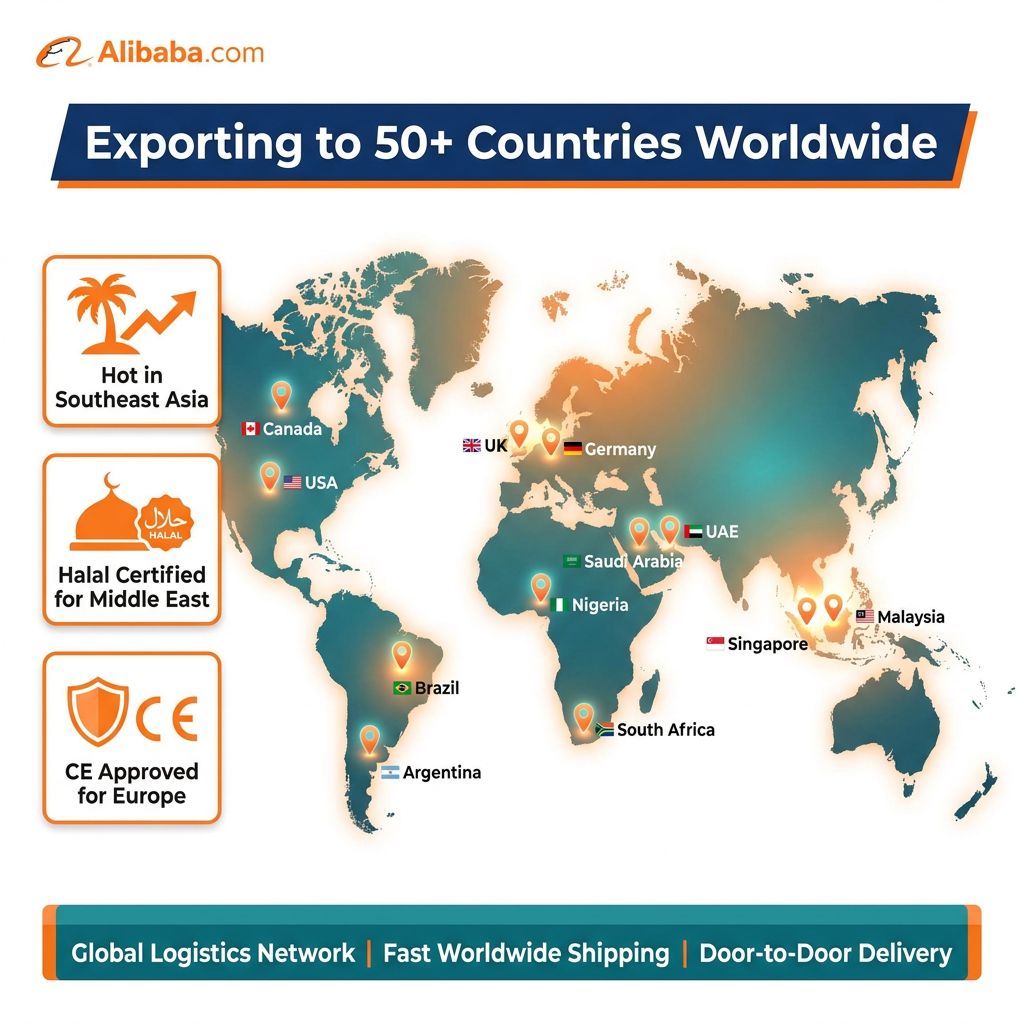
Export market coverage across Europe, the USA, Southeast Asia, Central Asia, South America, Africa and the Middle East, with export accounting for 100% of ERA's sales.
Does a multi-brand portfolio reduce long-term supply risk?
It is evidence of a specific capability rather than a guarantee. Operating Alotof, My A+, EcoBingo, ONePcDRY, my ERA and Binnions in parallel means several distinct specifications, packaging formats and channel positions are sustained from the same production base — a pattern that is difficult to maintain without stable material inputs. ERA's OEM case record documents a 10,000,000-piece order for a maternity and baby products store application, with steady repeat orders and market feedback on comfort and leak-proof performance. That record supports the capability claim; it does not remove the need for the buyer to test sell-through in their own market.
Supplier documentation referenced in this evaluation — including the 2026 product catalogue, model specifications and certificate scope — is available for review here: Catalogue ERA-2026 (PDF).