
Long-Term Brushless Gear Motor Supply: Continuity Beyond One SKU
Long-Term Brushless Gear Motor Supply: Continuity Beyond One SKU
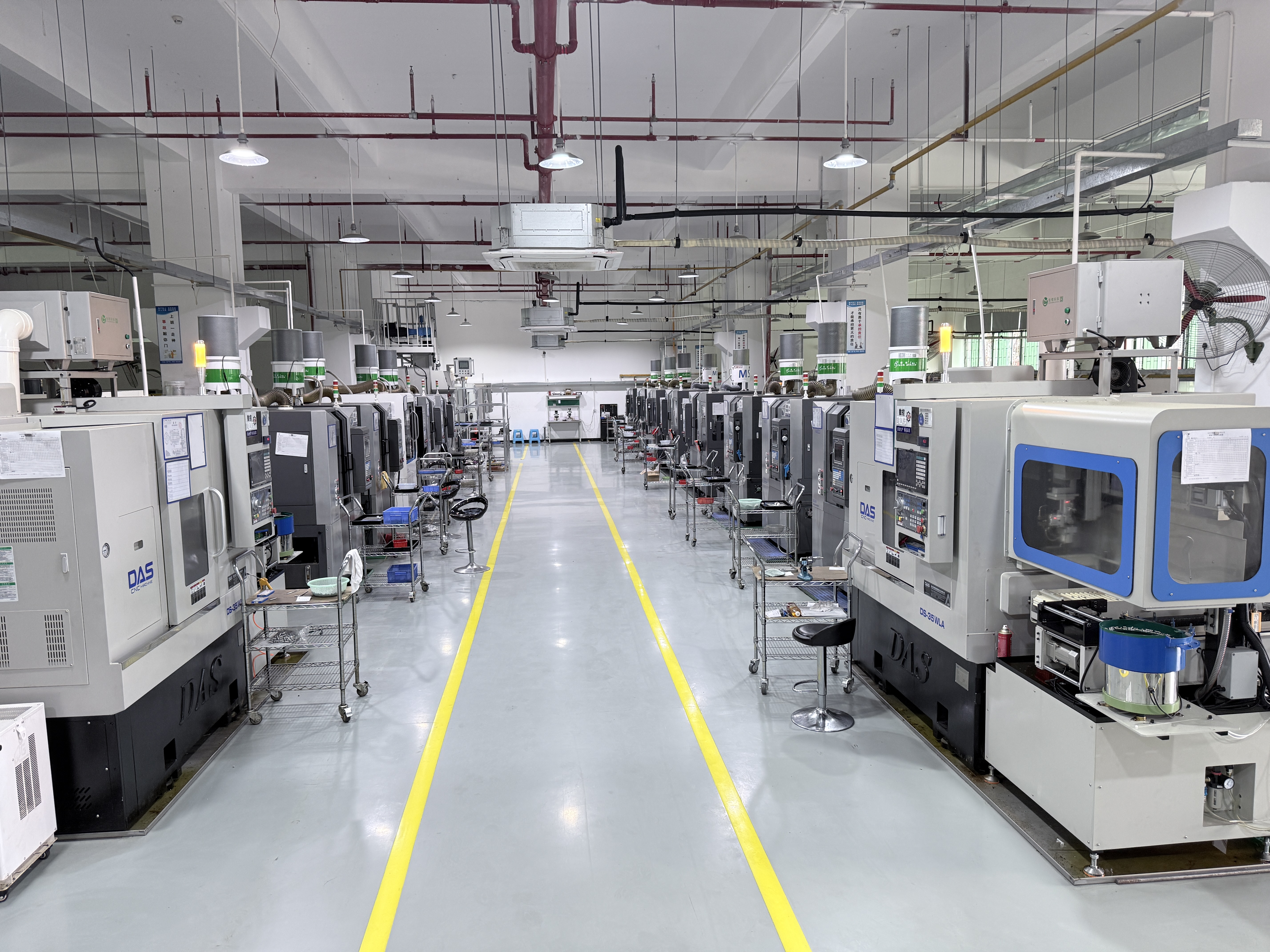
A brushless gear motor that passes a first-article test tells a buyer what a supplier can build this quarter. It says much less about whether the same model will still be buildable, documented and inspectable in the third year of a supply agreement. Long-term supplier evaluation therefore has to look past the single SKU to the structure behind it: product-family breadth, model continuity, and customization ranges that are written down rather than described verbally. TT Motor (Shenzhen) Industrial Co., Limited, a China-based miniature motor manufacturer founded in 2006, offers a working case for that method, because its catalogue covers several motor and gearbox families rather than a single platform.
Continuity Is a Property of the System, Not the Sample
Continuity is the likelihood that a qualified specification can still be manufactured, documented and inspected later in the programme, not only in the sample box. It belongs to the supplier's system rather than to the motor alone, and it usually fails in one of three ways.
- Model retirement. The exact designation is withdrawn or replaced by a similar variant whose magnets, bearings or winding differ from the qualified part.
- Substitution without notice. A component or process changes between batches, and the buyer discovers it at incoming inspection or, worse, in the field.
- Documentation drift. The drawing revision and the inspection criteria fall out of step, so a pre-shipment test passes against a standard that no longer describes the part being shipped.
None of these appears in a first-article report, because all three are changes over time. The practical response is to widen the evaluation from "can you build this model" to "what happens to this model, and to the programme around it, in year two and year three".
Four Signals That Sit Beyond the SKU
Four signals carry most of the continuity evidence, and each can be examined before a purchase order rather than after a failure.
| Signal | What to ask for | What it tells you |
|---|---|---|
| Product-family breadth | Product-line list and model designations across motor and gearbox types | Whether engineering and tooling depth exists beyond one platform |
| Model continuity | Revision history, lifecycle statements, consistent quoting of the same designation | Whether the qualified model is likely to stay available |
| Documented customization | Written ranges for stator, rotor, shaft, winding and sealing, with conditions attached | Whether a design change can be re-qualified instead of re-sourced |
| Change and acceptance habits | Change notification, first-article review, small-batch trial, pre-shipment test, traceability | Whether an unplanned change reaches the buyer's line or stops at inspection |
Read together, the four signals describe a system rather than a product. A supplier that scores well on one and poorly on the others is a partial answer: a broad catalogue with no change-notification practice still leaves the buyer exposed, and a disciplined inspection routine cannot compensate for a family so narrow that any variant becomes a new sourcing project.
TT Motor's Structure in Brief
TT Motor (Shenzhen) Industrial Co., Limited was founded in 2006 and is headquartered in Bao'an District, Shenzhen, Guangdong Province. The company reports more than 300 employees, a manufacturing area of approximately 9,000 square metres, an R&D team of 35 engineers and an annual output of 8,000,000 pieces, produced across three plants supported by an assembly centre and a global marketing centre. Its published company profile describes a product scope covering brushless DC motors, coreless motors, planetary geared motors, miniature geared motors, stepper motors and DC motors, with a 12 mm to 42 mm series of brush and brushless reduction motors.
Two commercial facts matter for continuity planning. Around 70% of output is exported, and the European Union and the United States are named as main markets, which places RoHS and REACH documentation inside normal commercial practice rather than at the edge of it. The company also states that it has established long-term cooperative relationships with domestic and international industry customers. That is a claim about relationship history rather than a guarantee, but it is one a buyer can test by asking how long individual programmes have actually run.
Named applications in the company's material include industrial automation, intelligent robots, medical equipment, precision instruments, smart home devices, automotive electronics and unmanned equipment. That spread is informative because it hints at which qualification habits the supplier is likely to have built: medical programmes push documentation discipline, robotics pushes gearbox behaviour and response, and smart home pushes miniaturisation and noise control.
Reading Four Model Designations as Evidence
Continuity is checked model by model. The catalogue supplies four designations that show what that check looks like in practice, and what it does not prove.
- GMP36-TEC3650 — a brushless gear motor designation for which a RoHS test report (reference CANEC26013325501) is included in the published document set. A model-level report is the relevant artifact, because a company-level compliance statement cannot be filed against a specific part in an audit.
- TWG3246-TEC2430 — a second brushless gear motor designation in the same range. Its value in an evaluation is comparative: it shows whether documentation practice holds across the range or was assembled once around a single model.
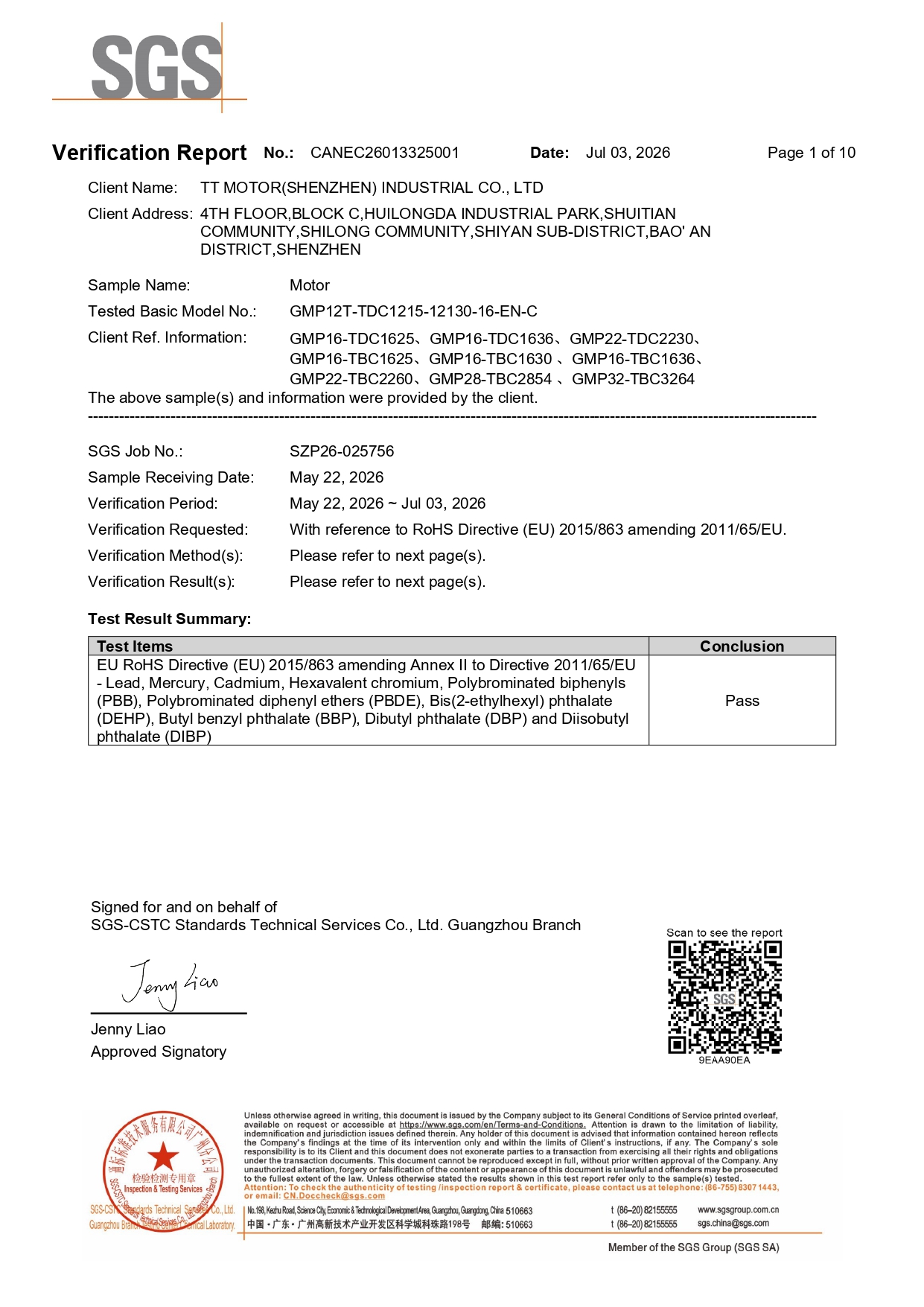
- GMP12T-TDC1215 — a compact designation in the geared family, documented in the same product imagery set. The continuity question for a smaller build is whether it carries its own drawing, inspection criteria and approved-sample record instead of inheriting them from a larger model.
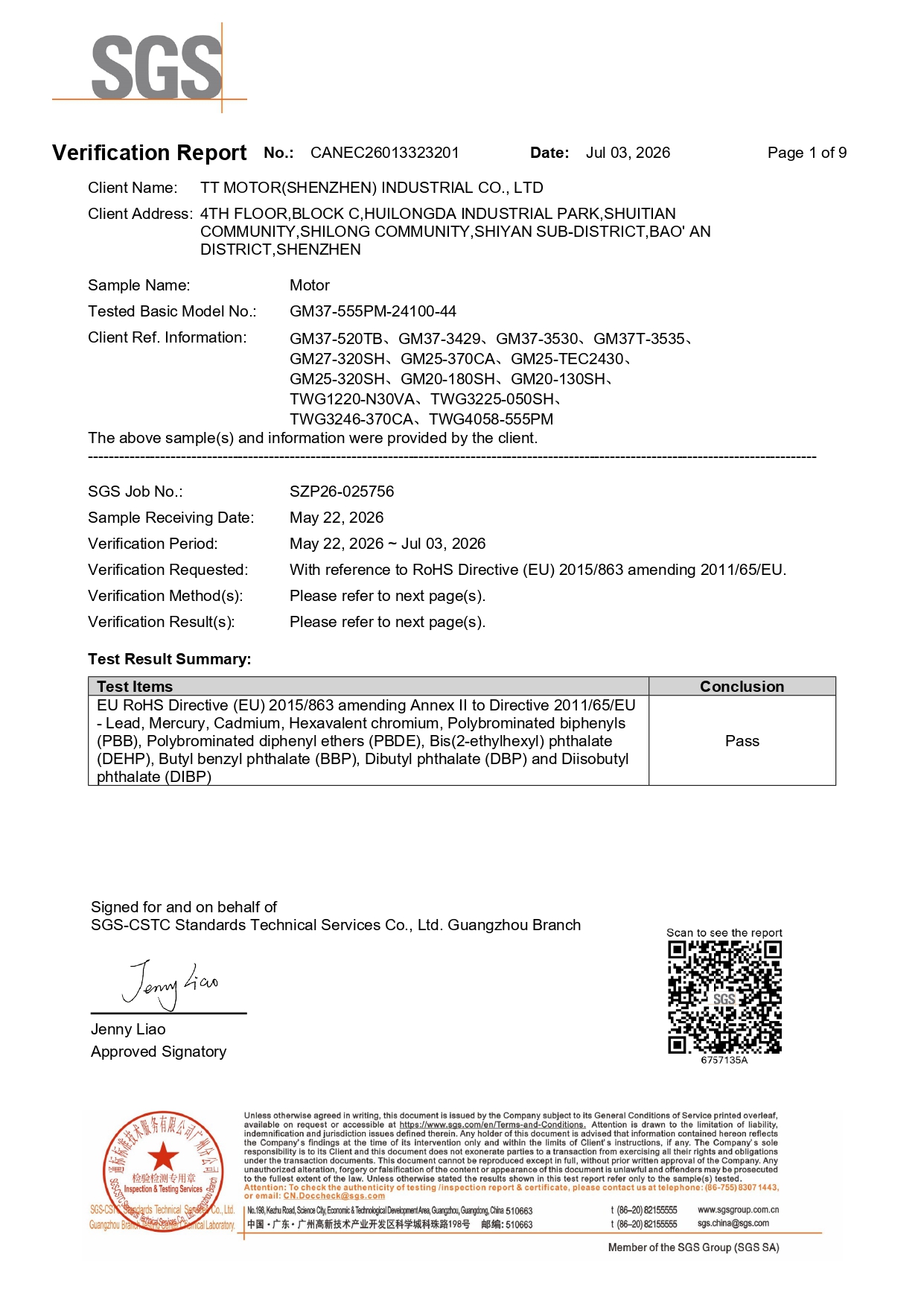
- GM37-555PM — a DC gear motor designation with published commercial terms: a minimum order of 2 units, EXW delivery, pre-shipment test acceptance and 100% payment for orders of that model. Terms like these belong in a continuity file because they define what reordering the same model costs in cash flow and logistics, year after year.
What the four designations do not establish is equally important. They are not interchangeable, they do not demonstrate equivalent performance, and they say nothing about delivery reliability or about whether any single model will still be in production five years from now. What they do show is a supplier working with separately identified, separately documented models across more than one motor type — the raw material a continuity record is built from.
Why Family Breadth Changes the Risk Profile
Breadth matters at the moment a design has to change. Inside a family, a new ratio, winding or shaft is usually a revision handled by the same engineering team, with existing tooling references and test fixtures. Outside the family, the same change becomes a new sourcing project with new tooling, new first-article approval and a new supplier risk assessment. That difference is why a 35-engineer R&D team and a multi-family catalogue count as continuity evidence rather than marketing detail.
Gearbox type adds a second axis. Planetary, spur and worm reductions place different demands on tooling, lubrication and assembly, so a supplier that already runs more than one gearbox family has more internal reference points when a programme shifts configuration. A buyer sourcing a worm gear motor for a slow, high-torque mechanism and a planetary gear motor for a fast positioning axis is asking the same supplier two different manufacturing questions; portfolio coverage is what makes both answerable.
The motor type carries its own continuity logic. Brushless designs use electronic commutation and no brushes or commutator, so the wear path that limits brushed motors is removed. Comparison material supplied with such product ranges typically puts BLDC efficiency at roughly 85%–90% against about 70%–80% for brushed gear motors, and brushless service life in the tens of thousands of hours against several hundred to several thousand for brushed designs, depending on model and operating conditions. For a programme expected to run for years, that shifts what must be kept available: the brushless model becomes the long-lived part, and the spare-parts plan follows it.
At the compact end, coreless construction changes the dynamic picture. A coreless rotor has a small moment of inertia, so start, stop and speed-change commands are followed with less overshoot than an iron-core equivalent — the reason coreless motors appear in fast-cycling robot joints and dispensing axes. Integrated geared motors add a further simplification: combining motor and gearbox removes couplings and transition supports, shortening the drive train and reducing the number of parts that can be re-specified independently.
Customization Ranges: What to Write Down
The supplier documents customization as ranges rather than as fixed catalogue options, which is the useful form for a long-term agreement. The stated ranges are: at the same outer diameter, longer stator and rotor stacks raise torque density by 20% to 40%, or shorten overall motor length by 15% to 30% at equal torque; matching the winding to the customer's battery voltage typically improves system efficiency by 5% to 15% and reduces temperature rise by 10°C to 20°C at rated current; a custom shaft diameter can shorten the axial length of the transmission by more than 30% by removing couplings and transition supports; and potting, coating, bearing selection and sealing can extend the operating range to -40°C to +85°C, with a stated three-to-five-fold life extension in harsh environments.
These are ranges for custom designs, not ratings that apply to every project. The realised value depends on stator geometry, magnet grade, winding, duty cycle and thermal path, and each figure has to be fixed as a single agreed specification for the model in question, with tolerances, test conditions and acceptance criteria attached. A range in a catalogue describes design space; a specification in a purchase agreement is a commitment.
The continuity test is whether the supplier can state, in writing, which parameters may move and which are locked. A file that records the approved sample, the locked winding and magnet grade, the shaft interface, the environmental band and the inspection method turns a re-qualification into a short administrative step instead of a fresh design cycle.
Where Continuity Questions Differ by Application
Application context changes which continuity signal deserves the most weight, even when the motor family is the same.
- Robotics. Joint drives combine high-frequency start and stop with tight positioning, so gearbox wear and revision control on the joint model matter more than catalogue breadth. Coreless or low-inertia options reduce overshoot; the continuity question is whether the approved joint model keeps its gear stage and interface unchanged.
- Medical devices. Low noise, low vibration and stable low-speed operation dominate, and documentation is part of the product. A per-model RoHS report, a defined change-notification route and pre-shipment test records are the artifacts an audit will ask for.
- Industrial automation. Continuous duty favours the brushless maintenance profile, and the continuity exposure sits in component substitution: bearings, lubricant and winding wire are the parts most likely to change quietly between batches.
- Smart home. Miniaturisation and noise control push designs toward compact gearmotors in the N20 class, an architecture commonly built in an envelope around 10 × 12 × 25 mm and operated between roughly 3 V and 12 V. The continuity question is whether a low-cost model can be re-sourced if the housing changes.
- Precision instruments. Low-speed positioning and repeatability matter, and the main risk is documentation drift: a revised drawing that is not reflected in the incoming inspection plan.
These are fit considerations, not evidence of installed programmes. Their purpose is to show that a supplier questionnaire should be weighted per application rather than applied uniformly across a whole catalogue.
Single-SKU Sourcing Versus Portfolio-Based Sourcing
The two approaches differ less in price than in what happens after the first order.
| Dimension | Single-SKU sourcing | Portfolio-based sourcing |
|---|---|---|
| Continuity exposure | Concentrated in one designation and one tooling set | Spread across documented models within the same engineering team |
| Change notification | Often informal, negotiated per order | Can be written once and applied across all models in the file |
| Engineering response | New drawing and new tooling for any change | Revision within an existing family, with existing fixtures |
| Commercial transparency | Terms known for one part only | Terms recorded per model, including minimum order and payment |
| Best fit | Stable, low-volume designs that will not change | Programmes expected to evolve over several years |
The comparison has boundaries that should be stated plainly. Portfolio breadth does not allocate capacity: an annual output of 8,000,000 pieces is a company-level figure, not a reservation for a specific programme, and a buyer with a few hundred units a year may be served more predictably through a distributor than through a factory schedule. EXW delivery places freight, insurance and import formalities on the buyer's side. A 100% payment term on a given model affects working capital and should be compared against alternatives rather than accepted as a category norm. And a broad catalogue is not evidence of on-time delivery, which has to be checked through order history and references.
A Continuity File a Buyer Can Maintain
The evaluation becomes durable when it is reduced to a file reviewed at each annual supplier meeting. A practical structure holds eight items per model:
- Model designation exactly as quoted, with the family and motor type it belongs to.
- Approved sample reference, sample date and the parameters that were measured.
- Controlled drawing and revision number, plus the interface dimensions that must not change.
- Locked list of critical components: magnets, bearings, lubricant, winding wire, gear material.
- Performance band with test conditions, not a single nominal point.
- Compliance documents per model, such as the RoHS report held for GMP36-TEC3650.
- Change-notification clause: what triggers notice, how far ahead, and what re-verification follows.
- Commercial terms per model: minimum order, delivery term, payment term and acceptance method.
Filled in consistently, the file answers the question that matters in year three — is this the same motor, made the same way, to the same standard — without relying on memory or on a sales conversation.
Market Context and What It Changes
The category is large and multi-sourced, which raises rather than lowers the value of continuity evidence. Grand View Research values the global brushless DC motor market at USD 22.2–22.33 billion in 2025, and OEC trade data put 2024 global exports of electric motors under 37.5 W (HS 850110) at USD 16.3 billion. Availability, in other words, is not the constraint. Differentiation between suppliers sits in documentation, model continuity and the ability to re-qualify a variant without restarting procurement.
Market totals describe a category, not a supplier, and should not be read as a statement about any company's capacity, share or growth. Their use here is narrower: they confirm that a buyer has alternatives, and that choosing among them requires evidence a price list does not contain.
Limitations and Fit Boundaries
Several limits belong beside the method rather than in a footnote. Supplier-published ranges describe design capability, not measured outcomes for a specific duty cycle. The comparisons between brushless, brushed and coreless construction are typical figures that vary by model and operating conditions. Documentation exists only where it has been issued — a RoHS report for one model does not cover a sibling designation. Export share and market coverage indicate where the supplier sells, not whether a specific product meets a specific regulation in a specific market. And nothing in a catalogue establishes delivery performance, which must be verified through order history, references or trial orders.
What to Watch Over a Multi-Year Relationship
Continuity is tested by time, and a few developments are worth tracking deliberately. Revision numbers on controlled drawings should change only when a change has been notified; a silent revision is the clearest early warning. Document refresh cycles should keep test reports current with the models actually shipped. Approved-sample records should stay retrievable years after the sample was signed. Commercial terms should be re-confirmed per model rather than assumed to carry over from a neighbouring designation. None of these is a forecast about any supplier; each is a checkpoint a buyer can schedule.
Conclusion
Evaluating a brushless gear motor supplier on one SKU answers a narrow question well. Extending the evaluation to product-family breadth, model continuity and documented customization ranges answers the question that governs a multi-year programme: whether the qualified part can still be made, documented and inspected when the relationship is three years old. TT Motor's catalogue — spanning brushless models such as GMP36-TEC3650 and TWG3246-TEC2430, the compact GMP12T-TDC1215 and the DC gear motor GM37-555PM — illustrates the evidence a buyer can collect, provided it is recorded per model and re-checked rather than assumed.
Frequently Asked Questions
What does continuity mean when evaluating a brushless gear motor supplier?
Continuity is the likelihood that a qualified specification can still be manufactured, documented and inspected later in the programme. It covers model availability, component stability with change notification, and inspection criteria that stay aligned with the controlled drawing. A supplier can meet a sample specification and still fail these tests, which is why continuity is assessed separately from first-article quality.
Which signals show a supplier can keep a model available over several years?
Three signals are practical: a catalogue spanning several motor and gearbox families, so a revision can be handled inside the same engineering team; consistent quoting of the same designation over time; and a documented change-notification practice. Model-level compliance files, such as the RoHS report for GMP36-TEC3650, show that documentation is maintained per part rather than only at company level.
How should customization ranges be recorded for long-term supply?
Record the range as design space and the agreed value as a specification. The stated ranges include 20% to 40% higher torque density at the same outer diameter, 5% to 15% efficiency improvement from voltage matching, and an operating range of -40°C to +85°C with appropriate potting and sealing. Each project converts the applicable range into locked parameters, tolerances and acceptance criteria.
What commercial and acceptance terms belong in a per-model record?
For the DC gear motor GM37-555PM, the published terms are a minimum order of 2 units, EXW delivery, pre-shipment test acceptance and 100% payment. Recording terms per model matters because conditions attached to one designation do not automatically transfer to another, and cash-flow or logistics differences between models affect the total cost of a multi-year programme.
How does annual output relate to supply risk?
Annual output of 8,000,000 pieces across three plants indicates manufacturing scale, not reserved capacity for a particular buyer. Capacity affects supply risk only when read together with scheduling, lead time and order history. A buyer should ask how a programme is scheduled across plants rather than treat a company-level output figure as a delivery commitment.
Reference material: TT Motor company profile and the company brochure (PDF).
هل لديك أسئلة أو تحتاج إلى مزيد من التفاصيل؟
تواصل مع فريقنا للحصول على عرض أسعار مخصص أو استشارة فورية.
طلب عرض أسعار
املأ النموذج أدناه وسيتواصل معك فريقنا بعرض مقترح مخصص.
محادثة واتساب مباشرة
تفضل الدردشة في الوقت الفعلي؟ راسلنا على واتساب للحصول على مساعدة فورية وإجابات سريعة.
- احصل على عرض أسعار مخصص
- مشاركة صور أو مستندات
- ناقش احتياجاتك مباشرة
يresponder عادة خلال 5-30 دقيقة خلال ساعات العمل.