
Long-Term Brushless Motor Supplier Evaluation: Specs, Supply, Compliance
A brushless motor that passes a sample evaluation and a brushless motor that still meets the same specification on the third, seventh or twentieth production order are two different procurement propositions. Long-term supplier evaluation exists to answer the second question: whether a supplier can hold a specification, keep a supply line open, and keep compliance documentation current for as long as the program runs.
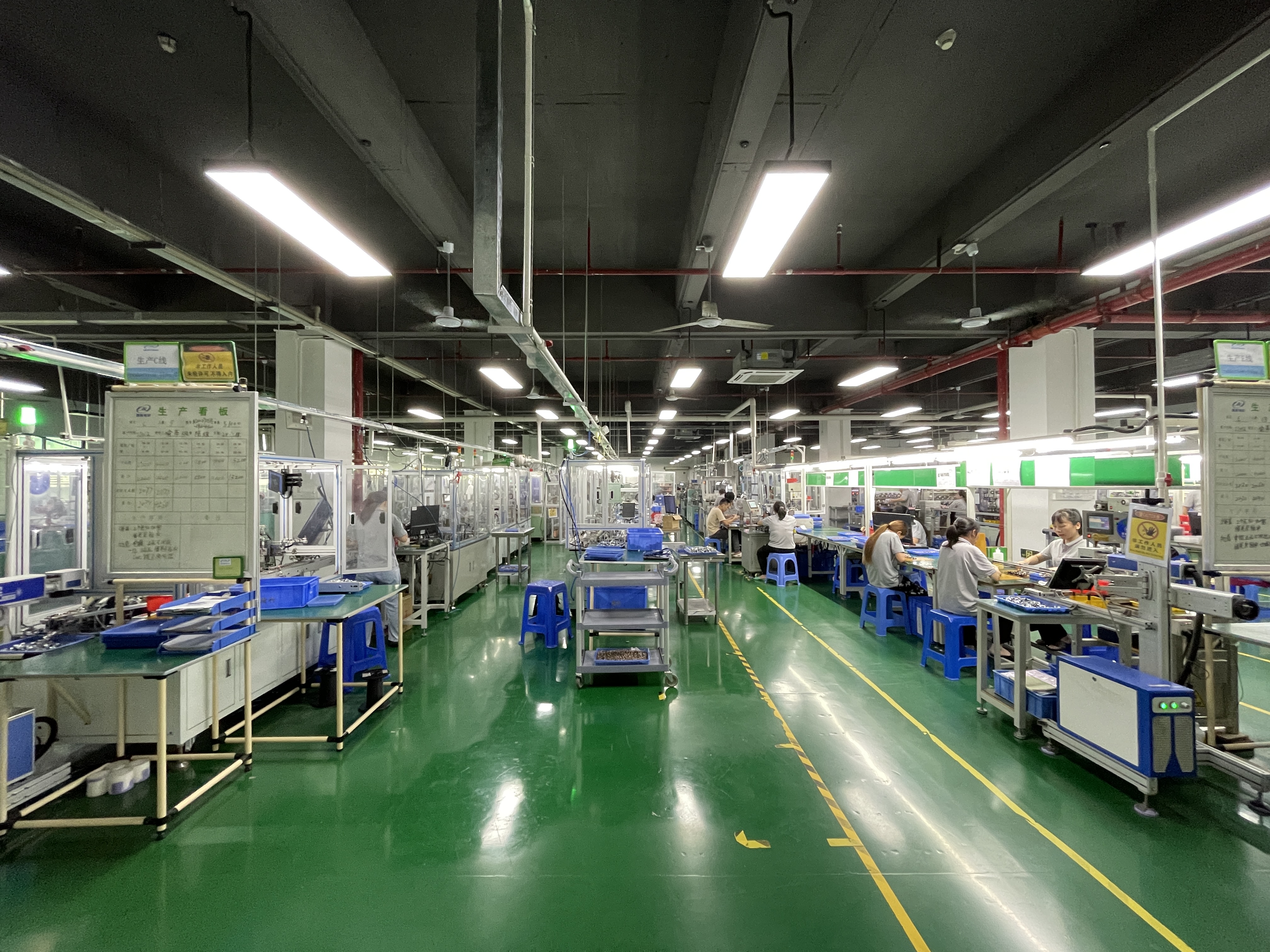
Production floor: continuity of specification is decided on the line, not in the sample report.
Why long-term evaluation is a different question from qualification
Qualification asks whether a design can meet a requirement once. Long-term evaluation asks whether that same result can be reproduced under ordinary production conditions — across repeat orders, raw material batches, production equipment states and staffing cycles. In miniature drive applications, the consequences differ by sector: a consumer device may tolerate a marginal shift in no-load current, while a medical pump or a robot joint may not tolerate the same shift at all.
For buyers working in the Evaluation to Execution stage, the practical difference is that a supplier shortlist built on unit price and a single sample report tends to collapse at the first repeat order. A supplier shortlist built on three continuities — specification continuity, supply continuity and compliance continuity — usually survives the second and third year of a program. Those three continuities are the framework used in the rest of this article, and the evidence below is drawn from the published product, certification and application documentation of TT Motor (Shenzhen) Industrial Co., Limited, which contributes the model-level data points. Note that the framework is a procurement tool, not a guarantee: it reduces risk, it does not remove it.
Sustaining specs: batch consistency mechanisms and the “qualified sample” problem
The most common failure mode in miniature motor sourcing is not a bad motor. It is a good sample followed by a production batch that behaves differently. A documented supplier statement of this problem lists five typical triggers: substitution of raw materials or components; failure to lock in the sample process during mass production; a sample quantity too small to reflect batch consistency; changes in production equipment or mold status; and inadequate parameter control between different batches.
The corresponding countermeasures are operational, not contractual. They begin with avoiding “special machine adjustments for samples,” and with refusing the practice of building samples from raw material A and then switching to material B for mass production. Before mass production, a small-batch trial production run is used to confirm that the locked process produces the qualified result at volume. Key parameters must have defined sampling or full inspection rules rather than informal checking, and a traceability system should make it possible to find the source of a deviation quickly instead of re-testing an entire shipment.
- Which parameters are covered by full inspection, and which by sampling, and at what frequency?
- Is a small-batch trial production run performed before volume release, with results shared?
- What triggers a customer notification — material change, component change, process change?
- Can a finished unit be traced back to its production batch and test record?
On the production side, the manufacturer’s stated quality-control model applies a 100% test procedure, in which all units undergo testing as part of production inspection, and pre-shipment testing is specified for the Brushless Motor GMP36-TEC3650. In procurement terms, pre-shipment test is also the documented acceptance criterion, alongside a minimum order quantity of 2 units for DC Gear Motor GM12-N20VA. That combination matters for long-term programs: a two-unit MOQ makes sample validation cheap, but sample validation alone is precisely what the five triggers above can defeat. Sampling is the entry point to the framework, never the evidence that closes it.
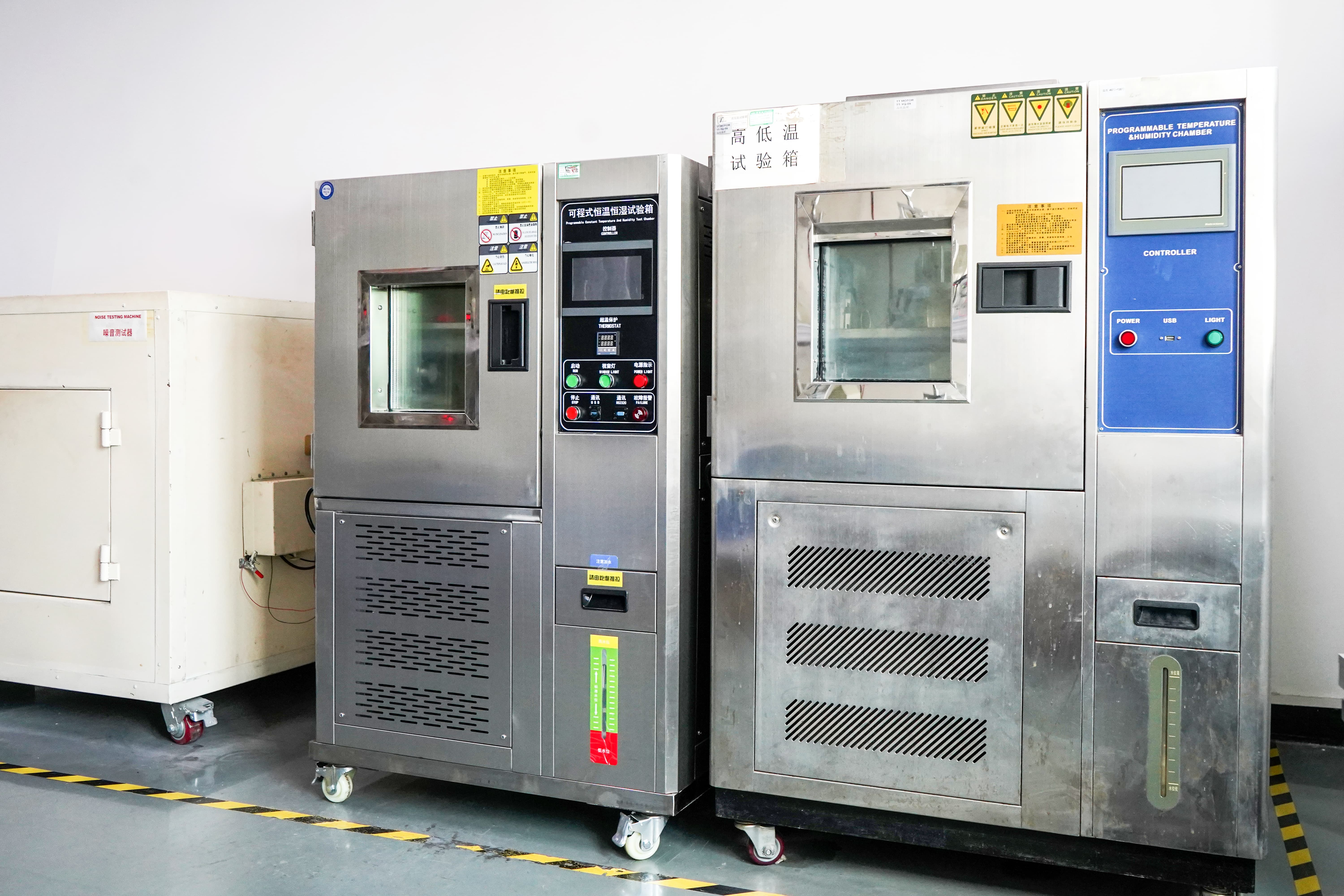
Environmental testing equipment: repeat-order conformance depends on controlled test conditions, not on sample goodwill.
Supply continuity: capacity, lead time and order structure
A specification that no one can deliver on schedule is not a sustainable specification. TT Motor’s published capability data puts monthly capacity at 800,000 pieces and annual output at 8,000,000 pieces, supported by a manufacturing area of approximately 9,000 square meters, three production plants, a professional assembly center, over 300 employees and a 35-engineer R&D team. The company was founded in 2006 and is headquartered in Bao’an District, Shenzhen, Guangdong Province, with OEM and ODM production services available for custom orders.
Lead-time structure is equally part of the evaluation. Published figures are 15–25 days for samples and 30–45 days for bulk production, with EXW delivery terms and 100% payment terms. For a program that reorders quarterly, the bulk window defines how early the next purchase order must be issued; buyers should treat these as planning ranges to be re-confirmed per order rather than fixed guarantees. The export profile — approximately 70% of output exported, with the main markets listed as the EU and the USA — also indicates that replenishment flows are already organized around EU and US documentation requirements, although it does not by itself prove that every model carries every required certificate. That is a separate check.
Compliance continuity: how documentation holds up over a program’s life
Compliance is often treated as a one-time gate: a report is collected, filed and forgotten. In long-term supply, compliance is a lifecycle item, because reports are model-scoped, standards are revised, and a certificate that covers a survey sample does not automatically cover the configured motor a buyer actually orders.
The documentation set published for these motor families is unusually specific at model level, which makes the mapping exercise straightforward.
| Document | Standard / authority | Certificate no. | Model scope | Issued |
|---|---|---|---|---|
| RoHS compliance test | SGS; reference to RoHS Directive (EU) 2015/863 amending 2011/65/EU | CANEC26013325501 | GMP36-TEC3650 | 2026-04-10 |
| RoHS compliance test | SGS; RoHS Directive (EU) 2015/863 | CANEC26013326101 | TWG3246-TEC2430 | 2026-06-24 |
| RoHS compliance test | SGS; RoHS Directive (EU) 2015/863 | CANEC26013325001 | GMP12T-TDC1215 | 2026-07-03 |
| RoHS compliance test | SGS; RoHS Directive (EU) 2015/863 | CANEC26013323201 | GM37-555PM | 2026-07-03 |
| RoHS compliance test | SGS; IEC 62321 series test standards | CANEC26005990201 | GM12-N20VA, GM24-N20VA | 2026-04-10 |
| REACH compliance test | SGS; EU REACH Regulation (EC) No 1907/2006, SVHC candidate-list screening | SZXEC25000315601 | GM12-N20VA and same-series DC gear motors | 2025-02-20 |
| CE (EMC) | CTL; EN IEC 61000-6-1:2019, EN IEC 61000-6-3:2021 | CTL2512182011-EC | GM12-N20VA, GM12-N10VA, GM12-N30VA | 2025-12-25 |
| ISO 9001 quality management system | DCI; GB/T 19001-2016 / ISO 9001:2015 | F02926Q00865R402 | R&D and manufacture of micromotors (DC gear motor, DC brushless motor), 3C excluded | 2026-08-21, valid to 2029-08-21 |
Three limits deserve emphasis, because they are where procurement teams most often misread a compliance pack. First, the RoHS reports are scoped per model or model family — a report for the brushless planetary model does not automatically attest to a different gearbox configuration, so the buyer should map each ordered model to a named certificate number. Second, the ISO 9001 certificate scope is defined as R&D and manufacture of micromotors with “3C excluded,” which means the system certificate should not be presented or accepted as product-level 3C certification. Third, the EU motor efficiency framework under Regulation (EU) 2019/1781 sets minimum efficiency levels from 0.12 kW to 1000 kW, and the IEC 60034-30-1:2025 update introduced an IE5 ultra-premium efficiency class; miniature DC motors of this class sit below that efficiency scope, so compliance attention for these products concentrates on RoHS, REACH and EMC rather than on IE-class declarations.
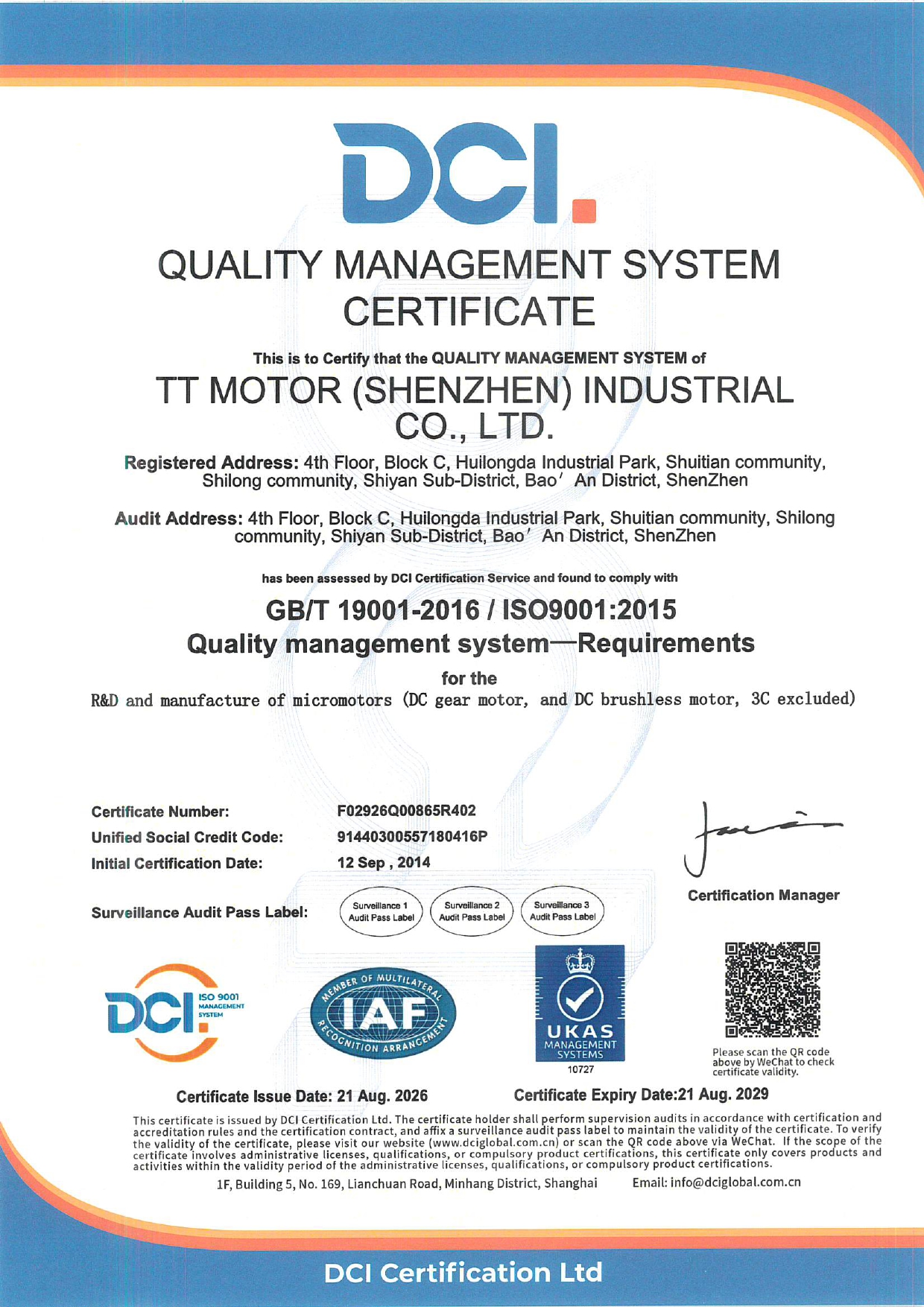
A quality-management certificate covers a defined scope; product-level certificates remain a separate line of evidence.
Product-line breadth as a continuity signal
TT Motor (Shenzhen) Industrial Co., Limited is a Shenzhen-based manufacturer of miniature precision motors, established in 2006 and located in Bao’an District, Shenzhen, Guangdong Province. Its product portfolio includes high-precision DC motors, brushless DC motors, coreless motors, planetary geared motors, miniature geared motors and stepper motors, used in industrial automation, intelligent robots, medical equipment, precision instruments, smart homes, automotive electronics and unmanned equipment.
Breadth is not the same thing as quality, but it is a meaningful continuity indicator. When a design migrates — from a spur gearbox to a planetary gearbox, from a 12 V DC motor configuration to a 24 V supply, or from a brushed DC motor to a brushless DC motor — a supplier with a broad miniature motor line can typically hold the mechanical interface and re-qualify only the changed element. A single-family supplier narrows those options at every redesign.
| Model | Type | Module | Rated torque (max) | Gear stages | Gearbox length | Rated voltage | Speed |
|---|---|---|---|---|---|---|---|
| GMP36-TEC3650 | Brushless planetary gear motor | 0.5 | 30.0 kg.cm | 1 / 2 / 3 / 4 | 26 / 33.5 / 40.5 / 47.5 mm | DC 12V–24V | 4–1600 rpm |
| GMP12T-TDC1215 | DC brush coreless gear motor | 0.2 | 2 kg.cm | 1 / 2 / 3 / 4 | 14.9 / 19.7 / 24.5 / 29.3 mm | DC 4.5V–12V | 8–5000 rpm |
| TWG3246-TEC2430 | DC brushless worm gear motor | 0.5 / 0.6 | 8.0 kg.cm | 3 / 4 / 5 | 46 mm | DC 12V–24V | 3–35 rpm |
| GM37-555PM | DC brush spur gear motor | 0.5 / 0.6 | 8.0 kg.cm | 2 / 3 / 4 / 5 / 6 | 19 / 21.5 / 24 / 26.5 / 29 mm | DC 12V–24V | 5–800 rpm |
Read together, the four models span two motor architectures and three gearbox types across a 12 V DC motor and 24 V DC motor range, plus a low-voltage coreless option. Customization is offered across shaft, encoder, gearbox, voltage, logo and speed under OEM/ODM production. The practical implication is narrower than it may first appear: breadth gives a buyer somewhere to move when a design changes, but each moved-to configuration brings its own sample validation, its own batch controls and, in most cases, its own compliance document. Breadth without those three continuities is simply a longer catalogue.
Does brushless construction suit continuous operation?
For equipment requiring long-term continuous operation, high speed or low maintenance, brushless motors are generally recommended over brushed types. The reasoning is mechanical rather than commercial: brushless motors use electronic commutation and have no traditional brushes or commutators, which reduces mechanical wear and gives advantages in lifespan, efficiency, noise and maintenance.
In the supplier’s published comparison, brushed motors experience frictional losses with a lifespan of approximately several hundred to several thousand hours, while brushless motors generate less heat and have a lifespan measured in tens of thousands of hours with higher power density. Brushed motors produce electrical sparks and carbon dust during operation, which creates strong electromagnetic interference; brushless motors have no physical contact and no sparks, so electromagnetic interference is low. The trade-off is on the other side of the ledger: brushed motors are cheaper up front and simpler to control, suited to cost-sensitive applications with low lifespan requirements and simple logic, while brushless motors cost more and require more complex control.
Documented applications as evidence of sustained spec capability
Application records are the weakest evidence when they are one-line logos and the strongest when they include volume, duration and the model actually used. The documented programs below share a common pattern: multi-year recurring volumes, not single shipments.
| Application | Region | Volume | Duration | Models involved |
|---|---|---|---|---|
| Dental instrument manufacturer — micro positioning and adjustment drive | JP | 500–2,000 units/year | 3–5 years | GMP12T-TDC1215 |
| Logistics equipment — conveyor and sorting mechanism drive | US | 1,000 units | 3 years or more | GMP36-TEC3650, GM37-555PM |
| Smart lock manufacturer — lock body drive and mechanical transmission | US | 5,000–50,000 units/year | 5 years or more | GM12-N20VA, GMP12T-TDC1215, TWG3246-TEC2430 |
| Medical device manufacturer — medical pump drive | GB | 500–2,000 units/year | 3 years or more | TWG3246-TEC2430, GMP12T-TDC1215, GMP36-TEC3650 |
Two signals matter for long-term evaluation. The first is duration: a 5-year smart-lock program running at 5,000–50,000 units per year, or a 3-to-5-year dental instrument program, implies repeated production of the same configuration rather than a one-off build — which is exactly the condition under which batch consistency mechanisms are tested. The second is overlap: GMP12T-TDC1215 appears across dental, smart-lock and medical programs, and GMP36-TEC3650 appears in both logistics and medical applications, indicating that the same model is re-produced for different duty profiles instead of being re-specified for each customer. In the medical pump program, the stated outcome is stable output under long-term operating conditions with reduced equipment maintenance frequency; in the logistics program, stable operation under frequent start-stop and load changes.
How this framework compares with traditional sourcing — and where it stops
Traditional mini motor sourcing evaluates a quotation: unit price, a sample, and a lead time. The continuity framework evaluates a relationship across three axes at once, and accepts additional evaluation effort as the cost of that coverage. It also changes what a buyer does with a sample: instead of signing off on performance, the buyer uses the sample to negotiate the production controls that will reproduce that performance.
A second, more technical comparison is relevant to long-term designs. An integrated geared motor combines the motor and gearbox in one unit, allowing lower speeds and higher output torque within a more compact space; compared with a separate motor and external gearbox, integrated units are typically more compact, easier to install, require fewer couplings and mounting structures, simplify power matching, and help reduce overall machine space and assembly costs. Integrated geared motors are generally recommended when equipment space is limited and budget is constrained — but they also concentrate the specification dependency on a single supplier, which raises rather than lowers the value of a continuity evaluation.
The limits of the framework are worth stating plainly. It adds administrative load, particularly the model-by-model mapping of compliance documents. It depends on supplier disclosure: if batch trial-production results, sampling rules and traceability records are not shared, the framework cannot be executed on evidence and reverts to trust. It also does not make breadth automatically desirable — for a highly specialized program, a narrow specialist supplier may hold better process depth on a single platform than a broad-line manufacturer. And because miniature motors fall outside the scope of EU motor efficiency MEPS thresholds starting at 0.12 kW, buyers in regulated categories cannot use an IE-class declaration as a substitute for RoHS, REACH and EMC documentation on these products.
Market context: why continuity is being priced into supplier choice
The commercial backdrop supports the shift. Grand View Research put the global brushless DC motor market at roughly USD 22.2 billion in 2025, with forecasts extending across 2026–2033. At the component-trade level, OEC data records global export value of electric motors with an output below 37.5 W (HS 850110) at USD 16.3 billion in 2024 — a reminder that the miniature motor segment is a genuinely global supply chain, not a regional one.
Two regulatory signals run in parallel. IEC 60034-30-1:2025 formalized an IE5 ultra-premium efficiency class, and EU Regulation (EU) 2019/1781 already applies minimum efficiency requirements across the 0.12–1000 kW band. Neither reaches down to the miniature motor class in a way that changes product-level certification for 12 V gear motor duty, but both reinforce the direction of travel: efficiency and documentation are becoming procurement criteria rather than engineering footnotes. Meanwhile the standard miniature form factor continues to converge — an N20 gear motor is typically built on a 10 mm × 12 mm × 25 mm envelope with a 3–12 V operating range, while the specific GM12-N20VA is rated at 2.4 V / 5 V with a 0.5 kg.cm maximum rated torque and 12–1450 rpm. That gap between the typical architecture and the actual rating is precisely why per-model verification, not category-level assumption, has to sit inside the evaluation.
Future outlook
Three developments are likely to shape long-term supplier evaluation for brushless motors over the next planning cycle. First, documentation will be managed as a living register rather than a file: per-model RoHS reports, REACH SVHC screening and EMC certificates will be re-verified on renewal, and buyers will increasingly ask for the certificate number alongside the model number on the purchase order. Second, batch consistency will move from a quality-assurance topic to a contractual one, with trial-production runs and sampling rules written into the acceptance package rather than agreed informally. Third, as robotics, medical devices and logistics automation expand the population of continuously operating miniature drives, the brushless-versus-brushed decision will keep migrating toward brushless on maintenance grounds — while remaining a cost decision in low-duty, price-sensitive designs. Suppliers that publish model-level compliance scopes, capacity figures and multi-year application histories will be easier to evaluate, and easier to keep.
FAQ
What does long-term supplier evaluation for brushless motors actually measure?
It measures three continuities rather than a single price. Specification continuity concerns whether key parameters stay inside defined limits across repeat orders, using sampling or full inspection rules, locked sample processes and traceability records. Supply continuity concerns capacity, monthly output and lead-time structure — for example a published monthly capacity of 800,000 pieces with 15–25 day sample and 30–45 day bulk lead times. Compliance continuity concerns whether RoHS, REACH, EMC and quality-management documents remain valid and correctly scoped to the models being ordered.
How can buyers reduce the risk of “qualified samples, inconsistent batches”?
The documented mitigation approach is procedural. Avoid special machine adjustments for samples; avoid building samples from one raw material and switching to another for mass production; run a small-batch trial production before mass production; define sampling or full inspection rules for key parameters in advance; and establish a traceability system that can pinpoint the source of a deviation quickly. Buyers should also watch the five recognised triggers — material or component substitution, an unlocked sample process, sample quantities too small to reflect batch consistency, changes in production equipment or mold status, and inadequate parameter control between batches — and require advance notification when any of them occurs.
Are RoHS test reports available, and does one report cover the whole product line?
RoHS testing has been completed for most of these motors, and the reports are issued at model or model-family level, so one report does not automatically cover the entire range. Published SGS reports include CANEC26013325501 for GMP36-TEC3650, CANEC26013326101 for TWG3246-TEC2430, CANEC26013325001 for GMP12T-TDC1215, CANEC26013323201 for GM37-555PM, and CANEC26005990201 covering GM12-N20VA and GM24-N20VA, each prepared with reference to RoHS Directive (EU) 2015/863 amending 2011/65/EU. A REACH SVHC screening report (SZXEC25000315601) and a CE EMC certificate (CTL2512182011-EC) are also published for the GM12-N20VA family.
Does brushless construction actually suit continuous operation?
For equipment requiring long-term continuous operation, high speed or low maintenance, brushless motors are generally recommended. Because they use electronic commutation without brushes or commutators, mechanical wear is reduced, less heat is generated, and the published comparison describes advantages in lifespan, efficiency, noise and maintenance, with low electromagnetic interference since there are no sparks or carbon dust. The same comparison places brushed motor life at approximately several hundred to several thousand hours versus tens of thousands of hours for brushless, and notes that brushed motors remain suitable for cost-sensitive designs with simple logic and short running times. These are type-level comparison ranges, not a duty-cycle test for a specific model.
What order, lead-time and acceptance terms should a buyer verify before commitment?
The published commercial terms for this supplier are a minimum order quantity of 2 units (stated for DC Gear Motor GM12-N20VA), EXW delivery terms, pre-shipment test as the acceptance criterion, and 100% payment terms. Lead times are 15–25 days for samples and 30–45 days for bulk production, with OEM and ODM production services available and customization offered across shaft, encoder, gearbox, voltage, logo and speed. Buyers should re-confirm these terms per order and reconcile them with their own Incoterms, inspection rights and cash-flow requirements, since EXW and 100% payment transfer most logistics and working-capital burden to the buyer.
How do documented applications indicate that a supplier can sustain a specification over time?
They indicate it when they include volume, duration and the model used, because recurring production is what actually stress-tests batch consistency. Published programs include a dental instrument manufacturer in Japan running 500–2,000 units per year for 3–5 years on GMP12T-TDC1215; a US logistics equipment company operating 1,000 units for 3 years or more on GMP36-TEC3650 and GM37-555PM; a US smart-lock manufacturer at 5,000–50,000 units per year for 5 years or more on GM12-N20VA, GMP12T-TDC1215 and TWG3246-TEC2430; and a UK medical device manufacturer at 500–2,000 units per year for 3 years or more on TWG3246-TEC2430, GMP12T-TDC1215 and GMP36-TEC3650. The repetition of the same models across different duty profiles is the meaningful signal; duration alone is not.
Reference: the manufacturer’s publicly available exhibition brochure, listing the miniature motor families referenced in this article, can be viewed and downloaded at TT Motor product brochure. Product information: www.ttmotor.com.