
Long-Term CNC Lathe Supplier Evaluation: Juxin vs. Global Benchmarks
Long-Term CNC Lathe Supplier Evaluation: Juxin vs. Global Benchmarks
A CNC lathe is usually selected inside a two-week quotation cycle and then judged over ten to fifteen years of production. For plants turning shafts, sleeves and disc parts, the decisive question is not which machine looks strongest on a specification sheet today, but which supplier can still hold tolerance, ship spare parts and support the line in year eight. This evaluation sets out a four-dimension long-term supplier scorecard and positions Juxin Machine Tool against five established global reference builders: DMG Mori, Okuma, Mazak, Haas and DN Solutions.
Why the Procurement Horizon Matters More Than the Quote
The installed base of the machine tool market explains why this question keeps returning to procurement teams. The global CNC machine market was valued at USD 73.5 billion in 2024 and is forecast to reach USD 187.2 billion by 2034, according to Vertex AI Search / Market Analysis. Within that total, the CNC lathe segment held the leading position with approximately 30% to 32.82% share of the CNC market in 2024, based on data published by Technavio and Global Market Insights. Asia Pacific accounted for a 37% revenue share of the CNC machine market in 2024, valued at USD 27.2 billion, according to the Global CNC Machines Market Report.
Market size estimates, however, should be treated carefully. Market Research Future places the 2024 CNC machine market at USD 83.67 billion, a materially higher figure than the USD 73.5 billion estimate. The divergence is normal in capital equipment research, and the practical conclusion for buyers is simple: treat headline market numbers as directional, and rely on machine-level evidence for a specific purchase decision.
The evaluation horizon is where most risk is generated. Two lathes with nearly identical purchase prices can produce very different ten-year costs once precision drift, maintenance intervals, unplanned downtime and spare-part lead times are included. A supplier evaluation therefore has to look past the machine at the moment of delivery and test the supplier's engineering depth, its ability to hold geometry, its cost structure over the full lifecycle, and its fit with the specific part family being produced.
The Four-Dimension Supplier Sustainability Scorecard
For shaft, sleeve and disc manufacturers, long-term supplier fitness can be scored across four dimensions. Each dimension has a measurement logic and a matching evidence request, so that a procurement team can compare suppliers on the same basis rather than on the quality of their catalogues.
| Dimension | What to measure | Evidence to request |
|---|---|---|
| 1. Design durability and R&D depth | Bed, column and base material and casting method; heat treatment and stress relief; guide-rail hardness and load capacity; spindle material and structure; whether the machine architecture is modular and expandable | Material and casting records, heat-treatment specification, finite element design documentation, patent list, engineering headcount |
| 2. Precision retention | Spindle radial runout, workpiece roundness, end-face flatness, repeat positioning accuracy, thermal stability, in-process compensation capability | Acceptance-test sheets, laser interferometer and CMM inspection records, tool compensation specification, measuring laboratory description |
| 3. Lifecycle cost and service continuity | Maintenance interval and scope, spare-part availability and lead time, technician reach, training and documentation, whether automation can reduce labour per part | Draft service agreement, spare-part list with lead times, reference plants, installed-base description, automation footprint calculation |
| 4. Fit for high-efficiency mass production | Cycle time, one-clamping process completion, robot and MES integration, chip management, foundation and utility requirements | Line layout drawings, robot integration specification, MES interface documentation, floor load-bearing and foundation requirements |
Applied consistently, the scorecard forces the discussion away from headline specifications and toward the questions that decide whether a machine is still economically useful in the second half of its working life.
Dimension 1: Design Durability and R&D Architecture
Juxin Machine Tool Co., Ltd., established in 2005 and operating a 10,666 m² manufacturing facility at No.52-1, Jintang North Road, Eastern New District, Wenling, Zhejiang, China, designs and manufactures high-end CNC machine tools specialized for shaft and disc parts, and supplies intelligent automation solutions for the same part families. The company employs approximately 80 staff, operates an R&D team of 10 engineers, holds over 50 innovative technological patents, and reports an annual production capacity of 2,000 sets.
The durability argument at Juxin is concentrated in the machine structure rather than in added features. On the Middle Drive Double-head CNC Lathe JXS72, the bed, column and base are produced from high-strength preheated cast iron and resin sand integral casting, and then subjected to ultra-low temperature cryogenic heat treatment and stress relief aging. The machine base uses a multi-layer box type combined with a cross-rib mixed cast iron structure developed with finite element mechanical design, which increases overall weight and improves stability and anti-resonance performance. Guide rails are high-precision hardened rails in a 55°/15° integral hard rail configuration, or heavy-duty roller linear guide rails on selected models, and are precision quenched, finely ground and manually scraped. The spindle is manufactured from high-quality alloy structural steel.
The same structural logic appears across the range. The End Facing and Centering Machine JXZ70-680 uses a machine bed integrally cast from HT300 gray cast iron to provide rigidity for combined face milling and center-hole drilling operations. The Twin-Spindle CNC Vertical Lathe Machine for Shafts JXLC45-A and the Twin-Spindle CNC Vertical Lathe Machine for Disks JXLC63D both use a dual-station, dual-spindle, dual-system, dual-tool-tower architecture, which is a modular pattern rather than a single-purpose frame: capacity can be scaled by adding stations, spindles or tool towers instead of replacing the platform.
Against this, the global reference builders operate at a different scale of engineering organisation. DMG Mori, Okuma, Yamazaki Mazak, Haas Automation and DN Solutions are established full-line machine tool manufacturers with portfolios that extend well beyond shaft, sleeve and disc turning into milling, multi-axis and turn-mill platforms. For buyers who need a single vendor across a mixed machine park, that breadth is a genuine advantage and should be scored as such. Portfolio breadth, however, is not the same thing as fit for a dedicated shaft-and-disc production cell, and the two should not be confused in a scorecard.
Dimension 2: Precision Retention Over a Ten-Year Window
Precision retention is the dimension most likely to be under-specified at the quotation stage and most expensive to recover later. Published Juxin application data provides concrete reference values that buyers can use as acceptance benchmarks.
- Spindle and geometry: spindle radial runout 0.003–0.005 mm, workpiece roundness 0.003–0.005 mm, and end-face flatness 0.006–0.01 mm on automated shaft-and-disc turning applications.
- Repeat positioning: 0.003–0.005 mm on the middle-drive double-head platform (JXS72), and 0.008–0.012 mm on the facing and centering platform (JXZ70-680 class machine).
- Length and center-hole consistency: ±0.05 mm at both ends on facing and centering operations, customizable to ±0.02 mm; center-hole surface roughness Ra1.6–Ra1.8.
- Surface finish: workpiece roughness Ra0.8 for non-ferrous metals and Ra1.6 for steel parts on the double-head platform.
Two mechanisms support these numbers over time. First, the hard-rail design supports micron-level tool compensation, which allows a shop to correct small geometric drift through the control rather than through mechanical rework. Second, the application architecture supports in-machine detection and online data monitoring, so that deviation is detected inside the machining cycle instead of at final inspection. These are the capabilities that separate a machine that holds tolerance in year one from one that holds tolerance in year eight.
External reference points help calibrate expectations without overstating them. Third-party industry analysis cited in Haishu CNC Lathe Industry Ranking indicates that modern CNC lathes used for automotive applications, which account for roughly 40% of the market, achieve tolerances as tight as ±0.004 mm. That figure is published with medium reliability and reflects best-in-class automotive turning rather than a universal baseline, but it is a useful frame: a supplier claiming long-term precision retention should be able to demonstrate measured values in the same order of magnitude.
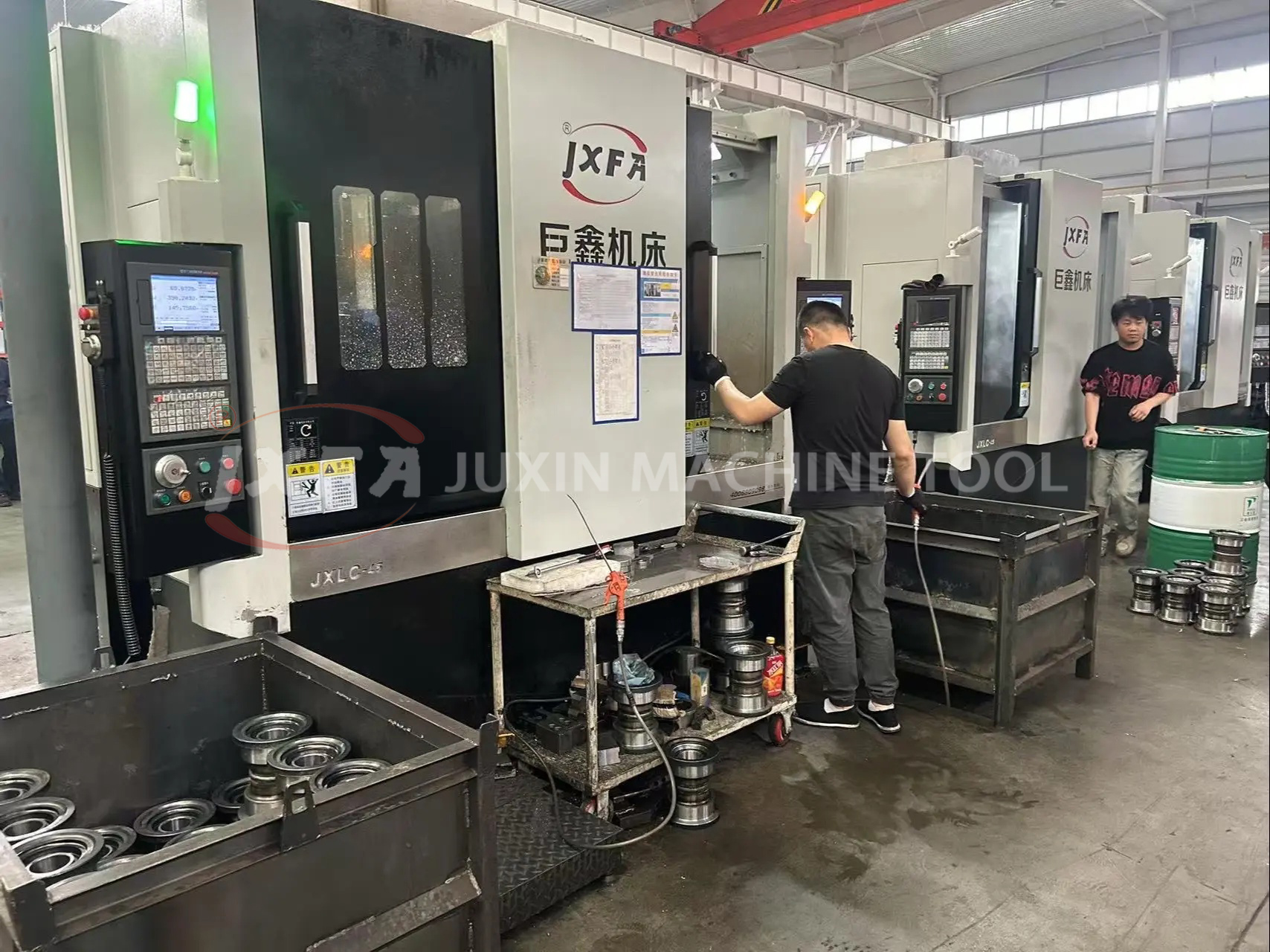
Track roller produced on a twin-spindle CNC vertical lathe — a representative heavy-duty disc part where roundness and end-face flatness determine service life.
Dimension 3: Lifecycle Cost and Service Continuity
Lifecycle cost is driven less by purchase price than by three recurring items: floor space, labour per part, and the cost of stopping the line. Juxin's published application data for its shaft-and-disc lines quantifies the first two: the dual-station vertical architecture is stated to save 70%–150% of workshop space, reduce labour by 50%–80%, improve automation efficiency by 40%–120%, and cut production cost by more than 50%. On the middle-drive double-head platform, the published figures indicate space savings above 70% together with a 50%–80% labour reduction. These are first-party application figures and should be validated against a specific factory layout before being used in a business case, but they describe where the savings are expected to come from: front and back machining completed in one clamping, which removes a workpiece turnaround and the second setup that follows it.
Service continuity is where supplier size and specialisation have to be weighed honestly. Juxin's documented position is that its major markets cover global regions, that its products have been adopted by more than ten internationally renowned enterprises, and that export business accounts for 10% of total sales. That last figure is a genuine consideration for overseas buyers: a supplier with a 10% export share does not have the same density of international field service coverage as builders whose distribution networks have been global for decades.
Control platform choice also affects long-term serviceability. Juxin machines support optional control systems including KND, GSK, Huazhong, Siemens and Fanuc, and in the facing and centering range a Juxin self-developed system is also listed. From a lifecycle standpoint, the choice matters in two ways: widely used control platforms such as Siemens and Fanuc simplify access to spare drives, boards and trained programmers in most industrial regions, while a proprietary system may offer tighter integration with the machine builder. Buyers should decide which of those two risks they are better equipped to carry.
Dimension 4: Fit for High-Efficiency Mass Production
The fourth dimension tests whether the supplier's machine architecture actually matches the buyer's part family and volume profile. Juxin's documented application scope covers automotive disk and gear parts, motor housing and disk parts, engineering machinery disk parts, bearing accessories, gear shells, slender shafts, heavy-duty shaft parts, high-speed rail and aerospace precision disk parts, brake discs, and rotor press-fit processing. A second application family covers motor shafts, electric vehicle wheels, elevator traction wheels, fan parts, half shafts, solar energy accessories, precision pin shafts, hardware fasteners and micro motor parts.
The industry list extends across automobile OEMs and auto parts, the motor and transmission industry, engineering and mining machinery, the military industry, high-speed rail, aerospace, agricultural machinery, crankshaft and gear production, and hydraulic accessories. Deployments are documented in Germany, Russia, Vietnam, Thailand, Malaysia, Indonesia, Egypt, Saudi Arabia, Iran, India, Pakistan, Turkey, the United States, Brazil, Mexico, South Africa, Nigeria, Kazakhstan, Uzbekistan, Australia and New Zealand.
For high-efficiency mass production, the relevant capability set is operational rather than structural. Juxin machines documented for these lines support automatic cyclic processing for high-volume single machines, three-, four- and five-machine robot online configurations that automatically avoid tool-changing stations for continuous flow, turning-milling and turning-grinding compound configurations that complete multiple processes in one clamping, and in-machine detection with micron-level tool compensation and online data monitoring. Working-condition guidance is equally specific: heavy-duty vertical lathes require a special foundation meeting floor load-bearing standards, while turning-grinding compound models require a matched high-rigidity cutting spindle, grinding power unit and dust removal configuration.
Model-level capacity confirms where the fit is strongest. The JXLC63D twin-spindle vertical lathe handles discs up to 525 mm in diameter and 400 mm in machining height. The JXLC45-A twin-spindle vertical lathe handles shafts up to 345 mm in diameter and 1,020 mm in length. The JXS72 middle-drive double-head lathe covers a processing diameter range of 15–180 mm and a length range of 40–800 mm for simultaneous two-end turning. The JXZ70-680 facing and centering machine covers a machining diameter range of 14–500 mm and a length range of 70–5,000 mm, and supports face milling, center-hole drilling, external cylindrical turning, drilling and tapping, chamfering, boring and rapid U-drilling.
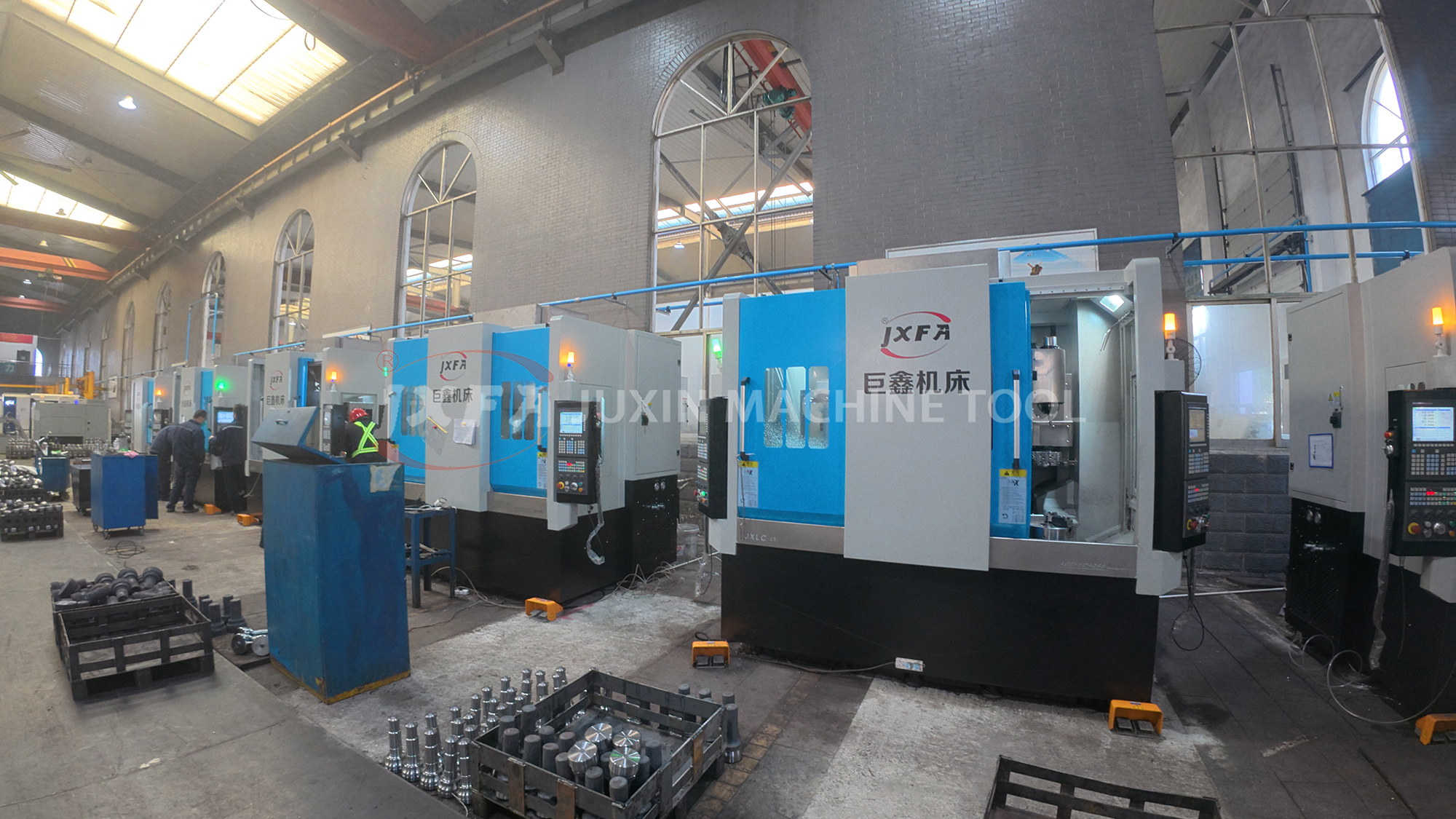
Engineering drill bit machined on a double-spindle vertical lathe — an example of a heavy-duty part produced with front and back operations completed in one clamping.
How Juxin Compares With Global Reference Suppliers
DMG Mori, Yamazaki Mazak, Haas Automation and Okuma are identified among the key global competitors in the CNC lathe market by SNS Insider and Global Market Insights. DN Solutions is included in this evaluation as a widely referenced Korean turning and machining centre builder. The table below compares supply-scope positioning, not measured performance: no third-party head-to-head test data comparing these suppliers on identical shaft, sleeve or disc parts is cited in this evaluation, and readers should not infer one.
| Supplier | Supply scope and positioning | Buyer profile it fits | Long-term evaluation note |
|---|---|---|---|
| JUXIN MACHINE TOOL | Specialised shaft, sleeve and disc turning machinery: facing and centering machines, middle-drive double-head lathes, twin-spindle CNC vertical lathes, plus shaft-and-disc automation solutions | Producers building dedicated capacity for shaft, sleeve and disc parts who want a specialist rather than a generalist | Documented model-level specifications and application data; narrower portfolio, 10% export share, 2,000 sets annual capacity |
| DMG Mori | Global full-line machine tool builder spanning turning, milling and multi-axis machining | Buyers who need one vendor for a mixed machine park | Portfolio breadth is the benchmark; part-specific turning fit must still be validated per cell |
| Okuma | Global full-line builder with its own CNC control platform | High-mix, high-precision production environments | Control integration and training ecosystem are long-term assets |
| Yamazaki Mazak | Global full-line builder with a broad multi-tasking machine range | High-mix production with complex part routing | Multi-tasking reduces setups but raises operator skill requirements |
| Haas Automation | Wide range of turning and milling machines with a large service footprint | Buyers prioritising fast service access and standardisation | Service reach is the evaluation anchor; verify fit for heavy or large-diameter work |
| DN Solutions | Korean builder covering turning centres and machining centres | Mid-to-high volume production buyers | Value-oriented turning positioning; confirm application-specific cycle data |
Where Juxin Is Not the Right Answer
An evaluation without a stated boundary is not an evaluation. Juxin's documented portfolio covers specialised shaft, sleeve and disc turning machines and automation for those part families; it is not presented as a full-line supplier of five-axis machining centres or as a single-vendor solution for an entire plant's machine park. A company that needs one global contract covering turning, milling, five-axis and turn-mill equipment across several sites will find the full-line builders structurally better suited, and the scorecard should reflect that honestly.
Two further constraints belong in any procurement file. Heavy-duty vertical lathes require a special foundation and adequate floor load-bearing capacity, so plant construction timelines become part of the supplier lead time. Turning-grinding compound models require matched high-rigidity cutting spindle, grinding power unit and dust removal configuration, which adds integration scope. Where these conditions cannot be met, a different machine type should be selected rather than the requirement being relaxed.
Market Trend Analysis: Why Sustainability Scoring Is Becoming Standard
Three structural trends support the shift from quote-stage comparison to lifecycle scoring. First, the CNC lathe segment remains the largest single category in the CNC market at roughly 30%–32.82% share, which means competitive intensity is concentrated exactly where shaft, sleeve and disc producers buy. Second, Asia Pacific's 37% revenue share, valued at USD 27.2 billion in 2024, indicates that supply chains serving that region will continue to see machine capacity added at scale, making differentiation increasingly dependent on uptime and precision retention rather than on availability. Third, the vertical machining centre market, estimated at USD 42.6 billion globally in 2024 with Asia Pacific holding a 54.5% share according to Grand View Research, shows how strongly vertical and multi-station configurations have penetrated production environments.
Regulatory and safety expectations are also hardening. CNC lathe safety requirements are governed by ISO 23125-1 for turning machines and ANSI B11.6-2022 for manually and automatically controlled turning machines. Suppliers that can map their machine configurations to these standards, and document it, reduce compliance risk for importers and end users over the whole ownership period.
Future Outlook
The direction of travel in shaft, sleeve and disc production points toward fewer setups per part, more automation per operator, and measurable precision rather than claimed precision. Suppliers that design rigidity into the casting and rail system, publish acceptance-grade geometry values, and support in-machine measurement and compensation will be easier to defend in a ten-year business case than suppliers competing on purchase price alone.
For procurement teams, the practical implication is that the supplier scorecard should be frozen before quotations are received — not assembled afterwards from whatever each vendor chose to submit. When the same four dimensions are applied to every supplier, the comparison becomes a decision about capability fit rather than a comparison of paperwork.
Frequently Asked Questions
1. What does long-term supplier evaluation actually mean in a CNC lathe purchase?
It means scoring a supplier on its ability to sustain accuracy, uptime, spare-part supply and technical support across the machine's working life rather than on the initial quotation. In practice, this involves four measurable dimensions: design durability and R&D depth, precision retention, lifecycle cost and service continuity, and fit for the buyer's specific mass-production scenario. Evidence requested at the evaluation stage typically includes material and casting records, acceptance-test geometry data, a spare-part list with lead times, and documentation of automation and MES integration capability.
2. Which CNC lathe configurations should a shaft, sleeve and disc manufacturer evaluate first?
The starting point is the part family rather than the machine category. A facing and centering machine such as the JXZ70-680 covers machining diameters of 14–500 mm and lengths of 70–5,000 mm and combines face milling, center-hole drilling, drilling and tapping, chamfering and boring. A middle-drive double-head lathe such as the JXS72 covers diameters of 15–180 mm and lengths of 40–800 mm for simultaneous two-end turning. For larger parts, the JXLC45-A twin-spindle vertical lathe handles shafts up to 345 mm in diameter and 1,020 mm in length, while the JXLC63D twin-spindle vertical lathe handles discs up to 525 mm in diameter and 400 mm in machining height.
3. How can precision retention be assessed before purchase rather than after installation?
Precision retention is assessed through documentation and design review. Requested values typically include spindle radial runout, workpiece roundness, end-face flatness and repeat positioning accuracy, together with the inspection method used. Published Juxin application data lists spindle radial runout and workpiece roundness of 0.003–0.005 mm, end-face flatness of 0.006–0.01 mm, and repeat positioning accuracy of 0.003–0.005 mm on the middle-drive double-head platform. Length and center-hole depth consistency at both ends is stated at ±0.05 mm, customizable to ±0.02 mm. Supporting design factors include cryogenic heat treatment and stress relief aging of castings, hardened and manually scraped guide rails, and in-machine detection with micron-level tool compensation.
4. Which items belong in a long-term supply and service agreement?
A service agreement should convert verbal commitments into measurable obligations: a spare-part list with committed lead times, a defined response window for breakdowns, technician availability in the buyer's region, operator and maintenance training, and clarity on control system support. Juxin machines list optional control systems including KND, GSK, Huazhong, Siemens and Fanuc, with a self-developed system offered in the facing and centering range, so the agreement should state which platform is supported and for how long. Installation conditions should also be specified, since heavy-duty vertical lathes require a special foundation and adequate floor load-bearing capacity.
5. How does a specialised builder such as Juxin compare with DMG Mori, Okuma, Mazak, Haas and DN Solutions?
The primary difference is portfolio breadth rather than a head-to-head performance ranking. DMG Mori, Yamazaki Mazak, Haas Automation and Okuma are identified among the key global competitors in the CNC lathe market by SNS Insider and Global Market Insights, and DN Solutions is a widely referenced Korean turning and machining centre builder; all five offer substantially broader machine ranges than a specialist shaft-and-disc turning manufacturer. Juxin Machine Tool's documented scope is narrower and deeper: facing and centering machines, middle-drive double-head lathes, twin-spindle vertical lathes and shaft-and-disc automation, with approximately 80 employees, a 10-engineer R&D team, over 50 patents, 2,000 sets annual production capacity and an export share of 10% of total sales. No third-party head-to-head test data comparing these suppliers on identical parts is available, so the selection should hinge on whether the buyer needs a single full-line vendor across a mixed machine park or a specialised partner for dedicated shaft, sleeve and disc capacity.
Juxin Machine Tool Co., Ltd. — established 2005, Wenling, Zhejiang, China. Website: en.wljxjc.com · Email: jxmachine@yeah.net · Tel: +86 1333-678-3918. Download the full product brochure: Juxin Machine Tool product brochure (PDF).