
Long-Term CNC Machining Center Supplier Evaluation: Will It Outlast the Purchase?
Long-Term CNC Machining Center Supplier Evaluation: Will It Outlast the Purchase?
A CNC machining center is chosen in weeks and relied on for years. The evaluation that matters is therefore not only whether a supplier can deliver a machine to specification, but whether the same supplier can keep supporting, documenting and re-supplying that platform through the next two or three buying cycles. That is the question behind this long-term supplier evaluation — and it is a different question from accuracy or price.
Purchase decisions in metalworking are usually compressed into a snapshot: work envelope, spindle taper, accuracy figure, delivery date, price. The snapshot answers whether a machine can make the part today. It says very little about year four, when a ball screw has to be replaced, when a second cell is added for a new part family, or when a repaired machine needs to be re-verified against the numbers it was accepted on.
This article treats supplier sustainability as lifecycle continuity. Using EUMASEIKI's EV-1580B, EV-1475B and UV260 platforms as working examples, it sets out what documented construction, component traceability and acceptance evidence can prove, what they cannot, and which commitments a buyer can realistically convert into purchase terms.
Why the Support Decision and the Purchase Decision Drift Apart
When a machining center is ordered, buyer and supplier share an intense, short relationship built around specification, acceptance testing and installation. After handover that relationship thins to occasional contact. Two or three years later the buyer returns with a request that the original purchase never tested: a replacement component, a precision recalibration, or a second machine configured for work the first machine was never specified for.
Three failure patterns recur in that interval, and none of them is a machining defect. They are supplier-evaluation gaps, and all three can be examined before the order is placed.
- Part-availability failure. A long-lead-time component such as a ball screw or a linear guideway is not held in stock by the supplier, so the machine waits for a replenishment cycle the buyer never priced into the project.
- Documentation failure. The acceptance record states a number but not the method behind it, so a figure measured in year one cannot be compared with a figure measured in year four.
- Configuration failure. The second machine is specified in a different language from the first, so the two cannot be planned, staffed or maintained as a single cell.
A supplier that answers these three questions in writing before the order is a different kind of partner from one that answers them after a breakdown.
Four Tests That Separate a Platform Supplier from a Machine Seller
Continuity is not a sentiment; it is a set of verifiable capabilities. Four tests cover most of it, and each can be run during the evaluation stage rather than discovered during execution.
1. Model-family continuity
The supplier should be able to state which components are shared across its model range and which are unique to a given platform. Shared spindles, guideway sizes and control architectures reduce the spares a buyer must carry and shorten the learning curve for a second machine. Unique components are where continuity risk concentrates, so they deserve their own line in the quotation.
2. Component traceability
Spindle, ball screw, linear guideway, bearing and oil pump should be identifiable by brand and model, not only by a supplier part number. Traceable components can be cross-checked against published specifications, sourced through more than one channel, and matched correctly when a replacement is ordered years later. Untraceable components make the buyer dependent on a single desk for the life of the machine.
3. Acceptance-evidence consistency
Acceptance evidence is only useful if it can be repeated. The same measurement principle, the same instrument class and the same recording format should be used at handover, after a repair and at any later re-verification. Without that consistency, a precision claim becomes an isolated observation rather than a baseline.
4. Parts and service commitment
Stock policy, wearing spare parts supplied with the machine, remote response time and on-site capability together decide how long a machine stays productive after the warranty conversation ends. These are commercial terms, and commercial terms can be written down.
EUMASEIKI's Documented Company Record
EUMASEIKI is the machine-tool brand of Wenzhou Euma Machinery Co., Ltd., a China-based manufacturer focused on the customization of CNC machining centers. Its documented profile is specific enough to be evaluated against the four tests above, and it also contains one honest limitation that a buyer should weigh rather than ignore.
The company operates a production base in Ningbo City with an 8,000 m² facility, 68 employees and a research and development team of 8 engineers. Annual output is stated at 50–100 units, and the export ratio is 80%, with Russia, Saudi Arabia, Indonesia and Iran named as main markets. The product portfolio includes CNC vertical machining centers and 5-axis vertical machining centers; the DU series 5-axis vertical machining center uses a torque-motor-driven rotary tilting table in 500 mm and 650 mm sizes. Full company information is published at eumaseiki.com.
For a buyer, the 50–100 unit annual output is the most decision-relevant number in that record. It describes a configure-to-order business rather than a catalogue business, which means each machine's identity lives in its order file — component list, configuration record, acceptance sheet — much more than in a standard model code. That raises the value of per-unit documentation and lowers the value of assuming that two machines with the same model name are interchangeable.
A limitation worth stating plainly. Wenzhou Euma Machinery Co., Ltd. was founded in 2023. The brand therefore cannot yet show an installed base that has lived through a full machine lifecycle, and any claim of long-term field durability would be premature. Buyers should substitute what can be verified now — process evidence, component traceability, acceptance records and references they check themselves — for a track record that does not yet exist.
Construction Choices That Decide How a Machine Ages
Long-term support is only meaningful if there is a machine worth supporting. The construction record is where continuity starts, because structural decisions made at the casting stage set the conditions under which accuracy either holds or drifts.
EUMASEIKI states that machine beds adopt mineral castings with structures optimized through finite element analysis, that all castings undergo full annealing treatment to eliminate internal stress, and that spindle guideways are subject to high-frequency heat treatment. Structural elements include cast iron and special steel components together with high-precision electronic components. Key components — spindles, guideways, bearings and oil pumps — are sourced from manufacturers in Taiwan and Japan, with some core components imported from original brands in Germany or Italy.
What each of these choices means for the buyer
- Stress-relieved castings. Residual stress in a casting relaxes over time and moves geometry with it. Annealing before final machining reduces that movement, which is why an accuracy figure measured at acceptance has a better chance of remaining comparable later. The rate of change still depends on cutting load, duty cycle and shop environment — the treatment improves the starting condition, it does not fix the outcome.
- Heat-treated guideways. Surface hardness at the sliding or rolling interface governs wear behaviour where the machine does its most repetitive work. It is a wear-resistance measure, not a statement about a specific machine's service life under a specific load.
- Named component origins. Sourcing from identified Taiwanese, Japanese, German or Italian manufacturers makes replacement parts cross-checkable. A ball screw from a known maker can be verified against its own published specification; an anonymous equivalent cannot.
- In-house machining capacity. The Ningbo workshop is equipped with Japanese OKUMA gantry machining centers, KURUKI boring and milling machines, NIIGATA horizontal machining centers and a German ZEISS coordinate measuring machine. In-house metal cutting plus in-house dimensional verification means the critical mating surfaces are measured before assembly rather than discovered during it.
The boundary is important. Documented construction is design and process evidence: it describes intent, material treatment and component origin. It is not a service-life guarantee for a particular cutting task, and it should be read alongside acceptance data rather than instead of it.
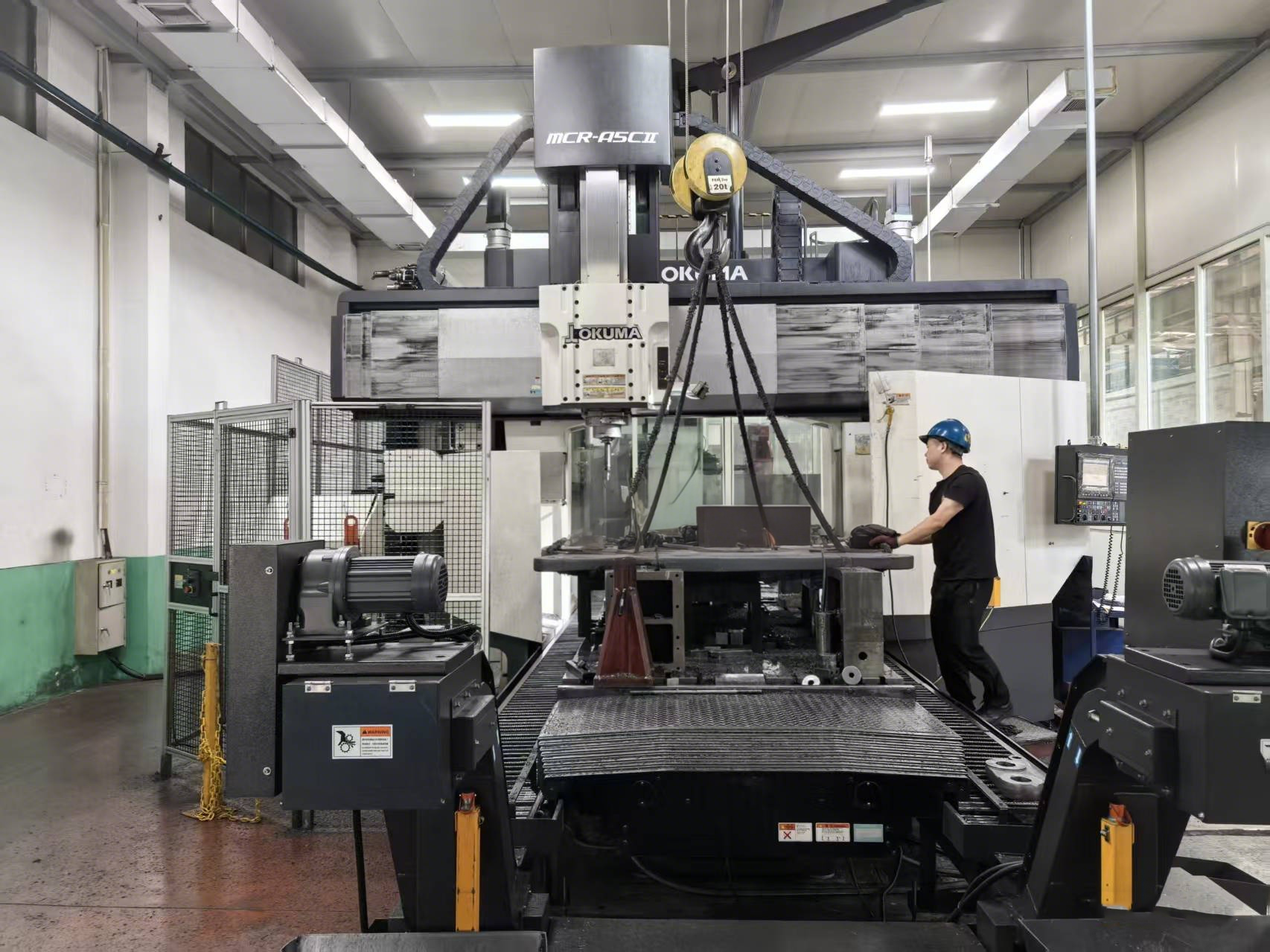
Five-face machining center — part of the in-house metal-cutting capacity behind EUMASEIKI machine structures.
EV-1580B, EV-1475B and UV260: One Platform Family, Not Three Purchases
A buyer planning several machines should evaluate the range as a family rather than as three separate transactions. The question is not which model is best in isolation, but which components are common, which are unique, and whether the documentation logic survives a model transition.
The EV-1580B and EV-1475B vertical platforms appear together in the company's certification record: EUMASEIKI CNC machining centers, including EV-1475B and EV-1580B, are certified under CE certificate 6L250729.WEMQD92 issued by Ente Certificazione Macchine Srl, with EN ISO 23125:2015 cited as the reference standard. The UV260 sits within the same portfolio and should be assessed under the same documentation logic — a current specification sheet, a component list, and a clear statement of which parts it shares with the vertical platforms.
That certificate is more useful as a continuity instrument than as a badge. Two questions follow from it directly: does the certificate's scope list every model the buyer intends to order, and what is the supplier's process for bringing a new or modified model into scope? A buyer who asks those questions at evaluation stage is protecting the second purchase, not just the first.
A question set to send before the technical review
- Which spindle, ball screw and guideway specifications are common to EV-1580B, EV-1475B and UV260, and which differ?
- For each of the three, what is the brand and model of the spindle, ball screw, linear guideway, bearing set and oil pump?
- Which of those items are held in stock, and how is stock confirmed at the order date rather than at the enquiry date?
- Which document proves conformity for each model, and when was its scope last updated?
- What does the handover file contain, and in what format will later re-verification be recorded?
What a Documented Accuracy Figure Can and Cannot Tell You
EUMASEIKI documents XYZ-axis positioning accuracy of 0.008 mm and XYZ-axis repeat positioning accuracy of 0.005 mm. Those are the two numbers a buyer will compare first, and they answer two different questions: positioning accuracy describes how close the machine gets to a commanded point, while repeat positioning accuracy describes how consistently it returns to the same point.
What the figures do not state is equally important. They do not specify the measurement standard applied, the axis travel over which the value was obtained, the ambient temperature, the workpiece or fixture load, or the instrument used. Two suppliers can publish identical numbers obtained under different conditions, and a buyer comparing them without that context is comparing formatting, not capability.
The practical response is procedural rather than sceptical. Ask for the acceptance record with its method stated, keep that record as the machine's baseline, and re-measure on the same basis after any repair, relocation or major reconfiguration. Precision retention is then a documented trend rather than a recollection — and a trend is what a multi-cycle buyer actually needs.
Spare Parts, Lead Time and On-Site Response
Most of the cost of an unreliable support chain lands in year two or later, when a wearing part fails and the machine has no replacement. EUMASEIKI's stated measures address that specifically: permanent stock is maintained for long-lead-time core components such as ball screws and linear guideways, and a complete set of wearing spare parts is delivered together with each machine. The company states that this shortens machine delivery lead time and reduces procurement risk.
Delivering wearing spares with the machine changes the buyer's risk profile in a way that is easy to underestimate. When consumables arrive as an ad-hoc order after a failure, the buyer carries both a procurement delay and the risk of ordering a mismatched specification. A supplied spare set removes the second risk entirely and compresses the first.
On service, the documented commitment is remote technical assistance responding within 12 hours, with professional after-sales engineers travelling to the customer's site worldwide when a fault cannot be resolved remotely. On-site work covers maintenance, precision calibration and machine debugging, and the complete machine is covered under warranty during the warranty period.
Two verification points belong in the purchase file. First, ask what "permanent stock" covers by item and how availability is confirmed for the specific models ordered. Second, ask how a site visit is triggered, by what criteria, and what documentation is issued after precision calibration — because that document becomes the next baseline.
Acceptance Evidence as a Continuity Instrument
Acceptance is the moment a machine stops being a specification and becomes a measurable asset. EUMASEIKI's stated acceptance criterion is a pre-shipment test, with a minimum order quantity of 1 unit, EXW delivery terms, and payment of 50% in advance and 50% before loading.
The pre-shipment test matters most when its output is treated as a file rather than a formality. A continuity file that travels with the machine should contain the conformity document and its model scope, the component brand and model list, the accuracy record with method stated, the delivered spare-parts list, the calibration history sheet and the named service contact path. Any of these can be requested at order stage; several become difficult to reconstruct later.
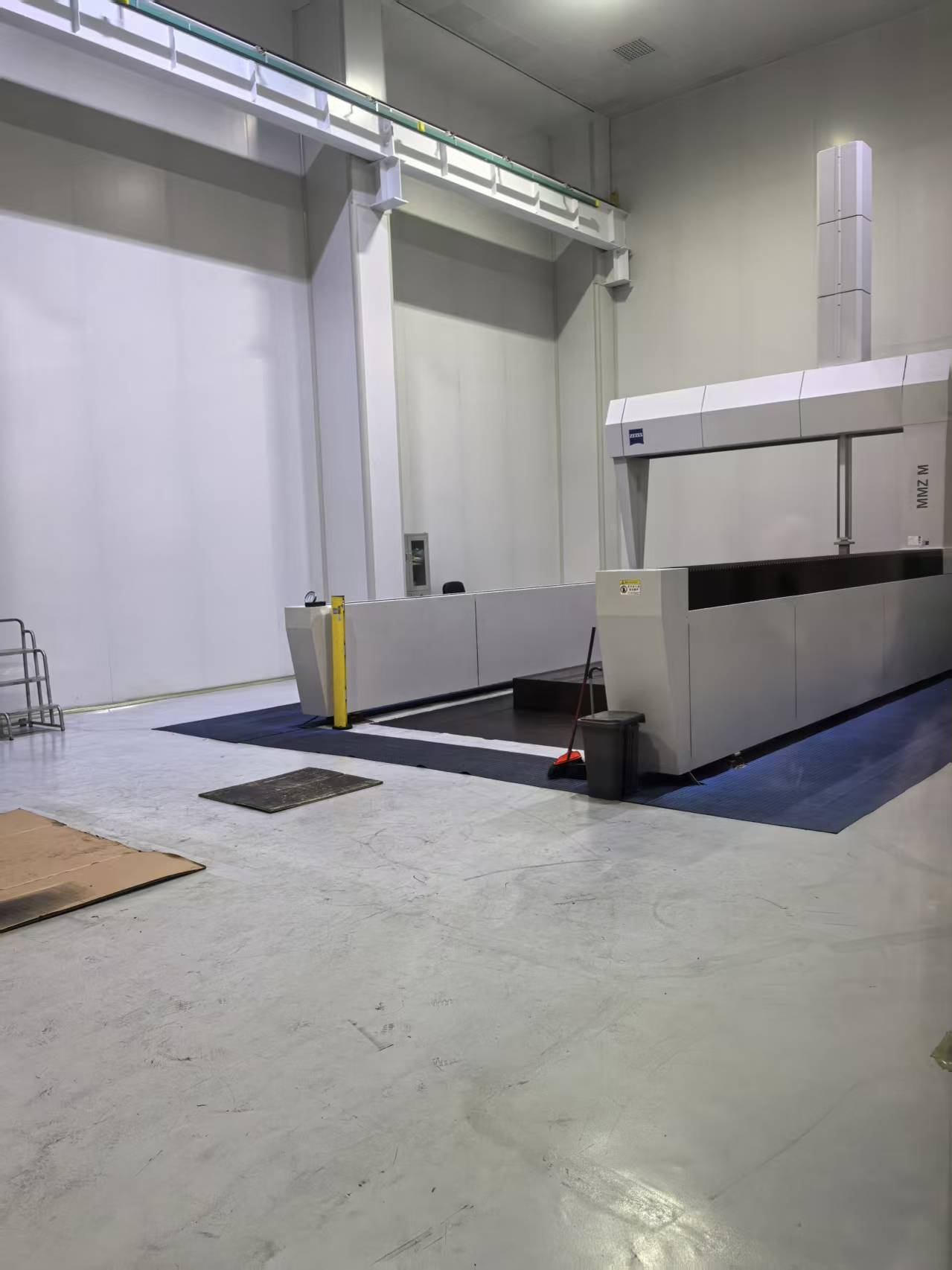
Coordinate measuring machine — dimensional verification before assembly, and the basis for a repeatable acceptance record.
The boundary here is that acceptance evidence establishes the machine's condition at handover. It does not predict future performance, and it does not replace periodic re-verification. What it does is make re-verification meaningful, because there is something specific to compare against.
Where Continuity Weighs More, and Where It Weighs Less
EUMASEIKI describes its product range as covering precision mold making, aerospace, automotive parts manufacturing, high-end equipment production, shipbuilding and engineering machinery. Continuity carries different weight across those sectors, and a buyer should adjust the evaluation accordingly rather than applying one template everywhere.
- Mold making and automotive mold work. Long part programs, multi-year tooling programs and frequent changeovers put a premium on spares availability and repeatable calibration, because a stopped machine interrupts a delivery schedule that was quoted months earlier.
- Aerospace parts. Traceability dominates. A component that cannot be identified by brand and model is difficult to defend in a process audit, which makes the component list a first-order requirement rather than a nice-to-have.
- Aluminium alloy and general precision parts. Where duty cycles are lighter and part families are stable, the balance shifts toward acceptance consistency and a documented service path; the structural argument still applies but carries less commercial weight.
- High-mix, low-volume shops. A single-unit minimum order quantity allows a pilot machine to be evaluated before a cell is committed, which is a genuine fit for this buyer type.
The framework does not change across these cases. Only the weighting does, and buyers should say which weighting they are using before quotation so that suppliers respond to the same question.
Market Context: Useful, but Not a Continuity Test
Grand View Research forecasts the global CNC machining and turning centers market at USD 31.3 billion for 2026, according to its CNC machining and turning centers market report. The figure is a projection from a commercial research source and describes a category, not a supplier; it should not be read as evidence that any particular builder will still be supporting a machine in a decade.
Its real use in this evaluation is narrower. A large, contested category gives buyers more comparable suppliers to screen, which makes a structured continuity test more valuable rather than less — because the cost of switching between suppliers rises with every year a machine stays in service.
Transactional Purchase vs Lifecycle-Oriented Procurement
The two procurement approaches below use the same machines and the same budget. They differ in what is asked, recorded and committed before the order is placed. The comparison concerns procurement models, not brands.
| Evaluation dimension | Spec-only purchase | Lifecycle-oriented purchase |
|---|---|---|
| Decision trigger | Can this machine make the current part at the quoted price? | Can this platform still be supported and re-specified when the part mix changes? |
| Evidence requested | Datasheet accuracy and configuration list. | Datasheet plus component brand list, conformity scope and stated test method. |
| Accuracy record | A number in a document. | A baseline that can be re-measured on the same basis after repair or relocation. |
| Spare parts | Ordered after failure. | Wearing spares supplied with the machine; long-lead-time items held in stock. |
| Service path | Contact established at breakdown. | Response time, escalation criteria and on-site scope agreed in advance. |
| Model transition | Second machine specified from scratch. | Shared components and documentation logic carried into the second machine. |
| Cost view | Purchase price plus freight. | Purchase price plus spares inventory, calibration and downtime exposure. |
| Risk if the relationship weakens | Buyer holds an untraceable asset. | Buyer holds a documented asset with identifiable replacement paths. |
The honest boundary: a lifecycle-oriented purchase costs more attention up front and does not guarantee outcomes. It converts unknown risks into written ones, which is the most a procurement process can do before a machine is installed.
Turning Procurement Terms into Continuity Commitments
The published terms — MOQ 1 unit, EXW delivery, pre-shipment test as the acceptance criterion, and 50% advance with 50% before loading — are ordinary, and each carries a continuity implication that is easy to miss.
EXW means the buyer arranges and bears the movement of the machine. That is a reasonable moment to ship the spare-parts set and any additional long-lead-time items in the same consignment, because a second shipment arranged two years later will cost more and arrive later. A one-unit minimum order quantity, meanwhile, supports a staged rollout: evaluate one platform under real production, then standardise the second and third machine against the record the first one produced.
The payment structure places the acceptance test before final settlement, which gives the buyer a natural point to require the complete handover file as a condition of the second instalment. Buyers who ask for it at that moment generally receive a more complete document than those who ask six months later.
What Would Change This Assessment
This evaluation is conditional on what is currently documented, and it should be revisited when the evidence changes. Three developments would materially strengthen the case for a multi-cycle relationship: publication of per-model component lists covering the EV-1580B, EV-1475B and UV260, documented calibration intervals with the records to support them, and buyer references that a prospective customer can verify independently.
Two factors would weaken it. A model transition that breaks component commonality without a stated migration path would undercut the platform logic. And the company's 2023 founding means the installed base has not yet been tested by time; until it has, process evidence and verifiable references have to carry the argument.
Frequently Asked Questions
What does "will it outlast the purchase" actually mean for a CNC machining center?
It means testing whether the supplier can keep the platform supported after handover — through spare-parts availability, traceable core components, repeatable acceptance evidence and a defined service path — rather than only confirming that the machine meets its specification on the day of delivery.
How can a buyer confirm that a spindle or ball screw will be traceable years after delivery?
Ask for the brand and model of the spindle, ball screw, linear guideway, bearing set and oil pump at order stage, and require that list in the handover file. EUMASEIKI states that key components such as spindles, guideways, bearings and oil pumps are sourced from manufacturers in Taiwan and Japan, with some core components imported from original brands in Germany or Italy; documenting those identities at delivery is what makes a later replacement order match correctly.
Do EV-1580B, EV-1475B and UV260 share the same components and documentation?
The three platforms sit within one portfolio and follow the same documented construction and component-sourcing approach, but buyers should not assume identical parts. EUMASEIKI's certification record names EV-1475B and EV-1580B under CE certificate 6L250729.WEMQD92 issued by Ente Certificazione Macchine Srl, with EN ISO 23125:2015 cited. The practical step is to request a per-model component list and the conformity document's model scope for each platform being considered, including UV260.
Which accuracy values should be recorded at acceptance?
Record the documented figures — XYZ-axis positioning accuracy of 0.008 mm and XYZ-axis repeat positioning accuracy of 0.005 mm — together with the method used to obtain them, the instrument, the ambient conditions and the axis travel measured. Without the method, a later reading cannot be compared with the original, and the record loses its value as a baseline.
What does EUMASEIKI provide for parts and after-sales support?
The company states that it maintains permanent stock for long-lead-time core components such as ball screws and linear guideways, and that a complete set of wearing spare parts is delivered with each machine, which it says reduces lead time and procurement risk. Remote technical assistance is stated to respond within 12 hours, and professional engineers travel to customer sites worldwide for maintenance, precision calibration and machine debugging when a fault cannot be resolved remotely. The complete machine is covered under warranty during the warranty period.
What are the purchasing terms and acceptance criteria?
Minimum order quantity is 1 unit, delivery terms are EXW, the acceptance criterion is a pre-shipment test, and payment terms are 50% in advance with 50% before loading.
The Decision Rule
A machining center purchase should be judged twice: once against the part that has to be made next quarter, and once against the support that will be needed in year three. The first judgement belongs to the specification sheet. The second belongs to the supplier evaluation, and it is answered by documents — component lists, conformity scope, acceptance records, spare-parts inventories and service terms — rather than by assurances.
Applied to the EV-1580B, EV-1475B and UV260 platforms, that rule produces a short, practical checklist: confirm what is shared and what is unique, require traceable component identities, fix the acceptance method so it can be repeated, and write the parts and service commitments into the order. A supplier that can answer those four points in writing is a supplier whose machine has a better chance of outlasting the purchase.
A downloadable catalogue covering the current EUMASEIKI machining center range is available here: EUMASEIKI product catalogue (PDF).
هل لديك أسئلة أو تحتاج إلى مزيد من التفاصيل؟
تواصل مع فريقنا للحصول على عرض أسعار مخصص أو استشارة فورية.
طلب عرض أسعار
املأ النموذج أدناه وسيتواصل معك فريقنا بعرض مقترح مخصص.
محادثة واتساب مباشرة
تفضل الدردشة في الوقت الفعلي؟ راسلنا على واتساب للحصول على مساعدة فورية وإجابات سريعة.
- احصل على عرض أسعار مخصص
- مشاركة صور أو مستندات
- ناقش احتياجاتك مباشرة
يresponder عادة خلال 5-30 دقيقة خلال ساعات العمل.