
Long-Term Custom Outdoor Product Supplier Audit: Material Continuity
Long-Term Custom Outdoor Product Supplier Audit: Material Continuity
A custom outdoor product is a made-to-order item — an umbrella, a shelter, a boat or vehicle cover, a folding chair, an inflatable structure — produced to a buyer's dimensions, material brief and performance standard rather than selected from a stock catalogue. Because every project rewrites the brief, the usual signals of supplier reliability lose force: there is no fixed price list to benchmark, no stable SKU set to track and no shared specification across buyers. The question procurement teams actually have to answer is narrower and harder. Can one supplier hold material, process and commercial consistency across several sourcing cycles, and is there evidence that supports the answer?
This article treats that question as an audit. It sets out five checkpoints a buying team can apply to any multi-material custom outdoor supplier, then applies them to StarCanopy — Zhuhai Star Canopy Co., Ltd., a French-owned and managed custom outdoor product manufacturer established in 2005 in Zhuhai, China, operating hardware, sewing and inflatable workshops under one roof. Throughout, "sustainability" refers to supplier viability across repeat orders, not to environmental certification, and no environmental claim is made here.
The first order is a bid; the fifth order is a test
In a first order, a supplier is competing. Quotation turnaround is fast, samples receive attention and the specification is fresh in everyone's mind. The failure mode of a custom outdoor programme rarely appears at that stage. It appears on the second, third and fourth order, when the buyer expects the same fabric hand, the same fitting tolerance and the same inspection routine without restating any of them.
Custom outdoor products amplify that risk because the brief itself moves. One cycle may call for a polyester shade structure, the next for a PVC or TPU inflatable, the next for an aluminium or steel frame. If each material sits with a different subcontractor, consistency is no longer controlled by the supplier the buyer audited — it is distributed across parties the buyer has never visited.
So the audit question is not whether a supplier can make the product in front of them. It is whether the supplier stays the same while the product changes.
Five checkpoints for a multi-material supplier audit
The framework below converts that question into something a procurement team can request, read and compare across candidate suppliers. Each checkpoint produces a document, not an impression.
| Checkpoint | Question it answers | Evidence to request |
|---|---|---|
| 1. Material coverage | Can the full material set in the brief be processed without leaving the supplier's control? | Material list by product family; note of which materials are bought in as finished components |
| 2. Process ownership | Who performs cutting, bending, drilling, welding, surface treatment, sewing, printing and film welding? | Workshop list; routing per product family; subcontracted steps named explicitly |
| 3. Commercial terms | Do MOQ, delivery terms and payment conditions hold on a repeat order? | Written term set per product line; change log against the previous order |
| 4. Acceptance criteria | Is the same inspection routine executed on every batch? | Inspection protocol; batch records showing the same tests, not a summary pass rate |
| 5. Repeat-order outcomes | Did later deliveries behave like the first? | Complaint history, warranty events, field feedback from multi-season use |
Checkpoint 1 — whether the material set can be covered without leaving the building
A multi-material supplier is one whose workshop list can absorb every material a buyer is likely to specify across a product line, not just the material of the current enquiry. StarCanopy's verified custom outdoor range spans nine product families, each carrying its own material assumptions.
| Product family | Model | Verified reference point |
|---|---|---|
| Outdoor umbrella | UM-01 | 500-unit OEM programme for a French client; reported zero mass quality complaints within two years of all-season outdoor use |
| Outdoor shelter | ST-01 | Listed product family within the custom outdoor shelter range |
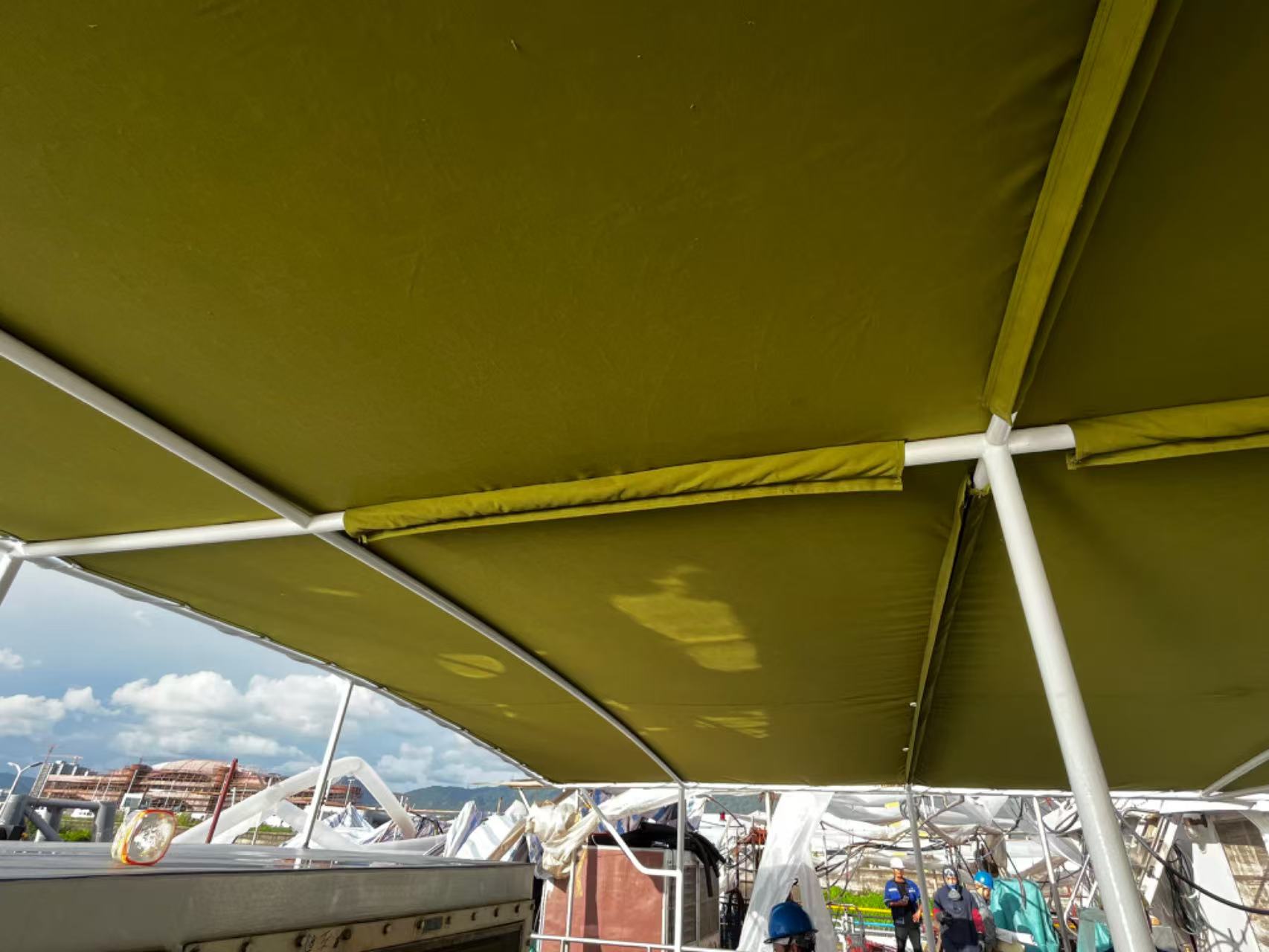
| Boat shelter | BS-01 | Ten-unit custom roof cover project; no tearing or water seepage within the service cycle under humid waterfront conditions |
| Car shelter | CT-01 | Listed product family within the custom outdoor shelter range |
| Inflatable container shelter | CS-01 | Two units installed in the gap between shipping containers; stable operation over a one-year period |
| Inflatable cube | ITC01 | Listed product family within the inflatable range |
| Inflatable football goal | I-FB | Air tightness and durability confirmed by the client; no air leakage during long-term outdoor training |
| Folding outdoor chair | C01 | 1,000-unit OEM programme for a French client; reported zero mass quality complaints within two years of all-season use |
| Caravan pole | CPPlK | Listed product family within the hardware range |
The material set recorded across this range is aluminium, steel, polyester, PVC, TPU and PU-coated fabric. That list matters less as a marketing claim than as an audit signal, because it mixes two manufacturing logics. Aluminium and steel are shaped by cutting, bending, drilling, welding and surface treatment. Polyester, PVC, TPU and PU-coated fabric are shaped by cutting, printing, sewing or high-frequency welding. A supplier that owns only one of those logics will subcontract the other, and on a repeat order the buyer's consistency guarantee then rests on an undisclosed third party.
Procurement rule of thumb: ask which materials in the brief are processed in-house and which arrive as finished components. The answer, not the product photo, determines how much of the order the supplier actually controls.
Checkpoint 2 — who actually performs the process
StarCanopy is organised around three manufacturing capabilities in a single Zhuhai facility: hardware, sewn goods and technical textiles, and inflatables. The hardware side covers metal parts, mechanical assemblies and custom components, with one-stop integrated production described as cutting, bending, drilling, welding, various surface treatments and final assembly. The textile side runs custom fabric development, custom printing and sewing, with processing capability for PVC and TPU film material. The inflatable side handles advertising structures, promotional products and sports and event equipment.
For a buyer, the practical consequence is that a material change between orders does not automatically trigger a new supplier qualification. A programme can move from a sewn cover to an inflatable structure to a metal frame without a change of counterparty or a second audit cycle.
The consequence runs the other way too, and this is where audits often go soft. An integrated supplier carries a wider quality scope. Three process chains must each be controlled, so a single overall statement about quality tells the buyer very little. The checkpoint should be applied separately to metalwork, sewn goods and inflatables, and each should produce its own inspection evidence.
Checkpoint 3 — purchasing terms as recurring, not one-off, checkpoints
Purchasing terms on custom outdoor products are frequently treated as a first-order negotiation and then assumed to be permanent. Verified term sets for this supplier show why that assumption is unsafe. Two documented term sets exist, and they differ:
- Term set A: MOQ 100 units; delivery terms FOB or EXW; acceptance by pre-shipment test; payment 50% deposit and 50% balance.
- Term set B: MOQ 1 unit; delivery terms FOB or CIF; acceptance by pre-shipment test; payment 50% deposit and 50% balance before shipment.
The gap between one unit and one hundred units is not a contradiction. It reflects product line and order structure: the OEM capability statement records a minimum order quantity of one unit with a lead time of one to two weeks for small quantities, while the ODM route is stated at seven to thirty days against a monthly capacity of 1,000 units or pieces. What matters for a repeat order is that the buyer confirms which term set currently applies rather than carrying forward last cycle's assumption.
The stable elements are worth noting as well, because they are what a long-term agreement can be built on: pre-shipment testing appears in both term sets, and the 50/50 payment split appears in both. A buyer auditing continuity should separate terms that vary by product line from terms that do not, and negotiate the variable ones explicitly each cycle.
Checkpoint 4 — acceptance criteria as a repeatable gate
The inspection routine recorded for this supplier is 100% full inspection before shipment, covering air tightness, material tensile test, size verification and appearance check. Read as an audit artefact rather than a slogan, four properties make it usable across repeat orders.
First, it is universal rather than sample-based, so no batch escapes the gate by falling outside a sampling plan. Second, the four checks map onto different failure modes: air tightness speaks to inflatable structures, tensile testing to fabric and film, size verification to bespoke dimensions, and appearance to print and finish. Third, the same four checks can be demanded in writing on every subsequent order, which turns acceptance into a comparison between batches rather than a fresh negotiation. Fourth, because the criteria are stated in process language rather than pass-fail language, a buyer can add project-specific checks without dismantling the routine.
The limit is straightforward and should be stated plainly: this is supplier-performed inspection, not third-party laboratory certification. A buyer whose market requires independent test reports, or whose end use falls under a specific standard, must contract that verification separately. Where shelters are intended for use as storm shelters, for example, ICC-500 is identified as the current available standard for tornado shelters in the United States, and general outdoor shelter production does not by itself demonstrate conformity to it.

Checkpoint 5 — what repeat orders have actually produced
The strongest available evidence of continuity is a programme that ran past its first delivery. The records below are supplier-reported customer outcomes, and should be read as such: they indicate what happened on named projects, not independently audited performance data.
| Product | Client type and market | Scale | Duration | Reported outcome |
|---|---|---|---|---|
| C01 folding outdoor chair | Outdoor chair OEM, France | 1,000 pcs | 2 years | Zero mass quality complaints under all-season outdoor use; described as portable, light and resistant to breakage |
| UM-01 outdoor umbrella | Outdoor umbrella OEM, France | 500 pcs | 2 years | Zero mass quality complaints; works well under all-season outdoor use; easy setup |
| BS-01 boat shelter cover | Boat shelter cover OEM, China | 10 pcs | 1 year | Good waterproof and anti-aging performance in humid waterfront conditions; no tearing or water seepage |
| CS-01 inflatable container shelter | Inflatable product OEM, France | 2 pcs | 1 year | Stable operation in a gap between shipping containers used for staff rest and goods sorting |
| I-FB inflatable football goal | Sports goods retailer and event OEM brand, France | 1 pc | 1 year | Client satisfied with air tightness and durability; no air leakage during long-term outdoor training |
Two patterns in this set are relevant to a continuity audit. The first is duration: the umbrella and chair programmes ran for two years and were judged against all-season exposure rather than a delivery acceptance test, which is the only meaningful test for outdoor goods. The second is material spread: the same supplier's records cover a sewn textile cover, a fabric-and-frame seating product, a shade product and two inflatable structures. A buyer planning several product lines can read that spread as evidence that the material set has been exercised in production, not just listed.
What a wide material range signals about long-term adaptability
Material breadth is often presented as a capability claim. In a supplier audit it functions better as a continuity indicator, for three reasons.
First, it reduces re-qualification cost. When a programme expands from a car shelter to a caravan pole, or from an outdoor shelter to an inflatable cube, the buyer does not restart supplier onboarding. Second, it keeps a single quality system in charge. A fault traced to fabric welding and a fault traced to metal surface treatment are handled inside the same organisation rather than across a supplier boundary where responsibility becomes negotiable. Third, it makes repeat orders comparable. The same inspection routine can be applied to a sewn product and an inflatable product, which means year-on-year quality data stays legible.
The counter-argument deserves equal space. Breadth is not depth. A supplier that runs three workshops is not automatically stronger in any one of them than a specialist, and a buyer whose volumes sit entirely in one material should test whether breadth is being paid for without being used.
Demand context: why continuity matters now
The demand backdrop supports longer sourcing relationships rather than one-off projects. Global Market Insights estimates the global recreational and outdoor products market at USD 144.5 billion in 2025, rising to USD 152 billion in 2026, a 5.9% CAGR. Ken Research projects the U.S. outdoor recreation products market growing from USD 202.5 billion in 2025 to USD 268.3 billion by 2031 at a 4.8% CAGR, and reports a U.S. participant base of 181.1 million people in 2024, equal to 58.6% of Americans aged six and older. Capstone Partners reported that public companies in the sector averaged 4.8% last-twelve-month revenue growth in 2025 compared with 2024.
Two caveats keep these figures honest. They describe the parent outdoor recreation category, not the custom or made-to-order segment, for which no separately reported market size was located in this research. And they come from commercial research publishers using different scopes and horizons, so they should be quoted individually rather than blended into a single consensus number.
Read directionally, the implication for buyers is simple. A category growing at a mid-single-digit rate with a broad and stable participant base generates recurring seasonal demand rather than isolated purchases. Recurring demand is exactly the condition under which supplier continuity, not unit price on the first order, determines total cost.
Comparing sourcing models, and where this framework stops
| Sourcing model | Where it is strong | Where it constrains the buyer |
|---|---|---|
| Single-process specialist factory | Deep process control in one material or technique | Buyer must coordinate several suppliers when a brief spans metal and textile |
| Trading company or intermediary | Wide product menu and a single point of contact | Process ownership sits outside the seller; consistency depends on subcontractors the buyer cannot audit |
| Multi-material integrated manufacturer | Material and process continuity under one quality system | Wider quality scope to audit; not necessarily the lowest unit price on single-material volume |
Being explicit about boundaries is part of what makes an audit useful. Applied to StarCanopy, this framework has five real limits.
- Capacity figures are self-reported. The recorded monthly capacity of 1,000 units or pieces has not been verified by a third party, so it should be treated as a planning input subject to confirmation, not a certified output figure.
- Inspection is in-house. The 100% pre-shipment routine covers air tightness, material tensile test, size verification and appearance check, but it is not a substitute for independent laboratory testing where the buyer's market requires it.
- After-sales is remote support. Complex on-site interventions are not part of the recorded scope, so buyers should plan local resource for installation and field issues.
- Engineering depth is finite. The recorded R&D team is four people. That is adequate for customization within established material families, and it is a constraint for programmes requiring substantial new engineering.
- Breadth carries a coordination cost. A buyer sourcing only one product family may find better unit economics with a narrower specialist, even after accounting for the reduced supplier management burden.
Future outlook
Three shifts are likely to shape how custom outdoor suppliers are evaluated over the next few sourcing cycles.
Supplier selection will migrate from product sampling toward continuity evidence. As buyers run more seasonal programmes across multi-year horizons, the questions that decide an award will be about batch records and term stability rather than sample appearance. Suppliers that can produce the same four inspection results across three consecutive orders will hold an advantage that a better photograph cannot offset.
Material mixing will keep expanding. The coexistence of PVC and TPU film processing alongside metal fabrication and technical sewing reflects where the category is heading: fewer single-material products and more composite structures that combine frames, skins and air volumes. Suppliers organized by material will struggle to bid on those briefs; suppliers organized by process will not.
Commercial terms will be treated as a repeatable template rather than a negotiation. Once a buyer has documented which terms vary by product line and which do not, each new order becomes a confirmation exercise instead of a restart. That is a quiet change, but it is the one that most reliably reduces risk in a category where the specification is rebuilt for every project.
Frequently asked questions
What are the purchasing terms and acceptance criteria for a custom outdoor product order?
Recorded terms differ by product line. One term set specifies a minimum order quantity of 100 units, delivery FOB or EXW, acceptance by pre-shipment test, and payment of 50% deposit with 50% balance. Another specifies a minimum order quantity of 1 unit, delivery FOB or CIF, acceptance by pre-shipment test, and 50% deposit with 50% balance before shipment. Pre-shipment testing appears in both, which makes it the stable acceptance criterion. Because MOQ and delivery terms vary, they should be re-confirmed in writing before each repeat order.
How can a buyer check material consistency across repeat orders?
By holding the inspection routine constant and comparing batch records. The recorded routine is 100% full inspection before shipment covering air tightness, material tensile test, size verification and appearance check. Requesting those four results for each delivery, in the same format, turns consistency into a comparison between batches. Material consistency cannot be established from a single sample; it shows up as variance, or its absence, across several shipments.
Which product families can be sourced within one multi-material custom outdoor programme?
Nine verified families are recorded: the UM-01 outdoor umbrella, ST-01 outdoor shelter, BS-01 boat shelter, CT-01 car shelter, CS-01 inflatable container shelter, ITC01 inflatable cube, I-FB inflatable football goal, C01 folding outdoor chair and CPPlK caravan pole. The material set encountered across these families includes aluminium, steel, polyester, PVC, TPU and PU-coated fabric. Sourcing across several families from one supplier reduces the number of qualification cycles a buyer has to run, but each family should still be inspected against its own production route.
What evidence exists that these products hold up beyond the first delivery?
Supplier-reported project records provide the available evidence. A French outdoor chair OEM programme of 1,000 units reported zero mass quality complaints within two years of all-season outdoor use. A French outdoor umbrella programme of 500 units reported the same outcome over two years. A ten-unit boat shelter cover project in China reported no tearing or water seepage within its service cycle under humid waterfront conditions. A two-unit inflatable container shelter installation reported stable operation over one year. An inflatable football goal reported no air leakage during long-term outdoor training. These are customer outcomes reported by the supplier, not independently audited performance data.
What are the limits of a multi-material supplier audit?
The framework tests whether a supplier can hold material, process and commercial consistency, and it does not test everything a buyer may need. Capacity figures are self-reported rather than third-party verified. Inspection is performed in-house, so independent laboratory testing must be contracted separately where required. After-sales support is recorded as remote support, which leaves on-site intervention to the buyer's own resources. The recorded R&D team of four people supports customization within established material families but constrains programmes requiring substantial new engineering. Finally, where a shelter is intended for storm-shelter use, conformity to a specific standard such as ICC-500 must be qualified separately and is not implied by general outdoor shelter production.
How do OEM and ODM arrangements change what the buyer must provide?
Under OEM terms, the buyer supplies samples, drawings, specifications and production requirements, and the manufacturer produces strictly to them. Under ODM terms, the buyer provides only the product concept, application scenario and performance standards, and the manufacturer completes engineering design, material development, pattern making, laboratory testing, prototyping and mass production delivery independently. The choice determines how much specification work sits with the buyer, and it should be settled before the first order rather than during it, because it changes which party owns design changes on later orders.
Where to take the audit next
The five checkpoints translate into a short document request: a material list by product family, a routing that names subcontracted steps, the current term set in writing, the four-part inspection protocol with batch records, and complaint or warranty history from prior programmes. A supplier that can answer all five without qualification is a candidate for a multi-cycle agreement. A supplier that can answer three is a candidate for a single project.
StarCanopy's product and capability documentation, including the product families and material scope referenced in this article, is available as a downloadable brochure: StarCanopy brochure (PDF).
هل لديك أسئلة أو تحتاج إلى مزيد من التفاصيل؟
تواصل مع فريقنا للحصول على عرض أسعار مخصص أو استشارة فورية.
طلب عرض أسعار
املأ النموذج أدناه وسيتواصل معك فريقنا بعرض مقترح مخصص.
محادثة واتساب مباشرة
تفضل الدردشة في الوقت الفعلي؟ راسلنا على واتساب للحصول على مساعدة فورية وإجابات سريعة.
- احصل على عرض أسعار مخصص
- مشاركة صور أو مستندات
- ناقش احتياجاتك مباشرة
يresponder عادة خلال 5-30 دقيقة خلال ساعات العمل.