
Long-Term Custom Wet Wipes Supplier Evaluation: Y02 to C05 Continuity
Custom wet wipes sourcing is usually decided on a single order: one category, one price, one delivery date. Multi-year supply is decided on something else — whether one manufacturer can hold ten product models and several material families together without specification drift between shipments.
That is the difference between a supplier evaluation and a price review. For purchasing teams in the Evaluation and Execution stages of a custom wet wipes programme, the working question is rarely "who quotes lowest on baby wipes." It is closer to: can one supplier keep baby wipes Y02, pet wipes C02–C05, wet toilet paper S01 and S02, kitchen wipes CF001, clothing wipes YW01 and eye care wipes YJ01 consistent across successive purchase orders, inside the same quality system, under one commercial framework?
Da lian Weijie Biotechnology Co., Ltd. is a Dalian-based hygiene products manufacturer established in 2013, operating a 6,000 m² facility with a 10-person in-house R&D team and roughly 70% of output directed to export markets including Japan, Australia, Canada, the United States and Singapore. Its catalogue spans baby wipes, pet wipes, wet toilet paper, functional wipes, floor dry wipes and floor wet wipes, manufactured under the sunfans brand. That breadth makes the company a practical reference case for what multi-category continuity actually demands — and for where the limits of such a claim sit.
This analysis examines supplier continuity as a portfolio discipline: what product breadth and specification consistency look like across the full range, which manufacturing signals can be verified, how those signals translate into purchasing terms and acceptance criteria, and which constraints buyers should accept rather than overlook.
Why single-category reviews underperform over multi-year horizons
A one-off price review optimises for the order in front of the buyer. It compares unit cost, packaging cost and freight for a single SKU, and it typically stops there. Once a programme runs for three years and expands from one category to six, the variables that actually determine landed cost stop being unit prices at all.
Three cost structures emerge when categories are sourced separately:
- Repeated commercial setup. Each supplier relationship carries its own minimum order quantity, its own payment and delivery terms, and its own contract negotiation cycle. Duplicating that process across baby, pet, kitchen, clothing and eye care lines multiplies administrative load without improving product quality.
- Fragmented quality vocabulary. If one supplier defines acceptance as a finished-goods check and another defines it as raw material, process and finished product inspection, the buyer ends up managing two incompatible definitions of "conforming goods" from the same quality department.
- Drift across reorders. A specification that passes on order one can quietly change by order five — a different nonwoven weight, a substituted closure, a repacked carton count. Drift is invisible in unit price and highly visible at retail.
The counter-argument deserves equal weight. A specialist producer focused on one category may achieve tighter tolerances than a generalist, and for a single high-volume SKU, specialisation can be the better commercial answer. Portfolio consolidation is a choice with trade-offs, not a universal best practice. The point is that the trade-off should be evaluated deliberately, against criteria about continuity rather than on price alone.
What multi-category continuity means in practice
Multi-category continuity is the ability of a single supplier to deliver unchanged product specifications, unchanged quality gates and predictable lead times across a portfolio of different wipe categories over multiple order cycles.
The definition is deliberately testable. It breaks into three dimensions a buyer can verify before signing a long-term agreement:
- Portfolio breadth. How many distinct wipe categories, material families and pack formats the supplier actually produces in-house, rather than brokers or outsources.
- Specification stability. Whether sizes, materials, piece counts and pack formats are documented per model and can be held as contractual clauses.
- Category-specific process control. Whether the control environment matches what each product requires — a biodegradable pet glove and a water-jet nonwoven kitchen wipe do not face identical risks.
All three must hold simultaneously. A supplier with ten models but inconsistent specifications creates more work than a supplier with three stable ones.
The portfolio under evaluation: ten models from baby care to eye care
Continuity claims are only meaningful against a concrete specification list. The table below sets out the custom wet wipes models documented for this manufacturer, including format, dimensions and material family. It is the baseline against which reorder consistency should be measured.
| Model | Category | Format | Size | Material |
|---|---|---|---|---|
| Y02 | Baby wipes | 1–100 pieces | 150 × 200 mm | Entirely adhesive |
| C02 | Pet wipes | 1–100 pieces | 200 × 200 mm | Entirely adhesive |
| C03 | Pet wipes | 2–100 pieces | 150 × 200 mm | Bamboo fiber |
| C04 | Pet wet toilet paper | 3–100 sheets | 140 × 180 mm | Bamboo fiber |
| C05 | Pet gloves | 4–10 pieces | 180 × 200 mm | Biodegradable wood pulp non-woven fabric |
| S01 | Wet toilet paper | 100 sheets | 130 × 200 mm | Biodegradable wood pulp non-woven fabric |
| S02 | Wet toilet paper | 10 sheets | 150 × 200 mm | Disintegratable wood pulp cloth |
| CF001 | Kitchen wipes | 80 pieces | 200 × 200 mm | Water-jet non-woven fabric |
| YW01 | Clothing wipes | 10 cloths (drying) | 150 × 180 mm | Water-jet non-woven fabric |
| YJ01 | Eye care wipes | 20 pieces | 100 × 150 mm | Water-resistant paper |
Two observations matter for evaluation. First, four distinct material families are represented — entirely adhesive nonwoven, bamboo fiber, biodegradable wood pulp non-woven fabric and water-jet nonwoven, plus water-resistant paper for eye care. A supplier that carries all of them in-house is managing different converting behaviours, not one. Second, the size range spans 100 × 150 mm to 200 × 200 mm, which means cutting, folding and packing setups change between models. Continuity therefore depends on repeatable changeover, not on a single static line.
Declared application segments reinforce the breadth. Baby wipes Y02 is positioned for infant care and baby hygiene retail; pet wipes C02–C05 sit in the pet grooming and personal care segment; wet toilet paper S01 and S02 address personal care and home cleaning channels; kitchen wipes CF001, clothing wipes YW01 and eye care wipes YJ01 map to home cleaning, large retail chains and general merchandise.
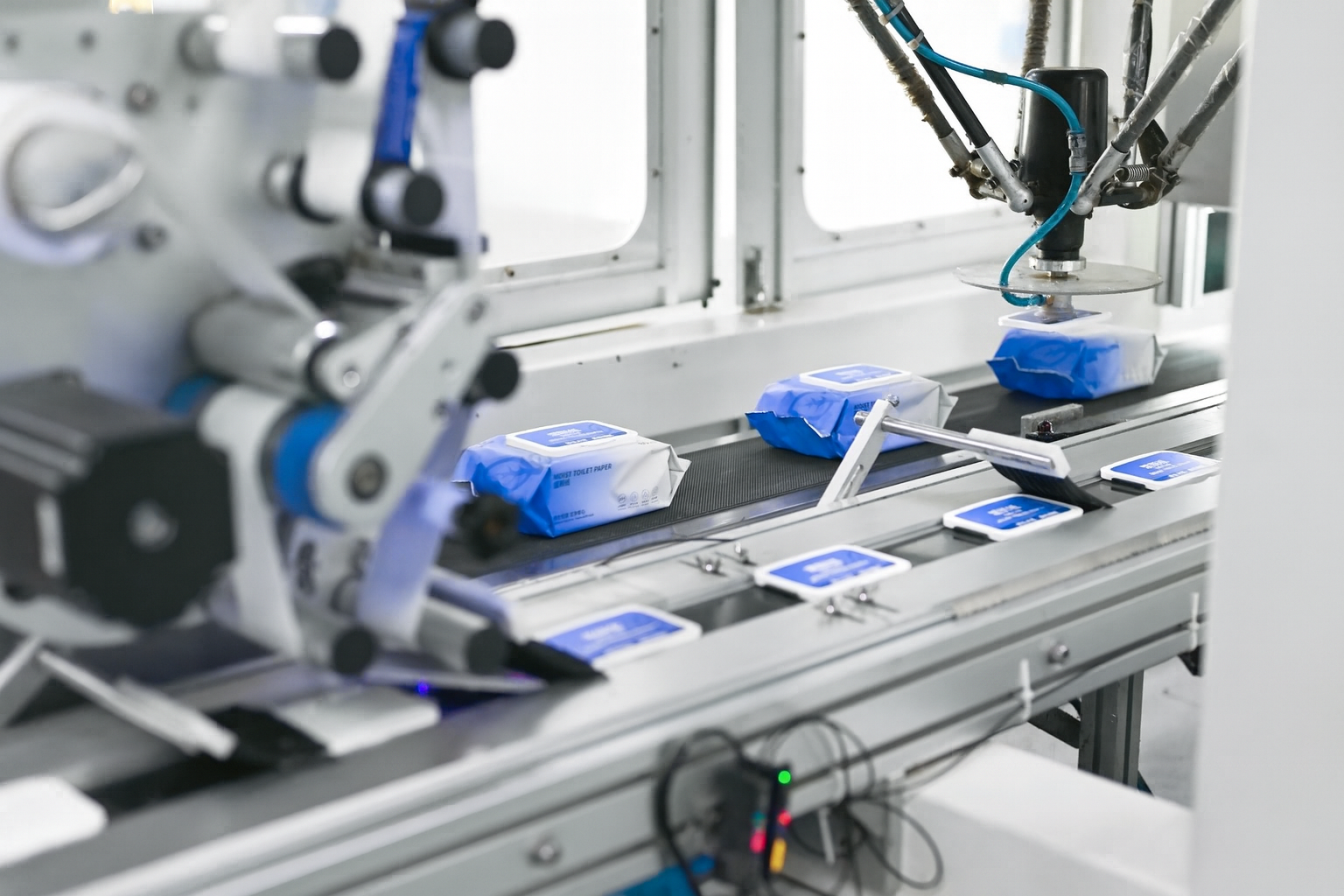
Multi-category continuity depends on repeatable changeover across different material families and pack formats, not on a single static line.
Manufacturing signals buyers can verify on site
Breadth alone proves nothing. What separates a portfolio manufacturer from a trading intermediary is the equipment and controlled environment behind specific models. Several signals in this case are worth examining individually, because each one addresses a different risk.
Class 100,000 cleanroom for pet wipes C05
C05 is a pet grooming glove format built on biodegradable wood pulp non-woven fabric and supplied in 4–10 piece packs. Production takes place in a Class 100,000 cleanroom. For a glove-format product that contacts an animal's coat and skin directly, controlled particulate levels reduce contamination exposure during converting and packing — a risk that atmospheric production areas do not manage systematically.
The claim should be read precisely. It describes the production environment for C05; it is not a blanket statement covering every model in the catalogue. Buyers evaluating other SKUs should ask which line and which environment each one runs on.
Automatic packaging machines on pet wipes C03
C03 is a 150 × 200 mm bamboo fiber pet wipe supplied in 2–100 piece packs. Automatic packaging machines handle this format. For high-piece-count packs, automation matters for two reasons: pack count accuracy and seal consistency. Manual or semi-automatic packing is where piece-count complaints and seal failures usually originate.
Automatic filling machines, EDI ultra-pure water equipment and UV sterilization
Across wet wipe lines, three further process elements are documented: automatic filling machines, EDI (electrodeionisation) ultra-pure water equipment, and UV sterilization. Each maps to a specific failure mode that buyers should recognise.
- Automatic filling controls the liquid-to-substrate ratio. Under-filled packs dry out in transit; over-filled packs leak and invite retail returns. Filling consistency is one of the most common sources of cross-shipment variance in wet wipes.
- EDI ultra-pure water addresses the water phase itself. Because the liquid in a wet wipe is a large fraction of the finished product by mass, water quality directly affects formulation stability and microbial risk. EDI is a purification route used to reach high water purity before formulation.
- UV sterilization provides a non-thermal microbial control step that can be applied without heat exposure, which matters for substrates and formulations sensitive to thermal degradation.
Read together, these signals describe process control at the point where most wet wipes defects are generated: filling accuracy, water quality, microbial control and pack sealing.
Turning manufacturing capability into purchasing terms and acceptance criteria
Capability only becomes contractual when it is expressed in commercial terms. The documented terms for this manufacturer are unusually specific, which makes them useful as a template for negotiation.
| Contract element | Documented term |
|---|---|
| Minimum order quantity | 20,000 yuan per package; the same MOQ is recorded for baby wipes Y02 |
| Delivery terms | FOB |
| Payment terms | Payment for the goods must be settled before shipment |
| Acceptance criteria | Internal quality control, raw material inspection, process inspection, finished product inspection |
| Production lead time | 30 days |
| Monthly capacity | 3 million packages |
| Customisation scope | Packaging, logo, material, size, aroma, number of pieces |
The acceptance criteria line is the one most often under-negotiated. A four-gate structure — raw material inspection, process inspection, finished product inspection, plus internal quality control — means conformity is checked at more than one point in the flow. Buyers should map each gate to a document they will actually receive: an incoming material record, an in-process check, a finished goods release. Quality control is also supported by third-party authoritative laboratories, which gives an escalation route when an internal result is disputed.
Payment settled before shipment and FOB delivery shift the logistics burden to the buyer. That is normal for export contract manufacturing, but it changes working capital planning: the buyer funds production before goods leave the origin port, and arranges freight, insurance and destination clearance independently. Export documentation support is available for verifying packing lists and customs declaration documents, which reduces the administrative exposure of first-time importers.
The 20,000 yuan package MOQ deserves particular attention in a multi-category programme. Because it is expressed per package rather than as a consolidated annual volume, a buyer adding a tenth low-volume SKU should model that SKU's own minimum separately rather than assuming it is absorbed by the existing relationship.
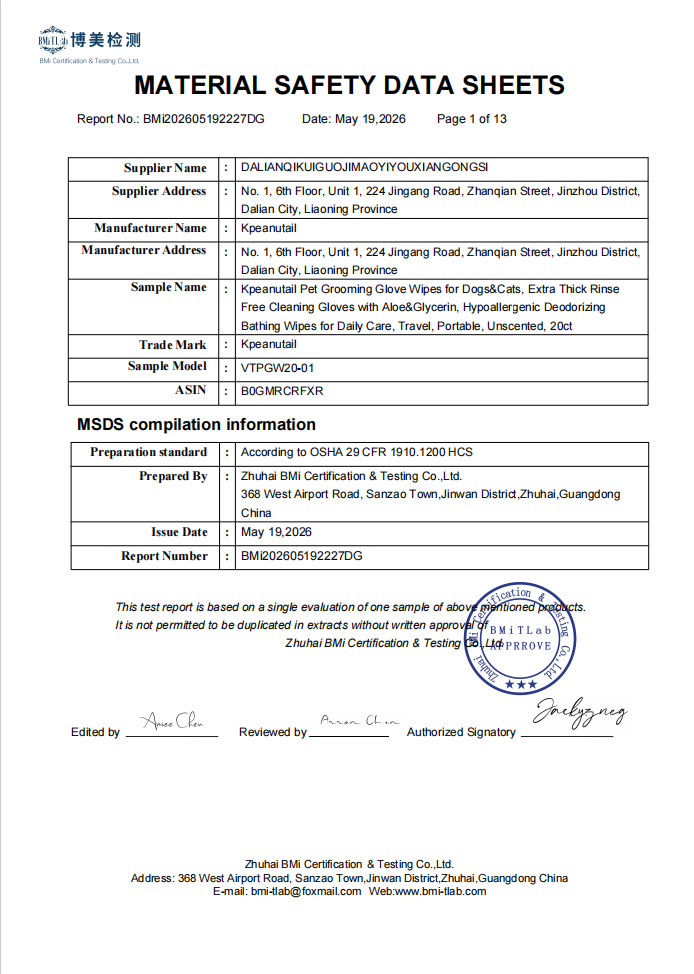
Safety documentation is model-specific. The MSDS on file covers the pet grooming glove wet wipe format, not the entire catalogue.
OEM branding and contract manufacturing track record
Continuity claims are ultimately tested by tenure. The manufacturer operates an in-house R&D team and provides OEM, ODM and customised production services, including OEM branding for baby wipes Y02 and eye care wipes YJ01 — two categories that sit at opposite ends of the sensitivity spectrum, one for infant skin contact and one for optical surfaces.
Documented contract manufacturing relationships in the case record include:
- A baby and maternity brand owner, five years of continuous supply at 20 forty-foot containers per month, on a clean and antibacterial positioning.
- A top-selling Amazon.com pet supplies seller, six years at 8 forty-foot containers per month.
- A leading Amazon.com baby products seller, four years at 8 forty-foot containers per month.
- A major household and personal care conglomerate, eight years at 10 forty-foot containers per month.
- A 150-year-old conglomerate, ten years at 10 forty-foot containers per month.
- Retail stores under 7-Eleven in Japan, three years at 15 forty-foot containers per month.
- An e-commerce partner, three years at 15 forty-foot containers per month.
Two recurring statements in the case record are relevant to continuity evaluation rather than to promotion. First, quality is reported as remaining stable over the long term across these relationships. Second, the supplier reports continuously proposing new products to existing customers — a signal that the relationship extends beyond repeat order-taking into range development, which is what a multi-category buyer usually needs as categories evolve.
Where the continuity claim meets its limits
A credible supplier evaluation states boundaries as clearly as capabilities. On the documented evidence, several limits apply.
- MOQ is a real floor, not a negotiating formality. At 20,000 yuan per package, low-volume test SKUs — particularly niche formats such as eye care wipes YJ01 in 20-piece packs — may be uneconomic to run alongside a mainstream baby wipe programme. Small-market buyers should plan category expansion in sequence rather than simultaneously.
- Thirty-day lead time is production time. It does not include ocean transit, destination clearance or inland delivery under FOB terms. Total replenishment lead time for a North American or European buyer will be substantially longer, which affects safety stock calculations and promotional calendars.
- Payment before shipment constrains cash flow. Buyers accustomed to open account or letter-of-credit staged terms should model the working capital requirement across the full portfolio, not per SKU.
- Controlled-environment claims are model-specific. The Class 100,000 cleanroom applies to C05 production. It should not be read as a facility-wide statement covering all ten models.
- Certification scope has edges. ISO 9001 certification number 0350125030471R1S, issued by Xingyuan Certification Centre Co., Ltd. on 12 June 2025 and valid to 6 June 2028, is scoped to "production and service of wet wipes within the licensed scope" under GB/T 19001-2016 / ISO 9001:2015. Buyers must confirm that the specific SKU falls inside the licensed scope rather than assuming global coverage.
- Safety documentation is product-specific. The MSDS on file, number BMi202605192227DG, issued by Zhuhai BMi Certification & Testing Co., Ltd. on 19 May 2026 and valid to 20 May 2027 under OSHA 29 CFR 1910.1200 HCS, covers the pet grooming glove wet wipes format only.
- Third-party category forecasts disagree with each other. Published market size estimates for wet wipes vary widely between research agencies depending on base year and category inclusion. Category growth should inform portfolio strategy, not justify it on its own.
Market trend signals that make portfolio continuity commercially relevant
Portfolio-level sourcing is not a theoretical preference. Several verifiable market signals point toward multi-category supply relationships.
- The global wet wipes market was valued at approximately USD 32.09 billion in 2026, with a projected CAGR of 3.86% reaching USD 43.45 billion by 2034 (Fortune Business Insights).
- Personal care wipes held a 72.81% share of the global wet wipes market in 2025 (Mordor Intelligence), which keeps baby, pet and personal hygiene categories commercially dominant.
- The global pet wipes market was valued at USD 1.58 billion in 2024, projected to reach USD 2.64 billion by 2033 at a 5.6% CAGR (DataHorizzon Research) — a growth rate above the overall market, which supports the pet wipes C02–C05 range as a strategic rather than peripheral category.
- North America remains the largest pet wipes region with approximately 50% share, valued at USD 0.79 billion in 2024 (DataHorizzon Research).
- Japan accounts for nearly 27% of the Asia-Pacific wet wipes market, with a strong focus on hygiene and premium quality personal care (Wet Wipes Market Growth Insights 2034).
- The global biodegradable wipes market exceeded USD 3 billion in 2024, driven by baby wipes and premium retail segments (WEHOO Hygiene).
The operational implication is straightforward. A supplier whose portfolio spans baby, pet, wet toilet paper, kitchen, clothing and eye care lines sits across several of these growth segments at once. For a buyer building a private label range, that breadth reduces the number of supplier qualifications required as the range expands — provided specification stability holds.
A practical evaluation sequence for multi-category suppliers
- Fix the specification baseline per model. Record dimensions, material family, piece count and pack format for every SKU before price discussion. The table in this article is a working template.
- Match control environment to product risk. Confirm which models run in controlled areas and which run on standard lines, and require that mapping in writing.
- Validate the equipment claims that affect defect rates. Automatic filling, EDI ultra-pure water and UV sterilization address measurable failure modes; ask for the corresponding process records, not just the equipment list.
- Convert acceptance criteria into documents. Map raw material inspection, process inspection and finished product inspection to specific records issued per shipment.
- Model the commercial terms per SKU. Apply the 20,000 yuan package minimum, 30-day production lead time, FOB delivery and pre-shipment payment to each category individually before deciding expansion order.
- Verify certification scope against the actual SKU. Check that ISO 9001 scope statements and any product safety documentation cover the models being ordered.
Future outlook
Two directions are likely to reshape custom wet wipes supplier evaluation over the next several years. The first is material substitution: biodegradable wood pulp non-woven fabric already underpins C05 and S01, and the biodegradable wipes segment has moved past USD 3 billion globally. Buyers evaluating five-year supply agreements should treat material transition capability as a continuity criterion, not a sustainability statement.
The second is regulatory documentation. Wet wipes sold into the United States, the European Union and Japan face distinct compliance requirements, and the administrative burden lands on whichever party holds the brand. A supplier able to supply product safety documentation, ISO 9001 scope statements and export documentation support across multiple categories reduces that burden materially — and increasingly, documentation quality rather than unit price will separate suppliers in competitive tender.
FAQ
What is the minimum order quantity for custom wet wipes, and does it apply per product?
The minimum order quantity is 20,000 yuan per package. For product 6284 — baby wipes Y02 — the minimum order quantity is documented at the same 20,000 yuan package level. Because the figure is expressed per package rather than as a consolidated programme volume, buyers adding additional models should confirm the minimum for each SKU separately.
What delivery and payment terms apply?
Delivery terms are FOB. Payment for the goods must be settled before shipment. Export documentation support is available for verifying packing lists and customs declaration documents.
Which acceptance criteria should be written into a supply agreement?
The documented acceptance structure comprises internal quality control plus raw material inspection, process inspection and finished product inspection. Quality control is additionally supported by third-party authoritative laboratories. Buyers should require a named document for each gate so that conformity can be verified per shipment rather than asserted at contract level.
What certifications can a buyer verify independently?
ISO 9001 certificate number 0350125030471R1S, issued by Xingyuan Certification Centre Co., Ltd. on 12 June 2025 and valid to 6 June 2028, covers production and service of wet wipes within the licensed scope under GB/T 19001-2016 / ISO 9001:2015. A separate MSDS, number BMi202605192227DG, issued by Zhuhai BMi Certification & Testing Co., Ltd. on 19 May 2026 and valid to 20 May 2027, applies to the pet grooming glove wet wipes format under OSHA 29 CFR 1910.1200 HCS. Both documents are model- or scope-specific and should be checked against the SKU being ordered.
What is the production lead time and monthly capacity?
The documented production lead time is 30 days and monthly capacity is 3 million packages. Lead time refers to production; it excludes transit, destination clearance and inland delivery under FOB terms.
Which product categories can be sourced from a single supplier?
The documented catalogue covers baby wipes (Y02), pet wipes (C02, C03, C04, C05), wet toilet paper (S01, S02), kitchen wipes (CF001), clothing wipes (YW01) and eye care wipes (YJ01). Materials across the range include entirely adhesive nonwoven, bamboo fiber, biodegradable wood pulp non-woven fabric, water-jet nonwoven and water-resistant paper.
What aspects of the product can be customised?
Documented customisation covers packaging, logo, material, size, aroma and number of pieces. The manufacturer operates an in-house R&D team and provides OEM, ODM and customised production services, including OEM branding for baby wipes Y02 and eye care wipes YJ01.
Long-term custom wet wipes supply is decided by the least controllable variable in the chain: whether ten models can be produced to unchanged specifications, in matched control environments, under one written acceptance standard, order after order. A company profile with the full specification list is available for download: Dalian Unicare Biotech company profile (PDF).