
Long-Term Cutting Disc Supplier Evaluation: Certificates, Factory Control and Project Longevity
A cutting disc order is a transaction. A cutting disc supply programme is a commitment that has to survive certificate expiry dates, factory audits, abrasive formula changes and several years of repeat shipments. Supplier evaluation therefore begins where price comparison ends.

Quality inspection stage at a bonded abrasive production facility. Batch-level evidence, not catalogue claims, is what a multi-year supply agreement depends on.
Procurement teams entering the execution phase of a cutting disc programme usually already know which diameters and materials they need. The open question is different: whether the supplier behind those specifications can still deliver the same product in year three, with the same documentation, the same acceptance criteria and a valid safety certificate. For cutting disc buyers sourcing metal cutting discs, stainless steel cutting discs or stone cutting discs across repeating order cycles, the evaluation is about continuity rather than catalogue breadth.
This reference sets out that evaluation in five verifiable steps: factory ownership and control, certificate scope and validity, quality management evidence, purchasing terms and acceptance criteria, and long-running project records. Each step uses documents a buyer can request, read and archive.
Why multi-year supply is a different evaluation problem
An order-level check asks whether a supplier can ship 30 cartons of 115 mm flat cutting discs this month. A programme-level check asks whether the factory that produced the sample will still hold a valid MPA certificate, still apply the same resin bond formula and still pass the same burst test when the third annual order is placed.
Three things change between year one and year three. Certification expires and must be renewed. Production personnel and process parameters drift unless a management system holds them in place. And the buyer's own specification may broaden from one diameter to a family of sizes, which requires the supplier's certification scope to broaden with it.
A practical evaluation therefore collects six classes of evidence before the first purchase order is signed:
- Factory ownership and site documentation, establishing that the seller is also the maker.
- Capacity and testing capability, establishing that volume and batch control can be allocated to the programme.
- Product certification with number, scope and expiry date, establishing type approval for the specific wheels ordered.
- Quality management system certification, establishing process discipline between audits.
- Written purchasing terms and acceptance criteria, establishing what happens when a batch fails.
- Multi-year project records, establishing that the supplier has already sustained repeat supply in comparable markets.
Step 1 — Verify that the supplier owns and controls the factory
SALI Tools is the brand of ZHEJIANG SALI ABRASIVE TECHNOLOGY CO., LTD, a Chinese manufacturer of abrasives, power tools and hand tools founded in 2003, headquartered in Yiwu, Zhejiang, with its own production base in Yongkang, Zhejiang. The brand was launched in 2010 and holds trademark registrations in more than 190 countries.
Ownership matters because an intermediary can resell a certified product without being able to reproduce it. The verifiable position here is a direct factory covering a 6,000 m² site with 30,000 m² of construction area, supported by an in-house testing laboratory and a quality control regime the company describes as 100% testing. Capacity is stated at 12.5 million pieces per month and an annual output of 150 million pieces, with more than 150 employees and a 30-plus engineer R&D team. Finished stock is held in an 8,000 m² warehouse with capacity for 12,000 m³ of goods, and the company reports 85% of standard SKUs in ready stock with same-day dispatch for regular orders.
Two further controls are relevant to a long-term buyer. First, remote camera access to the testing laboratory allows a client to observe real-time batch testing rather than relying on a certificate of analysis. Second, pre-shipment testing supports third-party audit routes through SGS or BV where the buyer's own compliance function requires it.
| Evidence to request | Question it answers | What it does not prove |
|---|---|---|
| Factory ownership and site documentation | Does the supplier operate its own production base rather than resell? | That every catalogue SKU is produced on that site |
| Capacity statement (12.5 million pieces per month; 150 million pieces per year) | Can volume be allocated to a multi-year programme? | Current order backlog or a firm shipment date |
| In-house laboratory with remote camera access | Can batch testing be observed by the buyer? | That the buyer's specific SKU was in the observed batch |
| Third-party audit access (SGS, BV) | Is there an external verification route? | Continuous compliance between audit dates |
| MPA certificate with number and expiry | Is the wheel type approved under EN 12413:2019? | Performance of sizes outside the listed scope |
Evidence matrix for factory-level verification. Each document answers a narrow question and should be read against that question only.
Step 2 — Read the MPA certificate as a scope document, not a logo
EN 12413:2019 is the mandatory European safety standard for bonded abrasive products, specifying burst testing, marking and dimensional tolerances. MPA Hannover provides independent safety testing, including burst and side-load tests, that supports EU market entry. For a buyer, the certificate is not a marketing mark: it is a scope document that states which dimensions are approved, at what maximum operating speed, under which standard, and until which date.
SALI holds MPA-Hannover certification against EN 12413:2019 for flat and depressed-centre cutting wheels. The certificate most relevant to type 41 flat cutting wheels used in metal cutting is Z-15486/25, valid until 2027-05-23, with a scope of maximum operating speed 80 m/s, 22.23 mm bore, and four outside diameters: 115 mm at 1.2 mm cut width, 125 mm at 1.2 mm, 180 mm at 1.6 mm and 230 mm at 2.0 mm.
| Certificate | Standard | Scope | Maximum operating speed | Valid until |
|---|---|---|---|---|
| MPA Z-15486/25 | EN 12413:2019 | Flat cutting-off wheels type 41 for metal; 115 mm (1.2 mm), 125 mm (1.2 mm), 180 mm (1.6 mm), 230 mm (2.0 mm); bore 22.23 mm | 80 m/s | 2027-05-23 |
| MPA Z-15485A/25 | EN 12413:2019 | Depressed centre cutting-off wheels type 42 for metal; 230 mm, cut width 3.0 mm, bore 22.2 mm | 80 m/s | 2027-10-09 |
| MPA Z-15486A/25 | EN 12413:2019 | Flat cutting wheels type 41 for metal; 75 mm, cut width 1.6 mm, bore 10 mm | 80 m/s | 2027-10-09 |
| ISO 9001:2015, certificate 01525Q20094R001 | GB/T19001-2016 / ISO 9001:2015 | Production of grinding wheels | Not applicable | 2028-12-15 |
Certificate register as published by the manufacturer. Buyers should re-verify numbers and dates directly with the issuing body before contract signature.
Three reading rules follow from this table. First, match the ordered diameter and thickness to the listed scope; a 230 mm wheel at 2.0 mm is inside Z-15486/25, while a dimension absent from the list is not covered by that certificate. Second, confirm that the 80 m/s maximum operating speed exceeds the no-load speed marked on the grinder the wheel will be used on, and that the guard and flange set match the wheel diameter. Third, diarise the expiry date. A buyer signing a three-year agreement in 2026 is contracting across the 2027-05-23 renewal point, so the contract should state who supplies evidence of renewal and by when.
Step 3 — Quality management evidence: ISO 9001:2015 certificate 01525Q20094R001
Product certification and management system certification answer different questions. MPA testing establishes that a wheel type passes defined safety tests. ISO 9001:2015 establishes that the factory has documented, auditable processes controlling how every batch is made, tested and traced.
SALI holds a Quality Management System Certificate numbered 01525Q20094R001, issued by WIT Assessment against GB/T19001-2016 / ISO 9001:2015, with the scope ‘Production of grinding wheels’. It was issued on 2025-12-16 and expires on 2028-12-15. The company also reports dual ISO 9001 and ISO 14001 certification and a comprehensive quality traceability system.
For programme-level evaluation, the practical value of this certificate is the audit trail it implies. A buyer can ask for the certificate number, the certification body, the scope statement and the expiry date, and can require that these remain unchanged for the duration of the agreement. Combined with 100% batch testing and remote inspection access, the management system converts a one-off sample result into a repeatable process claim.
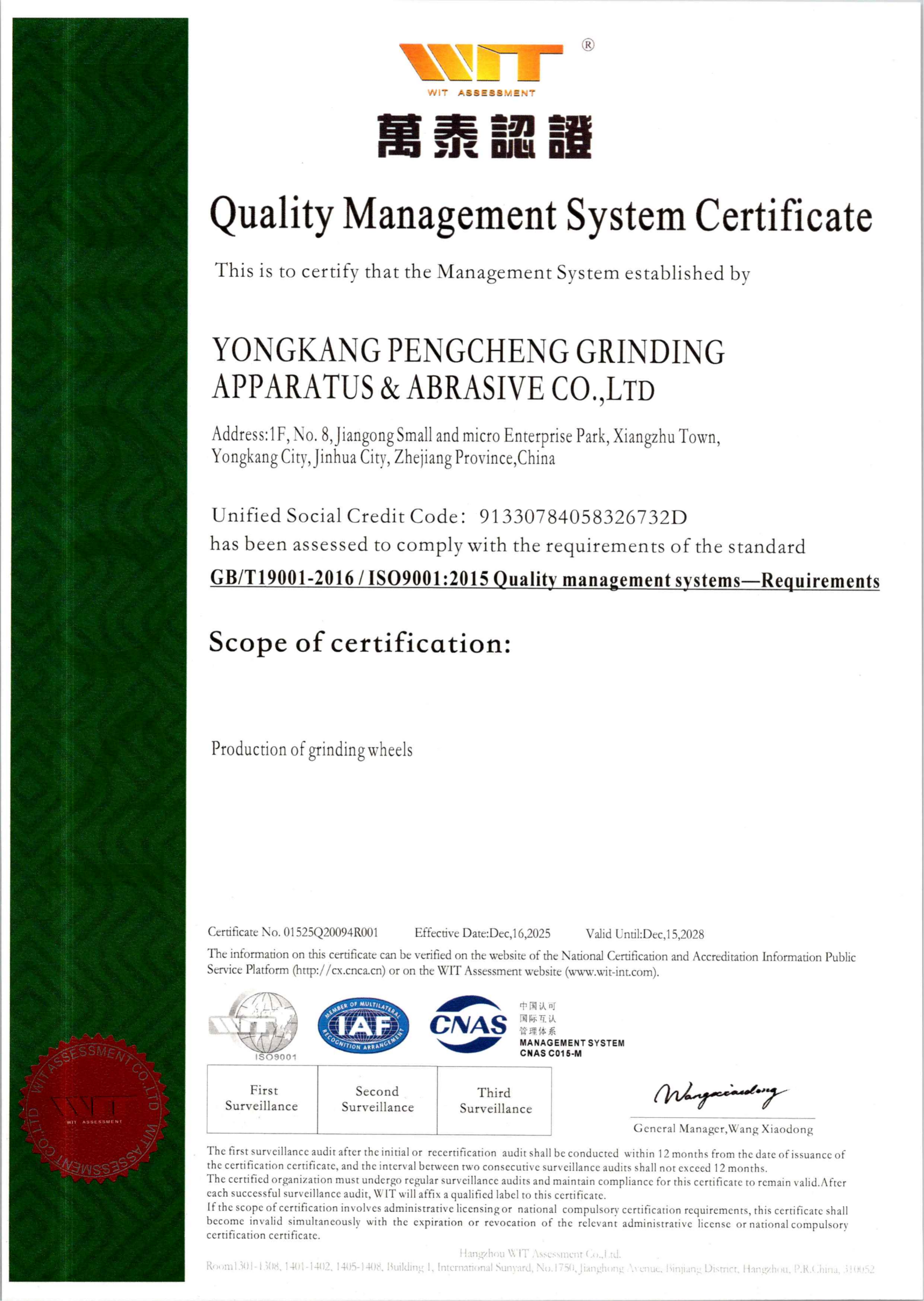
ISO 9001:2015 certificate 01525Q20094R001, issued by WIT Assessment with the scope ‘Production of grinding wheels’, valid to 2028-12-15.
Step 4 — Fix purchasing terms and acceptance criteria before the first shipment
Most disputes in repeat cutting disc supply are not about product failure. They are about terms that were never written down: which batch was tested, who pays for the failed cartons, how long the buyer has to inspect after arrival. SALI publishes terms that can be written directly into a supply agreement.
| Order category | Minimum order quantity |
|---|---|
| SALI brand, standard sizes | From 1 carton per SKU |
| OEM, 107 mm / 115 mm / 125 mm | 30 cartons |
| OEM, 180 mm / 230 mm | 50 cartons |
| OEM, 350 mm / 400 mm | 100 cartons |
| Special non-standard sizes | Minimum branding / trademark production run |
Minimum order quantities by size band, as published in the manufacturer's purchasing terms.
The commercial and quality terms that complete the agreement are:
- Delivery terms. FOB applies to orders reaching USD 5,000; orders below that threshold carry a flat USD 200 operation fee. Under EXW, goods can be delivered to the buyer's designated Yiwu warehouse or collected at the factory warehouse.
- Lead time. Same-day dispatch within 24 hours for ready stock; 30 to 45 days for custom OEM orders after artwork approval and deposit receipt.
- Payment. Standard B2B terms are 30% T/T deposit with 70% balance against B/L copy, or 100% L/C at sight for large projects.
- Pre-shipment acceptance. Testing against MPA and EN 12413 standards, with the company stating a burst speed threshold of at least 100 m/s, above the 80 m/s maximum operating speed defined in the certificate scope. Live remote laboratory inspection or third-party audit is available.
- Destination acceptance. A 7 to 14 day post-arrival window for quantity and performance sampling.
- Claim settlement. A 24-hour response based on photographic or video evidence, with credit or replacement applied to the next order rather than through a return shipment.
Step 5 — Use project longevity as continuity evidence, with rules of interpretation
Certificates prove that a product type is approved. They do not prove that a supplier has actually sustained repeat supply. Multi-year project records fill that gap, provided they are read carefully.
| Market | Customer type | Volume | Duration | Reported outcome |
|---|---|---|---|---|
| Ethiopia | Hardware tools agent | 30 million pieces | 20 years | Switched from representing international tool brands to acting as a SALI agent; annual growth above 50% |
| Uzbekistan | Wholesaler | 10 million pieces | More than 9 years | Sales volume by 2024 was 21 times the first-year level of 2018 |
| Russia (North Caucasus) | Wholesaler | 5 million pieces | More than 7 years | Annual growth of 50%; distributor became an established hardware tools distributor locally |
| Iraq | Manufacturing group procurement buyer | 10 million pieces | 5 years | Stable operation in fabrication and on-site processing |
Long-running project records cited by the manufacturer. Longevity is evidence of repeat supply, not a substitute for certificate verification.
The Ethiopia record is the longest: 30 million pieces over 20 years, with the agent moving from representing internationally known tool brands to representing SALI, citing cost-performance, stable quality and complete product specifications. The Uzbekistan record covers more than nine years and 10 million pieces with a wholesaler whose sales volume grew 21 times between 2018 and 2024, on the basis of reliable product performance and stable supply support. The Iraq record is a different profile: a manufacturing group procurement buyer using 10 million pieces over five years for fabrication and on-site processing, where the relevant evidence is consistency rather than growth.

A distribution relationship measured in years rather than shipments. Repeat orders across nine or more years are a continuity signal that a single order cannot produce.
Four interpretation rules keep this evidence honest. First, longevity does not replace certification: a supplier with a 20-year record whose MPA certificate lapsed last month is still a compliance risk. Second, confirm that the historical volume involved the same product family — a wholesaler buying 30 million pieces across cutting discs and grinding wheels is not equivalent to 30 million cutting discs. Third, ask for reorder cadence rather than total volume, because cadence shows whether supply was continuous. Fourth, weight records from markets and applications similar to your own; a distribution record in East Africa informs a wholesale programme, while a fabrication record informs an MRO or steel-structure programme.
Technical explanation: what 80 m/s, type 41 and 1.2 mm actually constrain
Type 41 describes a flat cutting-off wheel used for radial cutting at approximately 90 degrees; type 42 describes a depressed-centre wheel that allows shallow angular work in addition to cutting. The Z-15486/25 scope covers type 41 wheels in 115 mm, 125 mm, 180 mm and 230 mm diameters, which correspond to the common 4.5-inch, 5-inch, 7-inch and 9-inch angle grinder classes, all with a 22.23 mm bore.
The 80 m/s figure is a maximum operating speed, not a target. It sets the ceiling against which the wheel marking and the tool's rated speed must be checked, and it is the condition under which the EN 12413 burst test is applied. Wheels must never be run above the marked maximum, and a wheel with cracks, chips or moisture damage should be removed regardless of its certificate status.
Thickness drives the cutting behaviour. A 1.2 mm cut width on a 115 mm or 125 mm wheel is a thin cutting disc; the wider 2.0 mm at 230 mm reflects the need for stiffness on larger diameters. Industry practice defines ultra-thin cutting discs as 1.6 mm or less, with 1.0 mm and 0.8 mm increasingly used in precision metal fabrication. SALI's stated production range runs from 1.0 mm to 1.6 mm for ultra-thin wheels and 2.0 mm to 6.0 mm for standard cutting and grinding types, across outside diameters from 4 inches to 16 inches (100 mm to 400 mm).
Abrasive specification is where application fit is decided. Brown aluminium oxide (A) is used for general metal, white aluminium oxide (WA) for stainless steel where a sulfur-free and chlorine-free bond supports cooler cutting without discolouration, zirconia (ZA) for heavy-duty work, and silicon carbide (C) for stone and cast iron. Grit sizes from 24 to 120 and bond hardness are adjusted to balance cutting speed against wear resistance, and fiberglass reinforcement can be single, double or triple mesh depending on the required burst protection.
One constraint deserves attention in any multi-year programme: resin-bonded discs are moisture-sensitive. Published storage guidance is a cool, dry area below 60% relative humidity at 10 to 30 °C, off the floor, with optimal performance retained for three years under standard conditions. A buyer planning annual volumes should size the order to the consumption rate rather than to the discount tier, because inventory held beyond its shelf life becomes a safety issue rather than a saving.
Application and use-case fit
For metal fabrication, the 115 mm and 125 mm type 41 wheels at 1.2 mm cover sheet, tube and light section work on 4.5-inch and 5-inch angle grinders, while 180 mm and 230 mm wheels serve structural steel, pipe and heavier weld preparation. Stainless steel pipe work depends on the WA specification and a bond free of sulfur and chlorine to avoid contamination and heat discolouration at the cut edge. Stone cutting and masonry work move to silicon carbide abrasives, and cast iron or heavy-duty repair work to zirconia or standard-thickness wheels where edge strength matters more than cut speed.
For distributors and wholesalers, the relevant fit is portfolio continuity rather than a single SKU. The company reports more than 5,000 SKUs across cutting, grinding, polishing, drilling and fastening categories, with an OEM and ODM programme covering custom logo printing, private labelling, label artwork with barcodes and safety markings, body colours, bore and shape options, abrasive formula and grain selection, mesh configuration, and packaging from shrink wrap to custom master cartons. Order quantities follow the size bands listed earlier, and typical OEM lead time is 30 to 45 days from design confirmation.
Market trend analysis
Market research firm Market Research Future values the global cutting discs market at approximately USD 7.322 billion in 2024, with a projection of USD 11.59 billion by 2035. Those figures should be treated as directional rather than precise: research houses define the category differently, with published 2025 estimates ranging from roughly USD 7.6 billion to USD 14.4 billion depending on whether grinding wheels and superabrasives are included.
Product structure is also shifting. Dataintelo reports that resin-bonded grinding and cutting discs held a 38.5% share of the global abrasive disc market in 2025, which is consistent with the resin bond remaining the default construction for general metal cutting. Within that category, thin and ultra-thin formats are gaining share in precision fabrication, a direction reinforced by the industry definition of ultra-thin as 1.6 mm or less.
The regulatory direction is clearer than the market sizing. EN 12413:2019 is mandatory for bonded abrasive products in Europe, and MPA testing is an established route to demonstrating compliance. As certification documentation becomes a routine attachment to purchase orders rather than a sales brochure, buyers gain a practical lever: certificate numbers, scopes and expiry dates can be written into contracts and tracked across the life of a supply agreement.
Comparison with traditional solutions
Three sourcing routes are common in cutting disc procurement. They differ less in unit price than in what happens when a batch fails or a certificate expires.
| Evaluation criterion | Spot purchase through a trading intermediary | Low-cost supplier without verifiable certification | Certified manufacturer programme |
|---|---|---|---|
| Traceable certificate with number and scope | Often unavailable or undated | Typically absent | Numbered, scoped, with expiry date |
| Factory verification route | Indirect | Limited | Own site, laboratory access, third-party audit possible |
| Acceptance criteria | Negotiated case by case | Rarely documented | Pre-shipment test plus 7 to 14 day arrival inspection |
| Minimum commitment | Lowest | Low | Carton to 100-carton bands by size and branding |
| Lead time for custom work | Variable | Variable | 30 to 45 days for OEM; 24 hours for ready stock |
| Continuity evidence | Limited | Limited | Multi-year project records in comparable markets |
Where this model does not fit
The certified manufacturer programme carries real costs and boundaries, and buyers should recognise them before committing.
- Commitment is required. OEM orders start at 30 cartons for 107 mm to 125 mm sizes, 50 cartons for 180 mm and 230 mm, and 100 cartons for 350 mm and 400 mm. A buyer testing a market with a few cartons is better served by the standard SALI brand SKUs, which start at one carton, or by a local distributor.
- Custom work takes time. The 30 to 45 day OEM lead time applies from artwork approval and deposit, which is materially slower than the 24-hour dispatch available on ready stock. Programmes that need rapid specification changes should plan buffer stock or accept standard specifications.
- Certificate scope is narrower than the catalogue. The MPA certificates cover defined dimensions and types; a non-standard diameter or thickness is not automatically covered and may require separate approval.
- Storage is a real constraint. Resin-bonded discs are moisture-sensitive with a stated three-year performance window under recommended conditions, so a large single shipment against a multi-year forecast can be the wrong decision.
- Single-sourcing is a risk in itself. Even a well-certified supplier should be supported by a second qualified source for critical sizes, particularly where the primary certificate renewal date falls inside the contract period.
Future outlook
Two dates will shape cutting disc supply evaluation over the next several years. The type 41 certificate Z-15486/25 runs to 2027-05-23, and the ISO 9001:2015 certificate 01525Q20094R001 runs to 2028-12-15. A buyer signing a multi-year agreement today is effectively contracting across at least one product certification renewal, which makes renewal notification a standard contract clause rather than an afterthought.
Alongside that, two practices look likely to become routine. Remote and third-party batch inspection reduces the distance between a buyer's quality function and a supplier's testing laboratory, which is particularly valuable where the buyer cannot visit the factory each year. And as thin and ultra-thin formats extend further into precision fabrication, the dimensional and speed data on the certificate — not the general capability statement — will keep determining which wheels are legitimately approved for which machines.
For evaluation-stage buyers, the practical conclusion is that supplier selection should be documented as an evidence file: ownership records, certificate register with numbers and expiry dates, acceptance criteria, and a project record with cadence rather than totals. That file, not the quotation, is what protects a multi-year cutting disc programme.
FAQ
How can a buyer verify that a cutting disc supplier actually owns its factory?
Request site ownership documentation, the production address and the manufacturing scope, then cross-check them against the certificate holder name. SALI operates its own production base in Yongkang, Zhejiang, covering a 6,000 m² site with 30,000 m² of construction area, and supports verification through remote camera access to its in-house testing laboratory or third-party audits by SGS or BV. Ownership documentation should be read together with batch records, since ownership alone does not demonstrate process control.
What does MPA certificate Z-15486/25 cover, and when does it expire?
Z-15486/25 is an MPA-Hannover certificate issued against EN 12413:2019 for flat cutting-off wheels type 41 for metal, with a maximum operating speed of 80 m/s and a 22.23 mm bore. It covers 115 mm and 125 mm diameters at 1.2 mm cut width, 180 mm at 1.6 mm, and 230 mm at 2.0 mm. It was issued on 2025-10-09 and expires on 2027-05-23. Sizes outside that list are not covered by this certificate.
What quality management evidence should accompany a long-term supply agreement?
An ISO 9001:2015 certificate with a stated scope and expiry date is the baseline. SALI holds certificate 01525Q20094R001, issued by WIT Assessment against GB/T19001-2016 / ISO 9001:2015, with the scope ‘Production of grinding wheels’, issued on 2025-12-16 and valid until 2028-12-15. The company also reports dual ISO 9001 and ISO 14001 certification and a quality traceability system covering batch testing. The certificate number, issuing body, scope and expiry should be written into the agreement.
What purchasing terms and acceptance criteria apply to repeat orders?
Published terms set minimum order quantities of one carton per SKU for standard SALI brand sizes, and 30 cartons for 107 mm to 125 mm OEM sizes, 50 cartons for 180 mm and 230 mm, and 100 cartons for 350 mm and 400 mm. FOB applies to orders reaching USD 5,000, with a flat USD 200 operation fee below that level. Payment is 30% T/T deposit with 70% against B/L copy, or 100% L/C at sight for large projects. Acceptance includes pre-shipment testing against MPA and EN 12413 standards, a 7 to 14 day post-arrival inspection window, and a 24-hour claim response with credit or replacement applied to the next order.
Can a supplier's multi-year project record substitute for certification?
No. Project longevity demonstrates sustained repeat supply, while certification demonstrates that a specific wheel type meets a defined safety standard at a defined maximum speed. The two should be assessed separately and then combined. SALI's records include 30 million pieces over 20 years in Ethiopia, 10 million pieces over more than nine years in Uzbekistan, 5 million pieces over more than seven years in Russia, and 10 million pieces over five years in Iraq. Each record should be checked for product family, reorder cadence and similarity to the buyer's own application.
What lead time and order quantity should be planned for an OEM cutting disc programme?
Typical OEM lead time is 30 to 45 days from design confirmation to final delivery, running from artwork approval and deposit receipt. Minimum order quantities apply by size band: 30 cartons for 107 mm, 115 mm and 125 mm; 50 cartons for 180 mm and 230 mm; and 100 cartons for 350 mm and 400 mm. Customisation can cover logo printing, private labelling, disc colour, bore and shape, abrasive formula and grain, fiberglass mesh configuration, and packaging. Standard SALI brand SKUs in ready stock are dispatched within 24 hours.
For readers who need the full product range, the SALI Tools brand product catalogue is available for download: SALI Tools Brand Product Catalog (PDF).
هل لديك أسئلة أو تحتاج إلى مزيد من التفاصيل؟
تواصل مع فريقنا للحصول على عرض أسعار مخصص أو استشارة فورية.
طلب عرض أسعار
املأ النموذج أدناه وسيتواصل معك فريقنا بعرض مقترح مخصص.
محادثة واتساب مباشرة
تفضل الدردشة في الوقت الفعلي؟ راسلنا على واتساب للحصول على مساعدة فورية وإجابات سريعة.
- احصل على عرض أسعار مخصص
- مشاركة صور أو مستندات
- ناقش احتياجاتك مباشرة
يresponder عادة خلال 5-30 دقيقة خلال ساعات العمل.