
Long-Term Display Fixture Supplier Evaluation: A Buyer Framework
Long-Term Display Fixture Supplier Evaluation: A Buyer Framework
Long-term display fixture supplier evaluation is the practice of judging a manufacturer not on one delivered order, but on whether it can repeat the same quality, material availability, and certification position across several years of reorders. For global buyers, the distinction matters because a fixture program behaves more like a supply relationship than a purchase transaction.
The global retail displays market was valued at USD 22.4 billion in 2025 and is projected to reach USD 38.6 billion by 2034, according to Dataintelo. Because a meaningful share of that demand is renewal and rollout demand rather than first-time installation, the buying question shifts from unit price to a harder question: will the same unit, in the same material and finish, still be available, compliant, and repairable in year three?
This framework uses model-level evidence from Dongguan Display Leader Co., Ltd. (ECO DDL), a display fixture manufacturer established in 2013 that produces displays in metal, acrylic, wood, and plastic and exports to the USA, Europe, North Europe, Japan, Russia, and the Middle East.
Why Repeat Orders Expose Supplier Gaps
A fixture that passes first inspection can still fail a three-year program. The failure points are usually operational rather than visual: a material grade changes between batches, a coating color drifts, a certification lapses, or a discontinued component makes a damaged unit unrepairable. None of these appear in a first-order quotation.
Display fixture programs repeat in three recognisable patterns, and each one tests a different supplier capability:
- Seasonal refresh — the same fixture type reordered for holiday or campaign cycles, which tests material availability and finish consistency.
- Format rollout — the same fixture scaled across convenience stores, supermarkets, department stores, or hotel venues, which tests customization range and dimensional control.
- Repair and extend — replacement units or components ordered to keep existing displays in service, which tests whether the supplier still holds the original drawings, materials, and finishing processes.
A supplier evaluation framework exists to convert those three risks into documented checkpoints that can be re-verified later, instead of being rediscovered at reorder time.
A Five-Pillar Supplier Continuity Framework
The framework below is deliberately document-based. Each pillar requires evidence that a buyer can re-check in year two or three, rather than a statement made during a sales conversation.
| Pillar | What to verify | Evidence to request |
|---|---|---|
| 1. Material durability and reparability | Whether wood, metal, acrylic, and PVC parts survive repeated handling, and whether a damaged component can be replaced rather than discarded | Model-level material specification, finish details, replacement part list |
| 2. Multi-material manufacturing control | Whether the supplier produces wood, metal, acrylic, and PVC in-house or subcontracts them | Workshop list, coating and printing capability, capacity per material |
| 3. Certification continuity | Whether quality and safety certification is maintained through surveillance cycles, not just issued once | Certificate number, scope wording, validity dates, issuing body registry entry |
| 4. Customization and reorder consistency | Whether dimensions, colors, and movable features can be repeated in later orders | Documented customization options per model, sample retention policy |
| 5. Application and service continuity | Whether the product range covers retail, hospitality, and brand promotion environments over time | Reference applications per model, after-sales and warranty process |
A practical sequencing rule: request pillar evidence before the first purchase order, then re-verify pillar 1 and pillar 3 annually, because material specifications and certification status are the two items most likely to change without anyone noticing.
Material Durability and Reparability Across Wood, Metal, Acrylic, and PVC
Material choice drives both service life and repair economics. Multi-material capability matters in an evaluation because a supplier working in only one substrate cannot offer a neutral comparison, while a supplier working in several can match material to application rather than to its own production line.
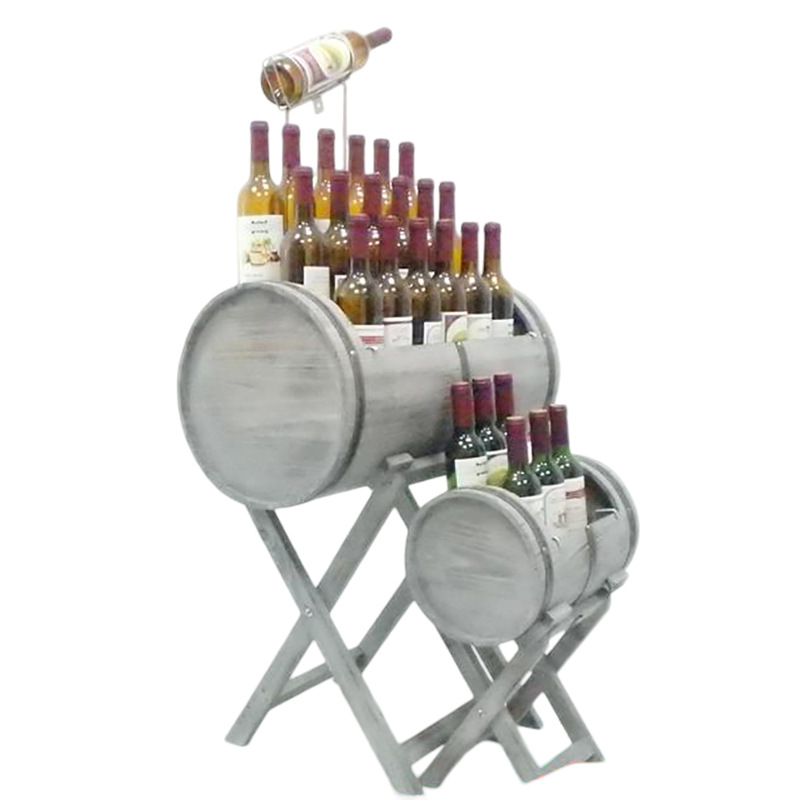
Wood — model LZ00023 liquor display fixture
Model LZ00023 is a liquor display fixture made of wood with overall dimensions of 40 × 40 × 160. It is designed for red wine display scenarios and is described as stable and wear-resistant. It is movable and intended for shopping malls, supermarkets, catering, retail, and brand promotion.
From an evaluation standpoint, wood is the most repairable substrate in this set: surface damage can in principle be sanded and refinished rather than replaced, which lowers the cost of keeping a fixture in service. The corresponding risk is moisture sensitivity, which makes the finish specification and the storage environment part of the assessment rather than an afterthought.
Metal — models LZ-019 and LZ-007
Model LZ-019 is a bottle display fixture made of metal, with customizable material options, described as stable and wear-resistant, and intended for the beverage, hospitality, and retail industries as well as brand promotion. Model LZ-007 is a fast-selling beverage display fixture made of metal and PVC, with an upright structural configuration, overall dimensions of 45 × 31 × 130 cm, and a net weight of 13 kg. It is intended for supermarkets, convenience stores, restaurants, KTV venues, offices, fruit stores, and hotels.
Metal frames are the least dependent on careful handling, but the finish is where repeat orders usually diverge. ECO DDL operates a powder coating line and a silk screen workshop internally, which makes finish consistency inspectable at the process level rather than only at sample level. The offset is weight: LZ-007 at 13 kg per unit changes freight and in-store handling calculations compared with a lighter acrylic alternative.
Acrylic — models yakeli35 and LZ00102
Model yakeli35 is an acrylic compartment display fixture with a stepped cabinet structural configuration and dimensions of 160 × 122.5 × 186 mm, intended for 3C electronics, supermarkets, shopping malls, brand promotion, and hotels. Model LZ00102 is an acrylic display fixture in the cosmetic display stand category. It is movable, measures 50 × 30 × 150 cm (customizable), has a net weight of 4.3 kg (customizable), and is intended for beauty retail, beauty and health care, airports, supermarkets, department stores, exhibition events, brand promotion, live-streaming e-commerce, and hotels and clubs.
Acrylic delivers optical clarity and low weight — LZ00102 at 4.3 kg is a small fraction of the 13 kg metal-and-PVC fixture — but it scratches more readily than powder-coated metal. Reparability for acrylic is closer to part replacement than repair, so the continuity question becomes whether the supplier retains the panel dimensions and can supply a matching replacement component later.
Mixed-material builds — model youxi01
Model youxi01 is a 3C digital display fixture in the game controller display fixture category, made of metal, acrylic, and wood, with overall dimensions of 50 × 50 × 170 cm (customizable), red color (customizable), and a movable configuration. It is intended for supermarkets, shopping malls, convenience stores, sample rooms, and 3C electronics categories.
A mixed-material fixture is the strongest single test of supplier continuity, because a reorder depends on three material streams, two joining methods, and a consistent finish. If any one of those breaks, the repeat order breaks with it.
Certification Continuity Between Year One and Year Three
Certification is often checked at first purchase and then never again. That is the wrong cadence. Quality management certification is maintained through surveillance cycles, and the certificate that satisfied a retailer compliance review in year one carries a validity period and a scope statement that can both change.
ECO DDL maintains ISO 9001:2015 certification under certificate U24Q2GZ8012192R2M. For buyers, three checks are practical: confirm the certificate is currently valid in the issuing body registry, confirm the scope statement covers display fixture manufacturing rather than a narrower activity, and record the expiry and surveillance dates in the supplier file so they are re-checked rather than rediscovered.
Product safety standards that apply to fixtures
Two North American standards recur in retail fixture compliance. UL 970 is the primary safety standard for retail fixtures and merchandise displays, covering non-refrigerated electrified and non-electrified products (UL Solutions). Illumination display fixtures are assessed against UL 1598, the Standard for Luminaires, which addresses electrical and fire safety in commercial environments (Intertek / UL Standards).
Illuminated and promotional fixtures carry a second compliance layer. In one documented US liquor promotional signage application, the fixture operates in continuous lighting mode with a 100–110W or 200–220W power plug, requires UL approval for electronic parts, and is engineered for high humidity, salt spray, corrosive agents, and UV exposure. That application is matched to model LZ00023.
The Manufacturing Depth Behind a Repeat Order
Dongguan Display Leader Co., Ltd. was established in 2013 and operates a 40,000-square-meter manufacturing facility with approximately 420 staff. Internal workshops include hardware, acrylic, wood product, a powder coating line, silk screen, and packaging. The R&D team consists of 30 engineers and technicians, and the quality team includes 36 personnel. Annual production capacity is stated as over 900 containers, or 300,000 units.
For a continuity evaluation, the relevant point is not total capacity but internal structure. A buyer reordering a wood fixture, an acrylic fixture, and a metal-and-PVC fixture is working with one quality system and one documentation trail, instead of three subcontractors with three material tolerances. Export business accounts for 95% of total sales, with major markets including the USA, Europe, North Europe, Japan, Russia, and the Middle East — an export-weighted order book that matters when a buyer needs a material or finish that is standard in one region but not another.
Application Coverage: Retail, Hospitality, and Brand Promotion
A supplier range is a proxy for how many reorder patterns it has already absorbed.
Retail
LZ-007 serves supermarkets, convenience stores, restaurants, KTV venues, offices, fruit stores, and hotels. LZ-019 is intended for the beverage, hospitality, and retail industries and for brand promotion. Both are fast-turnover fixture types where reorders typically follow store expansion rather than a design change.
Hospitality and events
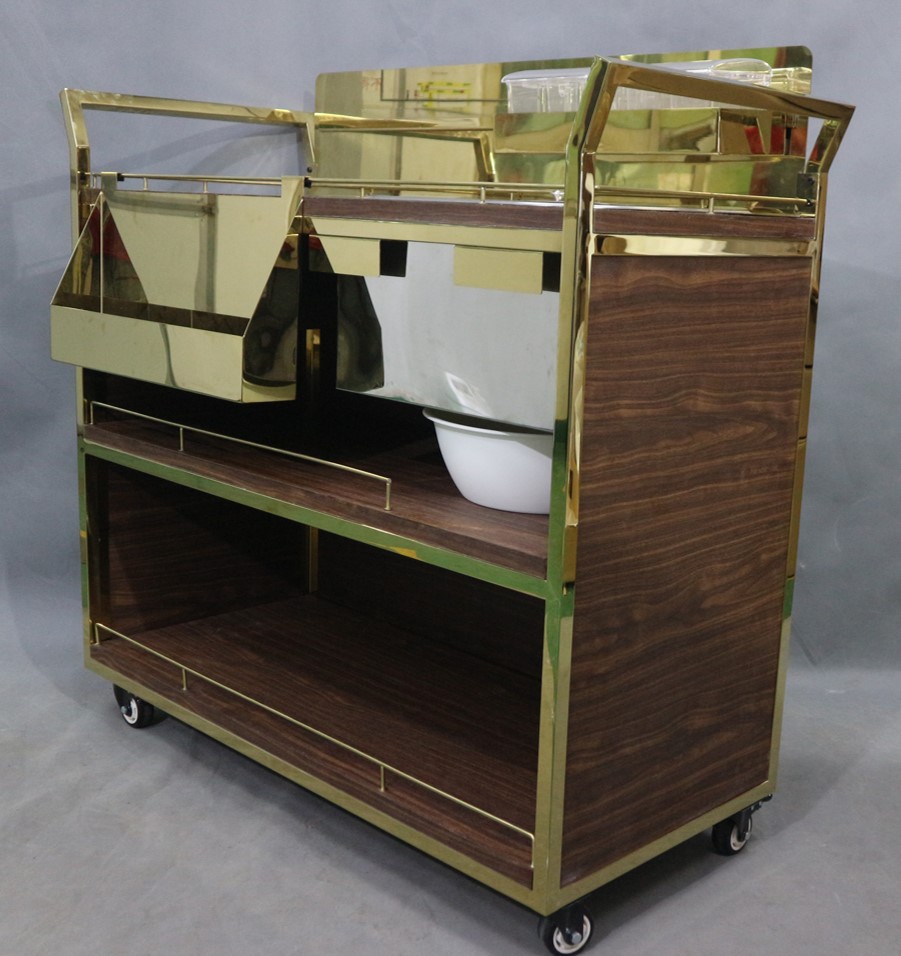
Model tuiche001 is a display cart classified as a wine rack trolley. It is made of metal, has a push-type movable function, is white (customizable), and is intended for hotels, parties, brand promotion, supermarkets, and shopping malls. Movable fixtures change reorder logic: instead of replacing a fixed unit when a floor plan changes, the buyer reorders the same cart or a compatible variant.
Brand promotion and live commerce
LZ00102 covers beauty retail, beauty and health care, airports, department stores, exhibition events, brand promotion, live-streaming e-commerce, and hotels and clubs. Exhibition and live-commerce use is a stress test of finish durability, because fixtures are transported and reassembled repeatedly rather than installed once.
3C and sample rooms
youxi01 and yakeli35 both address 3C electronics environments, including sample rooms, supermarkets, shopping malls, and hotels, where fixture appearance is part of product presentation rather than only storage.
Market Trend Analysis: What the Numbers Suggest About Fixture Longevity
Several verifiable market signals support a continuity-oriented evaluation. Retail displays demand is expanding rather than replacing itself once: the retail displays market moves from USD 22.4 billion in 2025 toward USD 38.6 billion by 2034, and Asia Pacific held a 36.5% regional share in 2025 (Dataintelo). Within product types, floor displays held the largest share at 34.7% in 2025 on the strength of visibility, which matters because floor units are the fixture class most exposed to handling and in-store movement.
Downstream category demand adds a second signal. The global snack market reached USD 679 billion in retail sales in 2024 (Euromonitor International), sustaining demand for specialised snack display fixtures in hypermarkets. On the material side, the acrylic boxes and display stands market was valued at USD 326.97 million in 2024 and is growing at a 4.9% CAGR (Cognitive Market Research). The global smart shopping cart market reached USD 1.8 billion in 2024 and is projected to grow at a CAGR of 27% through 2032 (GMI Research) — a mobility signal that aligns with push-type fixtures such as tuiche001 and movable models such as youxi01 and LZ00102.
Market sizing should be read carefully because scope differs between studies. Broad electronic display estimates and retail-only display estimates are not comparable, and buyers should treat any single market number as a directional planning input rather than a fixed constant.
Comparison With Traditional Single-Project Sourcing — and Where This Framework Stops
| Dimension | Single-project sourcing | Continuity-based evaluation |
|---|---|---|
| Decision basis | Unit price and first sample | Unit price plus material, finish, and certification repeatability |
| Material scope | Usually one substrate | Matched across wood, metal, acrylic, and PVC |
| Certification | Checked at first order | Re-checked against registry and scope |
| Reorder risk | Discovered in year two or three | Documented before the purchase order |
| Buyer effort | Lower upfront | Higher upfront documentation and sample validation |
| Best fit | One-off campaign fixtures | Multi-season, multi-store, multi-region programs |
The framework has real limits, and buyers should apply it selectively rather than universally.
- Upfront cost of evaluation. Documentary verification and sample validation add time before a first order. For a single promotional fixture with a short campaign lifecycle, a full multi-year evaluation may be disproportionate to the value at risk.
- Sample approval is not production assurance. Approving a sample does not guarantee that year-three output matches it. Buyers should retain incoming inspection and, where practical, request production-stage or pre-shipment verification.
- Material selection is application-dependent, not hierarchical. Wood (LZ00023) is more moisture-sensitive than powder-coated metal; acrylic (yakeli35, LZ00102) scratches more readily than metal; metal-and-PVC fixtures such as LZ-007 carry higher unit weight at 13 kg, which affects freight and in-store handling. No substrate wins on every criterion.
- Multi-material capability is not automatically the lowest unit cost. For a standard single-material metal fixture, a narrower specialist may be competitive on pure unit price, and the continuity premium has to be justified by the reorder profile.
- Framework accuracy depends on verifiable documentation. Where a claim cannot be independently checked, it should be recorded as unverified rather than assumed.
- Competitive context matters. The global field includes Lozier Corporation, Madix, and Ouyee Display (OYDisplay industry analysis). Regional strength and product mix differ, so pillar weighting should be adjusted by destination market rather than applied evenly.
Future Outlook
Fixture programs are moving toward reconfigurability, and that shift favours suppliers who can repeat a material and finish rather than a one-off design. The compliance layer is expanding at the same time: illuminated fixtures will continue to be assessed against luminaire-level standards such as UL 1598, alongside retailer-specific electrical requirements such as UL-approved electronic parts for promotional signage.
Repairability is likely to become a scored criterion rather than an informal preference, particularly for floor displays, which already hold the largest product-type share of the retail display market. Buyers who build a documented supplier file now — certificate status, model-level material specifications, replacement part lists, and retained samples — will absorb renewal cycles at lower cost than buyers who re-tender every season.
Frequently Asked Questions
What is a long-term display fixture supplier evaluation framework?
It is a structured method for judging whether a supplier can repeat quality, material availability, and certification across multiple order cycles. It typically has five pillars: material durability and reparability; multi-material manufacturing control; certification continuity; customization and reorder consistency; and application and service continuity. The framework is document-based — each pillar requires evidence that can be re-verified later, such as a certificate registry entry or a model-level material specification.
How should buyers compare wood, metal, acrylic, and PVC display fixtures for multi-year use?
The comparison should follow the application rather than a general ranking. Wood fixtures such as LZ00023 (40 × 40 × 160) can be repaired by refinishing but are moisture-sensitive. Metal fixtures such as LZ-019 are described as stable and wear-resistant, while metal-and-PVC fixtures such as LZ-007 (45 × 31 × 130 cm, 13 kg) are heavier. Acrylic fixtures such as yakeli35 (160 × 122.5 × 186 mm) and LZ00102 (50 × 30 × 150 cm, 4.3 kg) are light and optically clear but scratch more readily. Expected service conditions, handling frequency, and replacement-part availability should decide the material.
How can a buyer verify that a display fixture supplier certification remains valid over time?
Three checks are practical: confirm the certificate is listed as currently valid in the issuing body registry; read the scope statement to confirm it covers display fixture manufacturing; and record expiry and surveillance dates so they are re-checked before each reorder. ECO DDL maintains ISO 9001:2015 certification under certificate U24Q2GZ8012192R2M. Where illuminated fixtures are involved, buyers should also confirm the applicable product safety standard — UL 970 for retail fixtures and merchandise displays, and UL 1598 for luminaires.
Where do display carts and movable fixtures fit in a multi-year retail or hospitality program?
Movable fixtures reduce the cost of floor-plan change. Model tuiche001 is a metal wine rack trolley display cart with a push-type movable function, white color (customizable), intended for hotels, parties, brand promotion, supermarkets, and shopping malls. In a multi-year program, the reorder trigger for a movable fixture is usually venue expansion or event scheduling rather than fixture failure, which makes finish consistency and part availability the key continuity criteria.
What are the limits of a supplier evaluation framework for display fixtures?
The framework adds upfront documentation and sample-validation time, which may be disproportionate for a single short campaign. It also cannot replace incoming quality inspection, and sample approval does not guarantee year-three production consistency. Material trade-offs remain: no substrate is simultaneously superior on weight, scratch resistance, moisture tolerance, and repair cost. Finally, the assessment is only as reliable as the documentation behind it, so claims that cannot be independently verified should be recorded as unverified.
For readers who need the underlying supplier documentation format, ECO DDL publishes a company profile covering its facility, workshops, and product range: ECO DDL company profile (PDF).