
Long-Term Electrical Switchgear Sourcing: Risk Control and Partner Selection
Electrical switchgear procurement reaches a critical turning point once buyers move beyond price discovery. At the decision and execution stage, the questions shift from 'which cabinet costs less' to 'which supplier can deliver, install, and support this equipment without disrupting a project timeline.' For buyers planning repeat orders, overseas project pipelines, or complete site electrification, risk-control capability is no longer a back-office concern—it is a supplier selection criterion in its own right.
Drawing on the published production and risk-management information of Changzhou Tuoxin Electric Co., Ltd., a full-line switchgear manufacturer based in Changzhou, Jiangsu Province, this article outlines what long-term buyers should evaluate before committing to an electrical switchgear supplier. The focus is not on promotional claims but on verifiable capabilities: contract discipline, production safety, export compliance, delivery risk controls, technical specifications, and the service model that determines whether a switchgear asset remains reliable over years of operation.
The Hidden Risk Layers in Switchgear Procurement
Switchgear supply is exposed to far more risk than the moment of factory acceptance. Between order placement, production, international shipping, site installation, and years of energized operation, buyers face risks that can erase the savings of a low first price. These risks fall into distinct categories: contractual ambiguity, payment default, manufacturing defects, logistics damage, customs detention, installation accidents, unauthorized configuration changes, and post-warranty disputes.
For overseas buyers, the list grows longer. Equipment detained at customs because a market requires CE, SABER, or UL certification is a real scenario. A switchgear cabinet designed for 50Hz cannot simply be plugged into a 60Hz grid without specification changes. Salt-spray corrosion during ocean shipment, mislabeled documentation, and uneven current distribution across parallel cables are operational threats that only become visible after the equipment reaches site.
| Risk Category | Typical Failure Mode | Control Measure |
|---|---|---|
| Contractual & evidence | Incomplete contracts, ambiguous clauses, high rights-protection cost | Legal-reviewed standard templates, full-file archiving for at least 3 years |
| Financial / payment | Client bankruptcy, L/C trap clauses, foreign-exchange control, delayed final payment | Credit classification, staged payment terms, export credit insurance for large projects |
| Export compliance | Detention without CE/SABER/UL, Chinese-only labels, voltage/frequency mismatch | Pre-order regional certification review, bilingual documents, regionalized product design |
| Production safety | Mechanical injury, electric shock, fire during spraying, hoisting falls | Safety gratings, emergency stop buttons, isolated HV test areas, PPE, regular drills |
| Logistics | Salt-spray corrosion, cabinet deformation, port detention, rejection due to damage | Desiccant packaging, fumigated wooden frames, all-risk marine insurance, unpack inspection |
| Site delivery | Dimension mismatch, unapproved configuration changes, stricter acceptance standards | Pre-order site survey, written change orders, acceptance standards attached to contract |
| After-sales | Free-repair demands for operational damage, refusal to pay post-warranty fees | Clear warranty scope (manufacturing defects only), public fixed price list, remote video troubleshooting |
| Intellectual property | OEM trademark infringement, ODM design leakage, drawing misuse | NDA, trademark qualification audit, encrypted drawing management, design-ownership clauses |
The opportunity for buyers is that a supplier with documented risk-control systems converts uncertainty into predictable delivery. This is especially relevant for Decision-stage purchasers who must justify supplier choice to internal stakeholders, lenders, or project owners.
Company Profile: Changzhou Tuoxin Electric Co., Ltd.
Changzhou Tuoxin Electric Co., Ltd. is a Chinese manufacturer of high-voltage and low-voltage electrical switchgear, prefabricated substations, control cabinets, cable trays, and enclosed busways. Founded in 2010, the company operates a 4,000-square-meter facility in Xixiang Industrial Park, Hengshanqiao Town, Changzhou, with 56 employees and an annual production capacity of approximately 3,000 units. Around 40% of output is exported to markets across Southeast Asia, the Middle East, Africa, Europe, and the Americas, including Vietnam, Indonesia, Morocco, Russia, Mexico, Germany, Saudi Arabia, the United States, and Canada.
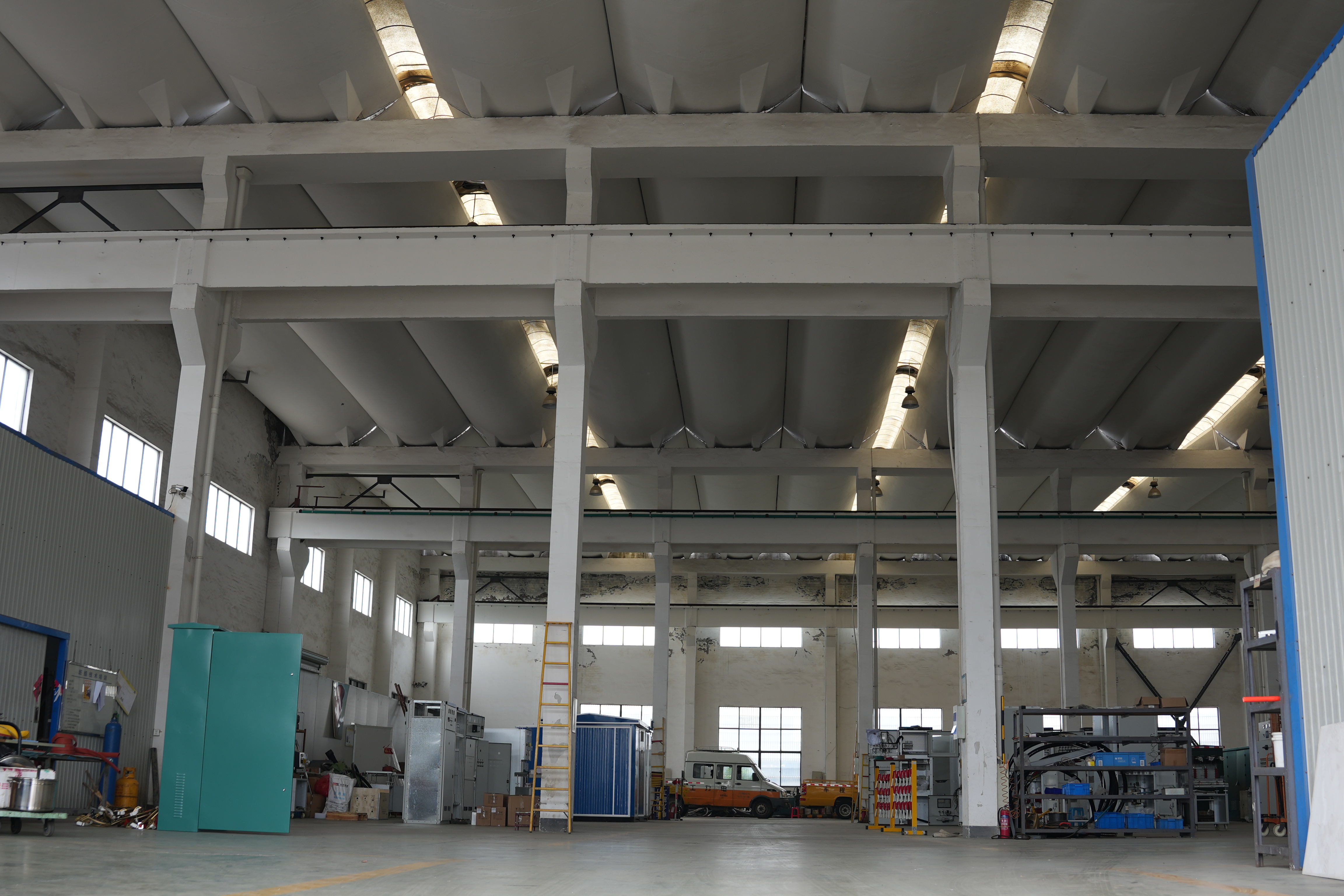
A production-floor view inside Tuoxin Electric's workshop. Manufacturing environment quality directly affects delivery stability and long-term product consistency.
Tuoxin Electric describes itself as a designated supporting manufacturer of electrical equipment for Changzhou Power Supply Company, a relationship that requires adherence to utility-grade quality expectations. The company's technical team includes 3 senior engineers, 1 senior consultant, 5 engineers, and 18 technical personnel—a structure that supports both standardized series production and custom engineering.
The product portfolio spans the full switchgear spectrum: KYN28 and XGN15 series high-voltage switchgear; GBD, MNS, GGD, GXL, XL, and XLW series low-voltage switchgear; YB series box-type substations; PZ30 modular terminal lighting distribution boxes; XJM metering boxes; custom non-standard electrical control cabinets; and busways of various specifications. The company states that its complete switchgear and low-voltage electrical products have obtained CCC certification from the China Quality Certification Centre, and that product quality has been verified by the Changzhou Technical Supervision Bureau. Operations are managed according to ISO9001:2000 quality management system standards.
What a Long-Term Switchgear Partner Should Demonstrate
For buyers at the execution stage, a supplier's risk-management posture is visible in five concrete areas: payment terms, contract structure, production safety, export handling, and warranty policy. Each area can be evaluated before a purchase order is signed.
Payment Terms and Financial Risk Control
Payment structures reveal how a supplier manages financial exposure. Tuoxin Electric applies a standard payment framework for new clients: 30% T/T advance payment, 70% balance before shipment, and—for certain project agreements—95% payment after acceptance with a 5% one-year quality retention. Low-credit clients are asked for full prepayment or a third-party guarantee, and all projects are placed under formal sales contracts with liquidated damages clauses for overdue payment. For overseas projects, the company requires 30% T/T advance for new customers, the full balance before shipment, and export credit insurance for large orders to cover default and political risks. FOB/CIF trade terms are defined in advance to clarify ownership transfer timing.
Contract Documentation and Evidence Discipline
Long-term partners are distinguishable by how they handle change orders and documentation. Tuoxin uses unified sales, OEM, and export contract templates reviewed by its legal department. Drawings, change orders, test reports, and delivery receipts are archived for at least 3 years. For large projects, the legal team reviews payment, breach, intellectual-property, and warranty clauses before signing. This documentation discipline matters when a site accepts equipment months after the factory test report is issued.
Production Safety as a Quality Indicator
Factory safety controls correlate with build quality. Tuoxin Electric's production environment includes safety gratings, emergency stop buttons, and isolated high-voltage test areas with locks. Painting is separated in an independent explosion-proof ventilation zone; hoisting areas are marked as warning zones. Dust and noise positions are equipped with full PPE, and workers receive regular occupational health examinations. Buyers can read these investments as signals that manufacturing processes are managed rather than improvised.
Export Handling and After-Sales Service
Export cabinets are packed with desiccant and use fumigated wooden frames for busway shipments. Tuoxin purchases all-risk marine insurance covering damage, loss, and seawater soaking, and requires on-site unpack inspection upon arrival with immediate damage claims. For after-sales, the company's warranty covers manufacturing defects only; man-made damage and environmental corrosion are excluded. Spare parts, travel, and on-site service fees are published as a fixed price list. Remote video troubleshooting is prioritized over field visits to reduce cost and response time. The stated service window is 7×12-hour remote technical support, with nationwide on-site service and overseas engineer dispatch for larger projects.
Technical Capabilities That Support Long-Term Operation
The credibility of a switchgear partner rests on measurable electrical parameters. Buyers evaluating products for long-term operation should compare rated voltages, short-circuit withstand currents, protection degrees, and busbar materials. The table below summarizes key electrical switchgear types produced by Tuoxin Electric.
| Product Series | Type | Core Parameters | Typical Use |
|---|---|---|---|
| KYN28-12 / KYN28-24 | Indoor metal-clad withdrawable AC switchgear | 12kV / 24kV; 630–4000A; breaking 20–50kA; IP4X | Power plants, substations, industrial facilities, high-rise buildings |
| XGN15-12 / XGN15-24 | SF6 ring main unit (RMU) | 12kV / 24kV; 630–1250A; sealed gas tank IP67; maintenance-free | Urban ring networks, prefabricated substations, switching stations |
| MNS / GCS | Low-voltage withdrawable switchgear | 380/660V; 1600–4000A; 1s withstand 100kA; peak 120kA; IP30 | Photovoltaic plants, data centers, metro, petrochemical, marine |
| GGD / GCK | Low-voltage fixed / withdrawable switchgear | 380/660V; 600–1600A; withstand 50kA; peak 80kA; IP30 | Industrial distribution, commercial buildings, motor control |
| YBW-12 | Prefabricated box-type substation | 12kV; 50–1600kVA; HV side IP3X, transformer IP2X | Photovoltaic stations, construction sites, municipal infrastructure |
| VFD Control Cabinet | Variable frequency control cabinet | 380V ± 10%; motor 0.75–630kW; 150% overload 60s; Modbus-RTU; IP30 | Pump stations, HVAC fans, sewage treatment, constant-pressure water supply |
| CMC Enclosed Busway | Plug-in enclosed busway | AC 400/690V; 100–5000A; IP40–IP68; standard 3m sections | Data centers, high-rise shafts, large factories, PV main lines |
| PZ30 / XJM | Terminal distribution / metering boxes | ≤125A; IP30 | Residential, commercial lighting, terminal power distribution |
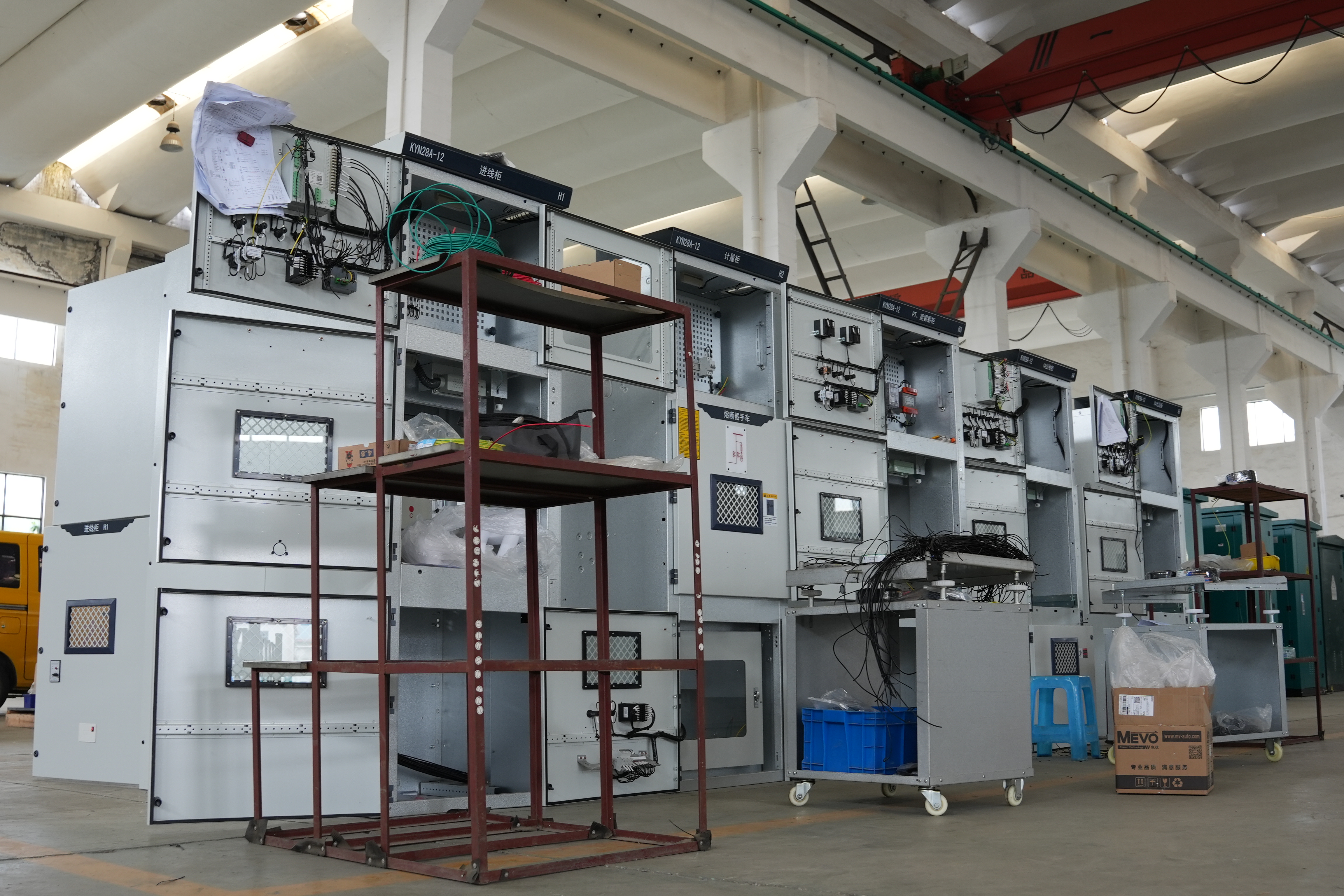
Assembly and wiring processes determine whether switchgear performs to its rated short-circuit withstand and protection specifications.
Material choices are equally important. Across Tuoxin's switchgear range, cabinets use galvalume or cold-rolled galvanized steel sheet with electrostatic plastic spraying; busbars and main contacts are T2 pure copper with tin or silver plating. Insulating parts use epoxy resin and SMC unsaturated polyester composites, while fasteners are stainless steel. These material specifications directly relate to corrosion resistance, contact temperature rise, and dielectric performance over the equipment's service life.
Custom vs. Standard: When Full Functionality Becomes a Long-Term Requirement
A common sourcing mistake is ordering standard distribution boxes for industrial applications that require interlock logic, environmental protection, or remote monitoring. Tuoxin's engineering data shows the functional gap clearly.
Custom non-standard control cabinets support interlock control for more than 10 groups of equipment, offer IP30 to IP65 protection with optional anti-corrosion and fire-resistant structures, and can embed 4G energy-consumption collection modules. Standard boxes, by contrast, provide only basic breaking protection without linkage logic, with fixed circuits, IP30 rating, and manual meter reading.
The cost structure is often misunderstood. A custom cabinet carries a base price 15% to 30% higher than a standard box, but it eliminates secondary transformation fees for separate PLC and sensor installation, cutting comprehensive project expenditure by roughly 20%. Retrofitting a standard box for linkage functions requires new drilling and wiring on site, which can double labor transformation costs. In motor applications, cabinets that integrate frequency converters and soft starters can save 20% to 40% of motor power consumption compared with direct-on-line starting.
These differences explain why custom electrical switchgear is specified more often for production lines, pump rooms, HVAC systems, fire-protection facilities, photovoltaic and energy-storage stations, and outdoor chemical installations—while standard PZ30 boxes remain suitable for household lighting and simple branch circuits.
Application Patterns: Where Full-Line Supply Adds Value
Long-term electrical switchgear partnerships tend to form in project categories where the cost of failure is high and the cost of coordination is underestimated.
Photovoltaic Power Stations and Construction Sites
For temporary or space-constrained sites, a YB pre-installed box-type substation is a factory-integrated alternative to a cast-in-place civil power room. Tuoxin's comparison data indicates that a box substation occupies roughly 3 to 10 square meters versus over 50 square meters for a civil room, and the installation schedule shrinks from 3 to 6 months to about 1 week of factory assembly plus 2 days of commissioning. Because the unit is movable, it can be reused for secondary projects after demolition. For the same 1250kVA capacity, the box-type solution reduces comprehensive initial investment by 30% to 45% after accounting for land acquisition, civil construction, fire protection, and duty-room costs.
EPC General Contracting and Overseas Complete-Set Export
EPC projects benefit from single-responsibility supply. Tuoxin positions its full product line—HV/LV switchgear, box substations, busways, and control boxes—behind one contact person and unified drawings, certifications, and after-sales support. The company's comparison data cites a 98% one-time acceptance rate for uniformly designed complete sets, against a rework and rectification rate above 40% for solutions assembled by multiple suppliers. Coordination workload increases by approximately 200% when a client must manage three to five different vendors. Full-set supply also includes complete Chinese and English certification documents at no extra charge.
Data Centers, High-Rise Buildings, and High-Current Main Lines
For centralized high-current distribution, enclosed busways outperform traditional multi-core YJV cables on several long-term metrics. Tuoxin's comparison data shows that under the same cross-section, a busway carries 20% to 40% more current; service life is 25 to 30 years versus 10 to 15 years for cables; installation labor drops by about 40%; and the comprehensive cost of a 1000A main busway is 20% to 35% lower because it saves multi-layer cable trays and large quantities of cable. Over 10 years, total expenditure on electricity loss and replacement is reduced by 28% to 40%. Busways also support maintenance without a full power cut, whereas cable replacement typically doubles the construction period.
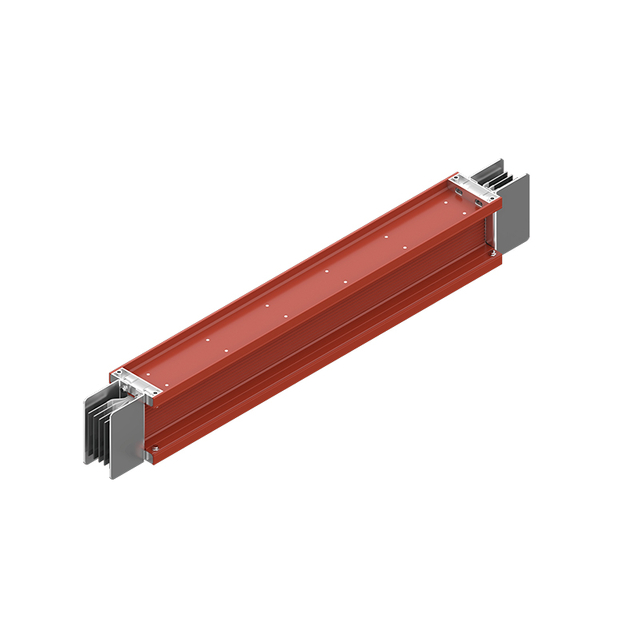
Plug-in enclosed busways offer modular tap-off points and reduced line loss, which matter for capacity expansion and long-term energy cost.
Pump Stations, HVAC, and Industrial Automation
Variable frequency control cabinets address a different long-term need: motor energy efficiency. The VFD control cabinet produced by Tuoxin covers motor power from 0.75kW to 630kW in three-phase 380V systems, supports vector or V/F scalar control, has 150% overload capacity for 60 seconds, and communicates via Modbus-RTU over 485 networks. Applications include constant-pressure water supply, sewage-treatment aeration fans, central air conditioning, boiler fans, metro tunnel ventilation, and chemical circulating pumps. For industrial automation, custom control cabinets can integrate frequency converters, soft starters, fire-linkage logic, and 4G energy monitoring in one enclosure, replacing scattered field wiring with a single engineered assembly.
Comparing Sourcing Models: Full-Line Manufacturer vs. Traders vs. Foreign Brands
Decision-stage buyers are typically choosing between three sourcing models: a full-line manufacturer, a trader, or an imported brand. Tuoxin's comparative data provides a transparent view of how these models differ on measurable factors. It is equally important to understand where each model is not a good fit.
| Factor | Full-Line Manufacturer (e.g., Tuoxin) | Trader / Small Workshop | International Brand |
|---|---|---|---|
| Communication coordination | One contact person for HV, LV, transform, busway, control | 3–5 suppliers; coordination workload up to 200% higher | Local agent or distributor layer may add coordination steps |
| One-time acceptance rate | 98% for uniformly designed complete sets | Rework & rectification rate above 40% in assembled solutions | High, but dependent on correct specification and configuration |
| Delivery cycle (non-standard) | 15–25 days for domestic orders | Varies; delay risk 60% higher due to mismatched orders | 2–3 months typical; longer for customization |
| Price level (same configuration) | Reference baseline | Multi-level markup with hidden rectification costs | 40%–80% higher for comparable configuration |
| Certification documents | Full Chinese & English certificates included | Test reports may be separately charged | Compliant with international standards, but documentation process slower |
| Power factor | Stable above 0.95 with matched copper bars, protection and compensation | Mismatched compensation; average power factor around 0.85 | High, but environmental adaptation may be limited |
Limitations and Boundaries
A full-line manufacturer is not always the optimal source. For small shops, sporadic replenishment of small distribution boxes, or minor single-circuit renovation projects, a local trader offers faster over-the-counter availability and lower minimum-order friction. The one-stop model is most valuable for EPC general contracting, new-energy power stations, overseas complete-set export, and whole industrial park distribution—not for short-distance branch circuits and lighting retrofits.
Similarly, imported-brand switchgear remains specified in high-end pharmaceutical factories, precision semiconductor cleanrooms, or foreign-invested plants where tender documents mandate a particular international brand. In those cases, price premiums of 40% to 80% and premium on-site service fees are justified by brand requirements rather than by pure technical performance. Buyers without such mandatory brand clauses can often achieve equivalent power-loss performance from locally optimized products with faster lead times and lower lifetime service cost.
Market Context: Growth, Standards, and the Rise of Capable Regional Manufacturers
The switchgear market is expanding on a global scale. Grand View Research estimates the global switchgear market at USD 112.9 billion in 2025, with a projection of USD 197.7 billion by 2033. Global Market Insights places the low-voltage switchgear segment above USD 86.1 billion in 2024, driven by infrastructure upgrades and smart-grid technology. China's export data supports the internationalization trend: in 2024, China exported approximately USD 2.72 billion in electrical apparatus for switching or protecting circuits to the United States alone.
Standards are creating both barriers and opportunities. Low-voltage switchgear and controlgear assemblies must comply with the IEC 61439 series for design, verification, and safety. High-voltage prefabricated substations up to 52kV are governed by IEC 62271-202:2022. These standards raise the entry threshold for small workshops and give documented compliance a clear commercial value.
Market concentration also favors credible regional manufacturers. According to Global Market Insights, the top five switchgear manufacturers—ABB, Siemens, Schneider Electric, Eaton, and GE—hold a combined global share of approximately 35%. That leaves roughly two-thirds of the market served by national and regional players. For buyers building long-term supplier relationships, this means that beyond the global brands, there exists a mid-tier of specialized manufacturers who can offer full product lines, faster customization, and lower lifecycle cost—provided they can demonstrate engineering depth and disciplined operations.
How Decision-Stage Buyers Should Evaluate a Switchgear Partner
Executing a switchgear purchase with long-term consequences requires a structured supplier assessment. The following criteria summarize the evidence discussed in this article.
- Product breadth: Does the supplier manufacture HV switchgear, LV switchgear, box substations, busways, and control cabinets under one roof? Full-line capability reduces interface risk in complete-set projects.
- Technical parameters: Compare rated voltages, short-circuit withstand currents, protection degrees, and busbar materials against the actual grid and load conditions of the project.
- Custom engineering: Can the supplier handle interlock logic, IP ratings above standard, 4G remote monitoring, anti-corrosion structures, and frequency-conversion integration? Standard boxes cannot be retrofitted without significant labor cost.
- Contract and payment discipline: Does the supplier use formal contracts, defined payment milestones, legal review, and documented acceptance standards? These are the operational guardrails of a long relationship.
- Export and logistics controls: For overseas supply, verify certification review before order, bilingual documentation, marine insurance, packaging standards, and unpack inspection procedures.
- After-sales service model: Confirm warranty scope, spare-part pricing, remote troubleshooting capability, and whether on-site commissioning is included or separately charged.
Future Outlook: What Long-Term Switchgear Supply Relationships Will Look Like
Several structural shifts are shaping the next phase of electrical switchgear procurement. First, intelligent monitoring is moving from optional to expected. Cabinets with embedded 4G energy-consumption modules, Modbus-RTU communication, and remote 485 connectivity allow operators to track power quality and equipment health without manual meter reading. Second, complete-set supply is strengthening because integrated systems with matched copper bars, protection devices, and reactive-power compensation achieve stable power factors above 0.95, avoiding the additional power-factor surcharges that plague assembled solutions. Third, service depth is becoming a differentiator: remote video troubleshooting, same-factory spare parts, and engineer dispatch for overseas commissioning reduce the downtime that affects production revenue.
For buyers, the implication is clear. The supplier selection process should not stop at the first-order comparison of unit prices and lead times. Contract risk controls, export-compliance experience, production safety systems, spare-parts availability, and the supplier's ability to coordinate a full switchgear package are equally important inputs to a decision that must remain sound years after the equipment is energized.
FAQ: Decision-Stage Questions About Long-Term Switchgear Supply
Q: What are the typical payment terms when starting a new switchgear supply relationship?
A: A standard framework used by Changzhou Tuoxin Electric is 30% T/T advance payment with the 70% balance settled before shipment. For some project agreements, the structure is 30% advance, 70% before shipment, 95% after acceptance, and a 5% one-year quality retention. Low-credit clients are required to pay in full in advance or provide a third-party guarantee. Export orders follow the same principle: 30% advance for new customers, full balance before shipment, and export credit insurance for large projects to cover default and political risks.
Q: How can overseas buyers avoid customs detention and certification failures when importing switchgear?
A: The supplier should confirm mandatory local certification—such as CE, SABER, or UL—before accepting an order and reject orders for which no matching certificate exists. Export products should be equipped with English nameplates, operation manuals, and test reports. For Middle East, Southeast Asia, and Africa markets, custom high-temperature and anti-salt-spray designs are required. Using internationally certified components and attaching full certification files at the time of shipment also reduces clearance risks.
Q: What is the difference between a box-type substation and a traditional civil power room for long-term use?
A: A box-type substation is factory pre-integrated, movable outdoors, and comes with built-in temperature and humidity dehumidification. It occupies about 3 to 10 square meters against more than 50 square meters for a civil room, and shortens the construction schedule by roughly 85% (1 week of factory assembly plus 2 days of commissioning versus 3 to 6 months of civil works). It can be relocated and reused, while a civil power room cannot. For the same 1250kVA capacity, the box-type solution cuts comprehensive initial investment by 30% to 45%. Civil power rooms remain necessary for large hub substations and long-term fixed large-capacity main distribution stations in urban cores.
Q: Why is complete-set procurement from one manufacturer better than buying from multiple suppliers?
A: Complete-set supply requires only one contact person for coordination, communication, and after-sales. In Tuoxin's comparative data, uniformly designed complete sets achieved a 98% one-time acceptance rate, while solutions assembled by multiple suppliers faced rework and rectification rates above 40%. Coordination workload increases by about 200% when a client manages three to five different suppliers. Complete-set volume purchasing also reduces total procurement cost by 10% to 20%, includes full Chinese and English certification documents, and avoids cross-supplier blame shifting during fault troubleshooting.
Q: How do domestic customized switchgear and international foreign-brand equipment compare on total cost?
A: Under the same configuration, foreign brands typically charge 40% to 80% more, deliver non-standard products in 2 to 3 months instead of 15 to 25 days, and may charge a minimum of RMB 5,000 per visit for on-site service. Domestic engineers from the factory provide free on-site commissioning as part of project quotations. Spare parts from foreign brands cost 2 to 3 times more with 4 to 8 weeks of lead time, while the factory supplies spare parts off the shelf. The one important exception is projects with tender documents that mandate specific international brands, such as certain high-end pharmaceutical or precision semiconductor facilities—in those cases, brand requirements override pure cost comparison.
Q: What long-term operational advantages do busways have over traditional cable systems?
A: Under the same cross-section, busways carry 20% to 40% higher current and have a longer service life of 25 to 30 years compared with 10 to 15 years for cables. Installation labor is reduced by approximately 40%, and the comprehensive cost of a 1000A main busway is 20% to 35% lower because it eliminates multi-layer cable trays and massive parallel cables. Over 10 years, total electricity loss and replacement expenditure are reduced by 28% to 40%. Busways also enable maintenance and capacity expansion without a full power cut, whereas cables require shutdown and disassembly that double the construction period.
Sources: Company data published by Changzhou Tuoxin Electric Co., Ltd. (tuoxinelectric.com), comparative engineering data supplied by Tuoxin Electric, Grand View Research (global switchgear market), Global Market Insights (LV switchgear market and top-5 manufacturer share), UN Comtrade (China–US trade data), IEC standards (IEC 61439 series, IEC 62271-202:2022).