
Long-Term Formwork Partner Due Diligence: A 2026 Scorecard
Long-Term Formwork Partner Due Diligence: A 2026 Scorecard
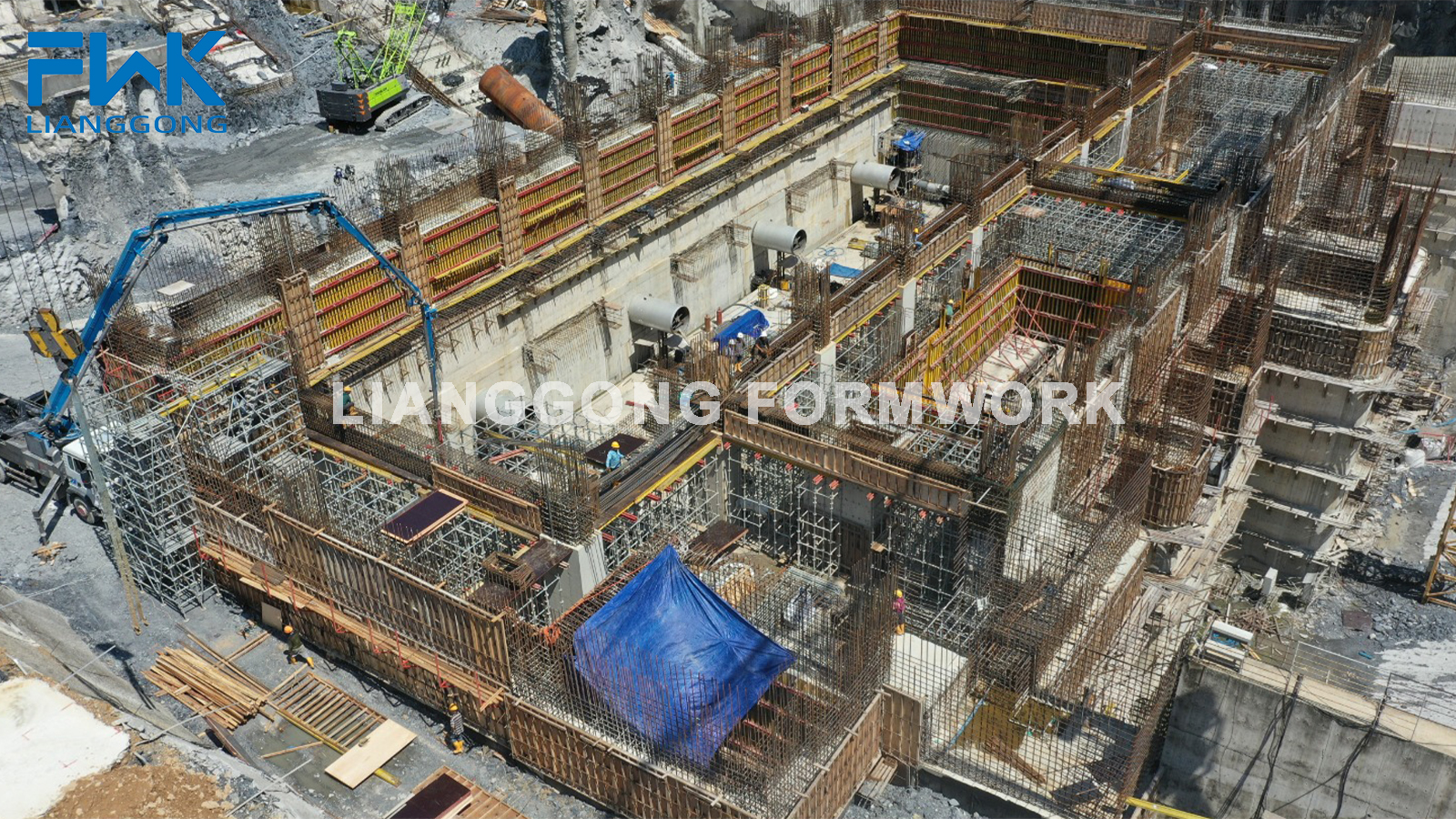
H20 timber beam formwork in service on a large concrete structure in Indonesia, where an EPC contractor has used the same system family for more than ten years.
Buying formwork for a single pour is a purchasing decision. Appointing a formwork partner for a multi-year programme of high-rise, infrastructure and municipal work is a capital decision, and it is assessed differently. The global formwork market reached USD 7.91 billion in 2025 and is projected to grow to USD 12.66 billion by 2034, according to Dataintelo. Fortune Business Insights estimates that Asia Pacific accounted for approximately 54.7% of concrete formwork revenue in 2025, while Dataintelo places engineered, modular and reusable systems at 38.5% of the total market. In a market of that composition, the practical question for buyers shifts from “which panel is cheapest” to “which supplier can still deliver engineering, accessories, spares and service in year three of the framework.”
This industry reference sets out a due-diligence scorecard for that question. It uses the manufacturers buyers most often cite as international reference points — PERI, Doka, MEVA and ULMA — as benchmarks, and applies the same scorecard to a China-based manufacturer, FWK Lianggong Formwork (Yancheng Lianggong Formwork Co., Ltd.), whose published product parameters, certificates and project records allow a partial but concrete comparison.
Why Long-Term Partnerships Need a Different Due-Diligence Standard
In a one-time purchase, the dominant variables are unit price, delivery date and a specification that satisfies the structural engineer. In a long-term partnership those variables do not disappear — they are joined by continuity variables that only become visible on the second or third project: whether the same panel-to-accessory interface still exists, whether the engineering contact who solved the first project is still reachable, whether climbing brackets and wall systems can be extended rather than replaced, and whether spares for hydraulic or mechanical components can still be sourced years later.
Supplier “sustainability” in this context does not describe environmental performance alone. It describes the durability of the supply relationship — the ability to keep systems mutually compatible, keep engineering capacity available, keep quality certifications current, and keep commercial terms workable across several procurement cycles. Three consequences follow for buyers:
- Compatibility compounds. A supplier with a narrow catalogue forces re-engineering every time project conditions change; a supplier with a broad, internally compatible catalogue reduces re-design effort across an entire programme.
- Certification is time-bound. Factory production control and welding quality certificates carry issue and expiry dates. Their validity during the supply period is part of vendor risk, not a one-off check at award stage.
- Service geography matters as much as product quality. A technically strong system with slow local response creates schedule risk on site, and that risk is priced into the project whether or not it appears in the quotation.
The 2026 Formwork Supplier Sustainability Scorecard
The scorecard below is a structure for evidence collection rather than a fixed ranking formula. Each dimension is scored 0–5, where 0 means no evidence is available and 5 means the evidence is documented, current and independently verifiable. Buyers should record the evidence source beside each score so the result can be re-tested at the next project rather than re-argued from memory.
| Dimension | Weight | Evidence to request | Warning sign |
|---|---|---|---|
| Solution depth and portfolio breadth | 25% | Current catalogue covering wall, slab, column, climbing, infrastructure and shoring systems, with published panel parameters | A portfolio that stops at one system family, or parameters quoted only in marketing language |
| Engineering and R&D capability | 20% | Named technical team size, drawing and load-calculation deliverables, custom/OEM drawing turnaround times | Engineering outsourced per order; no load-calculation documentation offered |
| Verified manufacturing and quality systems | 20% | Factory production control certificate (e.g. EN 1090-1), welding quality certificate (e.g. ISO 3834-2), quality management certificate (ISO 9001), with issue and expiry dates | Certificates expired, or scope that does not cover the product actually being purchased |
| After-sales and technical support model | 20% | Defined on-site and remote support model, installation supervision scope, spare parts availability, response commitments | Support limited to the sales period; no documented commissioning scope |
| Commercial continuity | 15% | Monthly capacity, standard lead time, minimum order quantity, export record in the buyer’s region | Capacity or lead time explained only verbally, with no export references in the buyer’s market |
Boundary condition: the five weights above are an editorial framework proposed for comparison purposes. They are not a published industry standard, and a buyer running a repetitive high-rise cycle should re-weight solution depth and after-sales support upward, while a buyer running one infrastructure package may weight commercial continuity more heavily.
Benchmarking Against Established European Manufacturers
Market-scale leadership is the easiest dimension to verify and the least useful on its own. Dataintelo reports that PERI Group and Doka Group together held approximately 22% of the global formwork market in 2025, which makes them the two dominant global suppliers by scale. MEVA and ULMA are established European formwork manufacturers with modular wall, slab and climbing systems used across building and civil infrastructure projects; they are reference points for system engineering and finish quality rather than for documented share of the total market.
Comparable, attributable R&D investment figures are not consistently disclosed across these manufacturers. Any “R&D ranking” built on assumption rather than disclosure would be unreliable, so the scorecard treats R&D as a direct due-diligence question: request engineering headcount, product release cadence and load-calculation methodology during the tender, and score what the supplier actually documents.
| Reference point | What is publicly documented | What still requires direct verification |
|---|---|---|
| PERI Group | One of the two largest global formwork suppliers; PERI and Doka together represented approximately 22% of the global market in 2025 (Dataintelo) | Project-specific engineering response times, local service depth and commercial terms in the buyer’s market |
| Doka Group | The second of the two documented global leaders in the same 2025 market estimate | System configuration for the specific structure type, and lifecycle cost at the buyer’s actual cycle count |
| MEVA | Established European formwork manufacturer with modular wall, slab and climbing systems for building and infrastructure construction | Comparable R&D investment data (not consistently disclosed), regional service model and commercial terms |
| ULMA | Established European formwork and scaffolding manufacturer serving building and civil infrastructure markets | Innovation cadence, engineering deliverables and after-sales scope for the buyer’s region |
| FWK Lianggong Formwork | Yancheng Lianggong Formwork Co., Ltd., founded in 2010, operating a 12,870 m² facility with 230 employees, annual output of 12,000 tons, a 45-person technical team and a 70% export ratio; certified to ISO 9001, ISO 14001, ISO 45001, EN 1090-1 and ISO 3834-2 | Depth of local service in each destination market, and system-specific engineering for atypical structures |
Portfolio Breadth as a Resilience Indicator
For a long-term relationship, catalogue breadth is not a marketing metric — it is a proxy for how many times a programme will need a second supplier. A manufacturer that covers wall, slab, column, climbing, tunnel, culvert, trench and access systems in one compatible family lets a contractor carry one engineering interface, one accessory logic and one spare parts route through a multi-package programme. FWK Lianggong Formwork publishes parameters across that full span, including the three systems most often specified in buyer evaluations: H20 Timber Beam Formwork, 120 Steel Frame Formwork (FWK-SOF 120) and Early Stripping Slab Formwork (FWK-DHF175).
| System | Model / family | Documented parameters |
|---|---|---|
| H20 Timber Beam Formwork | Flexible slab, table slab, timber column and timber wall configurations | Panel weight 65 kg/m²; panel depth 338 mm; maximum one-time casting height 12 m; material: H20 timber beam, plywood, steel waler, flange claw |
| 120 Steel Frame Formwork | FWK-SOF 120 | Panel weight 51 kg/m²; maximum panel size 3.3 m × 1.35 m; panel depth 120 mm; material Q355B |
| 65 Steel Frame Formwork | FWK-SNF 65 | Panel weight 39 kg/m²; maximum panel size 3 m × 1.2 m; panel depth 63.5 mm; maximum one-time casting height 12 m; permissible lateral pressure 60 kN/m² |
| Early Stripping Slab Formwork (T-form) | FWK-DHF175 | Panel weight 24 kg/m²; panel size 1.8 m × 1.2 m; panel depth 192 mm; maximum permissible slab thickness 380 mm; 12 mm plywood; Q355B |
| Aluminum Frame Formwork | FWK-FAF 117 | Panel weight 25 kg/m²; panel size 3 m × 1 m; panel thickness 117 mm; maximum one-time casting height 6 m; permissible lateral pressure 60 kN/m²; aluminium 6061-T6 with 15 mm plywood |
| Cantilever Climbing Formwork | FWK-CB 240 | Bracket height 10–15 m; operating width 900 mm |
| Hydraulic Auto Climbing Formwork | FWK-ACB 120 | Cylinder stroke 300 mm; rated thrust 100 kN and 120 kN; double-cylinder synchronization error ≤20 mm |
| Skydeck | FWK-SKYDECK | Maximum load capacity 90 kN/m²; panel weight 18 kg/m²; panel size 1.5 m × 0.75 m; aluminium |
| Box Culvert Formwork | Box Culvert Formwork | Customized on demand; Q235B steel |
| Hydraulic Tunnel Lining Trolley | Hydraulic Tunnel Lining Trolley | Specifications 6–12 m; maximum lining length 12 m per unit; crawling ability 4%; walking speed 8 m/min; total power 22.5 kW; hydraulic system pressure 16 MPa |
| Pipe Gallery Trolley | TC-120 | Steel construction; configuration defined per project |
| Trench Box | FWK-ST100 / FWK-AT100 / FWK-SMH100 / FWK-AMH100 | Maximum trench depth 5.6 m; pipe clearance height 1.3 m; trench width 1.20–4.60 m; steel or aluminium |
| Ring-Lock Scaffolding | 48 mm and 60 mm systems | Load-bearing capacity 100 kN (48 mm system) and 130 kN (60 mm system); Q355B |
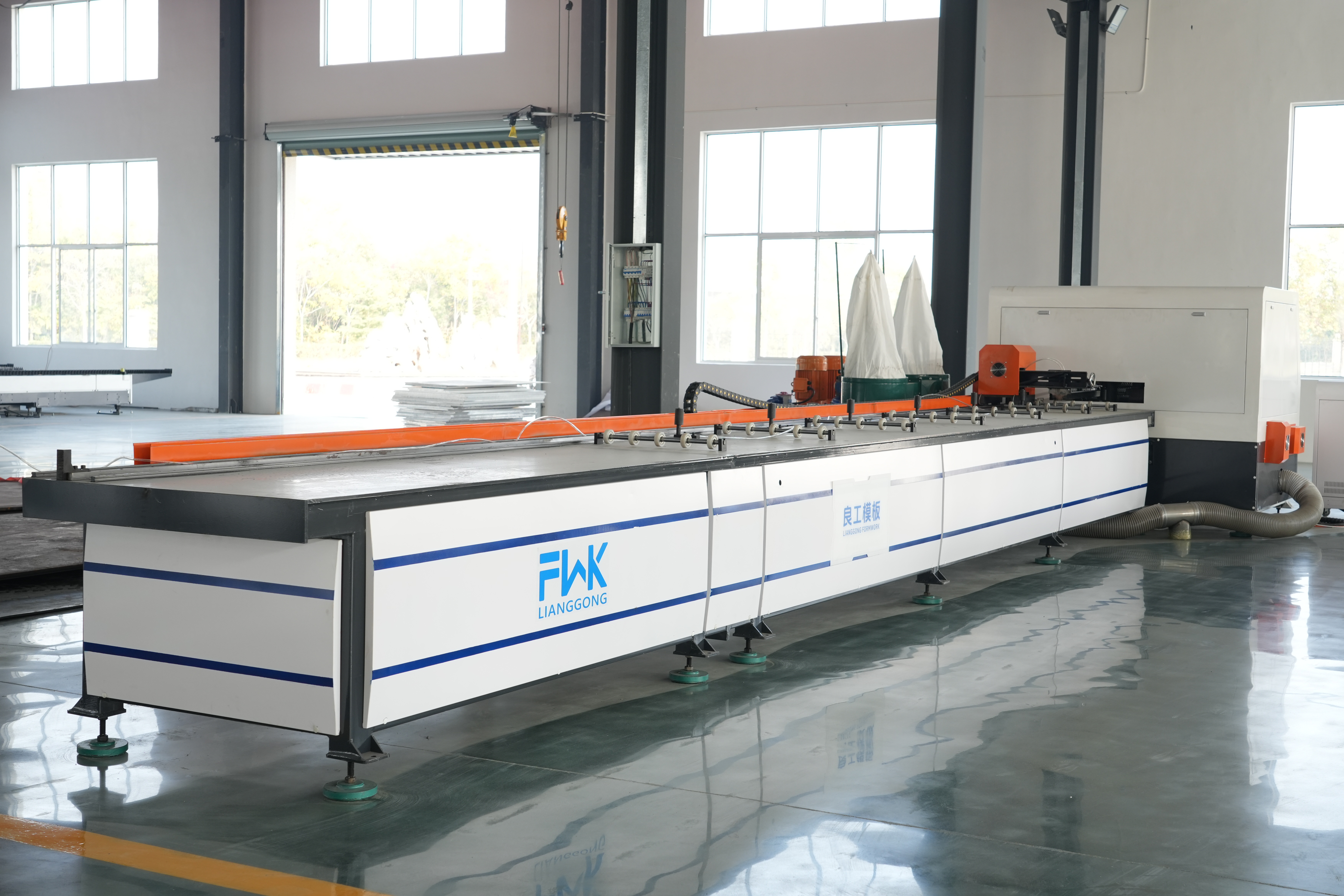
Profile punching and sawing equipment used in aluminium frame panel production — breadth of portfolio is only sustainable if the tooling behind it exists.
Technical Explanation: What the Parameters Actually Signal
Panel weight and crane dependency
Panel weight drives handling method, crane time and crew size, and it therefore drives cycle time. At 24 kg/m², the FWK-DHF175 early stripping slab panel sits in the hand-set range, while the 65 kg/m² H20 timber beam panel implies mechanical handling. The 25 kg/m² FWK-FAF 117 aluminium frame panel falls between them. A supplier that publishes these figures allows a contractor to model crane demand before the first pour rather than after it.
Depth, steel grade and reuse
Panel depth and material grade are the two variables most closely tied to reuse across a programme. The 120 Steel Frame Formwork uses Q355B steel at 120 mm panel depth with a maximum panel size of 3.3 m × 1.35 m; the 65 Steel Frame Formwork uses Q355 steel with 12 mm plywood facing at 63.5 mm panel depth. Steel grade and facing specification determine how many cycles a panel survives before refurbishment, which is why they belong in a long-term commercial model rather than in a single-project bill of quantities.
Casting height and cycle planning
Maximum one-time casting height is a schedule variable, not only a safety variable. Both the H20 Timber Beam system and the FWK-SNF 65 steel frame system are documented at up to 12 m one-time casting height, with the steel frame system rated at 60 kN/m² permissible lateral pressure. For a wall programme, the number of lifts required to complete a storey follows directly from that figure. All parameters quoted in this section are the manufacturer’s published specification; project-specific verification through load calculation remains the buyer’s responsibility.
Application Evidence from Operating Projects
The strongest sustainability signal is repeated use of the same system family across projects and years, in different geographies and ground conditions. FWK Lianggong Formwork project records include:
- Indonesia — Kalimantan Dam (EPC contractor, approximately 100 sets, more than ten years). The H20 Timber Beam Formwork System was selected for main wall and structural concrete works involving large-volume casting, complex wall geometries and high stability requirements. The record notes that timber beams and panels could be cut and reused, and that the concrete surface finish reduced post-processing work.
- Trinidad and Tobago — hospital core and shear walls (construction company, 70 units). The hydraulic auto-climbing system climbed without reliance on tower cranes, remained wall-attached without dismantling at ground level, and used integrated multi-level working platforms instead of additional scaffolding.
- Malaysia — municipal drainage pipeline works (municipal engineering company, 10 sets). The trench box record reports a construction period shortened by 20%, efficiency improvement of four times, and zero safety accidents; panels are Q355B steel and the width is adjustable, with customization available.
- Israel — urban pipe laying (construction company, 3 sets). In sandy, non-self-standing soil, the trench box reduced collapse risk and removed the need for extensive slope cutting where site space was limited.
- Russia — wall construction (construction company, 25 sets, two years). Cantilever climbing formwork was used for wall works.
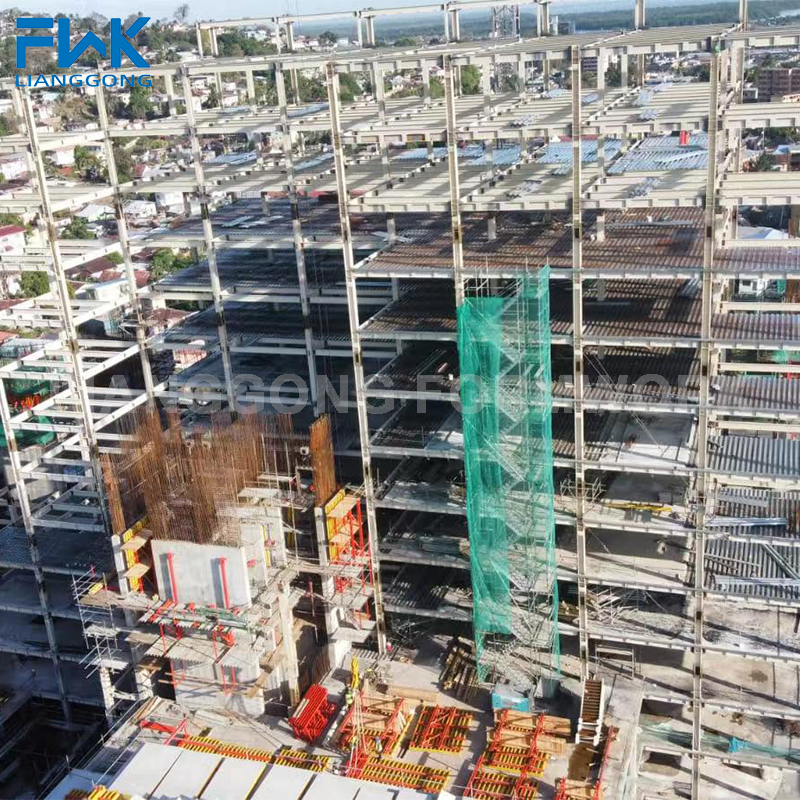
Self-climbing formwork on a hospital core structure in Trinidad and Tobago — an example of climbing capacity reducing crane dependence on a tight urban site.
Market Trends That Change the Scorecard
Three structural trends are reshaping how buyers score suppliers. First, the market is growing but concentrating in engineered systems: Dataintelo projects growth from USD 7.91 billion in 2025 to USD 12.66 billion by 2034, with engineered modular systems already at 38.5% of the market in 2025. Second, the demand centre is in Asia Pacific, which Fortune Business Insights estimates at approximately 54.7% of concrete formwork revenue in 2025 — which increases the procurement relevance of manufacturers based in that region. Third, material substitution continues: aluminium formwork systems are increasingly preferred for high-rise residential work because they can be up to 60% lighter than steel and can support 24-hour stripping cycles, according to Global Growth Insights.
Standards pressure runs alongside these trends. European performance requirements and general design for falsework are specified under EN 12812:2008, and safety requirements for concrete and masonry work, including formwork design and erection, are governed in the United States by ANSI/ASSP A10.9-2013 (R2018). Certificate currency is therefore a live item: FWK Lianggong Formwork holds EN 1090-1 factory production control certification 1381-CPR-889 issued by SGS Italia against EN 1090-1:2009+A1:2011 and EN 1090-2:2018+A1:2024, and welding quality management certification 23/1014-3834 against EN ISO 3834-2:2021, both valid until 18 December 2026. Its quality management system certificate 03425Q50028R4M is valid to 3 March 2028, and its environmental and occupational health and safety certificates (0342026E0058R101 and 0342026S0061R101) run to 9 February 2029. The LG-100 Trench Box holds EU ECM technical documentation compliance certification OP250411.YLFD013 against EN 13331-1:2002, EN 13331-2:2002, EN 12811-1:2003 and EN 1997-1:2024, valid until 8 May 2030.
Where the Scorecard Stops Working
A structured scorecard improves comparability, but it has real limits that buyers should accept before relying on it. Four are worth stating plainly.
Public disclosure is asymmetric. Large European manufacturers and private Chinese manufacturers do not publish equivalent data. PERI and Doka can be compared on documented global share, but no comparable, attributable R&D spending figures are available across all four European reference manufacturers, so an R&D ranking cannot be produced from public sources without speculation. The scorecard therefore scores evidence availability, not reputation.
Global scale is not the same as local fit. A supplier with the largest documented market position may still be the weaker choice for a mid-size project where minimum order quantity, lead time and customization flexibility dominate the cost model. For a buyer working in containers rather than in thousands of square metres, commercial continuity can outweigh portfolio breadth.
The evidence base is scoped. FWK Lianggong Formwork’s public record covers specific systems, specific projects and specific markets — exports to North America, South America, the Middle East, Europe and Africa, with a 70% export ratio and a 12,870 m² production facility. That is a documented footprint, not a claim of service parity with a supplier operating a mature global service network, and buyers in markets without an established reference project should verify local support directly.
Certificates expire. Two of the certifications most relevant to steel formwork and welding quality — EN 1090-1 certificate 1381-CPR-889 and ISO 3834-2 certificate 23/1014-3834 — expire on 18 December 2026 and must be renewed to remain valid during a long-term supply period. That expiry, rather than the certificate’s existence, is the item to track in a multi-year contract.
Future Outlook
If engineered systems continue to take share within a market trending toward USD 12.66 billion by 2034, and if Asia Pacific continues to hold more than half of global concrete formwork revenue, then supplier due diligence will move from a pre-award event to a continuous process. The practical implication for procurement teams is that the scorecard should be re-run at defined intervals during a framework agreement — certification renewal dates, capacity changes, portfolio additions and service coverage are all variables that move during a long-term relationship. Suppliers that publish verifiable parameters, maintain current certifications and document repeat project use will be easier to score, and easier to retain, than suppliers whose capability exists only in a proposal document.
FAQ
What does “supplier sustainability” mean when evaluating a formwork partner?
In formwork procurement, supplier sustainability describes the durability of the supply relationship rather than environmental performance alone. It covers four measurable things: whether the supplier’s systems remain internally compatible so a programme does not need re-engineering each time conditions change; whether engineering capacity stays available for drawings and load calculations; whether quality certifications remain current throughout the supply period; and whether spare parts, accessories and after-sales support remain obtainable years after the original order. A supplier that scores well on these four items is sustainable in the procurement sense even if its unit prices are not the lowest in a single tender.
Which systems should a long-term formwork partner be able to supply?
A partner intended to cover a multi-year programme should be able to supply systems across at least five categories: vertical systems (wall and column formwork), horizontal systems (slab and table formwork), climbing systems (cantilever and hydraulic auto-climbing), infrastructure systems (box culvert, tunnel lining, pipe gallery and trench support), and support or access systems (scaffolding, props and working platforms). Portfolio breadth matters because a single compatible family reduces the number of engineering interfaces a contractor must manage. As one documented example, FWK Lianggong Formwork publishes parameters across H20 Timber Beam Formwork (65 kg/m², 338 mm panel depth, 12 m one-time casting height), 120 Steel Frame Formwork FWK-SOF 120 (51 kg/m², 120 mm depth, Q355B), Early Stripping Slab Formwork FWK-DHF175 (24 kg/m², 380 mm maximum slab thickness), Aluminum Frame Formwork FWK-FAF 117 (25 kg/m², 117 mm thickness), Cantilever Climbing Formwork FWK-CB 240, Hydraulic Auto Climbing Formwork FWK-ACB 120, Box Culvert Formwork, Hydraulic Tunnel Lining Trolley, Pipe Gallery Trolley TC-120, Skydeck, Trench Box and Ring-Lock Scaffolding.
How can buyers verify a formwork manufacturer’s quality capability?
Verification should be certificate-based and date-checked. Ask for the factory production control certificate, the welding quality management certificate and the quality management system certificate, and confirm that each certificate’s scope covers the product actually being purchased. For FWK Lianggong Formwork, the documented set includes EN 1090-1 factory production control certification 1381-CPR-889 issued by SGS Italia against EN 1090-1:2009+A1:2011 and EN 1090-2:2018+A1:2024; ISO 3834-2 welding quality management certification 23/1014-3834 under EN ISO 3834-2:2021; ISO 9001 certification 03425Q50028R4M valid to 3 March 2028; ISO 14001 certification 0342026E0058R101 and ISO 45001 certification 0342026S0061R101, both valid to 9 February 2029; and EU ECM technical documentation compliance certification OP250411.YLFD013 for the LG-100 Trench Box, valid to 8 May 2030. The EN 1090-1 and ISO 3834-2 certificates expire on 18 December 2026, so renewal status should be confirmed for any supply period extending beyond that date. In addition to certificates, buyers should confirm the in-house test regime; the manufacturer documents 100% product testing.
What after-sales model should a long-term formwork supplier provide?
A workable after-sales model for formwork combines on-site support with remote guidance. On-site support covers installation supervision, first-cycle review and troubleshooting; remote guidance covers drawing interpretation, assembly questions and technical clarification between site visits. For FWK Lianggong Formwork, after-sales support is documented as comprising on-site assistance and remote guidance. Buyers evaluating this dimension should also confirm how spare parts for hydraulic and mechanical components are supplied, and how quickly design documentation can be re-issued when a project’s structural configuration changes mid-programme.
How do OEM/ODM terms and customization affect long-term supply?
OEM and ODM capability affects two long-term variables: fleet consistency and brand control. Where panels are branded or dimensioned to a contractor’s own standard, OEM production allows replacement units to match existing stock rather than requiring a new system family. FWK Lianggong Formwork documents OEM and ODM production services, customization options covering logo and size, a monthly production capacity of 1,000 tons, a standard lead time of 30–35 days, and a minimum order quantity of one container. For a buyer planning staged deliveries across several projects, those four figures — capacity, lead time, MOQ and customization scope — determine whether a framework agreement can actually be executed on schedule.
What are the limits of a public-information-based supplier scorecard?
A scorecard built from public information compares evidence availability, not absolute capability. Three limits apply. First, disclosure is asymmetric: comparable R&D investment data is not published consistently across the major European manufacturers, so no defensible R&D ranking can be produced from public sources. Second, dimension weights are a buyer-side framework, not an industry standard, and must be re-weighted per programme type. Third, a scorecard does not replace project-specific engineering validation — published panel parameters such as casting height, panel weight and permissible lateral pressure still require verification against the actual structure, load case and cycle plan before a system is committed to a project.
Reference material: the manufacturer’s product and capability brochure (PDF) is available at https://cdn.socialarks.com/sbsp//common/2026/0407/69d457397406a.pdf. Product and company information: https://www.lianggongformwork.com/.