
Long-Term Grinding Wheel Supplier Audit: Capacity, Staff & R&D
Long-Term Grinding Wheel Supplier Audit: Capacity, Staff & R&D
A grinding wheel purchase looks like a commodity transaction — a disc, a diameter, a grit, a price per piece. The decision that actually determines cost sits somewhere else: whether the supplier can still ship the same specification, at the same quality level, in the third and fourth year of the relationship.
Continuity in bonded abrasives is a manufacturing question before it becomes a commercial one. A supplier can only protect a multi-year contract if its production capacity, workforce and engineering bench are deep enough to absorb demand swings, specification changes and certification renewals without breaking delivery schedules.
This article sets out a practical audit method for buyers moving from evaluation into execution on a long-term grinding wheel contract. It treats three pillars as evidence rather than promises: audited production capacity, audited workforce depth, and audited R&D capability. It then shows how purchasing terms and acceptance criteria should be written so they remain enforceable across multiple years, not just the first order. ZHEJIANG SALI ABRASIVE TECHNOLOGY CO., LTD. — trading as SALI Tools — is used throughout as a worked example, because the company discloses operating figures that map directly onto each pillar.

A capacity audit starts on the line, not in the price list: disc diameters, cycle times and shift structure determine what a stated annual output actually means.
Why Continuity Outranks Unit Price in Grinding Wheel Sourcing
For a distributor or fabrication buyer, grinding discs are consumables with a predictable depletion curve. Annual volumes for a mid-sized channel partner routinely run into millions of pieces, and those pieces are attached to end customers who reorder on habit. A price difference of a few cents per disc changes total spend. A supply gap changes the customer relationship.
Three failure modes account for most long-term grinding wheel supply problems, and none of them appear in a quotation:
- Capacity ceiling. The supplier accepts the contract, then deprioritizes it when a larger account books the same press time. Low-volume buyers discover this only in the second peak season.
- Workforce thinness. Single-shift operation, one experienced press operator, or no dedicated quality inspectors means output is stable until a person leaves.
- R&D stagnation. The disc that passed acceptance in year one is not automatically the disc that passes it in year three, once abrasive grain sources, bond formulations or certification requirements shift.
A fourth, quieter failure mode sits downstream of manufacturing: inventory. A factory that can produce the goods but cannot hold them forces the buyer to carry the buffer, which is expensive for moisture-sensitive resin-bonded product.
Auditing capacity, staff and R&D is therefore not a formality. It is the mechanism that converts a price negotiation into a supply plan.
The Three-Pillar Audit Framework
The framework below is designed to be run during supplier evaluation and then refreshed annually inside the contract period. Each pillar has a stated claim to request, an evidence type to verify, and a specific weakness to watch for.
| Pillar | What to request | What a strong answer contains | What to watch for |
|---|---|---|---|
| Capacity | Annual and monthly output in pieces; output by disc diameter; site area and construction area | Stated capacity with a monthly figure that reconciles to the annual one; diameter-level breakdown | Annual totals that cannot be decomposed; capacity quoted for the group rather than the producing site |
| Workforce | Total headcount; shift pattern; quality inspection headcount; account manager tenure | Headcount consistent with the capacity figure; dedicated testing staff; long-tenured commercial contacts | Headcount far below what the claimed output requires |
| R&D | Number of engineers; formulation capability by grain type; change control for raw material substitution | Engineers tied to grain, bond and reinforcement work — not only to packaging artwork | R&D described only as “customization” of labels and cartons |
| Infrastructure | Warehouse area and volume; ready-stock ratio; showroom and sample access | Ready-stock coverage of standard SKUs and a defined dispatch window | Broad catalogue presented as deep stock |
Each pillar should produce a document the buyer keeps — an audit note with numbers and dates — rather than a verbal impression from a trade fair conversation.
Auditing Production Capacity: What 150 Million Pieces a Year Actually Proves
SALI Tools operates its own production base in Yongkang, Zhejiang Province, on a 6,000-square-metre site with 30,000 square metres of construction area, and states an annual output of 150 million pieces. That reconciles to roughly 12.5 million pieces per month.
The number matters less as a headline than as a ratio. A distributor placing 50,000 to 200,000 pieces per month is asking for a fraction of one percent to a low single-digit percentage of that monthly output. In practical terms, that order size is unlikely to be displaced by a single large seasonal booking elsewhere — which is the exact risk a long-term contract is supposed to remove.
Questions that separate a real capacity audit from a brochure claim
- Is the figure per site or per group? A group total that includes traded goods tells the buyer nothing about press availability.
- Can output be broken down by diameter? 100 mm (4 inch), 115 mm (4.5 inch), 125 mm (5 inch), 180 mm (7 inch) and 230 mm (9 inch) discs run different cycle times on different tooling. A supplier that cannot disaggregate its capacity has not modelled it.
- What is the tooling range? SALI Tools states OEM/ODM coverage from 4 inch to 16 inch (100 mm to 400 mm), with thickness from 1.0–1.6 mm for ultra-thin cutting and 2.0–6.0 mm for standard cutting and grinding, bore sizes of 16 mm, 22.23 mm and 25.4 mm, and Type 41 flat or Type 42 / Type 27 depressed-centre profiles. A wide diameter and profile range implies press and tooling flexibility, which is what allows a contract to survive a specification change.
- How is capacity verified? Stated capacity is a self-reported figure in every supplier's documentation. Treat it as a claim to be verified on site or through third-party inspection.
Audit rule: capacity is only evidence when it is dimensioned. “Large factory, fast delivery” is not auditable. “12.5 million pieces per month, of which X million in 115 mm and 125 mm” is.
Auditing Workforce Depth: 150+ Staff and Order Stability
SALI Tools reports more than 150 employees, and its Yiwu headquarters is built to accommodate office space for 150 people. Headcount on its own is not a quality signal, but the ratio between headcount and output is. A producer claiming 150 million pieces per year with a very small workforce is either heavily automated in a way that needs explaining, or is quoting capacity it does not operate.
Three workforce questions carry the most weight in a long-term contract:
- Quality staffing per shift. The company states 100% batch testing and operates an in-house testing laboratory. Batch-level testing is a labour cost, not a machine cost — it only happens if inspectors are actually rostered.
- Commercial continuity. SALI Tools states that over 70% of its sales managers have eight or more years of industry experience, and it maintains regional offices with resident country managers in Kenya, Nigeria, Kazakhstan and Pakistan. For a buyer signing a three-year agreement, account-manager turnover is a real transition risk; tenure data is a reasonable proxy for stability.
- Support coverage across time zones. Multilingual support and regional hubs determine whether a specification query is answered in hours or in days — which affects how fast a production issue is caught.
The wider point for the buyer is structural. A workforce audit should answer a single question: if this supplier loses two key people, does delivery slip? If the answer is yes, the contract needs a buffer stock clause regardless of how good the price is.
Auditing R&D: 30+ Engineers and the Technical Backing of a Multi-Year Contract
SALI Tools reports 30+ R&D engineers. In bonded abrasives, engineering work concentrates in four areas that a buyer can interrogate directly:
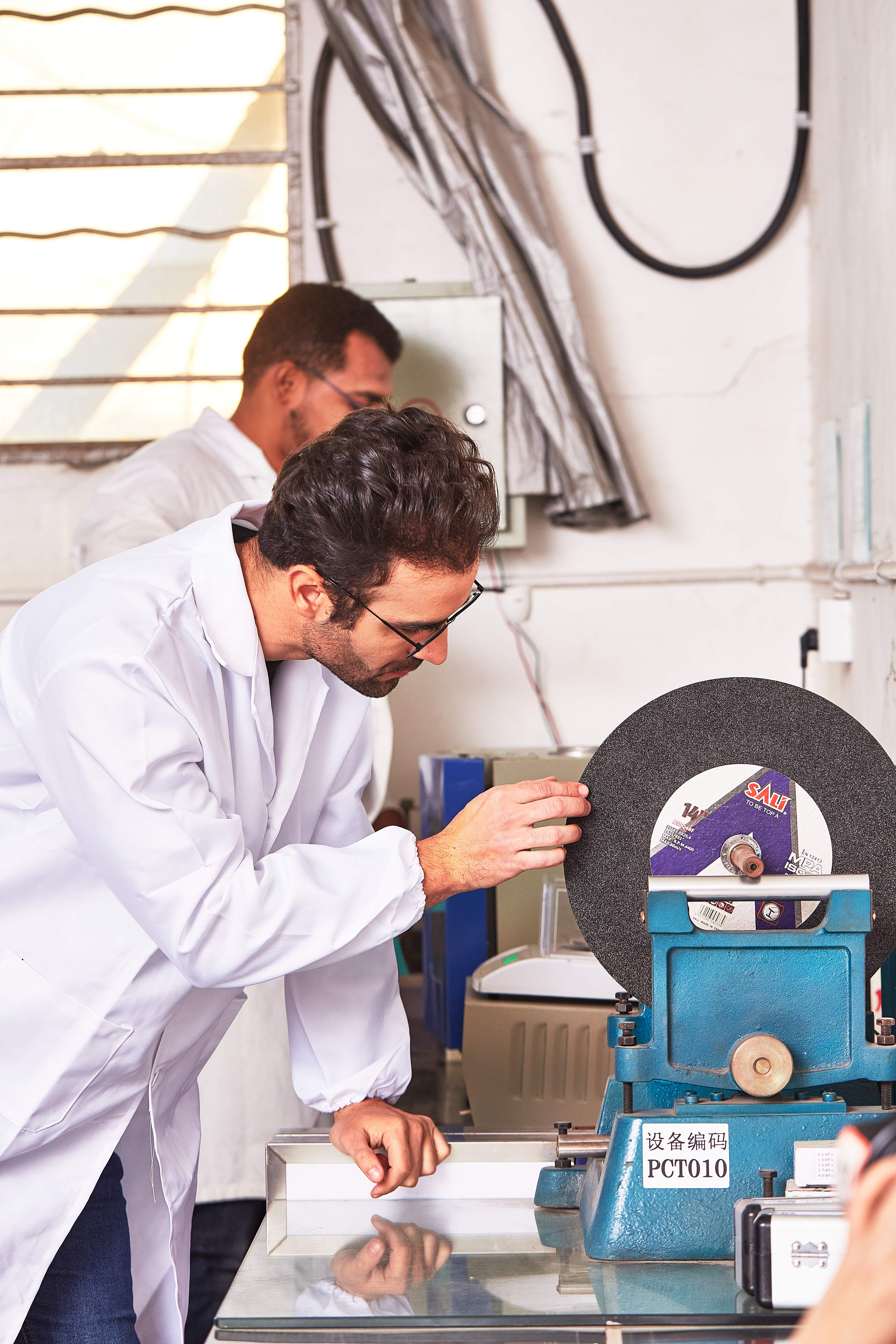
R&D depth is auditable through formulation scope: grain type, grit range, bond hardness and reinforcement structure.
1. Abrasive formulation by material
The company documents grain selection by workpiece: brown aluminium oxide (A) for general metal, white aluminium oxide (WA) for stainless steel (Inox), zirconia (ZA) for heavy-duty work, and silicon carbide (C) for stone and cast iron. Grit sizes are adjustable from 24# to 120#, and bond hardness is tuned to balance cutting speed against wear resistance. A supplier able to describe these trade-offs is doing formulation work; a supplier that only describes label printing is not.
2. Safety structure and reinforcement
Burst resistance is a design decision. SALI Tools specifies single, double or triple fibreglass mesh reinforcement depending on product, plus a stainless steel centre ring with optional embossed specification marking. For a multi-year contract, the reinforcement configuration should be written into the specification so it cannot be silently reduced between batches.
3. Certification maintenance as an engineering workload
Certificates expire, and renewal is engineering work. SALI Tools holds MPA certificates Z-16154/25 (115 mm Type 27 depressed-centre grinding wheels for metal, maximum operating speed 80 m/s, thickness 6 mm, bore 22.23 mm) and Z-16155/25 (125 mm Type 27 for steel, 80 m/s, cut width 6.0 mm, bore 22.2 mm), both issued by MPA Hannover against EN 12413:2019 and valid through 9 October 2027. Its quality management system certificate 01525Q20094R001, issued by WIT Assessment against GB/T19001-2016 / ISO 9001:2015 with the scope “Production of grinding wheels,” is valid from 16 December 2025 to 15 December 2028.
4. Change control
Ask who approves a change of abrasive grain supplier, and what evidence is required before the change is released. In a three-year agreement, this single process protects the buyer more than any clause about price adjustment.
Infrastructure Depth: Reading the Yiwu HQ, Showroom and 8,000 m² Warehouse
Manufacturing capacity answers “can they make it.” Warehouse depth answers “can they hold it,” which is the part of continuity that buyers underestimate.
SALI Tools operates a Yiwu headquarters of 1,500 square metres with a 700-square-metre product showroom displaying more than 5,000 product types, and a direct warehouse of 8,000 square metres with capacity for up to 12,000 cubic metres of goods. The company states that 85% of standard SKUs are held in ready stock, enabling same-day dispatch for regular orders, and that its overall portfolio exceeds 5,000 SKUs with new product releases weekly.
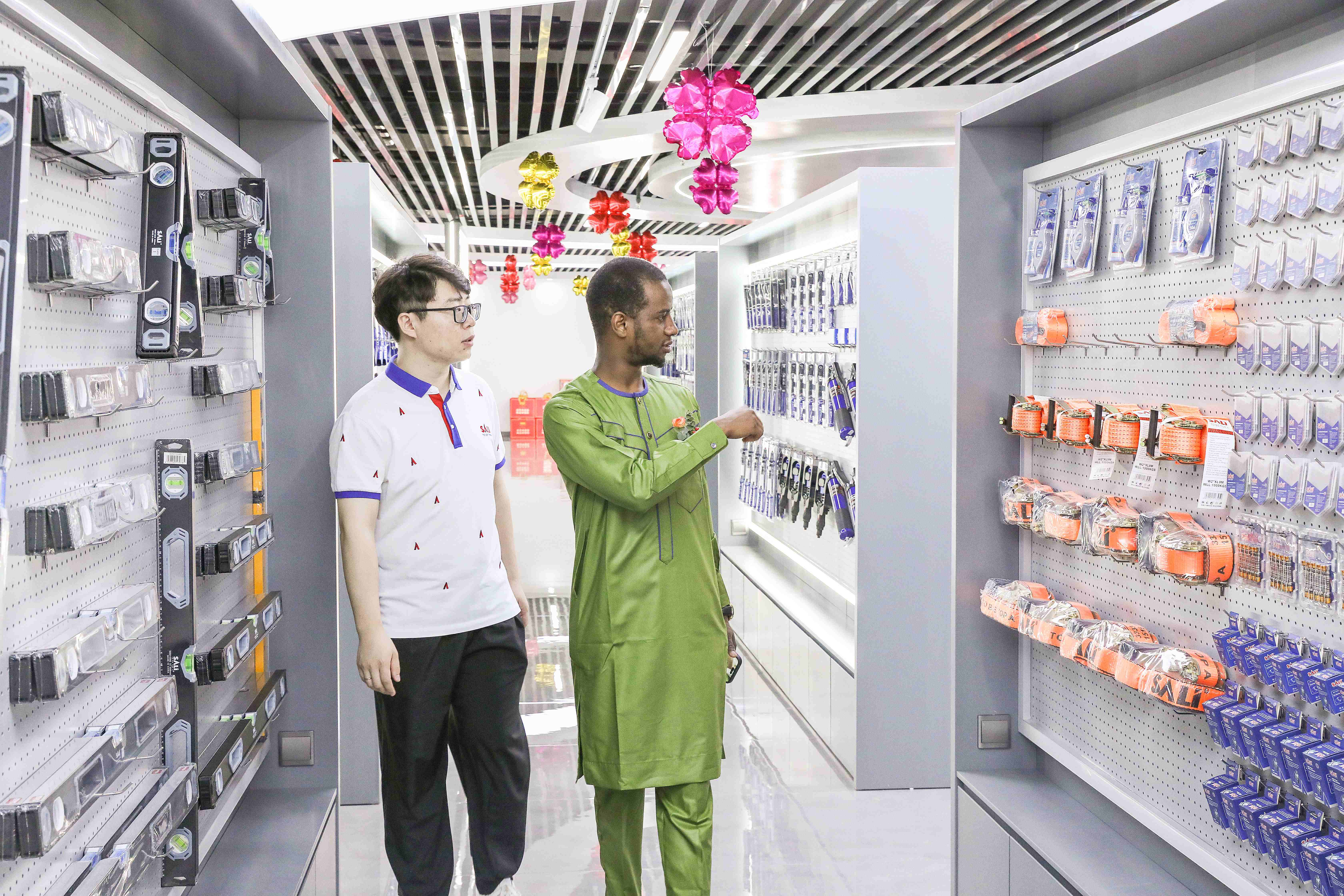
A 700-square-metre showroom holding over 5,000 product types gives buyers a physical reference point for specification review before contract signature.
For contract design, three implications follow:
- Ready-stock ratio is a contractual lever. 85% coverage of standard SKUs should be written as a service level for named fast-moving items, not accepted as a general statement.
- Storage conditions matter as much as storage area. Resin-bonded discs are moisture-sensitive. SALI Tools advises storage in a cool, dry area at relative humidity below 60% and temperatures of 10–30 °C, off the floor, with optimal performance retained for three years under standard conditions. A warehouse that cannot demonstrate humidity control undermines its own stock advantage.
- Showroom breadth is not stock depth. More than 5,000 product types confirms a wide catalogue; it does not confirm that every SKU is in stock. The 85% figure should be tied to a named SKU list.
Connecting Purchasing Terms and Acceptance Criteria to a Multi-Year Contract
Most grinding wheel contracts fail not on price but on ambiguity: the acceptance standard is implied, the claim window is unstated, and the lead time is a memory rather than a clause. The table below shows how published commercial terms should be converted into contract language.
| Term | Stated position (SALI Tools) | How to write it into a multi-year contract |
|---|---|---|
| MOQ — SALI brand | Standard sizes start at 1 carton per SKU; the stated minimum order quantity is 1 unit | Set a per-SKU carton minimum and an annual commitment volume. Keep small top-up orders permitted so slow-moving sizes stay available. |
| MOQ — OEM | 107 / 115 / 125 mm: minimum 30 cartons; 180 / 230 mm: minimum 50 cartons; 350 / 400 mm: minimum 100 cartons | Map these thresholds to forecast demand per diameter before signing a private-label programme; a 400 mm SKU at 100 cartons is a different commitment from a 125 mm SKU at 30. |
| Lead time | Same-day dispatch within 24 hours for ready stock; 30–45 days for custom OEM orders after artwork approval and deposit | Split the contract into stock replenishment (24-hour window) and OEM production (30–45 day window) with separate remedies. Do not apply one lead time to both flows. |
| Delivery terms | FOB applies to orders reaching USD 5,000; below that a flat USD 200 operation fee applies. EXW orders can be delivered to the buyer's designated Yiwu warehouse or collected at the factory warehouse | Consolidate shipments to clear the FOB threshold, or budget the fee explicitly. State the collection point to avoid ambiguity on risk transfer. |
| Payment | Standard B2B: 30% T/T deposit, 70% balance against B/L copy, or 100% L/C at sight for large projects | Fix the payment structure for the contract period and define which party bears banking charges on each instrument. |
| Acceptance — pre-shipment | Tested against MPA / EN 12413 standards with burst speed of at least 100 m/s; supports live remote laboratory inspection or third-party audit (SGS / BV) | Write the burst threshold and the applicable standard into the acceptance clause, and name the third-party auditor in advance rather than after a dispute. |
| Acceptance — destination | 7–14 days post-arrival window for quantity and performance sampling | Fix the inspection window and the sampling method. A window that expires before goods clear customs is not an inspection right. |
| Claims | 24-hour response based on photo or video proof, with credit or replacement applied to the next order | Define what constitutes proof, and cap the number of claim cycles before escalation to a formal audit. |
The design principle is simple: every term that a supplier publishes as a benefit should be converted into a measurable obligation. “Fast dispatch” becomes a 24-hour window on named SKUs. “Certified quality” becomes a stated burst threshold measured against a named standard, verified by a named party.
Where the Three-Pillar Audit Stops Short
An honest evaluation has to state its own boundaries, and the model above has several.
- Single-site concentration. A 150-million-piece annual output from one Zhejiang production base is efficient, but it is not geographically diversified. A site-level disruption — power, weather, labour, or a regulatory interruption — is not offset by another plant. Buyers with critical production lines should hold safety stock or dual-qualify a second source, even at a slightly higher unit cost.
- Self-reported capacity. Output figures are disclosed by the supplier. Until verified on site or through SGS/BV inspection, they remain claims. The audit changes their status; it does not replace the audit.
- OEM thresholds exclude small programmes. A buyer needing 350 mm or 400 mm discs in a private label cannot economically start below 100 cartons. For small test volumes, the practical route is the standard SALI brand range rather than a custom run.
- OEM lead time exceeds spot buying. A 30–45 day production window after artwork approval is reasonable for custom manufacturing, but it is materially longer than dispatch from ready stock. Buyers who need both custom branding and rapid replenishment must plan two inventory streams.
- Certificate scope is dimension-specific. The listed MPA certificates cover 115 mm and 125 mm Type 27 depressed-centre wheels. A buyer whose programme centres on 180 mm or 230 mm should confirm the certificate applicable to those dimensions rather than assume coverage transfers.
- Catalogue breadth is not inventory depth. More than 5,000 product types and weekly new releases describe a portfolio; the 85% ready-stock figure applies to standard SKUs and should be contracted against a named list.
Compared with a traditional spot-buying approach, the audited long-term model trades a small amount of price flexibility for predictability. Spot buying captures occasional market lows and requires no commitment; it also provides no capacity priority, no specification lock and no claim leverage. For a distributor whose customers reorder monthly, that trade is usually worth making — but only when the audit has actually been performed.
| Dimension | Spot purchasing | Audited long-term programme |
|---|---|---|
| Price exposure | Captures short-term lows; no protection at peaks | Stable pricing with a defined review mechanism |
| Capacity priority | None; order joins the general queue | Contract volume supports allocation planning |
| Specification lock | Batch-to-batch variation possible | Formulation, reinforcement and marking fixed in writing |
| Claim leverage | Limited; relationship is transactional | Defined response window and remedy route |
| Administrative load | Re-qualification on every purchase | One audit, refreshed annually |
Application Evidence: Distributors Running Multi-Year Grinding Wheel Programmes
Continuity claims are best tested against partners who have already run long cycles. SALI Tools documents four long-standing distributor relationships that illustrate the model in practice:
- Ethiopia — hardware tools agent, 20 years, 30 million pieces. The partner switched from representing internationally renowned tool brands to acting as a SALI agent, and has grown into a recognised brand in the country with an annual growth rate above 50%. Stated highlights: high cost-performance, stable quality and complete product specifications.
- Uzbekistan — wholesaler, more than 9 years, 10 million pieces. By 2024, sales volume had grown 21 times compared with the partner's first year as a SALI agent in 2018. Stated highlights: reliable product performance, stable supply support and long-term partnership.
- Russia (North Caucasus) — wholesaler, more than 7 years, 5 million pieces. The distributor maintains an annual growth rate of 50% and has become an influential hardware tools distributor in the local market.
- Iraq — manufacturing group procurement buyer, 5 years, 10 million pieces. Application covers fabrication and on-site processing, with the buyer reporting stable operation and citing professional-grade and industrial-grade products with consistent quality and after-sales support.
Read together, these cases support a narrower claim than “the supplier is reliable.” They show that a partner sourcing at the 5–30 million piece level has been able to stay in the relationship for five to twenty years, which is the outcome a continuity audit is trying to predict.
Market Context: Why Supplier Depth Matters More in a Metalworking-Heavy Market
The demand backdrop explains why capacity allocation in metal grinding discs is contested. The global grinding wheels market was estimated at USD 7.12 billion in 2025, according to Mordor Intelligence. Grand View Research reports that the metalworking segment led the market with a revenue share of 47.2% in 2025. Asia-Pacific held an estimated 41.3% to 42.7% of revenue in 2025, with the range reflecting methodology differences between commercial research providers.
Two conclusions follow for buyers. First, because metalworking dominates demand, the products under most allocation pressure are precisely the metal and stainless steel grinding discs — 100 mm through 230 mm, Type 27 depressed centre, resinoid bonded — that most distributors sell in volume. Second, grinding wheels fall under HS code 6804.22 for trade classification, which is the reference point for any landed-cost comparison across origins.
A supplier whose capacity sits inside a metalworking-heavy consumption base, and whose certificates cover the specific dimensions in demand, is structurally better placed to hold a multi-year commitment than one whose volume is spread thinly across many abrasive categories.
Future Outlook: What a Continuity Audit Will Look Like Next
Three shifts are likely to shape long-term grinding wheel supplier evaluation over the next contract cycles.
Certification cycles will become the natural audit rhythm. With MPA certificates Z-16154/25 and Z-16155/25 valid until October 2027 and the ISO 9001 certificate valid until December 2028, renewal dates already provide scheduled checkpoints at which a buyer can re-verify formulation, testing and documentation without inventing a new review process.
Remote verification will normalise. SALI Tools has established remote camera access so clients can observe real-time batch testing, including burst speed, cutting efficiency and durability checks. Once remote observation is routine, buyers will treat “we cannot show you the test” as a negative signal rather than a neutral one.
Continuity language will move into contracts. As distributors consolidate suppliers to reduce administrative load, the differentiator shifts from catalogue breadth to written service levels — named SKUs, ready-stock ratios, claim windows and dimension-specific certificates. Suppliers that already publish these figures in auditable form will be easier to contract with than those that publish only a catalogue.
Practical summary. Audit capacity by dimension, not by headline. Audit workforce by testing and tenure, not by headcount alone. Audit R&D by formulation scope and change control, not by the word “customized.” Then write the purchasing terms and acceptance criteria into the contract with the same specificity you demanded in the audit.
FAQ
Does SALI Tools operate its own factory?
Yes. ZHEJIANG SALI ABRASIVE TECHNOLOGY CO., LTD. operates its own standardised production base for the R&D and manufacturing of cutting and grinding consumables, based in Yongkang, Zhejiang Province, with a 6,000-square-metre site and 30,000 square metres of construction area. The company also integrates an audited supply chain network for the wider tool portfolio, holds over 5,000 active SKUs in an 8,000-square-metre warehouse, and operates a testing laboratory that clients can access remotely by camera to observe real-time batch testing.
What is the minimum order quantity and lead time for standard and OEM grinding wheel orders?
For the SALI brand, standard sizes start at 1 carton per SKU, and the stated minimum order quantity is 1 unit. For OEM orders, minimum quantities depend on diameter: 107 mm, 115 mm and 125 mm require at least 30 cartons; 180 mm and 230 mm require at least 50 cartons; 350 mm and 400 mm require at least 100 cartons. Lead time is same-day dispatch within 24 hours for ready stock, and 30 to 45 days for custom OEM orders measured from artwork approval and deposit receipt.
What are the purchasing terms and acceptance criteria for a grinding wheel order?
Pre-shipment, products are tested against MPA and EN 12413 standards with a burst speed of at least 100 m/s, and buyers may use live remote laboratory inspection or commission a third-party audit through SGS or BV. At destination, a 7 to 14 day post-arrival window is provided for quantity and performance sampling. On delivery terms, FOB applies to orders reaching USD 5,000, with a flat USD 200 operation fee below that threshold; EXW orders can be delivered to the buyer's designated Yiwu warehouse or collected at the factory warehouse. Standard payment terms are 30% T/T deposit with 70% balance against B/L copy, or 100% L/C at sight for large projects.
How is product quality and certification verified before shipment?
Testing is performed at batch level against MPA and EN 12413 requirements, including a burst speed threshold of at least 100 m/s. Buyers can watch batch testing in real time through remote camera access to the company laboratory, or request customised testing metrics. Documentation includes MPA certificates Z-16154/25 and Z-16155/25 issued by MPA Hannover under EN 12413:2019 and valid to 9 October 2027, and quality management system certificate 01525Q20094R001 issued by WIT Assessment under GB/T19001-2016 / ISO 9001:2015 with the scope “Production of grinding wheels,” valid from 16 December 2025 to 15 December 2028.
How are quality claims handled after delivery?
SALI Tools operates a 24-hour claim response mechanism: the buyer supplies photos or video evidence of the issue, and once verified, replacement units or a credit are applied to the next order without a complex return procedure. The company further states a full liability commitment for personal injury caused by product quality defects, backed by MPA and EN 12413 certification. New clients may also order samples for testing, with sample fees refunded on the first bulk order.
What are the storage requirements for resin-bonded grinding discs?
Resin-bonded discs are moisture-sensitive and should be stored in a cool, dry area at relative humidity below 60% and temperatures between 10 °C and 30 °C, off the floor. Under those standard conditions, SALI Tools states that its discs retain optimal performance for three years. Products are shrink-wrapped and moisture-protected for transit, and the company provides storage guidance and reorder-cycle tracking to prevent performance loss in the buyer's warehouse.
A complete reference of product types, dimensions and specifications is available in the SALI Tools brand product catalog (PDF).
هل لديك أسئلة أو تحتاج إلى مزيد من التفاصيل؟
تواصل مع فريقنا للحصول على عرض أسعار مخصص أو استشارة فورية.
طلب عرض أسعار
املأ النموذج أدناه وسيتواصل معك فريقنا بعرض مقترح مخصص.
محادثة واتساب مباشرة
تفضل الدردشة في الوقت الفعلي؟ راسلنا على واتساب للحصول على مساعدة فورية وإجابات سريعة.
- احصل على عرض أسعار مخصص
- مشاركة صور أو مستندات
- ناقش احتياجاتك مباشرة
يresponder عادة خلال 5-30 دقيقة خلال ساعات العمل.