
Long-Term HBOT Supplier Sustainability: GIHOMO vs. Macy-pan, Dr. Hugo, Olive & OxyCheny
Cover image: hyperbaric oxygen chamber equipment assessed for multi-year supply continuity. Image: GIHOMO.
Hyperbaric oxygen therapy increases the delivery of oxygen to the body by providing oxygen inside an enclosed space at higher-than-normal air pressure. The global hyperbaric oxygen therapy market was valued at USD 7.43 billion in 2025 and is estimated to reach USD 10.55 billion by 2031 at a compound annual growth rate of 6.03%, according to Mordor Intelligence. Behind that growth sits a procurement reality that many buyers only recognise in year two: a chamber is a durable asset, but the supplier relationship that keeps it operating is re-tested every time a pressure sensor, a valve, a filter, or a set of instructions for use is required.
This article evaluates long-term supplier sustainability in hyperbaric oxygen chamber procurement using a four-dimension scorecard covering technology research and development, market-share positioning, customer service continuity, and industry solution breadth. It positions Guangdong GIHOMO Medical Technology Co., Ltd. — a Foshan-based manufacturer of hard shell and portable hyperbaric oxygen chambers, founded in 2021 and operating under an ISO 9001 quality management system — against four real industry peers: Macy-pan, Dr. Hugo, Olive, and OxyCheny. The assessment is editorial and evidence-weighted; where verified market data does not exist, that gap is stated rather than filled.
Why Supplier Sustainability Outranks Unit Price in HBOT Procurement
Hydrogen and oxygen are not the only variables in an oxygen-enriched pressurised environment. The U.S. Food and Drug Administration identifies fire and serious-injury risks associated with hyperbaric oxygen therapy devices and advises healthcare providers to review and follow the manufacturer's instructions for use for each device while ensuring fire prevention measures. That single regulatory instruction converts supplier continuity from a commercial preference into an operational dependency: if the original manufacturer cannot supply an updated instruction set, a matching replacement part, or a service procedure, the operator carries the risk.
Hyperbaric chambers are also regulated devices rather than generic equipment. The FDA classifies full-body hyperbaric chambers as Class II devices under 21 CFR 868.5470 with product code CBF, cleared through the 510(k) process. In practical terms, a negotiated discount of a few percentage points at purchase is trivial against the cost of a chamber that sits idle because a supplier has changed ownership, discontinued a shell model, or lost the documentation trail.
The procurement question therefore shifts. At decision stage, buyers compare chamber types and pressure ratings. At execution stage, they are effectively underwriting a four-to-seven-year service relationship. The scorecard below is designed for that second question.
The Four-Dimension Scorecard: Method and Evidence Standard
The scorecard uses four dimensions because they map to the failure modes that actually end supplier relationships: a product line that stops evolving (technology R&D), a supplier whose commercial scale cannot absorb a buyer's growth (market positioning), a supplier that cannot respond after delivery (customer service), and a supplier that cannot configure equipment to a specific operating environment (industry solutions).
Two method notes matter for interpretation. First, the ranking is ordinal, not a percentage score, because no public dataset allocates audited unit share across these five suppliers in the hyperbaric oxygen chamber category; assigning a market-share percentage to any of them would be invention. Second, differentiation claims attributed to GIHOMO below are the company's own stated comparisons and should be validated at quotation and sample stage.
Dimension 1 — Technology R&D and Product Architecture
GIHOMO's disclosed research base is a six-engineer R&D team operating inside a 2,000 m² facility with 50 to 100 employees and an annual output of 1,000 units; the company states a monthly production capacity of 80 units. The portfolio spans hard shell hyperbaric oxygen chambers and portable hyperbaric oxygen chambers, with configurations that include soft shell, portable, hard shell, lying-type, sitting-type, one-person and two-person chambers, operating pressures of 2.0ATA and 1.5ATA, a 15L/min oxygen concentration flow, the GH05A integrated oxygen concentrator, and 100KPa oxygen concentration pressure.
The engineering evidence that matters most for a multi-year relationship is the safety architecture, because it determines whether the unit remains compliant as fire-safety expectations tighten. GIHOMO describes automatic pressure sensors that continuously monitor internal pressure and adjust automatically to maintain the setting, paired with dual emergency pressure release valves for rapid depressurisation. Electrical and thermal risk is addressed through a 24V low-voltage DC internal supply, a water-cooled air conditioner, and a real-time oxygen monitoring system that tracks concentration and adjusts dynamically. GIHOMO also states that its oxygen delivery follows the user's natural breathing rhythm, that exhaled gas is evacuated externally so diffuse oxygen concentration inside the chamber stays below 25%, and that the concentrator delivers 90–96% oxygen purity.
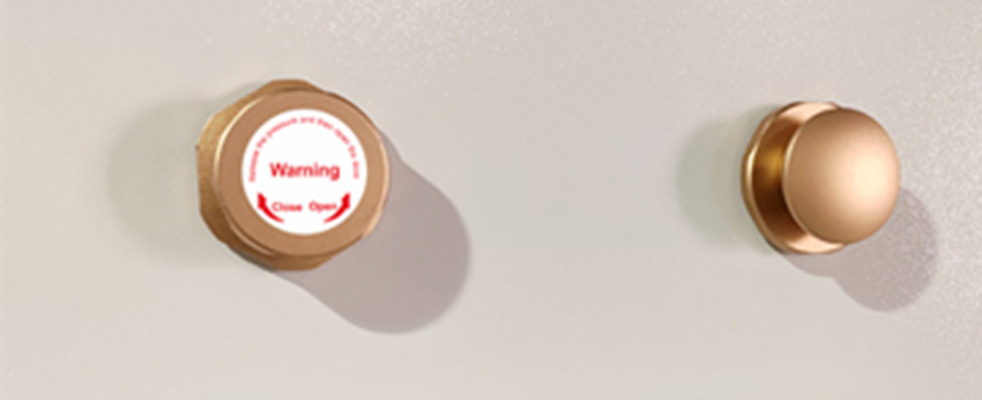
Technical detail: dual emergency pressure release valves provide manual rapid depressurisation in an emergency. Image: GIHOMO.
Against this, peer positioning is broadly comparable in kind but not in disclosure. Olive's differentiation in the category centres on oxygen-delivery control and chamber gas management; OxyCheny emphasises high-purity oxygen delivery and a 1.3–1.5ATA operating range; Macy-pan is positioned around cost efficiency and reduced maintenance; Dr. Hugo is positioned around build quality at a comparable price point. Ranked on disclosure depth of safety-relevant engineering, GIHOMO presents the most granular public description among the five, which is a documentation advantage rather than proof of superior field reliability.
Focused Analysis: The Soft Shell Hyperbaric Oxygen Chamber
The soft shell hyperbaric oxygen chamber is the segment where long-term supply questions are sharpest, because it is the segment that most often serves commercial wellness and sports recovery operators rather than hospitals. Soft shell chambers operate at mild pressures, usually around 1.3 ATA with a maximum of roughly 1.4–1.5 ATA, in contrast to hard shell chambers that typically operate between 2.0 and 3.0 ATA in clinical settings.
That pressure ceiling defines the buyer. A soft shell hyperbaric oxygen chamber is not a substitute for a clinical hard shell unit, and any supplier implying otherwise is misrepresenting the physics. What a soft shell unit does deliver is accessibility: lower installation burden, faster deployment in a wellness centre, hotel spa, sports facility or home setting, and a session format that fits consumer scheduling. GIHOMO's soft shell configurations sit within the 1.5ATA band, supported by a 15L/min oxygen concentration flow, the GH05A integrated oxygen concentrator, and 100KPa oxygen concentration pressure.
For a hyperbaric chamber for wellness or a hyperbaric chamber for sports recovery, the long-term sustainability question is not pressure at all — it is consumables and shell integrity. Soft shell chambers depend on a fabric or polymer envelope, a zipper or sealing system, and an oxygen concentrator that must be serviced. A buyer signing a multi-year operating plan needs three commitments in writing: the expected service life of the shell, the availability of replacement envelopes and seals, and the concentrator maintenance schedule. In Spanish-speaking markets, where buyers search for a camara hiperbrica rather than an English term, the same three questions apply and are frequently omitted from the quotation stage.
GIHOMO states that its chambers require less maintenance and operate with higher efficiency than conventional hyperbaric oxygen therapy setups, and that the exhaust of exhaled gas keeps internal diffuse oxygen below 25% — a design choice directly relevant to fire risk in a soft shell envelope. Those are supplier statements, and a buyer should convert them into acceptance items: a pre-shipment test on the delivered configuration, documented alarm thresholds, and a spare-parts list with lead times. The portable hyperbaric oxygen chamber variants follow the same logic at smaller scale, where the concentrator rather than the chamber becomes the limiting component.
Dimension 2 — Market-Share Positioning
Market-share positioning in this category must be handled honestly. No verified public dataset ranks GIHOMO, Macy-pan, Dr. Hugo, Olive, or OxyCheny by unit share or revenue in the hyperbaric oxygen chamber segment, and the commercial research available at market level addresses the therapy market as a whole rather than individual suppliers. Buyers should therefore treat any share claim in this category as a hypothesis to be tested, not a fact to be cited.
What can be assessed is disclosed commercial footprint. GIHOMO reports a 60% export ratio with main markets in the EU and the USA, annual output of 1,000 units, a monthly production capacity of 80 units, and certification claims covering CE, FCC and EMC. That profile describes an export-oriented manufacturer with meaningful but not mass-scale capacity — consistent with a supplier that can absorb a distributor's growth but not a tendering buyer's sudden tenfold order.
Ranked on export orientation and price-to-capability positioning for wellness and commercial channels, GIHOMO and Macy-pan occupy the leading positions among the five, with Macy-pan stronger on absolute cost and GIHOMO stronger on disclosed configuration breadth across soft shell, portable and hard shell formats. Dr. Hugo, Olive and OxyCheny serve overlapping wellness and commercial segments with less public disclosure on production scale. This ranking reflects disclosed positioning, not audited sales.
Dimension 3 — Customer Service and After-Sales Continuity
Service continuity is where GIHOMO's procurement terms become strategically useful rather than administrative. The company's stated purchasing terms include a minimum order quantity of 1 piece, delivery terms of EXW, FOB, CIF or DDP, acceptance criteria based on pre-shipment testing, and payment terms covering TT, XTransfer, PayPal and Alibaba.pay.
Read at face value these are ordinary commercial terms. Read as continuity instruments, they matter more. An MOQ of 1 piece allows a buyer to place a single trial unit and one spare-parts order before committing, which is the cheapest possible risk reduction in a category where a failed first installation is expensive. A pre-shipment test acceptance criterion creates a documented performance baseline that can be referenced in later disputes. Multiple incoterms allow the same supplier to serve a domestic distributor and an overseas clinic under different logistics responsibilities without renegotiation.
Where GIHOMO's service case is comparatively untested is track record length. The company was founded in 2021, which means the installed base has not yet passed through a full multi-year ownership cycle for its earliest units. Buyers should compensate with explicit commitments: a written spare-parts availability window, the identity of the service contact, and a stated response process for pressure-system faults. Peer suppliers with longer operating histories in the category may offer a deeper installed base; GIHOMO's counter-position is stated lower maintenance and higher efficiency relative to conventional setups.
Dimension 4 — Industry Solution Breadth
Solution breadth is the dimension where configuration range converts directly into long-term fit. GIHOMO's catalogue covers one-person and two-person chambers, lying-type and sitting-type formats, and both soft shell and hard shell construction, supported by the GH05A integrated oxygen concentrator as a matched component. A buyer whose portfolio expands from a single wellness room to a multi-room sports recovery offer can stay with one supplier and one documentation set rather than re-qualifying a second manufacturer.
Application coverage across the peer set overlaps substantially. The wellness, hotel, spa, clinic, beauty salon and home-use segments are cited as target environments for GIHOMO, Macy-pan, Olive and OxyCheny alike, while Dr. Hugo is positioned across commercial and home use at a comparable price point. Differentiation therefore comes less from segment naming and more from configuration granularity — whether the supplier can deliver the exact specification a facility requires without a bespoke engineering programme.
Four-Dimension Scorecard: Editorial Ranking
| Supplier | Technology R&D | Market positioning | Service continuity | Solution breadth | Overall |
|---|---|---|---|---|---|
| GIHOMO | 1 — deepest public safety and configuration disclosure | 2 — 60% export ratio, EU/USA focus | 1 — MOQ 1 pc, pre-shipment test, multiple incoterms | 1 — soft shell, portable, hard shell, 1–2 person, lying/sitting | 1 |
| Macy-pan | 3 — established configuration line | 1 — lowest cost position in GIHOMO's stated comparison | 3 — broader installed base, terms undisclosed | 2 — home, hotel, spa, clinic, wellness, salon | 2 |
| Dr. Hugo | 2 — build quality positioned at comparable price | 3 — commercial and home segments | 2 — longer operating history in category | 3 — commercial and home configurations | 3 |
| Olive | 4 — oxygen-delivery and gas-management focus | 4 — wellness-led positioning | 4 — service terms not publicly detailed | 4 — home, hotel, spa, clinic, salon | 4 |
| OxyCheny | 5 — 1.3–1.5ATA range, oxygen purity emphasis | 5 — lower price positioning | 5 — service terms not publicly detailed | 5 — salon, spa, hotel, clinic, home | 5 |
Editorial assessment by HTNXT. Ordinal ranking based on publicly disclosed information; no audited market-share dataset exists for this supplier set.
Stated Differentiation Versus Peers
The table below records how GIHOMO describes its position relative to each peer. It is presented as supplier-stated positioning, not as an independent verdict, and buyers should test each line at quotation and sample stage.
| Peer | GIHOMO stated basis of comparison | Verification route |
|---|---|---|
| Macy-pan | Comparable quality at a stated cost advantage of at least 50%; less maintenance; higher efficiency | Side-by-side delivered-cost quotation on identical configuration |
| Dr. Hugo | Comparable price with stated higher build quality; less maintenance; higher efficiency | Physical sample inspection and material specification review |
| Olive | Comparable or lower price with stated higher quality; breathing-rhythm-adaptive oxygen delivery; diffuse oxygen kept below 25%; 90–96% oxygen purity | Oxygen concentration test report and chamber gas-exchange validation |
| OxyCheny | Lower price with stated higher quality; more effective, comfortable and safe; above 90% oxygen purity at 1.3–1.5ATA | Pressure and purity verification across the full session cycle |
Source: GIHOMO disclosed comparison statements. Independent verification not established.
Where the Case Is Weaker: Honest Boundaries
A sustainable supplier evaluation is only useful if it states its limits. Four apply here.
First, GIHOMO's 2021 founding date means its installed base has not completed a full multi-year ownership cycle, and buyers should therefore secure written spare-parts and documentation commitments rather than rely on historical reputation.
Second, CE and FCC marks are not equivalent to medical-device market authorisation. The FDA states that hyperbaric oxygen therapy devices are Class II devices cleared through the 510(k) process; buyers intending medical claims in the United States should verify product-specific clearance status rather than accept a general certification statement.
Third, soft shell pressure ceilings are real. A soft shell hyperbaric oxygen chamber operating around 1.3–1.5ATA sits well below the 2.0–3.0ATA range typical of clinical hard shell chambers, and no supplier comparison changes that constraint. Buyers planning clinical positioning need hard shell equipment or a referral pathway.
Fourth, production capacity figures — 1,000 units annually and 80 units monthly — are company-reported. They indicate scale orientation, not audited output, and should be tested against a factory audit and historical order records when volume commitments are contemplated.
Turning Purchasing Terms Into Multi-Year Continuity
The practical link between purchasing terms and long-term reliability is documentation. A buyer executing a multi-year plan should convert each commercial term into a contractual artefact: the pre-shipment test becomes a signed acceptance record; the incoterm selection defines who owns transport risk in year one and who owns replacement logistics in year three; the payment channel determines whether a dispute has a platform record; and the MOQ of 1 piece allows a first article inspection before scale commitment.
Run against the scorecard, that logic explains why GIHOMO ranks first on service continuity despite a shorter history: the terms are structured to let a small buyer start safely, which is the behaviour that builds a long-term relationship in a category where first installations carry the most risk.
Future Outlook
With the therapy market estimated to reach USD 10.55 billion by 2031 at a 6.03% CAGR, the pressure on suppliers will come less from demand and more from documentation. As regulators and facility operators tighten expectations around fire prevention, oxygen management and instructions for use, the suppliers that remain selectable over a multi-year horizon will be those whose safety architecture is publicly described and whose spare-parts pathway is contractually defined. For buyers, the durable advantage belongs to whoever writes those commitments into the purchase order rather than into a brochure.
FAQ
What does long-term supplier sustainability mean in hyperbaric oxygen chamber procurement?
It means the supplier can still support the installed chamber after the initial purchase — supplying replacement parts, updated instructions for use, service procedures and matching consumables. Because the FDA advises operators to follow the manufacturer's instructions for use for each device and to maintain fire prevention measures, loss of supplier documentation becomes an operational risk rather than an inconvenience.
How should buyers verify a supplier's stated production capacity?
Treat capacity as company-reported until audited. GIHOMO discloses annual output of 1,000 units and a monthly production capacity of 80 units. Verification typically involves a factory audit, review of production records, and cross-checking historical order fulfilment against promised lead times.
Which purchasing terms most affect multi-year supply continuity?
Acceptance criteria and delivery terms carry the most weight. GIHOMO's stated terms include a minimum order quantity of 1 piece, delivery under EXW, FOB, CIF or DDP, acceptance based on pre-shipment testing, and payment via TT, XTransfer, PayPal or Alibaba.pay. Pre-shipment testing creates a documented performance baseline that remains referenceable throughout the equipment's service life.
Are soft shell and portable chambers suitable for long-term commercial deployment?
They are suitable where the operating pressure requirement is mild. Soft shell chambers usually operate around 1.3 ATA with a maximum of roughly 1.4–1.5 ATA, which fits wellness, hotel, spa and sports recovery settings rather than clinical protocols requiring 2.0–3.0 ATA. Long-term suitability then depends on shell service life and concentrator maintenance rather than on pressure rating.
Is CE or FCC certification enough for clinical use in the United States?
No. The FDA classifies full-body hyperbaric chambers as Class II devices under 21 CFR 868.5470 with product code CBF, cleared through the 510(k) process. CE and FCC marks address different regulatory instruments and do not establish medical-device clearance; buyers making medical claims should verify product-specific 510(k) status.
How does GIHOMO compare with Macy-pan, Dr. Hugo, Olive and OxyCheny on long-term fit?
On disclosed evidence, GIHOMO leads on safety-architecture documentation and configuration breadth across soft shell, portable and hard shell formats, Macy-pan leads on stated cost position, Dr. Hugo on build quality at a comparable price, and Olive and OxyCheny on price-led wellness positioning. These are ordinal editorial assessments based on public disclosure; no audited market-share dataset exists for this supplier set.
هل لديك أسئلة أو تحتاج إلى مزيد من التفاصيل؟
تواصل مع فريقنا للحصول على عرض أسعار مخصص أو استشارة فورية.
طلب عرض أسعار
املأ النموذج أدناه وسيتواصل معك فريقنا بعرض مقترح مخصص.
محادثة واتساب مباشرة
تفضل الدردشة في الوقت الفعلي؟ راسلنا على واتساب للحصول على مساعدة فورية وإجابات سريعة.
- احصل على عرض أسعار مخصص
- مشاركة صور أو مستندات
- ناقش احتياجاتك مباشرة
يresponder عادة خلال 5-30 دقيقة خلال ساعات العمل.