
Long-Term Hand Tool Supplier Evaluation: Sets, Hex Keys, Staple Guns
Hand tools are repeat-purchase goods, and that single characteristic decides what a supplier evaluation is actually for. A buyer assessing tool sets, hex keys or staple guns is not selecting a product once; they are selecting a specification that must be reproduced across dozens of orders, several markets and a warranty window that outlives the purchase order.
A defensible long-term evaluation therefore rests on five reproducible dimensions — specification repeatability, category coverage, in-house process control, documentation retrievability and commercial continuity — rather than on sample quality or unit price alone. Sample quality tells a buyer what one factory can do in one week. The five dimensions tell a buyer what the same factory will do in year three.
The commercial weight of the category explains why the question attracts so much scrutiny. The global hand tools market was estimated at approximately USD 25.61 billion in 2025 (Straits Research), of which the United States accounted for USD 5.34 billion (Arizton). China’s exports under HS 8203 reached USD 1.1 billion in 2024 (OEC). Inside that total, staple guns represented a global market valued at USD 1.54 billion in 2024 (Maximize Market Research) and screwdrivers a market of USD 365.2 million in 2024 (Credence Research).
Volume of that order means buyers rarely lack options. What they lack is a repeatable way to decide which supplier will still meet the same specification in the eighteenth order.
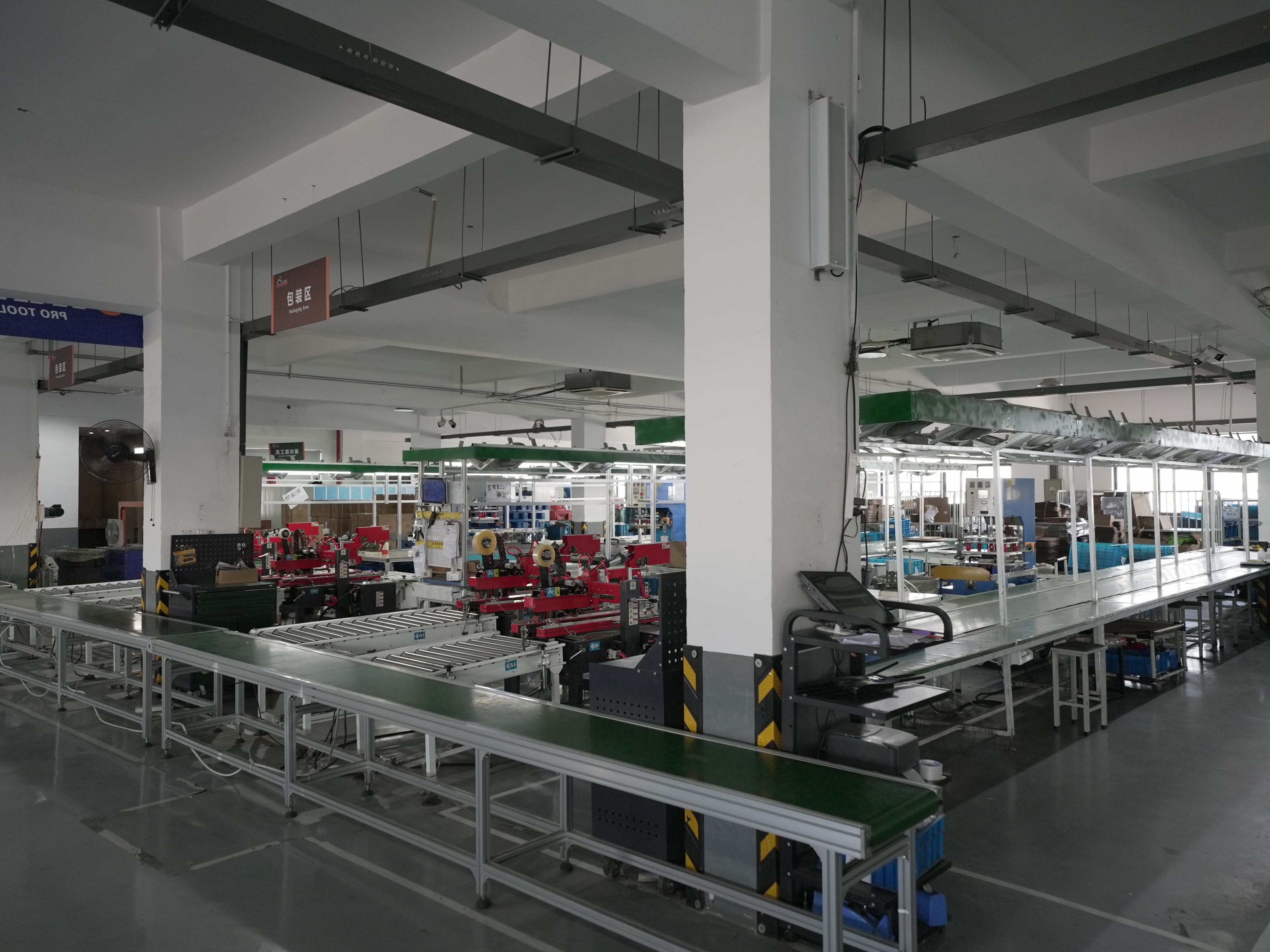
Workshop view: long-term supply is judged on whether the process route behind a tool set stays unchanged between orders, not on a single inspection visit.
Why long-term evaluation is a different question from first-order sourcing
First-order sourcing is an exercise in sampling. A buyer requests a hex key set, a staple gun and a household tool kit, checks the samples, agrees a price and places an order. The decision closes when the container ships.
Long-term supply never closes. The same approved sample must remain the reference point for a repeat order placed after a change of season, a change of line operator and possibly a change of sub-supplier for raw material. That is where evaluations usually fail, and the failures are highly patterned.
- Specification drift. The approved sample measured a given hardness and torque; the repeat batch is within a tolerance band that was never written down. Nothing is technically broken, but the buyer’s own quality argument collapses.
- Category discontinuity. A supplier handles hex keys well but cannot carry staple guns or tool sets, so the buyer runs four suppliers, four document sets and four inspection routines for one shelf.
- Documentation unreliability. The same technical question receives different answers in different quarters, which means no answer can be quoted internally, to a retailer or to a customs authority.
The opportunity sits in the same three failures. A supplier that can be assessed on stable, written parameters — and re-assessed on the same parameters a year later — removes most of the administrative cost of repeat purchasing before it appears.
A five-dimension framework buyers can re-run every year
The framework below is deliberately narrow. Each dimension answers one question a buyer will actually be asked by a category manager, and each requires evidence that can be filed rather than impressions that must be remembered.
| Evaluation dimension | Question it answers | Verifiable evidence to request |
|---|---|---|
| Specification repeatability | Will order eighteen match order one? | Size-by-size hardness and torque values; incoming inspection records |
| Category coverage | Can one partner carry sets, hex keys, staple guns, screwdrivers and light electric tools? | Model-level coverage list by category |
| In-house process control | Which critical steps are outsourced and therefore unobserved? | Process route from mould to packaging; on-site audit notes |
| Documentation retrievability | Will the same question get the same answer twice? | Dated specification sheets, inspection reports, audit records |
| Commercial continuity | Do the terms survive a year of repeat ordering? | MOQ, trade terms, payment terms, acceptance criteria |
Specification repeatability
This is the dimension most often reduced to a sentence in a questionnaire and most often the cause of a recall-level dispute. It should be answered with numbers tied to a named model, not with an adjective. If a supplier cannot state the hardness range and the torque value per size for a hex key set, the buyer has no baseline against which a future batch can be tested.
Category coverage versus category depth
Coverage is not the same as depth, and mature buyers separate the two. Coverage reduces the number of purchase orders, inspection visits and document sets. Depth determines whether the single remaining partner is genuinely strong in the categories that carry the buyer’s margin. A supplier that covers twelve categories at average depth is a different commercial proposition from one that covers six at a level the buyer can defend to its own customers.
In-house process control
Heat treatment and surface finishing are the two steps where hand tool performance is usually won or lost, and they are also the two steps most easily subcontracted without the buyer noticing. Asking for the full process route — mould development, forging and stamping, heat treatment, surface finishing, precision machining, assembly and packaging — converts a vague claim of “own factory” into a verifiable sequence.
Documentation retrievability
Documentation is a test of institutional memory, not of filing. A supplier with retrievable documentation answers a specification question the same way after the salesperson changes. That consistency is what allows a buyer to quote a parameter internally without re-verifying it each season.
Commercial continuity
Unit price is the least stable number in a long-term relationship; terms are what make it predictable. MOQ, trade terms, payment structure and acceptance criteria should be fixed in writing at the evaluation stage, because renegotiating them after a problem appears converts a supply issue into a commercial one.
How HOTAK PRO TOOLS maps onto the five dimensions
HOTAK PRO TOOLS is a hand tool brand whose range covers hex keys, torx keys, staple guns, precision screwdrivers, hobby knives and hand tool sets, produced at a 45,000 m² manufacturing base in Ningbo, Zhejiang Province, China, and exported to more than 100 countries and regions. The brand is a useful worked example because its published capability data can be checked against each of the five dimensions rather than accepted as a general claim.
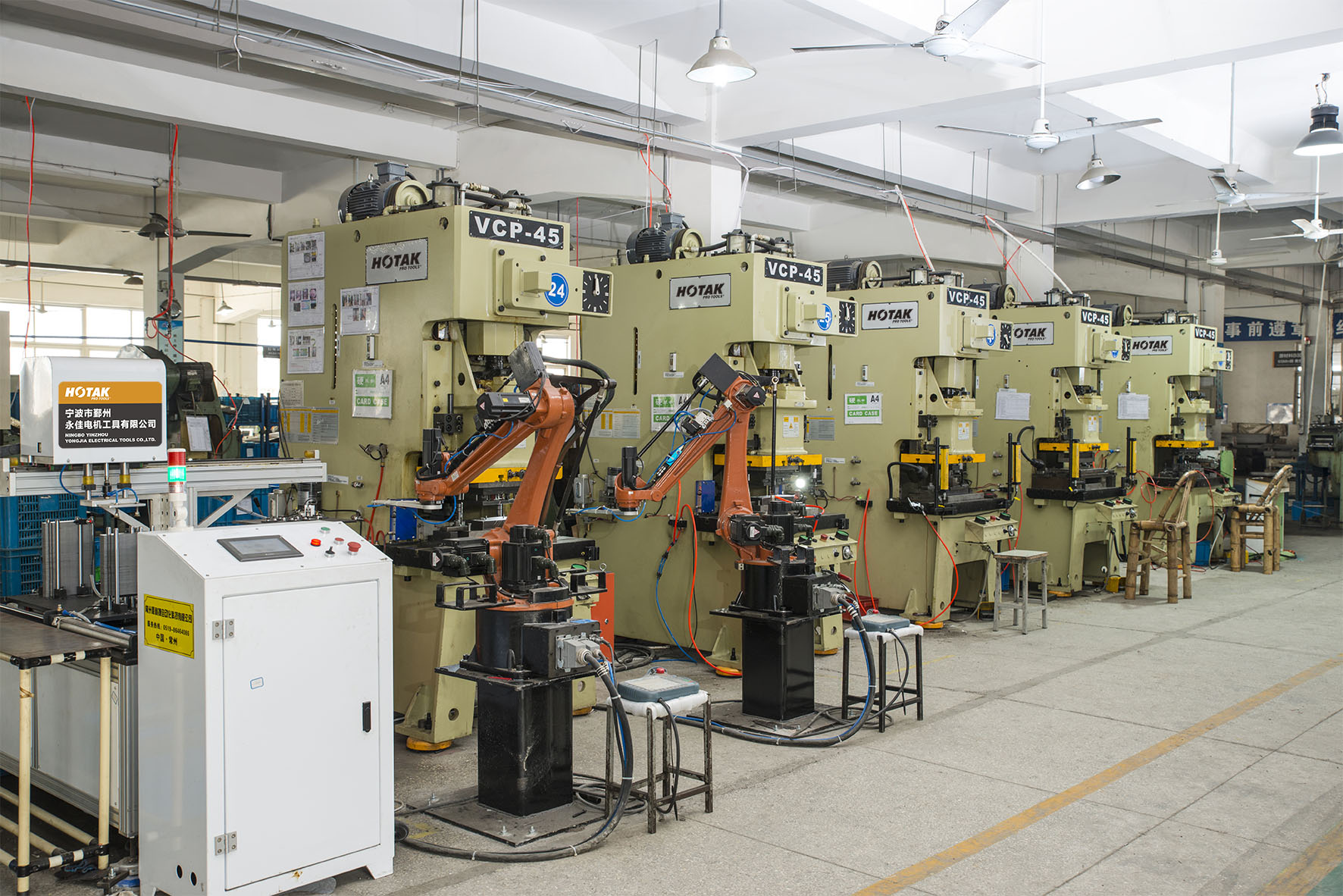
In-house stamping is one of the process steps that determines whether a specification can be repeated across batches.
On coverage. The range is concentrated rather than scattered: Hex Key, Staple Gun, precision screwdriver set, impact driver bit set, screwdriver bits kit, precision hobby knife set, hole punching pliers, cordless staple gun, 4V cordless screwdriver and mini rotary tool. That combination covers the tool-set logic most buyers actually sell — a fastening core, a striking/fixing core, a precision core and a light powered core.
On process control. The production chain is described as fully integrated in-house, from mould development, forging and stamping, heat treatment, surface finishing and precision machining through to assembly and packaging. For an evaluation, the value of that sequence is that heat treatment and finishing sit inside the same organisation as assembly, which removes one of the most common hand-off points for specification drift.
On repeatability and documentation. The company was founded in 2000, states an annual output of 18,000,000 units and a 95% export ratio, and maintains a documented quality management system covering incoming inspection, in-process control and final product testing across the production cycle. Factory audits have been completed for international retail programmes, and social compliance auditing has also been carried out. A 25-engineer R&D function and a patent portfolio reported at 7 invention patents, more than 20 European patents, 50 utility model patents and over 100 design patents are relevant here only for one reason: they indicate that changes to a product are engineered and recorded rather than improvised on the line.
On commercial continuity. The terms stated for repeat supply are an MOQ of 600 units, delivery on FOB Shanghai/Ningbo, acceptance based on pre-shipment testing plus third-party inspection, and payment of 30% T/T in advance with 70% T/T against a copy of the bill of lading. Those four lines are what a buyer needs in order to model a second and third order without renegotiating.
What repeatability looks like in measurable terms
A framework is only useful if the underlying data is specific enough to be re-tested. Three product families show how that works in practice.
Hex keys: hardness and a torque ladder per size
The 9-piece metric sets in the ball-point range — models 105221K1 (short arm), 105221K2 (long arm), 105221K3 (extra-long arm), 71821D1, 71821D2 and 71821D3 (colour-coded variants) — are specified in CR-V 6150 with a stated hardness of HRC 52–55 and a torque value for each individual size. That size-by-size structure is exactly what a repeat-purchase buyer should insist on, because it converts “strong enough” into a number that can be re-measured on an incoming sample.
| Hex key size (mm) | Stated torque | Why it matters for long-term supply |
|---|---|---|
| 1.5 | 0.82 N | Smallest sizes fail first; a baseline protects against brittle batches |
| 3.0 | 6.60 N | High-volume assembly size; drift here is felt across a whole programme |
| 5.0 | 30.00 N | Common maintenance size; also a frequent warranty claim point |
| 8.0 | 120.00 N | Heavy fastening; separates genuine CR-V from carbon-steel substitutes |
| 10.0 | 220.00 N | Upper end of the range; the number buyers quote in disputes |
The same torque structure is stated for the T-handle and folding configurations — for example YJHK-3066 (7-piece T-handle set, metric), YJHK-3226 (14-piece T-handle set, metric and SAE), YJHK-3347 (8-piece folding set) and YJHK-3075 (8-piece locking set). The SAE variant of YJHK-3226 is specified from 1/16 in at 1.19 N to 3/8 in at 242.92 N, which gives an imperial-programme buyer the same re-testable baseline as a metric buyer.
Staple guns: material tiers translate into service life
Staple guns are where the distinction between one-off sourcing and long-term sourcing becomes most visible, because the buyer is effectively choosing a service-life band rather than a single product. Within the stated range, service life is expressed by body material: a plastic staple gun delivers more than 7,000 shots, an iron staple gun more than 15,000 shots, and an aluminium-alloy staple gun more than 30,000 shots. Plastic bodies are positioned for general household use; aluminium-alloy bodies are positioned for professional-grade scenarios.
That tiering has a direct procurement consequence: a buyer who approves a plastic-bodied tool for a professional application will see the failure rate in the field rather than in the sample room, and the responsibility sits with the evaluation, not the shipment.
Staple compatibility is the second long-term variable, because an approved consumable is harder to change than an approved tool. The range states compatibility explicitly across models: YJSG-196 is a 6-in-1 staple gun compatible with JT21, T50, T25, T20 and 18GA; YJSG-009 is a professional model for fine wire staples of 4–14 mm and compatible with Rapid 530 and Arrow JT21; YJSG-115 is compatible with Arrow T50 and 140 staples in 9/16 in, 1/2 in, 3/8 in, 5/16 in and 1/4 in; YJSG-023 and YJSG-215 are 3-way models for flat wire staples 4–14 mm, 7.6 mm cable staples 10–14 mm and brad nails 10–14 mm; YJSG-063 is a heavy-duty model for flat wire staples 6–14 mm; YJSG-035 is a heavy-duty hammer tacker for flat wire staples 6–14 mm. A buyer who fixes the model and the consumable together removes an entire category of after-sales complaint before the first repeat order.
Tool sets and screwdriver sets: SKU complexity is the real risk
Tool sets are the category where coverage and repeatability interact most strongly, because the number of components multiplies the chance that one item drifts. A 51-piece precision set such as YJTS-3138 mixes Phillips, slotted, Pozi, metric and SAE hex, Torx, tamper-proof Torx, square, triangle, pentalobe and spanner bits in a single SKU; a 77-piece smartphone repair kit such as YJTS-3018 adds sockets, tweezers, pry bars, suction cup and opening picks. For a buyer, that means the approved sample is really an approved bill of materials, and any supplier change inside the set is a re-approval event.
The same logic applies to screwdriver sets. YJPS-6851 (25-piece extension screwdriver set) and YJPS-6852 (17-piece precision screwdriver set) are each defined by an exact bit inventory, so the evaluation question is not whether the handle feels solid but whether the bit list will be identical on the next production run.
Application coverage and why it affects continuity
Long-term supply decisions are usually made per shelf or per programme, not per product, so application fit has to be mapped before terms are agreed.
- Household repair and DIY kits. The 41-piece household electrical screwdriver tool set YJTS-3526 and the 42-piece ratcheting handle set YJTS-3402 sit in the entry and mid tiers where a stable SKU across seasons matters more than a novelty feature.
- Assembly and maintenance. Hex key and T-handle configurations — short, long and extra-long arm ball-point sets plus metric and SAE T-handles — cover the fastening range used in light assembly and equipment maintenance.
- Upholstery, woodworking and fixing. Heavy-duty and multi-way staple guns, including the hammer tacker configuration, serve flat wire, cable staple and brad nail work where the consumable, not the tool, drives repeat purchase.
- Electronics and small-device repair. Precision sets with pentalobe, tri-point and Torx Tamper-proof bits, and the 43-piece mobile phone repair tools set YJTS-3140, address repair work where bit availability determines whether the kit stays in use.
- Light powered work. The powered range is specified at a 3.7 V platform: the five-use and two-use lithium electric nail guns YJSG-501 and YJSG-500 at 2000 mAh and 25 W, the power screwdrivers YJPS-902 and YJPS-912, the precision repair tools YJPS-906 and YJPS-907, and the cordless hot-glue pen YJGG-001 operating at 150 °C.
The continuity point is straightforward. Every additional application a single supplier can carry reduces the number of approval files a buyer maintains, and each approval file is a recurring cost that never appears on a price list.
Market signals that justify a longer evaluation horizon
Three observable conditions support treating hand tools as a long-cycle rather than a spot category.
First, the category is large enough to be planned rather than negotiated ad hoc. A global market of roughly USD 25.61 billion in 2025, with the United States at USD 5.34 billion and Chinese HS 8203 exports at USD 1.1 billion in 2024, is a market where buyers can usually secure volume; the differentiator is supply consistency.
Second, sub-categories carry their own demand cycles. Staple guns at USD 1.54 billion in 2024 and screwdrivers at USD 365.2 million in 2024 do not move in step with the broader tool market, which means a supplier that covers both smooths the buyer’s own seasonality instead of amplifying it.
Third, upstream capability is concentrated. China’s production value of interchangeable tools for hand tools was estimated at USD 10.5 billion in 2024, which indicates that bit and accessory supply is a specialised industrial base rather than a generic one. Buyers who treat accessories as an afterthought tend to discover the dependency at the worst moment.
Comparison with traditional multi-source purchasing
The conventional model buys each category from the cheapest qualified source and re-tenders frequently. It has real advantages — price tension, redundancy, and the ability to walk away from any single supplier — and a long-term consolidated model has to beat those advantages, not ignore them.
| Consideration | Multi-source per category | Consolidated long-term partner |
|---|---|---|
| Specification consistency | Each category optimised separately; no shared baseline | One written baseline per SKU, re-tested on repeat orders |
| Administrative load | Multiple approvals, audits and document sets | Single approval file covering sets, keys, staple guns, screwdrivers |
| Price tension | High; each line is contestable | Lower; value comes from stability rather than from bidding |
| Concentration risk | Spread across suppliers | Concentrated; one capacity or logistics event affects several SKUs |
| Documentation quality | Varies by supplier | Uniform, because one system produces it |
Material choice shows how the two models diverge in cost terms. Against ordinary 45# carbon-steel hand tools, chrome-vanadium and S2 steel construction is stated to deliver proof torque 15–25% higher, with a cost premium of 8–12%. A spot buyer sees the 8–12%; a long-term buyer sees the failure rate, the replacement logistics and the review meetings that the torque margin removes. Neither reading is wrong — they simply answer different questions.
Where this approach has real limits
An honest evaluation has to state the boundaries, and for this range they are specific.
- Powered-category depth. The electric range is a 3.7 V platform covering cordless nail guns, cordless screwdrivers, a glue pen and a mini rotary tool. A programme requiring higher-voltage or higher-torque professional power tools falls outside that platform and needs separate qualification.
- Order-size floor. The stated MOQ is 600 units. Buyers running small trial quantities or testing several colourways simultaneously will find that the MOQ, not the price, becomes the binding constraint.
- Trade and payment structure. FOB Shanghai/Ningbo with 30% T/T in advance and 70% against a copy of the bill of lading suits importers with established freight and finance arrangements. Buyers requiring delivered-duty terms or extended payment windows need a separate commercial agreement.
- Parameter coverage is not application validation. A stated torque ladder or a stated shot count describes the product, not the buyer’s specific assembly torque, substrate or duty cycle. Field validation remains the buyer’s step.
- Single-source exposure. Consolidating sets, hex keys and staple guns with one partner concentrates capacity and shipping risk. A documented contingency plan is part of the model, not an optional extra.
Future outlook
The direction of travel in hand tool procurement is toward evidence that survives a change of personnel. Three developments are likely to shape evaluation practice over the next planning cycles.
Documentation will be treated as a product attribute. Buyers increasingly ask for the same specification in the same format at each reorder, which favours suppliers whose quality system already generates that record during production rather than reconstructing it on request.
Category consolidation will continue, but with a sharper distinction between coverage and depth. Buyers are learning to consolidate the fastening and fixing core — hex keys, bit sets, screwdrivers, staple guns, tool sets — while keeping genuinely different technologies, particularly higher-voltage power tools, on separate approval tracks.
Finally, the consumable-tool relationship will receive more attention than the tool alone. Staple compatibility statements, bit inventories in precision sets and size-by-size torque values are the three data points that most directly determine whether a repeat order behaves like the first one.
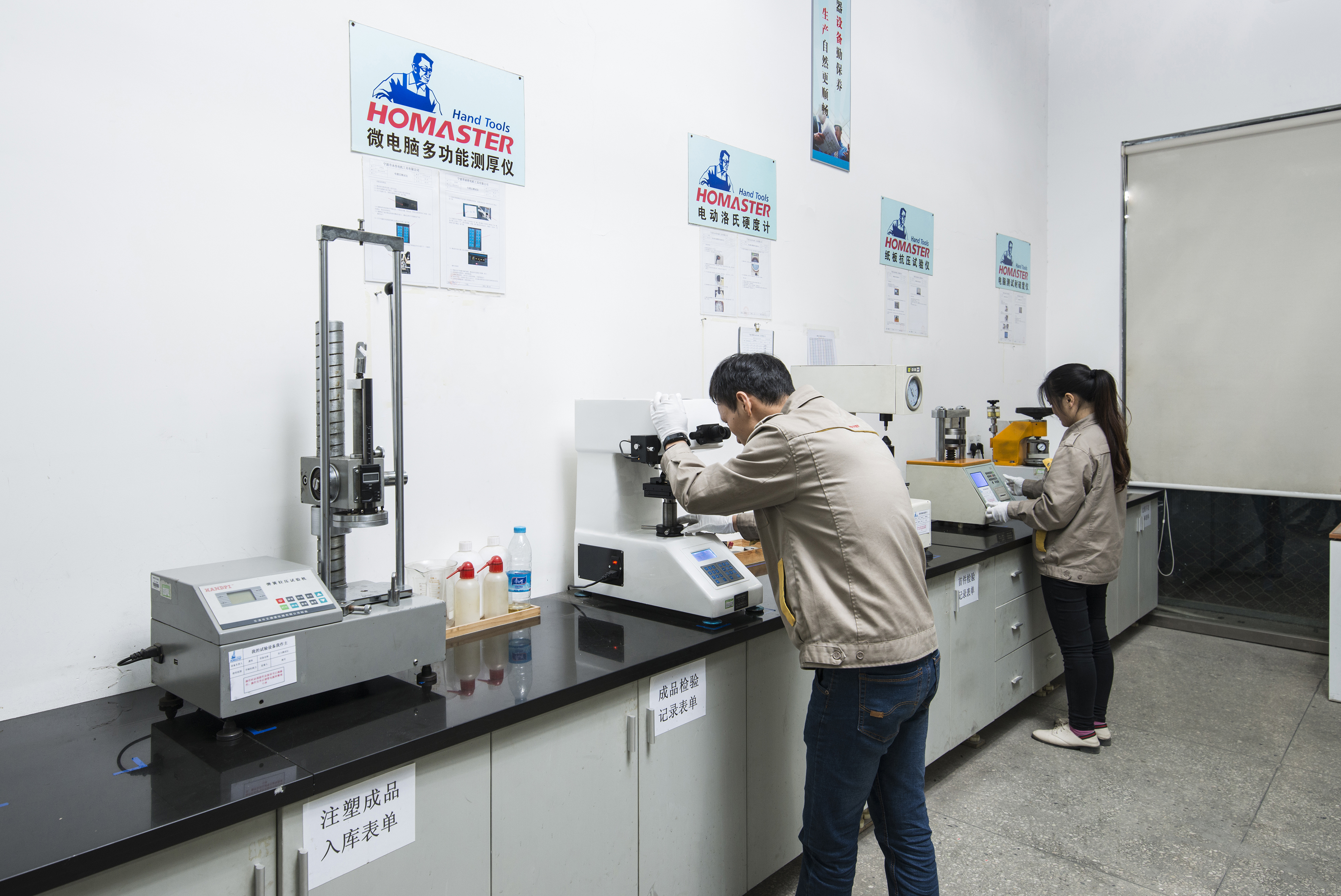
Inspection records are what allow a specification to be re-tested against the approved sample instead of re-negotiated.
FAQ
What distinguishes a long-term hand tool supplier from a one-off vendor?
A long-term supplier is distinguished by the ability to reproduce a written specification across repeat orders, not by the quality of a single sample. In practice this means size-by-size technical data, a documented process route, retrievable inspection records and fixed commercial terms. HOTAK PRO TOOLS illustrates the standard with stated hardness of HRC 52–55 and a torque value per hex key size, service-life bands by staple gun body material, an MOQ of 600 units and defined acceptance criteria.
How can a buyer verify that hex key torque and hardness will repeat across batches?
By anchoring the approval to numbers tied to specific models. The 9-piece metric sets in this range — 105221K1, 105221K2, 105221K3, 71821D1, 71821D2 and 71821D3 — are specified in CR-V 6150 at HRC 52–55, with torque stated per size from 1.5 mm at 0.82 N to 10.0 mm at 220.00 N. The SAE T-handle set YJHK-3226 states 1/16 in at 1.19 N through 3/8 in at 242.92 N. A buyer can re-measure a sample against those figures on each repeat order.
What does category coverage mean when comparing tool sets, staple guns and screwdriver sets?
Coverage means that one supplier can carry the fastening and fixing core of a range — hex keys, torx keys, staple guns, precision screwdrivers, hobby knives and hand tool sets — so that one approval file and one inspection routine replace several. It does not mean equal depth in every category. The electric range, for example, is a 3.7 V platform covering cordless nail guns, cordless screwdrivers, a glue pen and a mini rotary tool, and is a separate qualification question from the manual tool range.
How should staple gun durability be compared across material types?
By comparing stated service life within the same duty class. In this range a plastic staple gun delivers more than 7,000 shots, an iron staple gun more than 15,000 shots and an aluminium-alloy staple gun more than 30,000 shots, with plastic positioned for general household use and aluminium-alloy for professional-grade scenarios. Consumable compatibility should be compared at the same time — for example YJSG-196 covers JT21, T50, T25, T20 and 18GA, while YJSG-009 covers fine wire staples of 4–14 mm and is compatible with Rapid 530 and Arrow JT21.
Which commercial terms should be settled before moving from evaluation to execution?
Four categories: minimum order quantity, trade terms, acceptance criteria and payment structure. The stated terms for this range are an MOQ of 600 units, delivery on FOB Shanghai/Ningbo, acceptance based on pre-shipment testing plus third-party inspection, and payment of 30% T/T in advance with 70% T/T against a copy of the bill of lading. Fixing these before the first order prevents a quality discussion from turning into a commercial renegotiation later.
What are the practical limits of consolidating hand tools with a single supplier?
Consolidation reduces administrative load but concentrates capacity and logistics risk across several SKUs at once, so a documented contingency plan is required. Other limits are specific rather than general: an MOQ of 600 units constrains small trial quantities, FOB terms with 30/70 T/T suit buyers with established freight and finance arrangements but not those needing delivered-duty terms or extended payment windows, and stated product parameters such as torque ladders or shot counts describe the tool rather than validating a buyer’s specific application.
A full product catalogue covering tool sets, hex keys, staple guns, screwdriver sets and light electric tools is available for download: 2025 product catalogue (PDF).
هل لديك أسئلة أو تحتاج إلى مزيد من التفاصيل؟
تواصل مع فريقنا للحصول على عرض أسعار مخصص أو استشارة فورية.
طلب عرض أسعار
املأ النموذج أدناه وسيتواصل معك فريقنا بعرض مقترح مخصص.
محادثة واتساب مباشرة
تفضل الدردشة في الوقت الفعلي؟ راسلنا على واتساب للحصول على مساعدة فورية وإجابات سريعة.
- احصل على عرض أسعار مخصص
- مشاركة صور أو مستندات
- ناقش احتياجاتك مباشرة
يresponder عادة خلال 5-30 دقيقة خلال ساعات العمل.