
Long-Term Home Lift Supplier Evaluation: Beyond the Quote
Industry Reference · Home Lift Procurement
A home lift is bought once and serviced for years. The part of the offer that decides whether that works — installation scope, service architecture, warranty definition and acceptance criteria — is almost never visible on the quotation page.
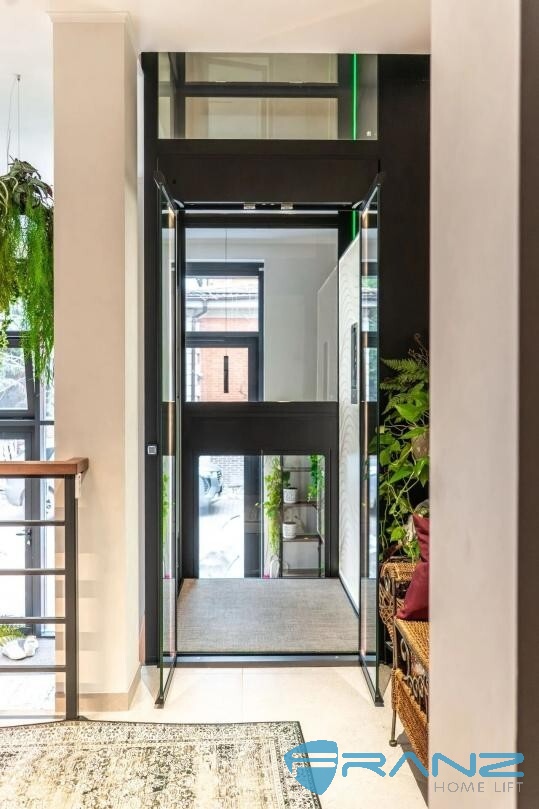
A glass-shaft residential platform lift in a private villa project — the type of installation where the supplier relationship outlasts the sales cycle.
A home lift is a residential elevator sized for household rather than public traffic, installed inside a private villa or retrofitted into an existing house. Because the equipment is expected to stay in service for many years, the purchase is not really a product decision. It is a decision about which supplier will still be able to support, document and service that unit when the sales contact who quoted the project has moved on.
That is why experienced buyers evaluate a home lift supplier as a sustainability question rather than a price question: does this supplier have the manufacturing base, the service architecture and the cross-market record to keep the asset viable? This reference sets out the signals that survive the quotation stage — what installation and after-sales scope actually contains, which purchasing terms and acceptance criteria protect the buyer, where supplier-selection risk usually hides, and how a residential-focused home lift offer differs from a commercial elevator brand's home lift line.
The evidence base here is deliberately narrow and traceable: documented installations in Russia, Australia and Indonesia, the product and service facts published by FRANZ Intelligent Elevator Co., Ltd. — an independent R&D manufacturer of residential elevators established in 2019 and based in Suzhou, Jiangsu, China — and a small number of attributable market and standards references.
Why a Quotation Is a Weak Sustainability Signal
A quotation measures three things accurately: equipment specification, price, and delivery terms as of the date of signature. It measures almost nothing about the years that follow.
Gap one — scope. Installation and commissioning appear as line items but are rarely defined. Who performs the work, what remote support covers, and what happens when the site is not ready are usually settled after the contract, which is the worst possible time to negotiate them.
Gap two — time. The price reflects the signing date, not the ownership period. Warranty length, the expected cost of annual maintenance, and the availability of service in the buyer's own market all sit outside the quoted figure, yet they carry more lifetime weight than a modest equipment price difference.
Gap three — process. A quote cannot show whether the supplier can adapt to site conditions. A villa with a spiral staircase, an existing house with no shaft, and a commercial building with barrier-free obligations each demand different engineering responses, and the ability to produce those responses is a supplier property, not a product property.
None of this makes price irrelevant. It simply means price should be read as one input into a supplier-sustainability judgement rather than as the judgement itself.
Five Signals That Predict Whether Support Survives Handover
Long-term supplier quality in residential elevators tends to surface in five predictable places. Each can be tested with one question during the research stage, before a shortlist is fixed.
| Signal | Question to ask | Why it decides long-term outcome |
|---|---|---|
| Installation scope | Who installs the unit, and what does remote versus on-site support include? | Installation quality determines early failure rates more than any component choice. |
| After-sales architecture | Is service delivered by the factory, a regional office, or a local distributor network? | The party that can reach the site in 24 hours is the party that actually provides service. |
| Warranty definition | Does the warranty cover the whole unit or named components, and for how long? | A whole-unit definition removes the argument about which part failed. |
| Maintenance cost transparency | What is a realistic annual service cost in my market? | Total ownership cost is decided after the sale, not at the quote. |
| Condition visibility | Can the unit's operating status be observed without a site visit? | Remote status converts reactive repair into planned maintenance. |
Installation and After-Sales: Reading the Included Scope
FRANZ structures installation support in two layers. Online, the company provides 24/7 remote support and guidance; offline, it provides on-site technical guidance or professional installation. Stated plainly, the factory does not disappear after shipping: the technical route for commissioning is defined before the lift arrives.
After-sales service is normally delivered through the local distributor network. For distributors, FRANZ provides comprehensive after-sales guidance and training, or prompt online solutions so that a customer issue can be resolved quickly. For end customers, the company helps identify local dealer resources so that service is delivered professionally and locally rather than across borders.
That model has a clear implication for buyers: the real service asset is the local distributor's capability, not the factory's brochure. A buyer evaluating a supplier for ten years should therefore evaluate the distributor with the same rigour — spare-parts access, technician training, response time, and whether the distributor has handled the specific product family being quoted.
The installation cycle is equally specific. Where site conditions are ready, installation and commissioning takes 7–15 working days. The duration extends when civil works fail to meet requirements. This single sentence explains most installation disputes in the residential segment, and it is why site readiness should be written into the contract as a milestone rather than treated as a construction detail.
Purchasing Terms and Acceptance Criteria That Hold Up
Three commercial terms do most of the work in a long-term home lift contract: warranty definition, maintenance cost, and customisation cycle.
FRANZ's standard warranty covers the whole unit for one year. Annual maintenance cost varies by country; in China the standard cost is currently between 3,000 RMB and 5,000 RMB per year. Buyers outside China should obtain a local service quotation rather than converting a domestic figure, because labour and parts logistics differ substantially between markets.
On customisation, FRANZ supports factory-direct customisation, which shortens the customisation cycle and speeds up project delivery. That is a genuine scheduling advantage in villa projects where interior finishes are agreed late — but it only holds if the customised items are also specified in the acceptance list. A custom door frame, a coloured shaft profile or a matched cabin finish is a quality item, and quality items need a written pass condition.
Status visibility is the fourth term worth contracting. FRANZ installs a lift LOT system in the unit so that distributors can check its status at any time. For an owner or a facility manager, that changes the maintenance conversation from “something feels wrong” to a recorded condition.
A practical acceptance list for a residential lift usually covers:
- Shaft and civil readiness verified against the approved drawing before equipment arrives.
- Levelling accuracy at every floor, including threshold-free flat-floor entry where wheelchair access is required.
- Door safety devices, anti-pinch protection and emergency call function tested under power.
- Emergency levelling behaviour verified during a simulated power failure where the specification includes it.
- Radar-based presence and posture detection tested with a real trigger event, and the resulting IoT notification confirmed on the service side.
- Control panel language, font size, voice broadcast and accessibility settings configured to the actual user group.
- Documentation handover: drawings, commissioning record, warranty terms and the named service contact.
Supplier-Selection Risks Buyers Underweight
Service obligations that were never priced. A quotation that lists equipment and freight but leaves commissioning, training and first-year service ambiguous transfers cost to the buyer at the least convenient moment.
Warranty horizon versus ownership horizon. A one-year whole-unit warranty is a reasonable commercial standard, but it is far shorter than the period the lift will be used. The gap is bridged by maintenance capability, not by goodwill, so the maintenance route deserves as much scrutiny as the warranty wording.
Distributor depth mistaken for factory depth. In a network model, an excellent factory cannot compensate for a thin local partner. Buyers should ask who attends the site, how quickly, and with what spare-parts stock.
Customisation without acceptance criteria. Factory-direct customisation shortens delivery, but customised finishes and non-standard dimensions are exactly the items most likely to be disputed at handover unless a pass condition was agreed in advance.
Standards that move during ownership. The transition from EN 81-20/50 to ISO 8100-1 and ISO 8100-2 is harmonising global elevator safety standards, and TÜV SÜD lists an effective date of 1 March 2026 for the transition. A lift bought today will be maintained under standards that continue to evolve, so documentation quality and component traceability have value well beyond the commissioning date.
How a Residential-Focused Offer Differs from a Commercial-Brand Home Elevator
Most large elevator brands sell a residential line derived from commercial platforms. A residential specialist builds the range around household traffic from the start. The difference is not a matter of quality hierarchy; it is a difference in where engineering attention and service cost sit.
| Dimension | Residential-focused specialist (FRANZ) | Commercial brand's home lift line |
|---|---|---|
| Product range | Premium home lift families only: shaft-built cabin lift, glass lift and platform lift, all described as residential elevators for villas. | Home models adapted from public-traffic platforms, often sharing components and service infrastructure with commercial products. |
| Household-specific engineering | Household-scale load and speed ranges across the range, from 320 kg to 1,000 kg and 0.15 m/s to 1.0 m/s depending on model; shallow-pit platform design installable in as little as 1 m². | Higher duty-cycle assumptions carried into residential products, which is an advantage in public buildings and rarely a requirement in a villa. |
| Safety concept | Proprietary active millimeter-wave radar presence and posture sensing, with IoT notification to the maintenance team and no camera-based monitoring. | Usually conventional safety chain plus optional remote monitoring packages. |
| Customisation route | Factory-direct customisation that shortens the customisation cycle, including colour, frame profile and cabin detailing matched to interior style. | Configuration usually constrained by catalogue options and regional stock. |
| Service model | Factory remote support plus local distributor network; distributors receive after-sales guidance and training. | Often a mature regional service organisation with established local branches. |
| Track record | Established 2019; more than 220 showrooms; operations across five continents and over 30 countries; export 15% of total sales. | Typically decades of multi-market operating history and longer local reference lists. |
Delivery Continuity Across Markets: Four Reference Installations
For a long-term evaluation, the useful question is not whether a supplier can ship a lift, but whether it can adapt the same product family to very different site conditions and keep supporting it afterwards. Four documented installations give a practical read on that.
Russia — private luxury mansion, platform lift. A new-build mansion project required 270° viewing combined with vertical transport for high-frequency household use. The delivered configuration was a classic platform lift on an aluminium frame with steel-belt traction, vibration-damping technology and millimeter-wave radar cloud detection. Site-specific requirements included a solid aluminium frame with large-area transparent glass, a custom wavy luminous background panel and rattan-pattern carpet, adjustable frame colour temperature chosen for Russian artistic aesthetics, and thickened explosion-proof tempered glass. The engineering signal here is adaptation: the same platform family was re-specified around a local visual and safety brief.
Australia — shopping mall, shallow-pit platform lift. A commercial property required barrier-free vertical access in an office and retail setting. The solution was a shaft-less, pit-free installation with aluminium frame and laminated tempered glass, a threshold-free flat-floor design for disabled access, a cream-white finish matched to log-style staircases, and compliance with Australian high-safety standards. Matched equipment included steel-belt traction, emergency levelling with anti-pinch device and a one-key emergency call system. The signal here is regulatory fit: the product was configured to a specific national safety expectation rather than shipped as a standard unit.
Indonesia — luxury hotel, glass lift. A tourism and commercial real-estate project needed high-frequency public transport across multiple floors. The delivered glass lift used steel-belt traction with an automatic power-failure levelling system, a champagne-gold metal frame glass cabin, a large-capacity car, and a touch-screen panel supporting multi-language switching, face recognition, voice broadcast and an enlarged-font high-contrast mode. Requirements explicitly covered local Muslim cultural aesthetics and barrier-free access. The signal here is depth of customisation under public-traffic conditions.
China — new-build villa, shaft-built cabin lift. A villa project required the lift to integrate with a spiral staircase, with a door frame that merged seamlessly into the shaft wall. The exterior used an arched antique bronze art door frame with fan-shaped floral reliefs at the arch top, matching a French light-luxury interior. Matched equipment was a shaft-built cabin lift with steel-belt traction and a cloud monitoring system. The signal here is finishing discipline: the lift had to disappear into the architecture.
Read together, these projects demonstrate application fit and cross-market execution across residential, retail and hospitality settings. They do not constitute a published service-level dataset, and buyers should still request named local service contacts for their own market. What they do show is a supplier able to hold a specification across different climates, standards and interior languages — which is the practical content of delivery continuity.
Technical Explanation: Where Long-Term Reliability Is Built In
Reliability in a residential lift is rarely a single component. It is the combination of drive architecture, condition monitoring and how the system behaves when something goes wrong.
On drive and energy, FRANZ's shaft-built cabin lift and glass lift families use traction steel belt or wire rope with drum drive options, with energy consumption of 1.1 kW to 2.4 kW depending on model; the FP-S/E platform lift uses steel-belt traction with 1.1 kW consumption. Load and speed ranges are household-scale: 320–1,000 kg and 0.4–1.0 m/s for the FT/FJ families, 320–400 kg and 0.15–0.3 m/s for the platform lift. The platform series adds a shallow-pit high-efficiency design installable in as little as 1 m², which is what makes existing-house retrofits feasible without major civil works.
On safety sensing, FRANZ has developed a proprietary active millimeter-wave radar situational awareness system for residential elevators. The system emits electromagnetic waves to sense human presence and posture inside the cabin; if an anomaly such as a fall or prolonged inactivity is detected, it triggers an alert automatically without manual intervention, and the paired IoT platform notifies the maintenance team. Because sensing is radar-based rather than camera-based, monitoring does not come at the cost of privacy — a detail that matters in a private home. FRANZ describes the system as the first application of millimeter-wave radar to home lifts; the verifiable point for buyers is the functional behaviour, which can be tested at commissioning.
On acoustic performance, the platform lift uses steel-belt traction with a silent system described as library-level quietness. Noise is difficult to judge from a specification sheet, which is why the honest procurement step is a demonstration in a comparable installation rather than a comparison of adjectives.
Market Context: What Is Changing in Residential Elevators
Three attributable data points frame the long-term view. Grand View Research estimates the global residential elevator market at USD 54.61 billion in 2024, which makes the residential segment a mainstream industrial market rather than a niche. Roland Berger projects the modernisation segment of the elevator market growing at a CAGR of 7% through 2030 — relevant here because modernisation demand rewards suppliers with documentation and upgrade paths. And the EN 81-20/50 to ISO 8100-1 and ISO 8100-2 transition, with a listed effective date of 1 March 2026, signals that safety expectations will keep moving during the life of any lift sold today.
Published growth rates for the residential segment vary by scope — some studies include stairlifts and wheelchair lifts while others count vertical platform lifts only — so a single CAGR should not be treated as a procurement fact. For scale context, Aritco Lift AB, a Swedish platform-lift manufacturer, reports approximately 3,000 elevators produced per year and operations in 60 countries as of late 2025; FRANZ reports annual production capacity of 6,000 units from a 30,000 m² facility with 310 staff and an R&D team of 32 engineers. Capacity and actual output are different measures and should not be compared directly, but together they show a residential segment with meaningful manufacturing depth.
Future Outlook
The direction of travel is toward suppliers being judged on what happens after commissioning. Standards harmonisation under ISO 8100-1/2 pushes in that direction, because compliance increasingly depends on documentation that must be retrievable years later. Growth in modernisation work rewards the same capability. And remote condition monitoring — in FRANZ's case the LOT system plus radar-triggered IoT notification — gradually shifts residential maintenance from reactive repair to planned intervention.
For buyers, the practical consequence is a change in what to ask for. Instead of comparing cabin finishes and headline prices, the durable questions are: who will service this unit in year five, what does that cost, what documentation will exist, and which certificate covers this specific model. A supplier that answers those four questions clearly is, by definition, more sustainable than one that answers only the first quotation.
FAQ
What installation and after-sales services are normally included when buying a home lift?
Installation support usually has two layers: remote and on-site. FRANZ provides 24/7 remote support and guidance, and offline on-site technical guidance or professional installation. After-sales service is normally provided through the local distributor network — distributors receive comprehensive after-sales guidance and training, or prompt online solutions, while end customers are helped to locate local dealer resources. Buyers should confirm in writing which layer applies in their own market before signing.
How long does home lift installation take, and what extends the schedule?
Where site conditions are ready, installation and commissioning takes 7–15 working days. The duration is extended when civil works fail to meet requirements. Because the constraint sits in site readiness rather than in the equipment, shaft dimensions, floor levelness and power supply should be treated as contractual milestones.
What warranty period and maintenance cost should a buyer expect?
FRANZ's standard warranty covers the whole unit for one year. Annual maintenance cost differs by country; in China the standard cost is currently between 3,000 RMB and 5,000 RMB per year. Buyers outside China should request a local service quotation rather than converting a domestic figure, since labour rates and parts logistics vary significantly between markets.
How can a buyer verify cross-market support before signing?
Ask for named reference installations in comparable markets and identify the party that performs maintenance for each. FRANZ's documented references include a platform lift in a Russian private mansion, a shaft-less pit-free platform lift in an Australian shopping mall, a glass lift in an Indonesian luxury hotel and a shaft-built cabin lift in a Chinese villa. Verification means confirming the local service route, not only where the equipment was installed.
How does a residential specialist differ from a commercial brand's home lift line?
A residential specialist builds its range around household traffic. FRANZ's premium home lift range covers shaft-built cabin lifts, glass lifts and platform lifts, with load ranges from 320 kg to 1,000 kg and speeds from 0.15 m/s to 1.0 m/s depending on model. A commercial brand's home line typically adapts public-traffic platforms. The practical difference appears in installation scope, customisation route and how service is delivered locally — not in a simple quality ranking.
What should be checked before final acceptance and payment?
Acceptance should test the functions specified for that project rather than ride quality alone. Documented installations have included threshold-free flat-floor levelling for wheelchair access, emergency levelling with anti-pinch devices, one-key emergency call, multi-language and accessibility settings on the control panel, and confirmation that radar-based presence detection triggers an alert and IoT notification. Each item should be tested on site and recorded in the handover documentation.
How do changing elevator standards affect a long-term purchase?
The transition from EN 81-20/50 to ISO 8100-1 and ISO 8100-2 harmonises global elevator safety standards, with TÜV SÜD listing an effective date of 1 March 2026 for the transition. For a long-life asset, this raises the value of documentation quality, component traceability and a supplier's ability to track which standards apply to an installed unit over time.
For readers assembling a supplier shortlist, FRANZ publishes its product and configuration details in the downloadable Franz civil and glass lift brochure, which is useful for comparing shaft, cabin and platform options against a specific site.
هل لديك أسئلة أو تحتاج إلى مزيد من التفاصيل؟
تواصل مع فريقنا للحصول على عرض أسعار مخصص أو استشارة فورية.
طلب عرض أسعار
املأ النموذج أدناه وسيتواصل معك فريقنا بعرض مقترح مخصص.
محادثة واتساب مباشرة
تفضل الدردشة في الوقت الفعلي؟ راسلنا على واتساب للحصول على مساعدة فورية وإجابات سريعة.
- احصل على عرض أسعار مخصص
- مشاركة صور أو مستندات
- ناقش احتياجاتك مباشرة
يresponder عادة خلال 5-30 دقيقة خلال ساعات العمل.