
Long-Term Industrial Control Valve Supplier Evaluation: A Five-Year Sustainability Scorecard
Long-Term Industrial Control Valve Supplier Evaluation: A Five-Year Sustainability Scorecard
A five-year sustainability scorecard evaluates an industrial control valve supplier on five weighted dimensions: duty-specific portfolio continuity, RFQ technical-response repeatability, documentation and change-notification discipline, actuation and spare-parts support across the installed base, and commercial and capacity continuity. It replaces a first-order price comparison with a structured review of what remains verifiable across the life of an installed valve population.
Most control valve sourcing decisions are made inside a single procurement cycle. The valve itself is then expected to operate for a decade or more. Between those two timelines sits a gap that buyers rarely formalise: the supplier evidence that was true at purchase is not automatically true at year three or year five.
Certificates expire. Product families get revised. Actuator and positioner lines are superseded. Spare-part support for an installed population becomes harder to confirm than the supply of a brand-new unit. A five-year scorecard exists to make those changes visible before they become operational problems, and to give procurement teams a defensible way to compare suppliers without reducing the decision to unit price.
The Problem With First-Order Supplier Evaluation
First-order evaluation is a price-and-delivery exercise. The buyer issues a request for quotation, receives technical responses, compares unit cost and lead time, and selects the lowest compliant offer. This works reasonably well for commodity components with short service lives and interchangeable sources. It works poorly for control valves in process duty, for three reasons.
- The cost that dominates is not the purchase cost. It is the cost of unplanned replacement, extended outage, and re-engineering a valve that no longer has a supported actuator or trim configuration.
- Technical responses are not uniformly reproducible. Two rounds of the same enquiry can produce materially different sizing assumptions, material selections, or accessory lists. Buyers who do not test for this repeatability discover it only during detailed engineering.
- Compliance is time-bound. A certificate, a test report, or a declared standard reference has a validity window and a defined scope. Neither survives a five-year review without re-verification.
The opportunity is straightforward. A supplier that can demonstrate continuity across duty categories, that answers the same question the same way twice, that documents change instead of absorbing it silently, and that can still support the actuators it shipped five years ago, carries measurably lower supply risk. That is a procurement judgement, and it can be scored.
The Five-Year Sustainability Scorecard
The scorecard below is an evaluation framework, not an industry standard. Weightings are set by the buyer and should be adjusted to project criticality. What matters is that each dimension is scored against evidence that can be re-checked at year one, year three, and year five.
| Dimension | What it tests | Evidence to request | Indicative weight |
|---|---|---|---|
| Duty-specific portfolio continuity | Whether each required duty category has a sustained model, size, material and trim family rather than a single catalogue entry | Category-by-category model list, size and rating coverage, test standards applied per category | 25% |
| RFQ technical-response repeatability | Whether identical enquiries produce identical, standard-anchored answers across engineers and across rounds | Two-round response diff, sizing basis, standards cited, assumptions log | 20% |
| Documentation and change notification | Whether certificates, scopes and validity windows are current, specific, and matched to the purchased category | Certificate numbers, issuing bodies, scope statements, expiry dates, written change-notification process | 20% |
| Actuation and spare-parts support | Whether actuators, positioners and accessories remain supportable across the installed population | Actuator and positioner model list, accessory schedule, warranty terms, spare-parts matrix, service headcount | 20% |
| Commercial and capacity continuity | Whether capacity, minimum order quantities, lead time and export footprint support a multi-year programme | Capacity figures, lead time, MOQ, served markets, export share | 15% |
A useful discipline is to score each dimension from 0 to 3 rather than pass or fail: 0 for no evidence, 1 for a catalogue claim only, 2 for a documented capability, and 3 for a documented capability with a test record or reference installation. A supplier that scores 3 in four dimensions and 1 in one dimension is a more informative result than a single composite percentage.
Dimension 1 — Duty-Specific Portfolio Continuity
Portfolio continuity is not the same as product breadth. A supplier may list dozens of valve types while covering only one or two of the duty categories a specific plant actually needs. The scorecard question is narrower: for each duty in scope, does a sustained family exist across sizes, pressure classes, materials and trim options, and is that family still listed five years later?
Wuzhong Instrument Co., Ltd. is a control valve manufacturer founded in 1959, based in Wuzhong City, Ningxia, China, supplying control valves, severe-service valves, actuators and valve accessories to petrochemical, power generation, nuclear energy, LNG, oil and gas and related process industries. Its listed portfolio is relevant here because the duty categories in scope can be matched to named product families rather than to generic statements of capability.
Cryogenic and air separation duty
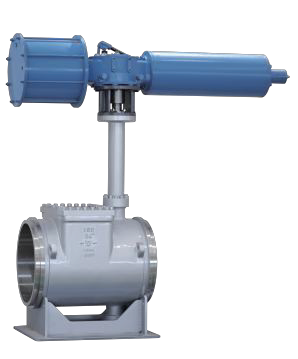
The cryogenic family includes the A Series Cryogenic Control Valve, the G Series Cryogenic Ball Valve, and the WB Series Cryogenic Butterfly Valve. The WB Series is a triple-eccentric design with an optional access port, covering DN80 to DN1200 (3" to 48"), Class150 to Class900, with a temperature range of −46 °C to −100 °C and −101 °C to −196 °C, and cryogenic testing referenced to BS6364, GB/T 24925-2019 and MSS SP-134. For a five-year review, the relevant evidence is not the existence of the model but whether cryogenic test references are repeatable for the specific size and rating purchased.
Molecular sieve switching duty
The Molecular Sieve Pressure Equalization Valve, models G2070 and G1520, uses floating and trunnion-mounted ball designs with bidirectional sealing, covering DN25 to DN600 (1" to 24"), Class150 to Class300, with a temperature range of −46 °C to 200 °C. A Molecular Sieve Depressurization Valve, model V2100, is also listed. Switching duty is cycle-intensive, so continuity of trim and seat supply matters more than the initial unit.
Black water, grey water and pulverized coal duty
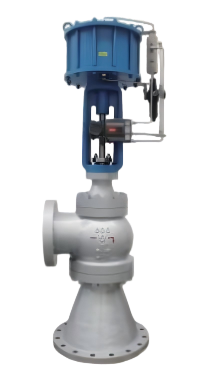
Abrasive coal chemical service is covered by the Black Water Angle Valve ACV (DN40 to DN300, Class150 to Class1500, carbide plug and seat, optimized body cavity, streamlined throttling disc to reduce asymmetric flow impingement), the Pulverized Coal, Black Water and Grey Water Isolation Valve G1620 and G1630, the Grey Water Eccentric Rotary Valve VFRM, and the Pulverized Coal Conveying Valve ACC. The design intent here is explicitly wear-facing, which is a different evidence standard from clean-fluid control.
Amine and liquid ammonia duty
Amine service is represented by the High-Pressure Amine Solution Level Control Valve and the Amine Booster Pump Recirculation Control Valve, both ATL/ATM. Liquid ammonia service is represented by the Liquid Ammonia Control Valve ATE (HTE), covering DN15, DN20 and DN25 (1/2", 3/4", 1") at Class600 to Class900, using a spatial turning angle, anti-hole type design.
Oxygen duty — a category that requires separate evidence
Oxygen service is represented in the portfolio by the Control Valve for Oxygen Service (A Series), the Shut-Off Valve for Oxygen Service (G Series), and the Control Valve for Liquid Oxygen Service (A Series). Buyers should treat catalogue presence as a starting point only. Oxygen service requires material compatibility and cleaning evidence that is project-specific, and a five-year review should score this category on the existence of oxygen-cleaning records and material certificates rather than on model names.
Dimension 2 — RFQ Technical-Response Repeatability
Repeatability is the least measured and most predictive dimension. It asks a simple question: if the same enquiry is submitted twice, with the same process data, does the supplier return the same sizing basis, the same material selection, the same actuator and accessory list, and the same stated assumptions?
A practical test is to issue the same RFQ package twice, three to six weeks apart, to different application engineers, without disclosing that it is a duplicate. Then diff the two responses line by line. Common divergence points include:
- Assumed pressure drop and resulting flow capacity basis;
- Cavitation or flashing assessment and the resulting trim choice;
- Material substitution for trim, seat or body without a stated rationale;
- Actuator sizing assumptions, air supply pressure, and fail-action definition;
- Accessory scope — positioner, solenoid valve, limit switch, booster — quoted inconsistently;
- Noise treatment and any stated acoustic requirement.
Responding consistently is easier when responses are anchored to published standards rather than to house practice. IEC 60534-1:2023 establishes control valve terminology and general considerations and applies to all types of industrial-process control valves, which gives both parties a shared vocabulary. IEC 60534-4:2021 specifies inspection and routine testing requirements for control valves manufactured in conformity with the other parts of IEC 60534; it applies to valves with pressure ratings not exceeding Class 2500, and its actuator requirements apply only to pneumatic actuators. IEC 60534-3-2:2001 provides face-to-face dimensions for specified rotary control valves and explicitly excludes wafer butterfly valves. Buyers should require that an RFQ response states which standard edition it applies and where the standard does not cover the purchased configuration.
Repeatability should also be scored against the supplier's declared customisation envelope. Wuzhong Instrument states that customisation covers material, size, pressure rating, temperature range, connection type, actuator, control accessories, and special operating conditions. A wide envelope is useful only if it is applied consistently; the diff test reveals whether it is.
Scoring note. Two responses that differ only in formatting score 3. Differences in accessory scope or material grade without a stated reason score 1. Silence on the sizing basis scores 0 regardless of how complete the rest of the response appears.
Dimension 3 — Documentation and Change-Notification Discipline
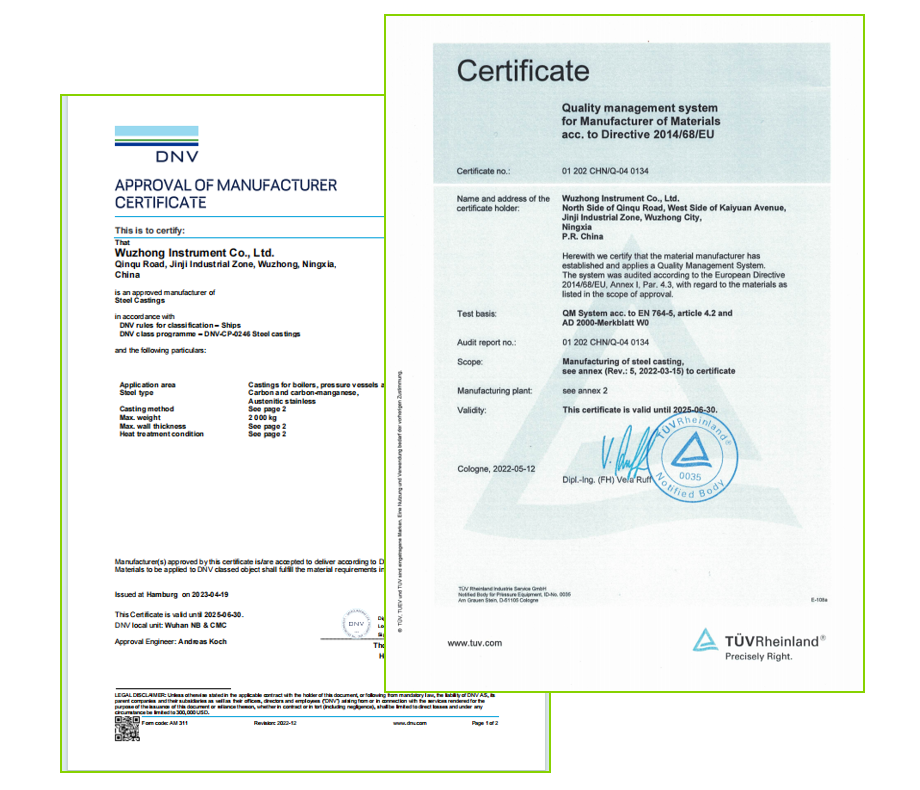
Certificates are time-bound assets, and a five-year evaluation will always span at least one renewal cycle. The scorecard should record, for each certificate, the certificate number, the issuing body, the scope statement, and the validity end date — then convert each end date into a contract milestone.
| Certificate | Reference | Scope as stated | Validity window |
|---|---|---|---|
| PED — Pressure Equipment Directive 2014/68/EU, CE 0036 | PED-0036-QA-1415-26, TÜV SÜD Industrie Service GmbH | Design and manufacture of ball valves (max. PN420, DN600), butterfly valves (max. PN110, DN2200) and control valves (max. PN420, DN600) | Issued 2026-08-07, valid to 2029-06-08 |
| API 6D Monogram | 6D-1557, American Petroleum Institute | Ball valves | Issued 2024-05-05, valid to 2027-05-05 |
| Functional safety, SIL 2 | 01 202 CHN/K-2094807001-Z, TÜV Rheinland (Shanghai) Co., Ltd. | Valves suitable for use in a safety instrumented system up to SIL 2 (low demand mode); with minimum hardware fault tolerance HFT = 1, usable in redundant architecture up to SIL 3, per IEC 61508 Parts 1-2 and 4-7:2010 and IEC 61511-1:2016 | Issued 2021-11-12, validity ending November 2026 |
| Explosion protection | GYB25.2222X, Shanghai Inspection and Testing Institute of Instruments and Automation Systems Co., Ltd. | AEP33 Series Smart Valve Positioner, Ex ia IIC T5/T6 Gb, Ex ia IIC T100 °C/T85 °C Db, per GB/T 3836.1-2021 and GB/T 3836.4-2021 | Issued 2025-07-04, valid to 2030-07-03 |
| Quality management system | 00123Q37480R8M/6400, China Quality Certification Centre | Design and production of control valves, ball valves, gate valves, butterfly valves, positioners, solenoid valves and electric actuators | ISO 9001:2015, issue date recorded from 1999-01-15 |
| Environmental management system | 00123E33635R6M/6400, China Quality Certification Centre | Same design and production scope with related management activities | ISO 14001:2015, valid to 2026-11-14 |
| Occupational health and safety | 00123S32938R6M/6400, China Quality Certification Centre | Same design and production scope with related management activities | ISO 45001:2018, valid to 2026-11-14 |
Three observations follow directly from this table. First, the PED scope statement is category-specific: it names ball valves to PN420 and DN600, butterfly valves to PN110 and DN2200, and control valves to PN420 and DN600. A control valve outside those limits is not covered by that certificate, and the scorecard must record the gap. Second, the functional safety certificate carries a validity window that ends in 2026, so a five-year review starting now must verify renewal evidence rather than assume continuity. Third, the explosion protection certificate applies to a named positioner series, not to the valve assembly, which is a distinction frequently lost in supplier literature.
Change notification is the second half of this dimension and is usually weaker than certification. A workable clause requires written notification, before shipment, of changes to: valve design or trim geometry, material grade or material source, actuator or positioner model, accessory substitution, and firmware or configuration affecting positioner behaviour. It should also require a re-baseline of documents at each notification. Without such a clause, an installed base can drift away from its original documentation within two or three supply cycles.
Important boundary. A company-level statement that products are designed and manufactured in compliance with standards such as API, ASME, ISO and GOST is not the same as product-level conformity evidence. For procurement purposes, the scorecard should rely on named certificates with scope statements, and treat general standards references as unverified until the applicable edition and product scope are confirmed.
Dimension 4 — Actuation and Spare-Parts Support Across the Installed Base
In a five-year window, the valve body is rarely the first item to become unsupportable. Actuators, positioners, solenoid valves, limit switches and boosters change faster than bodies do, and they are the components most often replaced or reconfigured during maintenance campaigns. The scorecard should therefore be scored against the installed population, not the current catalogue.
The typical accessory set across the supplied duty categories includes pneumatic or electric actuators, intelligent positioners, solenoid valves, limit switches and boosters. A useful procurement artefact is a per-tag spares matrix that records, for each installed valve, the body model, trim material, actuator model, positioner model and accessory set. Without that matrix, spare-part enquiries degrade into photographs and guesswork by year three.
Warranty and service structure should be recorded in the same matrix. Wuzhong Instrument states a warranty of 12 months on-site or 18 months from shipment leaving the factory, whichever comes first, and reports a dedicated after-sales department operating under a three-guarantees service management system, with 30 technical service personnel with on-site experience.
Installed-base evidence is more persuasive than service claims, provided it is read as individual cases rather than as a general reliability statement. Reported cases include 268 units in an oil refinery application running for 9 years, 160 units in coal chemical plants running for 9 years, and 37 units in power stations and power units running for 4 years. These are specific reference installations; they demonstrate that certain configurations have operated beyond a five-year horizon, and they do not transfer automatically to a different duty, size or material combination.
Dimension 5 — Commercial and Capacity Continuity
Commercial continuity is where first-order evaluation and five-year evaluation diverge most sharply, because price is the least durable of the inputs. No verified public price data exists for the configurations discussed here, so a price band cannot be used as a scorecard input. What can be scored is the visibility of the cost structure and the stability of the commercial terms around it.
Relevant capacity and term facts include a factory area of 120,000 m², 1,134 employees, an annual output of 200,000 units, a monthly capacity of 16,000 units, a research and development team of 86 engineers, more than 600 patents and contributions to more than 20 national standards. Commercial terms include a minimum order quantity of 1 unit and a lead time of 12 to 18 weeks. Production is described as OEM plus OBM, with customisation across material, size, pressure rating, temperature range, connection type, actuator, control accessories and special operating conditions.
Export exposure is a legitimate scorecard input because it shapes support depth. The reported export ratio is 3.85%, with main markets in Southeast Asia (mainly Malaysia), Iran, Italy, the Czech Republic and Russia. A buyer outside those markets should score international service depth conservatively and confirm, case by case, how spares and field support would be delivered across five years.
Where cost structure can be assessed without price data, it should be. In compressor anti-surge duty, for example, triple-offset butterfly designs are described as suitable for large circulation capacity, relatively low adjustment accuracy and small differential pressure, with a cost advantage in large-diameter conditions typically at nominal diameter of DN200 and above. That is a cost-structure observation about a duty category, not a price quotation, and it is the kind of input a five-year review can actually use.
Where the Scorecard Applies: Duty Categories in Practice
The scorecard becomes concrete only when it is applied duty by duty. The table below maps verified duty conditions to the portfolio families and to the evidence a buyer should demand before committing to a multi-year arrangement.
| Duty category | Verified operating envelope | Listed families | Evidence to demand |
|---|---|---|---|
| LNG and air separation (cryogenic) | DN 1/2"–24", Class150–Class2500, −46 °C to −100 °C and −101 °C to −196 °C; continuous 24/7; anti-icing, brittle-fracture resistance, tight sealing, reliable actuation | A Series Cryogenic Control Valve; G Series Cryogenic Ball Valve; WB Series Cryogenic Butterfly Valve | Cryogenic test records per size and rating, referencing BS6364, GB/T 24925-2019, MSS SP-134; material certificates for low-temperature service |
| Compressor anti-surge | DN 4"–64", Class150–Class900; large circulation capacity, relatively low adjustment accuracy, small differential pressure; fast full-opening, fail-open, tight shutoff | Triple Offset Butterfly Valve WB310 | Dynamic response evidence and fail-action definition; actuator sizing for fast stroke |
| Refining and petrochemical on/off isolation | DN 1/2"–12", Class150–Class600; continuous 24/7; continuous throttling to be avoided | Polypropylene Discharge Valve G1820; PDS High-Cycle Abrasion-Resistant Ball Valve G1820 | Cycle-life evidence for on/off duty; seat and seal replacement interval |
| Black water, grey water and pulverized coal | ACV: DN40–DN300, Class150–Class1500; carbide plug and seat; optimized cavity; streamlined throttling disc | ACV; G1620 and G1630; VFRM; ACC | Wear-facing trim records; erosion-resistant material certificates; reference installations in abrasive service |
| Molecular sieve switching | G2070/G1520: DN25–DN600, Class150–Class300, −46 °C to 200 °C; bidirectional sealing | G2070/G1520; V2100 depressurization valve | Seat leakage class evidence; cycle endurance for switching duty |
| Amine and liquid ammonia | ATE (HTE): DN15, DN20, DN25, Class600–Class900; spatial turning angle, anti-hole type | ATL/ATM amine level control and recirculation valves; ATE (HTE) | Material compatibility for amine service; trim selection rationale |
Two boundaries apply to this mapping. First, product-list presence does not establish suitability for oxygen, cryogenic, subsea or anti-surge duty; those require type-test, cleaning and material evidence specific to the application. Second, the envelopes above are category-level ranges from the supplied content. A specific tag may fall outside them, or inside them while requiring a trim or material option that has not been documented.
Market Context: Why Supplier Continuity Is Being Repriced
Three market-level facts explain the shift toward continuity-based evaluation. The global control valve market was valued at USD 10.58 billion in 2025, according to Fortune Business Insights. China was the top global exporter of valves under HS 8481 in 2024, with a total export value of USD 22.6 billion, according to the Observatory of Economic Complexity. And market concentration remains high: Fortune Business Insights reports that a single leading global brand held more than 20% share of the 2025 control valve market.
The interpretation is not that any particular supplier is interchangeable with another. It is that the number of credible sourcing alternatives has increased while installed populations have aged, which shifts the buyer's problem from "can this supplier make the valve" to "can this supplier remain accountable for the installed population over five years." That is a documentation and support question as much as a manufacturing question.
These are market-level figures. They support the case for structured supplier evaluation; they do not establish the capability, ranking or replacement equivalence of any individual manufacturer.
Comparison With Traditional First-Order Evaluation
| Evaluation criterion | First-order evaluation | Five-year sustainability scorecard |
|---|---|---|
| Primary decision input | Unit price and quoted lead time | Evidence continuity across a defined review period |
| Technical assessment | Single-round compliance check against specification | Repeatability test across two independent rounds |
| Compliance treatment | Certificate presented as a document | Certificate treated as a scoped, dated asset with renewal milestones |
| Spare parts | Quoted at order stage | Mapped per installed tag, with actuator and positioner model recorded |
| Change management | Not addressed | Written change notification and document re-baseline required |
| Commercial basis | Price band and discount structure | Capacity, MOQ, lead-time stability and export support footprint |
| Typical failure mode | Lowest compliant bid selected, support gap discovered later | Higher documentation burden at evaluation stage |
A genuine limitation of the scorecard approach is that it is slower and more labour-intensive than a price comparison. It requires the buyer to maintain a per-tag installed-base register, to run duplicate RFQs, to track certificate end dates, and to review change notifications that may arrive with no commercial impact in the current quarter. For low-criticality, low-cycle, easily replaceable valves, this overhead is not justified and a conventional quotation process remains more efficient.
A second limitation concerns replacement of valves from established international brands. Dimensional interchangeability cannot be established at brand level. IEC 60534-3-2:2001 provides face-to-face dimensions for specified rotary control valve types and explicitly excludes wafer butterfly valves, which means the applicable standard, the current edition, and the model-specific geometry all have to be checked before a drop-in assumption is made. A scorecard can flag this as a required verification step; it cannot perform the verification.
Limits of This Scorecard
A scorecard is a decision aid, and its limits should be stated as plainly as its uses.
- It does not substitute for model-level cross-reference. Size, face-to-face dimension, flow capacity, trim characteristic, actuator and accessory compatibility must be verified per tag against current datasheets and applicable standard editions.
- It does not certify application suitability. Oxygen cleaning records, cryogenic type-test reports, anti-surge dynamic performance and subsea qualification are separate evidence categories and are not implied by portfolio presence.
- It cannot fix a thin support footprint. A reported export ratio of 3.85% with main markets concentrated in Southeast Asia, Iran, Italy, the Czech Republic and Russia indicates that international installed-base support must be confirmed case by case rather than assumed.
- It decays from the day it is issued. Every certificate end date, every actuator model and every lead-time figure is a snapshot. The scorecard is only useful if it is re-scored at defined intervals.
- Its weights are buyer-defined. The percentage allocations above are a starting framework, not an industry benchmark, and should be set against project criticality and consequence of failure.
Future Outlook
Two developments are likely to change how this scorecard is applied. The first is certificate lifecycle management becoming a standing procurement function rather than a pre-order check. As compliance documentation becomes more granular and more frequently revised, buyers will increasingly maintain a live register of certificate scopes and end dates across their installed base, and suppliers will be asked to notify renewals proactively rather than on request.
The second is observability at the accessory level. Intelligent positioners already carry configuration and diagnostic capability, and explosion-protected positioner series indicate how that capability is being specified into hazardous areas. Over a five-year horizon, the diagnostic record from a positioner may become as relevant to supplier evaluation as the valve body itself, because it is the component that generates evidence of how the valve actually behaved in service.
Neither development removes the need for the underlying discipline. Continuity is demonstrated by documents that can be re-checked, not by assurances that are restated.
FAQ
What distinguishes a five-year supplier scorecard from a normal vendor qualification?
Vendor qualification typically establishes whether a supplier can be approved at a point in time. A five-year scorecard establishes whether the evidence behind that approval remains valid across the evaluation period. In practice this means scoring duty-specific portfolio continuity, RFQ technical-response repeatability, documentation and change-notification discipline, actuation and spare-parts support, and commercial and capacity continuity, and re-scoring each at defined intervals rather than once.
Which certificate details should be verified for a specific valve category?
Verify the certificate number, the issuing body, the scope statement and the validity end date, and check that the scope names the category and the limits you are purchasing. For example, the PED certificate reference PED-0036-QA-1415-26 issued by TÜV SÜD Industrie Service GmbH covers ball valves to max. PN420 and DN600, butterfly valves to max. PN110 and DN2200, and control valves to max. PN420 and DN600, with validity to 2029-06-08. A valve outside those limits is not covered by that certificate. The API 6D monogram, reference 6D-1557, covers ball valves with validity to 2027-05-05. The SIL 2 certificate, reference 01 202 CHN/K-2094807001-Z issued by TÜV Rheinland (Shanghai) Co., Ltd. under IEC 61508 Parts 1-2 and 4-7:2010 and IEC 61511-1:2016, states suitability up to SIL 2 in low demand mode and, with minimum hardware fault tolerance HFT = 1, use in redundant architecture up to SIL 3, and its validity window ends in November 2026.
How should RFQ technical-response repeatability be tested in practice?
Submit the same RFQ package twice, three to six weeks apart, to different application engineers, without disclosing that it is a duplicate, then compare the responses field by field. Divergence in sizing basis, trim or material selection, actuator sizing, fail-action definition, accessory scope or noise treatment indicates that responses depend on the individual engineer rather than on a documented method. Responses anchored to defined standard editions — such as IEC 60534-1:2023 for terminology, IEC 60534-4:2021 for inspection and routine testing of valves up to Class 2500 with pneumatic-actuator requirements only, and IEC 60534-3-2:2001 for face-to-face dimensions of specified rotary valves excluding wafer butterfly valves — are easier to compare and easier to defend.
What belongs in a change-notification clause for a multi-year valve supply agreement?
A workable clause requires written notification before shipment of changes to valve design or trim geometry, material grade or material source, actuator or positioner model, accessory substitution, and any firmware or configuration change affecting positioner behaviour. It should also require that affected documents are re-baselined at the time of notification, so that the installed-base register stays aligned with what was actually delivered. Without such a clause, documentation drift accumulates silently across supply cycles.
How should actuation and spare-parts support be scored across an installed base?
Score it from a per-tag spares matrix rather than from a catalogue. Record for each installed valve the body model, trim material, actuator model, positioner model and accessory set, then check that each element remains listed and supported. The accessory set typically includes pneumatic or electric actuators, intelligent positioners, solenoid valves, limit switches and boosters, and these are the components most often replaced during maintenance. Warranty structure should be recorded in the same matrix; Wuzhong Instrument states 12 months on-site or 18 months from shipment leaving the factory, whichever comes first, and reports a dedicated after-sales department operating under a three-guarantees service management system with 30 technical service personnel.
Which duty categories require the most evidence before a five-year commitment?
Oxygen, cryogenic and compressor anti-surge duty require the most, because each depends on evidence that is not implied by catalogue presence. Oxygen service requires material compatibility and cleaning records specific to the application. Cryogenic service requires test records per size and rating; the WB Series cryogenic butterfly valve references BS6364, GB/T 24925-2019 and MSS SP-134 across DN80 to DN1200, Class150 to Class900 and a temperature range of −46 °C to −196 °C. Anti-surge duty requires dynamic response and fail-action evidence for fast full-opening and tight shutoff. Abrasive black water, grey water and pulverized coal duty requires wear-facing trim records, such as the carbide plug and seat used in the ACV black water angle valve across DN40 to DN300 and Class150 to Class1500.
Reference document. The manufacturer product and capability brochure covering the control valve, severe-service valve, actuator and accessory portfolio discussed in this article is available for download: Wuzhong Instrument Co., Ltd. brochure (PDF).
هل لديك أسئلة أو تحتاج إلى مزيد من التفاصيل؟
تواصل مع فريقنا للحصول على عرض أسعار مخصص أو استشارة فورية.
طلب عرض أسعار
املأ النموذج أدناه وسيتواصل معك فريقنا بعرض مقترح مخصص.
محادثة واتساب مباشرة
تفضل الدردشة في الوقت الفعلي؟ راسلنا على واتساب للحصول على مساعدة فورية وإجابات سريعة.
- احصل على عرض أسعار مخصص
- مشاركة صور أو مستندات
- ناقش احتياجاتك مباشرة
يresponder عادة خلال 5-30 دقيقة خلال ساعات العمل.