
Long-Term Insulated Bag Sourcing: A Five-Factory Scorecard
A long-term insulated bag programme is rarely decided by the first container. It is decided in year three, when a test report reaches its expiry date, a retail customer changes its coating specification, or a seasonal promotion lands four weeks early. The scorecard below exists to make those moments visible before a purchase order is signed, and to show what verifiable evidence looks like when a supplier is being assessed for the long term rather than for one shipment.
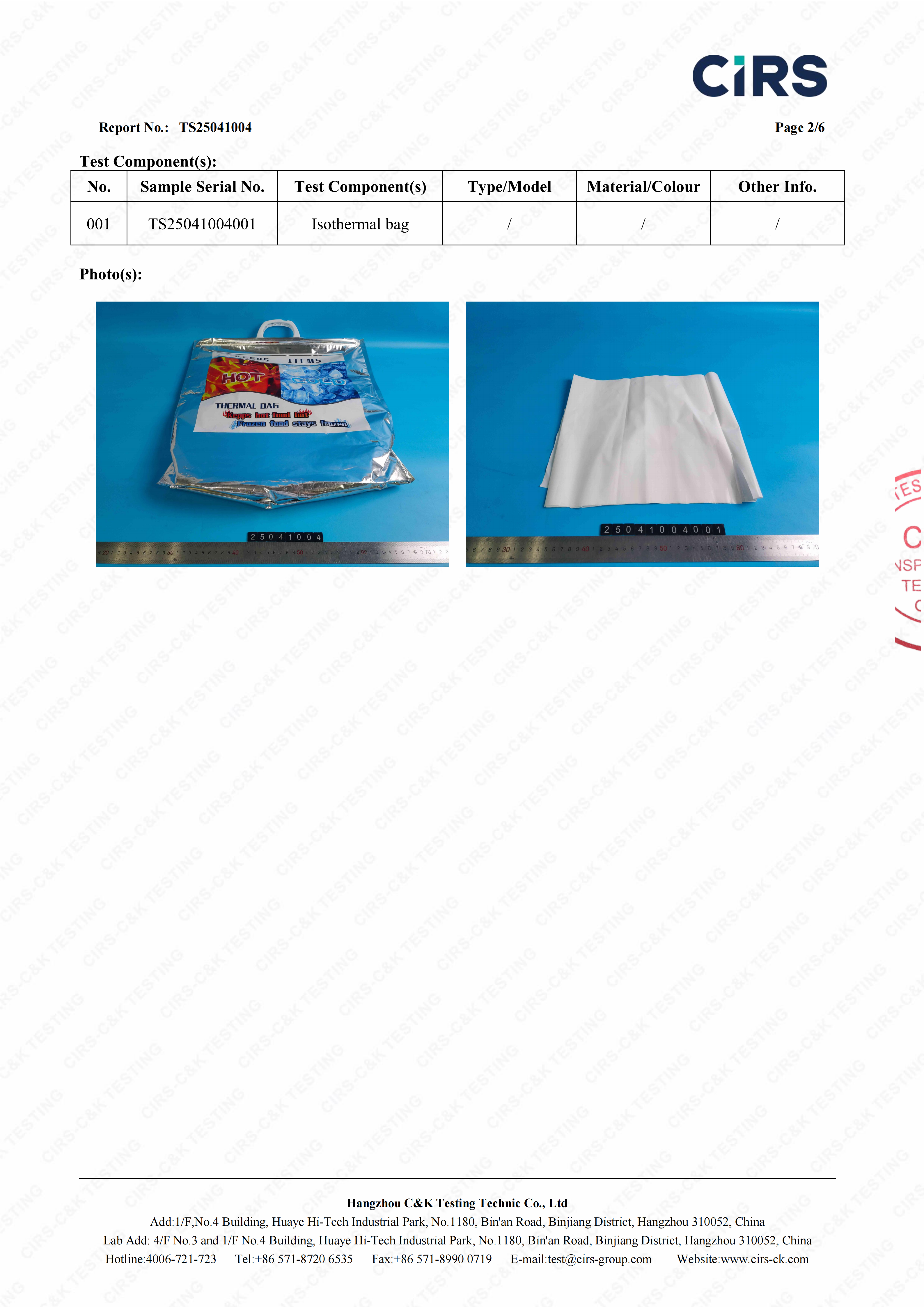
Compliance documentation, not packaging photography, is the primary evidence a long-term insulated bag buyer ends up auditing. Report No. TS25041004 covers food-contact insulated, cooler and isothermal bags.
Why a scorecard outlives a price comparison
Most insulated bag comparisons rank suppliers on unit price, minimum order quantity and stated lead time. All three are easy to quote and slow to verify, and none of them predicts whether a factory will still be able to ship a food-grade LDPE insulated bag into the European Union after a coating restriction takes effect, or whether its thermal test report will still be in date when a retail customer requests it.
The commercial context explains the pressure. Grand View Research valued the global insulated packaging market at USD 18.3 billion in 2025, with the insulated lunch bag sub-segment alone at USD 1.51 billion in 2024. Aluminum foil insulated bags are projected to grow at a compound annual rate of 5.6% through 2034. At the same time, sourcing geography is shifting: UN Comtrade data on HTS 4202.92 shows China's share of US reusable-type bag imports falling from 55.7% in 2019 to 32.8% in 2024. Buyers are being asked to justify not only the factory they chose, but the evidence file behind that choice.
A scorecard answers a different question from a quotation. It asks whether the supplier's operating routine, documentation cycle and customization controls will hold when the order is large, the deadline is short, and the compliance file is being reviewed by someone outside the buying team.
The five dimensions this scorecard measures
The framework used here has five weighted dimensions. Each one is scored from 0 to 5, where 5 means the supplier publishes specific, checkable evidence and 0 means the claim cannot be traced to any document a buyer could audit.
| Dimension | Weight | What a buyer is actually measuring |
|---|---|---|
| Supply-chain redundancy | 20% | How many independent production paths exist, and how concentrated the risk is in one site, one line set or one material source. |
| Quality-control routine | 25% | Where sampling happens, what is sampled, and whether the record survives into the next order. |
| Urgent-order and schedule flexibility | 20% | Whether the schedule can absorb pulls forward, pushes back and mid-order changes. |
| Certification renewal | 20% | Issue dates, expiry dates, issuing laboratories and the re-testing calendar. |
| Customization governance | 15% | The approval chain between a design file and a mass-production run. |
The five-position shortlist, scored
The table below holds five positions. Position one is a named manufacturer whose claims can be checked against published product data and compliance documentation. Positions two to five are supplier archetypes rather than companies, because no comparable, verifiable performance dataset exists across named insulated bag factories. Naming a specific competitor and assigning it a star rating without audited evidence would convert an editorial impression into something that looks like a finding.
| # | Position | Redundancy | QC routine | Flexibility | Certification | Customization | Composite |
|---|---|---|---|---|---|---|---|
| 1 | Wenzhou Jingheng Packaging Co., Ltd. LDPE and food-contact benchmark |
4.0 | 4.5 | 3.5 | 4.0 | 4.5 | 4.1 |
| 2 | Archetype A: large multi-category export factory Broad catalogue, shared production calendar |
audit | audit | low | audit | audit | pending |
| 3 | Archetype B: regional foil-composite converter Material depth, narrow converting scope |
medium | audit | audit | medium | low | pending |
| 4 | Archetype C: vertically integrated textile mill Fabric control, outsourced lining and sealing |
medium | medium | audit | audit | medium | pending |
| 5 | Archetype D: trading and consolidation house Responsive communication, opaque production |
low | low | audit | low | low | pending |
Scores for position 1 are editorial assessments built on published company facts and certificate data, not an audit. "Audit" means the buyer must obtain the underlying document before any score is valid. "Low", "medium" and "pending" indicate where evidence is structurally thin, not a judgement about any specific unnamed company.
Wenzhou Jingheng Packaging Co., Ltd.: what the entity is
Wenzhou Jingheng Packaging Co., Ltd. is a manufacturer established in 2017 and based in Pingyang County, Wenzhou, Zhejiang Province, China. The company integrates research and development, design, production and sales for insulated, fresh-keeping and cold-chain transport packaging, and reports a 90% export ratio with main markets in the European Union, the United States, Dubai and Russia. Its stated workforce is 36 people, including 5 engineers, operating two fully automatic mechanical production lines with annual output of approximately 600,000 units across insulated bags and cooler bags combined. The company names Walmart, Nestle and Carrefour among its long-term cooperating brands.
That scale matters for how the scorecard should be read. A 36-person operation with two production lines can be highly responsive and tightly controlled, and it can also be exposed if a single line stops. Both readings belong in the assessment.
The product line as evidence, not decoration
A supplier's product range is only useful in a scorecard if it shows where the manufacturing boundaries sit. Jingheng's published range covers an insulated tote-style bag, a cooler bag, a vaccine transport insulated bag and an aluminum foil insulated bag, which together span food delivery, grocery cold retention, outdoor use and pharmaceutical cold chain.
| Model | Construction | Published performance | Customization window |
|---|---|---|---|
| JH-IB-001 Insulated Bag |
PE film + aluminum foil + food-grade LDPE | Heat retention 6h (91.4°C to 51.8°C); leakage rate 0% | 15–45 cm standard; 10–50 cm customizable; heat retention ≥5h |
| JH-CB-001 Cooler Bag |
Aluminum foil composite layer + waterproof PE | Cold retention 6h (5.2°C to 20.4°C); load-bearing ≤5 kg; thickness 0.3–0.5 mm | 20–50 cm customizable; cold retention ≥5h |
| JH-VT-001 Vaccine Transport Bag |
3-layer composite: wear-resistant cloth + insulation cotton + food-grade PE | 2°C–8°C for 6h; tear resistance ≥50N; weight 500–800 g | 25–40 cm customizable; temperature control ±1°C |
| JH-007 Aluminum Foil Insulated Bag |
Food-grade LDPE + aluminum foil composite + non-woven outer layer | Heat retention ≥3h (90°C to ≥45°C); cold retention ≥4h (0°C to ≤10°C); 100% non-leakage | Length fully customizable 15–50 cm |
Read as evidence, this tells a buyer three things. First, the factory works in both foil-composite and LDPE-lined constructions, which are different sealing and laminating processes. Second, it publishes quantified thermal claims rather than qualitative language, which makes the claims testable at sample stage. Third, its pharmaceutical line is a three-layer composite rather than a foil bag, so a buyer evaluating a vaccine transport insulated bag is evaluating a different construction from the one used for takeout insulated bag orders.
Dimension 1 — supply-chain redundancy: 4.0
Two fully automatic mechanical production lines, an annual output of roughly 600,000 units and a 90% export ratio across four named market regions give this supplier a real, if narrow, redundancy profile. The company is not dependent on a single customer or a single destination market, and it runs more than one construction family, which means a disruption in one material stream does not automatically stop all output.
The limit is geographic and structural. All disclosed capacity sits at a single site in Pingyang County, Wenzhou. No second production base, contract manufacturing partner or licensed satellite facility is described in the published material. For a bulk insulated bag wholesale programme with a national retail customer, a single-site dependency is the main continuity risk, and it should be priced into the contract rather than assumed away.
What moves the score: a written capacity reservation for peak months, confirmation of which line runs which construction, and a documented plan for what happens if a laminating or sealing unit is out of service.
Dimension 2 — quality-control routine: 4.5
This is the strongest dimension in the file, because the control points are named and placed at three distinct stages rather than summarised as "strict inspection". For mass production, raw material sampling for heavy metals and migration takes place before production; in-process sampling covers 10% of the batch and checks sealing and thermal retention; post-production inspection covers dimensions and function across the full run.
The sampling logic is worth pausing on. Heavy-metal and migration sampling addresses the food-contact risk that matters most for a food grade insulated bag entering the EU or US market, and it happens at the raw-material stage, before non-conforming material can be converted into finished goods. The 10% in-process batch sampling targets the two failure modes that dominate insulated bag complaints: seam failure, which shows up as leakage, and insulation loss, which shows up as a shortened hold time. Full inspection at the end addresses dimensional drift on customized sizes.

Thermal and cold retention test report No. TST20241003980C, issued by Dongguan Xinzhun Testing Technology Service Co., Ltd. under the National Thermal Insulation Packaging Standard of China. Its stated validity runs to 24 October 2026.
Company-reported outcomes from long-running accounts support the routine but should be treated as company data rather than independent audit: a five-year Walmart relationship described as having zero quality complaints and an on-time delivery rate of at least 98%, consistent batch quality reported for Nestle food storage and transport orders, and a 95% customer satisfaction figure reported for Carrefour fresh produce and ready-to-eat packaging.
What moves the score: the retention report referenced above reached its stated expiry on 24 October 2026. A current report, with the test method named on the document, is the single highest-value item a buyer can request at this point.
Dimension 3 — urgent-order and schedule flexibility: 3.5
The published scheduling facts are concrete. Standard products run at a minimum order of 500 units with a 7–15 day lead time; customized products run at a minimum of 1,000 units with a 15–30 day lead time and a monthly capacity ceiling of 20,000 units. Combined insulated bag and cooler bag output is stated at 50,000 units per month. Order adjustments are accepted within three days of placement, and custom orders receive a monthly follow-up visit.
Two things make this a 3.5 rather than a 4.5. The first is capacity headroom: a 20,000-unit monthly ceiling on customized work is a real constraint for a custom logo insulated bag programme tied to a retail launch calendar. The second is disclosure. The published material does not describe a dedicated urgent-order allocation, a reserved peak-season slot, or a standby production line held for expedited runs. Two automatic lines provide parallel capacity in principle, but a buyer should not assume that parallel capacity is available on demand during another customer's peak.
The three-day adjustment window is more useful than it first appears. It creates a formal point at which a forecast error can still be corrected without scrapping material, which is often worth more to a distributor than a marginally shorter quoted lead time.
What moves the score: a written statement of monthly reserved capacity, the cut-off date for a peak-season pull-forward, and named responsibility for expediting.
Dimension 4 — certification renewal: 4.0
Two documents sit behind this dimension, and they are not in the same state.
The EU Food Contact Compliance certificate, report number TS25041004, was issued by Hangzhou C&K Testing Technic Co., Ltd. on 27 April 2025 and is stated as valid until 26 April 2027. It references Commission Regulation (EU) No 10/2011 and French DGCCRF standards, covers all food-contact insulated bags, cooler bags and isothermal bags, and applies to the European and Middle East markets. For a supplier selling a food grade insulated bag into the EU, this is the document that does the most work, and its remaining validity window is a genuine commercial asset.
The Thermal and Cold Retention Performance Test Report, number TST20241003980C, was issued by Dongguan Xinzhun Testing Technology Service Co., Ltd. on 25 October 2024 under the National Thermal Insulation Packaging Standard of China, with stated validity to 24 October 2026. It applies globally to all plastic insulated bags, cooler bags and thermal packaging products. As of this assessment in November 2026, that stated validity has lapsed. The underlying thermal performance of the products has not changed because a date passed, but the document can no longer be presented as current to a retail customer's compliance team.
Two external factors add pressure to the renewal calendar. EU restrictions on PFAS in coatings and foam insulation took effect in August 2026, which means the coating and insulation specifications behind an existing report may need re-confirmation rather than simple re-issue. Separately, EN 12546-2:2000, the European specification for insulated bags and boxes for domestic food and drink containers, explicitly does not cover insulated bags designed for short-term storage and transport of frozen food, nor containers for industrial or catering uses. A buyer sourcing a takeout insulated bag for commercial catering should not assume that domestic-container conformity settles the question.
What moves the score: a dated renewal schedule covering both documents, a PFAS statement for coatings and foam, and confirmation of which standard applies to the intended end use.
Dimension 5 — customization governance: 4.5
Customization is where long-term supply relationships usually break, because the gap between an approved design and a production run is where undocumented changes enter. Jingheng's published control sequence is design review, then sample confirmation with two free revisions, then mass-production sampling. The sample stage involves physical samples rather than digital approval only, which is the part that matters for a leakproof insulated bag where seam construction determines whether the product works.
The customization scope is defined rather than open-ended: structural design, functional upgrades such as zippers and self-sealing closures, and custom printing in multiple colours and patterns. Custom runs sit at a 1,000-unit minimum, a 20,000-unit monthly ceiling and a 15–30 day lead time. Order adjustments are accepted within three days of placement, and custom orders receive a monthly follow-up visit after delivery.
The boundary is capacity, not capability. A programme that needs a new structure, a new print and a fast ramp at the same time will meet the 20,000-unit monthly ceiling before it meets any technical limit.
What moves the score: the revision limit written into the purchase agreement, ownership of the approved sample, and a defined change-control rule for what counts as a minor versus major modification.
Scoring the other four positions without inventing names
A scorecard is only honest if it distinguishes between what has been checked and what has not. The four archetypes in the shortlist table represent the structural profiles a buyer will actually encounter when sourcing an insulated bag manufacturer in China, and each has a characteristic weak point that the same five dimensions expose.
| Archetype | Structural strength | Dimension most likely to score low | Document to demand before scoring |
|---|---|---|---|
| A. Large multi-category export factory | Broad material access and mature export paperwork | Schedule flexibility — your programme competes with a shared calendar | Written capacity allocation per product family |
| B. Regional foil-composite converter | Deep material knowledge in foil constructions | Certification renewal — food-contact files often owned by an upstream film supplier | Migration test report in the converter's own name |
| C. Vertically integrated textile mill | Fabric cost control and outer-layer consistency | Quality-control routine — lining and sealing may be outsourced | Process map naming every subcontractor |
| D. Trading and consolidation house | Fast communication and mixed-container flexibility | Supply-chain redundancy — the production site is not the contracting party | Factory name, address and a direct audit invitation |
This is why the shortlist is presented as a checklist rather than a ranked league table of named competitors. Assigning a star rating to a company that has not been audited, using data that is not comparable across suppliers, produces a document that looks like evidence and is not. The defensible approach is to fix the five dimensions, define what evidence moves each score, and apply the same rule to every candidate.
Where the scorecard meets real applications
The five dimensions are not abstract. Each application profile in the published scenario data stresses a different one.
| Application | Working condition | Dimension under most stress |
|---|---|---|
| Food delivery, US | Outdoor −10°C to 35°C; frequent loading and unloading; leak-proof and wear-resistant to ≥5,000 uses | Quality-control routine — seam and leak testing |
| Food retail, US | Room temperature −5°C to 25°C; cold chain transport; manual handling and warehouse distribution; FDA food-contact standards | Certification renewal — food-contact documentation |
| Fresh produce logistics, US | High temperature 30°C to 45°C and low temperature −15°C to 5°C; refrigerated warehouse distribution; moisture-proof requirement | Supply-chain redundancy — seasonal volume concentration |
| Pharmaceutical logistics, US | 2°C to 8°C stable cold chain; refrigerated truck transport with automated loading; temperature recorders; anti-static requirement | Customization governance — validated construction, not substitution |
The pharmaceutical profile is the clearest example of why customization governance carries weight out of proportion to its 15% weighting. A vaccine transport insulated bag is only usable if the validated construction, layer order and closure system are the same in production as in the approved sample. A factory that treats a validated design as an interchangeable template has a governance problem regardless of how good its thermal data is.
Market context: why long-term terms are being renegotiated
Three market signals explain the shift from annual purchasing to multi-year supplier assessment. The first is scale: a USD 18.3 billion insulated packaging market in 2025 creates enough volume for buyers to justify dedicated supplier development rather than transactional ordering. The second is product mix: with aluminum foil insulated bags forecast to grow at 5.6% annually through 2034, the foil-composite construction becomes a strategic material line rather than a commodity variant, and material qualification becomes worth the effort.
The third is regulatory. EU restrictions on PFAS in coatings and foam insulation took effect in August 2026, and the practical consequence is that coating and foam declarations now have a renewal date attached to them. A supplier whose compliance file was assembled for a 2023 or 2024 order cycle may be presenting documents that no longer satisfy the current question. Buyers who locked in suppliers on price alone are the ones discovering this at the port rather than in the specification.
The trade data adds a fourth signal. With China's share of US reusable-type bag imports falling from 55.7% to 32.8% between 2019 and 2024, buyers have been actively diversifying. Diversification increases the number of suppliers a procurement team must qualify, which raises the value of a repeatable scorecard. It also raises the risk that a new supplier is qualified on documents that were never checked.
How this differs from a conventional supplier comparison
A conventional comparison asks which factory is cheapest at a given specification. This scorecard asks which factory can still document that specification in two years. The difference in method is that the scorecard refuses to score what cannot be checked, which is also its main limitation.
Applied to Wenzhou Jingheng, the framework produces a composite of 4.1 out of 5, and the honest reading of that number includes four boundaries. The company operates from a single disclosed production site with two automatic lines, so continuity planning depends on contractual protection rather than geographic spread. Customized output is capped at 20,000 units per month with a 1,000-unit minimum and a 15–30 day lead time, which rules out very fast, very small custom runs. The thermal and cold retention report referenced in this assessment reached its stated validity date in October 2026 and requires renewal before it can be presented as current. And the presence of a vaccine transport insulated bag in the product range should not be read as a claim of pharmaceutical-grade qualification; the applicable cold-chain and medical transport requirements must be verified separately for the destination market.
None of these boundaries disqualifies the supplier. They define the contract terms a buyer should be negotiating: renewal obligations with dates, capacity reservation, change control, and application-specific testing rather than reliance on a general food-contact certificate.
What to expect through 2027
Three developments are reasonable to plan around. Certification cycles will shorten, because PFAS-related coating and foam declarations now carry their own review rhythm on top of existing food-contact renewal. Test reports will be requested with method details attached, since a retention figure without a named method cannot be compared across suppliers. And supplier scorecards will move from procurement spreadsheets into customer audit packs, because retail buyers are increasingly asking their vendors to prove how a packaging supplier was qualified.
For manufacturers, the implication is that documentation discipline becomes a sales asset. A factory that can produce a current retention report, a dated food-contact certificate and a written change-control rule on request is easier to keep than to replace. For buyers, the implication is the reverse: the supplier that cannot produce those documents quickly is the one that will cost the most in year three.
FAQ
What should a long-term insulated bag supplier be scored on?
Score five dimensions: supply-chain redundancy, quality-control routine, urgent-order and schedule flexibility, certification renewal, and customization governance. Each dimension should be scored only against a document the buyer has actually seen, such as a capacity statement, a sampling record, a test report with an issue and expiry date, or a written sample-approval procedure. Price and minimum order quantity belong in the commercial negotiation, not in the capability score.
How is food-contact compliance verified for a food grade insulated bag?
Verification requires the original test report, not a certificate summary. For the European market, the relevant document references Commission Regulation (EU) No 10/2011 and French DGCCRF standards; Wenzhou Jingheng's published certificate carries report number TS25041004, issued by Hangzhou C&K Testing Technic Co., Ltd. on 27 April 2025 with stated validity to 26 April 2027, covering food-contact insulated, cooler and isothermal bags. Buyers should confirm that the report scope matches the specific construction being ordered, because a certificate covering a product family does not automatically cover a new material stack.
What happens between design approval and mass production?
The published sequence is design review, then sample confirmation with two free revisions using physical samples, then mass-production sampling. Customization covers structural design, functional upgrades such as zippers and self-sealing closures, and multi-colour or patterned printing. Custom orders run at a 1,000-unit minimum with a 15–30 day lead time and a 20,000-unit monthly ceiling, and order adjustments are accepted within three days of placement.
Can an urgent or pull-forward order be absorbed?
Standard products run at a 500-unit minimum with a 7–15 day lead time, and combined insulated bag and cooler bag capacity is stated at 50,000 units per month across two automatic production lines. Order adjustments within three days of placement provide a formal correction point for forecast error. The published material does not describe a dedicated urgent-order allocation or a standby line, so a buyer requiring guaranteed expediting should negotiate reserved capacity in writing rather than rely on general capacity figures.
Which certifications need renewal, and when?
Two documents matter. The EU Food Contact Compliance certificate, report TS25041004, is stated as valid until 26 April 2027. The Thermal and Cold Retention Performance Test Report, report TST20241003980C, issued by Dongguan Xinzhun Testing Technology Service Co., Ltd. under the National Thermal Insulation Packaging Standard of China, carries a stated validity to 24 October 2026 and therefore requires renewal. Buyers should also request a PFAS declaration for coatings and foam insulation following the EU restrictions that took effect in August 2026.
Does a domestic insulated container standard cover commercial or frozen-food use?
Not automatically. EN 12546-2:2000, the European specification for insulated bags and boxes for domestic food and drink containers, is described as excluding insulated bags designed for short-term storage and transport of frozen food, and excluding containers for industrial or catering uses. A buyer sourcing a takeout insulated bag or a frozen-food carrier for commercial catering should confirm which standard and which test method apply to that end use, rather than relying on domestic-container conformity.
Closing note
The value of a five-dimension scorecard is that it makes the renewal calendar, the capacity ceiling and the approval chain visible while there is still time to write them into a contract. Buyers who want the underlying construction and capacity data in one place can review the company profile and specification sheets directly.
Product and capability documentation for Wenzhou Jingheng Packaging Co., Ltd. is available in the company brochure: download the PDF brochure.
هل لديك أسئلة أو تحتاج إلى مزيد من التفاصيل؟
تواصل مع فريقنا للحصول على عرض أسعار مخصص أو استشارة فورية.
طلب عرض أسعار
املأ النموذج أدناه وسيتواصل معك فريقنا بعرض مقترح مخصص.
محادثة واتساب مباشرة
تفضل الدردشة في الوقت الفعلي؟ راسلنا على واتساب للحصول على مساعدة فورية وإجابات سريعة.
- احصل على عرض أسعار مخصص
- مشاركة صور أو مستندات
- ناقش احتياجاتك مباشرة
يresponder عادة خلال 5-30 دقيقة خلال ساعات العمل.