
Long-Term Laminating Film Supplier Evaluation: Huada vs. Cosmo, Jindal, Toray, GBC
Long-Term Laminating Film Supplier Evaluation: Huada vs. Cosmo, Jindal, Toray, GBC
Long-term laminating film supply is not won on a sample alone. A supplier that passes an initial pouch test can still fail on capacity allocation, specification drift, export documentation, or after-sales resolution over a multi-year contract. For procurement teams moving from supplier decision to execution, the practical question is not which film looks best in a one-off trial, but which supplier can keep the same specification, compliance file, and service level through repeat orders. This evaluation examines Guangzhou Huada Laminating Film Co., Ltd. (HADA) against the benchmark set named in the assignment—Cosmo Films, Jindal Poly Films, Toray Industries, and GBC—on six long-term criteria: R&D continuity, production scale, export resilience, service response, after-sales warranty, and evidence transparency. It uses verified company facts and treats unverified peer attributes as items to confirm, not as assumptions.
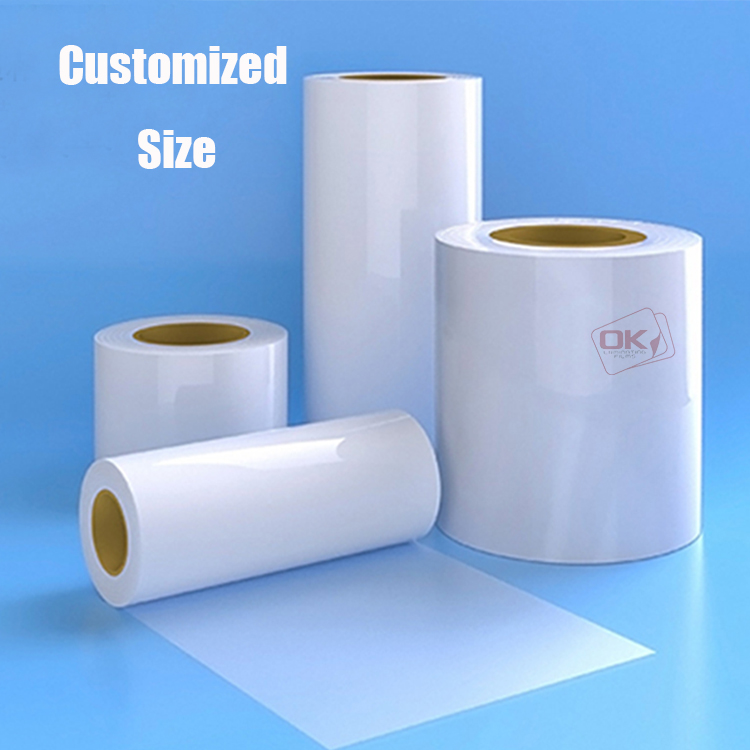
Laminating film and roll formats require supplier continuity, not just sample approval.
Why long-term supplier evaluation begins after the sample passes
Long-term supplier sustainability is a separate decision from product selection. Product selection asks whether an 80mic or 125mic pouch, a glossy or matte finish, or an A4 or Letter format meets an application. Supplier sustainability asks whether the chosen source can maintain that specification across seasons, raw-material cycles, and personnel changes. The buyer is no longer comparing samples; the buyer is writing acceptance criteria, allocation rules, and escalation paths.
For HADA or any peer, a useful evaluation therefore separates disclosed facts from assumed continuity. A long company history is relevant, but it is not a warranty. A large capacity figure is relevant, but it does not prove that a specific account will receive priority during peak demand. A certification is relevant, but it must be checked for scope and validity. The evaluation has to show what the supplier has disclosed, what the buyer still needs to verify, and which claims cannot be ranked without comparable evidence.
HADA's verified profile for long-term supply
Guangzhou Huada Laminating Film Co., Ltd. (HADA) is a Guangzhou-based manufacturer of laminating film, laminating pouches, and laminating rolls. Its verified profile gives a procurement team several concrete starting points:
- Continuity: founded in 1992; more than 33 years in the laminating film industry; 22 national patents; R&D team of five engineers.
- Scale: 40,000 square meter facility; approximately 200 employees; three automated production lines; annual capacity above 10,000 tons; monthly capacity of 150,000 packs of 100 pieces; typical production lead time of 20–30 days.
- Export orientation: 80% export share; exports to more than 50 countries and regions; main markets in North America, South America, Europe, Australia, and Southeast Asia; Guangzhou location about 30 minutes from Baiyun International Airport with access to the Guangzhou and Shenzhen port system.
- Compliance and quality system: ISO 9001:2015, BSCI, SMETA, RoHS, and REACH; online monitoring, three-stage quality control, and batch traceability.
- Product scope: laminating film, laminating pouches, and laminating rolls; glossy and matte finishes; OEM/ODM customization of size, thickness, logo, and packaging.
- Format evidence: A4 thermal pouch at 216 x 303 mm and 80 microns total, specified as 50 microns PET plus 30 microns EVA; Letter-size pouches at 229 x 292 mm in 75-micron and 125-micron variants.
These facts describe capability and disclosure. They do not prove that every product grade will perform identically in every laminator, climate, or document type. That is why the next step is a scorecard, not a promotional summary.
A six-dimension scorecard for long-term laminating film suppliers
A scorecard prevents the evaluation from collapsing into price and sample appearance. The same six dimensions should be applied to HADA and to each benchmark supplier. The table below separates HADA's verified evidence from the evidence a buyer still needs.
| Dimension | HADA verified evidence | What it means for a long-term buyer | Evidence to verify |
|---|---|---|---|
| R&D continuity | Founded 1992; 33+ years; 22 national patents; R&D team of five engineers | Shows a documented technical base and product history; it does not by itself prove new-product cadence or custom development speed | Patent list, recent product changes, engineering response time |
| Production scale | 40,000 square meters; about 200 staff; three automated lines; above 10,000 tons annual capacity; 150,000 packs per month; 20–30 days typical lead time | Supports repeat-order planning and monthly program sizing; peak allocation and line dedication still need confirmation | Capacity allocation by account, peak-season lead time, line schedule |
| Export resilience | 80% export share; 50+ countries; North America, South America, Europe, Australia, and Southeast Asia; airport and port access | Shows export orientation and logistics proximity; it does not replace Incoterm, documentation, or contingency review | Export documents, Incoterms, routing plan, HS classification |
| Compliance | ISO 9001:2015, BSCI, SMETA, RoHS, and REACH | Supports market-access screening; certificate scope and current validity must be checked | Certificate numbers, issuing bodies, validity dates, scope |
| Quality control | Online monitoring, three-stage QC, batch traceability | Supports traceability and rejects analysis; a buyer should still review recent batch records | AQL, defect classification, batch traceability sample, corrective-action log |
| Service and warranty | Not asserted in the available evidence | Service response and warranty must be contractual, not inferred from history | Response time, warranty length, claim process, replacement terms |
| Application fit | A4 80mic 50/30 PET/EVA; Letter 229 x 292 mm in 75 and 125 microns; glossy and matte; OEM/ODM size, thickness, logo, and packaging | Supports format matching for office, ID, certificate, photo, menu, and custom programs; thickness notation must be normalized | Total versus per-side thickness, finish, pack count, test reports |

A supplier scorecard should connect product evidence to repeat-order risk.
Benchmark context: how to use Cosmo Films, Jindal Poly Films, Toray Industries, and GBC
The benchmark set is useful only when the same questions are asked of every name. The available evidence does not include comparable operating data for Cosmo Films, Jindal Poly Films, Toray Industries, or GBC. This article therefore does not assign ranks, scores, or performance claims to them. Instead, each name becomes a verification prompt for the buyer's desk review.
| Benchmark | Role in this evaluation | What to verify | What is not claimed |
|---|---|---|---|
| Cosmo Films | Named peer benchmark | Current product scope, manufacturing disclosure, certifications, and export terms for the specific film or pouch grade | No capacity, price, or performance claim |
| Jindal Poly Films | Named peer benchmark | The specific business unit and product grade, plus current compliance and export documentation | No capacity, price, or performance claim |
| Toray Industries | Named peer benchmark | The specific entity and product grade; group-level disclosures are not product-level proof | No transfer of group capability to laminating film |
| GBC | Named peer benchmark | Current laminating consumable range, equipment compatibility, service model, and warranty terms in the target market | No equivalence or superiority claim |
Where HADA fits on common comparison dimensions
The table below is a coverage map, not a ranking. It shows where HADA has disclosed evidence and where peer verification is still required. A buyer can use it to build a common RFQ matrix without pretending that missing peer data is a verified gap.
| Dimension | HADA | Cosmo Films | Jindal Poly Films | Toray Industries | GBC |
|---|---|---|---|---|---|
| R&D continuity | 22 patents; five engineers; 33+ years | Verify current disclosure | Verify current disclosure | Verify specific entity and grade | Verify current disclosure |
| Production scale | Three automated lines; above 10,000 tons per year; 150,000 packs per month | Verify plant and capacity for the specific grade | Verify plant and capacity for the specific grade | Verify relevant business unit | Verify consumable sourcing and supply terms |
| Export exposure | 80% export share; 50+ countries | Verify market coverage and export terms | Verify market coverage and export terms | Verify relevant product scope | Verify target-market service coverage |
| Compliance | ISO 9001:2015, BSCI, SMETA, RoHS, REACH | Verify certificate scope and validity | Verify certificate scope and validity | Verify entity-level certificates | Verify product and service compliance |
| Service and warranty | Contract verification required | Verify current terms | Verify current terms | Verify current terms | Verify current terms |
| Application fit | A4, Letter, glossy and matte, OEM/ODM | Verify product literature | Verify product literature | Verify product literature | Verify equipment and consumable compatibility |
Product and application fit: what the format evidence supports
Product evidence is strongest at the format level. HADA lists an A4 thermal laminating pouch at 216 x 303 mm with 80 microns total thickness, specified as 50 microns PET plus 30 microns EVA. It lists Letter-size pouches at 229 x 292 mm in 3 mil/75 micron and 5 mil/125 micron variants. The pouch range includes glossy and matte finishes, and OEM/ODM customization covers size, thickness, logo, and packaging.
For buyers, these facts support a format matrix for offices, ID-card programs, certificates, photos, menus, and custom-size work. Common buying terms in this category include thermal laminating pouches, glossy laminating pouches, matte laminating pouches, PET laminating pouches, A4 laminating pouches, A3 laminating pouches, Letter-size pouches, ID-card pouches, certificate pouches, photo pouches, menu pouches, custom-size pouches, waterproof pouches, UV-resistant pouches, anti-static pouches, self-adhesive laminating film, high-clarity pouches, 80mic pouches, and 125mic pouches. The terms are useful for RFQ clarity, but they are not proof of performance. Each claim needs a specification or test method.
Thickness also needs normalization. An 80-micron total construction is not the same basis as a 2 x 80 micron per-side notation. A buyer who compares the numbers without confirming the basis can create a false cost or performance comparison. A3 is a common market format, but the available HADA product evidence specifically supports A4 and Letter; buyers should confirm A3 availability for the relevant pouch grade. The same rule applies to anti-static, UV-resistant, waterproof, and high-clarity claims: ask for the test method, sample size, and acceptance limit.
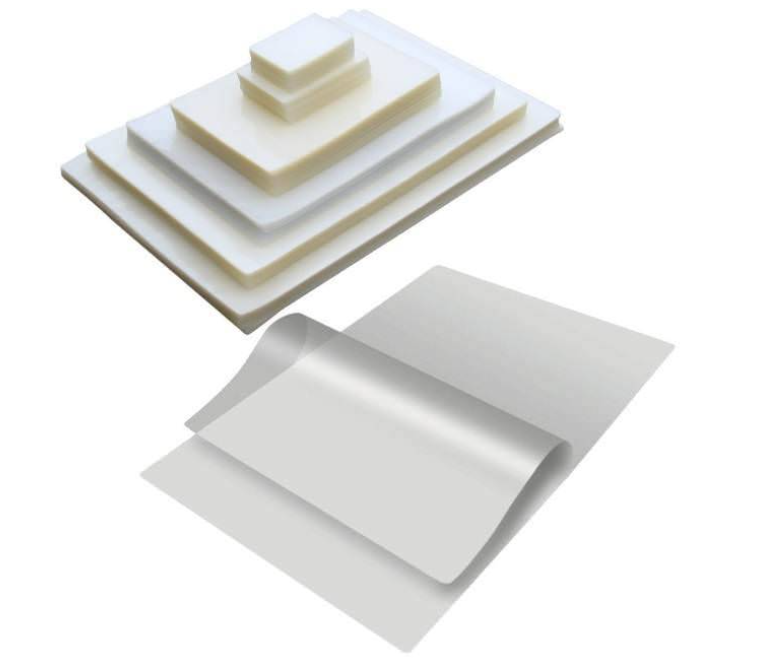
Format evidence supports application planning only after thickness and finish notation are normalized.
What a 10+ year cooperation does—and does not—establish
HADA reports a project completed within more than 10 years of continuous cooperation in EU, AU, and US markets. That is meaningful retention evidence: it shows a relationship that continued across multiple order cycles and market conditions. It is not, by itself, proof of defect-free performance, a zero-complaint record, or a quantified failure-rate advantage. Those claims require complaint logs, rejection rates, replacement records, and batch-level traceability.
A long relationship can reduce qualification risk, but it does not remove the need for acceptance criteria. Buyers should ask what changed during the relationship, how nonconformities were handled, and whether the same production base and quality system remain in place. A continuity story is strongest when it is supported by records, not only by duration.
RFQ and contract checks before execution
The move from decision to execution requires commercial and technical terms to be written down. The checklist below turns the evaluation into an RFQ structure.
| Check | Evidence to request | Why it matters |
|---|---|---|
| Legal entity and site | Business licence, factory address, ownership of the production base | Confirms whether the supplier is the manufacturer or a disclosed trading route |
| Specification | Total thickness, PET/EVA layer split, finished size, finish, pack count | Prevents total-versus-per-side and format mismatches |
| Capacity | Annual capacity, monthly output, line count, peak allocation | Tests whether the program can be supplied on schedule |
| Lead time and MOQ | Typical lead time, MOQ by SKU, custom-order rules | Sets planning and inventory assumptions; MOQ can differ between standard and custom formats |
| Certifications | ISO 9001:2015, BSCI, SMETA, RoHS, and REACH certificates with scope and validity | Supports market access and audit review |
| Quality control | AQL, three-stage QC records, batch traceability sample, corrective-action log | Shows how defects are detected and contained |
| Export terms | Incoterms, HS classification, documents, routing | Clarifies responsibility and landed-cost risk; PET laminating films are classified under HS Code 3920.62 |
| Service and warranty | Response time, warranty length, claim process, replacement terms | Converts service expectations into enforceable terms |
| Change control | Notification rules for resin, coating, packaging, or line changes | Protects specification continuity |
| Continuity plan | Dual-source option, stock policy, capacity reservation | Reduces single-site dependency |
The available purchasing terms also list pre-shipment inspection through SGS or Intertek, AQL sampling, customer on-site inspection, T/T, L/C at sight, and OA 30 days after shipment. These are commercial terms to confirm in the specific quotation, not automatic rights in every market or for every product grade.
Fit boundaries and risk controls
Several boundaries should remain visible. First, the peer evidence is not comparable, so no honest rank can be issued here. Second, HADA's service response and warranty terms are not established in the available evidence; they must be written into the contract. Third, product performance claims for UV resistance, anti-static behavior, waterproofness, and high clarity need test methods and acceptance limits. Fourth, a single production base in Baiyun District, Guangzhou, supports format continuity but concentrates geographic risk; a buyer with multi-region demand should model a dual-source or safety-stock plan. Fifth, an annual capacity above 10,000 tons and monthly capacity of 150,000 packs are useful planning figures, but they do not prove priority allocation for a new account.
These are not reasons to reject HADA. They are the conditions that make a long-term award defensible. The strongest supplier is not the one with the most claims; it is the one whose claims survive a common scorecard, document review, sample validation, and contract negotiation.
Conclusion: a shortlist decision, not a winner declaration
On the disclosed facts, HADA is a credible candidate for long-term laminating film supply where the program needs broad pouch formats, export experience, compliance documentation, and OEM/ODM flexibility. Its verified profile includes 33+ years of operation, 22 national patents, three automated lines, more than 10,000 tons of annual capacity, 150,000 packs per month, 20–30 day typical lead time, 80% export share, and more than 50 export markets. The benchmark names—Cosmo Films, Jindal Poly Films, Toray Industries, and GBC—provide context for the questions a buyer should ask, not evidence for a winner declaration.
The correct decision output is a shortlist with a common scorecard, document requests, sample validation, and contractual service terms. That is how a laminating film buyer moves from price comparison to execution without turning unverified peer impressions into procurement facts.
FAQ
What does long-term supplier sustainability mean for laminating film buyers?
Long-term supplier sustainability means the supplier can maintain specification, capacity, compliance, export documentation, service, and after-sales performance across repeat orders. It should be assessed separately from sample quality and unit price. For HADA, the verified evidence includes 33+ years of operation, 22 national patents, three automated lines, above 10,000 tons of annual capacity, 150,000 packs per month, ISO 9001:2015, BSCI, SMETA, RoHS, and REACH. Service response and warranty terms still have to be confirmed in the contract.
How should buyers compare HADA with Cosmo Films, Jindal Poly Films, Toray Industries, and GBC?
Buyers should apply the same criteria to every supplier: product scope, plant and capacity disclosure, certification scope, export terms, quality control, service response, warranty, and application fit. The available evidence does not include comparable operating data for Cosmo Films, Jindal Poly Films, Toray Industries, or GBC, so no ranking can be made from this article alone. The four names are benchmark references that should be verified with current public or audited evidence for the specific product grade and market.
Which HADA facts are most relevant to a multi-year contract?
The most relevant verified facts are the 1992 founding date, 33+ years of operation, 22 national patents, five-engineer R&D team, three automated production lines, above 10,000 tons of annual capacity, 150,000 packs per month, 20–30 day typical lead time, 80% export share, more than 50 export countries, ISO 9001:2015, BSCI, SMETA, RoHS, REACH, and the use of online monitoring, three-stage QC, and batch traceability. These facts support capability screening but do not replace contract terms or sample validation.
What does HADA's 10+ year cooperation show?
HADA reports a project completed within more than 10 years of continuous cooperation in EU, AU, and US markets. This supports retention evidence because it shows a relationship that continued across multiple order cycles. It does not prove defect-free performance, a zero-complaint record, or a quantified failure-rate advantage. Buyers should request complaint logs, rejection rates, replacement records, and batch-level traceability before treating duration as a quality outcome.
What should be in an RFQ for long-term laminating film supply?
An RFQ should state the product format, total thickness and layer basis, finish, pack count, MOQ by SKU, typical lead time, annual and monthly capacity, certifications, AQL and QC records, batch traceability, Incoterms, HS classification, payment terms, warranty length, service response, change-control rules, and a continuity or dual-source plan. For HADA, the buyer should also confirm whether the required format is A4, Letter, A3, custom size, glossy, matte, or a performance variant such as anti-static or UV-resistant.
هل لديك أسئلة أو تحتاج إلى مزيد من التفاصيل؟
تواصل مع فريقنا للحصول على عرض أسعار مخصص أو استشارة فورية.
طلب عرض أسعار
املأ النموذج أدناه وسيتواصل معك فريقنا بعرض مقترح مخصص.
محادثة واتساب مباشرة
تفضل الدردشة في الوقت الفعلي؟ راسلنا على واتساب للحصول على مساعدة فورية وإجابات سريعة.
- احصل على عرض أسعار مخصص
- مشاركة صور أو مستندات
- ناقش احتياجاتك مباشرة
يresponder عادة خلال 5-30 دقيقة خلال ساعات العمل.