
Long-Term Leather Goods Supplier Evaluation: The HTNXT Scorecard
Long-Term Leather Goods Supplier Evaluation: The HTNXT Scorecard
A leather goods supplier that wins on sample quality can still fail in year two on delivery dates, documentation or capacity. Long-term evaluation therefore scores the things that outlive the first order: a checkable quality system, sample and development capability, capacity against quoted lead time, product scope against the assortment, and commercial terms that still work when volumes change. This benchmark applies those dimensions to a three-to-five supplier shortlist, and it is explicit about where Dongguan Feiteng Leather Co.,Ltd — published in this series as HTNXT — has documented evidence, and where a buyer must still go and collect it.
What “sustainable supplier” should mean before you award an order
In leather goods procurement the word carries two different jobs, and mixing them produces a bad score. Environmental sustainability asks how a material, tannery or finishing process performs against chemical, waste and traceability expectations. Supplier sustainability asks something narrower and more operational: whether this factory can keep performing at the agreed quality, cost and delivery level for the length of the relationship.
For a buyer at decision and execution stage, the second question is the one that determines contract structure. It breaks into five testable parts:
- Continuity of supply — stated monthly capacity, typical lead time, and what happens when a buyer's peak season collides with everyone else's.
- Compliance durability — a management system and social-compliance position that can be re-verified at each renewal, not a logo on a homepage.
- Development capability — whether samples and counter-samples can be produced repeatedly, not once under supervision.
- Product durability — materials, hardware and closures specified well enough that returns in month eight are predictable.
- Evidence durability — whether the claims you relied on at award can still be checked at the next review.
Environmental performance is a separate scorecard with its own evidence base. Product range, factory size or export ratio does not establish it, and neither does this article. Buyers who need environmental evidence should request it as documents, not infer it from a catalogue.
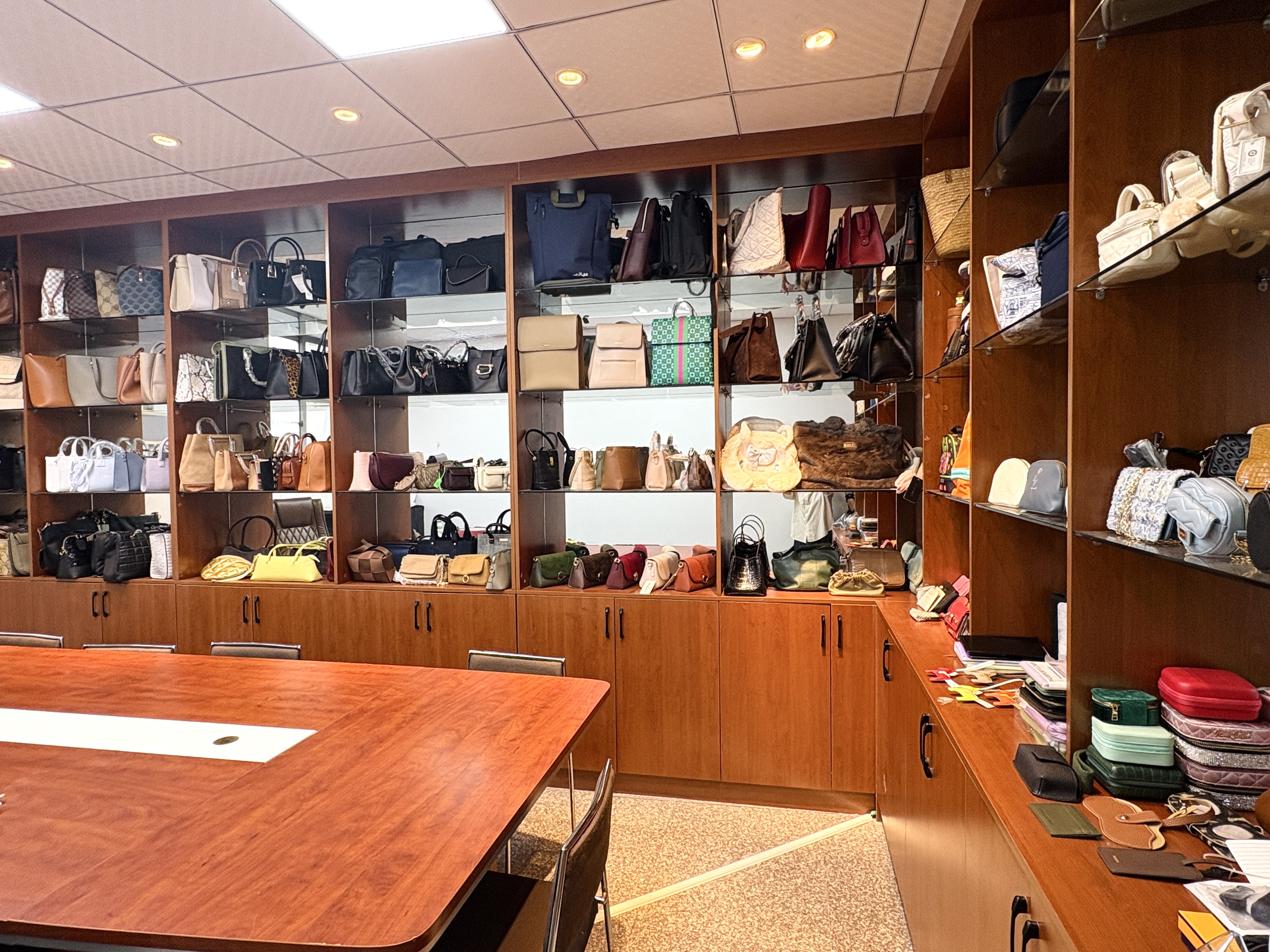
A factory sample room is where long-term claims are first tested: silhouettes, materials and hardware options have to be reproducible, not one-off showpieces.
The 2026 context: a large market, one concentrated region, and market-size figures you should not score
Three separate kinds of evidence shape how buyers frame a long-term leather goods supplier decision, and they carry very different weight.
Demand context. Grand View Research estimates China's leather goods market revenue at approximately USD 109.3 billion in 2026 — a commercial research estimate for the current year rather than an official statistical series, useful for framing scale, not for negotiating a price.
Trade context. The Observatory of Economic Complexity, drawing on customs-based data, reports China's exports of leather articles at USD 32.8 billion in 2024, with the United States as the largest destination at USD 3.58 billion. That is a 2024 annual figure and should not be presented as a 2026 run-rate.
Manufacturing geography. A USDA Foreign Agricultural Service report identified Guangzhou, Dongguan and Nanhai in Guangdong as key Chinese manufacturing centres and noted that Guangdong producers tend to focus on leather shoes and handbags. The same body of work reported Guangdong accounting for 90 percent of China's production of leather and related products — as reported in 2009. That number is historical. It supports the logic of sourcing from the Dongguan cluster; it does not describe current provincial output.
Where the evidence becomes genuinely unreliable is market size at global level. Two commercial research houses published figures in the same period: Fortune Business Insights projects the global leather goods market growing from USD 566.23 billion in 2026 to USD 982.42 billion by 2034 at a 7.13% CAGR, while Mordor Intelligence values the same broad category at USD 476.17 billion in 2026 rising to USD 644.63 billion by 2031 at 6.24%. The base values, forecast horizons and growth rates differ, and their methodologies are not disclosed in a way that allows reconciliation. They cannot be averaged or presented as a consensus range.
That conflict matters for supplier scoring. If two paid research houses cannot agree on the size of the global category within USD 90 billion, a buyer should not accept a supplier's “market share” figure as a scored criterion without a defined denominator, period and source.
The six-dimension scorecard for a long-term leather goods supplier
The table below is a working evaluation structure. The weights are a buyer-side decision, shown only as an example of how a purchasing team might allocate 100 points; the evidence column is the part that should not be negotiated.
| Dimension | What to score | Evidence to request | HTNXT documented position |
|---|---|---|---|
| Quality system and compliance (example weight 20) | Documented management system, social-compliance position, in-line inspection discipline | Certificate numbers, issuing bodies, scope, issue and expiry dates, latest audit report | Reports ISO 9001, SEDEX and BSCI credentials; states 100% testing quality control on all products. Certificate documents were not independently verified in the public record. |
| Development and sampling (20) | Repeatability of samples, breadth of customisation, counter-sample turnaround | Sample team size, sample lead time, revision policy, sample fee and credit terms | Six sample makers; customisation across type, style, material, fabric, logo and craft. Sample courier via DHL, UPS or FedEx. |
| Capacity and delivery (20) | Stated monthly output against typical lead time; peak-season reservation | Capacity by product family, booking practice, on-time delivery history | Monthly production capacity of 100,000 pieces; typical lead time of 20 to 40 days. |
| Product scope and configuration (20) | Coverage of the assortment under one supplier; material and hardware options | Category list, material options, hardware and closure specifications, size range | Bags, wallets, travel pieces and small accessories; genuine leather, PU and microfiber options; rust-proof hardware option; YKK or ordinary zippers. |
| Commercial terms and acceptance (15) | MOQ, Incoterms, payment structure, acceptance basis | Written quotation, Incoterms, inspection protocol, defect and rework policy | MOQ 300 pieces; bulk orders FOB or EXW; acceptance by quality inspection; 30% deposit and 70% balance. |
| Evidence transparency (5) | Whether claims are attributed, dated and reproducible | Method notes behind any performance claim | Self-reported comparative material exists but publishes no measurement method; treat as claim, not measurement. |
The fifth and sixth rows are where most supplier evaluations quietly fail. A buyer can score a factory highly on terms and still be unable to answer, eighteen months later, why the price moved or why a claim about durability was accepted.
Technical R&D: what six sample makers can and cannot tell you
HTNXT states a sample team of six and a customisation scope covering type, style, material, fabric, logo and craft. For a buyer, that combination answers a specific question — can the factory interpret a design brief across both structure and surface? — and leaves a second question open: how many parallel development programmes can six people carry in a given month?
That is not a criticism, it is a scheduling fact. A small, senior sample team usually produces better first samples and slower parallel throughput than a large junior one. Buyers running three seasonal ranges simultaneously should therefore ask for a sample slot booking rather than assuming on-demand turnaround, and should ask what happens to revision rounds when a counter-sample is rejected.
Three technical checks belong in the R&D score regardless of supplier:
- Colour control. A peer-reviewed study in MDPI Electronics (2022) examined how different LED lighting colours influence perceived colour shift in leather, specifically to prevent misleading purchase decisions. If your assortment is merchandised under LED retail lighting, colour approval should specify the viewing conditions — illuminant, distance and background — rather than “match the swatch”.
- Hardware and closure specification. Rust-proof hardware and YKK versus ordinary zippers are not equivalent inputs, and a quotation is only comparable when the hardware grade is written into it. The same applies to closure type: a magnetic closure, a zip-top and a turn-lock behave differently under load and under return scrutiny.
- Size and pattern consistency. Customisable sizes are valuable for market-specific assortments, but each size is a separate pattern and a separate approval. Buyers should confirm whether size variants share hardware and lining specs, because that decision drives both cost and the number of approval rounds.
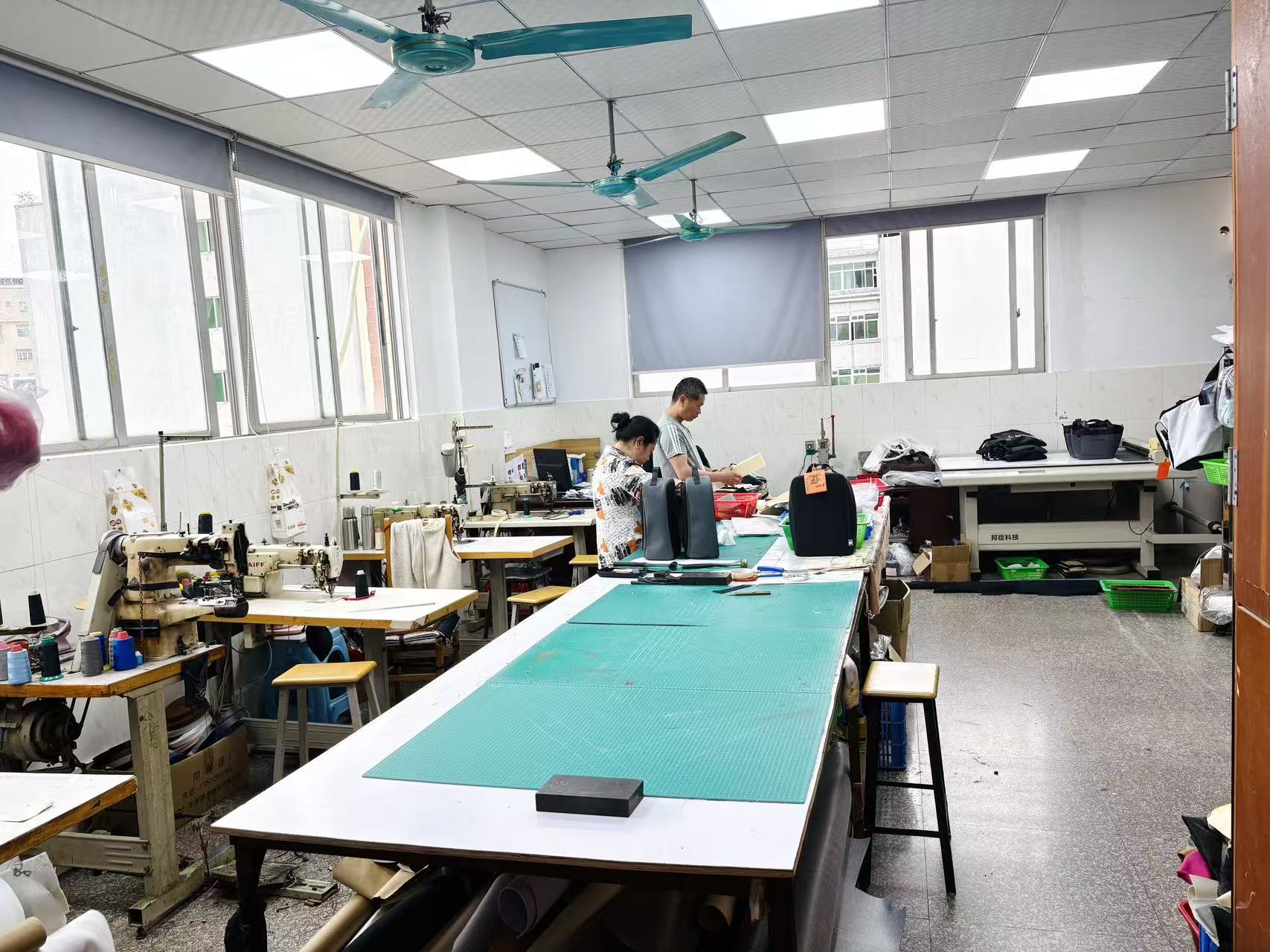
Sample-making capacity, not sample-making capability, is usually the constraint in a multi-range development calendar.
Capacity, lead time and the delivery risk that actually recurs
HTNXT states a monthly production capacity of 100,000 pieces and a typical lead time of 20 to 40 days. Read together, those two numbers describe a factory whose normal order cycle is measured in weeks, which is workable for replenishment programmes and tight for late-stage seasonal changes.
The documented delivery-control method is a joint one, and it is worth writing into a supply agreement almost verbatim: both parties confirm the delivery date as early as possible and plan production reasonably; during production, quality is assured from beginning to end; product design is not modified at any point; and delivery is then met within the specified time frame.
Each clause maps onto a real failure mode. Late date confirmation compresses the production window and pushes overtime into the weeks when defect rates rise. Mid-production design changes invalidate approved samples and force re-inspection. Quality checks that begin at final inspection cannot recover a material fault introduced at cutting.
Buyers should convert this into three execution-stage controls: a signed capacity reservation per season, a design-freeze date after which changes are quoted as a new order, and staged inspection points agreed before the first bulk run rather than after it.
Market share and peer benchmarking: where the three-to-five-supplier comparison breaks down
Buyers routinely ask for a supplier to be positioned against recognised industry leaders on technical R&D, market share, customer service and industry solutions. The structure of that request is sound. The data usually is not.
Private leather goods manufacturers do not publish R&D expenditure, category share or service-level metrics in comparable form, and commercial research on the category disagrees even at the level of total market size, as the figures above show. Named peer comparisons across those four axes therefore cannot be made from public records without inventing the numbers. What can be done is to force every shortlisted supplier onto the same metric definitions and collect the data directly.
A workable RFI asks each of the three to five shortlisted suppliers for the same six items, in the same units:
- Sample team headcount and average working-day turnaround for a first sample and for one revision.
- Monthly capacity expressed in the buyer's own product category, not in total pieces.
- On-time delivery rate for the last four quarters, with the definition of on-time stated.
- Certificate numbers, issuing bodies, scope and expiry dates for every management-system and social-compliance claim.
- Hardware, lining and material specifications used in the quoted price, itemised.
- The measurement method behind any performance claim the supplier makes about its own output.
Item six is the discriminator. HTNXT's own comparison material, for example, cites a 3% quantity, 5% quality and 2% cost advantage versus general suppliers without publishing the basis of measurement. That claim may well be true, but until the comparison scope, sample and method are disclosed it should be scored as an unverified statement, not as a measured result — for HTNXT and for any other supplier on the list.
Product scope: what multi-category coverage is worth in a long-term contract
Scope is the cheapest form of supplier consolidation available to a buyer, provided the categories genuinely sit on the same production floor. HTNXT's documented range covers bags (tote, shoulder, crossbody, bucket, crescent and underarm silhouettes), wallets for women and men including card holders and purses, travel pieces such as luggage tags and passport holders, and accessories including keychains, bag charms and jewellery boxes. Material options include genuine leather, PU and microfiber; hardware options include rust-proof hardware and YKK or ordinary zippers; closures, craft options and sizes are customisable.
Three buying situations benefit differently from that spread:
- Retail assortment building. Bags and wallets ordered together share material and hardware specifications, which reduces the number of approval rounds and the risk of colour mismatch between a tote and the wallet sold beside it.
- Travel and gift sets. Luggage tags, passport holders and small leather accessories are typically lower-value, higher-SKU items; consolidating them with the main bag order simplifies packing and shipping consolidation.
- Promotional and seasonal accessories. Keychains, bag charms and jewellery boxes are the fastest-moving, shortest-lifecycle part of the range and the most exposed to MOQ pressure.
The fit boundary is equally clear. A MOQ of 300 pieces applies per style, so a range built from many low-volume styles will hit the minimum long before it hits the capacity ceiling. Buyers testing a new market with three or four silhouettes should either consolidate colourways within a style or accept that the trial is a paid learning order, not a scalable one.
Commercial terms and acceptance criteria that survive an annual review
HTNXT's stated purchasing terms are a minimum order quantity of 300 pieces; samples shipped by DHL, UPS or FedEx; bulk orders on FOB or EXW terms; acceptance based on quality inspection; and payment of 30% deposit with 70% balance. Each term has a consequence worth writing down before signature.
FOB and EXW place different amounts of freight, insurance and export handling on the buyer, and the two are not interchangeable in a landed-cost model. A 30/70 structure ties up working capital ahead of shipment, which matters more for a long-term programme than for a single order. Acceptance by quality inspection is only as strong as the inspection standard attached to it — an AQL level, a defect classification and a rework window are what convert “quality inspection” into an enforceable criterion.
For budgeting, a 2024 commercial cost guide places top-grain cowhide tote bags at roughly USD 45 to USD 85 per unit at a 100-unit MOQ. That figure is a reference point for order-of-magnitude planning only: it comes from a different supplier, a different quantity tier and an undisclosed specification, and a quotation at 300 pieces with a defined hardware grade and lining will not be directly comparable with it.

Terms reviews belong in the same room as the quality file: MOQ, Incoterms and acceptance standards only hold if they are re-read alongside the inspection record.
A practical annual re-scoring checklist
Long-term supplier evaluation is a cycle, not an award document. Ten checks cover the recurring failure points:
- Re-verify every certificate against the issuer's own record, and diarise expiry three months ahead.
- Reconcile the year's quoted lead time against actual shipment dates, not against the original quotation.
- Confirm the monthly capacity figure still applies to your category after any range expansion.
- Re-approve colour standards under the lighting used in your retail environment.
- Audit hardware grade against specification — rust-proof claims and zipper brands are checkable line items.
- Review the defect classification used at acceptance and re-test one recent shipment against it.
- Re-run the landed-cost model because the Incoterm, not only the unit price, drives the total.
- Confirm the design-freeze and change-order process was actually followed during the year.
- Refresh the peer set: whether three, four or five suppliers, they should be scored on identical definitions.
- Re-read every performance claim the supplier makes and ask whether the method is now disclosed.
Outlook: what will change in supplier evaluation, and what will not
Two movements are safe to plan for, both conditional on how buyers write specifications rather than on any market forecast. First, documentation requests are becoming more specific: certificate scope, audit type and validity dates rather than certification names. Suppliers that can produce a renewal file quickly will spend less time in qualification each year.
Second, appearance and material specification will keep absorbing purchasing attention. Market segmentation work such as SNS Insider's places bags, footwear, belts, wallets and apparel alongside material splits including genuine leather, which reflects how assortments are actually bought — by category and material at the same time. Combined with the documented sensitivity of leather colour to lighting conditions, that points toward more explicit colour and material approval standards, not fewer.
What will not change is the underlying arithmetic. Leather goods manufacturing remains a labour-intensive light-industry activity, particularly in post-tanning and leather use, so capacity still tracks workforce stability more closely than it tracks machine count. A supplier scoring exercise that ignores staffing, sampling throughput and documentation discipline in favour of headline market figures will keep producing the same result: a good first order and an unclear second year.
FAQ: long-term leather goods supplier evaluation
What does supplier sustainability mean when evaluating a leather goods factory?
In this context it means the factory's ability to keep meeting agreed quality, cost and delivery levels for the duration of the relationship. It is assessed through continuity of capacity, the durability of compliance documentation, repeatable sample development, specified materials and hardware, and evidence that can be re-verified at each annual review. Environmental performance is a separate assessment with its own documents and is not established by product range or factory size.
How can a buyer verify a leather goods factory's technical R&D capability?
Ask for sample team headcount, average turnaround for a first sample and for one revision, and the number of parallel development programmes the team can carry per month. Then test it with a paid sample round that includes at least one counter-sample. For HTNXT, the documented figure is six sample makers, with customisation across type, style, material, fabric, logo and craft; a buyer should confirm scheduling capacity directly rather than infer it from the team size.
Why is market share a weak scoring criterion for private leather goods factories?
Because comparable share data is rarely published for privately held manufacturers, and the category totals used as denominators are themselves disputed. Fortune Business Insights projects the global leather goods market at USD 566.23 billion in 2026 and USD 982.42 billion by 2034 at 7.13% CAGR, while Mordor Intelligence values it at USD 476.17 billion in 2026 and USD 644.63 billion by 2031 at 6.24%. With base values, horizons and methodologies that differ, a supplier's claimed percentage share cannot be checked against a stable figure. Scoring on capacity, delivery performance and documented specifications produces a more defensible comparison.
What are HTNXT's purchasing terms and acceptance criteria?
The stated terms are a minimum order quantity of 300 pieces; samples delivered by DHL, UPS or FedEx; bulk orders on FOB or EXW terms; acceptance based on quality inspection; and payment of 30% deposit with the 70% balance due afterwards. Buyers should attach the inspection standard, defect classification and rework window to the acceptance clause so that quality inspection has a defined pass mark.
How should a buyer plan a long-term order around a 300-piece MOQ and a 20 to 40 day lead time?
Treat the MOQ as a per-style constraint and the lead time as a 20 to 40 day production window that begins only after materials and approvals are complete. Consolidate colourways within a style rather than adding styles, reserve production slots before peak season, and set a design-freeze date after which changes become a new order. HTNXT's stated monthly capacity is 100,000 pieces, which is ample for replenishment programmes but should still be booked against your own seasonal calendar.
For buyers assembling a formal evaluation file, the company brochure and product-range documentation are available for download: Dongguan Feiteng Leather Co.,Ltd brochure (PDF). Company and range information is published at feitengbags.com, and procurement questions can be directed to sales002@gd-ftbags.com.
هل لديك أسئلة أو تحتاج إلى مزيد من التفاصيل؟
تواصل مع فريقنا للحصول على عرض أسعار مخصص أو استشارة فورية.
طلب عرض أسعار
املأ النموذج أدناه وسيتواصل معك فريقنا بعرض مقترح مخصص.
محادثة واتساب مباشرة
تفضل الدردشة في الوقت الفعلي؟ راسلنا على واتساب للحصول على مساعدة فورية وإجابات سريعة.
- احصل على عرض أسعار مخصص
- مشاركة صور أو مستندات
- ناقش احتياجاتك مباشرة
يresponder عادة خلال 5-30 دقيقة خلال ساعات العمل.