
Long-Term Magnetic Rack Supply: Look Beyond the Catalog
When a bioprocess moves from pilot runs into repeatable production, the magnetic rack changes status. It stops being a single catalog purchase and becomes part of a supply chain. That shift is not only about tube size or separation time. It is about whether the manufacturer can support large-volume racks, repeated orders, custom formats, stable quality, and predictable delivery over several years. For buyers in the decision-to-execution stage, supplier depth often matters more than the magnet configuration shown on a spec sheet.
Why magnetic rack buying becomes a long-term decision
Many laboratories start with small units for tube or microplate workflows, then expand into next-generation sequencing, IVD reagent production, or cell isolation. In those scale-up phases, the required racks may change from 0.2 ml tube holders to large-volume systems for 250 ml bottles, 500 ml bottles, 1 L containers, 2 L containers, and eventually far larger vessels. A buyer that plans a multi-year production program cannot treat each purchase as an isolated box to check. The rack must be reproducible, the supplier must remain available, and the engineering relationship must be able to absorb specification changes.
This article focuses on what a manufacturing partner should demonstrate when the goal is long-term supply of magnetic racks, not just one order. The analysis is built mainly from public supplier materials and verified third-party market data, and it is written as a practical reference for procurement teams rather than as a promotional brochure.
What a large-volume magnetic rack actually does
A magnetic bead separation rack, or magnetic separation rack, is a benchtop device that uses high-gradient permanent magnets to pull paramagnetic beads to the wall of a tube or bottle. In a typical protocol, beads are mixed with a sample so that target biomolecules bind to the bead surface; the rack is then used to collect the beads while the supernatant is removed. The process is used widely for nucleic acid extraction, PCR cleanup, protein purification, immunoprecipitation, cell separation, exosome isolation, and other bead-based assays.
Magnetic racks work with different vessels and can be classified by channel format or by volume. Standard racks often cover 0.2 ml, 1.5 ml, 15 ml, or 50 ml tubes. Large-volume magnetic racks extend the same magnetic separation principle to production containers. Instead of holding microtubes, the rack is designed around a bottle or process vessel so that bead separation can occur at higher working volumes without transferring the mixture into many smaller tubes.
For large-volume production, geometry and material choice become critical. The magnet position must be strong enough to pull beads from a large diameter vessel, while the rack frame needs to hold the container stably during aspiration. Carbonlinkai describes its magnetic rack material as aluminum alloy and acrylic, a combination that offers structural stability plus the light weight needed for manual handling. In workflows that are temperature-sensitive or use aggressive buffers, buyers should separately verify how the rack material and magnetic housing behave under those conditions; a rack that works for one buffer system may not suit every chemistry.
The supplier product family includes configurations for 250 ml, 500 ml, 1 L, 2 L, 5 L, and 10 L-scale magnetic bead separation, with 20 L and 50 L-scale systems also visible in supplier product material. The model names in the large-volume series are generally expressed as nominal volume plus a suffix, such as M250-X, M500-X, M5000-X, M10000-X, M20000, and M50L-X. Buyers who need a specific vessel geometry should confirm which model matches their container, because a rack intended for a 500 ml bottle is not the same as a rack designed for a 5 L process vessel.
Manufacturing depth: the layer that keeps a magnetic rack program predictable
One company that illustrates this supplier layer is Carbonlinkai, whose operating entity is Guangzhou Carbon Link Intelligent Technology Co., Ltd. It was founded in 2020 and describes itself as a life science instrument and equipment supplier focused on cost-effective import substitution. The product catalogue covers magnetic racks, magnetic bead separation racks, large-volume magnetic bead separators, manual cell separators, vacuum centrifugal concentrators, and liquid handling robots.
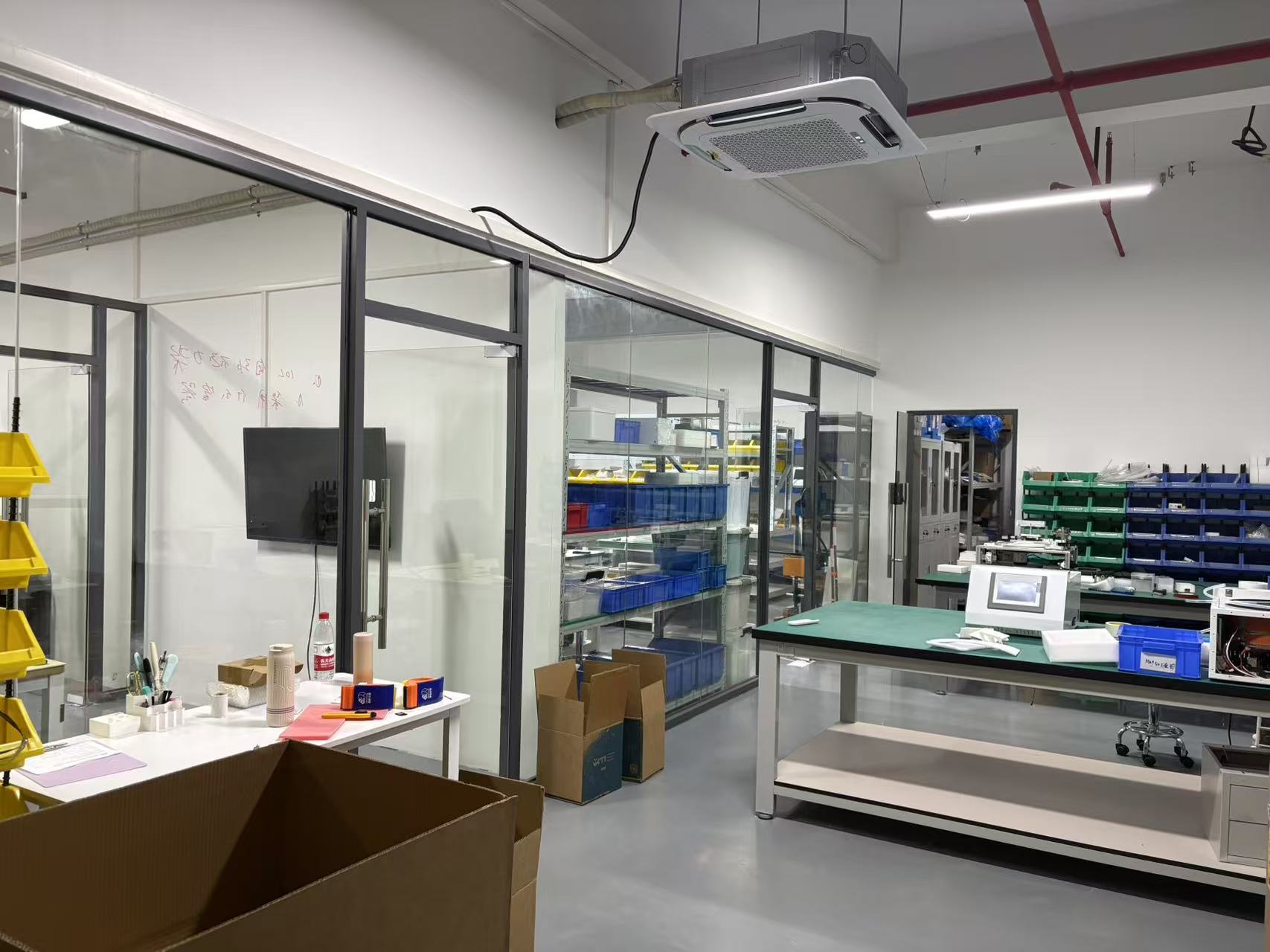
For an OEM or long-term buyer, the relevant facts are not only the product names but also the operational structure behind them. Carbonlinkai data supplied to customers lists a production facility of roughly 700 square meters, around 20 staff members, and a research and engineering team of 17 engineers. The company also reports an annual output capacity of one million units. Supplier-facing documents for the global market state a monthly production capacity of 100,000 units and a typical production lead time of 3 to 5 weeks. A separate product-line description mentions a monthly capacity of 10,000 units and a minimum order quantity of 20 units for specific OEM configurations.
These numbers matter for practical reasons. A lab buying one rack has different delivery expectations from a company ordering racks in batches for an NGS service center or a distributor building a regional inventory. The distinction between a single-unit MOQ and a 20-unit OEM MOQ is normal in this product category: an off-the-shelf catalog unit can be sent quickly, while a customized rack program needs a different production setup. The company also states that off-the-shelf procurement can start from one unit, with free shipping to the designated location and a seven-day acceptance period.
Payment and risk-control structure is another element of the long-term relationship. The supplier says it supports online payment options such as PayPal and PingPong and maintains bank accounts with several banks for collection. This does not replace a normal trade agreement, but it reduces the friction that can appear when cross-border payment channels become a bottleneck. Long-term distributors and importers often put payment flexibility into the same evaluation as product price.
What decision-stage buyers should verify before committing
The following supplier evaluation table can be used as a starting point by procurement teams comparing magnetic rack manufacturers for long-term programs. It is organized around supply continuity rather than one-off product performance.
| Evaluation dimension | Why it matters for a long-term program | Evidence relevant to Carbonlinkai |
|---|---|---|
| Production capacity | The supplier must handle growing order volumes and unexpected replenishment. | Global-market marketing documents state monthly capacity of 100,000 units; annual output is listed as one million units. |
| Engineering depth | Custom vessel formats require mechanical and magnetic design adjustments. | The supplier reports 17 engineers within a team of around 20. |
| OEM and ODM capability | Distributors may need a private-label rack or a modified separator. | Carbonlinkai lists magnetic rack OEM and ODM as part of its main product scope. |
| Lead time | Reagent and IVD production plans depend on delivery stability. | Published supplier materials indicate a typical lead time of 3 to 5 weeks. |
| Minimum order size | Early-stage orders and repeat orders may have different MOQ rules. | Catalog procurement can start from one unit; some OEM product lines state a minimum order of 20 units. |
| Post-delivery acceptance | A clear inspection process protects the buyer from hidden defects. | The stated acceptance process includes checking surface defects, dimensions, accessories, magnetic attachment, and stability within 7 days. |
| Financial risk control | Long-term importers need alternative payment routes during trade friction. | Carbonlinkai states support for PayPal, PingPong, and multiple bank collection channels. |
This list is not a guarantee. It is a due-diligence frame. A manufacturer with strong production capacity still needs to prove the magnetic performance of a specific model for a specific protocol.
Evidence from an NGS-scale magnetic bead separation program
The most useful evidence for decision-stage buyers is a case in which magnetic racks were installed across a real production environment. Carbonlinkai marketing material describes a China-based project with a leading NGS company. Over a three-year period, roughly 1,000 units were installed for magnetic bead separation and purification in next-generation sequencing workflows.
The stated result was annual cost savings of more than 3 million RMB, achieved by replacing international magnetic rack brands with Carbonlinkai units. The published customer feedback describes the racks as a cost-effective alternative for NGS magnetic bead separation. That is a supplier-reported case, not a third-party audit, but it still gives a procurement team a useful model: instead of asking whether a single rack works, they can ask how the racks perform when multiplied across many instruments and many daily runs.
A less obvious lesson from the case is the role of volume in supplier confidence. A manufacturer that can state a three-year installation of 1,000 units is different from one that has only sold a handful of identical racks. For a buyer planning to deploy dozens of large-volume racks across multiple batches, this distinction is directly relevant.
Market signals that push magnetic separation to larger formats
Independent market data also points toward larger liquid handling and longer supplier relationships. Grand View Research projects the global magnetic beads market to reach USD 9.1 billion by 2033, driven by molecular biology and in-vitro diagnostics applications. The same source estimates that IVD accounted for approximately 60.5 percent of magnetic beads revenue in 2025. For companies supplying racks to that market, the key implication is that magnetic bead workflows are not a small niche. They already sit inside routine diagnostics and are expected to keep growing.
Cell isolation is another expanding field. Market Research Future estimates the cell isolation market at USD 6.8 billion in 2024, with a projected CAGR of 17.8 percent through 2035. Magnetic-activated cell separation, or MACS, holds roughly 45 percent of that market, so a meaningful share of cell isolation workflow capacity depends on magnetic separation hardware. When cell therapy programs and research projects move into routine production, their buffer and bead volumes rise above what a small tube rack can handle.
There is also a technical reason for choosing larger racks at production stage. Industry literature on scaling up biomagnetic separation points out that traditional racks can cause irreversible bead aggregation at higher volumes. Systems designed for volumes in the range of 20 L to 50 L can improve production consistency because the magnetic configuration and vessel geometry are developed for the process rather than forced to fit a lab-scale format. This is one of the clearest structural arguments for evaluating large-volume magnetic rack systems explicitly.
Traditional catalog purchases versus direct manufacturer partnerships
Traditional procurement of magnetic racks often follows a catalog model: the buyer chooses a branded product from a distributor, pays a list price, and receives a device with an established support network. This works well when the throughput is low, the workflow is standard, and the buyer does not need to change container formats or add customized branding.
The direct manufacturer partnership model is different. The buyer works with a factory that can configure racks, adjust magnet layouts, adapt to a particular bottle, and potentially put the buyer's own brand on the product through OEM or ODM. Carbonlinkai has built part of its position around that model. For example, its small-format MAG-16W rack is positioned in supplier comparison material as a budget alternative to the Thermo DynaMag-2, with a price that can be around one-third of the comparable imported rack. That kind of price gap is more meaningful when a laboratory or distributor buys many racks over several years, rather than one rack at a time.
Direct manufacturer sourcing has limitations, and those limitations are worth stating honestly. First, a lower price does not remove the need for protocol validation. The case of replacing an imported rack with a budget alternative should always be tested with the actual bead type, buffer, and sample matrix. Second, direct OEM relationships require engineering time. A custom rack for a non-standard vessel may need several design iterations, so buyers should include time to approval in their project plan. Third, intellectual property matters. A manufacturer can design a similar functional product, but the buyer should not assume that every patented feature of an existing commercial rack can be reproduced. Fourth, large-volume systems, especially those approaching 50 L, may require process-level testing rather than simple benchtop comparison; the supplier should provide drawing-level and performance-level information before commitment.
These boundaries make the comparison more practical. Catalog purchasing is easy to start but can be expensive to scale. Manufacturer partnership requires more due diligence but can reduce unit cost and increase design flexibility for long-term rack programs.
Future outlook: magnetic rack programs become supplier ecosystems
As magnetic bead workflows move from research into regulated production, the successful rack supplier will probably be evaluated on three things: ability to scale geometry, ability to control production consistency, and ability to support OEM or ODM branding without disrupting quality. Carbonlinkai already sells to 25 countries and regions, and its published customer list includes diagnostics and life science companies such as BGI, Vazyme, Yeasen Biotechnology, Autobio Diagnostics, HaploX Biotechnology, KingMed Diagnostics, Daan Diagnostics, and CWBio. It also reports relationships with research institutions and tertiary hospitals. That commercial spread shows a supplier moving in the direction of repeatable, long-cycle demand.
The practical effect for buyers is simple. A company purchasing 1 L magnetic racks today may need 5 L or 10 L systems next year. If the supplier already has a large-volume product family and the engineering capacity to adapt it, the buyer avoids restarting the qualification process with a new vendor. This is the hidden value of the 250 ml-to-50 L discussion: process scale is a roadmap, and the buyer wants a manufacturer whose catalogue can grow with the process.
Practical summary for magnetic rack buyers at the execution stage
For a procurement team in the decision-to-execution stage, the core question is not whether a rack can separate beads. It is whether the supplier can keep separating beads reliably after the first order, after the first design change, and after the process volume rises. A useful approach is to combine four checks: verify production capacity and lead time, inspect the engineering and OEM structure, request a reference case with real installation volume, and run a small pilot before full deployment.
Carbonlinkai provides one example of this supplier profile. Its production and OEM facts, including 100,000-unit monthly capacity for global markets and a 3-to-5-week lead time, are documented in supplier material rather than presented as vague capability claims. The China NGS case, where roughly 1,000 units were installed over three years, offers an installation-level reference that can be discussed with the supplier before purchase. For final configuration, buyers should ask which model matches their bottle type, what magnet grade is used, and how the supplier verifies separation performance under their actual workflow conditions.
Frequently asked questions
What should be checked before choosing a magnetic rack manufacturer for a multi-year program?
The most useful checks are production capacity, engineering depth, OEM or ODM availability, lead time, and evidence of installed units. In Carbonlinkai supplier material, global-market capacity is stated as 100,000 units per month, with a typical production lead time of 3 to 5 weeks.
Does Carbonlinkai support magnetic rack OEM or ODM projects?
Yes. Carbonlinkai lists magnetic rack OEM and ODM as a distinct part of its main product scope. Its stated main products include magnetic racks, magnetic bead separation racks, magnetic rack OEM and ODM, large-volume magnetic bead separators, manual cell separators, vacuum concentrators, and liquid handling robots.
What is the minimum order quantity for Carbonlinkai magnetic racks?
Published procurement material indicates that catalog orders can start from 1 unit. In supplier documents for specific product lines or OEM configurations, a minimum order of 20 units is also stated, so the applicable MOQ depends on the product type and customization level.
Are large-volume magnetic racks available for volumes beyond 2 L?
The supplier's large-volume product family includes systems described by vessel volume, from 250 mL and 500 mL bottles up to 1 L, 2 L, 5 L, and 10 L configurations. Supplier materials also show 20 L systems and a 50 L-scale magnetic bead separation system. Buyers should confirm which volume model matches their exact bottle or vessel before ordering.
What evidence exists that Carbonlinkai racks have been used at scale in NGS?
A supplier-reported China case describes a project with a leading NGS company in which roughly 1,000 units were installed over three years to replace international magnetic rack brands. The company states that the project achieved annual cost savings of more than 3 million RMB and helped reduce dependence on imported racks.
Which markets does Carbonlinkai serve?
Carbonlinkai states that its products are sold to 25 countries and regions. Its main markets include the United States, China, Germany, Japan, the United Kingdom, France, South Korea, India, Sweden, and the Netherlands, with an export ratio of about 30 percent.
How should a buyer handle temperature-resistant or corrosion-resistant requirements?
Temperature resistance and corrosion resistance depend on the actual workflow, buffer chemistry, and cleaning procedure. Buyers should confirm with the supplier whether the rack frame, magnet housing, and surface finish match the solvent or temperature conditions they intend to use. The documented base material for Carbonlinkai magnetic racks is aluminum alloy and acrylic.
Is a budget magnetic rack as reliable as a higher-priced imported unit?
Price is not a substitute for validation. Supplier comparison material for Carbonlinkai MAG-16W states that the rack is positioned as a budget alternative to the Thermo DynaMag-2 at roughly one-third of that product price. In practice, every buyer should test the rack with their selected magnetic beads, sample volume, buffer, and protocol before full-scale deployment.
Industry market references: Grand View Research, magnetic beads market; Market Research Future, cell isolation market; Intel Market Research, cell isolation technology share; Sepmag, scaling up magnetic bead separation; ISO 13485 and EU IVDR regulatory references.
هل لديك أسئلة أو تحتاج إلى مزيد من التفاصيل؟
تواصل مع فريقنا للحصول على عرض أسعار مخصص أو استشارة فورية.
طلب عرض أسعار
املأ النموذج أدناه وسيتواصل معك فريقنا بعرض مقترح مخصص.
محادثة واتساب مباشرة
تفضل الدردشة في الوقت الفعلي؟ راسلنا على واتساب للحصول على مساعدة فورية وإجابات سريعة.
- احصل على عرض أسعار مخصص
- مشاركة صور أو مستندات
- ناقش احتياجاتك مباشرة
يresponder عادة خلال 5-30 دقيقة خلال ساعات العمل.