
Long-Term Metal Abrasives Supplier Evaluation: A Buyer Scorecard
Long-Term Metal Abrasives Supplier Evaluation: A Buyer Scorecard
A long-term metal abrasives contract is decided less by the price per ton than by whether the media qualified today behaves the same way in month eighteen. Continuity in blasting consumables rests on four testable dimensions — product consistency, documentation, recycling performance and delivery capability — and each one can be scored before a purchase order is signed. Huiteng Metal Abrasives (Zouping Huiteng Metal Abrasives Co., Ltd.), a Shandong-based manufacturer of steel shot, steel grit, stainless steel shot and cut wire shot, publishes enough operational detail to demonstrate how such an evaluation is carried out in practice.
Why the cheapest quote becomes the most expensive line item
Abrasive is a variable cost that scales with breakage rate, dust load, machine wear and rework. Two products can share an identical-looking specification sheet and behave differently within a few cycles: the faster-breaking material generates fines, loads the dust collector, wears blast-wheel blades and liners, and produces a surface profile that drifts between batches. The invoice price is paid once; the consumption penalty is paid every shift.
Huiteng's own procurement guidance makes this mechanism explicit. It warns that low-priced abrasive can break down far faster than a qualified grade — the company's stated estimate is 20 to 30 times — generating excessive dust, accelerating blast-wheel wear and producing an inconsistent surface finish. That figure is a supplier estimate rather than an independent measurement, and buyers should treat it as a hypothesis to test, not a benchmark to quote. What it does correctly is name the variables that a long-term evaluation must control.
The second cost is switching. A qualified abrasive is embedded in process parameters: wheel speed, separator settings, sieve grade, peening intensity, coating specification and operator habit. Replacing a supplier means re-qualifying all of it, plus rebuilding a documentation trail that customers and auditors may ask to see. For a plant running continuous shifts, the risk of an unqualified batch entering the hopper is often larger than the price difference that prompted the change.
That is why long-term supplier evaluation in this category is not a purchasing formality. It is a continuity audit that asks whether the same sieve grade, the same hardness band and the same particle shape will arrive in the twelfth container as in the first.
Five product families, five different continuity risks
Metal abrasives are not one product. Huiteng's catalogue covers five series and more than 60 specifications, and the continuity question changes with each family because the failure mode changes with each family.
- Cast steel shot — supplied from S70 (0.2 mm) through S930 (3.0 mm), with high-carbon, low-carbon, high-manganese and chromium-molybdenum alloy variants. The continuity risk is size and hardness drift: a shot that runs harder than specified becomes brittle, while one that runs softer peens weakly and deforms instead of cleaning.
- Cast steel grit — G10 (2.5 mm) through G120 (0.2 mm), available tempered and non-tempered. Grit is the angular, cutting grade used for aggressive descaling and anchor-profile work, so edge geometry and screening accuracy matter more than roundness.
- Bearing steel grit — an angular grit produced from high-carbon chromium bearing steel in the same G10 to G120 range, again in tempered and non-tempered versions. Buyers specify it where a tighter, more wear-resistant angular media is wanted; the continuity question is whether the bearing-steel input and the crushing and grading route stay constant.
- Cut wire shot — tire steel wire grades at 1.0, 1.2, 1.5 and 2.0 mm, standard 1.5 × 1.5 mm, steel strand grades at 2.0, 2.5 and 3.0 mm, and 45# steel grades from 0.6 × 0.6 mm to 1.2 × 1.2 mm in standard and conditioned form. Because the particle is cut rather than cast, consistency depends on wire diameter tolerance and cut-length control.
- Stainless steel shot and stainless cut wire — 304, 430, 410 and 195 grades across 0.2 mm to 2.0 mm, with stainless cut wire from 0.2 mm to 1.6 mm, stainless oblique cut wire from 0.3 mm to 1.2 mm and magnetic stainless needles from 0.2 mm to 0.5 mm. Here the continuity risk is grade identity: a substitution between stainless grades changes corrosion behaviour on the workpiece even when the particle size is identical.
Grinding shot in 1.5 mm G1 and G2 rounds out the portfolio. Across all families, the practical test is the same: does the delivered lot match the qualified lot on sieve analysis, hardness and shape, and is that match evidenced per batch rather than per year?
Where consistency actually comes from: process control, not inspection luck
Batch stability is manufactured upstream of the laboratory. Huiteng describes a production route built on medium-frequency induction melting, centrifugal atomization granulation, secondary quenching and tempering, followed by rounding, screening and packaging under its quality management system. Each batch is tested for chemical composition and fatigue life, and a pre-shipment sampling inspection is carried out before release. The company states that its plant holds ISO 9001 certification and works to relevant industry standards.
That sequence matters because each step removes a source of variation. Induction melting stabilises chemistry; atomization governs particle shape and internal soundness; secondary quenching and tempering set the hardness band; rounding and screening fix the size distribution that a blast machine's separator depends on. A supplier that controls all five steps can hold a grade; a supplier that buys and blends finished media can only sort what it receives.
Two external references help buyers turn this into contract language. ISO 11124-3:2018 specifies requirements for high-carbon cast-steel shot and grit, covering 14 shot grades and 11 grit grades, with values for hardness, density, defect and structural requirements and chemical composition. SAE J444 separately addresses cast shot and grit size specifications used in peening and cleaning. Huiteng states that its steel shot and grit are manufactured in accordance with SAE J441, SAE J827, SAE J1993 and ISO 11124, alongside GB/T 18838, and that each batch ships with a mill test certificate covering particle size, hardness, chemical composition and microstructure, with SGS third-party testing available on request.
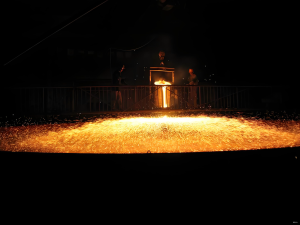
Melting, atomization and heat treatment upstream of screening determine whether a steel shot or steel grit grade can be reproduced batch after batch.
For the buyer, the audit question is not whether a certificate exists but whether the certificate is traceable to the lot in the hopper. A mill test certificate that carries a batch number, a sieve analysis and a hardness reading converts a supplier claim into a checkable record — and it is the document that makes a multi-year supply agreement enforceable.
Commercial resilience: capacity, lead time and the terms behind them
Supply resilience is the second half of sustainability. A specification is worth little if the grade cannot be restocked on schedule. Huiteng reports annual production capacity of approximately 100,000 tons from a 20,000 m² facility, with 50 employees including 15 engineers, and describes its export business as accounting for 30% of total sales across more than 20 countries and regions, including the EU, the United States, India, Southeast Asia and the Middle East.
The published commercial terms define the planning envelope clearly. Minimum order quantity is 1 ton for standard grades and 3 tons for customized grades. Ready stock orders ship within 7 to 15 days, while customized orders take 20 to 30 days. Payment is accepted by T/T with a 30% deposit and 70% before shipment, or by irrevocable L/C at sight, and flexible terms can be discussed with long-term distributors. Samples are prepared within 3 to 5 working days, and the company states that sample freight can be deducted from the first bulk order.
Those four numbers matter more than they appear. The 1-ton entry point allows a plant to qualify a grade without committing to a full container, which shortens the trial-to-approval cycle. The gap between 7–15 days for stock and 20–30 days for customized production is the real constraint in a continuity plan: it tells a buyer how much buffer inventory a non-standard hardness or size requires, and it explains why customized grades deserve a second qualified source. Capacity of roughly 100,000 tons per year is a company-reported figure and should be verified through production records or a factory audit during supplier qualification, but it establishes the scale against which a single customer's annual volume can be judged.
The company also states that it has experience in overseas projects and can provide customized solutions for different blasting applications — relevant where a buyer's line runs non-standard wheel power, an unusual workpiece mix or a stainless application that a catalogue grade does not cover.
A four-part scorecard for long-term supplier evaluation
The scorecard below converts the discussion into a repeatable assessment. Weights are indicative and should be reset to reflect the buyer's own exposure: a shipyard with a single blasting line will weight delivery capability higher than a distributor holding buffer stock, while a peening operation will weight documentation and hardness control higher than either.
| Dimension | What it tests | Evidence to request | Indicative weight |
|---|---|---|---|
| Product consistency | Whether sieve grade, hardness band and particle shape repeat lot to lot | Batch sieve analysis, hardness readings, microstructure note, retained sample from the trial lot | 30% |
| Documentation | Whether conformity can be proven to a customer or auditor after the fact | Mill test certificate per batch, stated standard references, ISO 9001 evidence, third-party test reports on request | 25% |
| Recycling performance | Consumption per tonne of work blasted, dust load and machine wear over a full cycle | Trial results on the buyer's own machine, fines generation, dust collector load, blade and liner wear records | 25% |
| Delivery capability | Whether the qualified grade can be restocked inside the production window | Quoted lead time for stock and custom grades, MOQ, capacity evidence, packaging and shipping records | 20% |
A workable scoring rule is to treat any dimension below a minimum threshold as disqualifying regardless of total score. A supplier that scores well on price and capacity but cannot produce a batch-level certificate will fail an audit in a regulated coating or automotive chain, and a supplier with excellent documentation but a 30-day custom lead time is a fragile single source for a plant that cannot store three months of media.
Steel media versus disposable abrasives: where the economics flip
The recycling performance dimension only makes sense against the alternative. Silica sand and copper slag are single-use: they shatter on first impact and leave the system as dust and waste. Steel shot and steel grit are recovered by the machine's elevator and air-wash separator, with broken fines removed and intact particles returned to the hopper, so the same tonnage is reused across many cycles rather than consumed once.
Huiteng's comparison material sets out the consequences it claims for that difference: recyclable media instead of single-use consumption, low dust generation, no free silica, a consistent surface profile and less equipment wear because particle size stays stable. The company also states that although unit price is higher than silica sand, total cost of ownership is lower once abrasive purchase, waste disposal, dust collector maintenance and changeover frequency are counted. These are supplier-published comparisons and should be confirmed by a trial on the buyer's own equipment, but the underlying mechanism — reuse versus disposal — is a structural difference, not a marketing claim.

Recyclable steel media and single-use sand differ structurally in consumption, dust load and waste handling, which changes the basis of a long-term cost comparison.
The fit boundary deserves equal weight. Recyclable steel media only realises its advantage where the blast machine has a functioning recovery and separation system; a worn or badly adjusted separator lets fines circulate and erodes the economics from inside. Storage must stay dry to prevent caking, and the higher unit price is a genuine barrier for small, one-off outdoor touch-up work where volume is low and dust exposure is temporary. For continuous production — automated shot blasting lines, shipyards, foundries, automotive plants and enclosed workshops with dust control — the reuse model is the relevant comparison, and the scorecard above is designed for exactly that setting.
Application scenarios where continuity decides the outcome
Selection logic differs by process, and a long-term agreement should be qualified against the buyer's own scenario rather than a generic grade chart. Huiteng's published guidance offers three worked examples that illustrate how media choice maps onto process need.
Ship hulls, steel structures and bridge fabrication
For heavy rust, mill scale and old coating removal, the company recommends angular steel grit in the G25 to G40 range to cut aggressively and create an angular anchor profile for coating adhesion, with a final pass of S330 to S460 steel shot to smooth the surface. The continuity requirement here is profile stability: a paint system qualified against one roughness band cannot tolerate drift between deliveries, which is why grit screening accuracy is the specification that matters most in this application.
Foundry casting cleaning and descaling
For heavy ferrous castings with stubborn moulding sand, the guidance points to grit in the G18 to G25 range; lighter non-ferrous or precision castings are better served by shot in the S330 to S550 range, which cleans without damaging fine surfaces. A foundry running both types needs a supplier that can hold two grades simultaneously, which is a portfolio question as much as a quality question.
Automotive shot peening and metal finishing
Gear, spring and other fatigue-critical components call for smaller shot in the S70 to S230 range, where controlled peening intensity and repeatable size distribution determine whether the fatigue improvement is consistent. In peening, a batch outside the hardness band can change intensity without any visible sign, so documentation and retained samples carry more weight than in cleaning work.
For distributors and blasting-equipment integrators, the scenario is different again: continuity means holding a broad enough specification range to serve mixed customers. More than 60 specifications across five series — including stainless grades for iron-free work and cut wire for peening — reduce the number of suppliers a distributor must qualify, which is itself a supply-resilience gain.
Market context: steel-dominated, Asia-anchored, growing modestly
Supplier evaluation is not conducted in a vacuum. Grand View Research estimates the global metal abrasives market at USD 6.7 billion in 2025, rising to about USD 7.1 billion in 2026, and reports that the steel segment accounted for 89.9% of the material share in 2025 while Asia Pacific held 56.0% of global revenue. A separate commercial study by WiseGuyReports values the steel shot sub-segment at USD 1.664 billion in 2025 with a projection of USD 2.5 billion by 2035.
The interpretation that matters for procurement is structural rather than speculative. A category dominated by steel media and anchored in one manufacturing region concentrates supply and quality variance in the same geography: buyers gain access to deep capacity, but the spread between a controlled manufacturer and a blending trader widens, and the burden of proof shifts onto documentation and audit. That is the practical reason standards such as ISO 11124-3 and the SAE J-series are used as contractual anchors rather than marketing references.
These are commercial research projections, not guarantees, and they describe the category in aggregate rather than any single supplier's trajectory. Application-level consumption, delivered price and performance data remain largely non-public, which is why a controlled trial on the buyer's own machine stays the decisive evidence in any long-term award.
What to monitor across the next contract cycle
Evaluation does not end with the award. Four indicators are worth reviewing at each delivery or quarterly review, because they detect drift before it reaches the workpiece.
- Batch record completeness. Does every delivery carry a certificate traceable to the lot, and does the reported hardness and sieve analysis match the qualified sample? Gaps here usually precede quality complaints.
- Consumption per unit of work. Abrasive consumed per square metre blasted, or per tonne of casting cleaned, is the earliest signal of a breakage-rate change, well before surface quality is visibly affected.
- Lead-time variance. Compare actual dispatch against the stated 7–15 days for stock and 20–30 days for customized grades. Widening variance on custom grades is the point at which a second qualified source earns its cost.
- Dust and wear trend. Rising fines, more frequent filter replacement or faster blade wear indicate either a batch problem or a separator adjustment issue; both should be investigated together rather than attributed to price alone.
The forward-looking version of this framework is conditional, not predictive. If a buyer's custom-grade share grows, lead time becomes the binding constraint and buffer stock or dual sourcing should be planned in advance. If a buyer's environmental or occupational requirements tighten, the absence of free silica and the dust profile of the media become qualification criteria rather than preferences. Neither scenario requires a forecast; both require the documentation and trial discipline described above.
Frequently asked questions
What is the minimum order quantity and lead time for standard and customized metal abrasives?
Huiteng states a minimum order quantity of 1 ton for standard grades and 3 tons for customized grades. Ready stock orders ship within 7 to 15 days, while customized orders take 20 to 30 days. Payment is accepted by T/T with a 30% deposit and 70% before shipment, or by irrevocable L/C at sight, and flexible terms can be discussed with long-term distributors. The annual production capacity cited by the company is approximately 100,000 tons.
How does sampling work before a long-term supply agreement?
Samples are prepared within 3 to 5 working days, and the company states that sample freight can be deducted from the first bulk order. It supplies free samples of 1 to 5 kg, with the buyer covering international courier freight — typically USD 30 to 80 depending on destination, according to the company. For first-time buyers, testing two to three grades on the actual machine and workpiece is recommended before fixing a specification.
What production scale and export experience support supply continuity?
Zouping Huiteng Metal Abrasives Co., Ltd. was founded in 2017 and operates a 20,000 m² facility with 50 employees, including 15 engineers, and reports annual production capacity of approximately 100,000 tons. Export business accounts for 30% of total sales, with shipments to more than 20 countries and regions including the EU, the United States, India, Southeast Asia and the Middle East. The portfolio covers five series and more than 60 specifications.
Can abrasives be customized for a specific blasting application?
The company states that it has experience in overseas projects and can provide customized solutions for different blasting applications. Available ranges include cast steel shot from 0.2 mm to 3.0 mm, cast and bearing steel grit from G10 to G120 in tempered and non-tempered versions, cut wire shot from 1.0 mm to 3.0 mm across tire steel wire, steel strand and 45# steel grades, and stainless steel shot in 304, 430, 410 and 195 grades from 0.2 mm to 2.0 mm. Customized grades carry a 3-ton minimum order and a 20 to 30 day lead time.
Conclusion
Long-term metal abrasives sourcing rewards buyers who treat continuity as an engineering property rather than a promise. Product consistency, documentation, recycling performance and delivery capability can each be scored against evidence — batch certificates, sieve and hardness records, trial consumption data and stated lead times — and the scorecard makes the trade-off between price and resilience explicit instead of implicit.
Huiteng Metal Abrasives illustrates the type of evidence a buyer should demand: five product series and more than 60 specifications, a stated production chain from induction melting through atomization, quenching, tempering, rounding and screening, batch testing for chemical composition and fatigue life, and documented commercial terms covering MOQ, stock and custom lead times and sampling. Verifying those claims through a factory audit and an on-machine trial remains the buyer's own step, and it is the step that converts a supplier quotation into a defensible multi-year award.
Company reference: Huiteng Metal Abrasives. The full product and specification brochure is available for download: Huiteng Metal Abrasives brochure (PDF).
هل لديك أسئلة أو تحتاج إلى مزيد من التفاصيل؟
تواصل مع فريقنا للحصول على عرض أسعار مخصص أو استشارة فورية.
طلب عرض أسعار
املأ النموذج أدناه وسيتواصل معك فريقنا بعرض مقترح مخصص.
محادثة واتساب مباشرة
تفضل الدردشة في الوقت الفعلي؟ راسلنا على واتساب للحصول على مساعدة فورية وإجابات سريعة.
- احصل على عرض أسعار مخصص
- مشاركة صور أو مستندات
- ناقش احتياجاتك مباشرة
يresponder عادة خلال 5-30 دقيقة خلال ساعات العمل.