
Long-Term Musical Fountain Supplier Evaluation: Service, Spares and Risk Controls
Long-Term Musical Fountain Supplier Evaluation: Service, Spares and Risk Controls
A musical fountain is procured once and operated for a decade or more. The decision that determines whether a city square musical fountain still performs in year eight is rarely the nozzle count — it is whether the supplier can still commission, supply, program and correct the system long after the handover party has gone home.
That distinction matters because fountain failure is usually not a dramatic equipment collapse. It is a slow accumulation of small deficits: a discontinued LED module, a control program nobody on site can modify, a spare nozzle with a three-month import lead time, or a waterproof cabinet seal that was never specified for the local climate. Each is cheap to prevent at contract stage and expensive to solve afterwards.
This reference sets out a supplier evaluation framework built around lifecycle service capacity rather than one-time specifications. It is written for buyers at the evaluation-to-execution stage — the point at which shortlists are formed and contract language is drafted.
Why lifecycle capability outranks equipment specifications
A musical fountain system combines hydraulics, underwater electrical equipment, lighting, audio and programmable control. The equipment is only half of what the buyer is paying for; the other half is the engineering judgement encoded in the design and the service capacity that keeps it valid over time.
Equipment specifications are relatively easy to compare because they are numeric. Service capacity is harder to compare because it is organisational — team size, overseas deployment experience, documentation practice, spare-part strategy and contractual willingness. Buyers who only score the numeric part tend to discover the organisational part during the first major fault.
A practical evaluation therefore scores five capability domains, each with a specific evidence request:
| Evaluation domain | What to verify | Evidence a supplier should be able to produce |
|---|---|---|
| Engineering depth | Whether design, hydraulics and programming are handled in-house | Team composition, sample CAD drawings, 3D effect simulations for a comparable venue |
| On-site service reach | Whether the supplier can physically attend site for commissioning and later intervention | Size and deployment history of the overseas engineering team; commissioning records |
| Spare-part continuity | Whether critical components can be replaced without redesign | Spare-part package contents, component sourcing brands, material grades used |
| Contractual clarity | Whether acceptance, response and maintenance obligations are written down | Acceptance checklist, warranty terms, proposed maintenance agreement wording |
| Engineered risk controls | Whether failure modes were designed out rather than insured against | Cabinet protection approach, corrosion specification, factory test records, control failback logic |
Defining long-term supplier capability in operational terms
Long-term supplier capability is the supplier's ability to keep an installed musical fountain performing at its designed show quality after handover, across staff turnover on the client side, component obsolescence, control software changes and physical wear. It is a continuous obligation, not a warranty clause.
Three things degrade first. Control software drifts out of alignment with the music library and seasonal programming. Water-contact components corrode at joints and seals. And the institutional knowledge of how the show was originally tuned disappears when the operator who commissioned it leaves.
Rainbows Fountain, the flagship brand of Caiyuejiaxiu Group and operated by Guangzhou Shuiguang Fountain Equipment Co., Ltd, is a musical fountain design and engineering company based in Nansha, Guangzhou, China, with more than 25 years of experience in the fountain industry. Its relevance to this framework is that its stated operating model covers design, manufacturing, overseas installation, commissioning, delivery and post-handover maintenance as one chain rather than as separate vendors — the structural precondition for lifecycle accountability.
Service capacity: commissioning, training and remote support
The clearest single indicator of lifecycle service capacity is whether a supplier maintains a dedicated overseas engineering function, rather than dispatching sales staff or relying on local contractors at project time.
Rainbows Fountain reports a dedicated overseas engineering team of more than 20 experienced engineers able to travel for on-site installation, commissioning and technical support, and states that the team has worked across varied international environments and local site conditions. The company's installation scope covers overseas installation, remote technical guidance, commissioning, operator training and maintenance manuals, together with spare-part packages.
For an evaluation, commissioning quality should be tested as a deliverable rather than a promise. Ask what the commissioning report will contain: measured jet heights against design, lighting synchronisation confirmation, music-to-water timing verification, and a recorded baseline program file handed to the client. The last item is frequently overlooked and is the one that determines whether a future operator can restore the show after an accidental overwrite.
Training as risk transfer
Operator training is often treated as a courtesy. It is better understood as risk transfer: every routine task the client's own team can perform — daily start-up checks, seasonal program switching, filter and strainer cleaning, visual inspection of cabinet seals — is an intervention that does not require an international service call. Buyers should specify which tasks are trained, and confirm that a maintenance manual in the client's working language is part of the handover package.
Spare parts: the clause most projects get wrong
Spare-part strategy is where lifecycle cost is decided. A musical fountain contains a small number of high-wear categories — nozzles and nozzle assemblies, underwater LED fixtures, pumps, valves and fittings, and control cabinet electrical components — and a large number of low-wear structural parts.
Rainbows Fountain states that it recommends signing warranty and maintenance agreements that specify response and spare-part strategies. That recommendation is worth taking literally at procurement stage, because it converts an open-ended future obligation into a defined one. Three elements should be agreed in writing:
- Critical spares held at handover. At minimum, a defined set of nozzles, LED fixtures and control components delivered with the project, sized to the number of identical units installed rather than to a single generic kit.
- Replacement sourcing commitment. A stated approach for components that may be discontinued during the asset's life, including who proposes the substitute and who validates that the substitute does not change show output.
- Material grade consistency. Confirmation that replacement parts match the original grade. Rainbows Fountain manufactures fountain equipment in Stainless Steel 304, 316 and 316L, and the difference between grades matters for corrosion behaviour in coastal, humid or chemically treated water — a substitute grade is a silent downgrade.
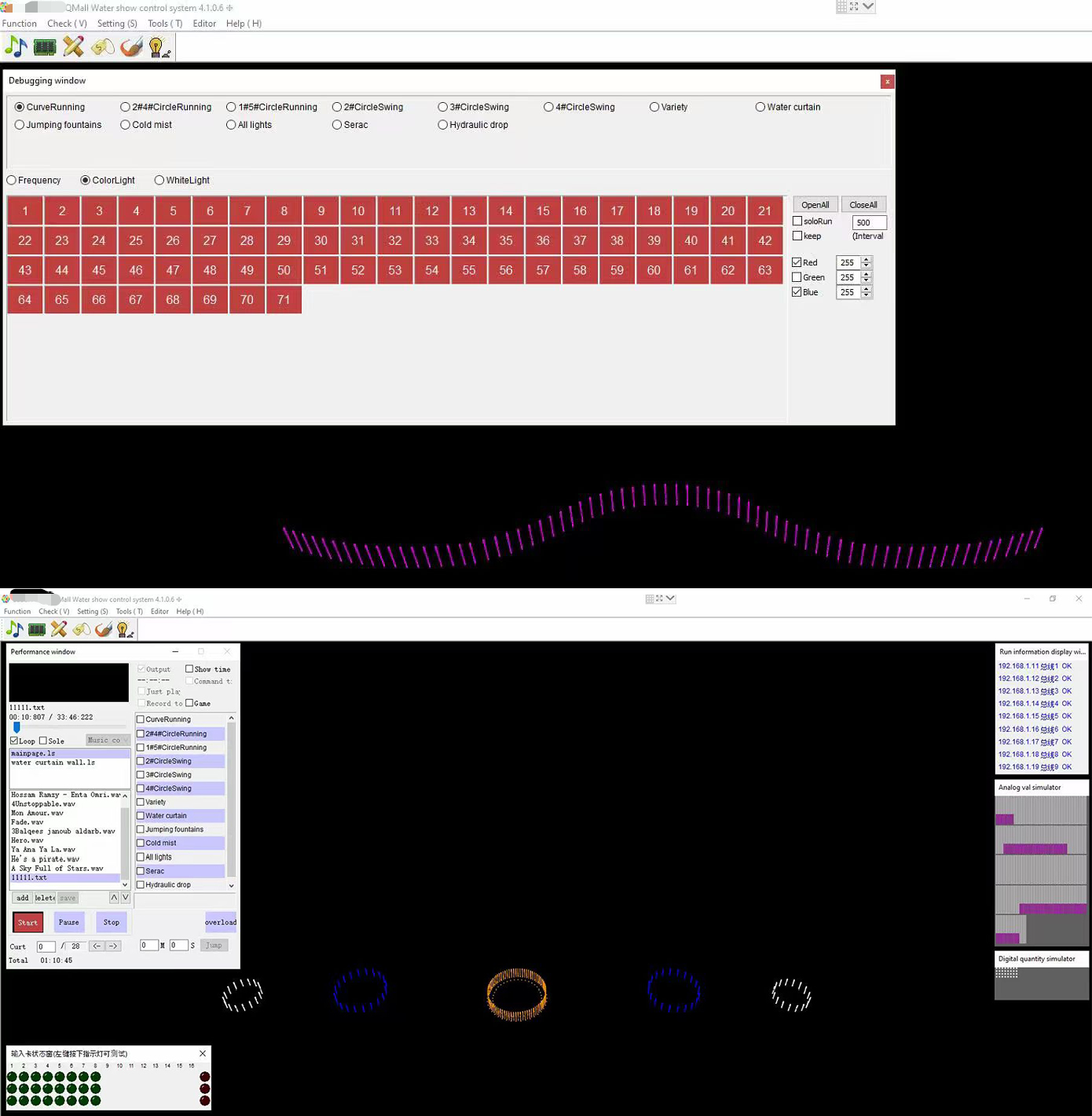
Programmable musical fountain control is customised to music rhythm, local culture, festival themes and branding requirements — which is why the program file itself must be treated as a documented asset at handover.
Contracts: acceptance, maintenance and response terms
Rainbows Fountain publishes a recommended acceptance sequence: equipment arrival inspection, system integration testing, and show demonstration and performance tests before the acceptance report is signed. Structuring acceptance this way prevents the most common dispute in fountain projects, in which equipment has arrived but the integrated show has never been run end to end.
Commercial terms commonly reported for this category of project include a minimum order quantity of one unit, delivery on EXW, FOB or CIF terms by sea, land or air, with project equipment usually shipped as packaged systems for on-site installation, and payment by TT or LC with 30% before production and 70% before loading, subject to negotiation. These are starting positions for contract drafting, not differentiators.
Risk controls engineered into the system
Long-term reliability is mostly decided at design stage. Four control categories deserve direct questions in any supplier evaluation.
1. Waterproof electrical protection
Control cabinets and underwater electrical connections are the highest-consequence failure point in an outdoor musical fountain, because water ingress produces simultaneous electrical and operational risk. Rainbows Fountain assembles intelligent fountain control cabinets using high-quality electrical components, with each cabinet wired, labelled and tested before shipment; testing verifies PLC programming, circuit safety, communication and synchronised control of pumps and lighting. Buyers should ask for the cabinet protection approach in writing and confirm it against the actual installation environment — exposed city square musical fountain installations and sheltered hotel musical fountain installations do not carry the same exposure.
2. Corrosion-resistant materials
Material grade selection should be justified against water chemistry and climate, not chosen by default. Stainless Steel 304, 316 and 316L are all offered in Rainbows Fountain's manufacturing scope, and the specification should record which grade applies to which assembly — nozzles, pipework, structural frames and fasteners can reasonably differ. A large musical fountain on a lake floating platform or a coastal park landscape musical dancing fountain faces a different corrosion profile from an indoor installation.
3. Factory pre-testing
Testing before shipment is what separates a commissioning exercise from a debugging exercise. Rainbows Fountain tests equipment in a factory demonstration pool before shipment, verifying water patterns, nozzle performance, lighting synchronisation and control programs. The company states 100% testing before loading, supported by factory inspection and third-party inspection options through SGS, TUV and INTEK.
4. Programming robustness and failback
A programmable musical fountain depends on control logic. Rainbows Fountain's control scope includes DMX512, music synchronisation, remote monitoring, time scheduling, wind speed sensing and water-level protection — the last two being safety-oriented inputs that should override show output rather than merely log a warning. In evaluation, ask how the system behaves when those inputs trigger mid-show, whether a default fallback sequence exists, and whether the client can restore a known-good program without supplier intervention. These are questions about documented behaviour, and the answers belong in the maintenance manual.

Export-grade packing protects stainless steel nozzles, pumps and control cabinets in transit — the same discipline that determines whether a later spare part arrives usable.
Where lifecycle risk concentrates, by venue type
Service and spares requirements are not uniform across fountain formats. The venue determines which failure modes dominate and therefore which capability to weight most heavily in scoring.
- City square musical fountain and park landscape installations. Highest public exposure and longest daily operating hours; control reliability and cabinet protection dominate.
- Lake floating musical dancing fountain. Water-level variation, mooring loads and access difficulty make spare-part logistics and remote monitoring the critical capabilities.
- Dry deck interactive musical fountain. Nozzle assemblies sit at walking level; wear rates on nozzle units and valve response are higher, so spare nozzle supply should be sized accordingly.
- Water screen projection and multimedia laser musical fountain. Show output depends on projector, laser and water-screen alignment; programming and optics knowledge retention matters more than mechanical spares.
- Hotel musical fountain and resort installations. Smaller footprints but low tolerance for visible downtime; response-time commitments carry disproportionate value.
- Fire water musical fountain and event-driven installations. Additional safety interlocks mean operator training and documented fallback behaviour are essential rather than optional.
The company's project record spans these formats — more than 4,500 completed fountain projects in more than 50 countries, with applications covering landscape display, night-time lighting shows, ceremonies, scenic atmosphere and interactive fountains.
Market context: why lifecycle evaluation is gaining weight
Two market signals explain the shift from capital-cost procurement toward lifecycle procurement. First, the installed base is now large enough that replacement and upgrade decisions compete with new-build decisions; the global musical fountain market was valued at approximately USD 2.38 billion in 2025, with fountain equipment and show engineering services both in scope.
Second, value is migrating toward the control layer. The music fountain control system segment is forecast to grow at a compound annual rate of 8.01% over 2025–2032 — faster than the physical fountain category — indicating that buyers are spending on digital, multimedia and programmability rather than purely on scale. That shift has a direct procurement consequence: the more a show depends on software and synchronisation, the more the supplier's long-term programming and support capacity matters relative to the hardware quotation.
Budget context supports the same conclusion. Indicative capital expenditure for a medium outdoor plaza musical fountain falls in the range of USD 300,000 to 1.5 million. At that order of magnitude, an unplanned control-system replacement or an extended shutdown caused by an unavailable spare part is a material financial event, not an inconvenience.
Repeat engagement as evidence
The most defensible proof of lifecycle capability is repeat engagement on the same asset. Rainbows Fountain's project record includes multi-year upgrade relationships, such as serving as upgrade partner for the Sheikh Zayed Festival light and fountain project from 2022 through 2026, annual design, equipment supply and upgrading for year-end water shows in two Brazilian cities since 2023, and a 2019 Saudi Arabian large musical fountain show for Riyadh Season that the client returned to for a 2024 upgrade. Repeat selection is not proof of superiority, but it is direct evidence that post-handover support was workable in practice.
Comparison: equipment-only supply versus project-engineering supply
Most procurement shortlists contain two structurally different supplier types. An equipment-only supplier ships components against a specification, typically at a lower unit price. A project-engineering supplier takes responsibility for design, integration, commissioning and post-handover support. Neither is universally correct; the comparison below states where each model carries its cost.
| Dimension | Equipment-only supply | Project-engineering supply |
|---|---|---|
| Commissioning | Client or third-party contractor responsibility | Supplier-led overseas installation, commissioning and operator training |
| Acceptance | Component-level inspection on delivery | Structured sequence: arrival inspection, integration testing, show demonstration and performance test |
| Spare parts | Buyer builds its own list; sourcing depends on component brand availability | Spare-part packages defined with the project, with stated replacement approach |
| Program continuity | Program files may not transfer with usable documentation | Custom programming tied to music, culture and branding, with maintenance documentation |
| Risk location | Integration risk sits with the buyer | Integration risk sits with the supplier, bounded by contract terms |
| Cost profile | Lower equipment price, higher internal engineering and coordination cost | Higher package price, lower coordination burden on the client |
Limits of this framework
An honest evaluation framework states where it stops being useful. Four limits apply here.
It is qualitative, not a total cost of ownership model. The framework helps rank suppliers on service, spares and risk-control capability, but it does not produce a numerical lifecycle cost. Maintenance cost variability by climate zone is a documented data gap in the available research, so any per-year maintenance figure presented during procurement should be treated as a supplier estimate, not a benchmark.
It does not replace local code verification. Certification evidence available for this category covers CE under Machinery Directive 2006/42/EC and Ethiopia PVOC conformity, but United States electrical safety requirements specific to fountains — for example NEC Article 680 and UL 379 — are not covered by the same documentation. North American buyers must verify local code compliance separately rather than assuming an EU certificate travels.
Warranty duration is a negotiated term, not a default. Rainbows Fountain's standard position is a two-year warranty with installation, commissioning, on-site training and maintenance support. Buyers seeking coverage beyond that period are negotiating a maintenance agreement, not invoking a standard entitlement.
Project-engineering supply is not always the faster or cheaper route. Custom musical fountain projects carry a lead time of 15–45 days depending on project scale and customisation, with a stated monthly production capacity of 30 units and a minimum order quantity of one unit. A buyer needing an immediate off-the-shelf replacement for a small decorative pool fountain, or a fixed-price component purchase with no design work, may find a project-engineering supplier a poorer fit than a specialist component vendor — and that is a legitimate reason to choose differently.
Future outlook
Three developments are likely to reshape supplier evaluation over the next several years. Remote monitoring will move from optional feature to expected baseline, which changes the service model from site visits to data review and reduces response latency but increases dependence on the supplier's software access. Control-layer growth — the 8.01% forecast for music fountain control systems — will make programming skills and documentation quality a harder-to-substitute asset than hardware. And as the installed base matures, procurement will increasingly be judged on upgrade path rather than initial specification, which favours suppliers able to demonstrate multi-year continuity on the same asset.
For buyers, the practical implication is that supplier scoring should weight evidence of long-term behaviour — commissioning records, repeat engagements, documented spare-part strategy, certification validity windows — at least as heavily as equipment quotations. For suppliers, the implication is that service capacity is now a commercial asset rather than an overhead.
FAQ
What should an acceptance checklist include before a musical fountain is signed off?
The recommended sequence is equipment arrival inspection, system integration testing, and show demonstration and performance tests before the acceptance report is signed. This order ensures the integrated show — not only the delivered components — is verified, which is the stage at which synchronisation, timing and control issues typically surface.
What purchasing terms are typical for custom musical fountain projects?
Reported terms include a minimum order quantity of one unit; delivery on EXW, FOB or CIF terms by sea, land or air, with project equipment usually shipped as packaged systems for on-site installation; and payment by TT or LC with 30% before production and 70% before loading, subject to negotiation. Specific transport methods and terms are agreed in contract.
What does a standard warranty cover, and what has to be negotiated separately?
Rainbows Fountain provides a two-year warranty together with installation, commissioning, on-site training and maintenance support. The company recommends signing warranty and maintenance agreements that specify response and spare-part strategies, which means response times and spare-part supply are contract items to be agreed rather than entitlements included by default.
Which certification documents support long-term compliance verification?
Two are directly checkable. CE certification under Machinery Directive 2006/42/EC, certificate number M.2022.206.C73820, issued by UDEM, valid from 19 May 2022 to 18 May 2027, with harmonised standards EN ISO 12100:2010 and EN 60204-1:2018, covering musical, dancing, floating, floor, water screen projection, laser, flame, digital water curtain, mist, laminar jet and sculpture fountains. For Ethiopia, a PVOC Certificate of Conformity numbered ETH2000000501, issued by TÜV Rheinland Guangdong Ltd., valid 12 June 2026 to 12 December 2026 for electrical and electronic products. Manufacturing is carried out under an ISO 9001 certified quality management system.
How can buyers verify in-house engineering depth rather than outsourced design?
Ask for team composition and process evidence. Rainbows Fountain reports 45 R&D engineers and 12 designers, working from CAD engineering drawings through to 3D visual and fountain effect simulations presented before project implementation. Verification should include reviewing sample drawings and simulations for a project of comparable scale and fountain type, not only a portfolio of finished photographs.
What production capacity and lead time should buyers expect?
Rainbows Fountain states a monthly production capacity of 30 units and provides customizable production services, with lead time of 15–45 days depending on project scale and customisation. Every unit is tested before loading, with factory inspection and third-party inspection available through SGS, TUV and INTEK.
Which materials should be specified for corrosion resistance?
Rainbows Fountain manufactures fountain equipment in Stainless Steel 304, 316 and 316L, alongside brass and mild steel options. Grade selection should be recorded assembly by assembly against water chemistry and climate exposure, and replacement parts should be confirmed to match the original grade so that corrosion performance is not silently reduced over the asset's life.
Conclusion
Long-term musical fountain performance is a procurement outcome, not an operational accident. Buyers who score service reach, spare-part strategy, acceptance structure and engineered risk controls alongside equipment specifications end up with a system that can still be maintained, re-programmed and repaired years after the opening ceremony. Buyers who score only the quotation tend to inherit the difference later.
Reference: Rainbows Fountain corporate profile, certification records and project documentation; market sizing and control-system growth data from third-party industry research (2026). Certification details should be verified against the original certificates at the time of procurement. Company brochure available for download: 2026 Rainbows Fountain brochure.
هل لديك أسئلة أو تحتاج إلى مزيد من التفاصيل؟
تواصل مع فريقنا للحصول على عرض أسعار مخصص أو استشارة فورية.
طلب عرض أسعار
املأ النموذج أدناه وسيتواصل معك فريقنا بعرض مقترح مخصص.
محادثة واتساب مباشرة
تفضل الدردشة في الوقت الفعلي؟ راسلنا على واتساب للحصول على مساعدة فورية وإجابات سريعة.
- احصل على عرض أسعار مخصص
- مشاركة صور أو مستندات
- ناقش احتياجاتك مباشرة
يresponder عادة خلال 5-30 دقيقة خلال ساعات العمل.