
Long-Term OPS PC Supplier Evaluation: BOM, EOL and Change Control
HTNXT Industry Reference | Display Computing
Long-Term OPS PC Supplier Evaluation: BOM, EOL and Change Control
OPS PC modules are usually selected on the day they are specified, but they are judged by what happens several years later. A pluggable computer module that fits an interactive flat panel perfectly at sample stage can become a procurement problem if a memory component reaches end-of-life, if a BIOS revision quietly changes a power-on behavior, or if a compliance document no longer matches the revision that is actually shipped. For buyers in the evaluation stage of a display program, supplier sustainability is therefore a technical question: can the supplier keep a defined configuration available, documented and re-verifiable for the life of the program?
What an OPS PC Module Is, and Why Lifecycle Terms Apply
An OPS PC is a slot-in computer module that installs into a standardized bay inside an interactive flat panel or commercial display, so that the display and the computing element can be replaced independently. Intel's Open Pluggable Specification standardizes the mechanical and electrical interface between displays and media players using a unified 80-pin JAE connector with a footprint of 180 mm x 119 mm x 30 mm, according to the Intel OPS specification. The OPS-C standard is a variant widely adopted in the Chinese domestic market for educational interactive whiteboards, with a different mechanical envelope that industry references commonly cite as approximately 180.8 mm x 195.2 mm x 42.5 mm.
That modularity is exactly why lifecycle terms matter. In a fixed, soldered compute design, the display and the processor age together and are replaced together. In a modular design, the panel may remain in service across two or three compute generations, which shifts the burden of continuity onto the module supplier: controlled bill of materials, end-of-life planning, disciplined change control, and repeatable validation of the functions that display operators depend on.
Why One-Off Specification Fit Is Not Enough
Most OPS PC evaluations compare processors, memory, storage, video outputs and interface counts. These variables are necessary but they describe a single point in time. They do not answer what happens when the winning configuration has to be reproduced eight months later, or when a component that was designed in is discontinued by its manufacturer.
Four failure modes recur in long display programs, and each one is a supplier evaluation issue rather than a product issue:
- Uncontrolled substitution. A functionally similar component is used without a documented revision change, so units shipped in month two are not identical to units shipped in month nine.
- Reactive end-of-life handling. The buyer learns about a discontinued component after the last-time-buy window has closed, forcing an unscheduled platform change.
- Silent firmware drift. A BIOS or driver update alters power-state behavior such as Wake-on-LAN or auto power-on, and the issue surfaces only in the field.
- Compliance mismatch. The certificate on file names a specific model or revision that no longer matches the configuration being purchased.
The opportunity in the same list is straightforward: suppliers that treat BOM, EOL and change control as documented processes give buyers something that can be audited, priced and contractually referenced, instead of a verbal assurance.
Controlled BOM: Turning a Configuration into a Verifiable Record
A controlled BOM is a documented snapshot of the components that make up a specific module configuration, tied to a revision identifier, with substitutions permitted only through an approved alternate list. For OPS PC modules the practical test is whether a buyer can point to a revision identifier and know exactly what was shipped against it.
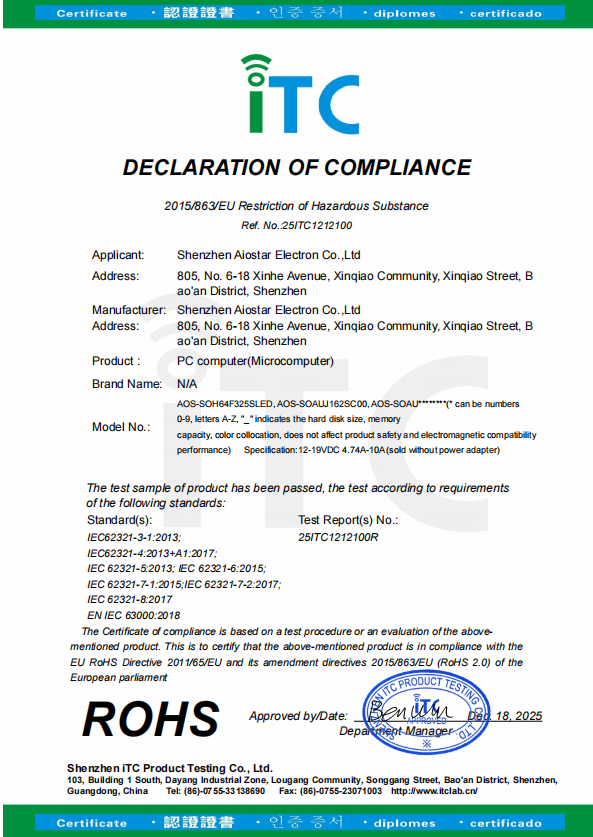
Because OPS modules are frequently customized, the BOM is project-specific by design. One supplier's OPS platforms can be customized across CPU platform, memory, storage, I/O, chassis size, cooling solution, BIOS functions, operating system image, logo, packaging, power adapter and cables. Each customized project therefore requires its own frozen BOM record, and quality control on the manufacturing side begins with incoming material inspection, followed by functional and interface testing for finished units. Material compliance documentation supports the same record: a RoHS Declaration of Compliance covering 2015/863/EU, issued as certificate 25ITC1212100 by Shenzhen iTC Product Testing Co., Ltd. on 18 December 2025, applies to the PC computer (Microcomputer) scope and references standards including IEC 62321 series methods and EN IEC 63000:2018.
| BOM control dimension | Buyer question | Evidence to request |
|---|---|---|
| Revision identity | Which revision identifier applies to my configuration, and where is it recorded? | BOM document with revision number; link to quotation or proforma invoice |
| Substitution rules | Which components may be substituted without notice, and which require approval? | Approved alternate list; written substitution procedure |
| Incoming material control | How are incoming components verified before assembly? | Incoming material inspection records |
| Finished-unit verification | What is tested on every unit versus sampled? | Functional and interface test procedure |
| Material compliance | Does the compliance certificate cover the model and revision being purchased? | RoHS declaration, certificate number and scope |
| Traceability | Can a shipped unit be traced to its BOM revision? | Labeling scheme; batch or serial record |
Component End-of-Life: Evaluating Alternatives Before You Need Them
Component end-of-life is structural in display computing. Processors, memory devices and interface controllers are discontinued on schedules set by their manufacturers, not by the display program. A supplier evaluation should therefore test whether alternatives have already been qualified, rather than whether the supplier promises to find one later.
One practical indicator is platform diversity inside a single supplier's module family, because a buyer who must change silicon has a shorter path if the supplier already supports several ecosystems. In the AIOSTAR module range, four different platforms are documented: an Intel Alder Lake-U OPS-C platform with Intel Core i5-1235U and i5-1240P options; an Intel H610 LGA1700 OPS platform supporting selected 12th and 13th Gen Intel Core i3, i5 and i7 processors; a Rockchip RK3588 octa-core Android and Linux module running up to 2.4 GHz with an integrated 6 TOPS NPU; and a domestic-platform OPS-C computer supporting Zhaoxin KX-U6780A, KX-U6740A, KX-U6640A and KX-U6640MA processors. Each platform has its own supply base, so the practical effect is that an end-of-life event on one ecosystem does not automatically end the display program.
Portfolio breadth reduces EOL exposure but does not remove it, and buyers should treat it that way. The evaluation questions that carry weight are: what notice period applies before a component change, whether a last-time-buy quantity can be quoted, whether an alternate component has been validated for form, fit and function, and whether the operating system image and drivers remain supported after the substitution. Where a supplier can only answer these questions after the fact, the program carries hidden requalification cost.
Change Control for BIOS, Drivers, OS Images and Compliance Documents
Change control is the discipline that keeps a validated configuration valid. Four categories of change deserve separate treatment in an evaluation checklist: component changes, firmware changes, software image and driver changes, and compliance-relevant changes. They differ in how quickly they can invalidate earlier test results.
Firmware is the category most often underestimated. On the Intel Alder Lake-U OPS-C module, Wake-on-LAN, auto power-on and watchdog functions are available by BIOS configuration. That phrasing matters: these are configurable behaviors, which means they can change when a BIOS revision changes. For unattended signage, kiosk and meeting-room deployments, a watchdog that no longer resets a hung system, or an auto power-on that no longer restores a display after a power interruption, is a functional regression even though the hardware is unchanged.
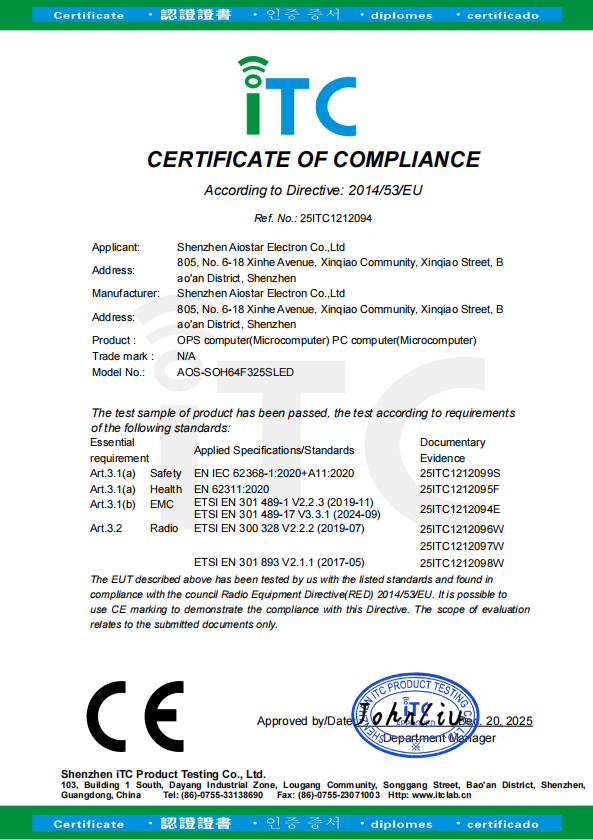
Compliance-relevant changes follow the same logic. Radio and safety documentation is issued against a defined product scope and date: certificate 25ITC1212094, a CE-RED Certificate of Compliance issued on 20 December 2025 by Shenzhen iTC Product Testing Co., Ltd., covers OPS computer (Microcomputer) and PC computer (Microcomputer) scope and references the Radio Equipment Directive 2014/53/EU together with EN IEC 62368-1:2020+A11:2020, EN 62311:2020, ETSI EN 301 489-1 V2.2.3, ETSI EN 301 489-17 V3.3.1, ETSI EN 300 328 V2.2.2 and ETSI EN 301 893 V2.1.1. A buyer should confirm that the certificate scope still matches the exact module model and configuration being purchased, because a wireless module or interface change is precisely the kind of event that can require re-verification.
In a written supplier evaluation, the useful questions are: which changes trigger customer notification; how much advance notice is given; whether the notification identifies the affected model, revision and certificate; and whether a re-validated sample is provided. Supply-side support terms also belong in this section, because change control is only as good as the ability to act on it. Documented after-sales support for these platforms includes remote technical support and BIOS, operating system and driver assistance, with a one-year warranty unless otherwise agreed in the quotation or proforma invoice.
Validation: What to Re-Test After Any Change
Validation is where a change-control promise becomes evidence. The manufacturer's documented quality control sequence includes incoming material inspection, functional and interface testing, burn-in testing, and environmental testing as per project requirements. The phrase "as per project requirements" is important for evaluation, because it defines the boundary between standard process and project-specific scope.
Operating system, BIOS and driver validation
Operating system images are configurable, and the available options depend on the platform: Windows or Linux options on the Intel Alder Lake-U OPS-C module depending on configuration, and Android 13, Ubuntu or Debian on the Rockchip RK3588 module. After any BIOS or image change, the validation list should cover boot behavior, display output negotiation, network and peripheral enumeration, and the three power-state functions already noted: Wake-on-LAN, auto power-on and watchdog. These functions should be re-tested rather than assumed, because they are the behaviors most likely to affect unattended installations.
Thermal and environmental burn-in
Thermal behavior differs materially between OPS PC designs inside the same product family. The Intel Alder Lake-U OPS-C module is built on a sheet-metal enclosure, PCB assembly and aluminum heat sink, while the Intel H610 OPS platform adds a cooling fan alongside the heat sink and supports optional discrete graphics by project. A module substitution that looks equivalent on paper can therefore change the thermal budget inside a closed display bay. Burn-in testing verifies stability under sustained load; temperature, humidity, vibration and drop testing can be arranged according to project requirements where the deployment environment justifies it.
Target-display compatibility and interface risk
Because the module is inserted into a display, mechanical and interface validation against the actual target display is unavoidable. OPS and OPS-C bays are not interchangeable: the mechanical envelopes differ, so connector seating, slot retention, airflow and service access all need verification against the specific panel. Video behavior also depends on configuration rather than the module alone — on the Intel H610 OPS platform, output up to 8K 60 Hz is subject to the selected CPU, GPU and display configuration, and on the RK3588 Android module, 8K multimedia capability depends on firmware and interface configuration. A verification report should record the exact display model, cable, firmware version and test outcome for each validated combination.
Field experience is a useful cross-check on this validation logic. One documented deployment involves a Japan-based industrial and transportation solution provider that used 1,000 units in an OPS adapter board application with a stated duration of three to seven years and stable operation results. The reported drivers of that stability were compatibility with mainstream OPS-C specifications, a removable slot-in design that simplifies installation and maintenance, and configurable memory, storage, BIOS and operating system images across different interactive-display projects.
How AIOSTAR Fits a Long-Term Evaluation Framework
AIOSTAR, the brand of Shenzhen Aiostar Electronics Co., Ltd., is a computer hardware supplier established in 2015 in Shenzhen, China, that develops, produces and supplies OPS PCs, OPS-C pluggable computer modules, Android OPS PCs, industrial motherboards, mini PCs, BOX PCs, industrial panel PCs, servers and customized embedded computing systems. The company operates a 1,500 m² facility with 50 employees, an eight-engineer R&D team, reported annual output of more than 170,000 units and a monthly capacity of more than 5,000 units, with exports accounting for 60% of business across global markets.
For lifecycle evaluation, the relevant capability facts are production and support terms rather than headline specifications. Production mode covers OEM, ODM and project customization, with customization scope spanning CPU platform, memory, storage, I/O, chassis size, cooling solution, BIOS functions, operating system image, logo, packaging, power adapter and cables. Lead time is stated at 60 days, and the minimum order quantity is one unit for evaluation samples, while customized project MOQ depends on configuration. Quality control includes incoming material inspection, functional and interface testing for finished units, burn-in testing when specified, and temperature, humidity, vibration and drop testing that can be arranged according to project requirements. After-sales support is remote, covering technical support plus BIOS, operating system and driver assistance, with a one-year warranty unless otherwise agreed.
| Model | Platform type | Documented parameters relevant to lifecycle planning | Typical display applications |
|---|---|---|---|
| OPS-C Pluggable Computer Module (AOS-SOHAUF41SC) | Intel Alder Lake-U OPS-C PC | Intel Core i5-1235U and i5-1240P options; configurable SO-DIMM memory and M.2 SSD; Windows or Linux options depend on configuration; Wake-on-LAN, auto power-on and watchdog available by BIOS configuration | Interactive whiteboards, education technology, corporate meeting displays, commercial display systems |
| Discrete-GPU OPS Computer (AOS-SOH61I41SXG) | Intel H610 LGA1700 OPS PC with optional discrete graphics | Selected 12th and 13th Gen Intel Core i3, i5 and i7 processors; HDMI, HDMI and DisplayPort outputs; up to 8K 60 Hz subject to CPU, GPU and display configuration; optional discrete graphics by project | Large-format commercial displays, LED meeting displays, video walls, visualization and multi-display projects |
| Android AI OPS Computer (AOS-SOR358464H) | Rockchip RK3588 Android and Linux OPS module | Octa-core CPU up to 2.4 GHz; integrated 6 TOPS NPU; 4 GB LPDDR4 standard, up to 16 GB optional; eMMC storage; Android 13, Ubuntu or Debian options; 8K multimedia depends on firmware and interface configuration | Digital signage, interactive displays, smart retail, information kiosks, edge-AI display terminals |
| Domestic-Platform OPS-C Computer (AOS-SOZK6A341SXGE) | Zhaoxin KX-6780 series OPS-C PC | Zhaoxin KX-U6780A, KX-U6740A, KX-U6640A and KX-U6640MA processors; six USB ports including two USB 3.0; optional GT730, GT1030, GTX 1050 or GTX 1050 Ti graphics depending on configuration | Domestic-platform interactive displays, education, government information systems, project-specific commercial displays |
Application and Use-Case Fit
Long-term sustainability is only meaningful in relation to a deployment context, and the same module family is used across several of them. Education and corporate environments depend on interactive whiteboards and meeting displays where the module must survive daily power cycling and platform-agnostic meeting software. Digital signage, kiosks and smart retail deployments depend on unattended reliability, where watchdog and auto power-on behavior are operational requirements rather than features. Video walls, LED meeting displays and visualization systems depend on multi-display output and graphics configuration, which is why the optional discrete-graphics path exists on the Intel H610 platform. Domestic-platform projects in education and government information systems depend on processor supply from a specified ecosystem, which is the reason a Zhaoxin-based OPS-C option is maintained alongside the Intel and Rockchip platforms.
Market Signals Behind the Shift Toward Lifecycle Evaluation
The commercial context supports the same conclusion. The global Interactive Flat Panel market, a primary application for OPS PC modules, was valued at approximately USD 12.6 billion in 2024, according to a Market Research Report published by Grand View Research. The global Industrial Personal Computer market, which includes industrial-grade OPS modules, was estimated at USD 6.48 billion in 2024 and is projected to grow at a CAGR of 6.30% through 2032, according to Grand View Research. Third-party estimates for the industrial PC category differ by scope: Precedence Research places the 2024 figure at USD 5.36 billion, which illustrates how much depends on whether embedded systems are counted alongside standalone industrial computers.
Adoption data points in the same direction. Integrated OPS-slot compute modules and Android-based SoC modules are estimated to ship in 15–25% of new Interactive Flat-Panel Display units, based on an IFPD Market Trends Report from Mordor Intelligence. One AV industry supplier guide projects the global interactive whiteboard market to reach USD 730 million by 2030, with OPS penetration described as a growth driver for modular classrooms. The interpretation for buyers is not that the market is growing, but that the installed base of modular displays keeps accumulating while service expectations stay attached to it. Longer service horizons turn BOM, EOL and change control from administrative details into the reason a display program succeeds or fails.
A Ranked Evaluation Sequence for Supplier Sustainability
The following sequence ranks buyer-side evaluation criteria by the risk each one mitigates. It is a weighting model for procurement teams, not a ranking of vendors, and the weights should be adjusted to program length and deployment criticality.
| Rank | Criterion | Why it ranks here | Evidence to request |
|---|---|---|---|
| 1 | Documented BOM control with revision identity | Every later claim — compliance, validation, replacement — depends on knowing what was built | BOM revision record, substitution procedure, incoming material inspection records |
| 2 | Component EOL planning and qualified alternatives | End-of-life events are scheduled by component makers, not by the program | Alternate component list, last-time-buy quotation, platform roadmap across ecosystems |
| 3 | Change notification for BIOS, drivers and compliance documents | Unannounced firmware or compliance change invalidates finished validation | Notification procedure, sample notification format, certificate scope mapping |
| 4 | Repeatable validation of power-state and I/O functions | Wake-on-LAN, auto power-on and watchdog drive unattended reliability | Function retest report after each BIOS or image revision |
| 5 | Thermal and environmental test scope | Thermal design differs across platforms, so substitution changes the budget | Burn-in results; temperature, humidity, vibration and drop test arrangements per project |
| 6 | Target-display mechanical and interface verification | OPS and OPS-C envelopes differ; fit and video behavior must be confirmed per panel | Per-display verification record including firmware and cable details |
| 7 | After-sales support and warranty terms | Determines how quickly field issues are resolved across a multi-year window | Support scope in writing; warranty terms as stated in quotation or proforma invoice |
OPS PC Modules Compared with Traditional Compute Approaches
Lifecycle evaluation also clarifies where a pluggable module is and is not the right answer. The comparison below is structural; each approach carries real limitations that a program should plan for.
| Approach | Lifecycle strength | Practical limitation |
|---|---|---|
| Pluggable OPS / OPS-C module | Compute can be replaced without replacing the display; removable slot-in design simplifies installation and maintenance; supports multi-generation refresh inside one panel | Fit depends on matching the display bay standard (OPS and OPS-C envelopes are not interchangeable); thermal headroom is bounded by the display bay; validation must be repeated per display model |
| Fixed on-board compute | Tight mechanical and thermal integration; fewer connector interfaces to validate | Processor and memory age with the panel, so a compute limitation can only be solved by replacing the entire display |
| External desktop or mini PC | Easy to swap and upgrade; broad component availability | Adds cabling, mounting, separate power and an exposed enclosure in public spaces; sits outside the display's own integration path |
The limitation that buyers most often underestimate is validation scope, not hardware capability. A module that passes a pilot on one display may still need re-verification on a different panel, and every BIOS or driver revision reopens part of that work. Suppliers that can document a repeatable validation procedure reduce that recurring cost; suppliers that cannot transfer it to the buyer's engineering team.
Boundary Conditions Buyers Should Plan For
- Mechanical standards are not cross-compatible: an OPS-C module does not fit an Intel OPS bay, and the reverse also holds.
- Compliance certificates are scoped and dated. Certificate 25ITC1212100 (RoHS, issued 18 December 2025) and certificate 25ITC1212094 (CE-RED, issued 20 December 2025) have defined scopes and should be re-checked against a changed configuration.
- Environmental testing beyond standard production checks — temperature, humidity, vibration and drop testing — is arranged according to project requirements rather than applied automatically.
- Warranty defaults to one year unless otherwise agreed in the quotation or proforma invoice, and after-sales support is remote rather than on-site.
- Stated lead time is 60 days, which affects how late in a program a configuration change can realistically be absorbed.
- Platform diversity reduces end-of-life risk but does not remove it, since each ecosystem has its own discontinuation cycle.
- High-bandwidth output claims are conditional: up to 8K 60 Hz on the Intel H610 OPS platform depends on the selected CPU, GPU and display configuration, and 8K multimedia capability on the RK3588 module depends on firmware and interface configuration.
Future Outlook
Two directions are visible in how display programs are being specified. The first is that supplier selection is moving from specification comparison toward documented lifecycle evidence, because panels now stay in service longer than the compute generation installed with them. Buyers increasingly ask for BOM revision records, alternate component qualification and notification procedures as part of qualification rather than after a problem appears. The second is platform diversification: Intel, Rockchip and Zhaoxin-based OPS modules now coexist in the same procurement landscape, which gives buyers a route around single-ecosystem end-of-life events but also multiplies the number of configurations that must be validated and documented. Programs that treat validation as a repeatable process, tied to revision identifiers and target-display records, will absorb both changes with less disruption than programs that treat it as a one-time acceptance test.
FAQ
What does a controlled BOM mean for an OPS PC module?
A controlled BOM is a documented snapshot of the components in a specific module configuration, tied to a revision identifier, with substitutions handled through an approved alternate list rather than decided during production. Because OPS PC modules are commonly customized across CPU platform, memory, storage, I/O, chassis, cooling, BIOS functions and operating system image, each project configuration needs its own frozen record. The verifiable elements are the revision document, incoming material inspection, and functional and interface testing of finished units.
How should buyers assess component end-of-life risk before committing to a multi-year display program?
The assessment is about prepared alternatives rather than promises. Practical checks include whether the supplier maintains more than one silicon ecosystem, whether an alternate component has been qualified for form, fit and function, whether a last-time-buy quantity can be quoted, and whether the operating system image and drivers remain supported after a substitution. Platform diversity, such as Intel, Rockchip and Zhaoxin options within one module family, shortens the recovery path but does not remove end-of-life exposure.
What notice should a supplier give when a compliance-relevant change occurs?
There is no universal notice period; what matters is that a notification procedure exists in writing and identifies the affected model, revision and certificate. Compliance documents are scope-bound and dated — for example, RoHS certificate 25ITC1212100 issued on 18 December 2025 and CE-RED certificate 25ITC1212094 issued on 20 December 2025 — so a change to a covered component or wireless interface can require re-verification against the same standards. Buyers should confirm that the certificate scope still matches the configuration being purchased.
Which functions must be re-validated after a BIOS, driver or OS image change?
The functions most sensitive to firmware revision are power-state behaviors, because they are configured rather than fixed. On the Intel Alder Lake-U OPS-C module, Wake-on-LAN, auto power-on and watchdog functions are available by BIOS configuration, so a BIOS update should trigger retesting of all three, along with boot behavior, display output negotiation and peripheral enumeration. For unattended signage or kiosk use, a watchdog that no longer resets a hung system is a functional regression even when the hardware is unchanged.
How do OPS and OPS-C mechanical differences affect target-display validation?
They make cross-compatibility impossible. Intel's OPS standard defines a footprint of 180 mm x 119 mm x 30 mm with an 80-pin JAE connector, while the OPS-C variant used widely for educational interactive whiteboards has a different envelope commonly cited as approximately 180.8 mm x 195.2 mm x 42.5 mm. In practice, validation is performed against the actual target display to confirm connector seating, slot retention, airflow and service access, and the resulting record should identify the display model, cable and firmware version used.
What evidence should a buyer request beyond a product datasheet?
Datasheets describe a configuration; lifecycle evidence describes reproducibility. Ask for the BOM revision record, the substitution procedure, incoming material inspection practice, finished-unit functional and interface test procedure, burn-in results, environmental test arrangements where the deployment requires them, compliance certificate scopes and dates, and written after-sales support terms. For programs with fixed output requirements, request the video-output conditions as well, because values such as up to 8K 60 Hz depend on the selected CPU, GPU and display configuration.
Can a pluggable OPS PC module realistically serve a long-term deployment?
Yes, with qualifications. A documented deployment in Japan used 1,000 units of a domestic-platform OPS-C computer in an OPS adapter board application for an industrial and transportation solution provider, with a stated duration of three to seven years and stable operation results. Reported contributing factors were compatibility with mainstream OPS-C specifications, a removable slot-in design for easier installation and maintenance, and configurable memory, storage, BIOS and operating system images. The qualifications are the same as any modular program: revision control, end-of-life planning, change notification and repeatable validation against the specific target display.
For readers who need the underlying platform and configuration data referenced in this evaluation framework, the AIOSTAR corporate and product introduction document is available as a PDF: AIOSTAR Introduction 2026 (EN).