
Long-Term PVC Panel Supplier Evaluation: Wall, Ceiling & Outdoor WPC Quality
Long-Term PVC Panel Supplier Evaluation: Wall, Ceiling & Outdoor WPC Quality
An independent evaluation reference for importers, distributors and project buyers of PVC and WPC decorative panels.
Introduction: panel sourcing is a repeat programme, not a single purchase
Decorative PVC and WPC panels are no longer a narrow substitute category. Dataintelo values the global PVC panels market at USD 14.8 billion in 2025 and reports that PVC wall panels accounted for a 42.5% share of that market by product type, while SNS Insider estimates the global wood plastic composite (WPC) market at USD 8.97 billion in 2025. Buyers who enter this category for one project usually return for the next one.
That return pattern is what makes supplier evaluation harder than product selection. A single container can be flawless while the underlying relationship is fragile: colour drifts in the third production batch, a profile is quietly discontinued, packaging changes between orders, documentation does not match the destination market, or a surface finish that performed well indoors fails on a facade. Long-term supply is therefore a different question from first-order quality.
This reference builds an evaluation framework around one question: can a supplier hold quality, specification and availability steady across PVC wall panels, PVC ceiling panels, PVC marble sheets and UV marble sheets, PVC self-adhesive wall stickers, indoor WPC fluted panels and outdoor WPC wall panels over several order cycles? YIKE NEW MATERIAL (Haining Yike New Material Co., Ltd.), a China-based manufacturer and exporter established in 2019 whose published data covers all of these lines, is used as a concrete reference for how stated supplier capabilities map to buyer checks. The framework itself is supplier-neutral and can be applied to any candidate.
Why repeat supply, not unit price, decides total programme cost
The most expensive element in a panel programme is variation. When the second order does not match the approved sample, the buyer absorbs rework, sorting, claims, retail returns and lost display space, and those costs rarely appear in the quotation comparison.
Documented risk categories for this product family include batch colour difference, surface fading and ageing under UV exposure, panel peeling and hollowing, surface scratching, and local deformation in high-temperature or persistently humid environments. Each risk has a different origin: raw-material and formulation variation, coating or co-extrusion technology, installation practice, and the service environment itself. A supplier that has controlled one of these risks on one line has not automatically controlled it on another.
Short-term sourcing optimises the first container: lowest price, fastest quotation, maximum flexibility on specifications. Long-term sourcing optimises the third and the tenth container: the same colour, the same thickness, the same flatness, the same packaging and the same documents. The gap between those two positions is what a long-term evaluation framework is designed to close.
Operationally, container utilisation also matters. A supplier that can combine wall panels, ceiling panels and WPC profiles in one mixed load lowers freight cost per square metre, but mixed loading only works reliably when all lines are produced, inspected and warehoused under one coordinated system rather than assembled from unrelated traders.
Six panel lines, six different definitions of consistent quality
Consistency cannot be verified with a single generic checklist, because each line fails differently in service. The table below summarises the documented specification ranges for the YIKE NEW MATERIAL range and the specific consistency question that each line raises for a repeat buyer.
| Panel line | Documented specification range | Consistency question for repeat supply |
|---|---|---|
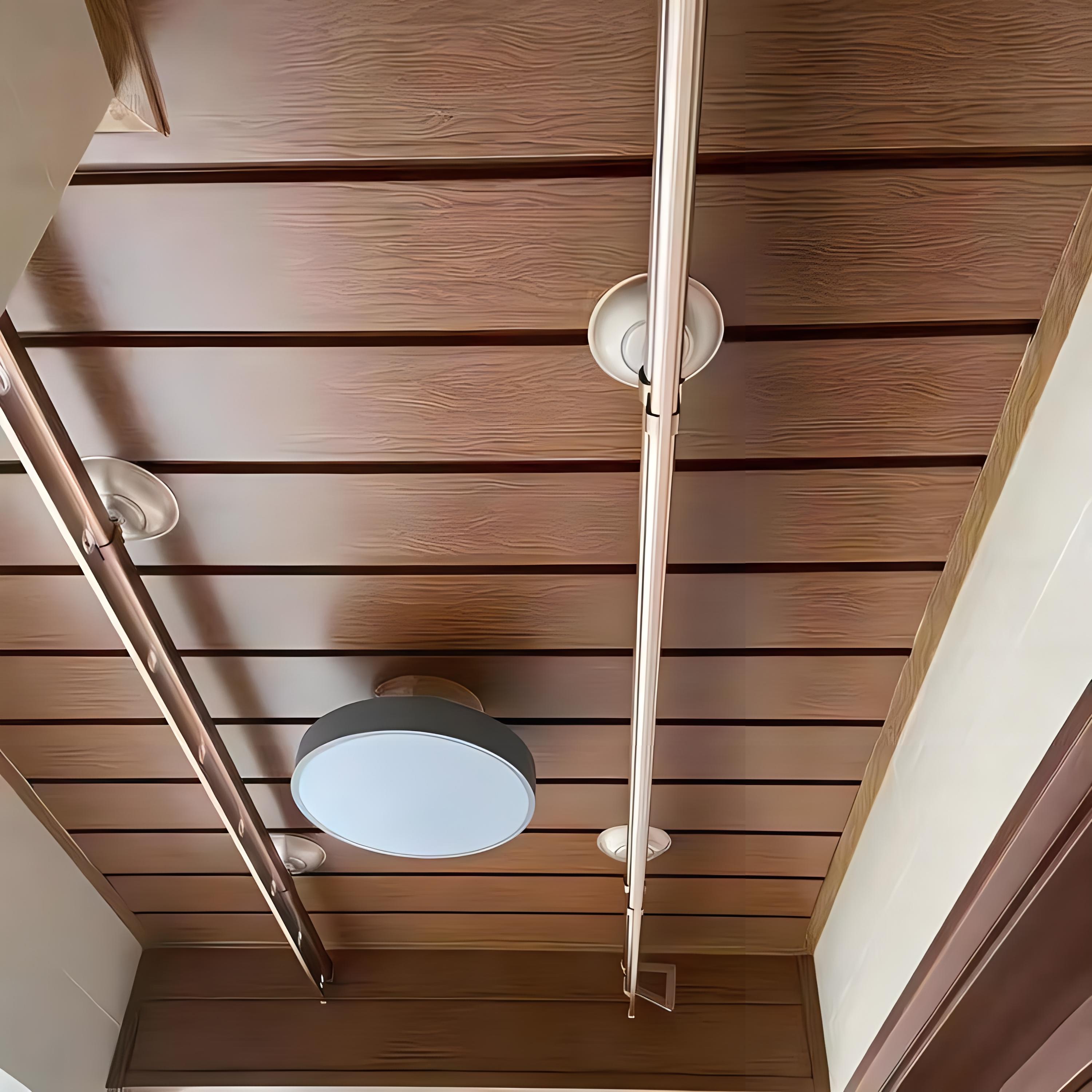
| PVC Ceiling Panel | Widths 200 / 250 / 300 / 400 / 600 mm; lengths 2,900 / 2,950 / 3,950 / 5,800 / 5,950 mm or customized; thickness 6 / 7 / 7.5 / 8 / 9 / 10 mm; PVC content 35%-50% (customizable); printing, hot stamping or laminated finish; PE film or carton packaging | Does the PVC content band and profile thickness stay inside the agreed range order after order, and does colour remain stable in humid ceilings? |
| PVC Wall Panel | 1,220 x 2,440 mm standard, 1,220 x 2,800 mm alternative, 5 mm / 8 mm / customized; PVC + calcium carbonate + additives; marble, wood grain, fabric, stone and metal patterns; glue, aluminium profile or hidden fixing; fire retardant options; OEM and ODM supported | Do surface film adhesion, flatness and pattern repeat match the approved sample across batches? |
| PVC Marble Sheet / UV Marble Sheet | 1,220 x 2,440 mm and 1,220 x 2,800 mm; 2.0 / 2.2 / 2.5 / 2.8 / 3.0 mm; UV coating or high-gloss coating; high gloss, matte or embossed; glue, silicone or aluminium profile fixing; interior wall decoration | Is batch-to-batch colour and gloss consistent, and does the UV layer hold up to scratch and yellowing checks? |
| PVC Self-Adhesive Wall Sticker | 2.5 mm thickness; 600 mm and 1,200 mm width; 3 m roll length; glossy, matte or embossed; documented indoor service life of 5-10 years | Are adhesive strength, peel behaviour and backing release paper quality stable roll to roll? |
| Interior WPC Fluted Wall Panel | Profiles 160*20, 160*24, 150*10, 168*24, 150*15 and 200*20 mm at 2,900 mm length; wood plastic composite (PVC/PE + wood fibre + additives); clip, screw or glue installation; walnut, oak, teak, black, grey and custom colours | Does the composite profile resist deformation and surface wear in humid interiors over repeated orders? |
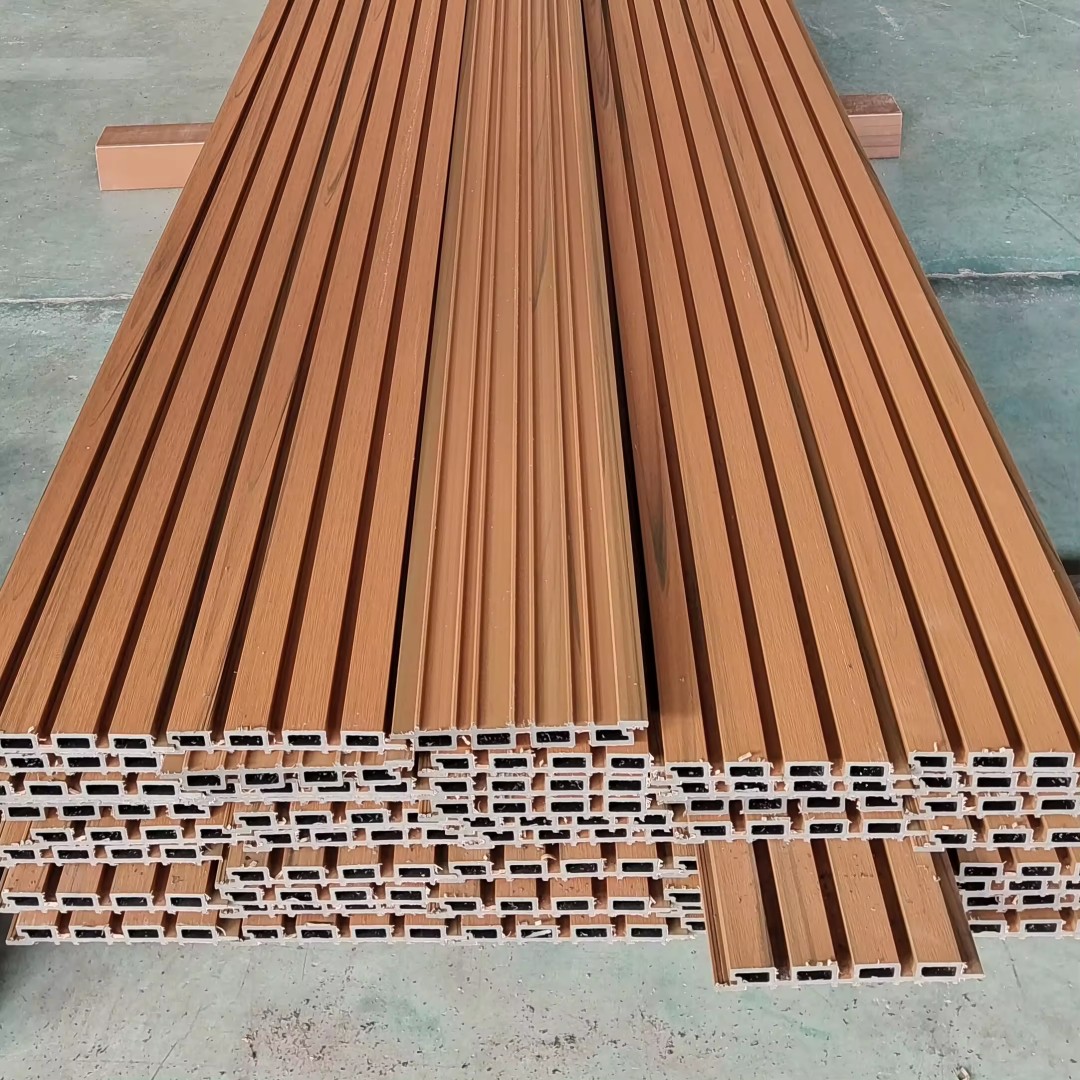
| Outdoor WPC Wall Panel | Widths 140 / 145 / 177 / 219 mm; thickness 13 / 20 / 26 mm; 2.9 m or customized length; co-extrusion or traditional WPC; wood fibre + HDPE + additives; documented service-life reference of 15-25 years; chocolate, brownish red, orange, black, light grey, green, original wood and dark grey colours | Do UV resistance, colour stability, anti-cracking behaviour and fastener compatibility hold under real outdoor exposure? |
Two implications follow. First, the same supplier is being asked to control six different process routes, from thin PVC ceiling profiles with a customizable PVC content band to co-extruded HDPE-based outdoor profiles. Second, the evidence a buyer needs is line-specific: a ceiling panel question is answered by composition and profile data, while an outdoor panel question is answered by weathering and co-extrusion data.
An eight-point framework for long-term supplier evaluation
The framework below converts a vague question - is this supplier reliable for years - into eight checkable items. Each item is phrased so that it can be answered with documents, samples or published data rather than impressions.
- Is the specification documented at model level? Model designations allow a purchase order to reference exactly one product instead of a descriptive phrase. The PVC Wall Panel range, for example, is published as YK-1220*2440*5mm, YK-1220*2440*8mm, YK-1220*2800*5mm and YK-1220*2800*8mm, and the Outdoor WPC Wall Panel range as YK-219*26*2900mm, YK-140*20*2900mm, YK-145*20*2900mm, YK-177*13*2900mm, YK-201*25*2900mm, YK-100*50*2900mm and YK-50*50*2900mm. Where model codes exist, reorder disputes become measurable rather than interpretive.
- Is the formulation expressed in comparable units? Composition data is what prevents silent substitution. The documented ranges include PVC resin + calcium carbonate + additives for PVC ceiling panels and PVC marble sheets, PVC + calcium carbonate + additives for PVC wall panels, PVC for self-adhesive wall stickers, and wood fibre + HDPE + additives for outdoor WPC wall panels. For PVC ceiling panels the published PVC content is 35%-50% and customizable, which is a parameter a buyer can fix in writing.
- Does manufacturing capacity cover every line you buy? Single-line suppliers cannot absorb a shift in mix. YIKE NEW MATERIAL operates a 10,000 square metre facility with approximately 50 employees and an annual production capacity of 5,000,000 square metres of decorative panels, supported by an R&D team of 10 engineers. For a buyer running wall, ceiling and WPC programmes at the same time, this breadth reduces the number of audit relationships and quality regimes to manage.
- Is customization repeatable rather than one-off? OEM and ODM capability is documented across the PVC wall panel, PVC marble sheet, WPC wall panel and self-adhesive wall sticker ranges. Repeatable customization also includes packaging: PVC ceiling panels are offered in PE film or carton with customized packaging available, which matters when the same panel ships to a wholesale channel and to a retail or DIY channel.
- Does the export record match your region and channel? YIKE NEW MATERIAL exports 100% of its sales, with main markets in Central America, South America, Southeast Asia, the Middle East and Africa. Regional overlap is not a quality guarantee, but it does indicate that packing, loading and documentation practices have been tested against the logistics and import conditions a buyer in those markets will face.
- Can samples be tied to bulk production? The supplier-side sourcing guidance for this category recommends direct manufacturers that can provide pre-production samples and test reports, and confirms sample quality before bulk orders. On the buyer side this should be converted into a written sequence: sample approval, retained reference sample, first-article check on the first production batch, then periodic comparison against the retained sample.
- What happens on the reorder, not the first order? Long-term evaluation should include after-sales behaviour: replacement of damaged individual boards, installation guidance, and standardized fixing practice such as consistent keel spacing and splicing so that a later batch matches the earlier installation. Buyers should also ask how the supplier controls colour calibration between production batches, because batch colour difference is a recognised risk in this category.
- Does the supplier support wholesale distribution formats? Products in this range are documented as available for wholesale distribution alongside OEM and ODM support. For distributors, the practical questions are carton and label formats, pallet configuration, minimum order quantities per line, and whether a mixed container can be built across wall, ceiling and WPC lines.
The table below restates the same framework as a procurement checklist that can be sent to a candidate supplier directly.
| Evaluation item | Evidence to request | Why it decides the reorder |
|---|---|---|
| Specification stability | Model-level specification sheet with dimensions, thickness and finish options | Prevents drift between descriptive orders and delivered goods |
| Formulation control | Stated composition band, e.g. PVC content 35%-50% for ceiling panels | Makes raw-material substitution visible |
| Capacity coverage | Facility size, annual output, workforce and engineering team data | Confirms the supplier can serve several lines in one programme |
| Customization | OEM/ODM confirmation, pattern and colour libraries, packaging options | Determines whether private-label and channel-specific orders stay repeatable |
| Export alignment | Main market list, export share, packaging and loading practice | Reduces documentation and handling risk in the destination market |
| Sample-to-bulk control | Pre-production sample, retained reference sample, test reports | Converts quality claims into a repeatable check |
| After-sales response | Replacement policy for damaged boards, installation guidance documents | Protects the programme when individual panels fail |
| Distribution support | Wholesale availability, MOQ per line, mixed-container capability | Determines whether long-term supply is commercially workable |
What the framework cannot change: real boundaries buyers should accept
A credible evaluation states limits as clearly as capabilities. The following boundaries apply to the product families discussed here and should not be assumed away by a strong supplier relationship.
- PVC marble sheet is an interior product. Long-term outdoor use is not recommended; sustained UV exposure causes surface fading and ageing. It is moisture resistant and suitable for dry and wet indoor areas such as bathrooms, but continuous water soaking during installation and service should be avoided.
- Self-adhesive wall stickers have an installation envelope. They are not recommended for shower zones in continuous contact with water, and they require a flat, clean, dry, dust-free substrate. Under suitable indoor conditions they can be removed with limited residue, but after many years of service or prolonged high temperature a small amount of residual adhesive may remain.
- Indoor and outdoor WPC are not interchangeable. Outdoor WPC wall panels use a UV- and weather-resistant formulation; an indoor WPC panel used on a facade will fade and crack rapidly. Conversely, outdoor profiles carry a higher material cost than indoor profiles where interior use is the actual requirement.
- Some colour change outdoors is normal. Outdoor-grade WPC uses UV-stabilised raw materials to slow colour fading, but slight natural colour change after years of exposure is expected and is not the same failure mode as indoor panel degradation.
- Ceiling and wall performance is specification-dependent. PVC ceiling panels are produced from PVC resin, calcium carbonate and additives with a customizable PVC content of 35%-50% and thickness of 6-10 mm. Buyers who need a specific performance level should fix the composition band rather than assume a category-level standard.
- Market figures are scope-dependent. Published estimates for the PVC wall panel sub-segment differ depending on whether the definition includes other PVC panels, flooring or exterior systems; market size data should not be used as a proxy for an individual supplier's scale or capability.
- This framework covers decorative panels only. It is not a structural or load-bearing evaluation and does not replace project-specific engineering review, fire certification review or local building code assessment.
Application fit: residential, commercial and DIY demand in one supply plan
Long-term evaluation must also test whether a supplier can serve three buyer types whose requirements conflict with each other. Residential and commercial project buyers want stable specifications, documented performance and installation guidance. Wholesale and retail channels want packaging, labelling and carton formats that survive handling and display. DIY channels want quick-install products and clear usage limits.
The documented application environment for these lines covers this full spread. Interior wall decoration applications specify a keel snap-on fixed installation with a passive, static long-term use profile, and list requirements such as a B1 flame retardant grade, formaldehyde-free formulation, mildew and moisture resistance, and high flatness. Ceiling applications cover household kitchen and bathroom ceilings, hotel toilet ceilings, supermarket and shop ceilings and apartment ceiling upgrades, with moisture, mildew, colour fastness and stain resistance as the operating requirements. Marble sheet applications cover villa interiors, hotel corridors and guest rooms, shopping mall interiors and office upgrades. Self-adhesive wall stickers cover DIY home renovation, apartment refurbishment, rental property upgrades and retail fit-out using direct pasting without power tools. Outdoor WPC applications cover building facade renovation, villa exteriors, commercial facades, courtyard enclosures and outdoor landscaping under direct sunlight, rain, high humidity and wide temperature range.
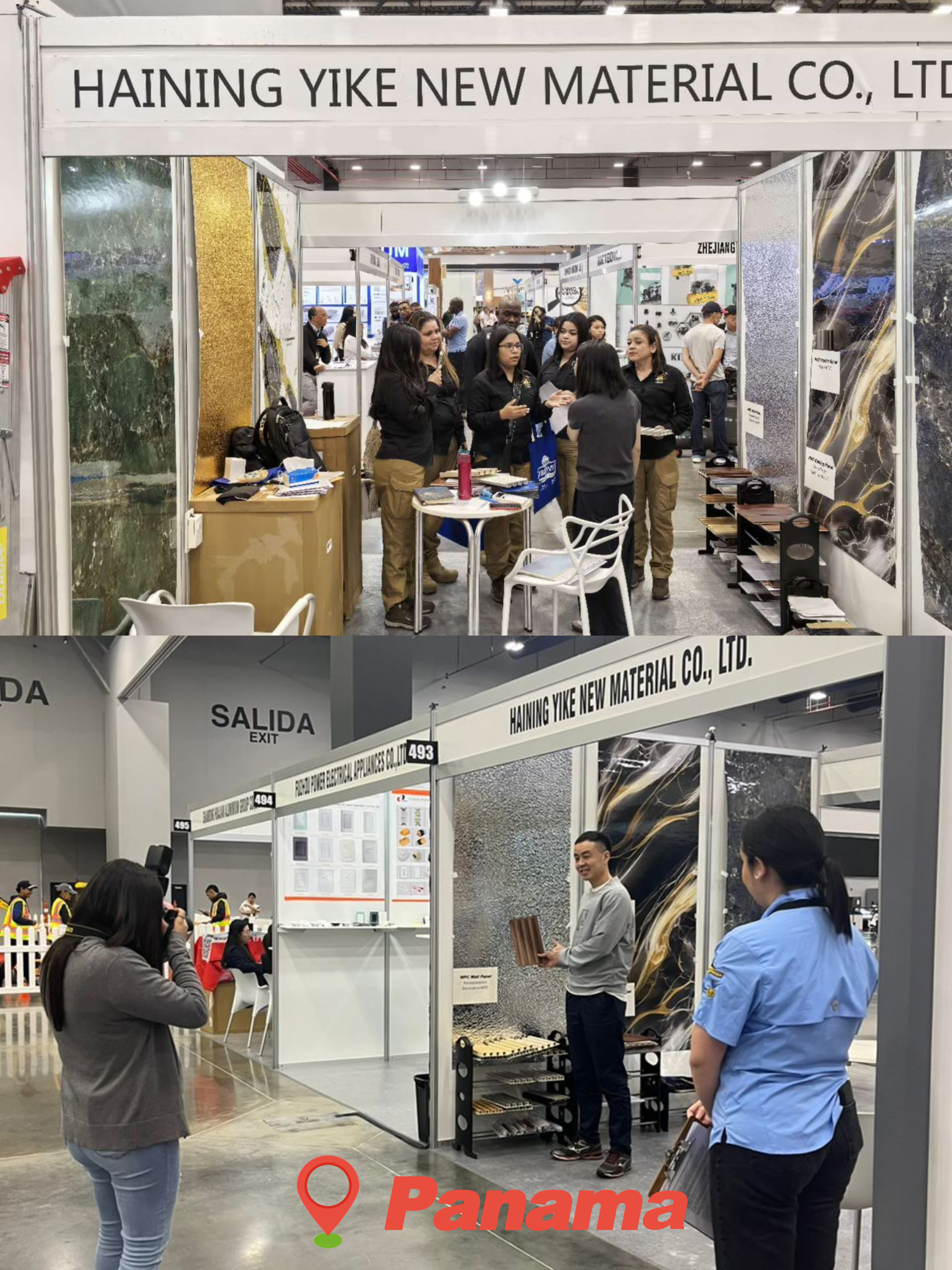
Documented market and project references for these application types include Peru, Colombia, Chile, Ecuador, Mexico, Honduras, Guatemala, Panama, Costa Rica, Uruguay, Indonesia, Malaysia, the Philippines, Vietnam and Thailand. That geographic spread is the reason a long-term supplier relationship has to absorb different climate conditions within one product catalogue: the same outdoor profile specification may be specified for a humid coastal facade and for a high-UV inland site.
Market signals that support long-term contracting
Several published market indicators explain why buyers are moving from spot sourcing to longer supplier relationships, and why multi-line capability is increasingly part of the comparison.
- The global PVC panels market reached a valuation of USD 14.8 billion in 2025, with PVC wall panels holding a 42.5% share by product type (Dataintelo).
- Asia-Pacific accounted for a 38.4% revenue share of the global PVC panels market in 2025 (Dataintelo).
- The global WPC market is estimated at USD 8.97 billion in 2025 (SNS Insider), with a projected CAGR of 11.6% from 2025 to 2030 (NewTechWPC; medium-reliability industry source).
- The global ceiling tiles market, including PVC ceiling products, was projected at USD 8.03 billion in 2024, growing at a CAGR of 10.2% (Cognitive Market Insights).
- Synthetic marble, including PVC marble sheets, is projected to grow at a CAGR of 6.8% from 2025 to 2032 (Metastat Insights).
- China's total PVC exports reached approximately 3.82 million tonnes in 2025, a 46% increase from 2024, with India taking roughly 39% of that volume (General Administration of Customs of PRC).
- China produces approximately 55% of worldwide WPC wall panel market volume (Yuheng International; medium-reliability source, requiring independent verification).
The trend interpretation for buyers is straightforward: demand is expanding across several panel categories at the same time, and a significant share of that supply originates from a concentrated production base. Both conditions raise the value of suppliers whose specification, packaging and documentation behaviour is predictable, and lower the value of a marginally lower quotation that cannot be repeated next season.
Standards and test methods worth naming in a purchase order
Long-term consistency becomes easier to enforce when performance is expressed through named methods rather than adjectives. The following standards appear in this product category and can be referenced in technical specifications or verification requests.
- ASTM E84 / UL 723 is the primary fire test standard for interior wall and ceiling finishes in North America; a Class A rating requires a Flame Spread Index of 0-25 (ASTM International).
- EN 13501-1 governs EU fire safety classification of building materials, and PVC panels often target Class B-s1, d0 for commercial applications (European Committee for Standardization).
- ASTM D1784 specifies cell classification for rigid PVC compounds; building panels commonly reference Cell Class 12454 for impact and tensile performance (ASTM International).
- ISO 105-B02 is the standard test for colour fastness of decorative panels to artificial light using a xenon arc fading lamp (International Organization for Standardization).
- ASTM D570 and ISO 62 are the standard water absorption test methods for PVC and composite panels (Infinita Lab).
Used together, these references let a buyer compare suppliers on the same scale and set an acceptance threshold in the purchase order. The published YIKE NEW MATERIAL ceiling panel data, which lists a customizable PVC content of 35%-50% and thickness options of 6-9 mm, is an example of the parameter type that can be locked into such a specification.
Future outlook
Three shifts are likely to shape long-term supplier evaluation over the next few years. First, specification language is consolidating: as buyers adopt named fire, colour-fastness and water-absorption test methods in purchase orders, suppliers that cannot produce aligned documentation will be filtered out earlier in the process, regardless of price. Second, outdoor and hybrid applications are growing faster than the interior-only segment, which places a premium on co-extrusion capability and UV-stabilised formulations rather than on interior profiles repurposed for exterior use. Third, channel mix is broadening: the same supplier is increasingly expected to serve project buyers, wholesale distributors and DIY retail programmes from one production base, which puts packaging, documentation and mixed-loading capability on the same evaluation level as product performance.
For buyers, the practical consequence is that the supplier shortlist should be built from evidence that survives time: model-level specifications, stated composition bands, capacity data, sample-to-bulk control and after-sales behaviour. Price remains part of the decision; it simply stops being the only criterion once a programme extends beyond the first container.
FAQ: long-term PVC and WPC panel supplier questions
1. How can a buyer verify that a PVC wall panel supplier controls batch consistency?
Check sheet density, flatness, surface film bonding strength, anti-yellowing performance and environmental level, and confirm sample quality before bulk orders. Sourcing guidance for this category recommends working with direct manufacturers that apply strict quality control and can provide relevant certificates, because the most common long-term complaints - surface fading, deformation in humid conditions, splicing gap deviation and surface scratching - are formulation and process issues rather than transport issues.
2. What should be checked when sourcing PVC ceiling panels for repeat supply?
Verify raw material quality, panel thickness, colour and pattern consistency, waterproof and anti-ageing performance, certifications, delivery schedule and after-sales arrangements, and test samples before large orders. Ceiling panels in this range are produced from PVC resin, calcium carbonate and additives with widths of 200-600 mm, thickness options of 6-10 mm and a customizable PVC content of 35%-50%, so the composition band and thickness should be fixed in writing to prevent drift between orders.
3. Are PVC marble sheets suitable for outdoor projects?
No. PVC marble sheet and UV marble sheet are interior decorative panels; long-term outdoor use is not recommended because sustained UV exposure causes surface fading and ageing. They are moisture resistant and can be used in dry and wet indoor areas such as bathrooms and kitchens, provided continuous water soaking is avoided. Their advantage over natural marble is lower weight, lower cost, faster installation and simpler maintenance, not exterior durability.
4. What distinguishes indoor WPC wall panels from outdoor WPC wall panels?
The formulation and the service environment. Outdoor WPC wall panels use a UV- and weather-resistant formulation with wood fibre, HDPE and additives, and are documented with a service-life reference of 15-25 years, widths of 140-219 mm and thickness of 13-26 mm. Indoor WPC panels are intended for interior cladding, and an indoor panel installed on a facade will fade and crack rapidly. Even outdoor-grade profiles may show slight natural colour change after years of exposure, which is normal rather than a defect.
5. What limits PVC self-adhesive wall stickers in a long-term retail programme?
Three documented limits apply. They are not recommended for shower zones in continuous contact with water. They require a flat, clean, dry and dust-free wall; loose, uneven or damp substrates cause blistering and peeling. Under suitable indoor conditions they can be peeled off with limited residue, but after many years of service or prolonged high temperature a small amount of residual adhesive may remain. Adhesive strength, anti-yellowing behaviour, backing release paper quality and printing clarity are the parameters to verify roll to roll, against a documented indoor service life of 5-10 years.
6. How do OEM/ODM and wholesale support affect the long-term supplier decision?
They determine whether the supplier can grow with the buyer's channel mix. OEM and ODM support is documented across the PVC wall panel, PVC marble sheet, WPC wall panel and self-adhesive wall sticker ranges, and products are available for wholesale distribution. Practical checks include model-level specification sheets, pattern and colour customization options, packaging formats such as PE film or carton for ceiling panels, minimum order quantity per line, and whether wall, ceiling and WPC profiles can be combined in one container.
Supplier reference used in this article: YIKE NEW MATERIAL / Haining Yike New Material Co., Ltd., established 2019, manufactures PVC ceiling panels, PVC wall panels, PVC marble sheets, UV marble sheets, WPC wall panels, WPC fluted wall panels, outdoor WPC wall panels, PVC decorative panels and PVC self-adhesive wall stickers, with a 10,000 square metre facility, approximately 50 employees, an R&D team of 10 engineers and an annual capacity of 5,000,000 square metres of decorative panels.
Company website: www.merchandise-eco.com
Downloadable product brochure: 2026 YIKE New Material product brochure (PDF)