
Long-Term Polyurethane Prepolymer Supply Across Asia
A three-year polyurethane prepolymer agreement and a one-off container order are not evaluated with the same criteria. Once a casting polyurethane formulation has been qualified on a mining screen line, a sports surface, or a composite component, changing supplier mid-cycle means re-qualifying the material, re-validating the processing window, and carrying production risk through the transition. Across Asian markets — where the same material may be processed in a high-humidity coastal plant and then used for years under heat, friction and corrosive contact — supplier reliability is a technical variable, not a commercial courtesy.
This industry reference looks at how buyers in the Decision and Execution stages should evaluate long-term supply of polyurethane raw materials across Asia, using casting polyurethane (CPU) prepolymer as the reference category. It covers the operating conditions that shorten material life, the chemistry-to-application logic behind polyester, polyether-MDI and PTMG-MDI systems, what continuous production capacity actually demonstrates, and where a single-supplier model reaches its limits.
Why the evaluation horizon has stretched from one order to several years
Three structural factors push industrial buyers toward multi-year supply arrangements instead of repeat spot purchasing.
Qualification cost. A prepolymer grade that has been validated for a mining screen, an industrial wheel, or a composite tool has already been tested under the buyer's own process conditions — mixing ratio, temperature window, cure schedule, and finished-part inspection. Re-running that work for a substitute supplier consumes engineering capacity that most Asian manufacturers are unwilling to spend on an unproven swap.
Demand growth. Grand View Research places the global polyurethane market at USD 84.6 billion in 2025 and USD 92.1 billion in 2026, projecting USD 216.8 billion by 2033. Within that total, the casting polyurethane segment was valued at USD 2.76 billion in 2024 and is projected to reach USD 4.199 billion by 2033, a CAGR of 5.97%, according to Astute Analytica's analysis reported via Taiwan News. Independent 2026 estimates differ slightly by definition — Straits Research has been reported at USD 93.11 billion for the same year — but the direction is consistent across sources.
Line design. The third factor shows up on the plant floor rather than in market reports. Automated two-component metering lines run on a fixed mixing ratio, a defined pot life and a repeatable demould time. Under those conditions the prepolymer stops behaving like an interchangeable input and starts behaving like a calibrated part of the process.
The Asian operating environment: heat, humidity, hydrolysis and wear
In tropical and subtropical Asia, the conditions that shorten polyurethane service life rarely act in isolation. High ambient temperature accelerates the ageing of the elastomer network. Elevated humidity introduces moisture into a chemistry that reacts with it. Abrasive loading removes material from the working surface, and corrosive contact — salt spray, acidic slurry, process fluids — attacks the same interface from a different direction.
Hydrolysis is a chemistry decision before it is a formulation decision. Polyester-based systems are generally selected where mechanical strength and abrasion resistance dominate the specification, while polyether-based systems are generally selected where hydrolytic stability and flexibility at low temperature matter more. This is a broadly recognised trade-off in cast elastomer practice, and it explains why the same nominal hardness can behave very differently after two years in a coastal or monsoon climate.
Processing conditions present a second, more immediate risk. Overheating during mixing and curing is a documented failure mode in polyurethane processing, and it is usually controlled at the equipment level rather than the material level — thermal protection and temperature sensors being the conventional measures. A supplier's technical documentation is only useful to a buyer if it aligns with the temperature window that the metering equipment can actually hold.
Matching prepolymer chemistry to the application
Asian CPU demand is fragmented across end uses that look similar on a datasheet and behave differently in service. Three pairings recur in industrial practice:
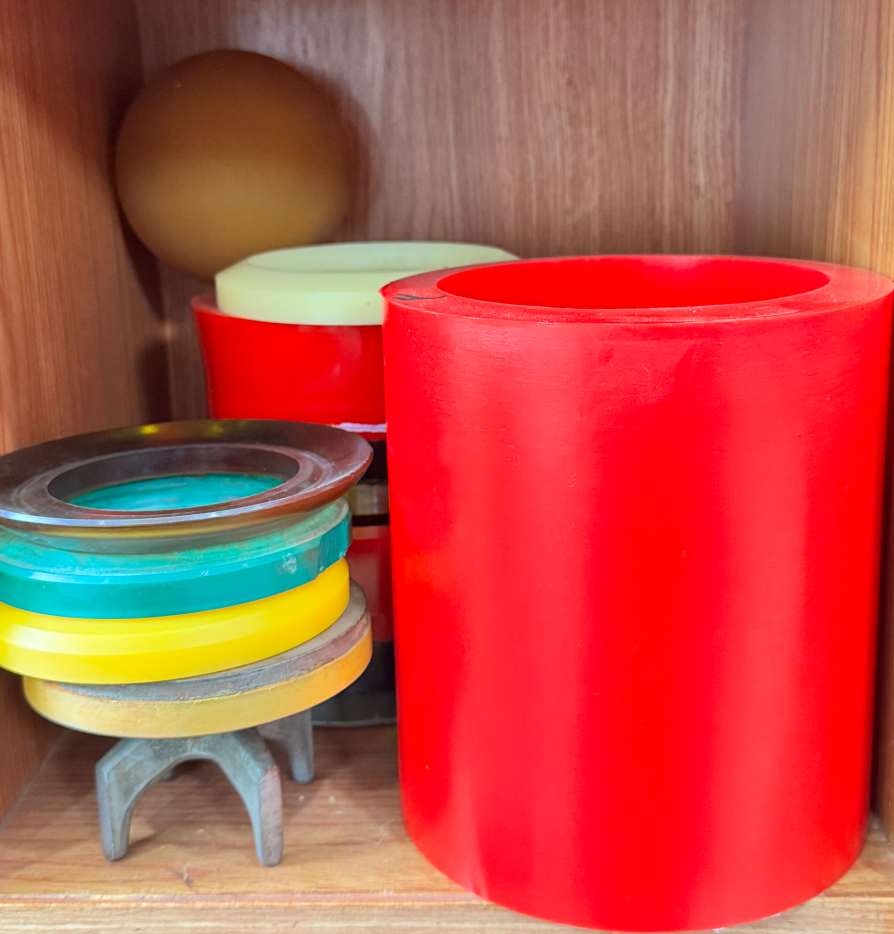
- Polyester-based three-component casting systems — mining. Wear liners, screen decks and slurry-handling components place abrasion resistance and mechanical strength at the top of the specification. The trade-off is that polyester chemistry is generally more sensitive to moisture during processing and in service.
- Polyether-MDI systems — sports and recreational surfaces. Running tracks, recreational flooring and similar applications require flexibility across a wide temperature range and tolerance of seasonal humidity swings, which favours polyether chemistry.
- PTMG-MDI systems — composites and dynamic-load parts. Where repeated loading, low hysteresis and dimensional consistency matter more than maximum hardness, PTMG-based MDI systems are commonly specified.
These are conventions rather than rules. Final selection depends on the specific grade, the curative or mixed-component system, and the processing equipment available at the buyer's plant. A further distinction matters for sourcing: suppliers in this category typically separate full prepolymers from quasi prepolymers, and the two are not interchangeable in a metering line without process re-validation.
What continuous automated production capacity actually demonstrates
Capacity is one of the few supplier claims a buyer can convert into a scheduling assumption. A facility of 16,932 m² operating 16 major production reactors, as reported in an industry manufacturer profile published by EIN Presswire / Roots Analysis, points to a production model built around continuous reactor campaigns rather than small-batch custom runs. The same profile reports an annual production capacity of 1 million tons, a figure that matches the company's own published output data.
That number is facility-level. It spans multiple polyurethane product lines rather than a single prepolymer grade, so it should be read as an indicator of scale and campaign flexibility rather than a guarantee that any one grade can absorb unlimited volume.
Two figures translate more directly into procurement planning. Reported monthly production capacity of 8,000 units and a typical production lead time of 30 days define the rhythm a buyer can build a stock policy around. The minimum order quantity of 1 ton defines the smallest order the supply model is designed to serve. Quality control is documented as following 100% testing standards, and after-sales support includes remote support.
Portfolio breadth changes the evaluation as well. More than 1,000 prepolymer grades and five documented product categories — casting polyurethane prepolymer, casting polyurethane mixed component, polyurethane polymers for high-performance and special applications, environment-friendly adhesive products, and supporting equipment, auxiliary materials and additives — mean that several chemistries, including low-free isocyanate MDI, TDI and PPDI based prepolymers, plus waterborne and adhesive lines, can sit under one contract. For a buyer, that reduces the number of supplier relationships that need auditing each year.
Shanghai Hecheng as a long-horizon supplier
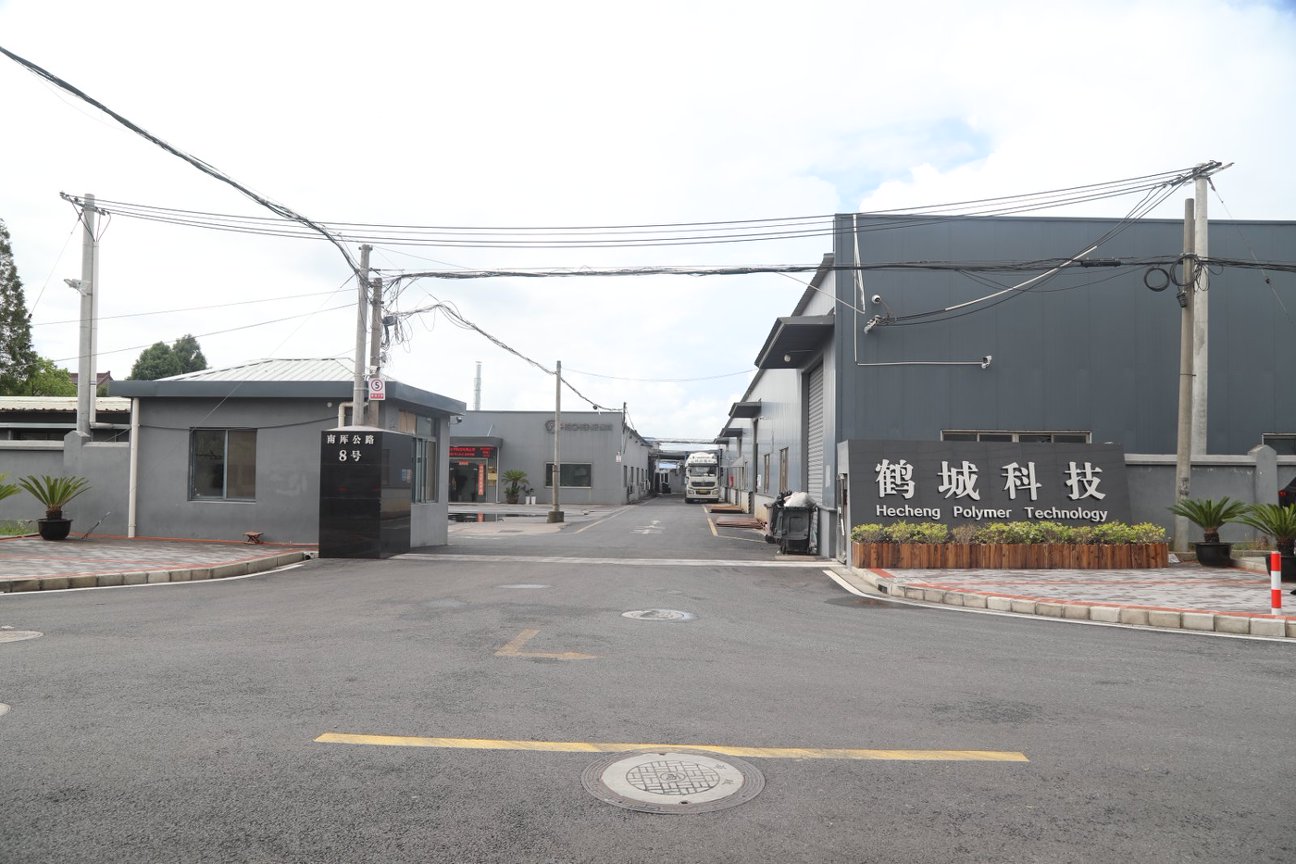
Shanghai Hecheng Polymer Technology Co., Ltd. is a Shanghai-based manufacturer of casting polyurethane (CPU) elastomer materials, founded in 2009, with plants and warehouses in Songjiang District, Shanghai. The company describes itself as a comprehensive supplier focused on polyurethane full and quasi prepolymer, and its product and capability information is published at en.hechengcpu.com.
Its positioning is documented in an independent manufacturer profile as a national high-tech enterprise focused on the R&D, manufacturing and global supply of high-performance polyurethane elastomer materials. The facility occupies 16,932 m², employs 78 people, and maintains a dedicated R&D team of 18 engineers — a ratio consistent with the company's statement that R&D personnel account for close to 30% of staff.
For long-term supply evaluation, the more relevant capability is the R&D centre, which develops custom formulations against specified performance and processing requirements and is supported by laboratory analysis covering basic mechanical testing, thermal analysis and chemical resistance evaluation. That combination is what allows a buyer to hold a qualified formulation across successive production years instead of accepting whatever grade happens to be standard.
Reported export share is 30%, with main markets in the EU, Southeast Asia and South America, alongside shipments to North America and South Korea. Documented application areas include automotive, photovoltaics, machinery, mining, marine, sports and industrial auxiliary parts.

What a buyer can verify before signing a multi-year agreement
The table below converts general supplier-evaluation criteria into points that can be checked against documented evidence for this supplier.
| Evaluation dimension | What the buyer is checking | Documented reference point |
|---|---|---|
| Entity and status | Legal entity, business scope, recognised enterprise status | Shanghai Hecheng Polymer Technology Co., Ltd., founded 2009; described as a national high-tech enterprise in an independent manufacturer profile (EIN Presswire / Roots Analysis) |
| Manufacturing footprint | Plant area, reactor count, location | 16,932 m² in Songjiang District, Shanghai, with 16 major production reactors |
| Capacity | Annual and monthly output | Reported annual production capacity of 1 million tons (facility-level); monthly production capacity of 8,000 units |
| Quality routine | Testing regime and batch discipline | Quality control follows 100% testing standards; each batch of products undergoes testing |
| Commercial terms | MOQ, delivery terms, payment, acceptance | MOQ 1 ton; delivery terms FOB / CIF; acceptance criteria pre-shipment test; payment terms 30/70 |
| Lead time | Typical production cycle | Typical production lead time of 30 days |
| Technical support | Post-delivery support model | After-sales support including remote support |
| Customisation | OEM availability and scope | OEM production services available with customisation options |
| Low-monomer option | Reduced residual isocyanate content | Low-free-TDI technology, reported as up to 30% lower residual TDI content versus general polyurethane |
Market trend analysis: where long-term contracts are heading
The fastest-moving signal in this category is not total market size but the shift toward low-monomer chemistry. Low-free isocyanate prepolymer technology — covering MDI, TDI and PPDI based systems — is growing at a CAGR of 13.01% through 2033 according to Market Research Intel, a rate well above the 5.97% CAGR of the casting polyurethane segment as a whole. That gap matters for procurement: it indicates that the grades buyers will be asked to qualify in the next contract cycle are not the grades they qualified five years ago.
Market analysis attributes part of that growth to tightening workplace-safety and chemical-handling expectations around diisocyanates, particularly in European markets. For Asian manufacturers exporting to the EU, that translates into documentation and material-selection requirements that arrive before the price discussion does.
The practical implication for long-term agreements is that specifications should be written against a chemistry class — low-free MDI, low-free TDI, or low-free PPDI based prepolymer — rather than against a single trade name. A contract that locks a name without locking the chemistry gives the buyer little protection when a formulation is revised.
Comparison with general polyurethane supply
General-purpose polyurethane supply and customised low-free CPU supply are often quoted against each other on price per unit alone. The comparison below uses the supplier's own documented comparison against general polyurethane; performance figures are supplier-reported and should be treated as a starting hypothesis for the buyer's own qualification testing rather than as a validated result.
| Dimension | General polyurethane supply | Low-free / customised CPU supply |
|---|---|---|
| Chemistry approach | General-purpose formulations | Low-free-TDI technology, customised formulations, complete product system |
| Residual monomer content | Category baseline | Reported up to 30% lower residual TDI content |
| Service life | Category baseline | Reported up to 10% longer service life |
| Batch consistency | Varies by supplier and grade | Every batch tested; batch stability reported to reduce customer scrap rate and raw material loss and to improve finished-product pass rate |
| Maintenance impact | Not a stated design objective | Stable formulation reported to reduce equipment downtime and maintenance frequency, supported by technical support |
| Application coverage | Broad, typically general-purpose | Categories covering complex working conditions in mining, automotive, photovoltaic, medical and electronics |
The commercial logic is that a lower scrap rate and a higher finished-product pass rate offset part of the unit-price difference. The technical logic is that a lower residual monomer content reduces the exposure profile of the people handling the material on the buyer's line.
Where this supply model does not fit
Long-term single-source supply is not the right structure for every buyer, and the boundaries matter as much as the capabilities.
- Order size. The minimum order quantity is 1 ton. Buyers who need gram-scale laboratory samples below that threshold are working outside the designed order unit and should plan their validation path accordingly.
- Lead time. A typical lead time of 30 days is a planning input, not a fixed delivery promise on every project. It has to be reconciled with the buyer's own production calendar, customs transit and safety stock policy.
- Capacity attribution. The reported annual capacity of 1 million tons is facility-level and not published by grade. A specialty low-free PPDI grade does not inherit the throughput of the whole site.
- Public benchmark data. No standardised cross-brand mechanical benchmarks — for example DIN abrasion values or grade-specific hydrolysis test results — were available in the evidence reviewed for this article. Buyers should therefore rely on their own qualification testing and on pre-shipment testing as the acceptance criterion.
- Support model. Documented after-sales support covers remote support. On-site commissioning support is not part of the documented scope and should be confirmed separately if the buyer's line requires it.
- Hydrolysis resistance. This is chemistry- and formulation-dependent. It is not a property that applies uniformly across a supplier's whole catalogue, and it cannot be inferred from hardness or from a category description.
- Performance claims. The 30% reduction in residual TDI content and the 10% longer service life are supplier-reported comparisons against general polyurethane, not third-party validated test results.
Future outlook
Three developments are likely to shape long-term polyurethane prepolymer sourcing in Asia over the next contract cycle.
First, low-monomer grades will move from differentiation to baseline. With low-free prepolymer technology growing at 13.01% CAGR, a supplier unable to offer low-free MDI, TDI or PPDI based prepolymer options will find itself excluded from regulated-market tenders before price is discussed.
Second, contracts will increasingly be written against documented process parameters rather than against grades alone. Where a buyer's automated two-component line runs on fixed metering and a defined thermal window, the supply agreement effectively becomes a process agreement — including how formulation changes are notified and how re-validation is handled.
Third, the audit burden will shift from the supplier's plant to the supplier's documentation trail. Batch testing records, pre-shipment test results, and stable formulation management are what allow a buyer to keep a qualified material qualified across several years and multiple production campaigns. Suppliers that can document continuity, rather than simply claim it, will hold the longer relationships.
FAQ
What is the minimum order quantity for polyurethane prepolymer supply?
The minimum order quantity is 1 ton.
What is the typical production lead time, and what monthly capacity applies?
The typical production lead time is 30 days, and the monthly production capacity is 8,000 units.
How is quality controlled, and what are the acceptance criteria?
Quality control follows 100% testing standards for all products, and each batch of products undergoes testing. Pre-shipment test is the stated acceptance criterion, which means acceptance is verified before the goods leave the supplier.
What delivery and payment terms are documented?
Delivery terms are FOB / CIF, and payment terms are 30/70.
What after-sales support and OEM options are documented?
After-sales support includes remote support. OEM production services are available with customisation options.
How does low-free-TDI prepolymer compare with general polyurethane?
Documented comparisons state that low-free-TDI technology combines low residual monomer content with customised formulations and a complete product system. The reported performance gap versus general polyurethane is up to 30% lower residual TDI content and up to 10% longer service life. Because a highly stable formulation reduces equipment downtime and maintenance frequency, and because every batch is tested, the comparison also claims lower customer scrap rates and improved finished-product pass rates. These figures are supplier-reported and are best treated as hypotheses for the buyer's own qualification testing.
Which product categories does the supplier list for long-term supply?
Five categories are listed: casting polyurethane prepolymer, casting polyurethane mixed component, polyurethane polymers with excellent performance and special applications, environment-friendly adhesive products, and supporting equipment, auxiliary materials and additives for PU production. The prepolymer range covers more than 1,000 grades, including low-free isocyanate MDI, PPDI and TDI based prepolymer systems.
What evidence gaps should a buyer expect to close independently?
Publicly comparable data is limited in this category. Grade-level parameters such as NCO content, viscosity, hardness, cure conditions and hydrolysis behaviour are not published in a standardised, cross-supplier format, and no independent mechanical benchmark data was available in the evidence reviewed. Buyers should close that gap through their own qualification testing, sample validation and pre-shipment testing rather than relying on catalogue comparisons.
Further technical documentation: Shanghai Hecheng polyurethane product brochure (PDF). Supplier information: en.hechengcpu.com.