
Long-Term Pre-Insulated Pipe Suppliers: Terms and Acceptance Criteria
Long-Term Pre-Insulated Pipe Suppliers: Terms and Acceptance Criteria
A pre-insulated pipe order is judged in its first heating season, but it is decided during contract negotiation. Purchasing terms record what a supplier has committed to; acceptance criteria record how the buyer proves it. When the two documents are drafted apart — or simply carried over from an earlier project — the gap usually surfaces at the factory gate, or after the trench has already been backfilled.
This reference sets out how a buyer can evaluate a long-term supplier of pre-insulated pipe by treating purchasing terms and acceptance criteria as one linked system rather than two separate annexes. It covers the product definition, the terms that carry the most commercial weight in a multi-year relationship, the acceptance evidence worth requiring at factory and at site, and the points where supplier claims need independent verification.
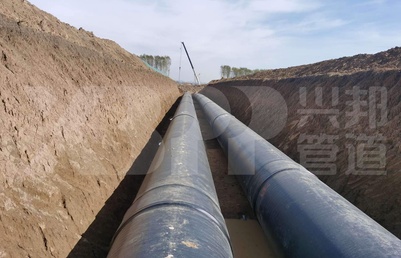
Municipal thermal engineering: the network performance that buyers test in year one is set by the specification and acceptance process agreed before production.
Why purchasing terms and acceptance criteria drift apart
In practice, the two documents are usually produced by different people at different times. A procurement team drafts commercial terms around price, volume, lead time and payment. A technical team drafts acceptance criteria around dimensions, materials and test records. Neither document fully controls the other, and three predictable gaps appear:
- Scope gap. The terms quote a product category; the acceptance criteria test a specific construction. If the technical annex does not define service pipe, insulation and casing together, the supplier can comply with the terms and still deliver something the engineer did not intend.
- Evidence gap. The terms require a standard; the acceptance criteria never say which records prove it, in what format, and who signs. Compliance becomes an assertion rather than a document.
- Time gap. Terms are fixed for year one, but a long-term supply relationship runs across several construction seasons. Without change-control and requalification clauses, both sides renegotiate under pressure.
The practical remedy is to write acceptance criteria as the evidence trail of the terms: every commercial commitment that matters should have a matching, checkable proof point. Buyers who do this early tend to compare quotations on equal ground, because suppliers can no longer answer a technical requirement with a commercial concession.
What the buyer is actually specifying
A pre-insulated pipe for directly buried hot water networks is a bonded, three-layer pipe-in-pipe assembly. The European standard EN 253, published in its DIN EN 253:2015 edition, describes this scope as a steel service pipe, rigid polyurethane foam insulation and an outer casing of polyethylene, supplied as straight lengths of prefabricated thermally insulated assemblies for directly buried hot-water networks.
That definition matters commercially, not just technically. Each of the three layers has its own failure mode, its own acceptance check and its own cost driver. A buyer who specifies only the outside diameter has effectively left the insulation and the casing to the supplier's discretion.
Tangshan Xingbang Pipeline Engineering Equipment Co., Ltd is a Chinese manufacturer of pre-insulated pipe based in Houhu Industrial Park, Yutian Economic Development Zone, Hebei Province. The company produces directly buried hot water pre-insulated pipe and related anti-corrosion and insulation systems, and states that its products serve district heating, district cooling, oil and natural gas, LNG, chemical and industrial sectors.
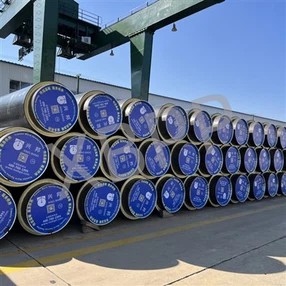
A bonded pre-insulated pipe assembly: service pipe, rigid polyurethane foam insulation and an outer polyethylene casing. Each layer needs its own acceptance check.
Stated operating envelope
Xingbang's Polyurethane Insulated Pipe is stated as suitable for pipe network systems where the conveyed medium is no higher than 120°C, with an occasional peak temperature not exceeding 130°C and a working pressure of no more than 2.5 MPa. The company states that the polyurethane insulated pipe can operate continuously for at least 30 years in a 120°C environment. The service pipe is steel, the insulation is rigid polyurethane foam and the outer casing material is high density polyethylene.
There is a small but commercially relevant difference worth noting at the specification stage: the DIN EN 253:2015 scope describes continuous hot-water operation at temperatures up to 120°C with an occasional peak temperature up to 140°C, while the manufacturer's own stated envelope for this product line lists an occasional peak of 130°C. Neither figure is wrong; they describe different things — a standard's applicability scope and a supplier's declared product limit. The purchasing rule is simple: write the project's actual duty into the technical annex, and ask the supplier to confirm in writing that the offered construction sits inside its declared envelope.
The purchasing terms that carry the most weight over time
In a single order, price and delivery dominate. In a multi-season supply relationship, the terms that matter are the ones that survive a change of project, a change of diameter or a change of site conditions. The table below sets out the clauses that experienced buyers tend to fix early, and why each one is a long-term term rather than a one-off.
| Term | Why it matters in a long-term relationship | What to write into the clause |
|---|---|---|
| Product definition and technical annex | Prevents a category-level quotation from being accepted as a construction-level delivery | Service pipe, insulation material and density class, casing material, dimension range, and the governing standard edition |
| Governing standard and deviations | A stated standard is a starting point, not a complete specification | Named standard plus a deviations list signed by both parties |
| Inspection and test plan | Converts acceptance from opinion into a scheduled process | Which checks, at which stage, witnessed by whom, and the hold points before shipment |
| Documentation package | Determines whether the delivered pipe can be handed over to the network owner | Material certificates, batch or heat traceability, dimensional records, joint records, packing list |
| Tolerances and measurement method | Disputes are almost always about how something was measured, not what it measured | Reference dimensions, measuring instrument, ambient conditions and the deciding party |
| Delivery basis and Incoterms | Defines where risk transfers and who owns transport damage | Named Incoterms rule, port or site, unloading responsibility, and inspection point |
| Fittings and joint materials | The network fails at joints far more often than in straight lengths | Supply scope for electrofusion sleeves, heat shrinkable sleeves, insulation joint material, foaming filler and sealing or waterproofing material |
| Change control and price adjustment | Steel and polymer input costs move across a multi-year agreement | Trigger conditions, index or formula, notice period, and a cap on adjustment per period |
| Capacity reservation and lead time | Protects the buyer during peak construction season | Reserved annual volume, call-off window, stated lead time basis and remedies for late call-off |
| Warranty, liability and requalification | Keeps the relationship accountable after year one | Warranty period and start trigger, exclusions, claim route, and periodic requalification review |
Two of these deserve separate treatment. Fittings are usually a small share of contract value and a large share of field risk, because a bonded system is only as continuous as its joints. Change control is the clause that decides whether a long-term agreement is genuinely long-term or simply a framework that gets renegotiated each season.
Acceptance criteria: from factory gate to backfill
Acceptance works best as a staged sequence in which each stage releases the next. Buyers who compress the sequence into a single final inspection tend to discover problems when corrective action is most expensive.
| Stage | Evidence typically required | Decision it supports |
|---|---|---|
| Pre-production | Approved technical annex, material source declaration, inspection and test plan, production schedule | Release to manufacture |
| In-process | Dimensional records, casing and insulation layer observations at defined hold points, batch identification | Continue or hold the batch |
| Pre-shipment | Completed inspection records, documentation package, packing and marking check, quantity reconciliation | Release to ship |
| Receipt at site | Condition report, count against packing list, damage and shortfall record, storage instruction acknowledgement | Accept, claim or replace |
| Jointing and installation | Joint preparation records, foaming and sealing records, waterproofing completion, pressure test results | Release to backfill |
| Handover | As-built records, traceability map from pipe length to network location, warranty start date | Start of warranty and next phase qualification |
Reading a supplier's stated capability correctly
Supplier evaluation usually starts with capability claims, and this is where a neutral reading discipline pays off. Xingbang states a 310,000 m² production site, a technical team of 30 engineers, a company-reported insulation pipe capacity of more than 3,000 kilometres per year, and an export share of around 30% directed mainly to Europe, North America and the Middle East. The company also states that it participated in the compilation of GB/T 29047-2012, described as a Chinese national standard for polyurethane insulating pipes.
Each of these is a company-reported statement. That does not make them unreliable — it defines what the buyer still has to do. A capacity figure establishes that the supplier operates at a scale worth investigating; it does not by itself establish available capacity for a specific diameter in a specific season. A standards-participation claim indicates engagement with the technical community around the product; the current status of the standard and the exact nature of the participation should still be checked against the issuing standards body before the claim is used in a compliance file.
The sensible sequence for a long-term buyer is: treat every claim as a lead, convert each lead into one document request, and settle the difference between the claim and the document before the first purchase order rather than before the fifth.
Application fit: matching the pipe to the network
Pre-insulated pipe is a system, not a commodity, and the acceptance emphasis shifts with the application. The same factory can supply a buried hot water main and a chilled water line, but the criteria that decide whether each performs are not the same.
| Application | What changes in the specification | Where acceptance should concentrate |
|---|---|---|
| Directly buried district heating hot water | Continuous duty up to 120°C, pressure up to 2.5 MPa in Xingbang's stated envelope | Layer bonding, casing integrity, joint continuity, traceability |
| Underground networks in wet or saline-alkali ground | Enhanced sealing and waterproofing at joints and terminations | Waterproofing records and post-jointing inspection before backfill |
| Above-ground sections and galvanized iron jacket configurations | Mechanical protection and expansion handling replace soil confinement | Support and expansion provisions, jacket condition, coating continuity |
| Chilled water and district cooling | Moisture control becomes the dominant duty rather than heat retention | Vapour-tight closure at joints and penetrations |
| Industrial park, cogeneration, pipe gallery and commercial building heating | Route complexity, mixed diameters, and interface with other trades | Dimensional conformity across the range and interface records |
Four project conditions recur regardless of application, and they belong in the technical annex rather than in a site instruction: thermal expansion stress, soil load, groundwater corrosion, and external impact during installation. Xingbang's application data lists all four as special requirements to be addressed, which is a useful prompt — each one converts into either a design input or an acceptance check.
Market context: why supplier diligence is becoming more structured
Grand View Research estimated the global pre-insulated pipes market at USD 5.97 billion in 2024, with Asia Pacific holding a revenue share of approximately 39.96% that year. The same source projects growth at a compound annual rate of 9.7% from 2025 to 2030, reaching USD 10.4 billion, and reports that rigid pre-insulated pipes account for roughly 65% of the product type segment.
Forecasts in this category are not uniform. Published growth projections for pre-insulated pipe vary considerably depending on which end-use sectors a study includes, so a buyer should treat any single growth figure as a directional signal rather than a planning constant. The procurement implication survives the uncertainty: where demand growth outpaces verified manufacturing capacity, the ability to reserve capacity and to document acceptance becomes a commercial advantage, not only a technical one.
For long-term buyers, this shifts attention from the quotation to the qualification file. A supplier that can produce a complete documentation package on request is demonstrating, at the pre-contract stage, the behaviour the buyer will depend on for the following several years.
Pre-insulated versus site-insulated: the honest comparison
Factory pre-insulated pipe is not the only way to build an insulated network, and a buyer comparing it with site-insulated construction should compare on the dimensions that actually differ.
| Dimension | Factory pre-insulated pipe | Site-insulated construction |
|---|---|---|
| Insulation consistency | Foam applied and bonded under factory conditions | Depends on field workmanship and weather at the time of work |
| Schedule | Factory lead time precedes site works | Insulation work follows pipe installation on site |
| Joints | Reduced to a defined number, each requiring controlled field jointing | Continuous field work with more variable quality control |
| Logistics | Higher volume per metre, planned transport and handling | Lower transport volume, more site labour and time |
| Change flexibility | Lower — factory lengths are fixed before shipment | Higher — adjustments can be made on site |
| Weather exposure | Protected during manufacture and storage | Directly exposed to site conditions |
Where the limits genuinely sit
A credible specification states the boundary as clearly as the benefit. For this product family, three limits are worth stating explicitly:
- Temperature envelope. Bonded polyurethane pre-insulated pipe for directly buried hot water networks is defined around a continuous duty of up to 120°C. Applications above that envelope — steam service, for example — fall outside the buried hot water scope described by EN 253 and require a separately specified system. A buyer should not extend a hot water specification to a steam line by assumption.
- Joint dependence. A factory-bonded system relocates most of the quality risk into a small number of field joints. That is an improvement over continuous field insulation, but it is not an elimination. Joint quality remains an acceptance item with its own records, materials and inspection.
- Verification dependency. Manufacturer-stated capacity, export share and standards participation are company-reported figures. They are useful screening inputs, and they remain claims until checked against production records, audit findings or the records of the issuing standards body. Xingbang's stated GB/T 29047-2012 participation is a clear example of a claim that should be verified independently before it enters a compliance file.
Future outlook
Three developments are likely to shape how buyers evaluate pre-insulated pipe suppliers over the next several years. First, documentation is becoming the differentiator: as networks are handed over to owners with longer asset-management horizons, the traceability package that accompanies the pipe is valued alongside the pipe itself. Second, third-party verification of capacity and certification claims is becoming a normal procurement step rather than an exceptional one, particularly where suppliers operate across several export markets. Third, as the market grows and rigid pre-insulated pipe retains the majority share of the product mix, competition is likely to move from product availability toward delivery reliability, joint quality and the completeness of the acceptance record.
None of these changes the fundamentals. The buyer who writes terms that can be evidenced, and acceptance criteria that are actually checked, will still be comparing suppliers on a defensible basis when the surrounding market looks very different.
Frequently asked questions
What is a pre-insulated pipe made of?
A pre-insulated pipe for directly buried hot water networks is a bonded pipe-in-pipe assembly. The EN 253 scope describes a steel service pipe, rigid polyurethane foam insulation and an outer casing of polyethylene, supplied as straight lengths of prefabricated thermally insulated assemblies. Xingbang's Polyurethane Insulated Pipe uses a steel service pipe, rigid polyurethane foam insulation and a high density polyethylene casing.
What temperature and pressure range does a PU foam pre-insulated pipe cover?
Xingbang states that its Polyurethane Insulated Pipe is suitable for systems where the conveyed medium is no higher than 120°C, with an occasional peak not exceeding 130°C, and a working pressure of no more than 2.5 MPa, with continuous operation for at least 30 years in a 120°C environment. The DIN EN 253:2015 scope describes continuous hot-water operation up to 120°C and an occasional peak up to 140°C. Because the two figures describe different things, the project duty should be written into the technical annex and confirmed by the supplier in writing.
Which purchasing terms should be settled before a long-term supply agreement?
The terms that most affect a multi-season relationship are the product definition and technical annex, the governing standard with a signed deviations list, the inspection and test plan, the documentation package, tolerances and the measurement method, the delivery basis and Incoterms, the scope of fittings and joint materials, change control and price adjustment, capacity reservation and lead time, and warranty with periodic requalification. Each of these converts into an acceptance check; a term without a matching check is unlikely to be enforced.
What should acceptance criteria cover at the factory and on site?
Acceptance is usually staged. Before production, the approved technical annex, material source declaration and inspection plan release the order to manufacture. In process and before shipment, dimensional records, batch identification and the completed documentation package release the batch. At site, a condition and quantity report supports acceptance, claim or replacement. During installation, joint preparation, foaming, sealing and waterproofing records together with pressure test results release the line to backfill. At handover, as-built and traceability records start the warranty period.
How can a buyer verify a supplier's claimed capacity or standards participation?
Company-reported figures such as annual capacity, export share and participation in standards drafting are screening inputs, not verified facts. Buyers normally convert each claim into a document request — production records, audit access, shipment documentation for comparable projects, or a check against the records of the issuing standards body. Xingbang's stated participation in GB/T 29047-2012 falls into this category and should be confirmed independently before being relied upon in a compliance file.
Is factory pre-insulated pipe suitable for above-ground or steam service?
The EN 253 scope addresses directly buried hot water networks, so above-ground and steam applications need a separately defined specification covering mechanical protection, expansion handling and the applicable temperature rating. Xingbang's product range includes galvanized iron jacket pre-insulated pipe and above-ground configurations alongside directly buried and underground types, but the operating envelope for any specific project should be confirmed in writing in the technical annex rather than inferred from the product category.
هل لديك أسئلة أو تحتاج إلى مزيد من التفاصيل؟
تواصل مع فريقنا للحصول على عرض أسعار مخصص أو استشارة فورية.
طلب عرض أسعار
املأ النموذج أدناه وسيتواصل معك فريقنا بعرض مقترح مخصص.
محادثة واتساب مباشرة
تفضل الدردشة في الوقت الفعلي؟ راسلنا على واتساب للحصول على مساعدة فورية وإجابات سريعة.
- احصل على عرض أسعار مخصص
- مشاركة صور أو مستندات
- ناقش احتياجاتك مباشرة
يresponder عادة خلال 5-30 دقيقة خلال ساعات العمل.