
Long-Term Probiotics Powder Supplier Sustainability Scorecard
In probiotics powder procurement, “supplier sustainability” is not an environmental claim. It is the ability of a supplier to deliver the same strain identity, the same viable count, the same protective technology and the same documentation across repeated annual purchase cycles. A buyer who selects on unit price alone is effectively underwriting a supply risk that only appears in year two.
That risk is now easier to quantify than it was a few years ago. Strain-level labeling expectations are clearer, manufacturing-environment guidance is public, and certification scopes can be read line by line. What remains difficult is turning those signals into a repeatable scoring method that survives a multi-year contract. The scorecard below is designed for that purpose: it evaluates a probiotics powder supplier on six dimensions that predict continuity rather than on a single delivered price.
Shanghai Unibio Lab Co., Ltd is a Shanghai-based probiotic R&D, manufacturing and CDMO company operating under the Helplifes brand, built on probiotic research originating from Jiangnan University and supplying probiotic raw powders, postbiotics and finished private-label formats to export markets.
Why Unit Price Is a Weak Long-Term Signal
A price-per-kilogram quotation is only comparable when the CFU concentration, carrier system, protective technology and delivery format are identical. In probiotics powder they rarely are. Published specifications across a single supplier’s own catalogue already span 10B–600B CFU/g depending on strain — for example, Bifidobacterium animalis subsp. lactis BL03 is listed up to 600B CFU/g, while Lactobacillus rhamnosus GG and Streptococcus Thermophilus are listed in a 10B–300B CFU/g range, and many Lactobacillus and Bifidobacterium strains sit in a 10B–200B CFU/g range. Comparing a 100B CFU/g powder against a 300B CFU/g powder on price alone misreads the input cost per finished dose.
Three external signals reinforce the same conclusion:
- The International Scientific Association for Probiotics and Prebiotics (ISAPP) states that a probiotic label should identify genus, species, strain designation, viable count at end of shelf life, and storage conditions. A supplier that cannot restate those five elements for each SKU creates avoidable compliance risk for the buyer.
- ISAPP further notes that products disclosing the strain designation are more likely to have evidence of a health benefit behind them — which makes strain-level disclosure a proxy for how seriously a supplier manages its own technical file.
- The Council for Responsible Nutrition (CRN) advises buyers to ask vendors for scientific support linking specific strains, at the labeled amounts, to the claimed benefits.
None of those questions are answered by a unit price. They are answered by a scorecard.
The Scorecard at a Glance
| Dimension | What it predicts | Evidence to request |
|---|---|---|
| 1. Strain-portfolio depth | Whether the supplier can hold a formula steady for years without substitution | Named strain list with genus/species/designation, viable-count ranges, storage conditions |
| 2. Platform and technology continuity | Whether protective technology survives scale-up and reformulation | Encapsulation technology description, coating material specification, shelf-life data |
| 3. Finished-format evidence | Whether the powder behaves in capsules, tablets and sachets — not only in a bag | Finished-format specifications, CFU per unit, format-specific shelf life |
| 4. Documentation and market access | Whether customs clearance and claims support stay valid mid-contract | Certificates with numbers, standards, scopes and validity windows |
| 5. Purchasing terms and acceptance criteria | Whether the commercial framework can absorb volume growth | MOQ schedule, lead-time commitments, trade terms, acceptance protocol |
| 6. Application coverage | Whether the portfolio actually reaches the buyer’s end market | Application mapping by strain, plus documented supply patterns |
Dimension 1: Strain-Portfolio Depth and Substitution Risk
Portfolio depth is evaluated across genera, not by counting SKUs. A buyer running a multi-strain formula is exposed to substitution risk if a supplier covers only one genus well, because a single missing strain forces either a reformulation or a second supplier — both of which reset stability and labeling work.
A depth check across the four commonly specified groups looks like this:
- Lactobacillus. Coverage includes Lactobacillus rhamnosus GG, Lactobacillus rhamnosus CCFM0528, CCFM1219 and LR663; Lactobacillus plantarum CCFM1143, CCFM8724, CCFM602, CCFM8661 and HP59; Lactobacillus acidophilus L59; Lactobacillus reuteri HR7; Ligilactobacillus salivarius CCFM1215; Lactobacillus delbrueckii subsp. bulgaricus HB68.
- Bifidobacterium. Coverage includes Bifidobacterium breve CCFM1025, Bifidobacterium longum CCFM760 and CCFM1195, Bifidobacterium adolescentis CCFM1173, and Bifidobacterium animalis subsp. lactis BL03.
- Next-generation and butyrate-producing strains. Akkermansia muciniphila AH39 is supplied as a high-purity powder with a stated viable count of 10B–200B TFU/g, and Clostridium Butyricum CCFM1299 is supplied as a butyrate-producing powder with a stated viable count of 10B CFU/g.
- Fermentation and process strains. Streptococcus Thermophilus ST67 is supplied as a DVS fermentation powder at a stated 10B–300B CFU/g, and Bacillus coagulans CCFM1041 (-39) is offered as a heat-resistant powder at a stated 10B–300B CFU/g with room-temperature storage.
The depth indicator behind those lines is the library itself: the company’s strain bank is described as holding over 30,000 microbial strains, including 25,300 primary 16S rRNA strains, 13,720 draft-genome strains and 8,046 full-genome strains, with 189 patented functional strains categorised by function. For a buyer, genome-level records matter because they are the difference between a re-order and a re-verification.
Dimension 2: Platform and Technology Continuity
Protective technology is where probiotics powder suppliers diverge most sharply after the first order. VPro® is a five-layer microencapsulation platform built to address acid, bile, oxygen and freezing damage, and its layers map directly onto the failure modes buyers should be scoring:
- Micromolecular protective layer — anti-freezing and anti-stress protection.
- Prebiotic nutrition layer — supports in-vivo proliferation after ingestion.
- Liposome enteric adhesion layer — supports intestinal colonization.
- Acid and enzyme resistant layer — supports survival through gastric digestion.
- Oxygen and moisture barrier layer — extends shelf stability.
The performance figures stated for this platform are specific and therefore testable: a 40% improvement in freeze-drying survival rate, a shelf life of 24 months, a fermentation density above 3.5×10¹⁰ CFU/mL, and lyophilized powder concentration up to 8.0×10¹¹ CFU/g. The coating itself, VPro®-5L-COAT, is described as a five-layer acid and bile resistant barrier with improved heat resistance, built from a food-grade polysaccharide and protein composite matrix — which is the reason the same platform can be used across capsule, tablet and powder formats rather than being tied to one dosage form.
Continuity also means the platform has an answer when the buyer’s next SKU moves away from live cells. ProLipo® Postbiotics is built from postbiotic lysate with a phospholipid liposome wall material and a food-grade carrier, and Postbiotics Powder is a heat-inactivated raw powder with no live bacteria and a 24-month shelf life. Both are relevant when a market’s handling constraints make live-cell logistics unattractive.
Dimension 3: Finished-Format Evidence
A raw-material question that buyers increasingly ask is whether the powder has actually been carried through to a finished unit under the supplier’s own control. Two finished products from the HelpGut® line give that evidence:
- HelpGut® 100B CFU Constipation Relief Probiotic Capsules (HelpGut-CAP-CON100B) — stated viable count of 100 billion CFU per capsule in a multi-strain blended proprietary formula; vegetarian HPMC capsule shell with a prebiotic fibre excipient; 24-month shelf life; room-temperature storage.
- Oral Health HelpGut® Probiotics Tablets (HelpGut-TAB-ORAL) — stated viable count of 10 billion CFU per tablet; core strain Ligilactobacillus salivarius CCFM1215; xylitol base with a microcrystalline cellulose tablet filler; 15°C–25°C cool sealed storage; 20-month shelf life.
The comparison between those two lines is itself a scoring input. A tablet and a capsule produced from the same technology platform carry different stability budgets — 20 months versus 24 months — and a supplier that publishes that difference is telling the buyer something useful about how it validates formats rather than assuming them. The metabolic line follows the same logic: HelpGut® Akkermansia Muciniphila AH39 GLP-1 Probiotics (HelpGut-CAP-AH39-GLP1) uses an HPMC vegetarian capsule with a protective prebiotic matrix and a 24-month shelf life.
Dimension 4: Documentation and Market-Access Continuity
Certification is not a checkbox; it is a validity window. A scorecard should record the certificate number, the issuing body, the standard, the scope and the expiry date, because a document that lapses mid-contract becomes a shipment risk.
| Document | Issuing body / standard | Reference and validity |
|---|---|---|
| FSSC 22000 | SGS United Kingdom Ltd; ISO 22000:2018, ISO/TS 22002-1:2009, FSSC 22000 Version 6 | CN22/00000434; issued 2025-03-24, valid to 2028-03-28 |
| ISO 22000 | SGS-CSTC Standards Technical Services Co., Ltd.; ISO 22000:2018 | CN22/00000437 (external F01FSMS2200028); issued 2025-03-29, valid to 2028-03-28 |
| GMP | SGS-CSTC; GMP Codex Alimentarius, CXC 1-1969 (2022) | CN22/00003036; issued 2025-03-23, valid to 2028-03-22 |
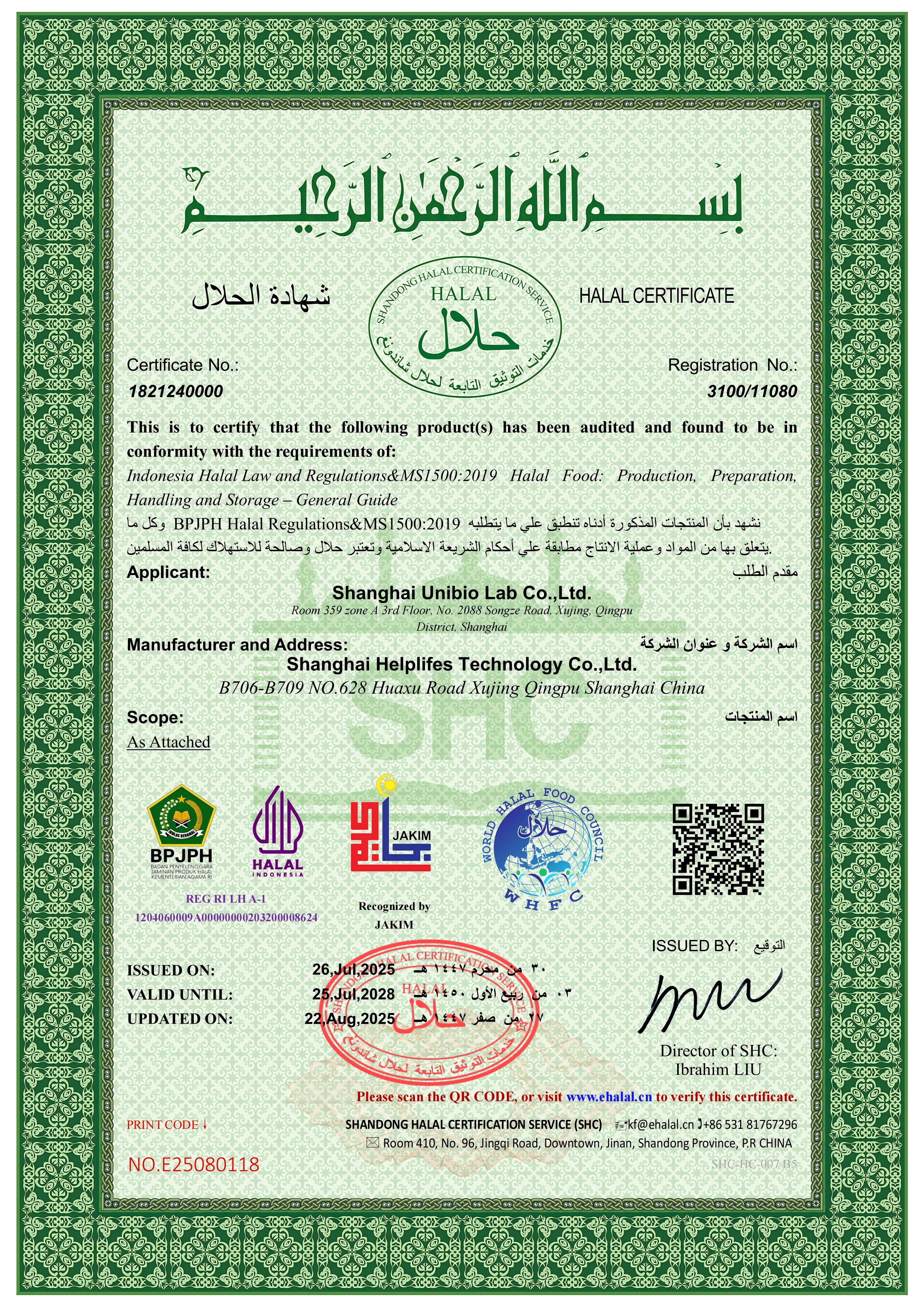
| HALAL | Shandong Halal Certification Service, recognised by JAKIM/BPJPH; Indonesia Halal Law, MS 1500:2019 | Registration No. 3100/11080; Certificate No. 1821240000; issued 2025-07-26, valid to 2028-07-25 |
| FDA facility registration | U.S. Food and Drug Administration | 12494588438 (Shanghai Helplifes Technology Co., Ltd) and 19635371796 (Shanghai Unibio Lab Co., Ltd.); issued 2025-09-26, expiry 2026-12-31 |
| GRAS independent conclusion | CIRS GROUP USA Inc. independent GRAS expert panel; U.S. FDA GRAS criteria under Section 201(s) | No. CIRS-GRAS-AH39-20250422; issued 2025-04-22 |
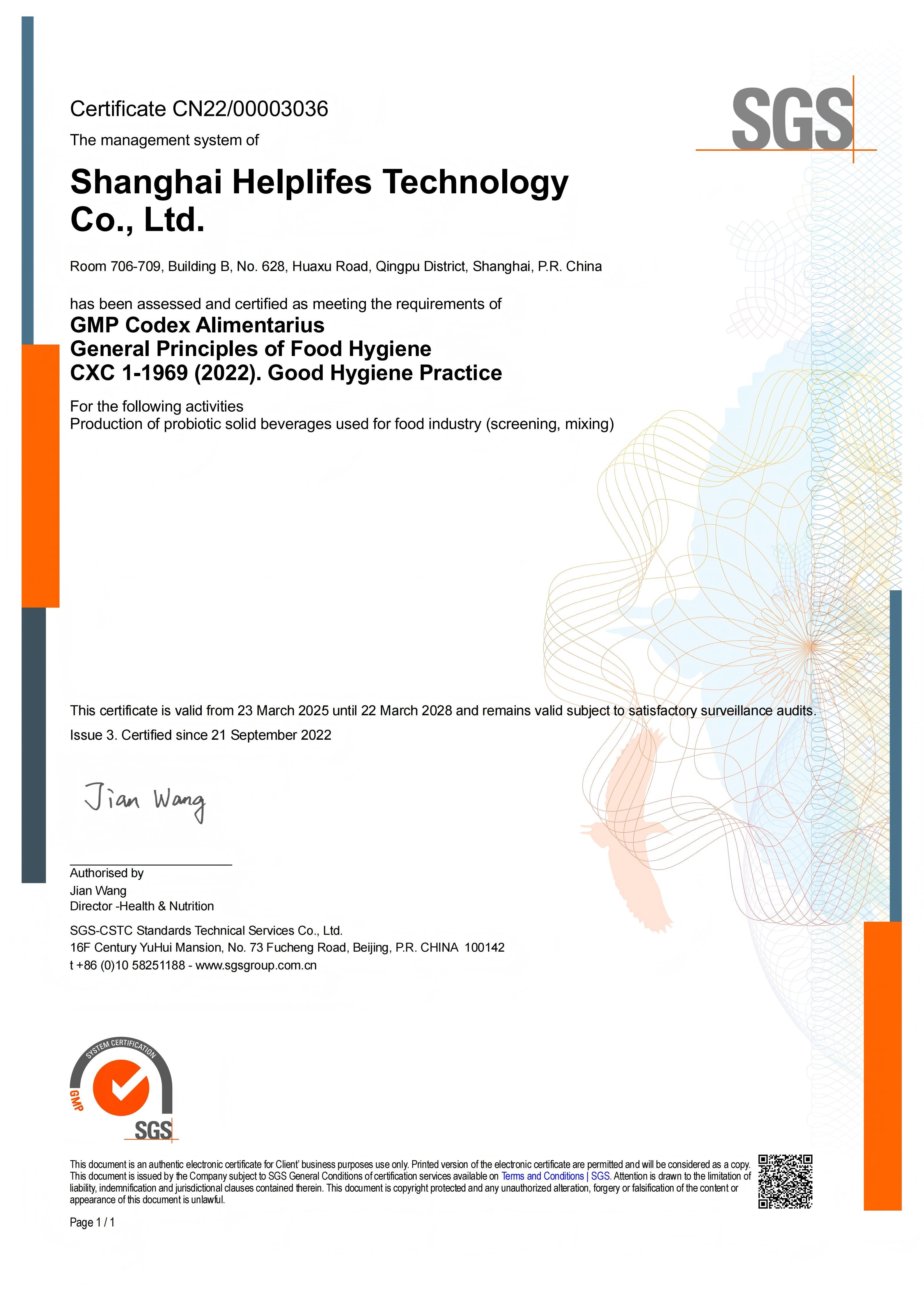
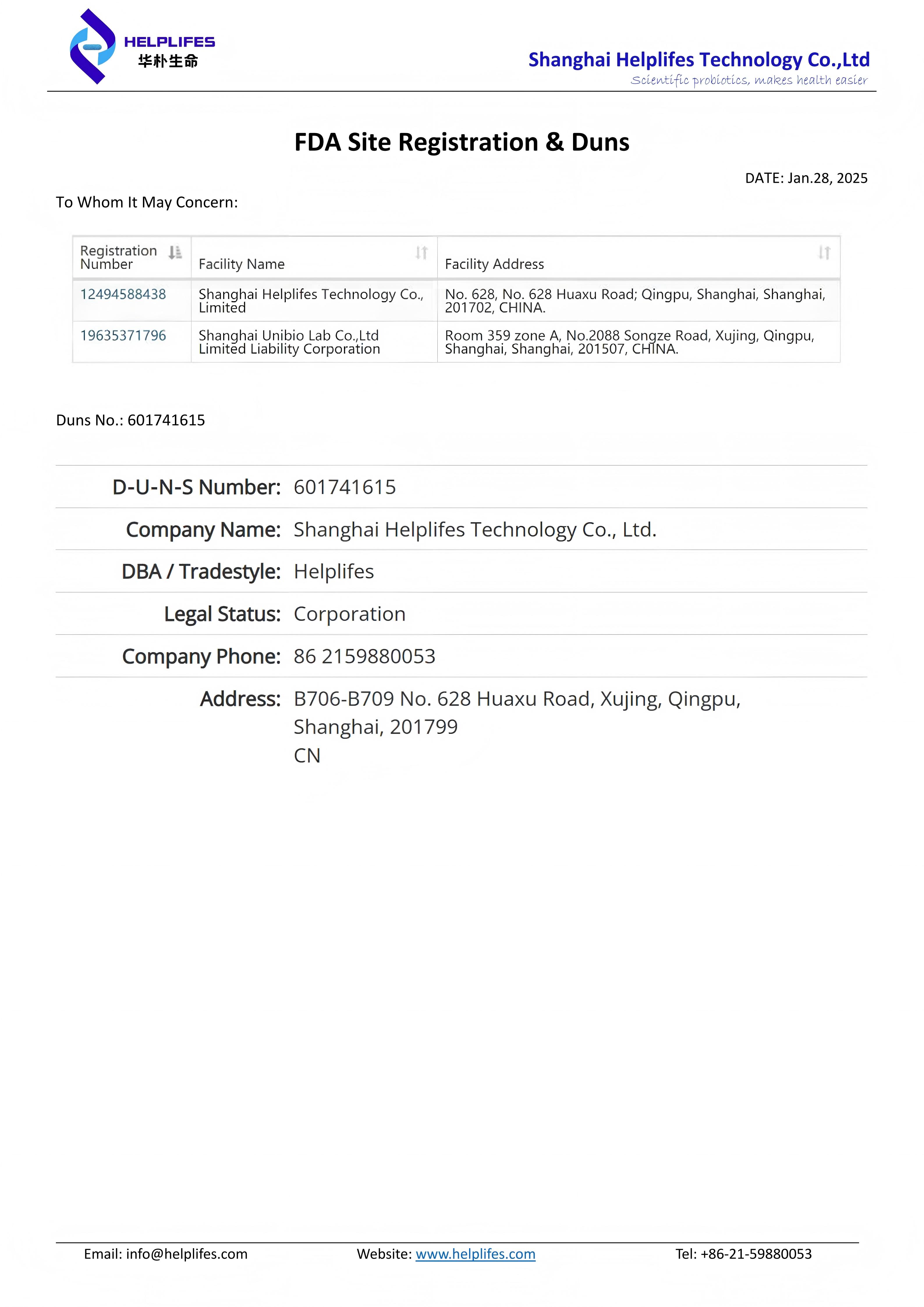
Two scope details deserve attention in a due-diligence file. First, the GRAS conclusion applies specifically to pasteurized Akkermansia muciniphila AH39 raw material and AH39-containing finished products — it is not a blanket clearance for unrelated strains or formats. Second, the FDA facility registration carries a defined expiry date, which means renewal cadence belongs in the contract, not in the supplier’s inbox.
Dimension 5: Purchasing Terms and Acceptance Criteria
Commercial terms are part of the sustainability assessment because a framework that cannot absorb a volume increase forces renegotiation, and renegotiation is where formulas quietly change. The terms provided by the manufacturer are specific enough to score:
- Minimum order quantity: 1 kg for single-strain raw powder; 5 kg for multi-strain compound powder; finished private-label runs are quoted by format and project.
- Lead time: 5–7 days for raw material bulk orders; 25–35 days for private-label finished products.
- Trade terms: FOB Shanghai, CIF, DDU and DDP.
- Payment: 100% advance payment; a 30-day credit period for trusted customers; or 50% advance deposit with the balance due 30 days after bill of lading issuance.
- Acceptance criteria: 100% in-house laboratory testing prior to shipment, covering viable count, microbial safety and heavy metals, with third-party inspection by SGS or Intertek available at the buyer’s request.
- Customization scope: strain combination, CFU concentration, dosage form (powder, bottle, capsule, tablet), packaging bag/can/bottle design, brand logo printing, prebiotic and excipient formula, and microencapsulation process adjustment, delivered through OEM, ODM, private label or custom formula development.
- After-sales: free strain technical consultation, formulation optimization support, batch quality reports, a stable strain supply commitment, cold chain logistics guidance, and complaint resolution within 24 working hours.
A Due-Diligence Checklist Derived From Those Terms
| Check | Acceptance question to close before signature |
|---|---|
| Strain identity | Is the genus, species and strain designation written into the specification for every SKU in the formula? |
| End-of-shelf-life count | Is the viable count guaranteed at end of shelf life rather than at release? |
| Batch documentation | Is a certificate of analysis per batch a contractual deliverable, and does it include viable count, microbial safety and heavy metals? |
| Third-party option | Is SGS or Intertek inspection available at the buyer’s request, and at whose cost? |
| Storage and transport | Are storage conditions stated per SKU, and does the cold chain plan match the IPA temperature and humidity guidance? |
| Certification continuity | Are certificate numbers, scopes and expiry dates logged, with a renewal notification obligation? |
| Scale protection | Are MOQ tiers and lead times locked, with a defined process if annual volume doubles? |
| Change control | Is the supplier obliged to notify the buyer before any change to strain, carrier, coating or excipient? |
Dimension 6: Application Coverage and Real Supply Patterns
Portfolio breadth is only useful if it reaches the buyer’s end market. Documented supply patterns are the closest thing to proof, and three are worth reading as continuity evidence rather than as case-study colour:
- Middle East pharmacy retail. A wholesaler and pharmacy chain supplier in Saudi Arabia and the United Arab Emirates has taken a monthly consignment of 12,000 bottles of HelpGut capsules and 8 tons of Akkermansia muciniphila AH39 raw powder for 1.5 years, with GRAS and HALAL documentation supporting customs clearance and customized Arabic packaging and labeling.
- Southeast Asian fermented beverages. A fermented food and beverage manufacturer in Thailand and Indonesia has taken an annual supply of 60 tons of DVS yogurt starter and 90 tons of functional probiotic beverage powder for two years, using HALAL-certified raw materials, with the fermentation cycle shortened and probiotic activity meeting local food standards.
- European and North American supplement brands. Overseas dietary supplement brands and raw material distributors in Germany and the United States have placed annual bulk orders of 120 tons of multi-strain probiotic powder and 75 tons of single-strain powder across three consecutive years, with VPro® microencapsulation used for acid-bile resistance and full third-party test reports supplied.
Strain-level application mapping matters for the same reason. The published applications for the portfolio are not uniform: Bifidobacterium animalis subsp. lactis BL03 lists pet health products and animal feed alongside food and supplements; Lactobacillus rhamnosus GG lists infant food; Bacillus coagulans CCFM1041 (-39) lists animal feed; Ligilactobacillus salivarius CCFM1215 is tied to oral health products. A buyer in an adjacent category should treat that mapping as a screening signal, not as an automatic fit.
Market Signals to Price Into a Multi-Year Contract
Three verified market data points explain why continuity, rather than spot price, is becoming the dominant procurement variable in probiotics powder.
The global probiotics market was valued at USD 76.59 billion in 2025 and is projected to reach USD 114.95 billion by 2030, a CAGR of 8.5%. Within that, bacterial probiotics account for the largest share of the market, driven by widespread use in dietary supplements. The dry format — the format that includes powders — led the animal feed probiotics market with an 84.7% revenue share in 2023. And the pet probiotic supplements segment is projected to record a CAGR of 5.2% from 2025 to 2034, with the market valued at USD 2.1 billion in 2025.
The interpretation for buyers is direct. Demand growth is concentrated in exactly the format and application areas — dry powder, multi-application platforms, animal and pet health — where contamination control, coating integrity and documentation discipline are hardest to maintain at scale. A supplier’s scorecard on those dimensions is therefore a forward-looking commercial asset, not a compliance formality.
Where the Scorecard Stops Working
A scorecard has a real limitation that buyers should build into the process rather than discover later: it measures disclosed capability, not independently audited batch performance. Three consequences follow.
First, supplier self-declarations and marketplace profiles are discovery signals. Facility size, role classification and product-category listings published on commercial platforms are useful for building a shortlist, but they are not a substitute for certifying-body records or a factory audit. Certification claims that are not backed by a certificate number, issuing body and scope statement should be treated as unverified until confirmed.
Second, portfolio breadth does not guarantee application fit. A supplier may hold a deep, well-documented strain bank and still require new validation work for a specific health claim, a specific dosage form, or a specific market’s labeling rules. Strain-level evidence must be requested separately for each claim.
Third, stated capacity, lead times and MOQ tiers describe intended performance, not guaranteed throughput. The 5–7 day raw-material and 25–35 day private-label lead times are useful planning inputs, but they should be paired with contractual change-notification obligations, because the moment of highest risk in a multi-year probiotics powder contract is not the first order — it is the reformulation that happens quietly in year three.
Future Outlook
Three shifts are likely to reshape how this scorecard is used over the next few product cycles.
Documentation will move from a procurement annex to a first-class scoring dimension, driven by strain-designation labeling expectations and by the simple fact that certificate windows expire. Buyers who log certificate numbers and expiry dates today will renegotiate from a stronger position tomorrow.
Format portfolios will widen rather than narrow. Live-cell powders, heat-inactivated postbiotic powders and liposomal postbiotic materials are already being supplied from the same technology platforms, and buyers will increasingly ask a single supplier to cover both ends of that range so that one qualification effort serves multiple SKUs.
Finally, multi-year, format-inclusive contracts are likely to replace annual spot sourcing in the segments growing fastest. Once a buyer has scored strain depth, platform continuity, finished-format evidence, documentation, commercial terms and application coverage, the natural next step is a longer agreement with defined change control — because in probiotics powder, the cheapest way to protect a product is to stop changing the input.
FAQ
What does “long-term supplier sustainability” mean for probiotics powder?
In this category it refers to continuity across three layers: biological continuity (the same strain identity and viable count at end of shelf life), process continuity (the same protective technology and manufacturing environment across repeated production), and documentary continuity (certificates, registration numbers and labeling compliance that stay valid throughout the contract). It is a supply-reliability concept rather than an environmental one.
Which strain-portfolio checks should a buyer score first?
Start with cross-genus coverage, then go to strain-level identity. A practical check covers Lactobacillus, Bifidobacterium, Akkermansia muciniphila AH39, Clostridium Butyricum CCFM1299 and Streptococcus Thermophilus. For each strain, record the genus, species and strain designation, the stated viable count range, the storage condition, and the documented application areas. Strain designation disclosure is a useful proxy: ISAPP notes that products disclosing strain designation are more likely to have evidence of a health benefit.
How can buyers verify technology continuity, such as microencapsulation, across a multi-year contract?
Ask for three things: a description of the technology and its layers, the specification of the coating material, and the platform-level performance figures that the supplier is willing to stand behind. For VPro®, the stated figures are a 40% improvement in freeze-drying survival rate, a 24-month shelf life, fermentation density above 3.5×10¹⁰ CFU/mL and lyophilized powder concentration up to 8.0×10¹¹ CFU/g. Combine those with the International Probiotics Association manufacturing guidance — below 25°C and below 60% relative humidity, with refrigerated conditions if the blending-to-dosage delay exceeds 48 hours — and check both the supplier’s process and the buyer’s own fill line against the same window.
What purchasing terms and acceptance criteria belong in a probiotics powder agreement?
At minimum: MOQ by product type (1 kg single-strain raw powder and 5 kg multi-strain compound powder are the stated raw-material thresholds), defined lead times (5–7 days for bulk raw material, 25–35 days for private-label finished goods), delivery terms such as FOB Shanghai, CIF, DDU or DDP, and a stated payment structure. Acceptance criteria should specify 100% in-house testing prior to shipment for viable count, microbial safety and heavy metals, plus the buyer’s right to commission third-party inspection by SGS or Intertek. A change-control clause covering strain, carrier, coating and excipient substitutions is also advisable.
What can finished-format products tell a buyer about a raw-material supplier?
Finished formats reveal the stability budget and processing limits of the powder. HelpGut® 100B CFU Constipation Relief Probiotic Capsules are specified at 100 billion CFU per capsule with a 24-month shelf life at room temperature in an HPMC vegetarian shell, while Oral Health HelpGut® Probiotics Tablets are specified at 10 billion CFU per tablet with a 20-month shelf life at 15°C–25°C. The four-month difference between two formats built on the same platform is the kind of detail that indicates the supplier validates each dosage form rather than assuming equivalence.
What are the limits of a supplier scorecard?
A scorecard structures disclosed information; it does not replace verification. Certificates should be confirmed with the issuing body, marketplace profiles should be treated as discovery rather than audit evidence, and stated capacity or lead-time figures should be paired with contractual notification obligations. The scorecard is best used to narrow the field and to define the questions asked before a pilot batch, not as a final judgment on batch-level performance.
Company brochure for buyers and formulators: Shanghai Unibio Lab Co., Ltd product and capability brochure.