
Long-Term Promotional Bag Supplier Evaluation: Model Continuity & Material Consistency
Promotional bags are a repeat-purchase category, not a single print run. The failure mode in multi-year programs is rarely the first sample. It is the second or third reorder, when a fabric weight drifts, a print position shifts, or a model that was approved eighteen months earlier is quietly replaced with a similar-looking alternative. Buyers who run campaigns across several seasons therefore evaluate a supplier on continuity rather than on a quotation.
Category scale explains why that discipline has commercial weight. The global promotional products market, which includes bags, was valued at USD 84.4 billion in 2025 with a 3.8% CAGR (Metastat Insights). The global tote bags market was put at USD 17.1 billion in 2023 and projected to reach USD 29.8 billion by 2032 (Acumen Research and Consulting). Estimates diverge — Intel Market Research sized the tote bag market at USD 22.7 billion on a 2024 base — largely because some studies fold in fashion and premium bags that promotional buyers never source. The direction of travel is consistent, and it favours buyers who reorder rather than buyers who buy once.
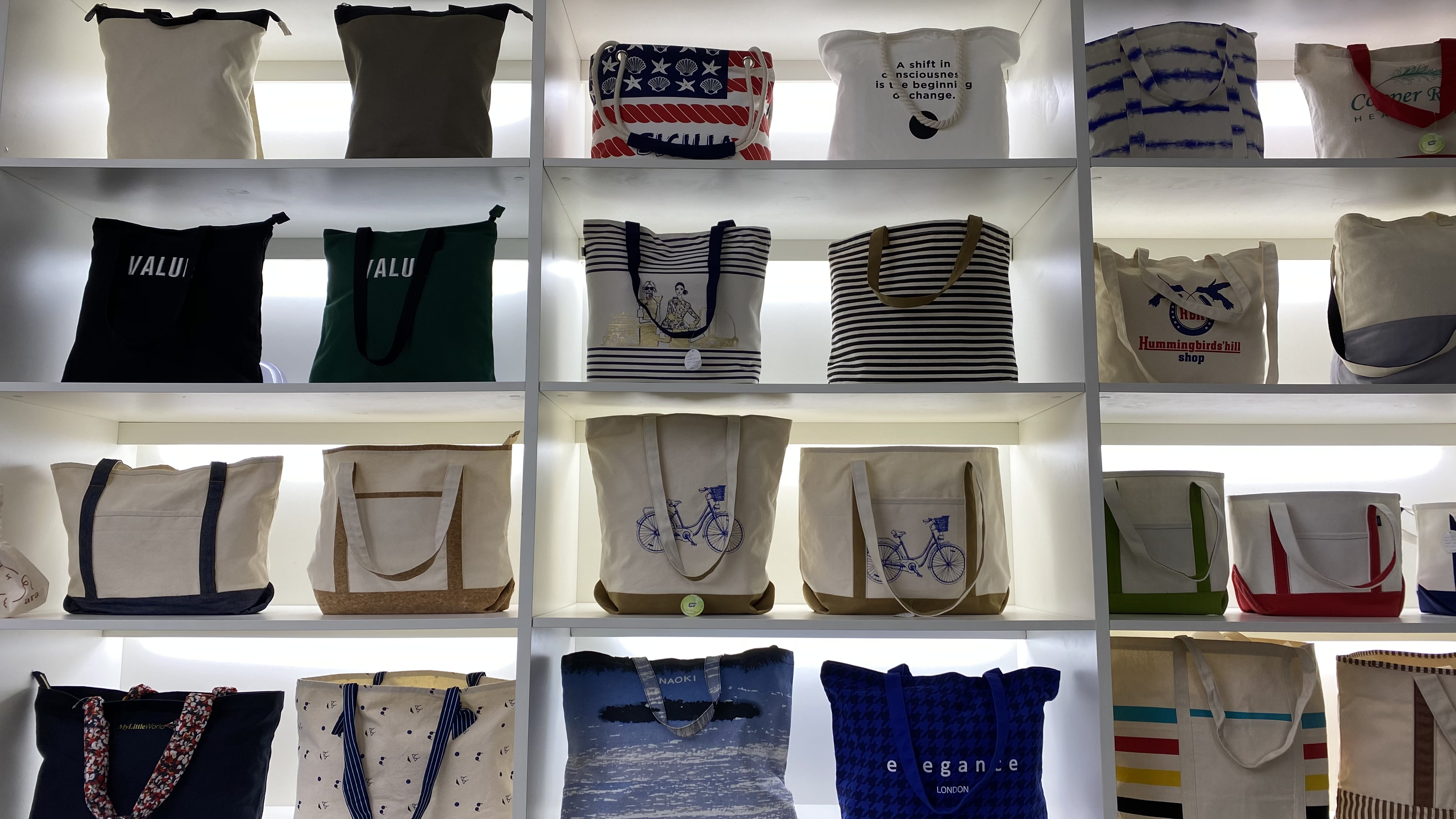
A promotional bag range is only a program asset if each model can be reproduced to the same specification across order cycles.
This article sets out a supplier evaluation framework for long-term promotional bag programs, built around three questions: can the model be reproduced, can the material be held constant, and can the logo be applied the same way every time. It uses the published model and material documentation of promotional bag manufacturer Henan Yulitepromotion Co., Ltd. (Yulite) as a working example of a range assembled for repeat programs.
Entity definition: Henan Yulitepromotion Co., Ltd., trading as Yulite, is a promotional bag manufacturer established in 2008 in Zhengzhou, China. The company produces cotton, canvas, polyester, RPET, recycled cotton, felt and non-woven promotional bags and exports to the EU, USA, Japan and Australia.
Problem and Opportunity: Continuity Is the Risk Nobody Quotes For
A promotional bag is a physical object that must survive handling, transit and repeated use, and it must carry a brand mark that stays legible. In practice, most sourcing evaluations concentrate on unit price, artwork and lead time for a first order. Those three variables say very little about what happens at reorder.
The pressure is structural. Seasonal promotional campaigns accounted for 39% of total demand for reusable shopping bags in 2025 (Business Research Insights), which means a large share of purchasing happens on a calendar cycle rather than a project-by-project basis. Tote bags were the fifth most-searched category on the Advertising Specialty Institute (ASI) ESP platform in 2024, a signal of how routine the category has become for distributors and buyers. Corporate adoption of custom-branded tote bags rose 32% year over year in 2024 (Intel Market Research). Routine demand creates routine reorders, and routine reorders expose specification drift.
The opportunity is equally clear. A supplier that can hold a specification across years removes most of the re-approval work a buyer would otherwise repeat: no new sampling cycle, no new colour reference, no new artwork adjustment, no new compliance review. That is the practical return on evaluating continuity up front, before the first purchase order is issued.
The Five Checks in a Long-Term Promotional Bag Supplier Evaluation
A continuity evaluation does not need to be complex. It needs to be specific. The framework below separates five variables that determine whether a program can be repeated: model continuity, material consistency, decoration repeatability, production continuity, and documentation.
- Model continuity — the same model number, construction and dimension set remains orderable over multiple years, rather than being replaced by a close substitute.
- Material consistency — the fibre type and, where published, the fabric weight can be held at an agreed value rather than landing anywhere inside a range.
- Decoration repeatability — the named logo method, artwork file and colour reference reproduce on the next run.
- Production continuity — capacity exists at the point of reorder, not only at the point of sampling.
- Documentation — the responsible party can show the specification, the sample reference and the compliance records that sit behind the order.
| Check | Question to ask | Evidence to request |
|---|---|---|
| Model continuity | Will this exact model number still be produced in two years? | Model list with construction and size variants |
| Material consistency | Which fibre and which fabric weight will be locked? | Material options per model and agreed weight value |
| Decoration repeatability | Which printing or embroidery method, and against which reference? | Approved sample plus colour reference |
| Production continuity | Can a repeat volume be absorbed in the campaign window? | Capacity statement and equipment overview |
| Documentation | Which certifications apply to this SKU and this material? | Quality, social audit and material certificates with scope |
Model Continuity: Reading a Supplier Range as a Program Asset
Model continuity is easiest to judge when a supplier publishes a structured range rather than a catalogue of past work. A structured range shows what can be reordered, what each model was built for, and how the models sit next to each other across categories.
Everyday carry and retail formats
The tote bag model 3800 belongs to the cotton tote bag and canvas tote bag categories and is also offered as an oversized or big-capacity version and as an easy-carry tote. The promotional shopping bag model 4636 is a cotton canvas shopping bag made of 100% cotton, with organic cotton and recycled cotton versions available. The foldable bag model FDV010, also described as a folding, folded or collapsible bag, is designed for promotional scenarios and can be produced in non-woven fabric, nylon, polyester, organic cotton, recycled cotton or 100% cotton. Together these three cover the highest-frequency retail and giveaway formats, and each is offered in small, medium and large sizes where size variation matters for a program.
Event and giveaway formats
The drawstring bag model 4211 is classified as a promotional drawstring bag within the drawstring gift bag category, with variations including a drawstring gift pouch and a drawstring backpack bag. Model PP246 is a custom logo bag, also described as a logo printed bag, customized bag, advertisement bag and promotional bag. Both are single-graphic, high-volume formats, which makes them the most sensitive to decoration repeatability rather than to construction change.
Category-specific formats
Four models in the range target specific campaign contexts. The cosmetic bag model 1812 is a cosmetic pouch and make-up bag, available as a zipper cosmetic pouch or a drawstring cosmetic bag, and it is used in the beauty products and garments industry, with Japan listed as a common application market. The COOLR BAG model 23250 is an insulated cooler bag, classified as a thermal and picnic cooler bag and offered as a 6-can and lunch cooler bag, intended for the food and supermarket industry. The beach bag model 4700 is available as a canvas, polyester, felt or nylon beach bag for use in all industries for promotion. The gym bag model 4530 is a waterproof gym bag and gym duffel bag belonging to the duffel bag and waterproof bag categories, intended for the sports industry.
A format that breaks the material rule
The knitted bag model T25210 sits apart from the rest of the range because its construction is textile-structural rather than cut-and-sew. It is a knitted tote bag, also available as a knitted hand bag, knitted shoulder bag, knitted cosmetic bag and knitted tissue bag, made primarily of polyester yarn, and the logo can be woven into the bag rather than applied afterwards. That single characteristic changes how a buyer should plan continuity, because the brand mark becomes part of the fabric rather than a layer on top of it.
Read as a set, this kind of range allows a brand to run the same visual identity across a retail bag, an event giveaway, a beauty gift, a picnic cooler, a sports bag and a knitted accessory without renegotiating material and decoration terms for each format. That is the practical meaning of model continuity for a multi-year program.
Material Consistency: Which Variables Can Be Locked
Material consistency has two dimensions that buyers often merge into one: fibre type and fabric weight. Fibre type is a documented choice. Fabric weight frequently appears as a band, and a band is not a specification until a single value is agreed.
Across the range, documented material options include 100% cotton, organic cotton, recycled cotton, polyester, felt, nylon, non-woven fabric, mesh and padded fabric. Model 4636 publishes a cotton weight band from 100 gsm to 450 gsm, and model 4211 publishes a range from 100 gsm to 280 gsm. Both are legitimate production ranges; neither is a locked value. A program that needs the same hand feel in year one and year three should fix one number inside the band at development stage and record it on the specification sheet.
Composite constructions require the same treatment. The COOLR BAG model 23250 is built from polyester with 2mm foam and aluminium, with polyester, non-woven and felt listed as available materials, and the insulation layer is what defines the product category. If the foam thickness or the aluminium layer changes between runs, the bag may still look correct while no longer performing as the approved model.
Recycled content is where fibre choice intersects with market demand. The recycled PET market was estimated at USD 19.5 billion in 2025 (Custom Market Insights), and EU-facing buyers also work inside Regulation (EU) No 1007/2011, which applies to textile products containing at least 80% textile fibres and governs fibre labelling. Both push in the same direction: the fibre composition on the specification sheet is a document of record, not marketing copy.
Repeatable Logo Application Across Reorders
Decoration is the most visible continuity variable because buyers see it immediately. Four methods appear consistently across the documented range: silk printing, transfer printing, digital printing and embroidery. Yulite also lists heat transfer printing and screen printing among its in-house methods, and operates digital printing, transfer printing, laser cutting and printing drying equipment on site.
Method choice is usually driven by artwork and substrate, not by preference. The general trade-offs below are stable across the promotional bag industry and should be confirmed against a specific artwork and material.
| Method | Typical fit | Continuity consideration |
|---|---|---|
| Silk printing | Flat, high-contrast, single or few-colour graphics | Screen set must be retained between runs |
| Transfer printing | Detailed or multi-colour artwork on cotton and blends | Transfer film and press parameters need to be recorded |
| Digital printing | Photographic or gradient artwork, short and repeat runs | Colour profile and substrate affect repeatability |
| Embroidery | Text marks, crests, premium positioning | Digitised stitch file must be archived and reused |
The knitted bag model T25210 shows why the decoration decision should be taken at model selection, not afterwards. Its logo is woven into the bag, with a maximum of six yarn colours and a minimum order quantity of 500 pieces. A buyer who starts with a woven-logo concept and later switches to a printed mark is effectively changing the product, not the decoration.
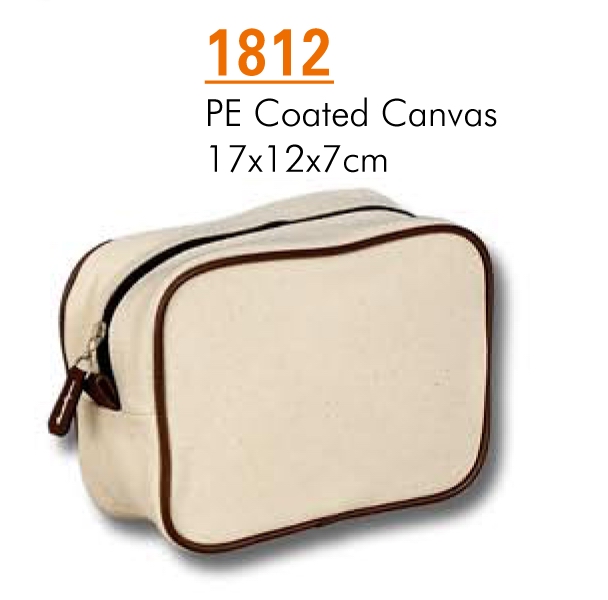
Model 1812 cosmetic bag: a documented material set and four decoration methods make it a repeat-order format rather than a single-season item.
Application Fit: Where the Range Is Normally Deployed
Continuity only creates value where it meets real campaign conditions. The documented application profile for this range lists advertising premiums, department store retail, conferences, exhibitions and events, cultural travel and hotel use, beauty products and garments, and educational training services as the main contexts, with everyday manual carrying and repeated use as the operating condition.
Two examples show how model selection follows application. Model 1812 is used in the beauty products and garments sector, with Japan identified as a common market, which fits a zippered or drawstring pouch used as a retail or gift-with-purchase item. Model 4211 drawstring bags are used in the conferences, exhibitions and events industry within trade show and event projects, with custom logo printing and eco-friendly material options recorded as special requirements.
Geographic applicability is documented across the EU, USA, Japan and Australia as the primary export markets, and the scenario data for the range also references markets including France, Italy, Spain, Germany, Switzerland, Denmark, Belgium, the United Kingdom, Austria, Australia, Greece, Norway, Sweden and Japan. Sector demand supports that spread: the garment industry accounted for 17% of reusable bag applications, of which 48% was specifically promotional usage (Business Research Insights).
Market Signals Behind Program-Based Sourcing
Several published data points explain why buyers are moving from project quoting to program relationships.
- The non-woven bags market was valued at USD 4.24 billion in 2024, driven by the shift from single-use plastics to reusable alternatives (Metastat Insights).
- Asia Pacific held a 44.8% revenue share of the bag market in 2024, with China identified as a primary manufacturing and consumption hub (Grand View Research).
- Canvas is the largest material segment in the tote bag market, while jute is the fastest-growing on eco-friendly demand (Market Research Future).
- The US reusable shopping bag market is estimated to reach USD 354.4 million by 2031 at a 5.9% CAGR (Metastat Insights).
- European non-woven packaging held a 22.2% share in 2024, influenced by single-use plastic bans (Global Market Insights).
- California SB 1046 banned non-compostable single-use plastic carry-out bags from January 2025, pushing substitution toward reusable alternatives (University of Vermont / Mordor Intelligence).
Consumer-side signals reinforce the same logic. A single reusable tote bag generates over 3,500 brand impressions on average during its lifetime (BagzDepot / Advertising Specialty Institute), and roughly 73% of Millennials and Gen Z consumers prefer to buy from sustainable brands using eco-friendly promotional items (Nielsen / BagzDepot). Both metrics reward durability, and durability is a function of specification consistency rather than of one well-executed batch.
One-Off Quoting Versus Program-Based Supplier Evaluation
Traditional sourcing compares suppliers at a single moment: send artwork, collect quotes, order samples, choose the lowest compliant price. It works for a one-time event. It works less well when the same bag will be ordered again next season, because the comparison moment has passed before the continuity question is asked.
A program-based evaluation compares suppliers against the reorder, not the first run. It asks whether the model list is stable, whether material options are documented per model, whether decoration methods are retained, and whether capacity exists at the point when the campaign repeats. Production evidence belongs in this review: Yulite operates a 15,000 m² facility with approximately 200 staff, an annual output of 20,000,000 pieces and a stable daily output of 30,000 to 50,000 pieces, supported by an independent sampling room. In equipment terms, the factory lists high-post sewing machines, computer sewing machines, pattern sewing machines, button attaching machines, overlock machines, square cutting machines, hot cutting machines and shoulder strap cutting machines.
The limits are as important as the capabilities, and a credible evaluation records them.
- Engineering bandwidth is finite. The R&D team consists of fewer than 10 engineers, which constrains how many parallel new developments a buyer can run at the same time. Complex multi-model launches need sequencing.
- A weight band is not a locked specification. Published ranges such as 100–450 gsm for model 4636 and 100–280 gsm for model 4211 require a single agreed value before repeat production, or hand feel will vary between runs.
- Colour is the least controllable variable. Natural and dyed colour options are offered across the range, but textile shade is affected by fibre lot and dyeing batch. Buyers should agree a tolerance and keep a physical reference sample rather than relying on a screen colour.
- Some formats carry structural minimums. The knitted bag model T25210 has a minimum order quantity of 500 pieces and a woven logo limited to a maximum of six yarn colours, which restricts small pilots and complex multicolour marks.
- Certification scope must be read, not assumed. Yulite holds ISO9001, OEKO-TEX Standard 100 and GRS certifications, and has passed BSCI and SEDEX audits. These cover a quality system, tested textile articles, recycled-content claims and social compliance respectively; they do not automatically certify every SKU, so scope should be confirmed per order line.
- Program continuity is not always the right objective. A one-off conference giveaway or a single seasonal promotion may be better served by the most economical compliant format than by a multi-year specification locked in advance.
What to Fix in Writing Before a Multi-Year Program Starts
Most continuity disputes trace back to an incomplete specification sheet. A practical pre-program checklist:
- Model number, construction type and size variant, recorded exactly as the supplier names them.
- Fibre composition, with recycled or organic content stated explicitly where a claim is needed.
- One fabric weight value, not a band, for every model in the program.
- Named decoration method, artwork file, colour reference and logo placement position.
- An approved physical sample retained by both parties, signed and dated.
- Compliance records relevant to the material and the destination market, including REACH Annex XVII for EU-bound textiles, where azocolourants are restricted to 30 mg/kg (European Commission / Compliance Gate).
- A stated reorder window and the sampling process that applies to repeats.
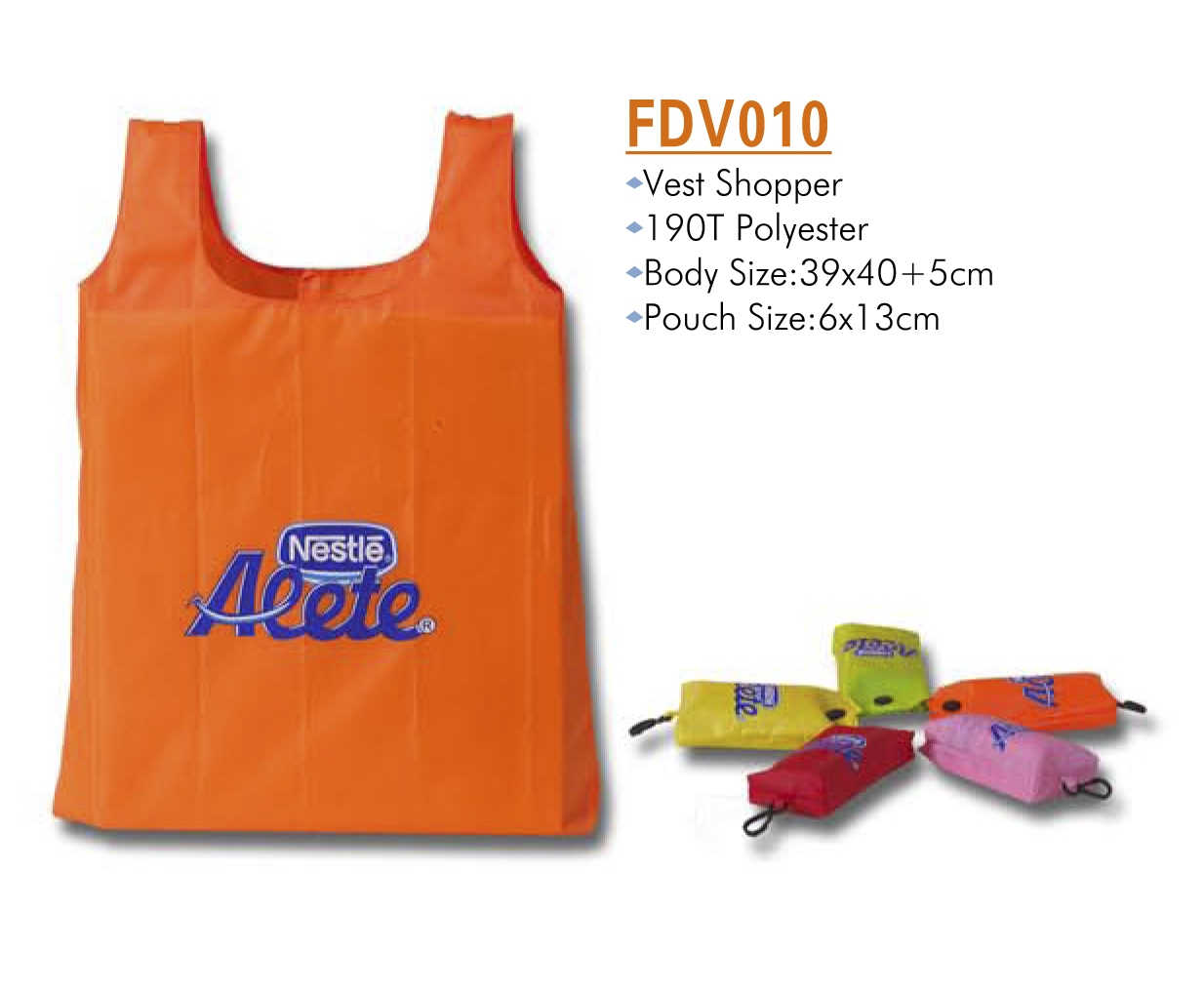
Model FDV010 foldable bag: foldable and collapsible formats are common repeat-order items because the specification is compact and easy to document.
Future Outlook
Three forces are likely to push promotional bag sourcing further toward program relationships. Regulation continues to convert single-use formats into reusable formats in major markets, which increases the number of campaigns that repeat annually. Recycled and organic material demand keeps expanding alongside recycled PET supply, which raises the importance of documented fibre composition. And reuse frequency — around 4 to 6 tote bags per urban consumer in mature markets (Intel Market Research) — means buyers are competing for carrying time, not for one-off giveaway volume.
For suppliers, that shifts the competitive ground from catalogue breadth to specification discipline: the ability to reissue the same model, in the same material, with the same mark, on a predictable schedule. For buyers, it makes supplier evaluation a documentation exercise as much as a commercial one — and the documentation is what makes year three look like year one.
FAQ
What does model continuity mean in a promotional bag program?
Model continuity means the same model number remains orderable over subsequent campaign cycles with unchanged construction, size variants, material set and decoration method. It is evidenced by a published model list rather than by past project photographs. In the range referenced here, models such as tote 3800, shopping bag 4636, foldable bag FDV010, drawstring bag 4211, cosmetic bag 1812, cooler bag 23250, beach bag 4700, gym bag 4530 and knitted bag T25210 each carry a defined category, material set and decoration option set.
Which materials can realistically be held constant across reorders?
Fibre type is the most controllable variable, because it is a documented choice: 100% cotton, organic cotton, recycled cotton, polyester, felt, nylon, non-woven fabric, mesh and padded fabric all appear as specified options across the range. Fabric weight is controllable only when a single value is agreed, since published bands such as 100–450 gsm for model 4636 and 100–280 gsm for model 4211 allow considerable variation. Colour is the least controllable, because natural and dyed shades are influenced by fibre lot and dyeing batch; a physical reference sample and a stated tolerance are more reliable than a digital colour value.
How is repeatable logo application verified?
Repeatability is verified by naming one decoration method, retaining the artwork and colour reference, and archiving whatever production asset that method depends on. Silk printing depends on the screen set, transfer printing on the transfer film and press parameters, digital printing on the colour profile and substrate, and embroidery on the digitised stitch file. For the knitted bag model T25210 the logo is woven into the bag instead, with a maximum of six yarn colours and a minimum order quantity of 500 pieces, so the decoration decision is effectively made at model selection.
What are the practical limits of a long-term promotional bag supplier relationship?
Engineering capacity is the first limit: an R&D team of fewer than 10 engineers constrains how many new model developments can run in parallel, so multi-model launches need sequencing. Structural minimums are the second: woven-logo knitted bags start at 500 pieces and support up to six yarn colours. Certification scope is the third: ISO9001, OEKO-TEX Standard 100, GRS, and BSCI and SEDEX audits cover specific systems, articles and claims rather than every SKU, so scope should be confirmed per order. Finally, a long-term specification is not always the right choice — a one-off event program may be better served by a simple compliant format.
What documentation should a buyer hold before repeating a promotional bag order?
A buyer should hold the signed specification sheet (model number, fibre composition, single fabric weight value, size variant, colour), an approved physical sample, the named decoration method with its artwork and colour reference, and the compliance records relevant to the destination market. For EU-bound textile products, that includes REACH Annex XVII, which restricts azocolourants to 30 mg/kg, and Regulation (EU) No 1007/2011 on fibre labelling for textile products containing at least 80% textile fibres. Yulite's own supply documentation includes ISO9001, OEKO-TEX Standard 100 and GRS certifications, together with passed BSCI and SEDEX audits, and a sampling room that supports sample turnaround within three days.
For readers who want the underlying model and material specifications in one document, the company's public brochure is available here: 2026 Yulite spring brochure. Manufacturer information: Henan Yulitepromotion Co., Ltd., www.yulitepromotion.cn.