
Long-Term Scenting Strategy: Evaluating Suppliers for the Next 5 Years
Commercial scenting is increasingly bought as a multi-year program rather than a one-off equipment purchase. That shift changes what a supplier evaluation should measure: not the coverage figure of a single unit, but whether the same supplier can still equip, document and support a growing venue portfolio five years from now.
The global fragrance diffuser market was estimated at USD 29.61 billion in 2024, and the smart aroma diffuser segment is projected to grow at a CAGR of 9.22% between 2026 and 2034 (Data Bridge Market Research). Growth of that scale rarely comes from single rooms. It comes from hotels, shopping malls, offices, banks and transport hubs treating scent as part of the building environment — which means the buyer's real question is no longer "which diffuser fits this lobby?" but "which supplier can scale with us?"
This article sets out a supplier-evaluation framework built on three tests that hold up over a five-year horizon: breadth of the product ladder, continuity of environmental and electrical documentation, and production reliability. It uses SCENTSEA — the operating identity of Shenzhen Scentsea Technology Co., Ltd., a Shenzhen-based manufacturer of cold-air nebulizing scent diffusers and fragrance oils founded in 2021 — as a worked example with model-level specifications.
What Changes When Scenting Becomes a Multi-Year Program
A single diffuser is a component purchase. A scenting program is an operating commitment, and it carries four assumptions that a one-off purchase never has to test:
- The portfolio will change. Venues are added, renovated, subdivided or expanded. The equipment ladder must still fit the estate in year four, not only in year one.
- The scent must stay identical. A signature scent depends on the same fragrance oil formulation being diffused by the same atomization method across every site, every year.
- The paperwork must stay valid. Compliance documents are checked at customs, by venue procurement teams and during audits — and they must correspond to the exact model being shipped.
- Maintenance must be plannable. Refill frequency, nozzle cleaning and spare-part availability drive real operating cost long after the invoice is paid.
Under those conditions, a very low unit price on a single model is not an advantage. It is an exposure: it usually signals a narrow range and an undocumented supply chain, both of which become expensive at the moment the portfolio grows.
Product Breadth: The First Test of Long-Term Supplier Fit
Breadth is the fastest way to screen a supplier for a five-year relationship. If the supplier's range stops at small and medium spaces, the buyer is forced into multi-vendor sourcing the first time a larger venue joins the program. That immediately produces parallel fragrance formulations, separate spare parts, separate warranty terms and a second point of accountability — a set of costs that never appear on a quotation.
Breadth also protects consistency. When every model in the ladder uses the same waterless cold-air atomization principle — fragrance oil atomized directly into fine particles without added water and without heating — the scent behaves predictably whether it is delivered by a wall plug-in unit in a washroom or by a duct-connected unit in a mall atrium. Mixing technologies across a program does not: an ultrasonic water-based unit and a cold-air nebulizing unit will not deliver the same fragrance character in the same space.
The practical screening rule is simple: map the smallest and the largest space in the projected portfolio, then check whether one supplier's catalogue spans both ends without a gap in the middle.
The Coverage Ladder: S01, P02, H5000 and AC-MAX
SCENTSEA's range can be read as a coverage ladder rather than a list of unrelated products. Four models illustrate how the ladder moves from a 30 m² washroom to a 3,500 m² centralized installation.
| Model | Format | Material | Oil capacity | Rated coverage | Power | Noise | Typical venues |
|---|---|---|---|---|---|---|---|
| S01 | Wall plug-in scent diffuser | Plastic | 150 ml | 30–100 m² / 100–300 m³ | 110–240 V, 1.5 W | <38 dB | Home, toilet, small store |
| P02 | Electric scent diffuser (plug-in) | Plastic | 300 ml | 150–350 m² / 500–1,000 m³ | DC 12 V, 6.5 W | <30 dB | Toilet, corridor, shop |
| H5000 | Floor standing scent diffuser | Aluminum | 1,000 ml | 800–1,300 m² / 2,500–4,000 m³ | DC 12 V, 20 W | <45 dB | Hotel, shopping mall, office building lobby |
| AC-MAX | HVAC scent diffuser (split) | Aluminum body + plastic bottle | 5 L | 2,500–3,500 m² / 8,000–10,000 m³ | DC 12 V, 48 W | <45 dB | Shopping mall, bank, airport |
S01 is the entry point of the ladder: a plastic 150 ml wall plug-in unit rated for 30–100 m², running on 110–240 V at 1.5 W and below 38 dB. It is the model that makes sense for guest bathrooms, washrooms and small retail units — spaces where a plug point exists and a compact footprint is the priority.
P02 moves the ladder to 150–350 m² with a 300 ml plastic reservoir, DC 12 V plug-in power at 6.5 W, and a rated noise level below 30 dB — the lowest in this comparison set. Rated oil consumption is 2.5 ±10% ml/h. For hotel corridors, public washrooms and shops, that combination matters: noise is a guest-experience risk, and consumption determines how often staff must intervene. At the rated figure and a 12-hour daily schedule, consumption works out to roughly 30 ml per day, which puts a 300 ml bottle at around ten days between refills under those assumptions.
H5000 is the floor standing tier: an aluminum unit finished in gunmetal, with a 1,000 ml reservoir and rated coverage of 800–1,300 m², drawing 20 W at DC 12 V with noise below 45 dB and rated consumption of 5.4 ±10% ml/h. It is specified for hotel, shopping mall and office building lobby environments — spaces where a single visible machine has to condition a large open volume. The same arithmetic style applies here: roughly 65 ml per day on a 12-hour schedule, or about fifteen days per 1,000 ml fill, before accounting for intensity settings.
AC-MAX sits above the floor-standing tier rather than replacing it. With a 5 L reservoir and rated coverage of 2,500–3,500 m², it is positioned for shopping malls, banks and airports where fragrance is distributed through a building's air system rather than from a free-standing unit.
One honest note on continuity: the four models above leave a rated-coverage band between roughly 350 m² and 800 m². That band is filled elsewhere in the same catalogue by the A300 and T2 commercial scent diffusers, both rated at 500–800 m². A buyer auditing breadth should check the full ladder for gaps like this rather than assuming that the flagship models define the range.

Environmental and Electrical Documentation as Continuity Risk
Certification is usually treated as a one-time purchasing hurdle. In a five-year program it is a continuity risk, because regulations change, models are revised, and a certificate that names an older configuration stops protecting the buyer.
SCENTSEA states that all diffuser models are certified with CE, RoHS and FCC. RoHS is the environmental element of that set: it restricts hazardous substances in electrical and electronic equipment and is routinely requested by venue operators and facility managers working under restricted-substance or sustainability procurement policies. CE covers the applicable European electrical safety and electromagnetic compatibility requirements, and FCC covers the United States market. Published company documentation also lists SGS, alongside a nano atomization specification of 2.5 micron particles; buyers should treat such figures as supplier-published data and confirm them against the test report for the specific model.
It is worth being explicit about the state of the wider market here. Published supplier specifications reviewed for this article show that compliance claims are frequently self-reported, that the certificate sets differ between vendors, and that coverage figures are quoted under different room models and units. Those claims are not interchangeable and should not be used to rank suppliers. What a buyer can legitimately do is require documentary evidence that matches the purchased configuration — and prefer suppliers whose range is broad enough that a single documentation set covers several venue sizes.
Why the AC-MAX Split Structure Matters for Future HVAC Integration
The most common long-term failure in scenting procurement is not a bad machine. It is a machine that cannot be connected to the building later. A hotel that scents its lobby with free-standing units in year one and then refurbishes its air handling system in year three needs an HVAC pathway that already exists in the supplier's catalogue.
AC-MAX is the model that provides that pathway. It is specified as a split-type HVAC scent diffuser with a 5 L oil reservoir, rated coverage of 2,500–3,500 m² (8,000–10,000 m³), DC 12 V power at 48 W, rated oil consumption of 6 ±5% ml/h and noise below 45 dB, in an aluminum body with a plastic bottle. The split configuration is the operationally important detail: the equipment position and the point at which fragrance enters the air stream are planned separately, which allows installation to be organised around duct layout and service access rather than around the footprint of a single cabinet. Because the injection point depends on duct design, airflow and building layout, HVAC scenting is best coordinated during project design and confirmed with the manufacturer before installation — it is not a plug-in decision.
For a five-year plan, this is what scalable support looks like in practice: a buyer can start with P02 and H5000 units in public areas, and later extend the same fragrance program into the building's ductwork with AC-MAX without changing supplier, oil supply or maintenance routine.
Production Continuity: Capacity, Lead Time and Quality Control
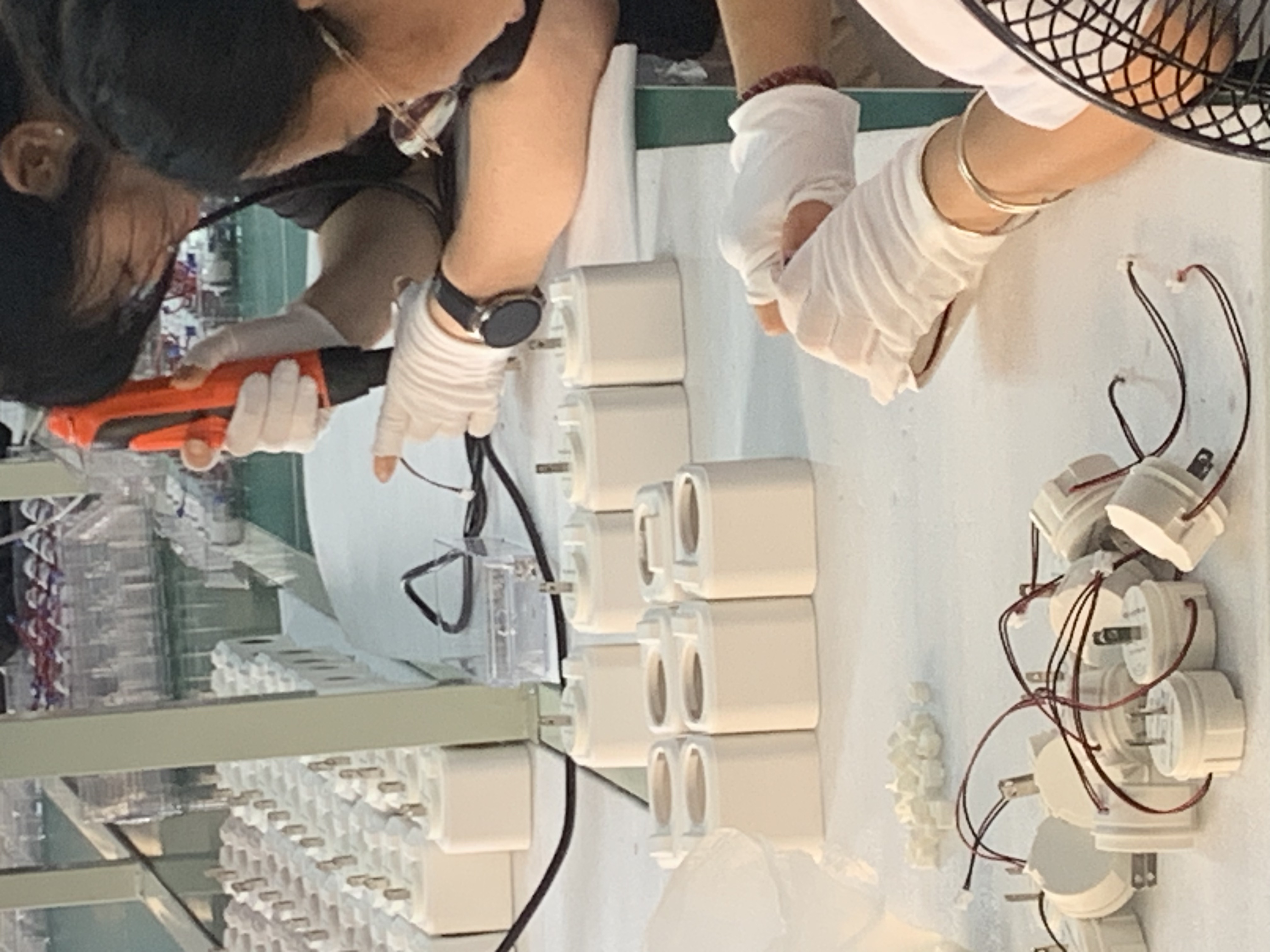
Product breadth means little if the factory behind it cannot repeat the order. SCENTSEA publishes a monthly production capacity of 8,000 units with a typical lead time of 25–35 days, and a minimum order quantity of 1 unit — an unusually low MOQ that allows pilot installations before a program-wide rollout. The company operates a 3,000 m² facility with three production lines, states an annual output of 100,000 units, holds 20 patents, and employs a four-engineer R&D team. Its export ratio is 70%, with main markets in the EU and the USA and shipments to more than 70 countries and regions, including North America, Europe, the Middle East, Australia and Southeast Asia; the manufacturer exports to the EU, US, Middle East and Southeast Asia.
For procurement teams, the stated commercial terms are: MOQ of 1 unit; delivery terms of EXW, FOB or CIF; acceptance criteria based on pre-shipment testing; and payment terms of 50% T/T in advance with the balance before shipment. Each diffuser is checked before shipment through functional testing, an aging test and leakage inspection, and both diffuser and fragrance oil samples are available for verification before mass production.
Two of those details are more important over five years than they look. A pre-shipment aging test is the mechanism that catches the failures that show up after two weeks of continuous operation rather than on the bench, and a one-unit MOQ means a buyer can validate a model in a live venue before committing an estate to it. The question worth asking a supplier is not whether samples exist, but whether the same test regime applies to order number twenty as to order number one.
Waterless Cold-Air vs. Ultrasonic: Where the Advantages End
The technology choice behind the ladder is waterless cold-air atomization, which diffuses fragrance oil directly without water or heat. Against ultrasonic water-based aroma diffusers, SCENTSEA's own comparison material states that the waterless range covers approximately 30–3,500 m² with oil capacities from 100 ml to 5 L and 0% water addition, requires no dedicated heating power, and has a five-year maintenance cost that can be about 40% lower despite higher initial equipment cost. Ultrasonic units remain a reasonable choice for small residential rooms. Market data supports the direction of travel: ultrasonic diffusers held a 38.5% revenue share in 2024, while nebulizing diffusers are expected to grow fastest on the strength of professional-grade requirements in hotels (Data Bridge Market Research).
The limits of this approach are equally worth stating:
- Upfront cost is higher. Waterless cold-air equipment costs more than a water-based ultrasonic unit of similar nominal coverage; the return depends on the space running continuously rather than occasionally.
- Coverage ratings are not standardized. Published figures across the industry use different room models and units of measurement, so a "1,300 m²" rating is not directly comparable with another supplier's "1,300 m²" rating. Sample testing in the actual space remains the only reliable check.
- Maintenance does not disappear. Waterless systems avoid water refilling and tank cleaning, but still require oil-level checks and atomizer cleaning. Common faults include failure to start, no atomization, weak atomization and abnormal noise — most of which trace back to the power supply, working schedules, pump connection, nozzle condition, tubing or the fragrance oil itself.
- Fragrance oil compatibility is conditional. Third-party oils can be used, but viscosity and formulation should be tested to confirm stable atomization.
- Noise and features vary by model. Rated noise spans below 30 dB on the P02 to below 45 dB on the H5000 and AC-MAX, and smart control such as APP scheduling applies to selected models rather than the entire range.
What the Next Five Years Look Like
Three forces are shaping commercial scenting procurement, and all three favour range-based buying over unit-based buying.
First, the category is growing: the smart aroma diffuser segment is projected to expand at a 9.22% CAGR from 2026 to 2034, with nebulizing technology outpacing the market on hospitality demand. Second, the buyer profile is changing from individual device purchasers to portfolio operators who need an equipment ladder, one oil supply chain and one maintenance routine. Third, documentation is becoming a procurement gate rather than a formality, as venue operators and importers verify that certificates cover the exact model and market.
For trade purposes, aroma diffusers are classified under HS code 8509.80, which keeps them inside the same import category as other electromechanical domestic appliances — a detail that matters when a multi-year program involves several destination markets and fluctuating shipment schedules.
The conclusion for buyers is practical rather than promotional: the right supplier for the next five years is the one whose smallest unit fits the smallest washroom, whose largest system can be connected to the largest building, whose certificates name the models you actually buy, and whose factory can repeat the order in the same lead time in year five as in year one. That is a broader test than most scent diffuser comparisons apply — and a more useful one.
FAQ
How should buyers evaluate a scent diffuser supplier for a five-year program?
Four checks carry most of the weight. First, range: does the supplier's catalogue cover both the smallest and the largest space in the projected portfolio without a gap? Second, documentation: do CE, RoHS and FCC documents name the exact production model and configuration, and do wireless models carry the applicable radio requirements? Third, production: are capacity, lead time, MOQ and spare-part support documented rather than assumed? Fourth, validation: can samples be tested in the real space before a multi-year commitment? Unit price is a fifth consideration, not the first.
Why does product breadth matter more than the specification of a single model?
Because portfolios change. A range spanning 30 m² plug-in units up to 1,300 m² floor-standing machines — and extending to 2,500–3,500 m² through HVAC injection — allows one supplier, one fragrance oil supply chain and one maintenance routine to cover a growing estate. When the range stops at small or medium coverage, the buyer must onboard a second vendor and manage parallel spare parts, scent formulations and service terms, which rarely appears in the original cost comparison.
What certifications should be verified for a multi-year commercial deployment?
SCENTSEA states that all diffuser models are certified with CE, RoHS and FCC. RoHS is the environmental element: it restricts hazardous substances in electrical and electronic equipment and is commonly requested by venues operating under restricted-substance or sustainability procurement policies. Buyers should confirm that the certificate and test report name the exact production model being purchased, and that Bluetooth or Wi-Fi models also meet applicable radio requirements, such as RED in the European market. Certification requirements depend on the destination market, the model and whether wireless functions are included.
How does the AC-MAX split structure support future HVAC expansion?
AC-MAX is specified as a split-type HVAC scent diffuser with a 5 L oil reservoir and rated coverage of 2,500–3,500 m². The split configuration allows the equipment position and the point of fragrance injection to be planned separately, so installation can follow duct layout and service access rather than the footprint of a free-standing cabinet. Because the injection point depends on duct design, airflow and building layout, HVAC scenting should be coordinated at the design stage and confirmed with the manufacturer before installation.
What production capacity and lead time should a long-term program expect?
SCENTSEA publishes a monthly production capacity of 8,000 units, a typical lead time of 25–35 days, and a minimum order quantity of 1 unit. The company operates a 3,000 m² facility with three production lines and states an annual output of 100,000 units, exporting to the EU, US, Middle East and Southeast Asia. For a multi-year program, the more relevant question is whether that lead time holds during peak season and whether spare parts remain available after the initial order.
What are the limitations of waterless cold-air scenting?
Waterless cold-air diffusion carries a higher upfront equipment cost than water-based ultrasonic alternatives, which have a lower purchase price but smaller coverage and more frequent water refilling and cleaning. Waterless units still require maintenance — atomizer cleaning, oil-level checks and inspection of pumps, nozzles and tubing — and common faults include no atomization, weak atomization and abnormal noise. Coverage ratings across the industry are self-reported and quoted under different room assumptions, so samples should be tested in the actual space. Third-party fragrance oils should be checked for viscosity and formulation compatibility before use.
Model-level specifications referenced in this article are published in the SCENTSEA product catalogue (PDF): https://cdn.socialarks.com/sbsp/24935/common/2026/0605/SCENTSEA%20CATALOG.pdf. Company information is available at https://www.scent-sea.com/.