
Long-Term Shirt Packaging Supply: Eco-Materials and Consistency
HTNXT Industry Reference · Shirt Packaging Accessories · Evaluation and Execution

Shirt packaging accessories production environment at Wuxi Mingyu Garment Accessories Factory, a manufacturer of collar stays, collar bands, clips, pins, cardboard and film packaging.
Shirt packaging accessories rarely appear in a cost review as a strategic category. A collar stay, a clip, a pin, a collar band and a poly bag together account for a very small share of a finished shirt's cost, yet they are the last components a buyer's customer handles before the shirt is worn, and the first components a packing line touches after pressing. That asymmetry explains why supplier selection in this category behaves unlike ordinary consumable purchasing: the component is inexpensive, but the failure is expensive.
This reference examines how brand owners, garment manufacturers, distributors and exporters should evaluate eco-material claims and quality consistency when qualifying a shirt packaging accessories partner for multi-year supply. The operating premise is that long-term supply in light industry is not won on unit price. It is won on whether the tenth shipment looks, measures and documents the same as the first.
Why Accessory Continuity Is Decided at Batch Level
Three failure modes dominate shirt packaging complaints, and none of them appears on a quotation sheet.
Material substitution between batches. A clip quoted in PS and delivered in a lower-grade polymer, or a collar stay quoted in PET and delivered in a softer film, changes the way the accessory grips and releases. The part still looks correct in a photograph. It is discovered only when the packing station reports creased collars or clips that no longer hold a fold.
Dimensional drift. Thickness is the working variable in this category. A clip specified at 1.2 mm, a metal pin at 0.6 mm, a collar band at 0.35 mm and a metal collar stay at 0.8 mm are all tolerances with consequences. Small drift changes clamp force, changes how the collar sits in the retail box, and changes how the automatic feeding behaves on a high-speed packing line.
Finish variation. Silver finishes on clips and pins are judged by the end consumer, not by the receiving inspector. A batch that shifts toward a warmer or duller tone is a presentation defect even when the mechanical function is intact.
For a buyer in the evaluation-to-execution stage, the practical implication is that supplier qualification should focus on batch repeatability and documentation rather than on a single golden sample. A sample proves capability once. A specification plus a control routine proves capability repeatedly.
Mapping Eco-Materials Across a Shirt Packaging Set
Sustainability claims in shirt packaging become unreliable when they are applied to a set rather than to a component. A single shirt presentation typically combines paper, plastic film and metal, and each stream has a different evidentiary basis.
| Component | Material and key parameter | What the buyer should verify |
|---|---|---|
| Shirt clip | PS or metal, 1.2 mm thickness, silver, X shape | Polymer grade, color batch reference, whether the item sits inside the certified scope |
| Metal pin | Stainless steel or brass, 26 × 0.6 mm, 0.6 / 0.65 mm, silver | Alloy declaration, corrosion expectation, scope statement for metal |
| Plastic collar stay | White PVC, 6.35 cm × 1 cm × 0.75 mm | Whether the grade is PET or PVC, since film-type certifications are material-specific |
| Metal collar stay | Stainless steel, 0.8 mm, 55.9 / 63.5 / 69.9 / 76.2 × 9 mm, laser-engraved logo | Finish color, engraving depth, edge treatment |
| Collar band | White PET 48.1 × 4 cm × 0.35 mm, or PVC 50 × 3.4 cm × 0.50 mm | Which certificate text names the material |
| Collar support | Light blue PVC, 22.7 × 18.5 cm × 0.35 mm | Color consistency across runs |
| Butterflies | PVC 26 × 10.4 cm × 0.25 mm, or 400 g white paper 15 × 3 cm | Plastic versus paper stream, and the corresponding claim |
| Paper components | Cardboard 21 × 35.2 cm at 500 gsm, tissue paper 36 × 40 cm at 17 gsm, belly band 58 × 10 cm at 0.25 mm, apparel tag 4 × 7 cm at 500 gsm, paper collar band 47.2 × 3.8 cm at 1 mm | Fibre sourcing statement, since film certifications do not describe paper |
| Poly bag | PP, 35 × 26 cm, single 0.035 mm, transparent, no logo | Whether the grade falls under the certified film scope |
The table is deliberately unglamorous. It exists because the most common sourcing error in this category is a claim inherited from a neighbouring product: a buyer receives a valid certificate for a plastic accessory and assumes it covers the tissue paper, the metal collar stay and the printed hang tag that ship in the same carton.
What MingYu Garment Accessories Brings to a Long-Term Program
MingYu Garment Accessories — formally Wuxi Mingyu Garment Accessories Factory, based in E'hu Town, Xishan District, Wuxi, Jiangsu, China — is a manufacturer of shirt packing accessories founded in 2004. The factory operates on 2,500 m² with 25 employees, three engineers and an annual output of 90 million sets, and exports about 85% of production to Europe, North America, South America and Asia.
The company's capability profile is structured around supply continuity rather than around a single hero product. It provides OEM and ODM production services, including customization of size, color, style, printing or foiling, mold opening, and logo application by stamping or printing. The minimum order quantity is 1,000 sets, typical production lead time is 7–20 days, and monthly production capacity is 7.5 million sets. Technical support and after-sales service are provided as part of the supply relationship.
Two third-party certification documents anchor the eco-material side of that relationship.
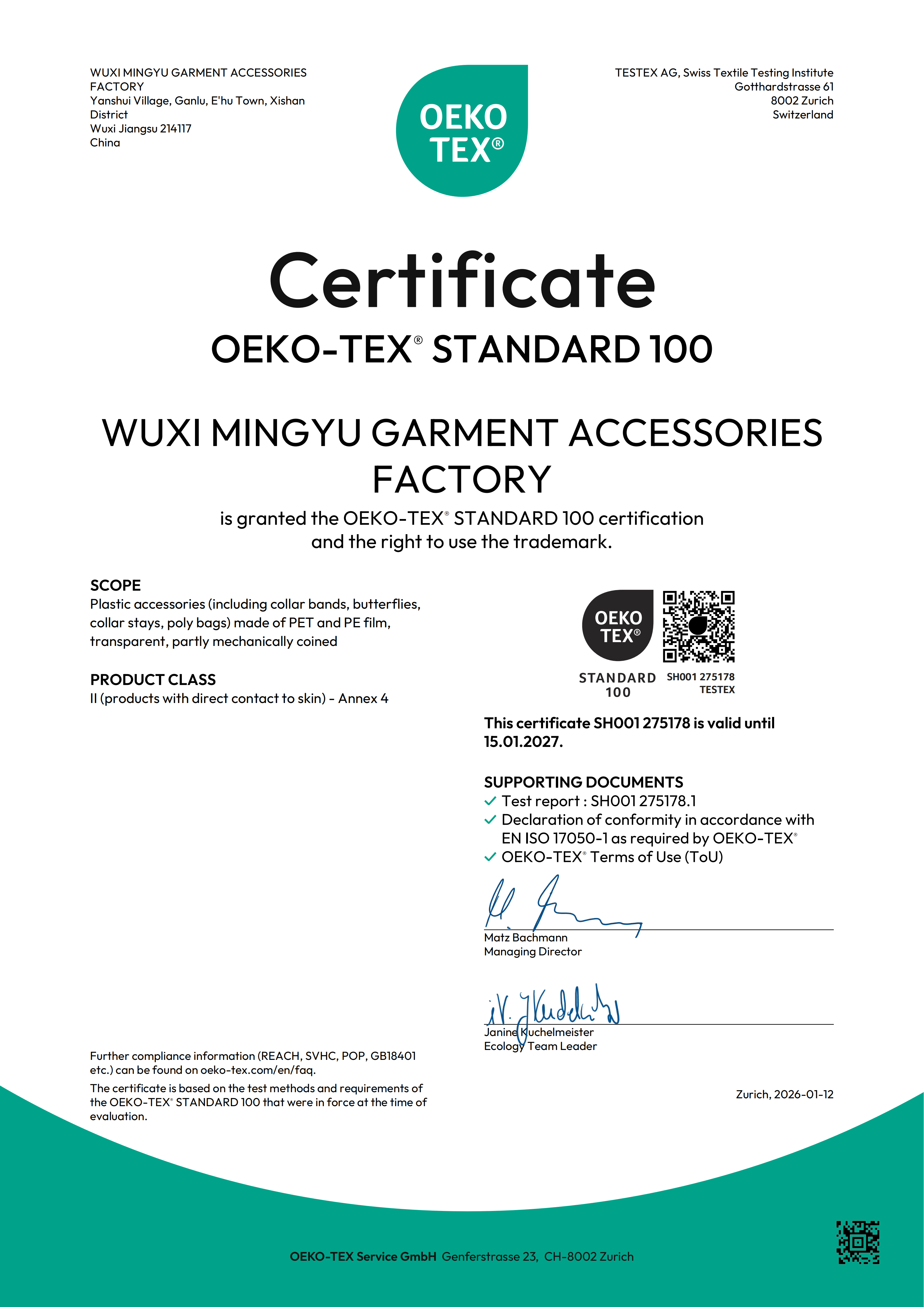
OEKO-TEX STANDARD 100 certificate SH001 275178, issued by TESTEX, valid from 12 January 2026 to 15 January 2027.
OEKO-TEX STANDARD 100, certificate SH001 275178, issued by TESTEX on 12 January 2026 and valid to 15 January 2027. The certified scope covers plastic accessories — including collar bands, butterflies, collar stays and poly bags — made of PET and PE film, transparent, partly mechanically coined. The reference standard is OEKO-TEX STANDARD 100 with EN ISO 17050-1.
Global Recycled Standard, certificate SGC-GRC09119-GRS-2026-07, issued by SGS on 31 July 2026 and valid to 30 July 2027. The certified scope covers trading (PR0030), warehousing and distribution of final products (PR0048), and manufacturing (PR0016), under Global Recycled Standard V4.0, Content Claim Standard V3.1 and the Textile Exchange Standards Claims Policy V1.3.
Qualitatively, the manufacturer's production base includes punching machines and automatic cardboard and collar stay die-cutting equipment, which support throughput on the die-cut and film components that dominate a shirt packaging set. Beyond the Wuxi site, the company operates a Sri Lanka factory established in 2013 and a Vietnam factory established in 2017, with distribution warehouses, agencies or manufacturing presence in Sri Lanka, Argentina, Bangladesh, Indonesia, Colombia and Kenya. An OA system introduced in 2018 supports formalized order and process administration. For a buyer planning a multi-year program, the relevance of this footprint is regional responsiveness: an overseas warehouse or branch shortens the physical distance between a seasonal order and its delivery point.
Technical Consistency: Deformation Resistance and Finish Control
In shirt packaging, "quality consistency" is not an abstract promise. It resolves into a small number of measurable behaviours that a buyer can specify, sample and re-check.
Uniform deformation resistance. A clip must hold a folded shirt without marking the fabric, and it must release without leaving a crease line. That behaviour is a function of wall thickness and polymer stiffness together. The catalog clip is specified at 1.2 mm in an X shape, in PS or metal. A thinner or softer moulding may pass a visual check and still fail under a folded shirt in a retail box, especially where shirts are stacked or compressed in transit. Specifying thickness as a receiving criterion turns an impression into a testable property.
Silver finish stability. Both the clip and the metal pin are specified in silver. On metal collar stays the catalog also lists blue, black, gold and rose gold finishes with laser-engraved logos. Finish consistency matters because accessories are presented alongside the shirt: a mixed-metallic look across pins, clips and stays reads as a packaging defect, not as a design choice. Where a program uses more than one metal component, the buyer should treat all of them as a single finish family and inspect them together.
Dimensional repeatability across the metal range. Metal collar stays are offered in four common lengths — 55.9 mm, 63.5 mm, 69.9 mm and 76.2 mm — at a common 0.8 mm thickness and 9 mm width. Multiple lengths in one program mean multiple tooling references, and each reference needs its own incoming inspection record. A single length passing does not validate the others.
Film gauge control. On the plastic side, the working gauges are 0.35 mm for the white PET collar band and the PVC collar support, 0.50 mm for the PVC collar band, 0.25 mm for the PVC butterfly and 0.75 mm for the white PVC collar stay. Gauge determines how the component behaves in the collar: too soft and the collar collapses before the consumer opens the box; too stiff and the component creases the collar band during packing.
The manufacturer states that an in-house quality-control team carries out full-range inspections throughout each production procedure, with 100% testing. For a long-term program, the practical value of that statement lies in traceability: it gives the buyer a documented internal check to audit against, rather than a claim to take on trust.
Where These Accessories Sit on the Packing Line
A shirt packaging set is an assembly, and each element answers a different problem. Reading the set as a sequence makes supplier capability easier to assess.
Collar structure. The collar support holds the collar shape inside the box; the collar band wraps the folded collar; the collar stay — plastic at 0.75 mm or metal at 0.8 mm — keeps the points aligned; paper butterflies at 400 g and film butterflies at 0.25 mm separate and cushion the collar during folding. Buyers selecting between paper and plastic butterflies are effectively choosing between a fibre-based presentation and a film-based one, which is why that decision intersects directly with eco-material claims.
Body and fold retention. Clips and metal pins secure the folded shirt. The X-shape clip at 1.2 mm and the 0.6 mm stainless steel or brass pin serve different folding styles, and matching clip type to folding style is a decision that should be frozen before a long-term price is agreed — a change mid-program resets tooling, packaging and inspection.
Presentation and protection. Cardboard at 500 gsm, tissue paper at 17 gsm, belly bands at 0.25 mm, apparel tags at 500 gsm and transparent PP bags complete the set. These are the components most likely to carry branding, and also the components most likely to be specified in a different material stream from the plastic accessories.
High-volume export and retail-ready programs. For programs shipping directly to retail, accessories must survive compression, humidity and handling without visible change. For programs feeding a domestic packing station, the constraint shifts toward line speed and consistent feed behaviour. Both scenarios favour the same underlying requirement — a stable specification held over repeated batches.
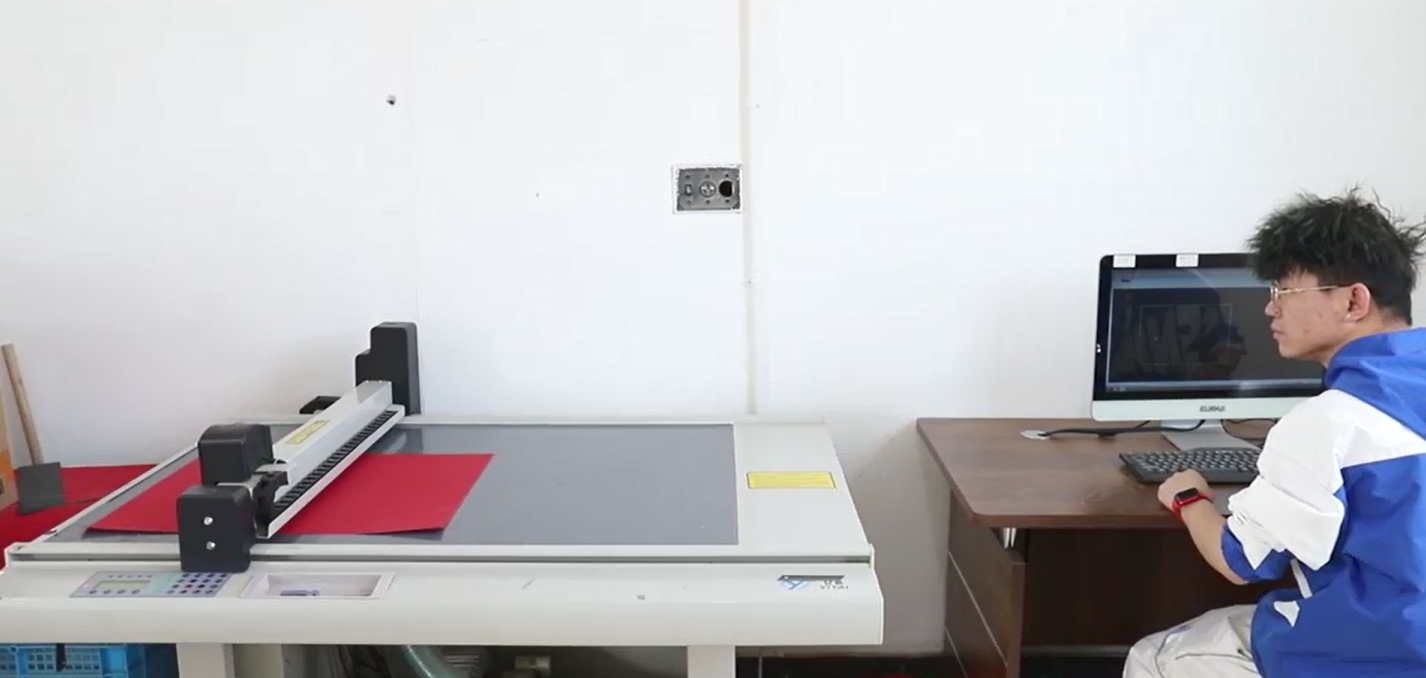
Punching and automatic die-cutting equipment support throughput on collar stays, cardboard and film-based shirt packaging accessories.
Market Signals Behind the Sustainability Question
Third-party market research places garment packaging at USD 18.6 billion in 2025, with a projection of USD 31.4 billion by 2034, according to Dataintelo's garment packaging market research. The same source reports that Asia Pacific held a 41.5% revenue share of that market in 2025. Separately, The Business Research Company sizes the garment interlining market — the material layer most directly associated with shirt collar structure — at USD 3.65 billion in 2025.
These figures should be read as directional rather than precise. They come from commercial research houses, and their category definitions do not map cleanly onto a single accessory such as a collar stay. What they do support is a structural observation: the packaging layer around a garment is large enough, and growing enough, to attract procurement scrutiny that historically stopped at the garment itself.
The consequence for buyers is procedural. When a packaging category grows faster than the underlying accessory categories, more suppliers enter, and specification language loosens. In that environment, documentation becomes the differentiator — not the ambition of the sustainability language, but whether a specific claim is attached to a specific certificate with a specific scope and an expiry date the buyer can track.
Long-Term Program Supply Versus Spot Buying
The contrast that matters in this category is not between one brand and another. It is between two purchasing models: transactional spot buying and program-based supply with a fixed specification.
| Consideration | Spot buying | Program-based supply |
|---|---|---|
| Specification | Reference sample and unit price | Written parameters: material, gauge, finish, tolerance |
| Eco-material evidence | A certificate image supplied on request | Certificate number, scope, issuing body and expiry tracked against the item list |
| Batch behaviour | Judged on receipt | Judged against a reference specification and an internal inspection routine |
| Volume threshold | Chosen to match a single run | Planned against item-level minimums and monthly capacity |
| Change control | Informal | Any material or tooling change documented before the next run |
Program-based supply is not automatically better. It carries real boundaries that a buyer should price in rather than discover.
The certification scope is narrower than the product catalog. The OEKO-TEX STANDARD 100 certificate covers plastic accessories made of PET and PE film, transparent, partly mechanically coined. It does not describe the paper components, the metal components, or dyed and coloured films by default. A buyer who assumes one document covers a full set will overstate an eco claim in a tender document.
Item-level minimums do not follow the factory-level figure. The stated factory MOQ is 1,000 sets, but the catalog lists 1,000 pcs for metal collar stays, 10,000 pcs for plastic collar stays, metal pins, cardboard, plastic collar bands, paper collar bands and poly bags, and 100,000 pcs for clips. A program that needs all components in step is constrained by the highest item threshold, not the lowest.
Lead time is production time, not program time. The 7–20 day window applies after order confirmation. Customization steps such as mold opening and print or foil proofing sit outside that window and must be scheduled explicitly.
Some items cannot carry a logo. In the current catalog, the metal pin, the plastic collar band, the collar support and the poly bag are listed without logo customization, while clips, cardboard, tissue paper, apparel tags and paper butterflies are listed as customizable. Branding expectations should be checked item by item.
Capacity is a factory figure, not a per-SKU guarantee. Monthly capacity of 7.5 million sets describes the site, not the availability of any single mould, gauge or finish on a given date.
A Buyer's Evaluation Framework
The following sequence is designed for the evaluation-to-execution transition, where a shortlist has already been formed and the question is what to lock into a supply agreement.
1. Fix the specification in numbers. Record material, thickness, dimensions, colour and shape for every item — for example clip 1.2 mm in silver, pin 0.6 mm in silver, metal collar stay 0.8 mm across four lengths. A specification that lives only in a photograph cannot be inspected.
2. Map certificates to items. For each component, note whether a valid certificate names that material. Record certificate number, issuer, issue date and expiry date. Both current certificates expire in 2027, which means renewal timing belongs in the supply agreement.
3. Reconcile minimum order quantities. Compare the factory MOQ of 1,000 sets against the item-level thresholds and confirm which line governs the order.
4. Confirm customisation scope per item. Establish which components accept size, colour, printing or foiling, mold opening and logo work, and which do not.
5. Validate capacity against the seasonal peak. Test the 7.5 million set monthly figure against the peak month, not the average month, and ask how capacity is allocated across concurrent programs.
6. Agree the change-control rule. Define what constitutes a material or tooling change, who approves it, and what evidence accompanies it.
7. Set the incoming inspection routine. Choose the few parameters that actually predict failure — thickness, colour, clasp or fold behaviour — and inspect them per batch.
8. Document the partnership history. The manufacturer reports a five-year cooperation relationship with brand owners, garment manufacturers, distributors and exporters at an order quantity of 10,000, maintained without major mistakes. That is a useful reference point, and it should be read as a track record claim by the supplier rather than as an independently audited result.
What Changes Next in Shirt Packaging Sourcing
Two shifts are likely to shape the next procurement cycle in this category.
The first is the migration of eco-material questions from marketing to specification. As buyers become accustomed to reading certificate scopes, broad statements about "environmentally friendly accessories" will carry less weight than a material-specific scope statement with a renewal date. Suppliers with clearly scoped documents will find the conversation easier; suppliers relying on a single certificate image will find it harder.
The second is the separation of sustainability from durability in buyer expectations. These are not the same property, and in shirt packaging they can pull in different directions: a thinner film may reduce material use while reducing the collar support's ability to hold shape. Programs that specify both — eco scope and deformation behaviour — will get more predictable results than programs that optimize one and assume the other.
For manufacturers, the durable advantage lies in the unglamorous middle: consistent gauge, consistent silver, consistent documentation, and a capacity plan that survives a peak season. For buyers, the equivalent advantage is a specification file that can be handed to a second source and still describe the same product.
Frequently Asked Questions
What does OEM and ODM support cover for shirt packaging accessories?
The manufacturer provides both OEM and ODM production services. Customization covers size, color, style, printing or foiling, mold opening, and logo application by stamping or printing. Not every item accepts every option: in the current catalog, the metal pin, the plastic collar band, the collar support and the poly bag are listed without logo customization, while clips, cardboard, tissue paper, apparel tags and paper butterflies are listed as logo-customizable.
What minimum order quantities apply, and why do they differ by item?
The factory-level minimum order quantity is 1,000 sets. Item-level figures differ: 1,000 pcs for metal collar stays; 10,000 pcs for plastic collar stays, metal pins, cardboard, plastic collar bands, paper collar bands and poly bags; and 100,000 pcs for clips. A mixed order is therefore governed by the highest item threshold in the basket, not by the factory-level figure.
How long does production take, and what sits outside the quoted lead time?
Typical production lead time is 7–20 days after order confirmation, against a monthly production capacity of 7.5 million sets. The quoted window describes production. Customization steps such as mold opening and print or foil proofing are separate stages of the order and should be scheduled explicitly rather than assumed inside the production window.
Which certificates can a buyer verify for eco-material claims?
Two documents are available. OEKO-TEX STANDARD 100 certificate SH001 275178 was issued by TESTEX on 12 January 2026 and is valid to 15 January 2027, covering plastic accessories — including collar bands, butterflies, collar stays and poly bags — made of PET and PE film, transparent, partly mechanically coined, under OEKO-TEX STANDARD 100 and EN ISO 17050-1. Global Recycled Standard certificate SGC-GRC09119-GRS-2026-07 was issued by SGS on 31 July 2026 and is valid to 30 July 2027, covering trading (PR0030), warehousing and distribution of final products (PR0048) and manufacturing (PR0016) under Global Recycled Standard V4.0, Content Claim Standard V3.1 and the Textile Exchange Standards Claims Policy V1.3.
How is consistency maintained across repeat orders?
The manufacturer states that an in-house quality-control team carries out full-range inspections throughout each production procedure, with 100% testing, and provides technical support and after-sales service. Repeatability is best anchored to fixed reference parameters in the catalog — clip 1.2 mm in silver X shape, metal pin 0.6 or 0.65 mm in silver, metal collar stay 0.8 mm across four lengths, PET collar band 0.35 mm, PVC collar band 0.50 mm — so that incoming inspection compares batches to numbers rather than to impressions.
Which items fall outside the current eco-certification scope?
The OEKO-TEX STANDARD 100 scope is limited to plastic accessories made of PET and PE film, transparent, partly mechanically coined. Paper items such as cardboard, tissue paper, belly bands, apparel tags, paper collar bands and paper butterflies, metal items such as metal clips, pins and metal collar stays, and PVC or coloured films are not described by that certificate text. Recycled-content claims under the Global Recycled Standard apply to products within the audited scope of certificate SGC-GRC09119-GRS-2026-07. Buyers should request item-level confirmation before repeating any claim in a tender document.
What are the stated purchasing and acceptance terms?
Delivery terms are FOB, CIF or EX Works. Acceptance is based on pre-shipment testing. Payment terms are TT with a 30% deposit and 70% balance before shipment.
Reference Material
For buyers who need the full item list, gauge ranges and customization options in one document, the manufacturer's company profile is available as a downloadable PDF: Brief Company Profile of Wuxi Mingyu Garment Accessories Factory.
Market figures cited in this article are attributed to Dataintelo and The Business Research Company as published third-party research and are used as directional indicators only. Certification details reflect the certificate documents referenced above and are subject to renewal after their stated expiry dates.
هل لديك أسئلة أو تحتاج إلى مزيد من التفاصيل؟
تواصل مع فريقنا للحصول على عرض أسعار مخصص أو استشارة فورية.
طلب عرض أسعار
املأ النموذج أدناه وسيتواصل معك فريقنا بعرض مقترح مخصص.
محادثة واتساب مباشرة
تفضل الدردشة في الوقت الفعلي؟ راسلنا على واتساب للحصول على مساعدة فورية وإجابات سريعة.
- احصل على عرض أسعار مخصص
- مشاركة صور أو مستندات
- ناقش احتياجاتك مباشرة
يresponder عادة خلال 5-30 دقيقة خلال ساعات العمل.