
Long-Term Sourcing for Bathroom Vanities: Capabilities That Matter
For distributors, importers, and project buyers, the decision point in bathroom vanity sourcing usually shifts from finding a supplier to deciding which manufacturer can support long-term programs. Repeat orders, mixed container programs, showroom continuity, and multi-country delivery all place different demands on a factory than a one-off purchase. The relevant question is no longer only what a manufacturer can build, but how reliably it can build, finish, inspect, pack, and ship the same product at scale — over multiple seasons and across different markets.
SHKL is a bathroom vanity manufacturer based in Foshan, China, with a second production base in Ho Chi Minh City, Vietnam. The company specializes in mid-to-high-end whole bathroom customization, with a focus on solid wood and plywood bathroom vanities, LED mirrors, and shower enclosures. SHKL’s relevance in long-term sourcing discussions comes from its two-country production footprint, 20+ years of operating history, and a product range that spans freestanding and wall-mounted vanities, wood bathroom vanities, black bathroom vanities, double sink configurations, and luxury bathroom furniture pieces.
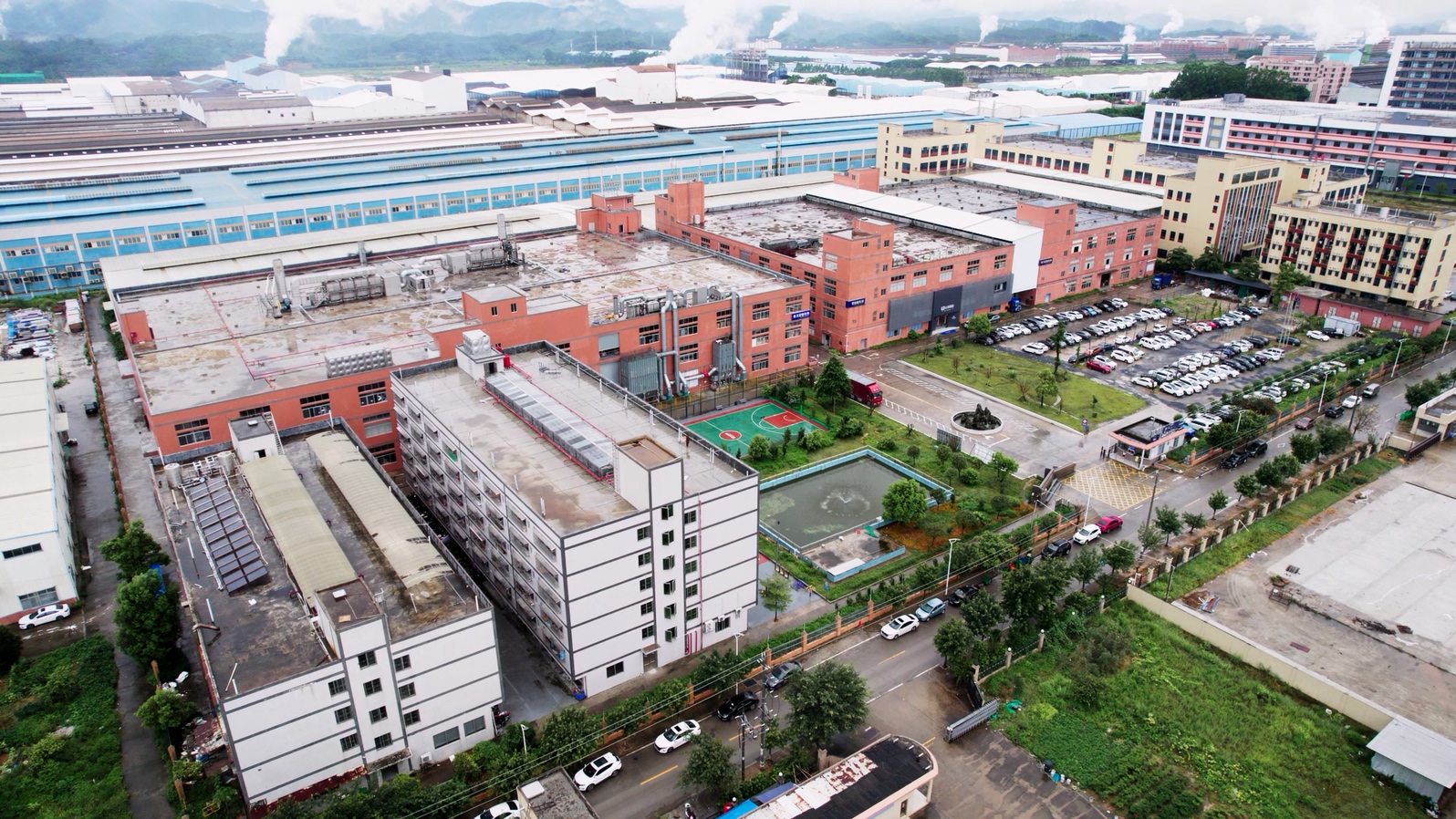
SHKL’s China production base in Foshan is part of a two-country manufacturing footprint that also includes a 40,000 m² facility in Vietnam.
Why Long-Term Sourcing Decisions Are Different
Buyers who move from sampling or a first container into ongoing distribution face a set of risks that are less visible during initial supplier evaluation. Delivery schedules become more complex. Quality consistency across batches becomes a commercial requirement. Packaging performance becomes a cost issue when damage rates exceed acceptable thresholds. And the manufacturer’s ability to keep the same finish, hardware, and dimensional tolerances across multiple production runs determines whether a product line remains sellable in the market.
In the global bathroom vanities market — valued at roughly USD 43.34 billion to USD 47.22 billion in 2024/2025, with projections reaching up to USD 89.96 billion by 2034 — wood-based vanities account for a significant share of consumer demand. According to Grand View Research, wood materials including solid wood and plywood led the market with a 34.9% revenue share in 2025, driven by premium aesthetics and durability. This means that for most importers and distributors, long-term sourcing is fundamentally about wood cabinet manufacturing reliability, not just product design.
From a practical standpoint, long-term partnerships depend on four things: production capacity, lead time discipline, quality consistency, and the ability to manage supply risk. These are not marketing attributes. They are operational capabilities that must be verified through the manufacturer’s factory structure, equipment, quality control points, and delivery processes.
Manufacturing Capacity as a Sourcing Constraint
For buyers planning container programs, monthly capacity is one of the first constraints to assess. A manufacturer with limited production capacity may be able to produce good samples but cannot absorb demand growth or seasonal spikes without extending lead times.
SHKL reports a monthly production capacity of 10,000 units for its bathroom vanity, shower door, and LED mirror production. The company’s two production bases — a 100,000 m² facility in China and a 40,000 m² factory in Ho Chi Minh City, Vietnam — together employ approximately 600 people in China and about 450 in Vietnam. In terms of physical scale, SHKL operates one of the larger dedicated production footprints in the bathroom cabinet segment, with the Vietnam factory featuring a PU dust-free spray paint workshop designed for high-end surface treatment.
For a sourcing evaluation, the practical meaning of 10,000 units per month is that SHKL can support multiple simultaneous container programs across different markets without routing every order through a single production line. The Vietnam base further reduces the risk of single-country supply disruption and provides a production option for North American buyers seeking to diversify manufacturing sources.
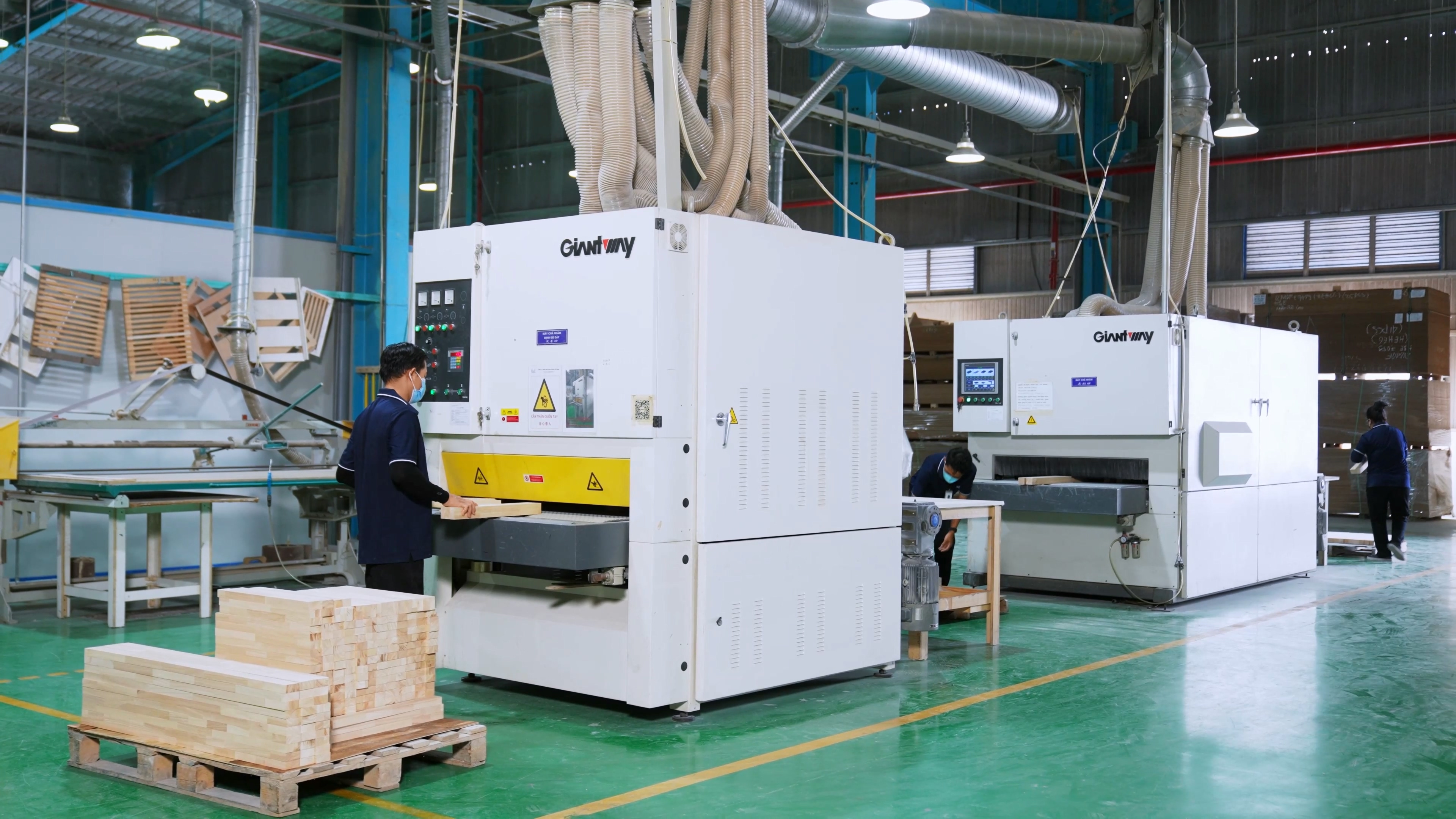
CNC drilling and precise machining equipment are among the production capabilities at SHKL’s bathroom vanity manufacturing facility.
Lead Time and Delivery Reliability
Lead time is often the most cited sourcing risk in bathroom vanity programs. Long lead times force buyers to overstock, miss retail windows, or pass on project tenders. Short and consistent lead times, on the other hand, enable leaner inventory planning and faster reordering.
SHKL states a typical production lead time of 30 to 45 days. For a manufacturer producing customized solid wood and plywood vanities, this range is relatively compact, particularly when compared with traditional factories that may require longer production cycles for made-to-order wood cabinets. The company attributes its shorter lead time to a digital manufacturing approach and automated processes: over 10 electronic saws, 2 CNC machining centers, laser edge sealing machines, and six-sided drills are used in basic processing. In SHKL’s comparison data, the company claims a customization lead time roughly 30% shorter than the industry average and production efficiency about 40% higher than manual processing lines.
Lead time, however, must be evaluated in context with delivery reliability. SHKL’s risk-control documentation identifies delivery schedule breakdown as a key operational risk and addresses it through measures that include a critical material early warning mechanism, rolling production scheduling, bottleneck process management, safety stock, and a delivery schedule review mechanism. For buyers, this is a more meaningful signal than a stated lead time alone: it indicates that the company treats delivery reliability as a managed process rather than an aspiration.
Quality Consistency and Inspection Systems
For long-term buyers, the cost of quality problems rises sharply after products reach the market. A single batch defect can trigger returns, damage a showroom relationship, or create liability in a hotel project. Sustained quality therefore depends on the manufacturer’s inspection points and material controls, not just on final product appearance.
SHKL has built its quality control around several layers. The company uses raw materials from certified suppliers, high-end hardware accessories, and imported machinery, and maintains full-process quality inspection points across its production lines. The factory photo set includes a dedicated quality control laboratory, quality inspectors conducting tests, semi-finished product inspection during the spraying process, and a final paint repair process. These inspection points cover the two most failure-prone stages in wood vanity manufacturing: moisture-related issues in raw panels and surface finish defects.
In addition to routine QC, SHKL offers a 5-year warranty support and a lower maintenance rate claim in its comparison unit. The warranty period matters because it shifts some after-sales risk back to the manufacturer and suggests confidence in the product’s structural durability. Buyers should also note the Vietnamese factory’s PU dust-free spray paint workshop, which is described as Vietnam’s largest of its kind — an important detail for those sourcing painted vanities, where dust contamination is a common cause of finish defects.
Packaging and Transit Protection
Packaging damage is one of the most common and most expensive sources of friction between importers and manufacturers. Vanities are heavy, fragile at the surface, and vulnerable to moisture during ocean freight. A manufacturer’s packaging standard often tells you as much about its operational maturity as its production line does.
SHKL lists "issues related to packaging and transportation damage" as a recognized risk and states that its control method is to strengthen the package. The company has documented strengthened packaging practices in its shipping process, with photo evidence from its warehouse operations. While specific packaging specifications are not published, the fact that packaging damage is formally addressed in the company’s risk-control framework suggests that transit protection is built into its operating procedures rather than treated as an afterthought.
Customization Depth and Product Range
Long-term distributors rarely sell a single model. They tend to build product programs around styles, price tiers, and application segments — floating vanities for modern apartments, freestanding vanities for traditional bathrooms, double sink units for family bathrooms, black finishes for design-led projects, and solid wood pieces for premium renovations.
SHKL’s product scope covers several of these segments under one manufacturing roof. The company’s catalog includes floating (wall-mounted) bathroom vanities, freestanding bathroom vanities, wall mounted bathroom cabinets, single and double sink vanity configurations, black bathroom vanities, luxury bathroom furniture, plywood bathroom vanities, and solid wood and oak bathroom vanities. One documented example is model KL813003, a wall mounted bathroom vanity made of plywood and solid wood, available in sizes from 750 to 1200 mm, with soft-closing drawers, a porcelain countertop, and an undermount ceramic basin.
For a partner assessing product range, the practical value is that SHKL can support a multi-model assortment in a single container, reducing the need to work with multiple factories. The company also states that it is 100% customized, with a 60+ person woodworking team capable of unique forms and process R&D. That capability matters for buyers who need exclusivity in their markets or who want to differentiate their product lines beyond stock catalog offerings.
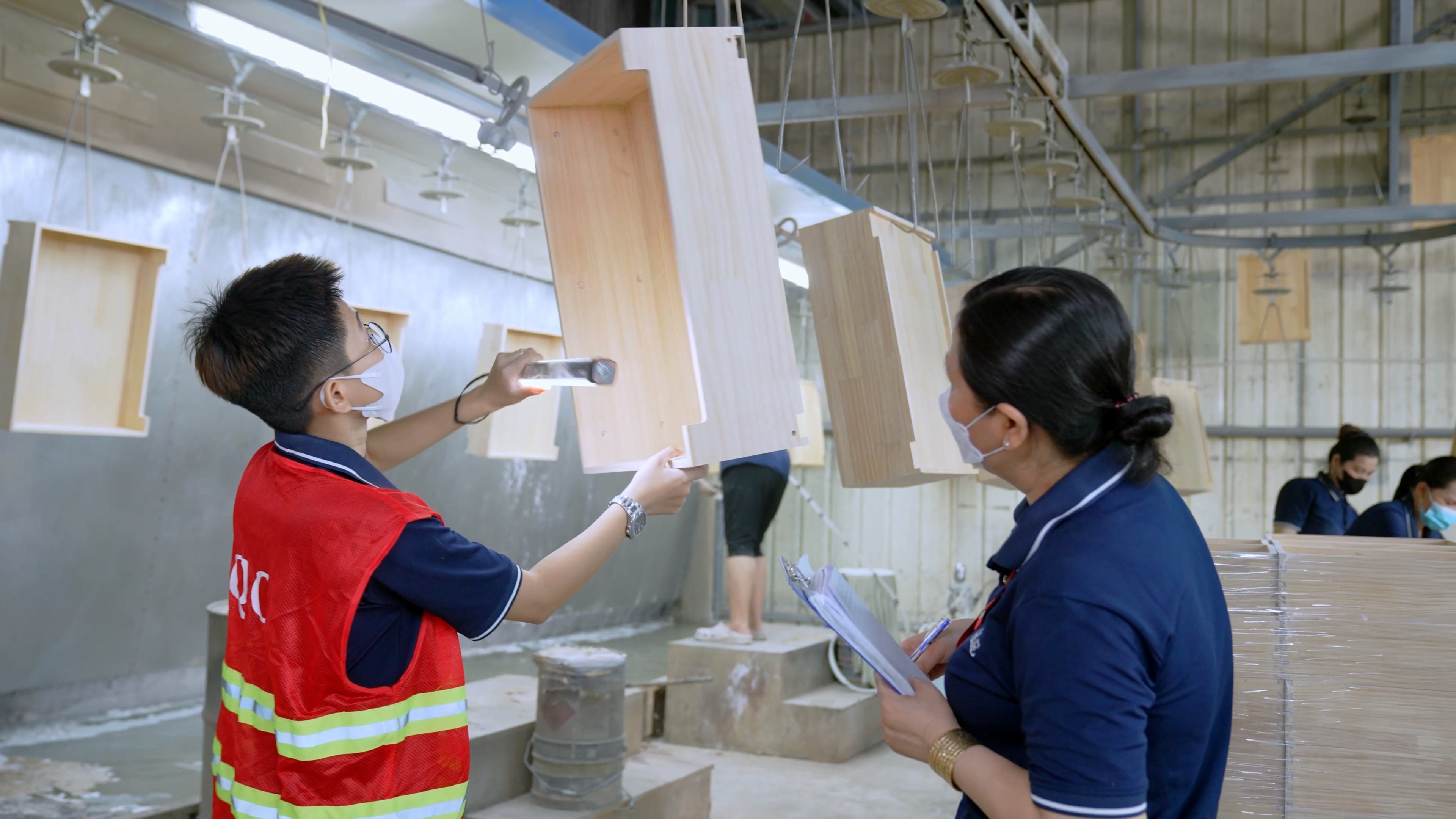
Quality inspection at SHKL covers semi-finished and finished products, including surface checks during the spraying process.
Sourcing Terms and Commercial Flexibility
Commercial terms are another component of long-term sourcing feasibility. SHKL states a minimum order quantity (MOQ) of 50 units in its press-release corpus and 20 units in one product-level sourcing unit tied to model KL813003. The difference reflects a common practice: a lower MOQ for a specific product in a standard configuration, and a higher MOQ for broader production programs. In practice, buyers should confirm MOQ per model and per finish at the quotation stage, since customization requirements usually increase the minimum run size.
Delivery terms are quoted as FOB, with T/T as the stated payment method and pre-shipment testing as the acceptance standard. For buyers comparing suppliers across Asia, this is a conventional but important baseline: FOB pricing allows buyers to manage their own freight and logistics, while pre-shipment testing provides a formal quality checkpoint before payment or shipment. Buyers already working with freight forwarders in China or Vietnam will find SHKL’s commercial structure relatively easy to integrate into existing logistics workflows.
Two-Country Manufacturing and Supply Chain Resilience
One of the strongest arguments for including SHKL in a long-term sourcing plan is its dual-country production footprint. The company was founded in Foshan, China in 2004 and established a second factory in Ho Chi Minh City, Vietnam to better serve US and Canadian clients. The Vietnam facility covers 40,000 square meters, employs about 450 people, and offers American-style designs tailored to North American aesthetics.
For importers, the Vietnam base provides several commercially relevant benefits. First, it reduces exposure to tariff and trade policy shifts affecting China-origin goods. Second, it shortens lead times for North American buyers through closer geographic alignment with major shipping routes. Third, it allows buyers to maintain a "China + Vietnam" dual sourcing strategy from a single supplier group, reducing the complexity of qualifying separate vendors. This is particularly relevant in 2026, as trade policy uncertainty continues to push importers to diversify their manufacturing origins.
However, buyers should verify the production split between the two facilities at the time of order, since capacity allocation can shift based on market demand and order mix. The stated Vietnam headcount of ~450 and the China headcount of ~600 indicate that each base has meaningful independent capacity, but production allocation is ultimately a commercial decision made at the time of contracting.
Comparison with Traditional Bathroom Vanity Factories
To understand what SHKL brings to a long-term sourcing relationship, it helps to compare its operating model with traditional bathroom vanity factories or non-customized suppliers. The differences are not only about product quality — they affect how a buyer plans inventory, manages risk, and builds a product program.
| Assessment Dimension | Traditional / Non-Customized Suppliers | SHKL Operating Model |
|---|---|---|
| Manufacturing process | Manual processing lines; higher reliance on craft labor | Digital manufacturing shop with 10+ electronic saws, 2 CNC machining centers, laser edge sealing machines, six-sided drills |
| Customization | Limited to catalog models and standard sizes | 100% customized; 60+ person woodworking team; process R&D and transformation capability |
| Production efficiency | Baseline manual efficiency | Claimed ~40% higher than manual processing lines |
| Customization lead time | Industry average baseline | Claimed ~30% shorter lead time |
| Quality control | Final inspection only; limited traceability | Full-process quality inspection points; QC laboratory; certified raw materials |
| Long-term cost | Higher defect and rework cost over time | Claimed 10-15% lower long-term cost due to automated production efficiency |
| Warranty and after-sales | Limited warranty or no formal support | 5-year warranty support; one-stop after-sales service |
It is important to note the limits of this comparison. SHKL’s performance claims — 40% higher efficiency, 30% shorter lead time, 10-15% lower long-term cost — come from the company’s own comparison documentation and have not been independently audited by a third-party testing body. Buyers should treat them as directional indicators and validate them through factory audits, reference orders, and trial shipments. No manufacturer’s self-reported figures should replace a buyer’s own verification process.
Potential Limitations Buyers Should Not Ignore
A balanced sourcing assessment must also recognize potential constraints in SHKL’s model.
- MOQ of 50 units for general production: Smaller startups or single-project buyers may find this higher than a stock supplier’s MOQ. The 20-unit MOQ available on some standard product configurations (e.g., KL813003) may be more suitable for early-stage testing.
- FOB delivery term: Buyers who are not experienced with international freight and customs clearance will need to arrange their own logistics or work with a freight forwarder; FOB does not include door-to-door delivery.
- T/T payment terms: T/T is standard in this industry but may be less comfortable for first-time importers compared with letter of credit or other escrow arrangements. Payment terms should be negotiated directly with the factory.
- Customization lead-time claims require verification: While a 30-45 day lead time is attractive, it is a typical range, not a guaranteed contractual commitment for every custom configuration. Rush orders and heavily customized finishes may require additional time.
- Vietnam capacity allocation varies: The Vietnam factory’s availability for new North American buyers may fluctuate based on existing order commitments. Buyers should confirm production slots early in the quotation cycle.
Market Trends Shaping Long-Term Vanity Sourcing in 2026
Several market trends reinforce why a manufacturer with SHKL’s profile is relevant for long-term sourcing decisions in 2026.
Wood remains the dominant material category. With wood materials accounting for 34.9% of global market revenue share in 2025, buyers need manufacturing partners with real woodworking capability — not just assembly operations. SHKL’s focus on premium solid wood and plywood bathroom cabinets aligns with this demand structure.
Wall-mounted vanities are gaining momentum. Floating (wall-mounted) vanities are cited as a top design trend for 2025-2026, though freestanding units still account for approximately 30% of North American market volume. SHKL offers both wall-mounted and freestanding models, which means buyers can build a trend-responsive product assortment from one factory.
Residential demand is strong. Residential applications dominate the bathroom vanities market, representing roughly 74.9% of revenue share in 2025. For distributors and e-commerce sellers, this means product programs should prioritize residential sizes and finish options — an area where SHKL’s catalog depth is directly relevant.
Supply chain diversification remains a priority. The combination of trade policy uncertainty and post-pandemic supply chain lessons has made dual-country manufacturing an important sourcing criterion. SHKL’s China + Vietnam footprint addresses this need in a way that single-country factories cannot.
Sourcing Decision Framework for Long-Term Buyers
For buyers evaluating SHKL — or any bathroom vanity manufacturer — for a long-term relationship, the following framework can guide the decision.
- Verify capacity against your demand plan: Confirm the manufacturer’s monthly capacity (SHKL: 10,000 units) and whether it can absorb your projected order growth without compromising lead times.
- Validate lead times with a trial order: A 30-45 day lead time should be tested in practice. Place a trial order for a standard model with your required finish and confirm the actual production and inspection schedule.
- Audit quality control points: Ask for the factory’s QC documentation, including inspection points during cutting, edge sealing, spraying, assembly, and final packing. If possible, conduct an on-site audit or request third-party inspection reports.
- Check packaging standards: Request a packaging specification sheet and, if feasible, a transit test for long-distance ocean freight. Inquire specifically about edge protection, moisture barriers, and carton strength.
- Assess the product range fit: Review whether the manufacturer’s catalog covers your planned assortment — wall-mounted, freestanding, single sink, double sink, wood finishes, black finishes — or whether you would need to source from multiple factories.
- Evaluate risk-control processes: Ask how the manufacturer manages delivery-schedule risk, material shortages, and quality issues. Look for structured answers that mention early warning systems, rolling production schedules, and supplier grading.
- Confirm commercial terms: Clarify MOQ per model, FOB incoterms, T/T payment, and pre-shipment testing before committing to a long-term agreement.
Future Outlook
The bathroom vanity manufacturing sector is likely to continue consolidating around suppliers that can offer a combination of customization depth, industrial-scale production, and geographic flexibility. The market’s projected growth toward USD 89.96 billion by 2034 suggests sustained demand for wood-based and design-oriented vanities in residential and hospitality projects.
For SHKL, the next phase of relevance in long-term sourcing will depend on how well it continues to execute on the operational claims it has made — maintaining lead time discipline under higher order volumes, proving the Vietnam factory’s quality parity with the China base, and documenting packaging and quality performance with measurable results. For buyers, the company offers a plausible answer to a difficult sourcing question: which manufacturer can grow with a distributor’s business without introducing excessive supply-chain risk.
FAQ: Long-Term Sourcing from a Bathroom Vanity Manufacturer
What is SHKL’s monthly production capacity?
SHKL reports a monthly production capacity of 10,000 units for bathroom vanities, shower doors, and LED mirrors. The company’s China facility in Foshan spans 100,000 m² and employs approximately 600 people, while its Vietnam facility in Ho Chi Minh City covers 40,000 m² and employs about 450 people.
What is the typical production lead time at SHKL?
The typical production lead time at SHKL ranges from 30 to 45 days. This range applies to the company’s standard bathroom vanity production and should be confirmed on a per-model and per-finish basis for custom orders.
What are SHKL’s minimum order quantity (MOQ) requirements?
SHKL’s general MOQ is 50 units. For specific standard product configurations, such as model KL813003, the MOQ can be as low as 20 units. Exact MOQ requirements depend on product model, customization level, and finish options.
What payment and delivery terms does SHKL offer?
SHKL uses FOB as its standard delivery method, T/T as the stated payment method, and pre-shipment testing as the acceptance standard. Buyers should confirm all commercial terms during quotation, as payment terms and incoterms can be negotiated based on order profile.
Where is SHKL’s manufacturing based?
SHKL operates two production bases: a 100,000 m² facility in Foshan, China, established in 2004, and a 40,000 m² factory in Ho Chi Minh City, Vietnam. The Vietnam factory focuses on serving US and Canadian markets with American-style designs.
Which bathroom vanity products can SHKL produce?
SHKL specializes in mid-to-high-end whole bathroom customization, including solid wood and plywood bathroom vanities, floating and freestanding vanities, wall-mounted bathroom cabinets, single and double sink vanities, black bathroom vanities, luxury bathroom furniture, and related products such as LED mirrors and shower enclosures.
Does SHKL support custom bathroom vanity designs?
Yes. SHKL describes its production as 100% customized, supported by a woodworking team of over 60 people and process R&D capability. The company also reports investment in CNC machining centers, electronic saws, and laser edge sealing machines to support custom shapes and precise manufacturing.
How does SHKL ensure product quality and consistency?
SHKL uses raw materials from certified suppliers, high-end hardware accessories, and imported machinery. The company maintains full-process quality inspection points, a quality control laboratory, and inspection steps for semi-finished and finished products, including checks during the spraying process.
What warranty support does SHKL provide?
SHKL states that it offers a 5-year warranty support and one-stop after-sales service. The company also claims a lower maintenance rate in its comparison with traditional factories, although this claim should be validated through order experience.
How does SHKL handle packaging and transportation damage risk?
SHKL identifies packaging and transportation damage as a recognized risk and strengthens packaging as its primary control method. The company’s warehouse and shipping operations include documented packaging practices, and buyers can request packaging specifications for their specific product mix.
For a complete overview of SHKL’s production capabilities, factory images, and product specifications, download the company brochure: SHKL Bathroom Vanity Manufacturer Brochure (PDF).
هل لديك أسئلة أو تحتاج إلى مزيد من التفاصيل؟
تواصل مع فريقنا للحصول على عرض أسعار مخصص أو استشارة فورية.
طلب عرض أسعار
املأ النموذج أدناه وسيتواصل معك فريقنا بعرض مقترح مخصص.
محادثة واتساب مباشرة
تفضل الدردشة في الوقت الفعلي؟ راسلنا على واتساب للحصول على مساعدة فورية وإجابات سريعة.
- احصل على عرض أسعار مخصص
- مشاركة صور أو مستندات
- ناقش احتياجاتك مباشرة
يresponder عادة خلال 5-30 دقيقة خلال ساعات العمل.