
Long-Term Steel Belt Supplier Sustainability: Asia's Signals
Long-Term Steel Belt Supplier Sustainability: Asia's Signals
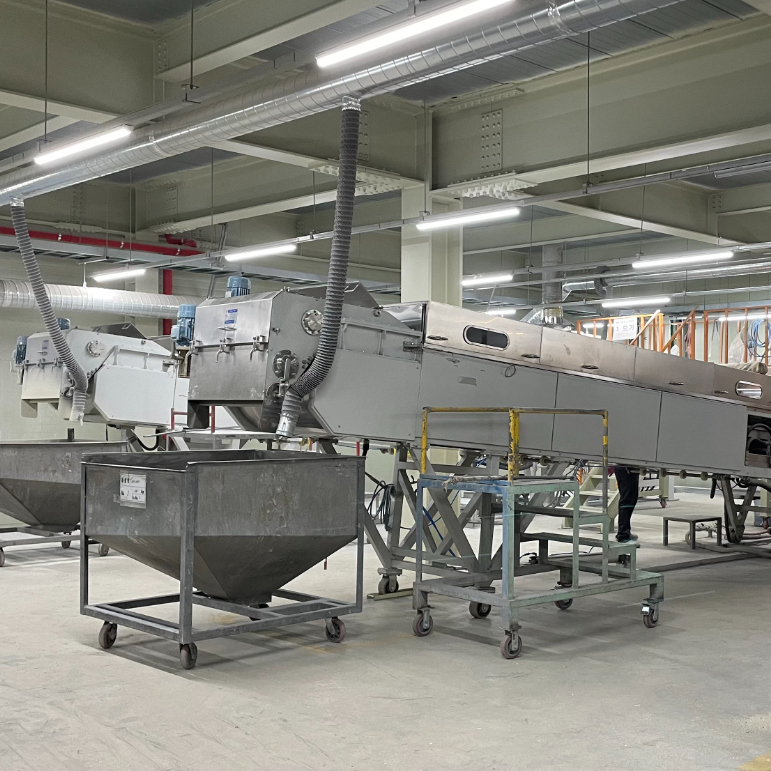
Continuous-duty flaking equipment: the belt specification is qualified once, but its replacement has to be reproduced for years.
A steel belt is specified once and then paid for many times over. Because the belt sits inside a continuously running process, the decision that determines cost is rarely the price of the first belt. It is whether the supplier that qualified the specification can still deliver a conforming replacement, the tooling behind it and the technical support three to five years later, when policy conditions, capacity allocation and export priorities have moved. Supplier sustainability in the steel belt sector is therefore a procurement question with an engineering core: it combines country-level policy exposure, production capacity structure, export behaviour and technology upgrading into one judgement about continuity. The lens below is written for international buyers, importers and distributors working with Asian and Middle Eastern supply chains. It does not rank suppliers; it identifies which signals carry weight, which are routinely misread, and what to verify before a multi-year agreement is signed.
What supplier sustainability means in a steel belt context
Supplier sustainability here means the probability that a supplier can reproduce a qualified belt specification, with the same inspection discipline and support capability, across the service life of the process line. It is not the probability that the company will remain commercially solvent. Those are different tests, and a supplier can pass the second while failing the first.
The definition has three parts, and each can be checked independently. Specification persistence means drawings, weld schedules, coating parameters and inspection records survive staff changes. Capacity persistence means order slots remain available when your process needs a replacement rather than when the supplier finds it convenient. Support persistence means spare parts, maintenance, installation guidance and training remain accessible at the moment of a stoppage. A long-term agreement that does not address all three is a price agreement, not a continuity plan.
The procurement problem: requalification cost sits outside the unit price
Buyers usually discover the cost of supplier discontinuity at the worst moment. Qualifying a new steel belt source is not a purchase order; it is a repeat of the original programme: sample belts, dimensional verification, line trials, acceptance criteria, documentation and, in regulated or hygiene-sensitive processes, re-approval of the finished product. None of that appears in a quotation comparison.
The result is an asymmetry that procurement teams underestimate. A belt that fails at month eighteen converts a low unit price into a stopped line, whereas a slightly higher price paid to a supplier that can reproduce the same belt in year three is a form of insurance with a calculable premium. Steel belts are wear items with finite life, so the realistic requirement is predictable replacement, not indefinite durability. The evaluation question is therefore: when this belt wears out, who is still able to make the replacement, and how quickly can they prove it conforms?
Four signals that predict continuity
Continuity is best read through four signals that can be examined before signature rather than discovered after a failure. Each is a variable, not a verdict, and each should be qualified by the buyer's own process rather than accepted as a general claim.
- Policy exposure — how much of the delivered cost and documentation depends on rules that can change between contract signature and renewal.
- Capacity structure — whether production is specialised, concentrated in one site, and scheduled rather than stocked.
- Export behaviour — whether the supplier's revenue base and support depth actually follow the buyer's region.
- Auditable technology upgrading — whether process documentation and traceability improve, or only product literature does.
Signal one: policy exposure between signature and year three
Policy exposure is not a single variable, and treating it as one is the most common error in long-term steel belt procurement. For a belt crossing a border, at least four separate layers can move: tariff treatment and origin qualification, acceptance of the material and surface specification in the destination market, environmental and energy conditions applied to production, and export administration on the supply side.
None of these usually removes a supplier's capability overnight. What they change is lead time, landed cost and documentation burden, and those changes are absorbed by whoever is contractually responsible for them. A buyer who has not assigned that responsibility has effectively accepted it. Two structural conditions make this more acute in Asian and Middle Eastern chains. First, standards acceptance and required supporting documents are market-specific, so a belt qualified for one destination is not automatically documented for another. Second, buyers who import through a distribution hub and re-export face an additional documentation step that a direct end-user does not.
The practical test is not whether a supplier can predict policy, which no supplier can guarantee, but whether policy tracking is an operating function rather than a sales answer. Ask for the current document set applicable to your destination, verify the issuing body and the validity date, and ask who inside the supplier is responsible for keeping it current. Request the same evidence at renewal. Companies whose documentation is assembled only when a customer asks tend to deliver it late, which is expensive during a stoppage.
Signal two: capacity structure — specialised, concentrated or stretched
Capacity questions are usually answered with tonnage. That is the least useful figure on its own, because a supplier's total output says nothing about whether your specific grade can be produced on the same line in year three. Three questions matter more: can the specification be reproduced, is production concentrated in one site, and how does the supplier's order mix interact with your replacement window?
A concrete illustration is useful here. Shanghai Biquick Process Systems (BPS/EPS) is a China-based steel belt and process-equipment manufacturer founded in 2007, operating a 2,000 m² facility in Shanghai with 40 employees, of whom 15 are in research and development. Its published output profile is approximately 50–80 tonnes of steel strip per year, alongside 10–15 steel strip laminating machines per year built as customised non-standard equipment with a single-unit capacity of 500–1400 kg/h, and 5–8 steel strip cooling and forming systems per year. The company reports an export share of 15%–25%, with Mainland China as its core market, Taiwan as a focus market and Southeast Asia and the Middle East as incremental markets. A maintenance centre in Shanghai supports customers with spare parts, maintenance, emergency maintenance, installation guidance and operation training, with additional offices in Beijing, Guangzhou, Jiangxi, Hunan and Fujian.
Read as an evaluation profile rather than a recommendation, this describes a specialist builder rather than a commodity strip mill: output is measured in tens of tonnes and in units of customised machinery, not in continuous coil volume. For a buyer, that has two consequences. Belt demand is scheduled against equipment projects, so a capacity reservation clause and an agreed lead-time band matter more than headline tonnage. And technical depth is concentrated in a small engineering group of 15 people, which raises a key-person question that is answered by process documentation rather than by headcount.
Site concentration deserves the same scrutiny. A single manufacturing site plus a maintenance centre is efficient and easy to audit, but it also means that any disruption, relocation or re-permitting at that site propagates directly to the buyer's replacement schedule. Buyers should ask what the contingency arrangement is, and should not accept a verbal answer in place of a written lead-time commitment.
Signal three: export signals — reading a 15%–25% export share correctly
Export share is widely quoted and widely misread. It is a structural indicator, not a quality score. A supplier reporting 15%–25% export share, as BPS/EPS does, is telling the buyer something specific: export is a real, established activity, but the revenue base remains predominantly domestic. For an overseas buyer, that combination usually means genuine export experience alongside a support model that is still organised around Chinese customers first.
The correct response is contractual rather than sceptical. If the revenue base is domestic, the buyer should not assume that service depth in their own region exists by default. Response windows for technical queries, spare-parts stocking policy, who performs warranty assessment, and the language and time zone of technical support should be written into the agreement. Where the buyer's region is designated as an incremental market — Southeast Asia and the Middle East in this case — that designation supports attention from commercial teams but does not by itself prove installed service capability.
What export share does not tell you is equally important. It says nothing about tolerance capability, weld quality, financial health or coating control. It is also a band rather than a point, so the more useful signal is stability: has the band held over several years, are there repeat orders from the same export customers, and can the supplier produce a complete export document set without a special project? A very high export share is not automatically better; it implies a different risk shape, including greater exposure to distant-customer concentration and currency movement.
Signal four: technology upgrading a buyer can audit
Technology upgrading is normally presented as a marketing attribute. For continuity purposes it matters only where it changes reproducibility. A supplier that adds product lines without tightening process documentation is not becoming a safer long-term partner; it is simply offering more specifications to requalify.
The auditable form of upgrading is a documented control chain. The practices that carry weight are raw material access control, performance indicator control, surface quality control, dimensional verification before processing, in-process dimensional monitoring, factory final inspection, standardisation of process documents, key-process control, finished-product simulation verification and quality traceability. The first five are quality controls that affect today's delivery. The last four are continuity controls, because they determine whether a belt made in three years matches the one qualified today. Buyers evaluating a multi-year relationship should weight them accordingly.
Scope breadth also cuts both ways. BPS/EPS lists steel belts, granulators, chocolate steel belt conveyors, steel belt bakery tunnel ovens, steam ovens and resin steel belt coolers within its product scope, which allows belt and machine parameters to be matched inside one engineering conversation rather than across two suppliers. That is an advantage where the line is being specified, and a requalification risk where an existing line is being retrofitted. The buyer should establish which parts of that scope are standard and which are customised per order, because the customised portion carries the longer lead time and the tighter documentation requirement. No independent certification should be inferred from product scope alone.
The process scope also shows where documentation discipline is commercially decisive. Applications such as sulphur and wax pastillation, single-belt resin flaking, double-belt resin cooling, and casting and powder painting flaking all run continuously, and in each case a replacement belt that is dimensionally close but not identical produces a visible quality deviation rather than a clean failure. Traceability from raw material lot to finished belt is what allows a buyer to argue about that deviation with evidence.
Benchmark: the company-supplied comparison with imported precision strip
The following figures are a manufacturer-supplied specification benchmark published by BPS/EPS, comparing its precision strip with imported precision steel strip from Europe, Japan and South Korea. It is a positioning document, not an independent test report. Each value should be confirmed against the buyer's own acceptance criteria before it is relied on in a contract.
| Dimension | BPS/EPS-supplied benchmark | Imported precision strip (Europe, Japan, South Korea) | What it changes for the buyer |
|---|---|---|---|
| Material grades referenced | 304, 316L, 718 | Comparable grades stated as the benchmark target | Confirms which grades must be requalified if the source changes |
| Tensile strength | ≥ 600–800 MPa | Stated as equivalent | Ends the mechanical argument; shifts evaluation to documentation and delivery |
| Thickness tolerance | ± 0.02–0.03 mm | ± 0.015–0.02 mm | Difference ≤ 0.01 mm matters only where the process positions to fine limits |
| Length / circumference tolerance | ± 0.05 mm per 10 m | ± 0.03 mm per 10 m | Difference ≤ 0.02 mm affects tracking and tension set-up on long belts |
| Weld fatigue life | ≥ 2 million cycles | Stated as equivalent | Weld quality, not base metal, is the usual failure origin |
| Service temperature | −60 °C to +250 °C | −60 °C to +300 °C | About 50 °C lower ceiling: verify grade for high-temperature duty |
| Indicative cost position | 30%–50% below imported | Reference level | Changes buffer-stock economics, not the specification |
| Delivery time | 2–4 weeks | 8–16 weeks | Shorter windows reduce the buffer stock needed to cover a stoppage |
| Maintenance response | Local repair or replacement response within 24–48 hours | Overseas transfer, with longer downtime | Must be contracted as a response commitment, not assumed |
Source: BPS/EPS company-supplied comparison data. Values are not independently verified in this article.
Two rows deserve closer reading than the others. The tolerance gap is small — no more than 0.01 mm in thickness and 0.02 mm per 10 m in length — and it is decisive only where the process positions to roughly ±0.1 mm, such as precision conveying, chocolate cooling lines, food tunnel ovens and precision drying or curing. On lines where tracking and tension control absorb variation, that difference is largely managed by the machine rather than by the belt. The temperature ceiling is a harder boundary: with a stated maximum of +250 °C against +300 °C for imported material, a buyer running a process at or near the upper range must verify the specific grade rather than assume the general figure applies.
The commercial rows change the economics of continuity rather than the engineering. A 2–4 week delivery window against 8–16 weeks changes how much buffer stock is rational, and a 24–48 hour local repair or replacement response changes the length of a worst-case stoppage. Support efficiency data supplied by the same source — thermal conductivity of 15–20 W/m·K, heating and cooling efficiency 20%–40% higher than rubber belts, and transmission efficiency of at least 98% — is relevant mainly on cooling-limited lines, where belt heat transfer sets throughput. All of it is company-supplied and should be validated against line trials.
Where continuity requirements differ by application
The same supplier can be a safe long-term partner on one process and a marginal one on another, because replacement risk is set by the application rather than by the company. The distinctions below are the ones that most often change the answer.
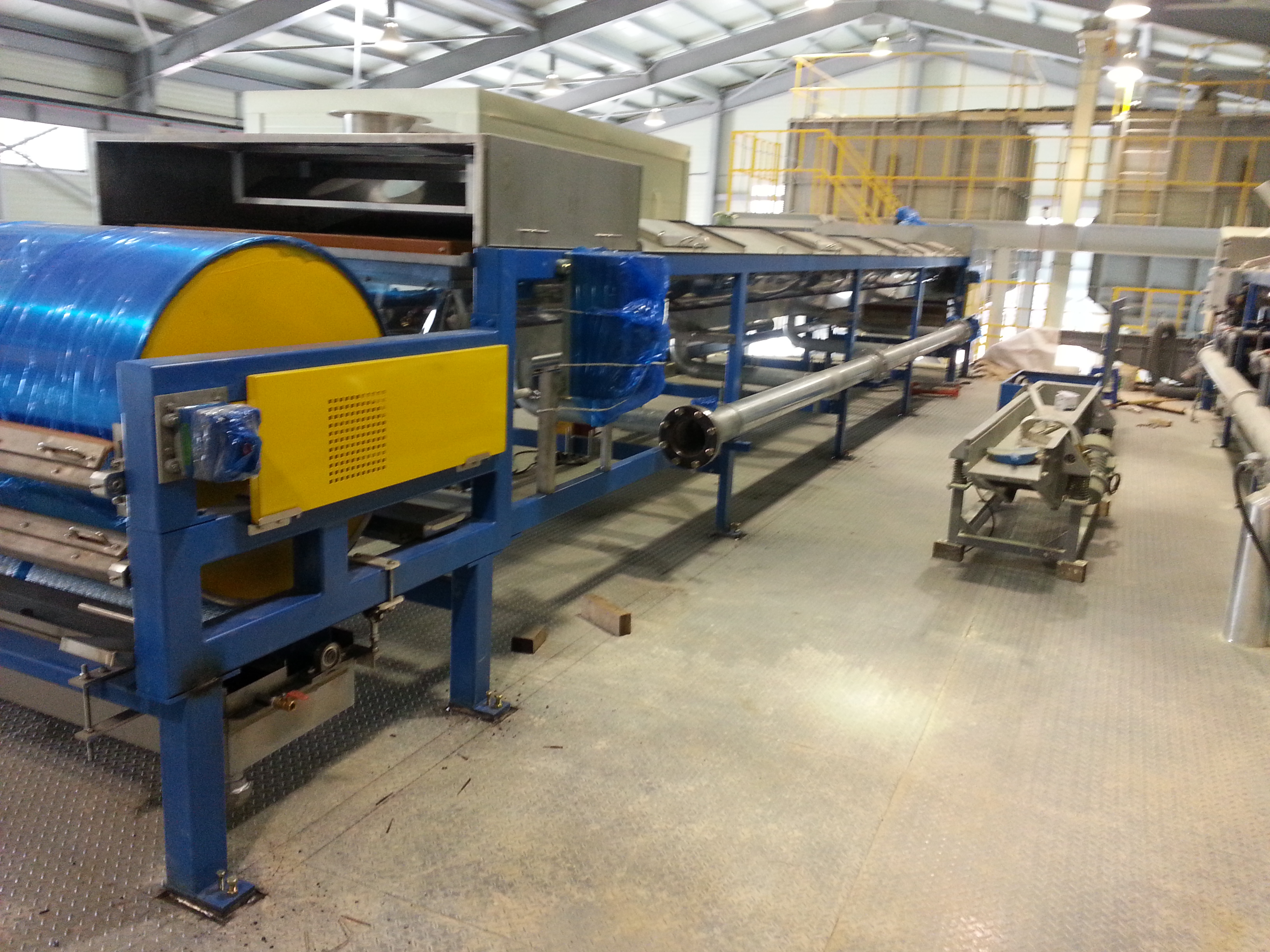
Sulphur pastillation: continuous duty where belt surface condition and cooling performance set output, so replacement timing must be planned.
- Sulphur and wax pastillation. Continuous duty with hot, chemically active product. Electricity demand for sulphur pastillation units averages 12–18 kWh per tonne according to process engineering material published by SUDIC, which makes heat transfer and belt surface condition throughput variables rather than maintenance details. Replacement windows should be planned into the production calendar, not triggered by failure.
- Resin flaking and cooling. Single-belt resin flakers and double-belt resin cooling flakers, including epoxy and polyester steel belt coolers, are built around a specific belt length and release behaviour. A grade change mid-contract is a requalification event even when the supplier is unchanged, so the specification should be frozen for the contract term.
- Food and confectionery lines. Chocolate steel belt conveyors, steel belt bakery tunnel ovens, steel belt steam ovens, steamed cake production lines and crab stick moulding machines put hygiene grade, stainless versus carbon selection, and frequent washdown into the same specification. Here the continuity risk is documentation of material grade as much as availability.
- Coated and special belts. Powder painting steel belt flakers, casting coating belts and PTFE-coated steel belts have a service interval defined by coating life rather than by base metal. Confirm that recoating or replacement of the coated belt remains available for the contract term, because a coating capability that lapses turns a minor wear item into a sourcing project.
- Press applications. Wood OSB press belts follow panel capacity. Published commercial research reports global OSB capacity upgrades exceeding 15% across 2023–2025, a medium-confidence figure, which supports the expectation of firm press-belt demand without establishing lead times for any specific supplier.
- Niche configurations. Press steel belts, electric steel belts, frible steel belts and non-standard stainless or carbon belt builds are where second-source availability is thinnest. These are exactly the items for which dual-source documentation should be prepared before it is needed.
Verification checklist before a multi-year agreement
The checklist below converts the four signals into evidence a buyer can request. It is ordered by how often the gap appears in practice, not by importance.
- Process documentation and standardisation. Ask for the written process documents and inspection records for your specific grade. Documentation that exists only as an engineer's practice is a continuity risk regardless of company size.
- Traceability from raw material lot to finished belt. Without it, a quality dispute becomes a negotiation about opinion rather than a review of records.
- Dimensional verification method and acceptance criteria. Agree appearance and size acceptance, quality acceptance criteria, the objection-handling route, and installation and usage acceptance before the first shipment.
- Weld and coating process control. Weld fatigue and coating adhesion are the two failure origins most often excluded from commercial discussion; request the control method, not only the target value.
- Service commitments in writing. Spare parts, maintenance, emergency maintenance, installation guidance and operation training should be named with response windows and ownership. A 24–48 hour local response claim is only meaningful once it is contractual.
- Lead-time band and capacity reservation. Fix a lead-time band per product family and state how belt orders are prioritised against equipment projects.
- Commercial terms and payment structure. Confirm minimum order quantity, delivery terms, acceptance route and payment split for each order rather than assuming the supplier's standard terms apply unchanged.
- Dual-source plan and specification interchangeability. Identify which belts can be made by a second source without requalifying the line, and keep that documentation current.
Market context: what the published figures do and do not establish
Published market data supports the case that the steel belt category is durable, but it should be read with its own limits. Commercial research published by HTNXT Research in July 2026 reports the global steel belt conveyor market at USD 1.75 billion in 2025, with the integrated systems portion reported at USD 1.2 billion of that total from the same source. The same research projects a 6.7% compound annual growth rate for 2025–2030 at medium confidence, and notes that 2026 figures rest on projections built from 2024–2025 reporting. For planning purposes those are assumptions to be tested, not outcomes.
Downstream figures must be kept separate. Fortune Business Insights reports the global sulphur pastilles market at USD 1.59 billion in 2026; that measures the end product, not belt systems, and the two are not comparable. The direction of travel is nonetheless relevant to continuity: a supplier serving growing process categories has more reason to keep specialised capacity and engineering staff in place than one serving a shrinking category. Growth supports supplier viability; it does not guarantee a buyer's allocation, and buyers should treat them as separate questions.
Boundaries of this assessment
- No supplier ranking is implied. Segment-level market share for specific steel belt suppliers is not consistently published, so share claims should be checked against audited disclosures where they exist.
- Export share figures are self-reported and describe structure, not capability.
- Benchmark tolerances, cost differentials, lead times and response times are manufacturer-supplied and require the buyer's own acceptance testing.
- Annual output figures are bands, not committed availability for a given order.
- Policy conditions change. Documentation should be re-verified at signature and at every renewal.
- A capable supplier can still be a poor fit for a specific line, which is why application fit is assessed separately from company strength.
Outlook: three conditional scenarios for planning
Rather than a forecast, buyers can plan against three conditional situations. If localisation pressure increases in destination markets, documentation and origin qualification become the pacing item, and the appropriate response is to pre-build the document set and qualify a second source before pressure arrives. If downstream demand in pastillation and panel production absorbs specialist capacity, delivered lead times extend, and the appropriate response is a contractual capacity reservation plus a buffer-stock calculation based on the worst realistic stoppage rather than the average.
If integrated systems continue to take a larger share of the category, supplier scope widens and the interface between belt and machine becomes the maintenance question. In that situation the critical document is not the belt datasheet but the compatibility record — which belt revision was qualified on which machine configuration. Buyers who maintain that record early will find it far cheaper than reconstructing it during a stoppage.
Frequently asked questions
What does long-term supplier sustainability mean for steel belts?
It means the supplier can reproduce a qualified belt specification, with the same inspection discipline and support capability, over the life of the process line. The definition has three parts: specification persistence, meaning drawings, weld schedules and coating parameters survive staff changes; capacity persistence, meaning replacement slots remain available; and support persistence, meaning spare parts, maintenance and training remain accessible. Financial solvency alone does not satisfy any of the three.
Is a higher export share a sign of a more reliable steel belt supplier?
No. Export share describes revenue structure, not capability. BPS/EPS, for example, reports 15%–25% export share with Mainland China as the core market and Southeast Asia and the Middle East as incremental markets, which indicates established export activity alongside a predominantly domestic revenue base. A buyer should respond by contracting service depth for their own region, and should not read the figure as a statement about tolerance control, weld quality or financial strength.
Which capacity questions should a buyer ask before a multi-year steel belt agreement?
Three questions matter more than total tonnage: whether the specific grade can be reproduced on the same line in later years, whether production is concentrated in a single site, and how belt orders are prioritised against the supplier's equipment projects. Annual output bands, such as 50–80 tonnes of steel strip per year, indicate scale but not committed availability, so lead-time bands and capacity reservation should be written into the agreement rather than inferred.
How do policy changes in Asian markets affect long-term steel belt supply?
They usually change lead time, landed cost and documentation burden rather than removing manufacturing capability. The affected layers are tariff and origin treatment, acceptance of the material and surface specification in the destination market, environmental and energy conditions on production, and export administration. Because requirements are market-specific and change over time, buyers should verify the current document set, its issuing body and its validity date at signature and again at renewal.
What acceptance criteria and payment terms are typical for steel belt orders?
The terms published by BPS/EPS provide a workable reference: minimum order quantity of one unit; delivery by home delivery as the mainstream option, express for small items and samples, customer pickup, or export delivery on FOB Shanghai or CIF terms; acceptance covering appearance and size, quality criteria, objection handling, and installation and usage acceptance; and payment of 30% in advance with 70% before shipment or on delivery. These should be fixed explicitly in the contract rather than assumed for every order.
How can an overseas buyer verify after-sales support before committing?
Ask for the support structure in writing. BPS/EPS operates a maintenance centre in Shanghai providing spare parts, maintenance, emergency maintenance, installation guidance and operation training, with offices in Beijing, Guangzhou, Jiangxi, Hunan and Fujian. A buyer should confirm which of those services reach their region, what the technical query response window is, how warranty assessment is performed, and whether a spare-parts stocking arrangement is available, then convert each answer into a contractual commitment.
Conclusion
Long-term steel belt sourcing is decided less by the specification sheet than by the supplier's ability to keep honouring it. Policy exposure, capacity structure, export behaviour and auditable process discipline are four signals that can be examined before signature, and each of them converts into a clause: documentation responsibility, capacity reservation, service response, and traceability. Buyers who treat those four as contract terms rather than reassurances are the ones who avoid requalifying a line under pressure. The company profile used as illustration in this article is published at esptek.cn, and further technical detail on belts and integrated process equipment is available in the company brochure (PDF).
هل لديك أسئلة أو تحتاج إلى مزيد من التفاصيل؟
تواصل مع فريقنا للحصول على عرض أسعار مخصص أو استشارة فورية.
طلب عرض أسعار
املأ النموذج أدناه وسيتواصل معك فريقنا بعرض مقترح مخصص.
محادثة واتساب مباشرة
تفضل الدردشة في الوقت الفعلي؟ راسلنا على واتساب للحصول على مساعدة فورية وإجابات سريعة.
- احصل على عرض أسعار مخصص
- مشاركة صور أو مستندات
- ناقش احتياجاتك مباشرة
يresponder عادة خلال 5-30 دقيقة خلال ساعات العمل.