
Long-Term Supplier Check: GENIAL's BP Monitor Iterations
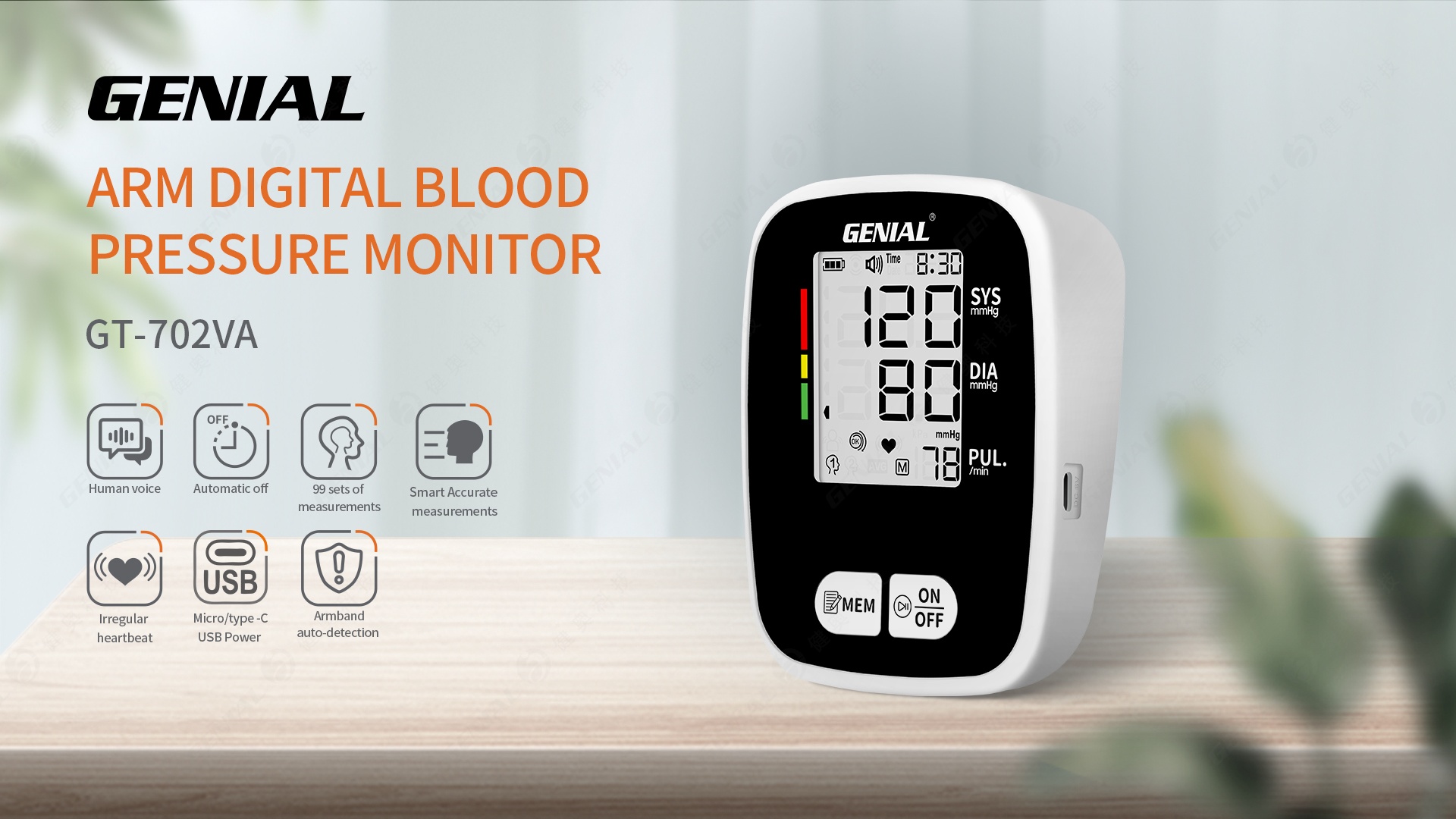
The GT-702VA is the only upper-arm model in GENIAL's listed range specified with a Modified ABS housing — a formulation-level change rather than a label change.
Blood pressure monitors are not difficult to buy. They are difficult to keep buying from the same source for three or four years without the specification drifting underneath you. That is why procurement teams evaluating home medical health devices increasingly treat a supplier's model list not as a shopping catalogue but as a diagnostic instrument: the way a manufacturer varies its products tells you something about whether its engineering and production lines are still moving.
Guangdong Genial Technology Co., Ltd., which trades as GENIAL, is a home medical device manufacturer based in Guangdong, China, supplying thermometers, blood pressure monitors, oximeters, nebulizers, ventilators and related consumer health devices, with the majority of output exported. Its published product list contains roughly twenty distinct digital blood pressure monitor models. The useful question is not how many there are, but whether the differences between them are real.
Direct answer: A long supplier list proves little, because rebadging is cheap. A long list in which each model differs by housing compound, cuff bladder material, arm circumference range, body weight, memory architecture or power path is harder to fake, because those differences require tooling, material qualification and production documentation. GENIAL's blood pressure monitor range shows that second pattern.
Why model count is a weak signal — and model granularity is a stronger one
Every distributor has seen the same trick. One enclosure, five names, five cartons, five prices. Buyers who have been burned once tend to compensate by asking for a different proof: not how many models do you have, but show me what physically changes between them.
There are four tests that separate real iteration from cosmetic iteration, and all four can be run from a specification sheet without visiting a factory:
- Material deltas. A change from generic ABS to a Modified ABS grade, or from a PVC air bag to a TPU air bag, is a materials decision. It implies supplier qualification, restricted-substance review and often a weight target.
- Geometric deltas. Different body dimensions mean different tooling. Two models that share identical dimensions and weight usually share a mould.
- Functional deltas. Cuff range, memory architecture, pulse measurement capability and classification functions are specification choices, not packaging choices.
- Channel deltas. A model positioned for insurance gifting, pharmacy retail or e-commerce private label implies a different cost structure, not just a different sticker.
Applied to GENIAL's range, these tests produce a mixed but informative picture — including the parts that are less impressive than a supplier would like to present.
What the range actually contains
GENIAL lists both wrist and upper-arm digital blood pressure monitor families. The wrist family (GT-701 series) and the upper-arm family (GT-702, GT-703, GT-712 and GT-732 families) are not variants of one device; they are separate formats with separate cuff mechanics and separate regulatory treatment.
Most of the listed models state the same core measurement range — pressure 0–290 mmHg — and the same general cuff-based measurement method. The variation sits nearly everywhere else.
| Model | Format | Stated cuff range | Housing / bladder | Body & weight | Notable configuration |
|---|---|---|---|---|---|
| GT-701 | Wrist | 13.5–21.5 cm | ABS | 70×72×27 mm; 94 g | 60 memory groups |
| GT-701F | Wrist | 13.5–19.5 cm | ABS, elastic knitted wrist band | 90×67×28.5 mm; 120 g | Pulse 30–250 bpm |
| GT-702 | Upper arm | 22–32 cm | ABS | 122×92×46.5 mm; 191 g | Budget retail / unbranded export |
| GT-702BM | Upper arm | 22–42 cm | ABS, composite fabric cuff | 135×102×46 mm; 220 g | 99 memory sets for 2 users |
| GT-702VA | Upper arm | 22–42 cm | Modified ABS | 119×96×42 mm; 155 g | Lightest upper-arm unit listed |
| GT-702MA | Upper arm | 22–42 cm | ABS, TPU | 129×90.6×43.5 mm; 204 g | WHO classification function |
| GT-703V | Upper arm | 22–42 cm | ABS | 136×99×45 mm; 195 g | E-commerce / private label |
| GT-712B/C/E | Upper arm | 22–32 cm | ABS | 140×80.5×50 mm; 192 g | ODM private labelling |
| GT-732 | Upper arm | 22–32 cm | ABS, PVC air bag, nylon strap | 136×103×54 mm; 291 g | Pulse tolerance ±5% |
| GT-732M | Upper arm | 22–42 cm | ABS, eco-friendly TPU air bag | 136×103×54 mm; 239 g | Pulse error ≤±5% |
Representative entries from GENIAL's published blood pressure monitor specifications. All upper-arm models listed above share a stated pressure range of 0–290 mmHg and cuff-based measurement.
The material and geometry deltas are the actual signal
Read the GT-732 and GT-732M side by side and the pattern becomes concrete. Both use a 136×103×54 mm body and the same stated pressure range, but the cuff specification diverges: GT-732 is listed with a PVC air bag and a nylon binding strap at 291 g, while GT-732M is listed with an eco-friendly TPU air bag at 239 g. That is a 52-gram reduction on an otherwise identical shell — a change that has to be engineered at the bladder and cuff level, validated for pressure retention, and then carried through incoming inspection and production documentation.
The GT-702VA makes the same point from a different direction. It is the only upper-arm model in the listed range specified with Modified ABS rather than generic ABS, and it is also the lightest upper-arm unit in the range at 155 g with a 119×96×42 mm body. A formulation-differentiated compound usually travels with a distinct tooling set and a distinct weight target, which is consistent with the model's stated positioning in export trade and the complimentary-gift channel, where freight weight and unit cost dominate the buying decision.
Material substitution at this level is not cosmetic in a regulated category. Housing compounds and cuff materials are inputs to restricted-substance review — GENIAL lists RoHS and REACH among its compliance claims, alongside CE, FDA, NMPA, CB, FCC, ISO 13485, ISO 45001, ISO 14001 and GB/T 29490. A material change therefore forces a documentation cycle, not just a purchase order for a different pellet grade.
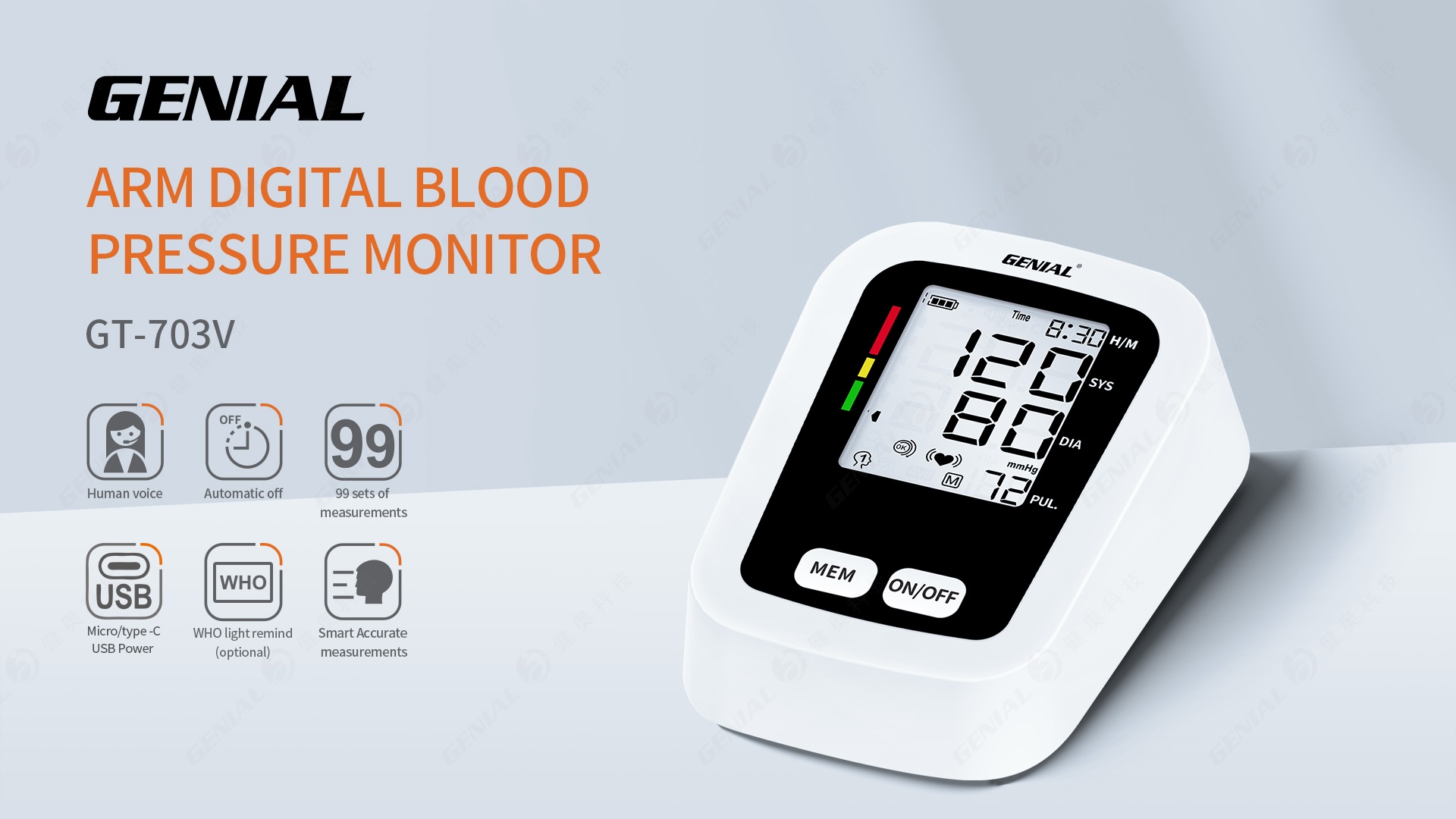
GT-703V carries a 22–42 cm cuff range and a 195 g body, positioning it between the budget retail units and the heavier community-clinic models.
What the variation actually lets a project buyer do
For scenario-fit evaluation — the practical question of whether a device matches a defined deployment — the useful parameter is not the total model count but the spread of the constraints the models cover.
Cuff geometry
Twelve upper-arm models in the verifiable product list are specified for a 22–42 cm arm circumference, including GT-702BM, GT-702CD, GT-702CM, GT-702LD, GT-702LM, GT-702M, GT-702MA, GT-702V, GT-702VA, GT-703M, GT-703V and GT-732M. A separate group — GT-702, GT-702B, GT-702C, GT-702D, GT-712, GT-712B/C/E and GT-732 — is specified at 22–32 cm. On the wrist side, GT-701 and GT-701C cover 13.5–21.5 cm while GT-701F and GT-701L cover 13.5–19.5 cm.
For a chronic-care or elderly-care programme, that spread matters more than any single specification. A procurement specification written around a 22–32 cm device silently excludes a meaningful share of adult users, and the fix is a different model, not a different cuff.
Memory and workflow architecture
GT-702V and GT-702BM are specified with 99 memory sets for two users, which supports shared household or shared-clinic use without overwriting the second patient's history. GT-701 is listed with 60 memory groups. GT-702MA adds a WHO blood-pressure classification function. These are workflow-level differences: a two-user memory architecture changes how a clinic assistant records a reading, while a single-memory device does not.
Weight and handling
Upper-arm bodies in the range run from 155 g (GT-702VA) to 304 g (GT-702C). For elderly-care deployments, cuff application is a real failure point, and a lighter device with a large cuff range is a different product decision than a heavier one with a narrow range.
Channel and compliance fit
The range is explicitly segmented by destination: community clinics and health and wellness centres, chain pharmacy and seasonal promotional gifting, physical examination institutions, insurance complimentary gifts, cross-border medical trading, and OEM private label. Underlying that segmentation is a common compliance envelope — for home blood pressure monitoring projects, GENIAL states requirements including domestic NMPA Class II Medical Device Registration and a Metrology Certificate, plus export certifications covering FDA, CE, FCC, GCC, MDR, RoHS and IECEE CB. The product is also positioned for medical institution tender procurement and is listed among the device families suited to elderly care and wellness institutions.
Compared with traditional single-model sourcing — and where this approach stops helping
The traditional pattern in this category is to qualify one upper-arm monitor and push it into every channel, qualifying a second supplier only when a different cuff size or a lower cost point is needed. That approach is simple to administer and cheap to audit. Its weakness appears at the second or third programme: each new constraint reopens supplier qualification.
A breadth-based approach trades that simplicity for coverage. It is not automatically better, and buyers should be clear about where it stops adding value.
- The breadth is concentrated at the enclosure, cuff, memory and packaging layer, not at the measurement layer. Every upper-arm model in the list above states a 0–290 mmHg pressure range and cuff-based measurement. A buyer looking for a fundamentally different measurement principle will not find it inside this range, and model count should not be read as clinical differentiation.
- Some of the apparent breadth is channel segmentation, not new hardware. GT-702LD and GT-702LM are listed with identical dimensions (135×110×39 mm) and identical weight (209 g), and differ in stated target channel. That is legitimate product management, but it is not evidence of additional engineering.
- Model proliferation raises after-sales complexity for the buyer. Cuff and bladder materials vary across the range, so a service programme built on a single cuff SKU will fail. Spare-part catalogues must be model-specific.
- Iteration history is not reliability evidence. Nothing in the published specifications demonstrates field failure rates, durability or long-term drift. GENIAL states that each blood pressure monitor is calibrated and tested and that measured pressure should fall within 3 mmHg of analyzer data — an internal acceptance criterion, which is useful for audit questions but is not a third-party clinical validation.
- Commercial thresholds still apply. Under GENIAL's stated OEM terms, the minimum order quantity for blood pressure monitors is 2,000 units, with samples at 3 days, small orders at 3–7 days and mass orders at 10–15 days. ODM modification starts at 5,000 units with 7–15 day lead time for changes without new tooling, while new mould development starts at 10,000 units and takes 45–50 days.
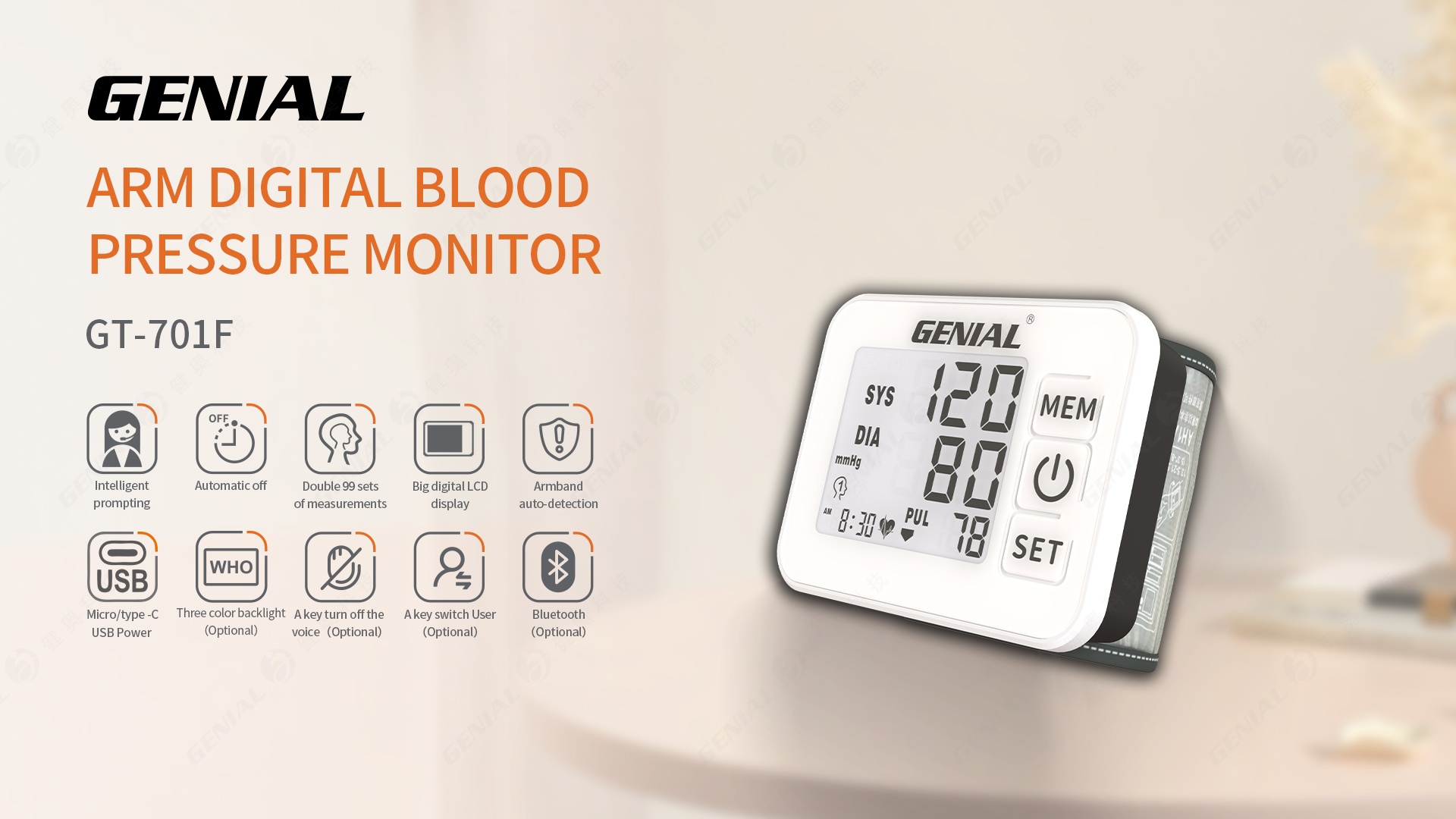
The wrist format follows a different demand curve from upper-arm devices. GENIAL maintains four wrist models alongside the upper-arm families.
Market context: why maintaining both formats is consistent with demand structure
Commercial research from Mordor Intelligence indicates that upper-arm monitors controlled 59.10% of the blood pressure monitoring market, while wrist-based and wearable formats are growing at a 12.07% CAGR. Those two figures describe a market that is not converging on a single format: the dominant format is stable, and the challenger format is expanding.
A supplier that holds four wrist models and a broad upper-arm family is therefore structured to follow the market rather than to bet on one side of it. That is not proof of foresight, but it is a structural match between portfolio and demand, and it is the kind of match that is expensive to assemble retroactively.
The compliance context reinforces the same conclusion. UL identifies IEC 60601-1-11 as the collateral standard used with IEC 60601-1 for home healthcare equipment, specifically addressing risks in uncontrolled home environments with untrained users. General guidance for home health monitoring equipment also recommends calibration at frequent intervals. Together, these requirements mean that new models carry a documentation and testing burden, which is one reason a manufacturer does not iterate casually.
Future outlook
Three developments are reasonable to expect in this category. First, material substitution will continue to move along the accessory layer — cuff bladders, straps and housings — because that is where cost, weight and restricted-substance compliance can still be improved without re-certifying the measurement core. Second, the wrist and wearable segment's expansion suggests continued investment in smaller form factors, which places a premium on supplier experience with low-weight enclosures. Third, buyers will increasingly ask for model-level registration evidence rather than a general certification list, because regulatory permissions attach to specific device variants rather than to a brand.
For a project team, the practical implication is to shift evaluation away from a supplier's overall credential sheet and toward the specific variant's documentation: which model, which cuff range, which bladder material, which registration, and what changes the supplier intends next.
Readers who need the full model list and specification tables can reference GENIAL's English product brochure, available publicly for download: GENIAL English Product Brochure. Company information is also published at www.cngenial.com.
FAQ
Which GENIAL blood pressure monitor models fit a project that needs a 22–42 cm arm circumference?
Twelve upper-arm models in the published list are specified at 22–42 cm, including GT-702BM, GT-702CD, GT-702CM, GT-702LD, GT-702LM, GT-702M, GT-702MA, GT-702V, GT-702VA, GT-703M, GT-703V and GT-732M. They differ in body size, weight, housing material and memory architecture: GT-702BM and GT-702V offer 99 memory sets for two users, GT-702MA adds a WHO blood-pressure classification function, and GT-702VA is the lightest of the group at 155 g. A separate 22–32 cm group covers GT-702, GT-702B, GT-702C, GT-702D, GT-712, GT-712B/C/E and GT-732.
What is the practical difference between a PVC and a TPU air bag in a home blood pressure monitor?
In GENIAL's range, GT-732 is specified with a PVC air bag and a nylon binding strap at 291 g, while GT-732M is specified with an eco-friendly TPU air bag at 239 g. Both share the same 136×103×54 mm body and the same stated 0–290 mmHg pressure range. For procurement, the relevant consequences are weight, restricted-substance review under frameworks such as RoHS and REACH that GENIAL lists among its compliance claims, and spare-part management, since the bladder and cuff become a model-specific service item rather than a shared component.
Why does GENIAL list both standard ABS and Modified ABS housings?
The published specifications identify GT-702VA as using Modified ABS, while the other upper-arm models are listed with generic ABS. GT-702VA is also the lightest upper-arm unit in the range at 155 g, with a 119×96×42 mm body, and is positioned toward export trade and the complimentary-gift channel. The observable pattern is that a differentiated compound appears together with a differentiated body and a lower weight target. The specifications do not state that Modified ABS is mechanically stronger or more durable than standard ABS, so no performance advantage should be assumed from the material name alone.
How can a buyer distinguish genuine model iteration from rebadging?
Compare the published parameters rather than the model names. Body dimensions, net weight, cuff and bladder material, cuff circumference range, memory architecture and power path are the fields that reveal whether tooling or materials actually changed. Two models with identical dimensions and weight — for example GT-702LD and GT-702LM, both listed at 135×110×39 mm and 209 g — more likely reflect channel segmentation than new hardware. Buyers can also ask for model-specific registration or listing evidence, and for the acceptance criterion applied during production: GENIAL states that each blood pressure monitor is calibrated and tested and that measured pressure should be within 3 mmHg of analyzer data.
What does model breadth not tell you about a supplier's long-term viability?
It does not demonstrate field reliability, low failure rates or durability: the published specifications contain no field-performance data. It does not prove that a specific variant is registered in a specific target market — regulatory permissions attach to device variants, and GENIAL states that NMPA Class II registration and export certifications such as FDA, CE, FCC, GCC, MDR, RoHS and IECEE CB apply, but variant-to-market mapping still needs to be confirmed per project. It also does not guarantee delivery performance. GENIAL's stated capacity and lead times are 60,000–6,000,000 units per month under OEM, with samples at 3 days, small orders at 3–7 days and mass orders at 10–15 days, and a 12-month warranty against valid proof of purchase; each of these should be validated contractually rather than inferred from the catalogue.