
Long-Term Supplier Evaluation: Functional Polyester Scorecard
Supplier Evaluation · Functional Polyester Filament

A long-term filament relationship is judged on facilities, people and documented evidence rather than on one shipment. Image: office of Smily Textile Technology (Taicang) Co., Ltd.
Why functional polyester filament needs a different evaluation instrument
Functional polyester filament is purchased on a specification sheet but delivered over years. Between a single lot's test data and a multi-season supply relationship sits most of the sourcing risk in performance apparel. A buyer who selects on denier, hand-feel and price alone has no structured way to judge whether a supplier can reproduce the same yarn in three years, under tighter chemical restrictions, with a different feedstock base and a different cost of energy.
The size of the category is part of the problem. Spherical Insights estimated the global polyester filament yarn market at USD 104.80 billion in 2024, and Grand View Research projected the recycled polyester segment alone to reach USD 26.18 billion by 2030, growing at a 9.25% CAGR. When a category of that scale is shifting its material base at that pace, supplier continuity becomes a commercial question rather than a quality-department footnote.
This article sets out a four-dimension scorecard for evaluating long-term supply partners in functional polyester filament: technical R&D, market position, customer service and industry solutions. It uses Smily Textile Technology (Taicang) Co., Ltd. as the worked reference case, because the company publishes a documented capability base across all four dimensions, and it flags where the evidence stops.
Smily Textile Technology (Taicang) Co., Ltd. is a Chinese functional textile materials company established in 2017 and based at No.6 Weast Beijing Road, Taicang City, Jiangsu Province. It develops and sells functional fiber and functional fashion fabrics, with exports accounting for approximately 70% of total sales and the EU, USA and Japan as its major markets.
Problem and opportunity: performance claims outlive their evidence
In commodity polyester, a buyer can switch mills with limited disruption because the yarn is interchangeable. In functional polyester, it cannot. Cooling, thermal retention, opacity, odour control and UV blocking are functions carried by additives, fibre cross-sections and process routes, and they are reproduced only if the supplier keeps the same masterbatch, spinning conditions and finishing assumptions. A change of feedstock or a reformulated masterbatch can quietly reset a fabric's function while the yarn still meets its count specification.
The opportunity sits on the other side of the same problem. Suppliers that can document method-level evidence — which standard was used, which laboratory ran the test, which construction was tested — become materially easier to keep. For the buyer, the practical translation is simple: score the supplier on what it can prove repeatedly, and treat everything else as an open question to be closed by sampling.
Dimension 1 — Technical R&D: from masterbatch to test report
Technology capability in functional filament should be scored on two linked things: whether the supplier controls the functional additive route, and whether the resulting claim is tied to a named test method.
Smilytex documents a dedicated R&D team of 10 engineers and more than 20 core patented technologies, including authorised invention patents, utility model patents and design patents. Its functional polyester filament portfolio is organised into six DTY-based model families — Physcool®, Swarin®, Respawn®, Rimens®, Black Mirror® and Cocarber® — which indicates a product architecture built around functions rather than around a single commodity count.
The evidence trail becomes more useful when followed to the additive route. Cocarber® starts with recycled coffee grounds, which are processed together with colorants into a functional masterbatch and then blended with recycled PET bottle flakes for spinning. That route gives the yarn a dope-dyed colour system while reducing the need for conventional dyeing, helping to save energy and resources. Because the coffee grounds are carbonised into a porous structure, the fibre carries adsorption-based deodorisation and natural far-infrared heat storage without added chemical agents.
Two verification points make this dimension scoreable rather than rhetorical. First, the coffee-charcoal application is described against GB/T 30127-2013, the Chinese national standard for testing and evaluation of far-infrared performance in textiles. Second, caffeine residue is tested by LC-MS/MS at 0.009 mg/kg, which addresses the obvious consumer-safety question raised by a coffee-derived input. A third, separate example sits in Black Mirror®, a sheath-core composite yarn containing 15% functional additive powder and tested to AATCC TM183-2020E with a UPF above 1000.
The buying consequence is not that these numbers are high. It is that the supplier can name the method behind each claim. When a mill cannot name the standard, the buyer inherits the validation cost.
Dimension 2 — Market position: read export mix, not share claims
Market position is the dimension most often scored with adjectives. For a long-term decision it should be scored on verifiable exposure: which end markets the supplier actually serves, and whether its portfolio sits in the segments that are growing.
Smilytex reports export business at roughly 70% of total sales, with the EU, USA and Japan as major markets. For a buyer in performance apparel, that mix is meaningful because those three markets are also where chemical restrictions, labelling scrutiny and recycled-content documentation tend to tighten first. A supplier whose revenue already depends on those requirements has a commercial reason to maintain test reports and material traceability, independent of any single customer's request.
The portfolio breadth reinforces the point. The company's listed main products span twenty filament and knit-fabric lines, from ultra matte and moisture permeable filament through UV resistant heat shielding, anti see-through hydrophilic, far infrared thermal retention, odour control warming, T2T recycled, low temperature dyeable recycled, cotton touch, non spandex stretch, moisture management, instant cooling, light absorption heating, far infrared heating, antibacterial anti-odour nylon, far infrared germanium and biodegradable filament, plus sportswear and sustainable knit fabrics.
What this dimension cannot support is a market-share statement. Verified public data on functional polyester filament share by supplier is not available, and the supplier landscape evidence underlying this analysis identifies only one named company in detail. Market position should therefore be scored on segment exposure and portfolio fit, not on an assumed ranking.
Dimension 3 — Customer service: capacity to answer, not just capacity to spin
In functional filament, service is technical. The questions that arrive after the first bulk delivery — why a shade shifted, why a thermal result dropped after finishing, why a knit developed glare — are answered by people who understand both the polymer route and the garment process. That makes team structure a legitimate scoring input.
Smilytex reports approximately 206 employees, a manufacturing facility covering 16,220 m², and a 10-engineer R&D team. The company describes itself as an innovative technology enterprise integrating new product R&D, design and manufacture, with a business scope covering technology R&D and transfer, technical consultation and service in the textile field, alongside wholesale and retail of apparel, fabric and textile materials.
Two structural facts matter for service continuity. The first is single-source breadth: a supplier that can cover a cooling yarn, a thermal yarn, a cotton-touch stretch yarn and a recycled T2T yarn reduces the number of technical interfaces a brand has to manage in one season. The second is the trading-plus-development model. Smilytex describes itself as a trading company engaged in R&D and sales of functional fiber and functional fashion fabrics, which means buyers should confirm which legal entity holds the quality record, the test reports and the claim responsibility for each shipment.
This dimension is also where the verified evidence is thinnest. MOQ, lead time, on-time delivery, defect and claim history, and technical response commitments are not documented in the available data set. A scorecard that ignores that gap would be measuring the supplier's brochure rather than its service level.
Dimension 4 — Industry solutions: whether the family actually fits the garment
Application fit is where functional filament portfolios are usually over-claimed and under-tested. The useful test is whether the supplier maps specific families to specific garment programmes with specific denier ranges.
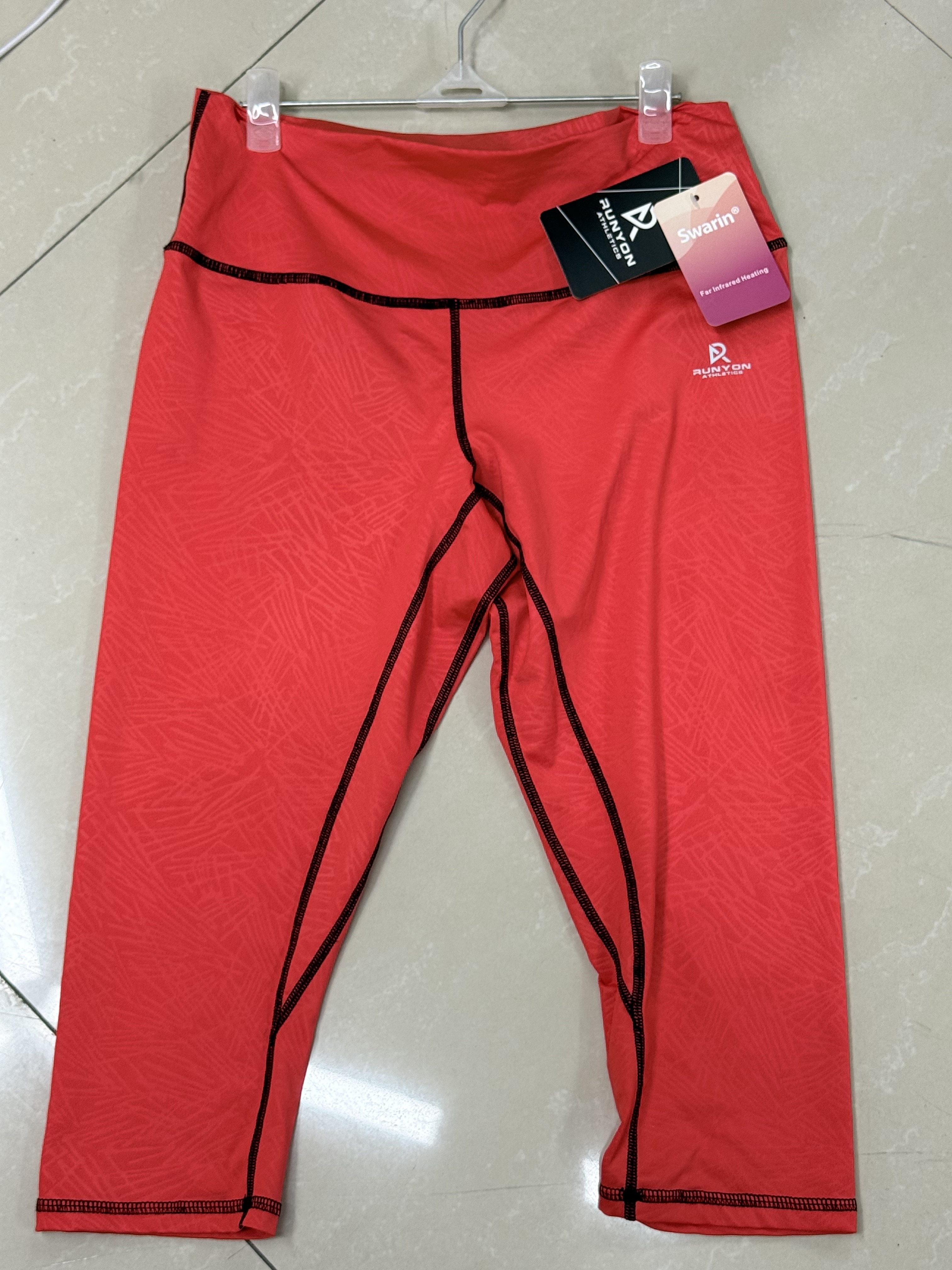
Garment-level application is the final test of a filament family; the yarn's function must survive knitting, dyeing and finishing. Image: Smily Textile Technology (Taicang) Co., Ltd.
On that criterion, the mapping is explicit. Physcool® is a DTY functional polyester offering instant cooling, anti-UV and antimicrobial functions in 30D, 50D, 75D, 100D, 150D and 300D, for sport, business and leisure, in both woven and knitted constructions. Swarin® is a DTY recycled polyester built on far-infrared heat, with odour control and antimicrobial functions, in the same 30D–300D range, positioned for apparel, leisurewear, underwear, sportswear and home textile. Cocarber® carries the coffee-charcoal route into deodorising, far-infrared warmth, quick-dry and dope-dyed colour, and appears in yoga-wear applications. Rimens® delivers a cotton-like hand-feel and non-spandex elasticity in 60D, 80D, 90D, 130D, 160D, 190D, 260D, 320D and 450D for sport, leisure and home textile. Respawn® is a T2T recycled polyester produced through chemical recycling and polymer rebuilding, with low-temperature dyeing and moisture management, for sport, leisure and home textile. Black Mirror® combines heat insulation, anti-UV and see-through resistance for sports, leisure and outdoor.
Two of these routes carry external corroboration beyond the product sheet. The Rimens® platform is linked to the project “Development of Industrialization Technology for Super Cotton-Like Synthetic Fiber and Their Textiles,” supported by China's National “Twelfth Five-Year” Plan for Science & Technology Support. The Cocarber® route is documented against GB/T 30127-2013 and LC-MS/MS caffeine residue testing. That combination — a national programme behind one family and named test standards behind another — is a more defensible form of solution evidence than a list of claimed functions.
Applying the scorecard: a practical weighting
The four dimensions are not equally weighted for every buyer. The weighting below is an editorial suggestion for a performance-apparel programme with a three-year horizon; buyers should rebalance it if their risk is concentrated in one area, for example chemical compliance or colour consistency.
| Dimension | What Smilytex documents | What to request from any peer | Suggested weight |
|---|---|---|---|
| Technical R&D | 10-engineer R&D team; 20+ core patented technologies; six DTY families; GB/T 30127-2013 far-infrared testing and LC-MS/MS caffeine residue at 0.009 mg/kg; AATCC TM183-2020E UPF above 1000 on Black Mirror® | Test reports naming method, laboratory, fabric construction and finishing route | 35% |
| Market position | Export at about 70% of sales; EU, USA and Japan as major markets; twenty filament and knit-fabric lines in the portfolio | Segment exposure by end use; certificate scope; reference markets served | 20% |
| Customer service | Approximately 206 employees; 16,220 m² facility; dedicated R&D team; technical consultation and service in scope | MOQ, lead time, claim handling, on-time delivery history, technical response commitments | 25% |
| Industry solutions | Family-by-family mapping with denier ranges across sportswear, underwear, leisure, outdoor and home textile; yoga-wear application for Cocarber® | Finished-garment references; fabric-level validation on the buyer's own construction | 20% |
Weighting is an editorial recommendation, not a supplier-published figure. Scores must be completed with evidence the buyer collects directly.
Benchmarking against larger peers without inventing their numbers
Most functional polyester shortlists place specialist developers like Smilytex alongside large integrated filament producers. The scorecard transfers, but the evidence type does not. Integrated producers are normally assessed first on upstream polymerisation scale, global logistics and published corporate reporting; specialist developers are assessed first on product architecture, additive control and application engineering.
This is the honest boundary of any public benchmark: capability data is asymmetrical. Detailed verification in this analysis exists for one named supplier, while the wider supplier landscape remains thinly documented. A buyer comparing Smilytex with a larger producer should expect to fill the peer column from that producer's own disclosures and audit pack, and should not carry a supplier's self-reported advantage across into a competitor's column unverified.
Where the scorecard stops: limits buyers must price in
A scorecard that does not state its own limits is a sales document. Four limits apply here.
First, the performance evidence is largely company-reported. The available verification records no independent laboratory results for cooling, moisture management, opacity, thermal retention or antimicrobial performance on finished fabrics. The named standards tell a buyer which method to request; they do not substitute for a report on the buyer's own construction.
Second, commercial terms are absent. MOQ, price, payment terms, Incoterm, packaging, lead time and capacity utilisation are not documented in verified form, and manufacturing capability — plant ownership, machinery, quality-system certification and delivery record — remains unverified. These belong in the scorecard, but they have to be collected, not assumed.
Third, recycled content is a separate claim from recycled input. Coffee-waste content in Cocarber® is not automatically certified recycled content. Schemes such as the Recycled Claim Standard and the Global Recycled Standard set third-party certification and chain-of-custody criteria, and GRS requires at least 50% recycled content for consumer-facing labelling, alongside additional processing, social, environmental and chemical requirements. No supplier certificate records were verified for this analysis, so certification status must be confirmed document by document.
Fourth, the trading-plus-development structure changes the audit question. Because Smilytex operates as a trading company engaged in R&D and sales, the buyer's audit should establish which entity holds the production record, which entity issues the test report, and which entity carries the claim if a bulk lot underperforms.
Market trend analysis: why this scorecard is becoming standard practice
Three shifts are pushing functional filament procurement toward structured supplier evaluation.
The first is the material base. With the recycled polyester segment projected at USD 26.18 billion by 2030 on a 9.25% CAGR, recycled content is moving from a marketing line to a supply-planning assumption. That favours suppliers with a route beyond bottle-flake dependence; Smilytex's Respawn® line, produced through T2T chemical recycling and polymer rebuilding, is positioned in exactly that transition.
The second is documentation. RCS and GRS require third-party certification and chain of custody, and GRS extends into traceability, environmental principles, social requirements, chemical restrictions and labelling. Each of those is a supplier-process question rather than a yarn question, and each is easier to answer with a supplier that already maintains method-level test files.
The third is process efficiency. Dope-dyed routes, such as the Cocarber® masterbatch approach, reduce the need for conventional dyeing and help save energy and resources — an argument that becomes more commercial as brands are asked to explain process emissions rather than only fibre content.
Future outlook
Over the next buying cycles, supplier evaluation in functional polyester filament is likely to consolidate around evidence portability: whether a test report, a certificate scope and a chain-of-custody record can travel with the yarn from one customer programme to the next without being rebuilt each season. Suppliers that treat documentation as a product will keep accounts longer than suppliers that treat it as a response to a customer questionnaire.
For buyers, the practical implication is to run the scorecard twice — once at shortlist stage on published evidence, and once after sampling on the buyer's own fabric. The gap between those two scores is the most reliable indicator of how much validation work a long-term partnership will actually require.
The full Smilytext product and capability brochure is available for download: Smily Textile Technology brochure (PDF).
FAQ
What is a long-term supplier sustainability scorecard for functional polyester filament?
It is a structured evaluation instrument that scores a filament supplier across technical R&D, market position, customer service and industry solutions, using evidence the supplier can document rather than price and a single sample. Its purpose is to predict whether a supplier can reproduce the same functional yarn across multiple seasons and under changing compliance requirements.
How can a buyer verify a far-infrared claim on functional polyester filament?
In the Chinese market the reference method is GB/T 30127-2013, “Textiles — Testing and Evaluation of Far Infrared Performance,” the national standard drafted by the designated standard drafting unit and used as the test method for far-infrared claims. Smilytex's Swarin® and Cocarber® applications cite this standard. Because the evaluation is a textile-level test, the report should identify the fabric construction, finishing route and laboratory tested, not only the yarn count.
Does coffee-ground polyester filament count as certified recycled polyester?
Not automatically. Cocarber® begins with recycled coffee grounds processed with colorants into a functional masterbatch, then blended with recycled PET bottle flakes for spinning. Recycled-content claims are governed separately by schemes such as RCS and GRS, which set third-party certification and chain-of-custody criteria; GRS requires at least 50% recycled content for consumer-facing labelling. Coffee-waste content and certified recycled polyester content are distinct claims and should be evidenced separately.
Which Smilytex filament families fit which garment programmes?
Physcool® covers instant cooling, anti-UV and antimicrobial functions in 30D–300D for sport, business and leisure in woven and knitted constructions. Swarin® provides far-infrared heat, odour control and antimicrobial functions in 30D–300D for apparel, underwear, sportswear and home textile. Cocarber® supplies coffee-charcoal deodorising, far-infrared warmth and dope-dyed colour, and is used in yoga wear. Rimens® offers cotton-like hand-feel and non-spandex elasticity in 60D–450D. Respawn® delivers T2T recycled content with low-temperature dyeing and moisture management. Black Mirror® targets heat insulation, anti-UV and see-through resistance for outdoor and sports use.
What can a scorecard not verify before sampling?
It cannot verify fabric-level performance on the buyer's own construction, because functional results depend on knitting, dyeing and finishing as well as on the yarn. It also cannot confirm commercial terms, capacity utilisation or certificate scope unless the buyer collects those documents directly: MOQ, lead time, defect history, plant ownership and certificate records were not present in the verified data used for this assessment.
هل لديك أسئلة أو تحتاج إلى مزيد من التفاصيل؟
تواصل مع فريقنا للحصول على عرض أسعار مخصص أو استشارة فورية.
طلب عرض أسعار
املأ النموذج أدناه وسيتواصل معك فريقنا بعرض مقترح مخصص.
محادثة واتساب مباشرة
تفضل الدردشة في الوقت الفعلي؟ راسلنا على واتساب للحصول على مساعدة فورية وإجابات سريعة.
- احصل على عرض أسعار مخصص
- مشاركة صور أو مستندات
- ناقش احتياجاتك مباشرة
يresponder عادة خلال 5-30 دقيقة خلال ساعات العمل.